Asian Journal of Applied Science and Technology (AJAST)
Volume 1, Issue 1, Pages 96-98, February 2017
© 2017 AJAST All rights reserved. www.ajast.net
Page | 96
Smart Voting System using Aadhar Card
G.Sathya#
, B.Abinaya*, B.Asma*, Christina John* and N.Divya*
#
Assistant Professor, Department of Electronics and Communication Engineering, SNS College of Engineering, Coimbatore, India.
*UG Scholar, Department of Electronics and Communication Engineering, SNS College of Engineering, Coimbatore, India.
Article Received: 11 February 2017 Article Accepted: 21 February 2017 Article Published: 23 February 2017
1. INTRODUCTION
India is one of the world’s largest democracies with the
community of 1 billion. India has an electorate of around 700
million persons. Voting theory began formally in the 18th
century and proposals for voting system are been made ever
since. The current voting mechanism has many security
problems. The past experience of electoral process enforced
to focus on the use of latest technologies in e-voting process.
The development of voting system can be in the field of
additional security in authentication process. The
improvisation in the current voting system can be made using
biometric technology. Biometric recognition refers to the use
of fingerprint, Iris, face palm and speech characteristics.
These are called Biometric identifiers. Fingerprint matching
play an important role in this project. Today, it is mandatory
for every citizen to have Aadhar card in which fingerprint and
iris of individuals are stored. In this paper, Raspberry pi and
fingerprint scanner which is used to store the images of
fingerprint in a database.
At the time of voting he/she places his/her fingerprint, if it
matches with already stored one in a database then he/she will
proceed for voting. If the same person tries to vote twice, the
buzzer buzzes indicating the bogus voting. So this kind of
practices can be prevented by this system.
1.1 Paper Based Voting
As far as India is concerned, voting system began in the 18th
century itself. There are various voting methods available
according to its development with technologies.
Paper based voting has been used since long time before the
advent of internet. A ballot is a device used to cast votes in an
election. In this method they used a piece of paper for voting
which included the decisions made by the voter.
In simple elections ballot may be a simple scrap of paper on
which each voter writes the name of the candidate. This
method requires of presence of person in the booth to choose
their candidate through paper and put the paper in the ballot
boxes.
Drawbacks
a) It is very difficult to collect the ballot boxes and transport to
main centres.
b) Errors may occur during manual counting.
c) Need more man power for security.
d) Need more time to vote.
e) Chances of invalid voting.
f) Need more time for counting.
1.2 E-Voting
E-voting is the voting process electronically, without the use
of paper and ballot boxes. In this system, election data is
recorded, stored and processed primarily as digital
information. It is defined as any voting process where an
electronic means is used for votes casting and results
counting. E-machine consists of buttons and symbols of
respective candidate which when pressed the count of votes
get stored in the EVM. But still, there is a practice of fake
votes in this system. So, further development should be
implemented to prevent these kinds of activities.
Drawbacks
a) Security problems- One can change the program installed
in the EVM and can change the result after the polling.
b) Illegal voting which is faced in every electoral procedure.
One candidate casts the vote of all members in the electoral
list illegally. This results in loss of votes for other candidates
participating in election.
2. BIOMETRICSYSTEM
The main focus of the proposed system is the use of
fingerprint image of a voter to authenticate him/her and to cast
the vote very securely. A biometric system is a pattern
recognition system that operates by acquiring parametric data
ABSTRACT
This paper proposes the need of authenticated voting system in our election due to the increase in illegal voting or bogus voting in Loksabha and
Rajyasabha election. Here the authentication of an individual is done using biometric and eligibility of the voter is verified using the Aadhar card. In
this project, the database stored in the Aadhar card provides the reference data. Moreover, added tier of security is enforced as biometrics. The key
functions of this paper are enrolment and matching. Initially, the voters’ fingerprints are enrolled and stored. Once the fingerprints are stored it can be
retrieved at any time for authentication. During election, when the voter keeps his/her fingerprint the already stored Aadhar card details will be
displayed from the database. An individual’s details can be deleted from the database if not required. The use of biometric requires less man power,
save much time for voters and personnel, ensures accuracy, transparency and avoids bogus voting.
Keywords: Fingerprint, biometric, Aadhar card and authentication.
Asian Journal of Applied Science and Technology (AJAST)
Volume 1, Issue 1, Pages 96-98, February 2017
© 2017 AJAST All rights reserved. www.ajast.net
Page | 97
of an individual. It can be used either in the verification mode
or identification mode. Identity verification is typically used
for positive recognition, where the aim is to prevent multiple
people from using the same identity. In the identification
mode, the system recognises the individual by searching the
identities in the database for a match. Therefore, the system
conducts one-to-many comparisons to establish an
individual’s identity.
A biometric system is designed using the following four main
modules.
Sensor module: This captures the biometric data of an
individual. An example is a fingerprint sensor that images the
full structure of a user’s finger.
Feature extraction module: Here, the biometric data is
processed to extract a set of salient features.
Matcher module: Here, the feature is extracted during
recognition are compared against the stored templates to
generate matching scores. Example, the fingerprint-based
biometric system.
System database module: It is used by the biometric system
to store the biometric templates of the enrolled users.
3. PROPOSED SYSTEM
The main components of the voting system is listed as
follows,
1. Arduino mega 2560
2. Fingerprint Identification Module
3. PC
4. Power supply
3.1 ARDUINO MEGA 2560
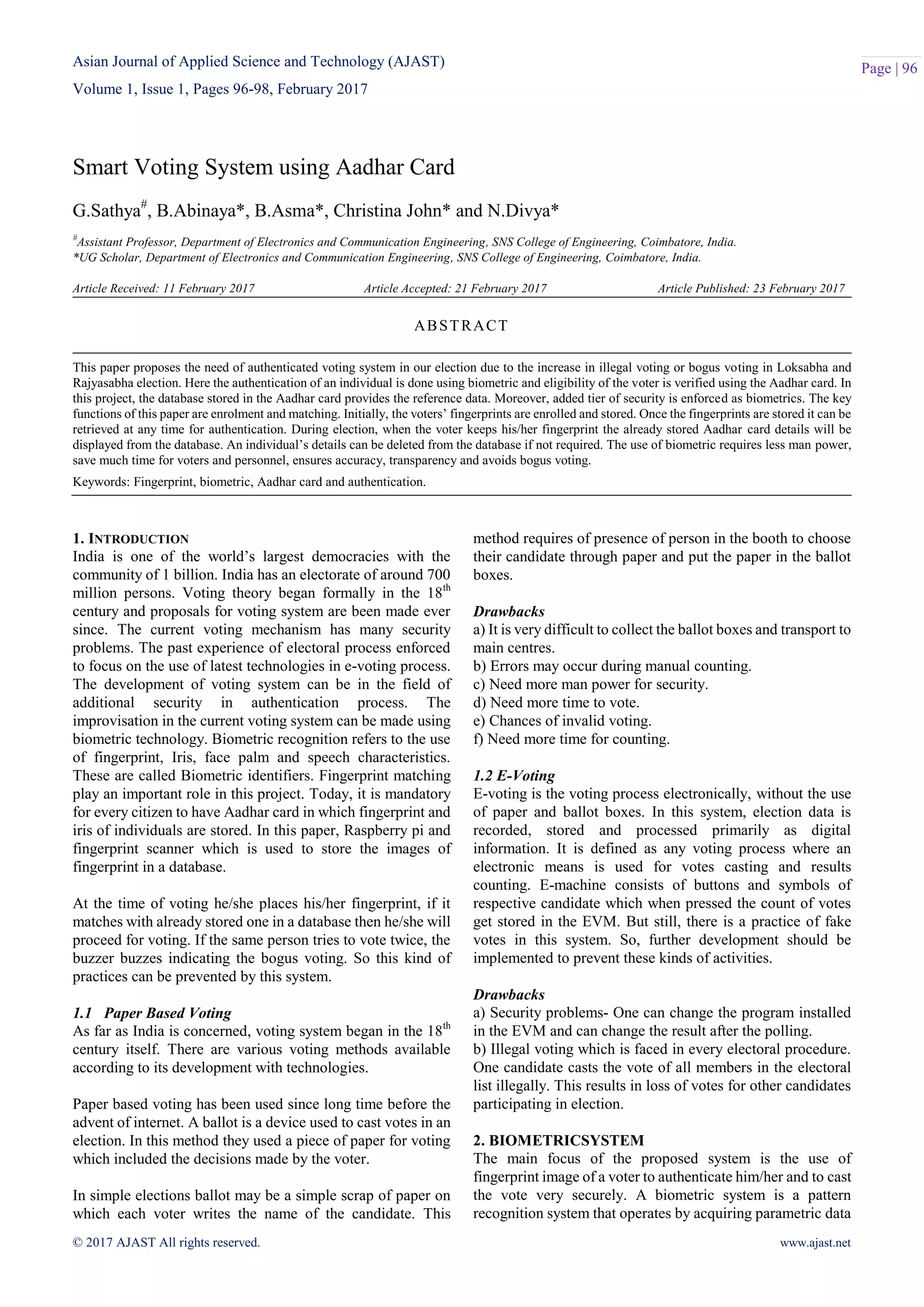
The mega 2560 is a microcontroller board based on the
Atmega 2560. It has 54 digital input/output pins of which 15
can be used as PWM outputs. 16 analog inputs, 4 UART’s
(hardware serial ports), a 16 mega Hertz crystal oscillator.
A) Power-The mega 2560 can be powered via the USB
connection or with an external power supply. The power
source is selected automatically.
B) memory-It has 250 KB of flash memory for storing code, 8
KB of SRAM and 4KB of EEPROM.
Fig.1. Arduino Mega-Pin Diagram
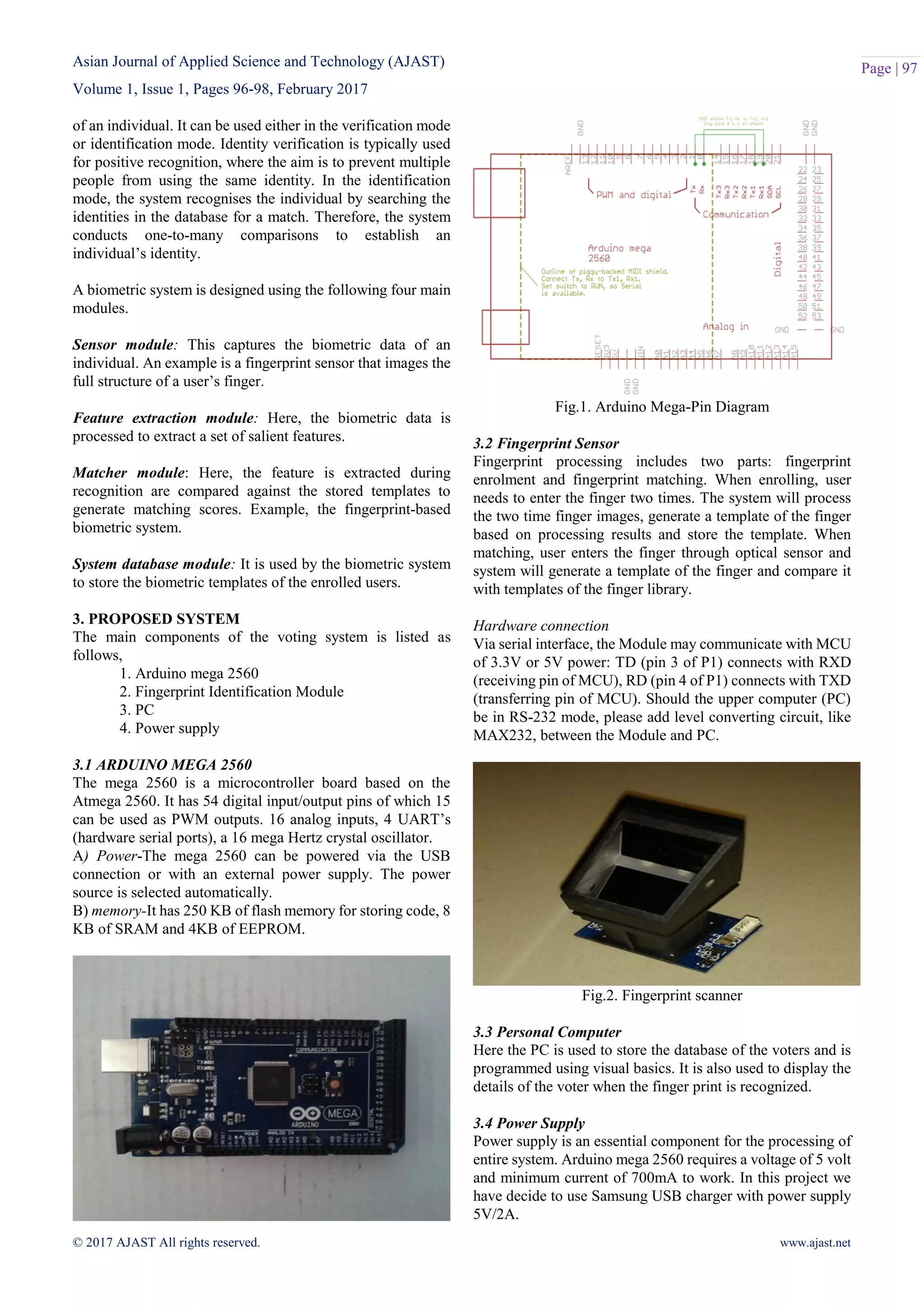
3.2 Fingerprint Sensor
Fingerprint processing includes two parts: fingerprint
enrolment and fingerprint matching. When enrolling, user
needs to enter the finger two times. The system will process
the two time finger images, generate a template of the finger
based on processing results and store the template. When
matching, user enters the finger through optical sensor and
system will generate a template of the finger and compare it
with templates of the finger library.
Hardware connection
Via serial interface, the Module may communicate with MCU
of 3.3V or 5V power: TD (pin 3 of P1) connects with RXD
(receiving pin of MCU), RD (pin 4 of P1) connects with TXD
(transferring pin of MCU). Should the upper computer (PC)
be in RS-232 mode, please add level converting circuit, like
MAX232, between the Module and PC.
Fig.2. Fingerprint scanner
3.3 Personal Computer
Here the PC is used to store the database of the voters and is
programmed using visual basics. It is also used to display the
details of the voter when the finger print is recognized.
3.4 Power Supply
Power supply is an essential component for the processing of
entire system. Arduino mega 2560 requires a voltage of 5 volt
and minimum current of 700mA to work. In this project we
have decide to use Samsung USB charger with power supply
5V/2A.
Asian Journal of Applied Science and Technology (AJAST)
Volume 1, Issue 1, Pages 96-98, February 2017
© 2017 AJAST All rights reserved. www.ajast.net
Page | 98
Working
The data base is created using visual basic studio which
contains the Aadhar card details of the voter. When the voter
keeps his fingerprint it is checked with the already stored data
base. If the finger print is recognized then the voter is allowed
to vote.
Fig.3. Operation
4. CONCLUSION
This project is to develop an authorised voting system. The
Aadhar card detail creates a unique profile of the individual to
avoid bogus voting. So only the eligible candidates can cast
their votes in the election. This project also reduces the man
power and enhances the security.
REFERENCES
[1] Anandaraj S., Anish R., Devakumar P.V, “Secured
Electronic voting machine using Bio metric”, IEEE
sponsored second International conference on Innovations in
Information, Embedded and Communication
Systems(ICIIECS), 2015.
[2] Devendra Vijay Naik, “Smart Wireless authenticating
voting machine”, IEEE ICSCP 2015 Conference.
[3] Anooshmita Das, Manash Pratim Dutta, Subhasish
Banerjee, C.T. Bhunia, “Cutting edge multi stratum secured
Electronic voting machine design with inclusion of bio
metrics RFID and GSM Module”, 2016 IEEE 6th
International Conference on Advanced Computing.
[4] Syed Mahmud Hasan, Arafa Mohd. Anis, Hamidur
Rahman, Jennifer Sherry Alam, Sohel Islam Nabil and Md.
Khalilur Rahman, “Development of electronic voting
machine with the inclusion of Near field communication ID
cards and Bio metric fingerprint identifier”, 2014 17th
International conference on computer and information
technology.
[5] D.Krishna, T.Hemalatha,G.Dhana Mani Shankar,K.Bala
Krishna,V.Bala Subhramanyam, “Aadhar based electronic
voting system and providing authentication”, IJESAT
Volume-4 Issue-2 237-240.
[6] Soumyajit Chakraborty, Siddhartha Mukherjee, Bhaswati
Sadhukhan1, Kazi Tanvi Yasmin, “Biometric voting system
using Aadhar card in India”, International journal of
Innovative research in Computer and Communication
Engineering, Vol. 4, Issue 4, April 2016.
[7] Rohan Patel, Vaibhav Ghorpade, Vinay Jain and Mansi
Kambli, “Fingerprint Based e-Voting System using Aadhar
Database”, International Journal for research in emerging
science and technology, Volume 2, Issue 3, March 2015.
[8] Umang Shah ,Trupt Shah ,Marteen Kansagara,Sagaar
Daxini,“ Biometric Secured Voting Machine to Avoid Bogus
Voting Based on AADHAR CARD” International Journal of
Innovative Research in Computer and Communication
Engineering, 2015.

Smart Voting System using Aadhar Card

  • 1.
    Asian Journal ofApplied Science and Technology (AJAST) Volume 1, Issue 1, Pages 96-98, February 2017 © 2017 AJAST All rights reserved. www.ajast.net Page | 96 Smart Voting System using Aadhar Card G.Sathya# , B.Abinaya*, B.Asma*, Christina John* and N.Divya* # Assistant Professor, Department of Electronics and Communication Engineering, SNS College of Engineering, Coimbatore, India. *UG Scholar, Department of Electronics and Communication Engineering, SNS College of Engineering, Coimbatore, India. Article Received: 11 February 2017 Article Accepted: 21 February 2017 Article Published: 23 February 2017 1. INTRODUCTION India is one of the world’s largest democracies with the community of 1 billion. India has an electorate of around 700 million persons. Voting theory began formally in the 18th century and proposals for voting system are been made ever since. The current voting mechanism has many security problems. The past experience of electoral process enforced to focus on the use of latest technologies in e-voting process. The development of voting system can be in the field of additional security in authentication process. The improvisation in the current voting system can be made using biometric technology. Biometric recognition refers to the use of fingerprint, Iris, face palm and speech characteristics. These are called Biometric identifiers. Fingerprint matching play an important role in this project. Today, it is mandatory for every citizen to have Aadhar card in which fingerprint and iris of individuals are stored. In this paper, Raspberry pi and fingerprint scanner which is used to store the images of fingerprint in a database. At the time of voting he/she places his/her fingerprint, if it matches with already stored one in a database then he/she will proceed for voting. If the same person tries to vote twice, the buzzer buzzes indicating the bogus voting. So this kind of practices can be prevented by this system. 1.1 Paper Based Voting As far as India is concerned, voting system began in the 18th century itself. There are various voting methods available according to its development with technologies. Paper based voting has been used since long time before the advent of internet. A ballot is a device used to cast votes in an election. In this method they used a piece of paper for voting which included the decisions made by the voter. In simple elections ballot may be a simple scrap of paper on which each voter writes the name of the candidate. This method requires of presence of person in the booth to choose their candidate through paper and put the paper in the ballot boxes. Drawbacks a) It is very difficult to collect the ballot boxes and transport to main centres. b) Errors may occur during manual counting. c) Need more man power for security. d) Need more time to vote. e) Chances of invalid voting. f) Need more time for counting. 1.2 E-Voting E-voting is the voting process electronically, without the use of paper and ballot boxes. In this system, election data is recorded, stored and processed primarily as digital information. It is defined as any voting process where an electronic means is used for votes casting and results counting. E-machine consists of buttons and symbols of respective candidate which when pressed the count of votes get stored in the EVM. But still, there is a practice of fake votes in this system. So, further development should be implemented to prevent these kinds of activities. Drawbacks a) Security problems- One can change the program installed in the EVM and can change the result after the polling. b) Illegal voting which is faced in every electoral procedure. One candidate casts the vote of all members in the electoral list illegally. This results in loss of votes for other candidates participating in election. 2. BIOMETRICSYSTEM The main focus of the proposed system is the use of fingerprint image of a voter to authenticate him/her and to cast the vote very securely. A biometric system is a pattern recognition system that operates by acquiring parametric data ABSTRACT This paper proposes the need of authenticated voting system in our election due to the increase in illegal voting or bogus voting in Loksabha and Rajyasabha election. Here the authentication of an individual is done using biometric and eligibility of the voter is verified using the Aadhar card. In this project, the database stored in the Aadhar card provides the reference data. Moreover, added tier of security is enforced as biometrics. The key functions of this paper are enrolment and matching. Initially, the voters’ fingerprints are enrolled and stored. Once the fingerprints are stored it can be retrieved at any time for authentication. During election, when the voter keeps his/her fingerprint the already stored Aadhar card details will be displayed from the database. An individual’s details can be deleted from the database if not required. The use of biometric requires less man power, save much time for voters and personnel, ensures accuracy, transparency and avoids bogus voting. Keywords: Fingerprint, biometric, Aadhar card and authentication.
  • 2.
    Asian Journal ofApplied Science and Technology (AJAST) Volume 1, Issue 1, Pages 96-98, February 2017 © 2017 AJAST All rights reserved. www.ajast.net Page | 97 of an individual. It can be used either in the verification mode or identification mode. Identity verification is typically used for positive recognition, where the aim is to prevent multiple people from using the same identity. In the identification mode, the system recognises the individual by searching the identities in the database for a match. Therefore, the system conducts one-to-many comparisons to establish an individual’s identity. A biometric system is designed using the following four main modules. Sensor module: This captures the biometric data of an individual. An example is a fingerprint sensor that images the full structure of a user’s finger. Feature extraction module: Here, the biometric data is processed to extract a set of salient features. Matcher module: Here, the feature is extracted during recognition are compared against the stored templates to generate matching scores. Example, the fingerprint-based biometric system. System database module: It is used by the biometric system to store the biometric templates of the enrolled users. 3. PROPOSED SYSTEM The main components of the voting system is listed as follows, 1. Arduino mega 2560 2. Fingerprint Identification Module 3. PC 4. Power supply 3.1 ARDUINO MEGA 2560 The mega 2560 is a microcontroller board based on the Atmega 2560. It has 54 digital input/output pins of which 15 can be used as PWM outputs. 16 analog inputs, 4 UART’s (hardware serial ports), a 16 mega Hertz crystal oscillator. A) Power-The mega 2560 can be powered via the USB connection or with an external power supply. The power source is selected automatically. B) memory-It has 250 KB of flash memory for storing code, 8 KB of SRAM and 4KB of EEPROM. Fig.1. Arduino Mega-Pin Diagram 3.2 Fingerprint Sensor Fingerprint processing includes two parts: fingerprint enrolment and fingerprint matching. When enrolling, user needs to enter the finger two times. The system will process the two time finger images, generate a template of the finger based on processing results and store the template. When matching, user enters the finger through optical sensor and system will generate a template of the finger and compare it with templates of the finger library. Hardware connection Via serial interface, the Module may communicate with MCU of 3.3V or 5V power: TD (pin 3 of P1) connects with RXD (receiving pin of MCU), RD (pin 4 of P1) connects with TXD (transferring pin of MCU). Should the upper computer (PC) be in RS-232 mode, please add level converting circuit, like MAX232, between the Module and PC. Fig.2. Fingerprint scanner 3.3 Personal Computer Here the PC is used to store the database of the voters and is programmed using visual basics. It is also used to display the details of the voter when the finger print is recognized. 3.4 Power Supply Power supply is an essential component for the processing of entire system. Arduino mega 2560 requires a voltage of 5 volt and minimum current of 700mA to work. In this project we have decide to use Samsung USB charger with power supply 5V/2A.
  • 3.
    Asian Journal ofApplied Science and Technology (AJAST) Volume 1, Issue 1, Pages 96-98, February 2017 © 2017 AJAST All rights reserved. www.ajast.net Page | 98 Working The data base is created using visual basic studio which contains the Aadhar card details of the voter. When the voter keeps his fingerprint it is checked with the already stored data base. If the finger print is recognized then the voter is allowed to vote. Fig.3. Operation 4. CONCLUSION This project is to develop an authorised voting system. The Aadhar card detail creates a unique profile of the individual to avoid bogus voting. So only the eligible candidates can cast their votes in the election. This project also reduces the man power and enhances the security. REFERENCES [1] Anandaraj S., Anish R., Devakumar P.V, “Secured Electronic voting machine using Bio metric”, IEEE sponsored second International conference on Innovations in Information, Embedded and Communication Systems(ICIIECS), 2015. [2] Devendra Vijay Naik, “Smart Wireless authenticating voting machine”, IEEE ICSCP 2015 Conference. [3] Anooshmita Das, Manash Pratim Dutta, Subhasish Banerjee, C.T. Bhunia, “Cutting edge multi stratum secured Electronic voting machine design with inclusion of bio metrics RFID and GSM Module”, 2016 IEEE 6th International Conference on Advanced Computing. [4] Syed Mahmud Hasan, Arafa Mohd. Anis, Hamidur Rahman, Jennifer Sherry Alam, Sohel Islam Nabil and Md. Khalilur Rahman, “Development of electronic voting machine with the inclusion of Near field communication ID cards and Bio metric fingerprint identifier”, 2014 17th International conference on computer and information technology. [5] D.Krishna, T.Hemalatha,G.Dhana Mani Shankar,K.Bala Krishna,V.Bala Subhramanyam, “Aadhar based electronic voting system and providing authentication”, IJESAT Volume-4 Issue-2 237-240. [6] Soumyajit Chakraborty, Siddhartha Mukherjee, Bhaswati Sadhukhan1, Kazi Tanvi Yasmin, “Biometric voting system using Aadhar card in India”, International journal of Innovative research in Computer and Communication Engineering, Vol. 4, Issue 4, April 2016. [7] Rohan Patel, Vaibhav Ghorpade, Vinay Jain and Mansi Kambli, “Fingerprint Based e-Voting System using Aadhar Database”, International Journal for research in emerging science and technology, Volume 2, Issue 3, March 2015. [8] Umang Shah ,Trupt Shah ,Marteen Kansagara,Sagaar Daxini,“ Biometric Secured Voting Machine to Avoid Bogus Voting Based on AADHAR CARD” International Journal of Innovative Research in Computer and Communication Engineering, 2015.