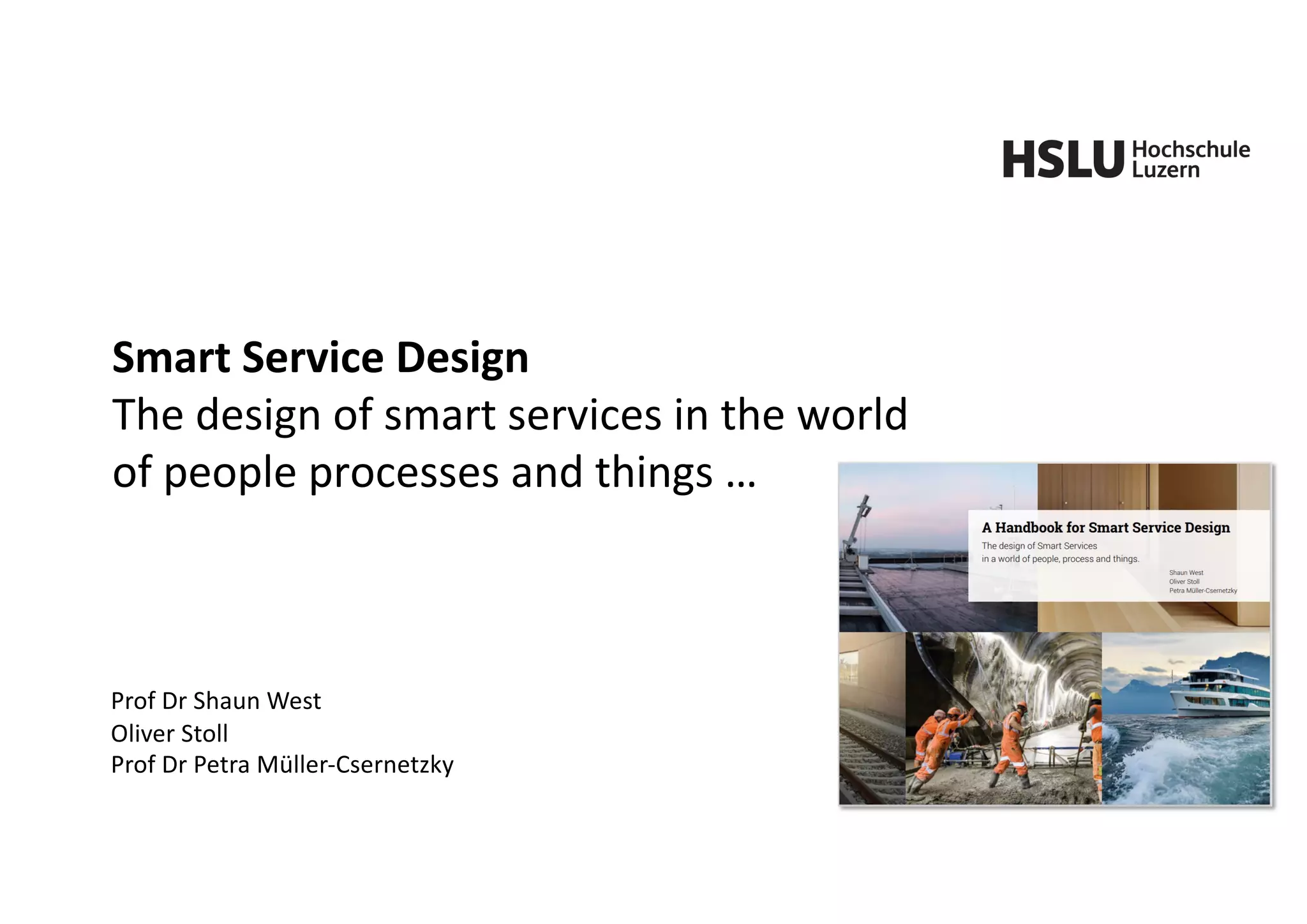
Smart Service Design
The design of smart services in the world
of people processes and things …
Prof Dr Shaun West
Oliver Stoll
Prof Dr Petra Müller-Csernetzky
Smart Service Design| Prof Dr Shaun West, Oliver Stoll & Prof Dr Petra Müller-Csernetzky
Purpose
To provide an insight into smart service design
The digital twin is a
technological concept,
that can support new
value propositions via the
creation of Smart Twins
and Smart Services.
We will introduce the concepts of the digital twin
You will provide links to our publications
We will explore one of our cases
We will describe our development framework
Smart Service Design| Prof Dr Shaun West, Oliver Stoll & Prof Dr Petra Müller-Csernetzky
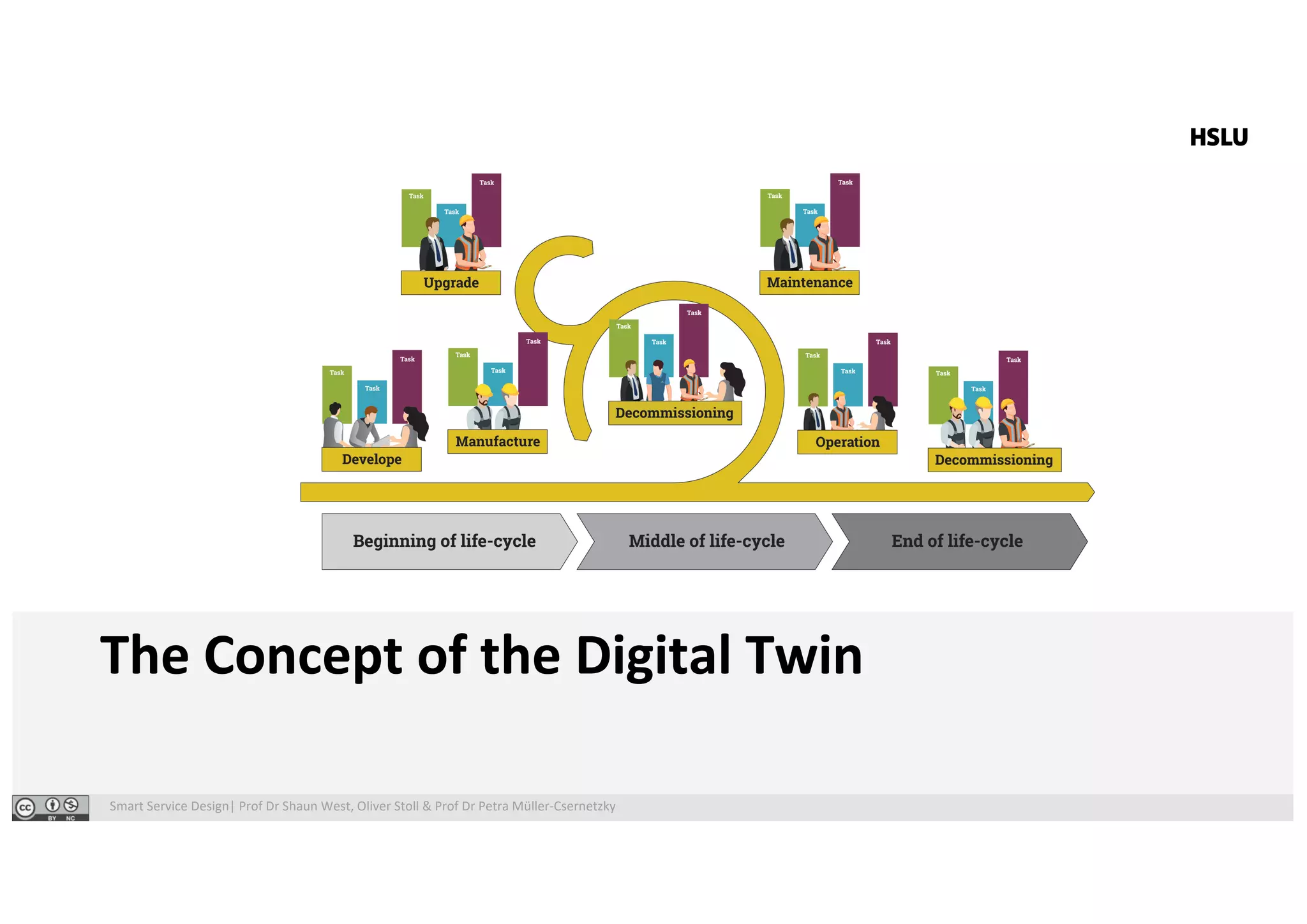
The Concept of the Digital Twin
Smart Service Design| Prof Dr Shaun West, Oliver Stoll & Prof Dr Petra Müller-Csernetzky
The Concept of the Digital Twin
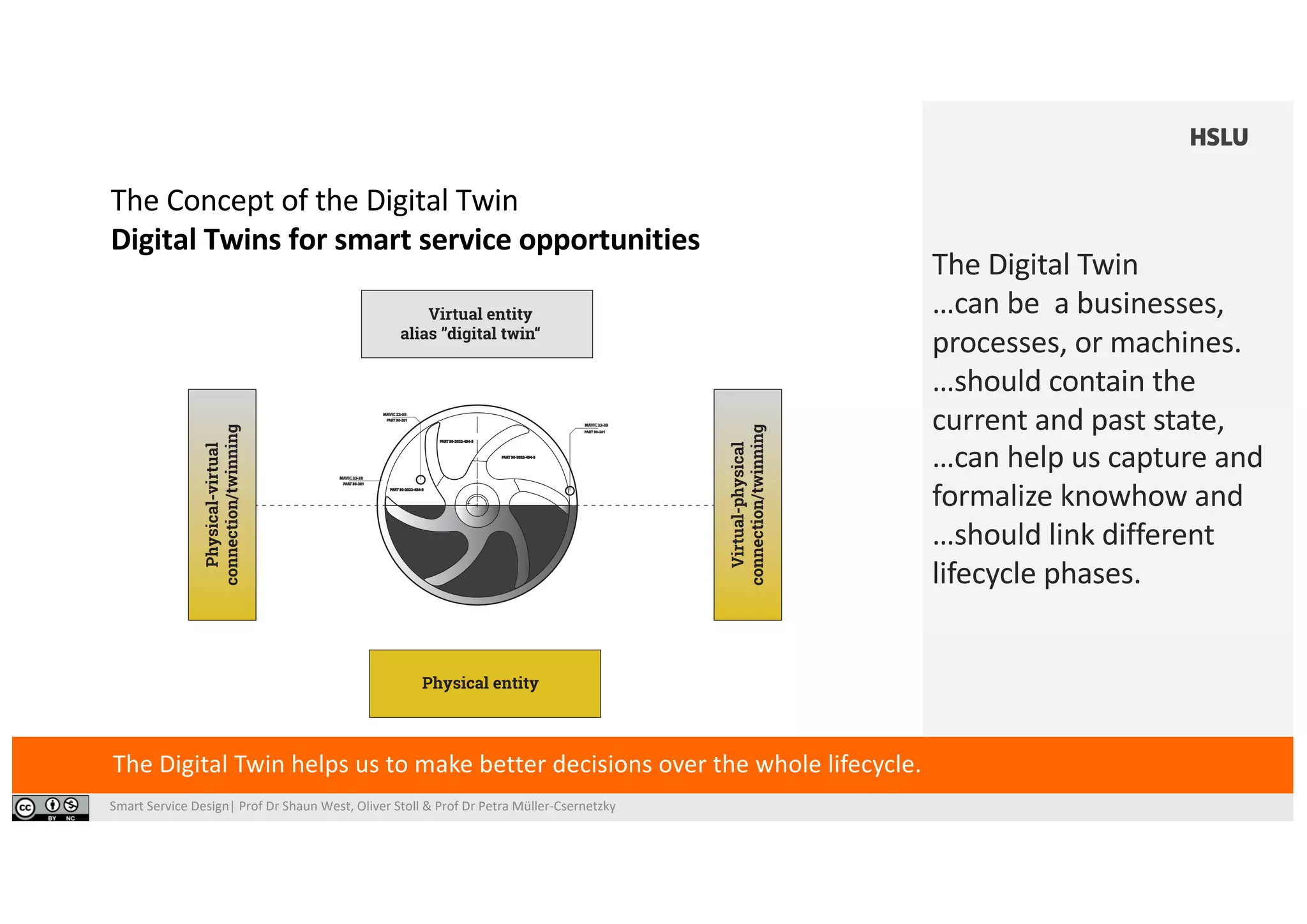
Digital Twins for smart service opportunities
The Digital Twin helps us to make better decisions over the whole lifecycle.
The Digital Twin
…can be a businesses,
processes, or machines.
…should contain the
current and past state,
…can help us capture and
formalize knowhow and
…should link different
lifecycle phases.
PART 30-2022-434-3
PART 30-2022-434-3
PART 30-2022-434-3
PART 30-201
MAVIC 22-33
PART 30-201
MAVIC 22-33
PART 30-201
MAVIC 22-33
Virtual entity
alias ”digital twin“
Virtual-physical
connection/twinning
Physical entity
Physical environment
Virtual environment
Physical-virtual
connection/twinning
Smart Service Design| Prof Dr Shaun West, Oliver Stoll & Prof Dr Petra Müller-Csernetzky
The Concept of the Digital Twin
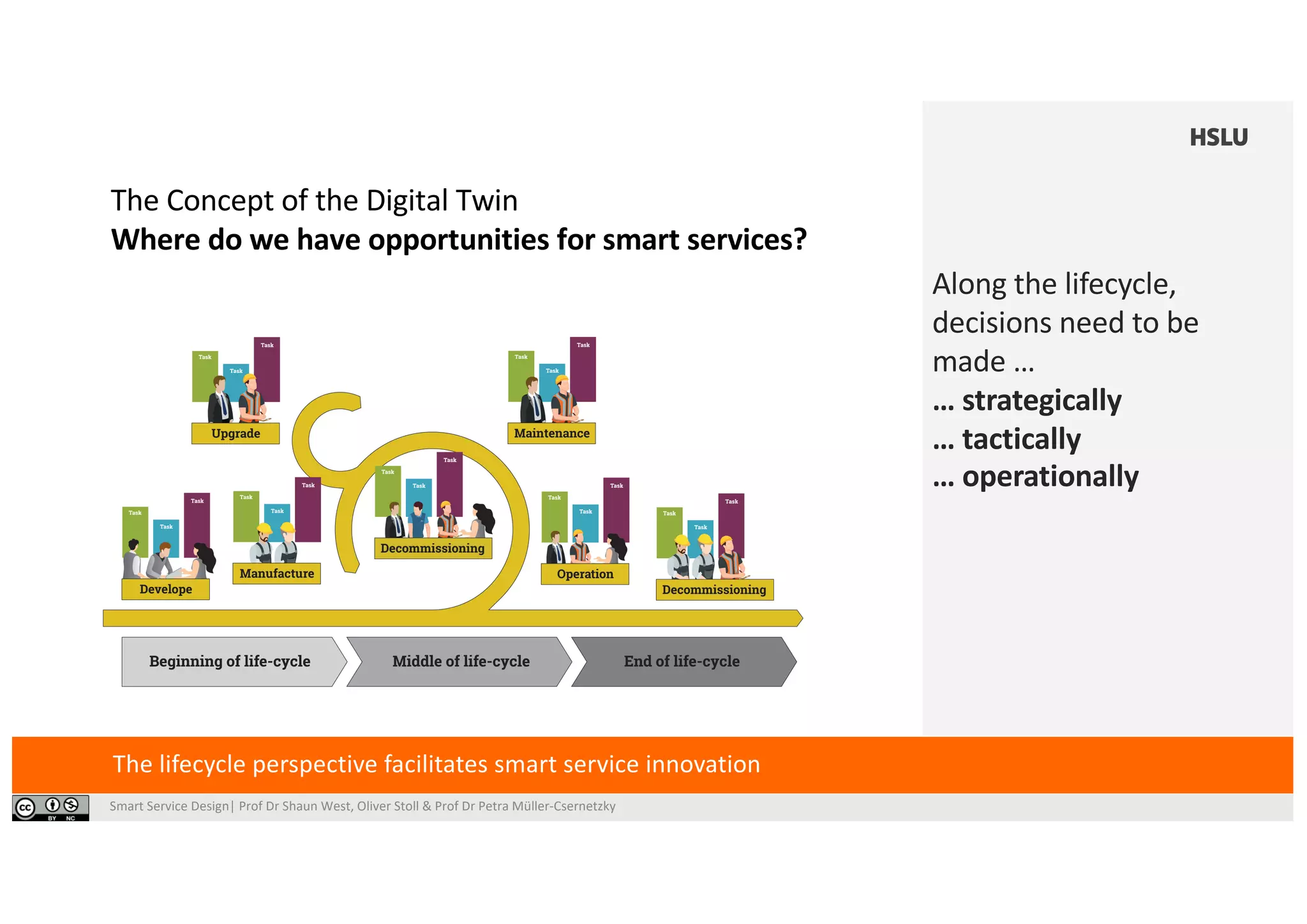
Where do we have opportunities for smart services?
The lifecycle perspective facilitates smart service innovation
Along the lifecycle,
decisions need to be
made …
… strategically
… tactically
… operationally
Smart Service Design| Prof Dr Shaun West, Oliver Stoll & Prof Dr Petra Müller-Csernetzky
ting the cyber-physical environment. The Di-
gital Twin offers an excellent opportunity to
help solve different problems in the planning
and operation of product-service systems.
Assisting operational decision-making. Ma
take place on subsystems (e.g., one vehicle of a
while the general goal is to optimize the surroun
mance (e.g., the overall transportation capacity)
data from the subsystems with a model of the o
Using the models of th
Twins can act as a training facility for new opera
simulator). This can be done if the physical syst
Figure 3: Many different actors,
jobs and processes; (© shutterstock)
In summary, Digital T
opportunity for digita
By incorporating the
different timeframes
well-founded decisio
a common goal.
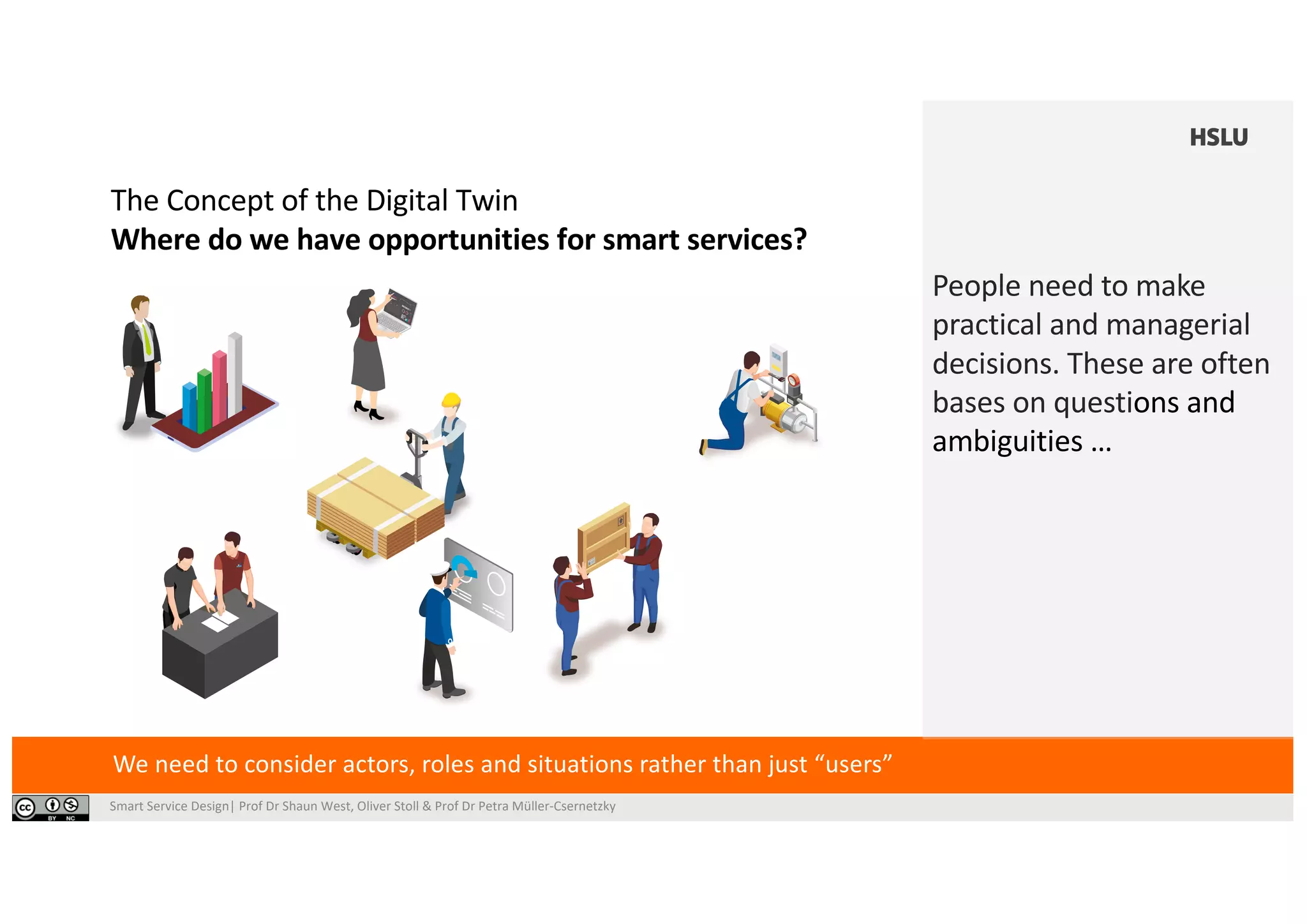
We need to consider actors, roles and situations rather than just “users”
People need to make
practical and managerial
decisions. These are often
bases on questions and
ambiguities …
The Concept of the Digital Twin
Where do we have opportunities for smart services?
ns
arts
al
ose
m
ate
nd
he
al
ned
erfor-
pec-
ital
how
s.
and report back when necessary – in effect,
they become a co-worker. Together, the data
and simulation models provide a virtual re-
presentation of the physical system, crea-
ting the cyber-physical environment. The Di-
gital Twin offers an excellent opportunity to
help solve different problems in the planning
and operation of product-service systems.
hazardous developments (i.e
Assisting operational dec
take place on subsystems (e
while the general goal is to o
mance (e.g., the overall trans
data from the subsystems w
Us
Twins can act as a training f
simulator). This can be done
Figure 3: Many different actors,
jobs and processes; (© shutterstock)
In
o
B
d
w
a
Smart Service Design| Prof Dr Shaun West, Oliver Stoll & Prof Dr Petra Müller-Csernetzky
The Concept of the Digital Twin
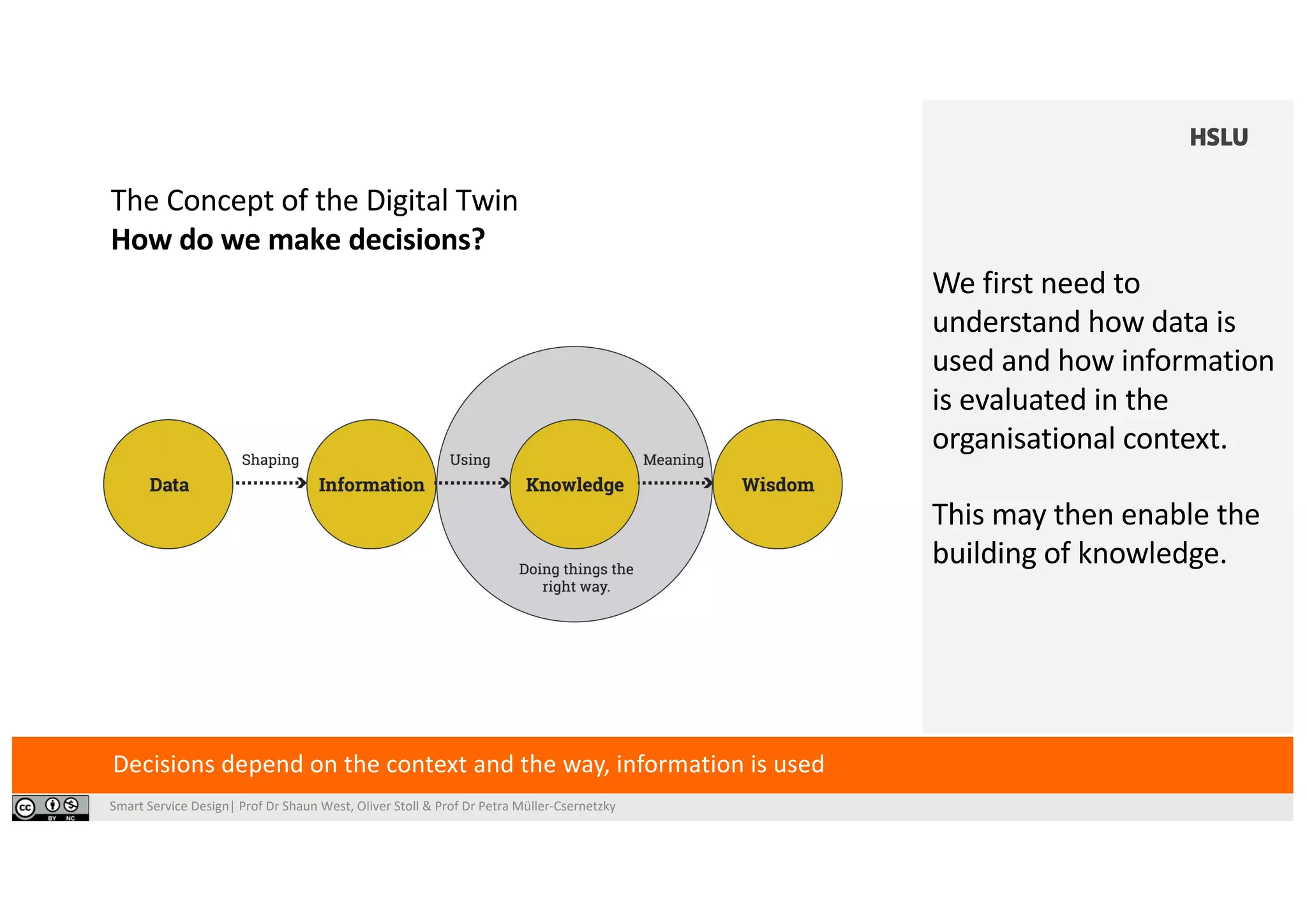
How do we make decisions?
Decisions depend on the context and the way, information is used
We first need to
understand how data is
used and how information
is evaluated in the
organisational context.
This may then enable the
building of knowledge.
Smart Service Design| Prof Dr Shaun West, Oliver Stoll & Prof Dr Petra Müller-Csernetzky
The Concept of the Digital Twin
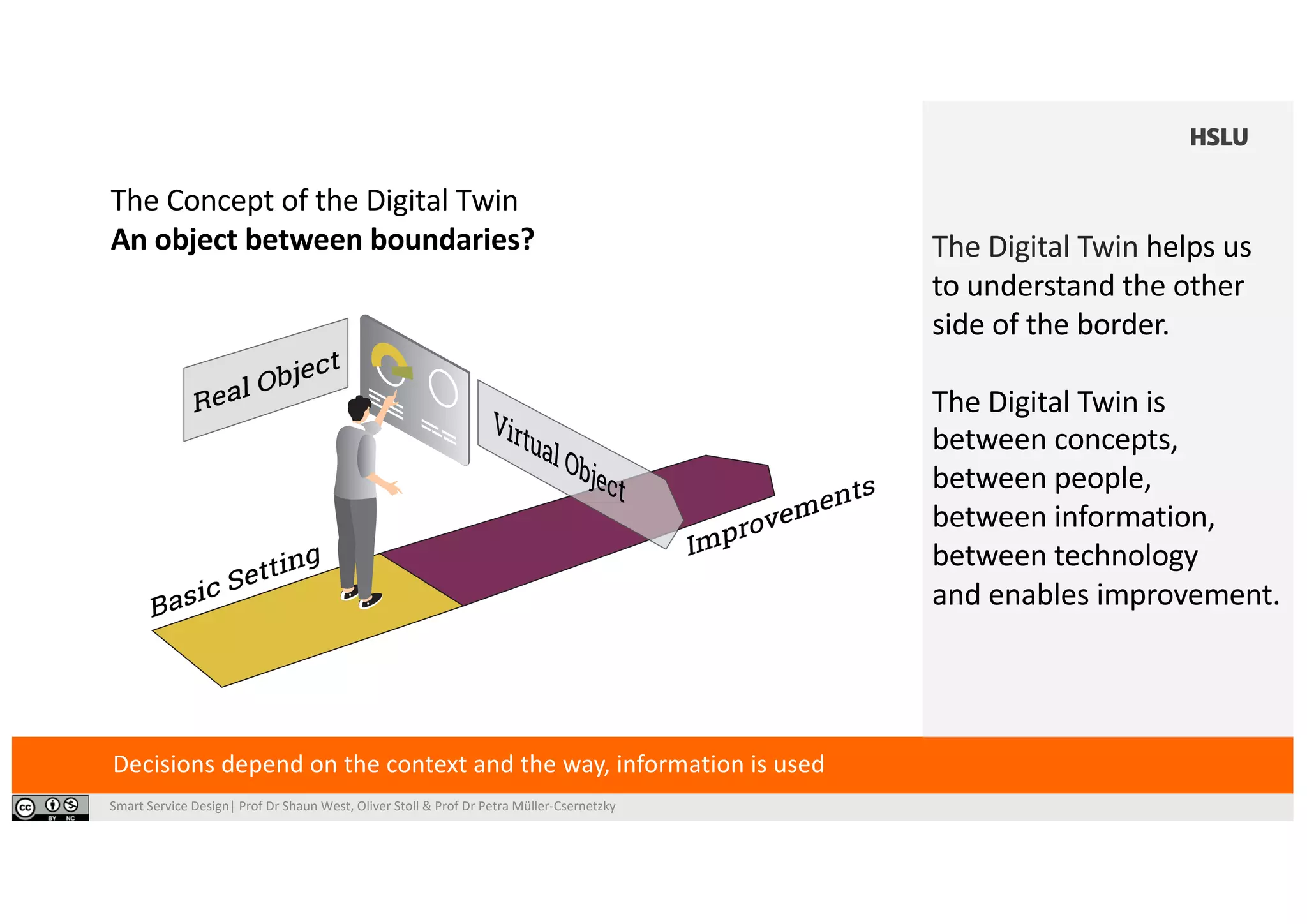
An object between boundaries?
Decisions depend on the context and the way, information is used
The Digital Twin helps us
to understand the other
side of the border.
The Digital Twin is
between concepts,
between people,
between information,
between technology
and enables improvement.
Smart Service Design| Prof Dr Shaun West, Oliver Stoll & Prof Dr Petra Müller-Csernetzky
The Concept of the Digital Twin
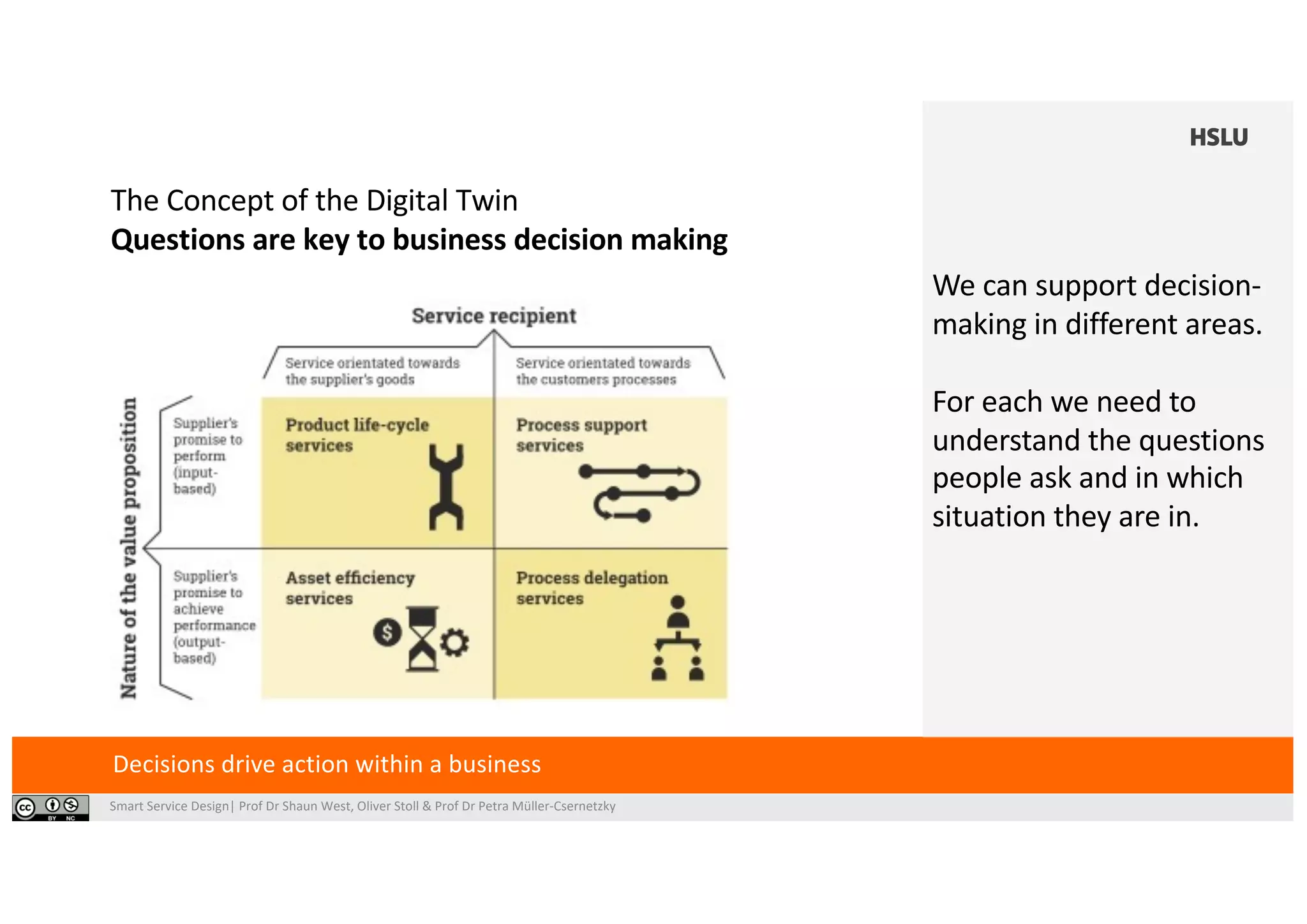
Questions are key to business decision making
Decisions drive action within a business
We can support decision-
making in different areas.
For each we need to
understand the questions
people ask and in which
situation they are in.
Smart Service Design| Prof Dr Shaun West, Oliver Stoll & Prof Dr Petra Müller-Csernetzky
The Concept of the Digital Twin
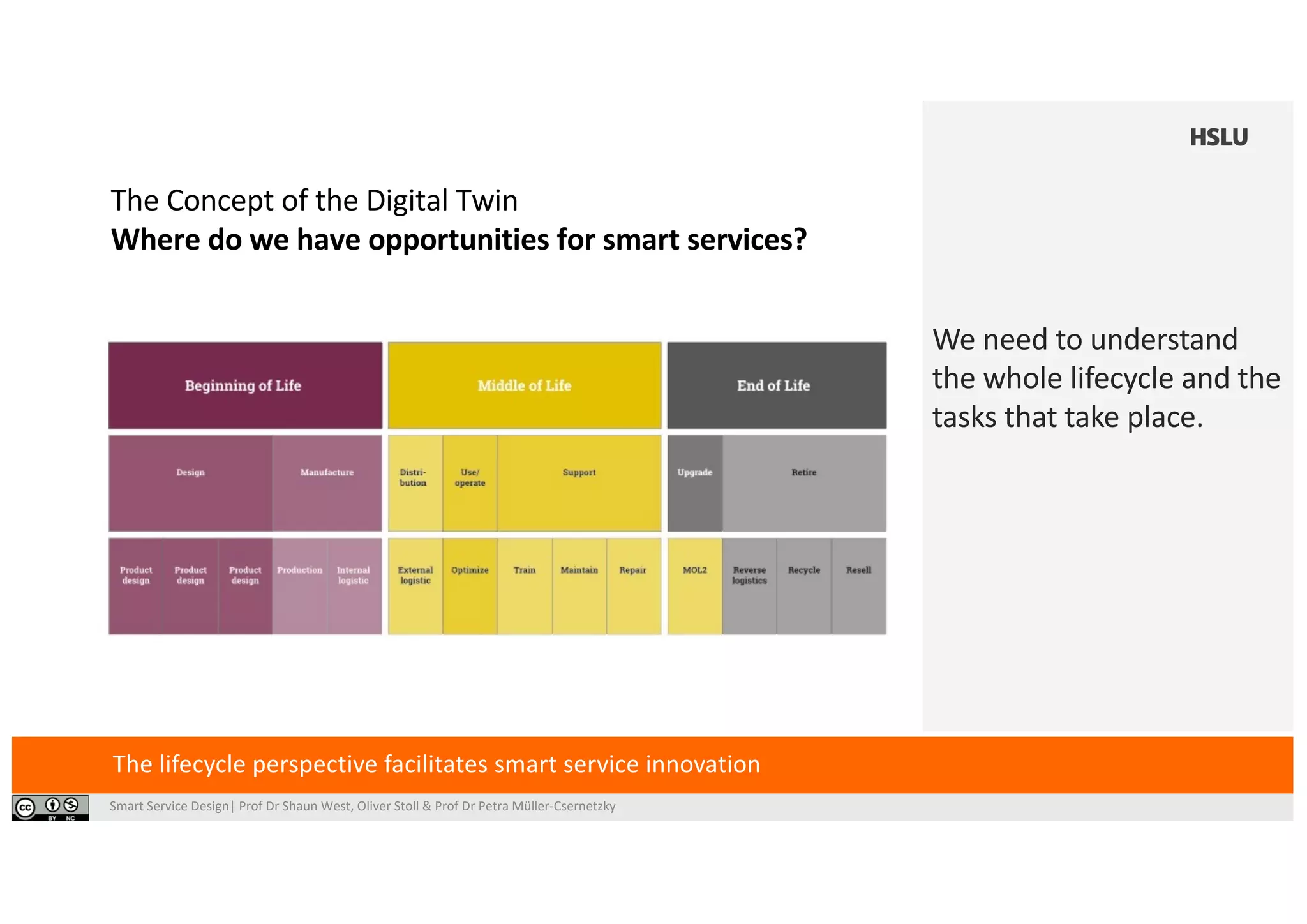
Where do we have opportunities for smart services?
The lifecycle perspective facilitates smart service innovation
We need to understand
the whole lifecycle and the
tasks that take place.
Smart Service Design| Prof Dr Shaun West, Oliver Stoll & Prof Dr Petra Müller-Csernetzky
The Concept of the Digital Twin
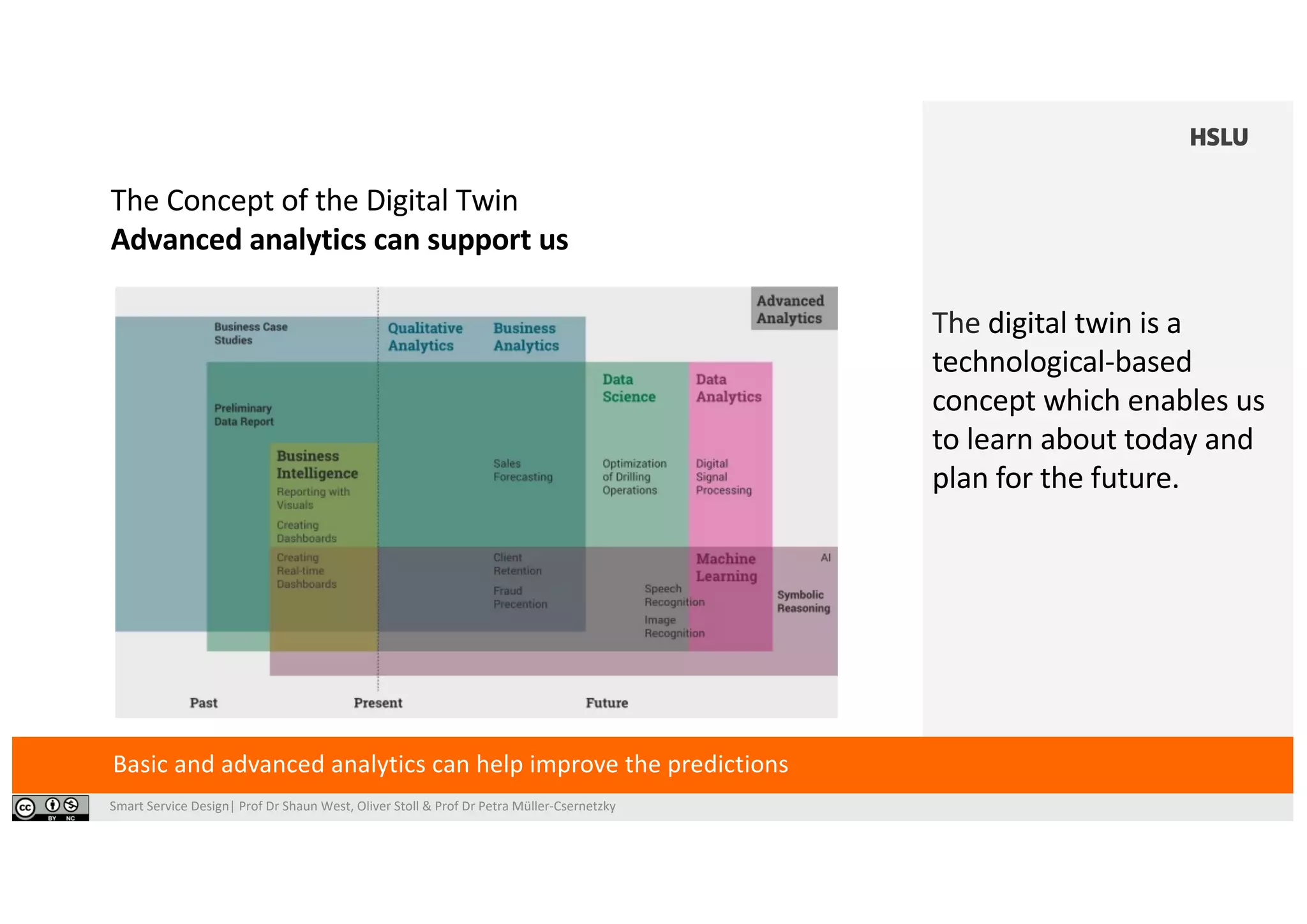
Advanced analytics can support us
Basic and advanced analytics can help improve the predictions
The digital twin is a
technological-based
concept which enables us
to learn about today and
plan for the future.
Smart Service Design| Prof Dr Shaun West, Oliver Stoll & Prof Dr Petra Müller-Csernetzky
The Concept of the Digital Twin
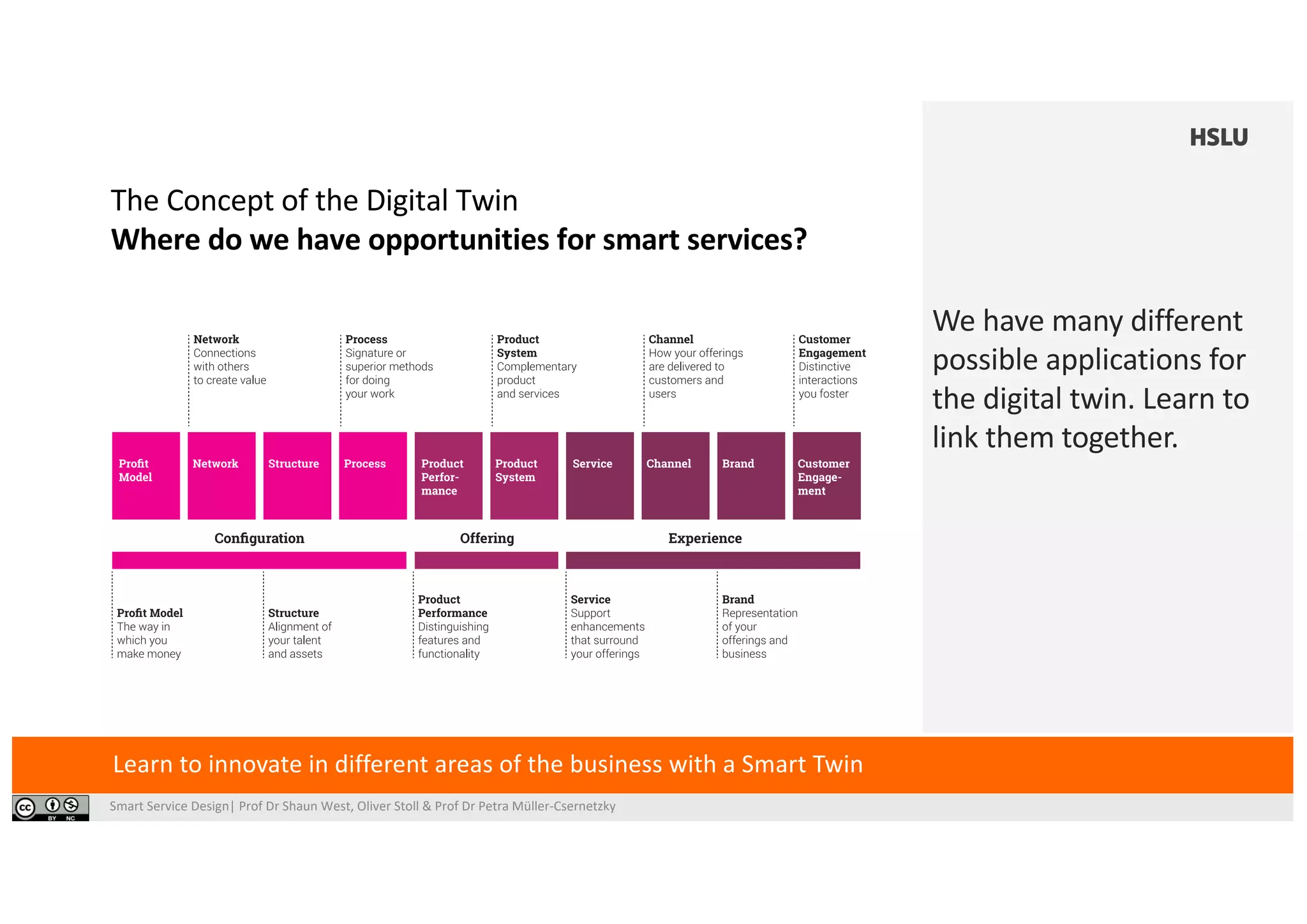
Where do we have opportunities for smart services?
Learn to innovate in different areas of the business with a Smart Twin
We have many different
possible applications for
the digital twin. Learn to
link them together.
Smart Service Design| Prof Dr Shaun West, Oliver Stoll & Prof Dr Petra Müller-Csernetzky
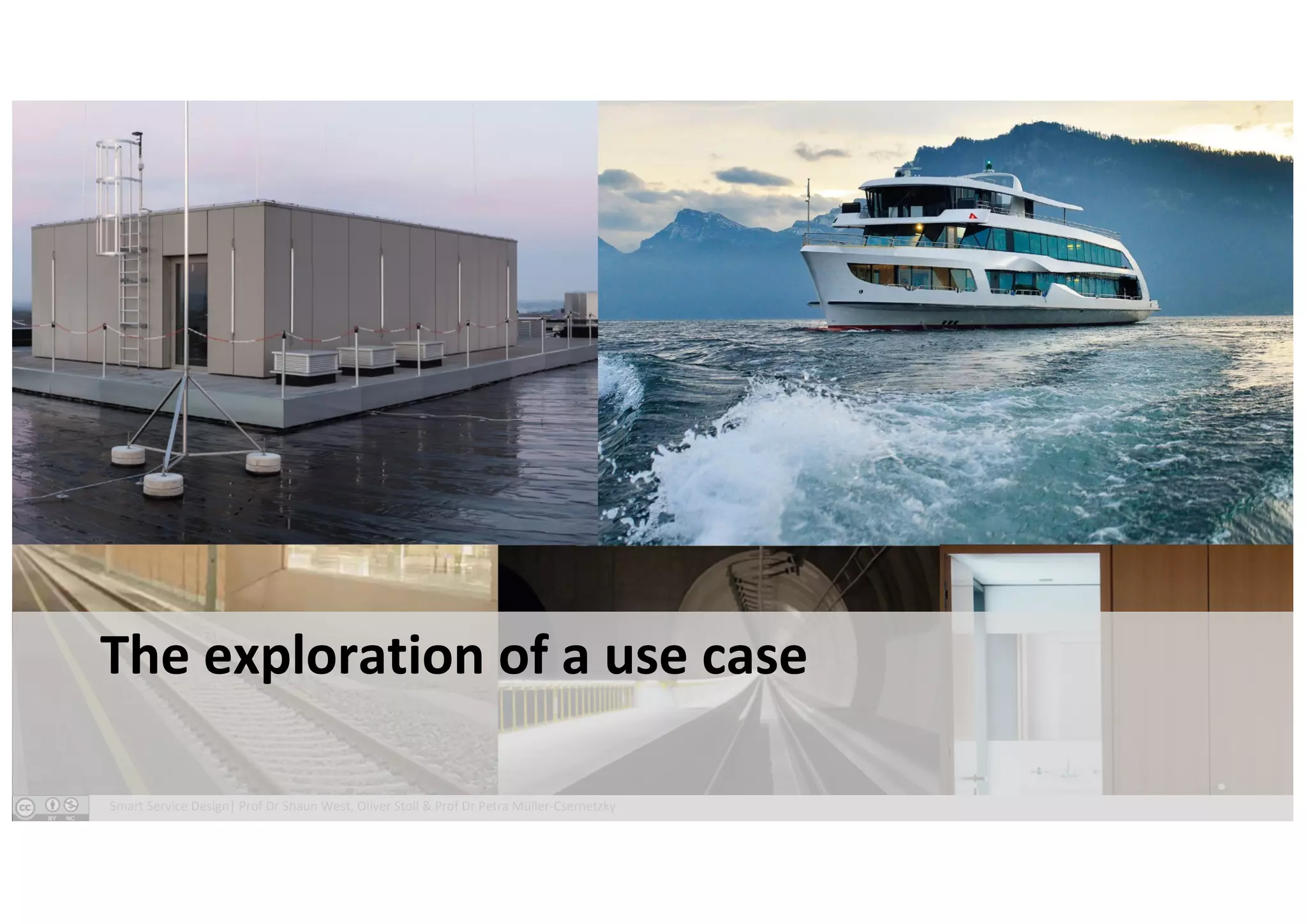
The exploration of a use case
Smart Service Design| Prof Dr Shaun West, Oliver Stoll & Prof Dr Petra Müller-Csernetzky
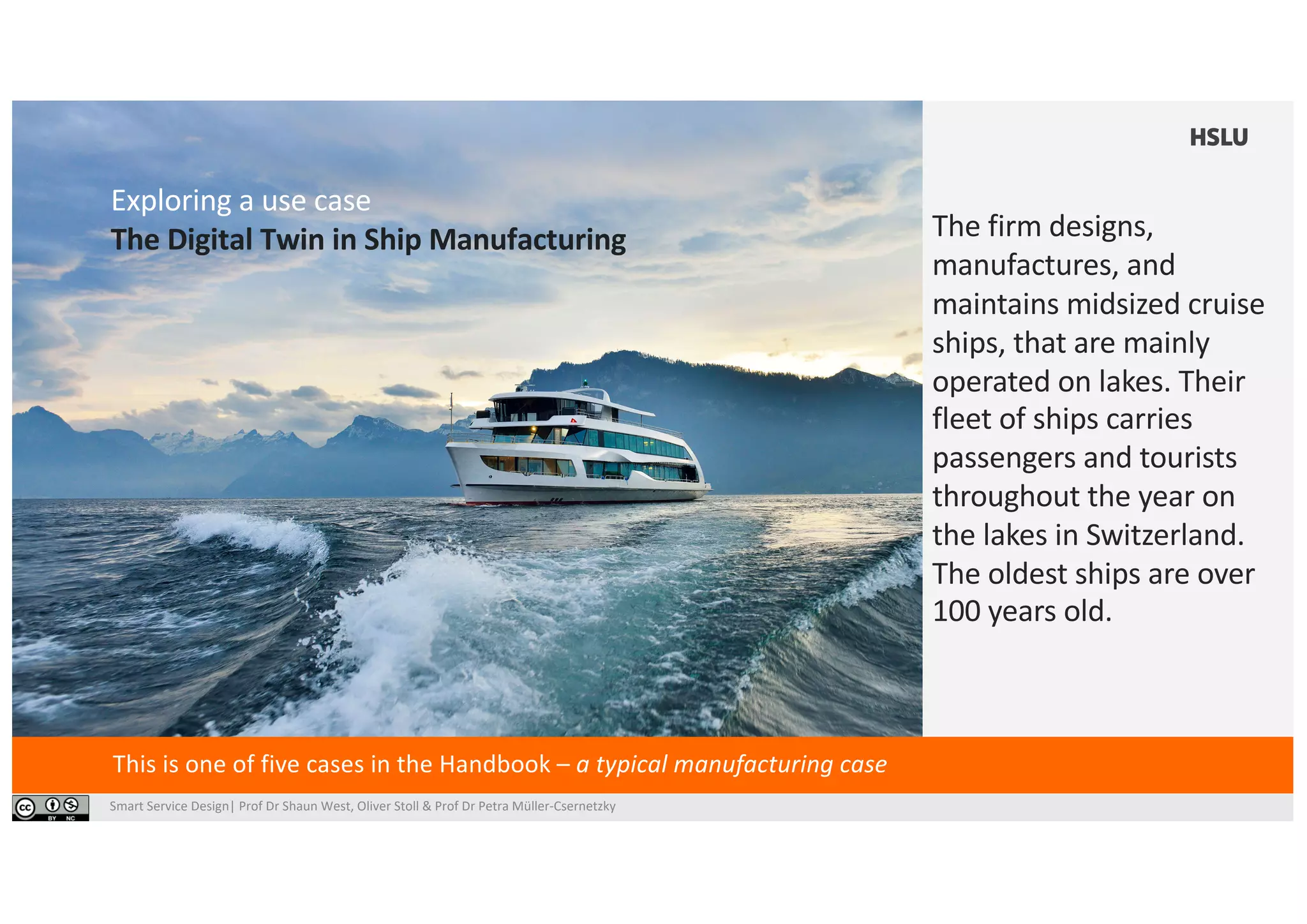
Exploring a use case
The Digital Twin in Ship Manufacturing
This is one of five cases in the Handbook – a typical manufacturing case
The firm designs,
manufactures, and
maintains midsized cruise
ships, that are mainly
operated on lakes. Their
fleet of ships carries
passengers and tourists
throughout the year on
the lakes in Switzerland.
The oldest ships are over
100 years old.
Smart Service Design| Prof Dr Shaun West, Oliver Stoll & Prof Dr Petra Müller-Csernetzky
Exploring a use case
Where do we have opportunities for smart services?
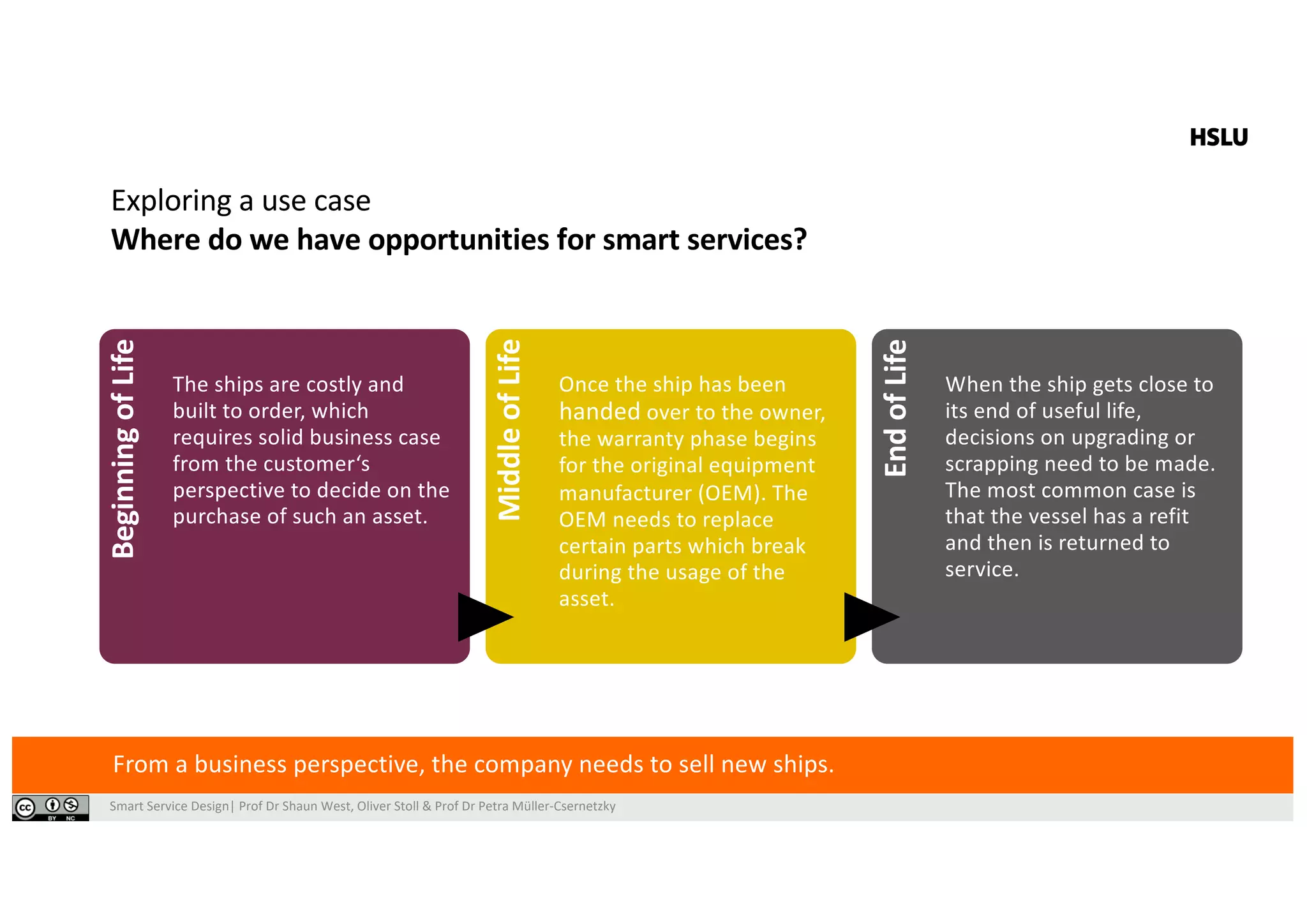
From a business perspective, the company needs to sell new ships.
Beginning
of
Life
The ships are costly and
built to order, which
requires solid business case
from the customer‘s
perspective to decide on the
purchase of such an asset. Middle
of
Life
Once the ship has been
handed over to the owner,
the warranty phase begins
for the original equipment
manufacturer (OEM). The
OEM needs to replace
certain parts which break
during the usage of the
asset.
End
of
Life
When the ship gets close to
its end of useful life,
decisions on upgrading or
scrapping need to be made.
The most common case is
that the vessel has a refit
and then is returned to
service.
Smart Service Design| Prof Dr Shaun West, Oliver Stoll & Prof Dr Petra Müller-Csernetzky
Exploring a use case
Where do we have opportunities for smart services?
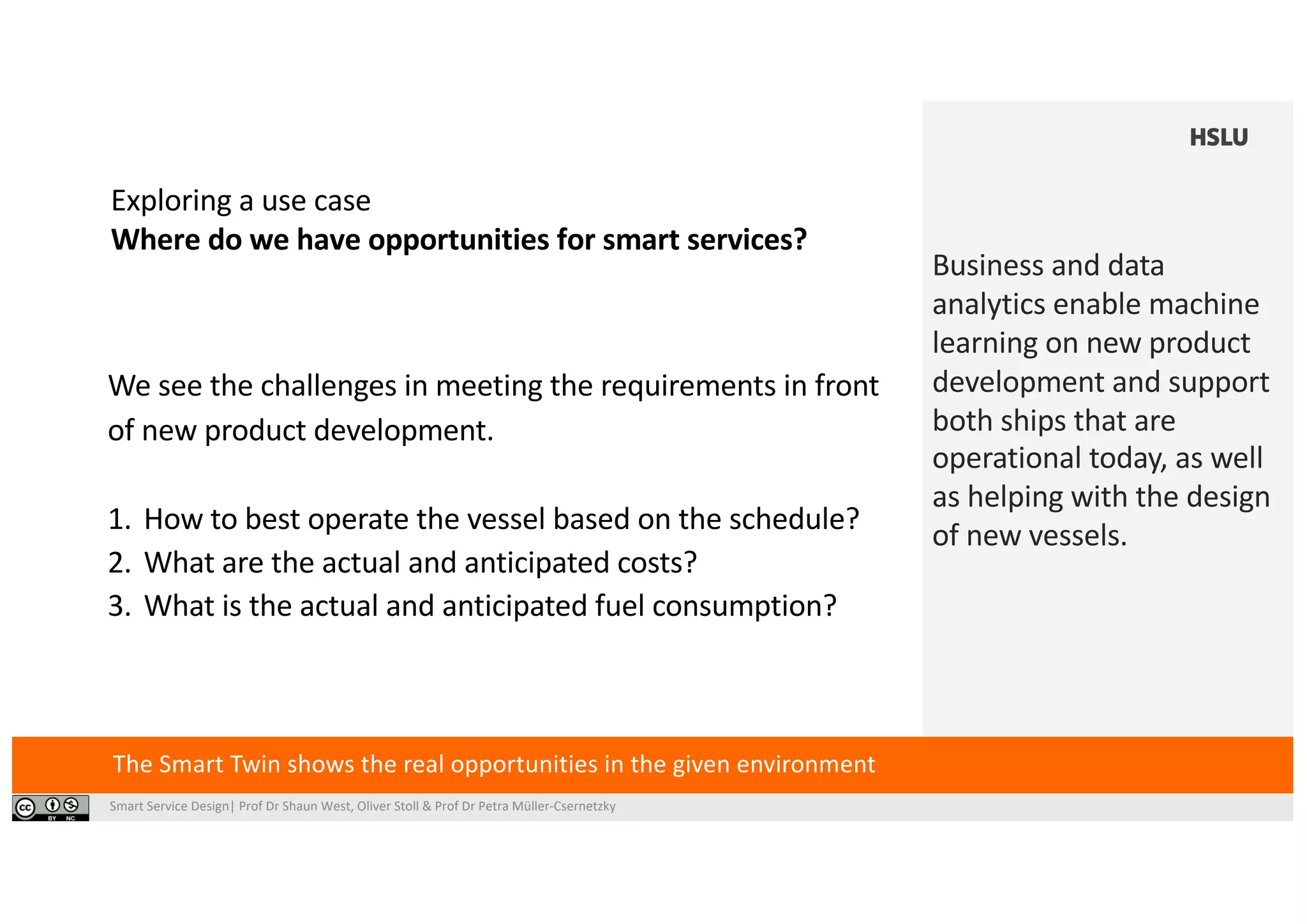
The Smart Twin shows the real opportunities in the given environment
We see the challenges in meeting the requirements in front
of new product development.
1. How to best operate the vessel based on the schedule?
2. What are the actual and anticipated costs?
3. What is the actual and anticipated fuel consumption?
Business and data
analytics enable machine
learning on new product
development and support
both ships that are
operational today, as well
as helping with the design
of new vessels.
Smart Service Design| Prof Dr Shaun West, Oliver Stoll & Prof Dr Petra Müller-Csernetzky
Exploring a use case
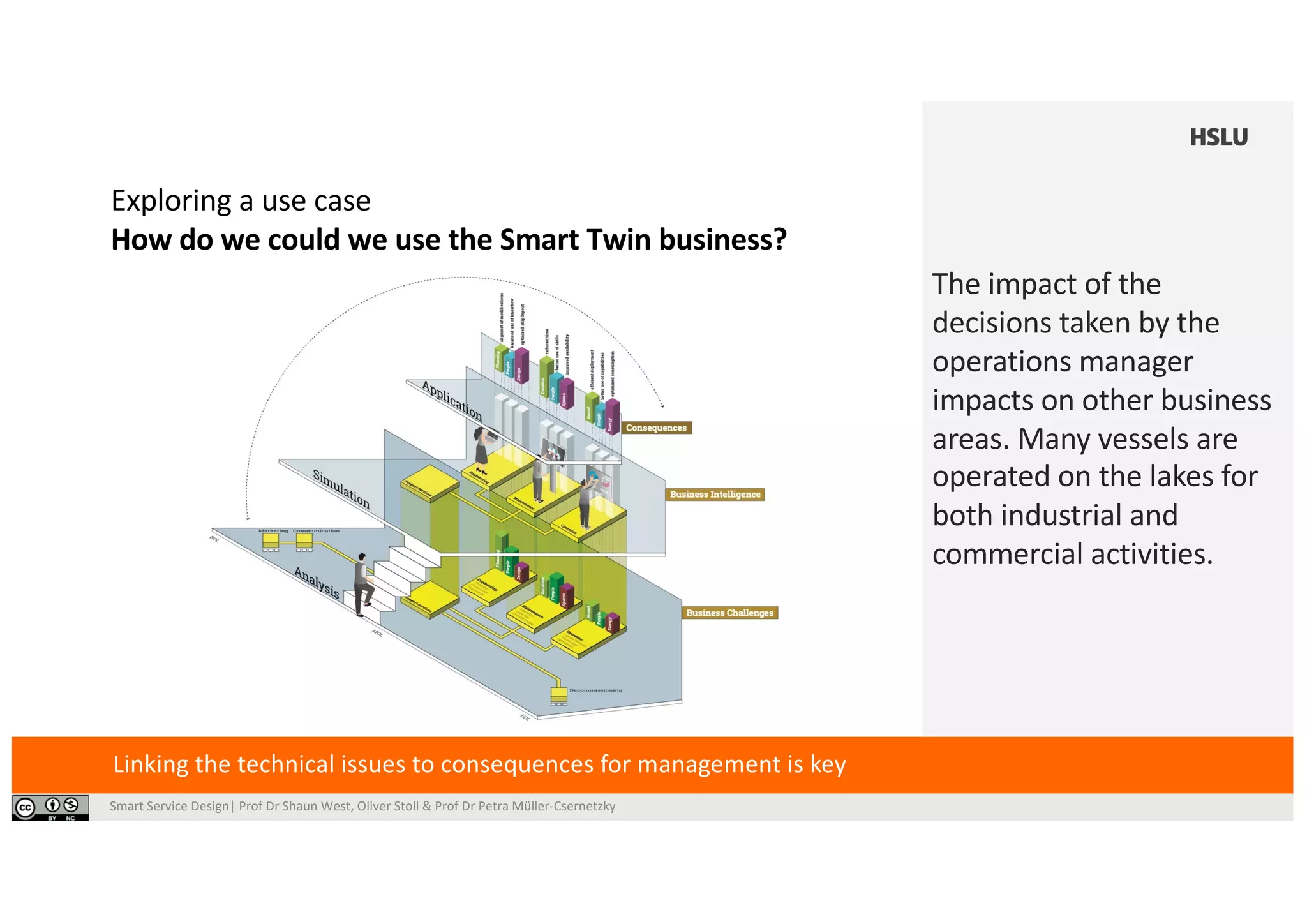
How do we could we use the Smart Twin business?
Linking the technical issues to consequences for management is key
The impact of the
decisions taken by the
operations manager
impacts on other business
areas. Many vessels are
operated on the lakes for
both industrial and
commercial activities.
Smart Service Design| Prof Dr Shaun West, Oliver Stoll & Prof Dr Petra Müller-Csernetzky
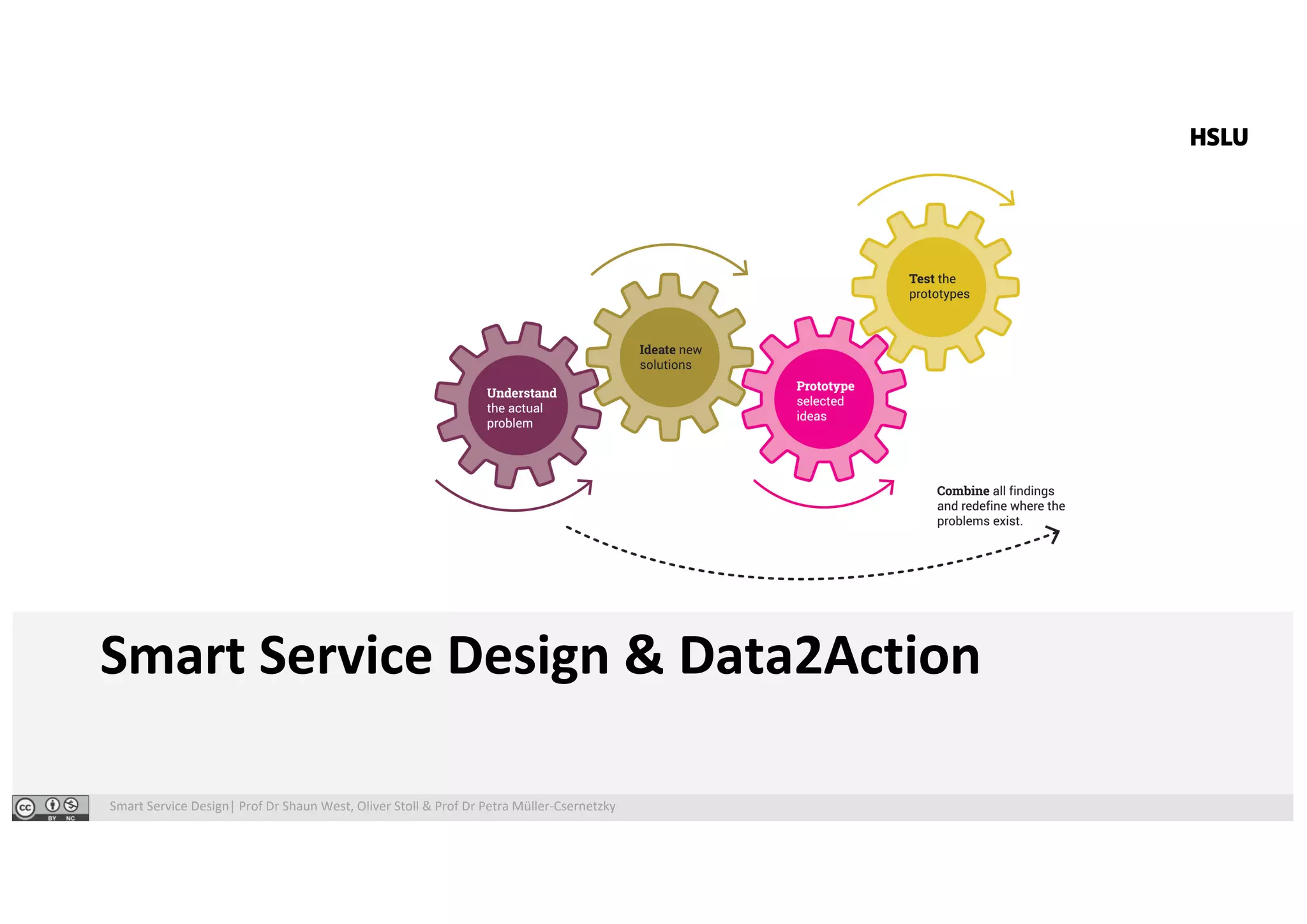
Smart Service Design & Data2Action
Smart Service Design| Prof Dr Shaun West, Oliver Stoll & Prof Dr Petra Müller-Csernetzky
Smart Service Design & Data2Action
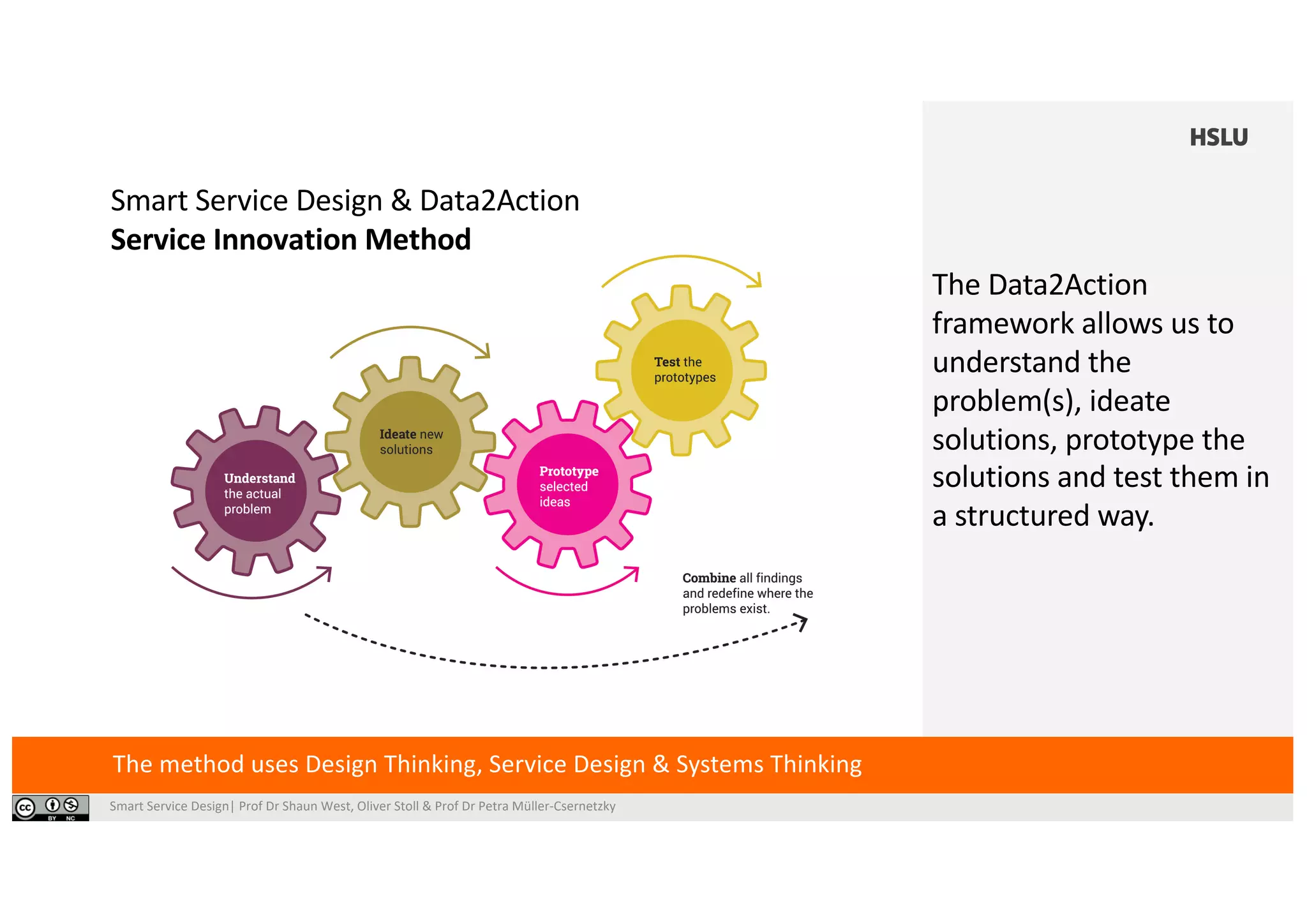
Service Innovation Method
The method uses Design Thinking, Service Design & Systems Thinking
The Data2Action
framework allows us to
understand the
problem(s), ideate
solutions, prototype the
solutions and test them in
a structured way.
Smart Service Design| Prof Dr Shaun West, Oliver Stoll & Prof Dr Petra Müller-Csernetzky
Smart Service Design & Data2Action
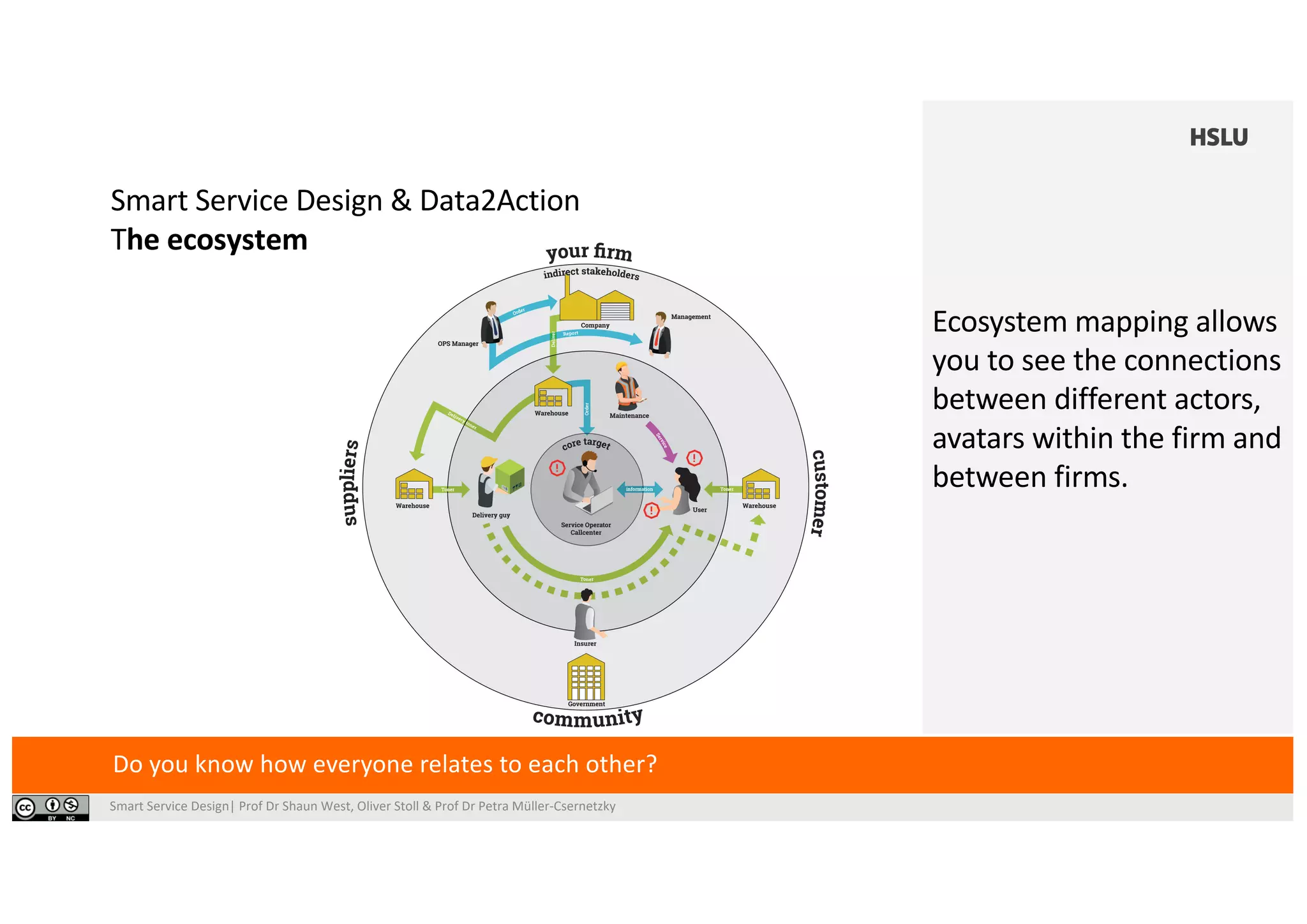
The ecosystem
Do you know how everyone relates to each other?
Ecosystem mapping allows
you to see the connections
between different actors,
avatars within the firm and
between firms.
Smart Service Design| Prof Dr Shaun West, Oliver Stoll & Prof Dr Petra Müller-Csernetzky
Smart Service Design & Data2Action
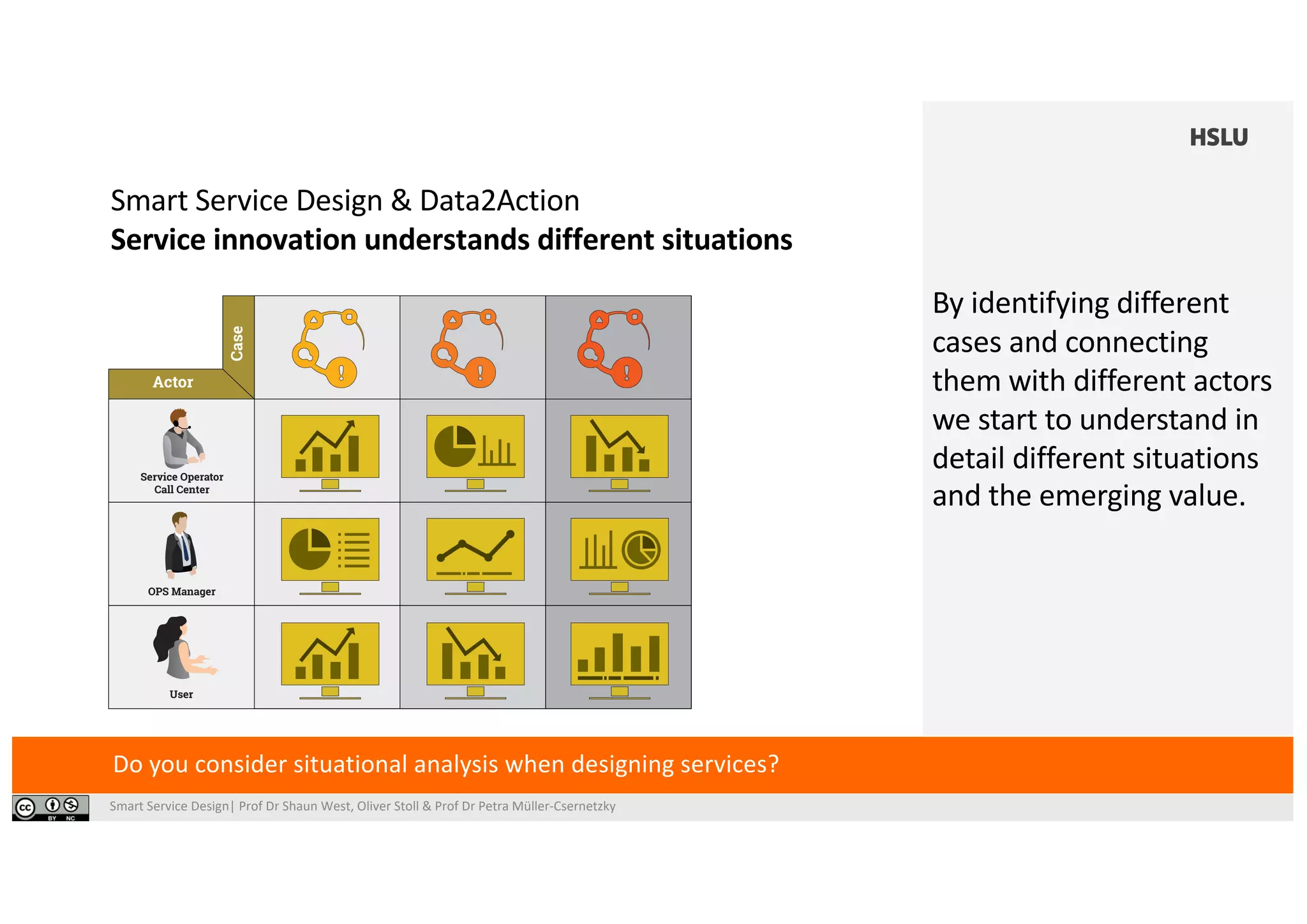
Service innovation understands different situations
Do you consider situational analysis when designing services?
By identifying different
cases and connecting
them with different actors
we start to understand in
detail different situations
and the emerging value.
Smart Service Design| Prof Dr Shaun West, Oliver Stoll & Prof Dr Petra Müller-Csernetzky
Smart Service Design & Data2Action
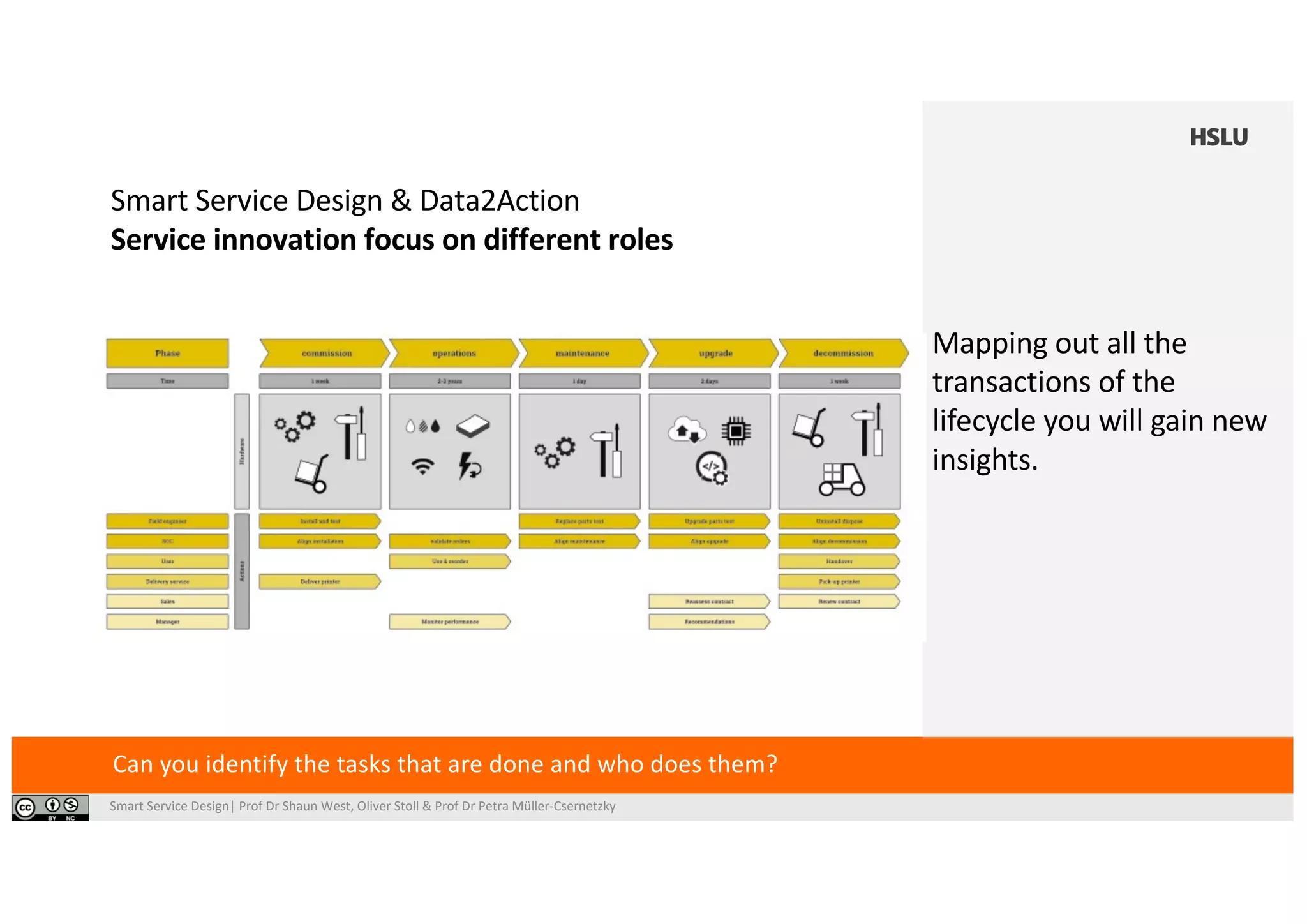
Service innovation focus on different roles
Can you identify the tasks that are done and who does them?
Mapping out all the
transactions of the
lifecycle you will gain new
insights.
Smart Service Design| Prof Dr Shaun West, Oliver Stoll & Prof Dr Petra Müller-Csernetzky
Smart Service Design & Data2Action
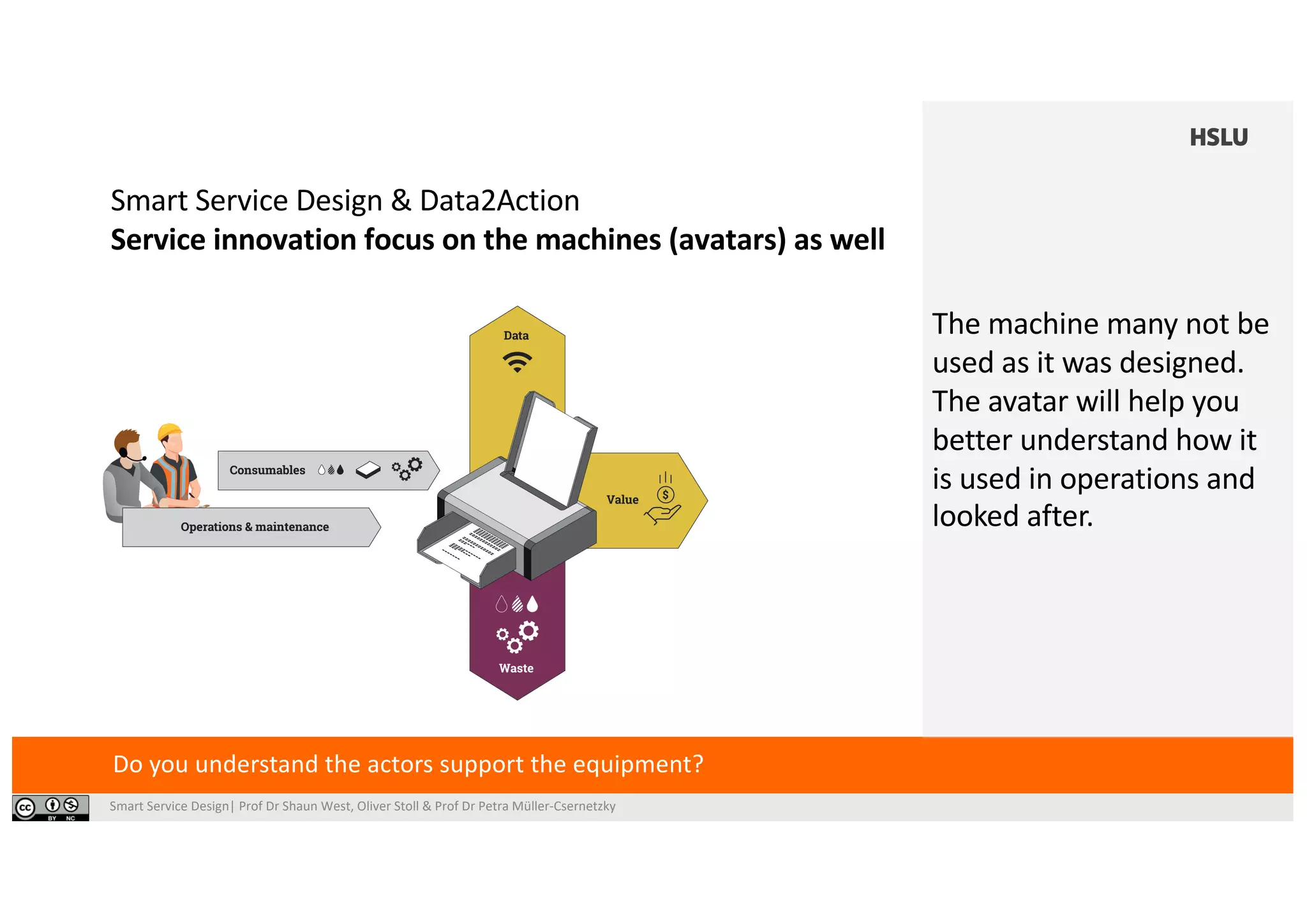
Service innovation focus on the machines (avatars) as well
Do you understand the actors support the equipment?
The machine many not be
used as it was designed.
The avatar will help you
better understand how it
is used in operations and
looked after.
Smart Service Design| Prof Dr Shaun West, Oliver Stoll & Prof Dr Petra Müller-Csernetzky
Smart Service Design & Data2Action
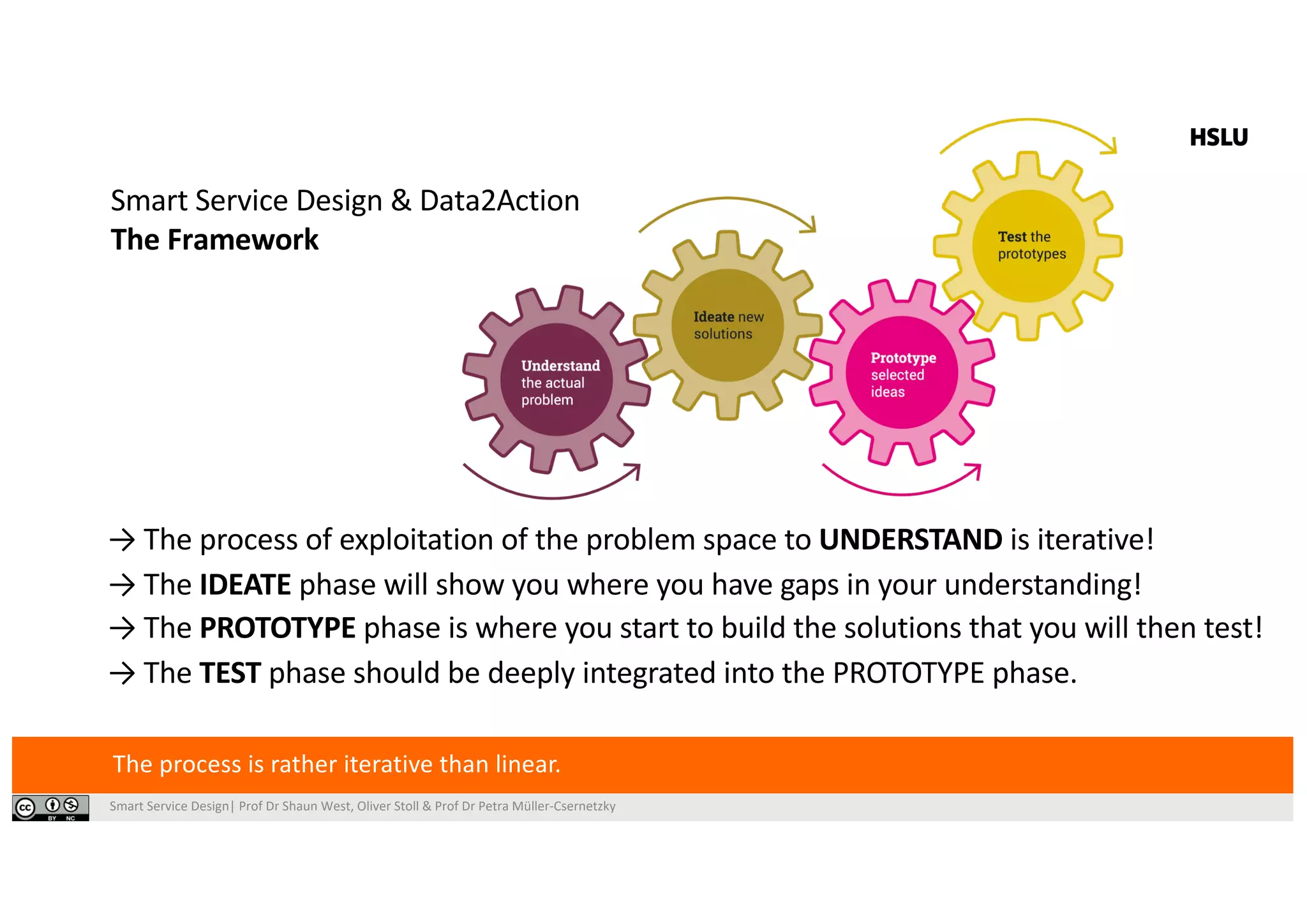
The Framework
The process is rather iterative than linear.
→ The process of exploitation of the problem space to UNDERSTAND is iterative!
→ The IDEATE phase will show you where you have gaps in your understanding!
→ The PROTOTYPE phase is where you start to build the solutions that you will then test!
→ The TEST phase should be deeply integrated into the PROTOTYPE phase.
Smart Service Design| Prof Dr Shaun West, Oliver Stoll & Prof Dr Petra Müller-Csernetzky
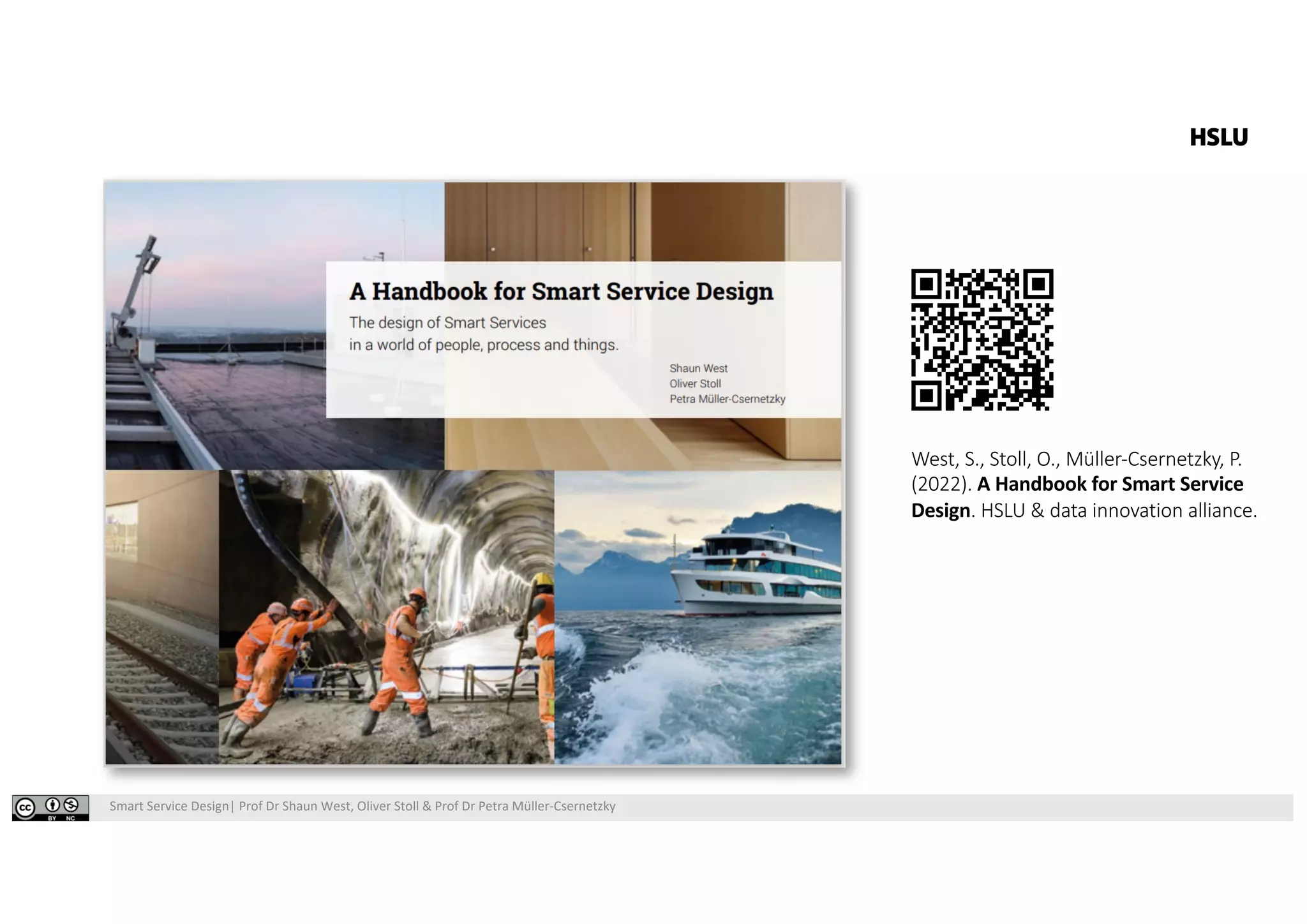
West, S., Stoll, O., Müller-Csernetzky, P.
(2022). A Handbook for Smart Service
Design. HSLU & data innovation alliance.
Smart Service Design| Prof Dr Shaun West, Oliver Stoll & Prof Dr Petra Müller-Csernetzky
Sources
Our key papers
Barni, A., Pietraroia, D., Züst, S., West, S., & Stoll, O. (2020). Digital twin based
optimization of a manufacturing execution system to handle high degrees of
customer specifications. Journal of Manufacturing and Materials Processing, 4(4),
109.
Gharaei, A., Lu, J., Stoll, O., Zheng, X., West, S., & Kiritsis, D. (2020, August). Systems
engineering approach to identify requirements for digital twins development. In IFIP
International Conference on Advances in Production Management Systems (pp. 82-
90). Springer, Cham.
Meierhofer, J., & West, S. (2019, June). Service value creation using a digital twin.
In Naples Forum on Service, Service Dominant Logic, Network & Systems Theory and
Service Science: Integrating Three Perspectives for a New Service Agenda, Ischia (pp.
4-7).
Meierhofer, J., & West, S. (2020, June). Data-driven decision support by digital twins in
manufacturing. In 2020 7th Swiss Conference on Data Science (SDS) (pp. 53-54).
IEEE.
Meierhofer, J., Schweiger, L., Lu, J., Züst, S., West, S., Stoll, O., & Kiritsis, D. (2021).
Digital Twin-Enabled Decision Support Services in Industrial Ecosystems. Applied
Sciences, 11(23), 11418.
Meierhofer, J., West, S., Rapaccini, M., & Barbieri, C. (2020, February). The digital twin
as a service enabler: From the service ecosystem to the simulation model.
In International Conference on Exploring Services Science (pp. 347-359). Springer,
Cham.
Stoll, O., West, S., Gaiardelli, P., Harrison, D., & Corcoran, F. J. (2020, August). The
successful commercialization of a digital twin in an industrial product service
system. In IFIP International Conference on Advances in Production Management
Systems (pp. 275-282). Springer, Cham.
Stoll, O., Zou, W., Rodel, E., & West, S. (2021, November). Value Co-creation in the
Context of Digitally-Enabled Product-Service Systems. In Working Conference on
Virtual Enterprises (pp. 337-344). Springer, Cham.
West, S., Gaiardelli, P., & Rapaccini, M. (2018). Exploring technology-driven service
innovation in manufacturing firms through the lens of Service Dominant logic. Ifac-
Papersonline, 51(11), 1317-1322.
West, S., Gaiardelli, P., Resta, B., & Kujawski, D. (2018). Co-creation of value in Product-
Service Systems through transforming data into knowledge. IFAC-
PapersOnLine, 51(11), 1323-1328.
West, S., Meierhofer, J., Stoll, O., & Schweiger, L. (2020). Value propositions enabled by
digital twins in the context of servitization. Advanced Services for Sustainability and
Growth, 152.
West, S., Stoll, O., & Mueller-Csernetzky, P. (2020). 'Avatar journey mapping'for
manufacturing firms to reveal smart-service opportunities over the product life-
cycle. International Journal of Business Environment, 11(3), 298-320.
West, S., Stoll, O., Meierhofer, J., & Züst, S. (2021). Digital twin providing new
opportunities for value co-creation through supporting decision-making. Applied
Sciences, 11(9), 3750.
West, S., Zou, W., Rodel, E., & Stoll, O. (2021). Value Co-creation in Digitally-Enabled
Product-Service Systems. In The Palgrave Handbook of Servitization (pp. 403-417).
Palgrave Macmillan, Cham.
Züst, S., Huonder, M., West, S., & Stoll, O. (2021). Life-Cycle Oriented Risk Assessment
Using a Monte Carlo Simulation. Applied Sciences, 12(1), 8.
Smart Service Design| Prof Dr Shaun West, Oliver Stoll & Prof Dr Petra Müller-Csernetzky
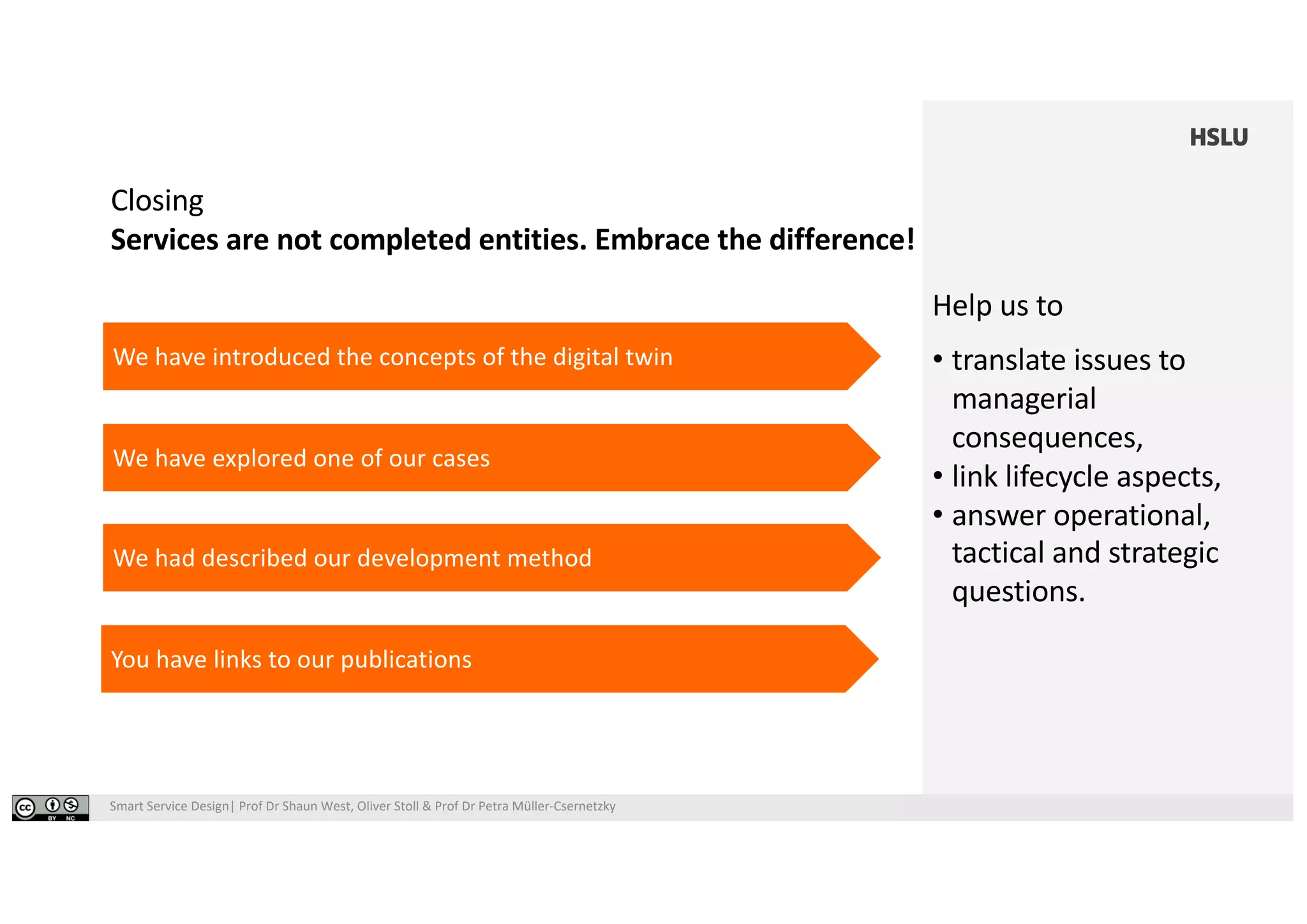
Closing
Services are not completed entities. Embrace the difference!
We have introduced the concepts of the digital twin
You have links to our publications
We have explored one of our cases
We had described our development method
Help us to
• translate issues to
managerial
consequences,
• link lifecycle aspects,
• answer operational,
tactical and strategic
questions.
Smart Service Design| Prof Dr Shaun West, Oliver Stoll & Prof Dr Petra Müller-Csernetzky
Closing
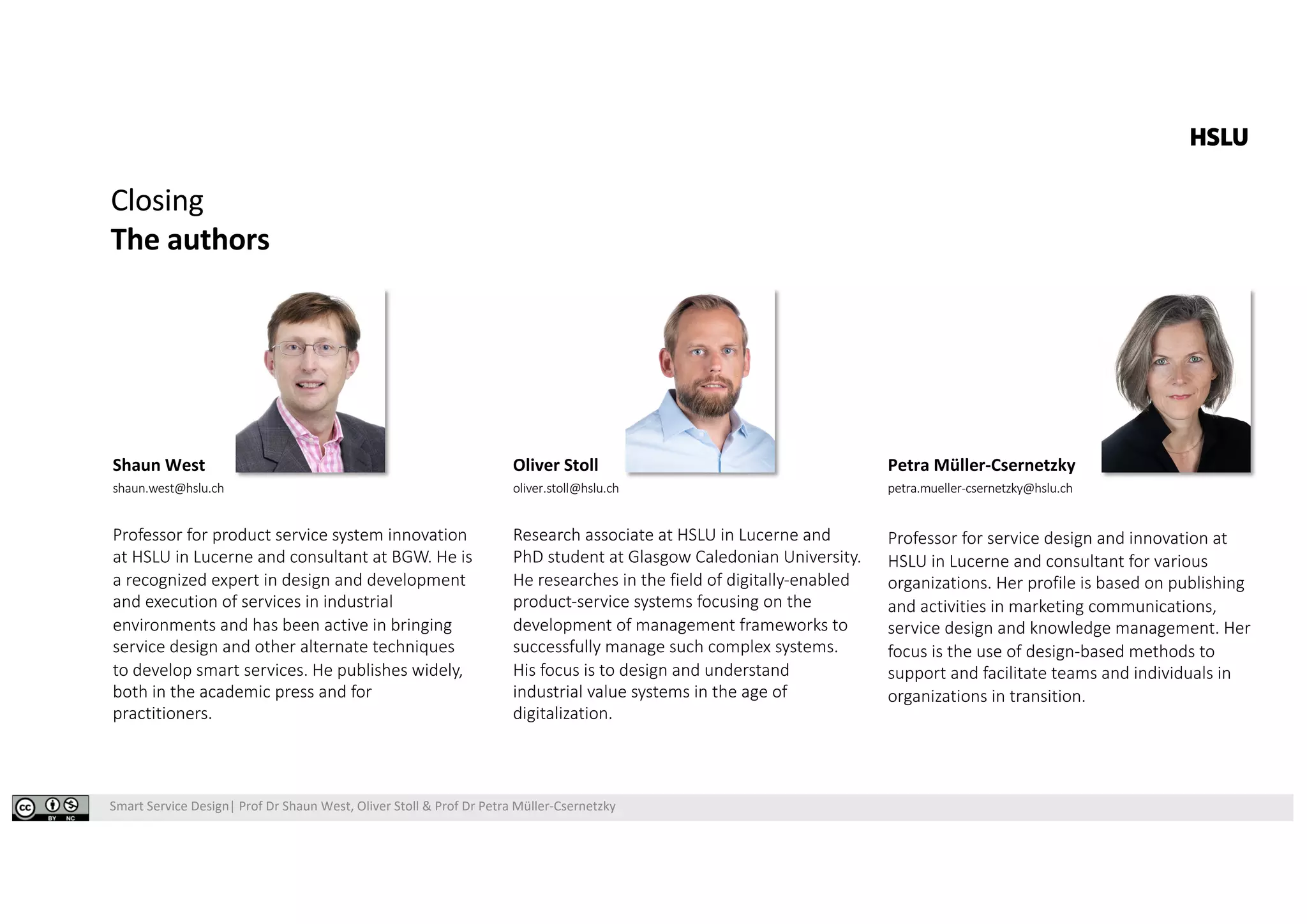
The authors
Shaun West
shaun.west@hslu.ch
Professor for product service system innovation
at HSLU in Lucerne and consultant at BGW. He is
a recognized expert in design and development
and execution of services in industrial
environments and has been active in bringing
service design and other alternate techniques
to develop smart services. He publishes widely,
both in the academic press and for
practitioners.
Oliver Stoll
oliver.stoll@hslu.ch
Research associate at HSLU in Lucerne and
PhD student at Glasgow Caledonian University.
He researches in the field of digitally-enabled
product-service systems focusing on the
development of management frameworks to
successfully manage such complex systems.
His focus is to design and understand
industrial value systems in the age of
digitalization.
Petra Müller-Csernetzky
petra.mueller-csernetzky@hslu.ch
Professor for service design and innovation at
HSLU in Lucerne and consultant for various
organizations. Her profile is based on publishing
and activities in marketing communications,
service design and knowledge management. Her
focus is the use of design-based methods to
support and facilitate teams and individuals in
organizations in transition.
Smart Service Design
The design of smart services in the world
of people processes and things …
Prof Dr Shaun West
Oliver Stoll
Prof Dr Petra Müller-Csernetzky

Smart Service Design The design of smart services in the world of people, processes and things …

  • 1.
    Smart Service Design Thedesign of smart services in the world of people processes and things … Prof Dr Shaun West Oliver Stoll Prof Dr Petra Müller-Csernetzky
  • 2.
    Smart Service Design|Prof Dr Shaun West, Oliver Stoll & Prof Dr Petra Müller-Csernetzky Purpose To provide an insight into smart service design The digital twin is a technological concept, that can support new value propositions via the creation of Smart Twins and Smart Services. We will introduce the concepts of the digital twin You will provide links to our publications We will explore one of our cases We will describe our development framework
  • 3.
    Smart Service Design|Prof Dr Shaun West, Oliver Stoll & Prof Dr Petra Müller-Csernetzky The Concept of the Digital Twin
  • 4.
    Smart Service Design|Prof Dr Shaun West, Oliver Stoll & Prof Dr Petra Müller-Csernetzky The Concept of the Digital Twin Digital Twins for smart service opportunities The Digital Twin helps us to make better decisions over the whole lifecycle. The Digital Twin …can be a businesses, processes, or machines. …should contain the current and past state, …can help us capture and formalize knowhow and …should link different lifecycle phases. PART 30-2022-434-3 PART 30-2022-434-3 PART 30-2022-434-3 PART 30-201 MAVIC 22-33 PART 30-201 MAVIC 22-33 PART 30-201 MAVIC 22-33 Virtual entity alias ”digital twin“ Virtual-physical connection/twinning Physical entity Physical environment Virtual environment Physical-virtual connection/twinning
  • 5.
    Smart Service Design|Prof Dr Shaun West, Oliver Stoll & Prof Dr Petra Müller-Csernetzky The Concept of the Digital Twin Where do we have opportunities for smart services? The lifecycle perspective facilitates smart service innovation Along the lifecycle, decisions need to be made … … strategically … tactically … operationally
  • 6.
    Smart Service Design|Prof Dr Shaun West, Oliver Stoll & Prof Dr Petra Müller-Csernetzky ting the cyber-physical environment. The Di- gital Twin offers an excellent opportunity to help solve different problems in the planning and operation of product-service systems. Assisting operational decision-making. Ma take place on subsystems (e.g., one vehicle of a while the general goal is to optimize the surroun mance (e.g., the overall transportation capacity) data from the subsystems with a model of the o Using the models of th Twins can act as a training facility for new opera simulator). This can be done if the physical syst Figure 3: Many different actors, jobs and processes; (© shutterstock) In summary, Digital T opportunity for digita By incorporating the different timeframes well-founded decisio a common goal. We need to consider actors, roles and situations rather than just “users” People need to make practical and managerial decisions. These are often bases on questions and ambiguities … The Concept of the Digital Twin Where do we have opportunities for smart services? ns arts al ose m ate nd he al ned erfor- pec- ital how s. and report back when necessary – in effect, they become a co-worker. Together, the data and simulation models provide a virtual re- presentation of the physical system, crea- ting the cyber-physical environment. The Di- gital Twin offers an excellent opportunity to help solve different problems in the planning and operation of product-service systems. hazardous developments (i.e Assisting operational dec take place on subsystems (e while the general goal is to o mance (e.g., the overall trans data from the subsystems w Us Twins can act as a training f simulator). This can be done Figure 3: Many different actors, jobs and processes; (© shutterstock) In o B d w a
  • 7.
    Smart Service Design|Prof Dr Shaun West, Oliver Stoll & Prof Dr Petra Müller-Csernetzky The Concept of the Digital Twin How do we make decisions? Decisions depend on the context and the way, information is used We first need to understand how data is used and how information is evaluated in the organisational context. This may then enable the building of knowledge.
  • 8.
    Smart Service Design|Prof Dr Shaun West, Oliver Stoll & Prof Dr Petra Müller-Csernetzky The Concept of the Digital Twin An object between boundaries? Decisions depend on the context and the way, information is used The Digital Twin helps us to understand the other side of the border. The Digital Twin is between concepts, between people, between information, between technology and enables improvement.
  • 9.
    Smart Service Design|Prof Dr Shaun West, Oliver Stoll & Prof Dr Petra Müller-Csernetzky The Concept of the Digital Twin Questions are key to business decision making Decisions drive action within a business We can support decision- making in different areas. For each we need to understand the questions people ask and in which situation they are in.
  • 10.
    Smart Service Design|Prof Dr Shaun West, Oliver Stoll & Prof Dr Petra Müller-Csernetzky The Concept of the Digital Twin Where do we have opportunities for smart services? The lifecycle perspective facilitates smart service innovation We need to understand the whole lifecycle and the tasks that take place.
  • 11.
    Smart Service Design|Prof Dr Shaun West, Oliver Stoll & Prof Dr Petra Müller-Csernetzky The Concept of the Digital Twin Advanced analytics can support us Basic and advanced analytics can help improve the predictions The digital twin is a technological-based concept which enables us to learn about today and plan for the future.
  • 12.
    Smart Service Design|Prof Dr Shaun West, Oliver Stoll & Prof Dr Petra Müller-Csernetzky The Concept of the Digital Twin Where do we have opportunities for smart services? Learn to innovate in different areas of the business with a Smart Twin We have many different possible applications for the digital twin. Learn to link them together.
  • 13.
    Smart Service Design|Prof Dr Shaun West, Oliver Stoll & Prof Dr Petra Müller-Csernetzky The exploration of a use case
  • 14.
    Smart Service Design|Prof Dr Shaun West, Oliver Stoll & Prof Dr Petra Müller-Csernetzky Exploring a use case The Digital Twin in Ship Manufacturing This is one of five cases in the Handbook – a typical manufacturing case The firm designs, manufactures, and maintains midsized cruise ships, that are mainly operated on lakes. Their fleet of ships carries passengers and tourists throughout the year on the lakes in Switzerland. The oldest ships are over 100 years old.
  • 15.
    Smart Service Design|Prof Dr Shaun West, Oliver Stoll & Prof Dr Petra Müller-Csernetzky Exploring a use case Where do we have opportunities for smart services? From a business perspective, the company needs to sell new ships. Beginning of Life The ships are costly and built to order, which requires solid business case from the customer‘s perspective to decide on the purchase of such an asset. Middle of Life Once the ship has been handed over to the owner, the warranty phase begins for the original equipment manufacturer (OEM). The OEM needs to replace certain parts which break during the usage of the asset. End of Life When the ship gets close to its end of useful life, decisions on upgrading or scrapping need to be made. The most common case is that the vessel has a refit and then is returned to service.
  • 16.
    Smart Service Design|Prof Dr Shaun West, Oliver Stoll & Prof Dr Petra Müller-Csernetzky Exploring a use case Where do we have opportunities for smart services? The Smart Twin shows the real opportunities in the given environment We see the challenges in meeting the requirements in front of new product development. 1. How to best operate the vessel based on the schedule? 2. What are the actual and anticipated costs? 3. What is the actual and anticipated fuel consumption? Business and data analytics enable machine learning on new product development and support both ships that are operational today, as well as helping with the design of new vessels.
  • 17.
    Smart Service Design|Prof Dr Shaun West, Oliver Stoll & Prof Dr Petra Müller-Csernetzky Exploring a use case How do we could we use the Smart Twin business? Linking the technical issues to consequences for management is key The impact of the decisions taken by the operations manager impacts on other business areas. Many vessels are operated on the lakes for both industrial and commercial activities.
  • 18.
    Smart Service Design|Prof Dr Shaun West, Oliver Stoll & Prof Dr Petra Müller-Csernetzky Smart Service Design & Data2Action
  • 19.
    Smart Service Design|Prof Dr Shaun West, Oliver Stoll & Prof Dr Petra Müller-Csernetzky Smart Service Design & Data2Action Service Innovation Method The method uses Design Thinking, Service Design & Systems Thinking The Data2Action framework allows us to understand the problem(s), ideate solutions, prototype the solutions and test them in a structured way.
  • 20.
    Smart Service Design|Prof Dr Shaun West, Oliver Stoll & Prof Dr Petra Müller-Csernetzky Smart Service Design & Data2Action The ecosystem Do you know how everyone relates to each other? Ecosystem mapping allows you to see the connections between different actors, avatars within the firm and between firms.
  • 21.
    Smart Service Design|Prof Dr Shaun West, Oliver Stoll & Prof Dr Petra Müller-Csernetzky Smart Service Design & Data2Action Service innovation understands different situations Do you consider situational analysis when designing services? By identifying different cases and connecting them with different actors we start to understand in detail different situations and the emerging value.
  • 22.
    Smart Service Design|Prof Dr Shaun West, Oliver Stoll & Prof Dr Petra Müller-Csernetzky Smart Service Design & Data2Action Service innovation focus on different roles Can you identify the tasks that are done and who does them? Mapping out all the transactions of the lifecycle you will gain new insights.
  • 23.
    Smart Service Design|Prof Dr Shaun West, Oliver Stoll & Prof Dr Petra Müller-Csernetzky Smart Service Design & Data2Action Service innovation focus on the machines (avatars) as well Do you understand the actors support the equipment? The machine many not be used as it was designed. The avatar will help you better understand how it is used in operations and looked after.
  • 24.
    Smart Service Design|Prof Dr Shaun West, Oliver Stoll & Prof Dr Petra Müller-Csernetzky Smart Service Design & Data2Action The Framework The process is rather iterative than linear. → The process of exploitation of the problem space to UNDERSTAND is iterative! → The IDEATE phase will show you where you have gaps in your understanding! → The PROTOTYPE phase is where you start to build the solutions that you will then test! → The TEST phase should be deeply integrated into the PROTOTYPE phase.
  • 25.
    Smart Service Design|Prof Dr Shaun West, Oliver Stoll & Prof Dr Petra Müller-Csernetzky West, S., Stoll, O., Müller-Csernetzky, P. (2022). A Handbook for Smart Service Design. HSLU & data innovation alliance.
  • 26.
    Smart Service Design|Prof Dr Shaun West, Oliver Stoll & Prof Dr Petra Müller-Csernetzky Sources Our key papers Barni, A., Pietraroia, D., Züst, S., West, S., & Stoll, O. (2020). Digital twin based optimization of a manufacturing execution system to handle high degrees of customer specifications. Journal of Manufacturing and Materials Processing, 4(4), 109. Gharaei, A., Lu, J., Stoll, O., Zheng, X., West, S., & Kiritsis, D. (2020, August). Systems engineering approach to identify requirements for digital twins development. In IFIP International Conference on Advances in Production Management Systems (pp. 82- 90). Springer, Cham. Meierhofer, J., & West, S. (2019, June). Service value creation using a digital twin. In Naples Forum on Service, Service Dominant Logic, Network & Systems Theory and Service Science: Integrating Three Perspectives for a New Service Agenda, Ischia (pp. 4-7). Meierhofer, J., & West, S. (2020, June). Data-driven decision support by digital twins in manufacturing. In 2020 7th Swiss Conference on Data Science (SDS) (pp. 53-54). IEEE. Meierhofer, J., Schweiger, L., Lu, J., Züst, S., West, S., Stoll, O., & Kiritsis, D. (2021). Digital Twin-Enabled Decision Support Services in Industrial Ecosystems. Applied Sciences, 11(23), 11418. Meierhofer, J., West, S., Rapaccini, M., & Barbieri, C. (2020, February). The digital twin as a service enabler: From the service ecosystem to the simulation model. In International Conference on Exploring Services Science (pp. 347-359). Springer, Cham. Stoll, O., West, S., Gaiardelli, P., Harrison, D., & Corcoran, F. J. (2020, August). The successful commercialization of a digital twin in an industrial product service system. In IFIP International Conference on Advances in Production Management Systems (pp. 275-282). Springer, Cham. Stoll, O., Zou, W., Rodel, E., & West, S. (2021, November). Value Co-creation in the Context of Digitally-Enabled Product-Service Systems. In Working Conference on Virtual Enterprises (pp. 337-344). Springer, Cham. West, S., Gaiardelli, P., & Rapaccini, M. (2018). Exploring technology-driven service innovation in manufacturing firms through the lens of Service Dominant logic. Ifac- Papersonline, 51(11), 1317-1322. West, S., Gaiardelli, P., Resta, B., & Kujawski, D. (2018). Co-creation of value in Product- Service Systems through transforming data into knowledge. IFAC- PapersOnLine, 51(11), 1323-1328. West, S., Meierhofer, J., Stoll, O., & Schweiger, L. (2020). Value propositions enabled by digital twins in the context of servitization. Advanced Services for Sustainability and Growth, 152. West, S., Stoll, O., & Mueller-Csernetzky, P. (2020). 'Avatar journey mapping'for manufacturing firms to reveal smart-service opportunities over the product life- cycle. International Journal of Business Environment, 11(3), 298-320. West, S., Stoll, O., Meierhofer, J., & Züst, S. (2021). Digital twin providing new opportunities for value co-creation through supporting decision-making. Applied Sciences, 11(9), 3750. West, S., Zou, W., Rodel, E., & Stoll, O. (2021). Value Co-creation in Digitally-Enabled Product-Service Systems. In The Palgrave Handbook of Servitization (pp. 403-417). Palgrave Macmillan, Cham. Züst, S., Huonder, M., West, S., & Stoll, O. (2021). Life-Cycle Oriented Risk Assessment Using a Monte Carlo Simulation. Applied Sciences, 12(1), 8.
  • 27.
    Smart Service Design|Prof Dr Shaun West, Oliver Stoll & Prof Dr Petra Müller-Csernetzky Closing Services are not completed entities. Embrace the difference! We have introduced the concepts of the digital twin You have links to our publications We have explored one of our cases We had described our development method Help us to • translate issues to managerial consequences, • link lifecycle aspects, • answer operational, tactical and strategic questions.
  • 28.
    Smart Service Design|Prof Dr Shaun West, Oliver Stoll & Prof Dr Petra Müller-Csernetzky Closing The authors Shaun West shaun.west@hslu.ch Professor for product service system innovation at HSLU in Lucerne and consultant at BGW. He is a recognized expert in design and development and execution of services in industrial environments and has been active in bringing service design and other alternate techniques to develop smart services. He publishes widely, both in the academic press and for practitioners. Oliver Stoll oliver.stoll@hslu.ch Research associate at HSLU in Lucerne and PhD student at Glasgow Caledonian University. He researches in the field of digitally-enabled product-service systems focusing on the development of management frameworks to successfully manage such complex systems. His focus is to design and understand industrial value systems in the age of digitalization. Petra Müller-Csernetzky petra.mueller-csernetzky@hslu.ch Professor for service design and innovation at HSLU in Lucerne and consultant for various organizations. Her profile is based on publishing and activities in marketing communications, service design and knowledge management. Her focus is the use of design-based methods to support and facilitate teams and individuals in organizations in transition.
  • 29.
    Smart Service Design Thedesign of smart services in the world of people processes and things … Prof Dr Shaun West Oliver Stoll Prof Dr Petra Müller-Csernetzky