Service Design Thinking
A new approach to deliver:
... the right information,
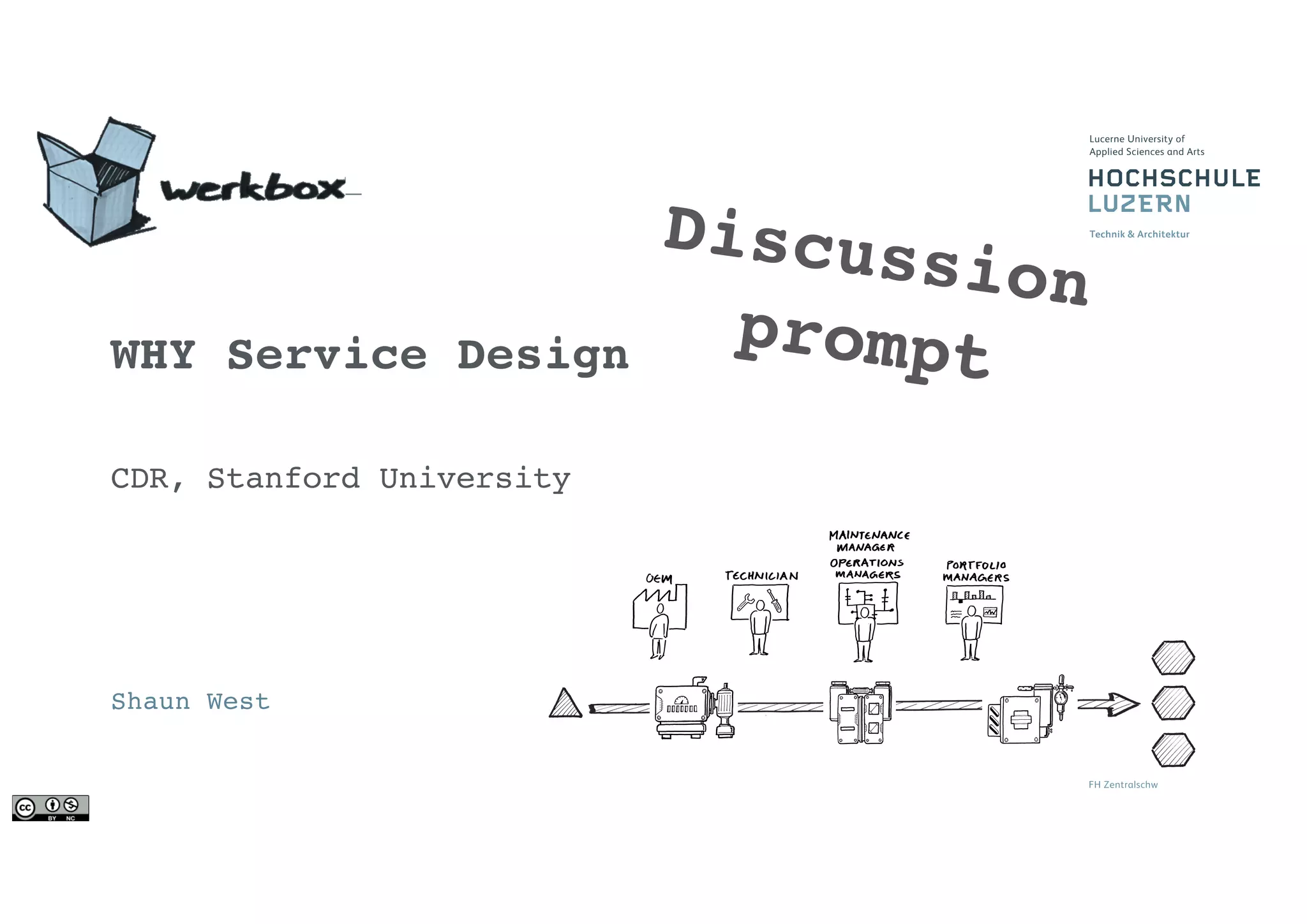
WHY Service Design
CDR, Stanford University
Shaun West
Technik & Architektur
Lucerne University of
Applied Sciences and Arts
Discussion
prompt
Industrial IOT hackathon | September 2018| Shaun West
Service Design Thinking
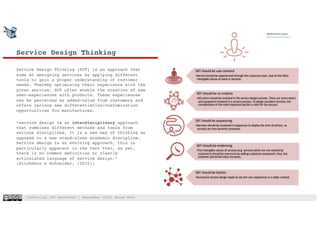
Service Design Thinking (SDT) is an approach that
aims at designing services by applying different
tools to gain a proper understanding of customer
needs. Thereby optimising their experience with the
given service. SDT often enable the creation of new
user-experiences with products. These experiences
can be perceived as added-value from customers and
offers various new differentiation/customization
opportunities for manufactures.
“service design is an interdisciplinary approach
that combines different methods and tools from
various disciplines. It is a new way of thinking as
opposed to a new stand-alone academic discipline.
Service design is an evolving approach, this is
particularly apparent in the fact that, as yet,
there is no common definition or clearly
articulated language of service design.”
(Stickdorn & Schneider, (2015))
SDT should be user-centred.
•Service should be experienced through the customers eyes. Due to the often
intangible nature of value in services.
SDT should be co-creative.
•All actors should be involved in the service-design process. There are many actors
and equipment involved in a service process. To design excellent services, the
consideration of the most important parties is vital for the success.
SDT should be sequencing.
•Services should be visualized in sequences to display the time of actions, as
services are very dynamic processes.
SDT should be evidencing.
•The intangible nature of services (e.g. services which are not noticed by
customers) should be overcome by adding a physical component, thus, the
customer perceived value increases.
SDT should be holistic.
•Successful service-design needs to see the user experience in a wider context.
2
Industrial IOT hackathon | September 2018| Shaun West
WHY Service Design
In order to carry out the 5 Whys analysis properly, the
following advice should be followed:[citation needed]
i. It is necessary to engage the management in the 5 Whys
process in the company. For the analysis itself,
consider what is the right working group. Also consider
bringing in a facilitator for more difficult topics.
ii. Use paper or whiteboard instead of computers.
iii. Write down the problem and make sure that all people
understand it.
iv. Distinguish causes from symptoms.
v. Pay attention to the logic of cause-and-effect
relationship.
vi. Make sure that root causes certainly lead to the
mistake by reversing the sentences created as a result
of the analysis with the use of the expression "and
therefore".
vii. Try to make our answers more precise.
viii.Look for the cause step by step. Don't jump to
conclusions.
ix. Base our statements on facts and knowledge.
x. Assess the process, not people.
xi. Never leave "human error", "worker's inattention",
"blame John", etc. as the root cause.
xii. Foster an atmosphere of trust and sincerity.
xiii.Ask the question "Why?" until the root cause is
determined, i.e. the cause the elimination of which
will prevent the error from occurring again.[10]
xiv. When you form the answer to the question "Why?" it
should be from the customer's point of view.
-Why…
…is only the first step, you can
ask more questions to understand
the context
-Who
-What
-When
-Where
… you can then move to
-Why–because analysis
Industrial IOT hackathon | September 2018| Shaun West
Value
4
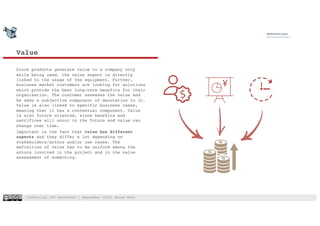
Since products generate value to a company only
while being used, the value aspect is directly
linked to the usage of the equipment. Further,
business market customers are looking for solutions
which provide the best long-term benefits for their
organisation. The customer assesses the value and
he adds a subjective component of denotation to it.
Value is also linked to specific business cases,
meaning that it has a contextual component. Value
is also future oriented, since benefits and
sacrifices will occur in the future and value can
change over time.
Important is the fact that value has different
aspects and they differ a lot depending on
stakeholders/actors and/or use cases. The
definition of value has to be uniform among the
actors involved in the project and in the value
assessment of something.
Industrial IOT hackathon | September 2018| Shaun West
Ecosystems
5
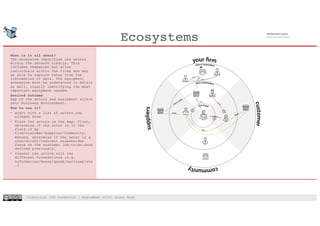
What is it all about?
The ecosystem identifies the actors
within the network clearly. This
includes companies but allow
individuals within the firms who may
be able to capture value from the
information or data. The equipment
ecosystem must be understood in detail
as well, clearly identifying the most
important equipment needed.
Desired outcome
Map of the actors and equipment within
your business environment.
How to use it?
• start with a list of actors you
already know
• Place the actors on the map. First,
determine if the actor is in the
field of my
firm/customer/supplier/community.
Second, determine if the actor is a
core/direct/indirect stakeholder
focus on the customer job-to-be-done
defined previously.
• Connect the actors with the
different transactions (e.g.
information/money/goods/services/etc
.)
Industrial IOT hackathon | September 2018| Shaun West
Personas
6
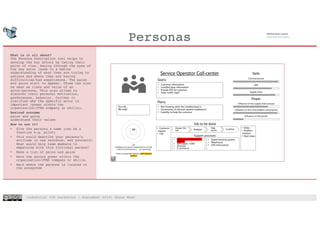
What is it all about?
The Persona Description tool helps to
develop the key actors by taking their
point of view. Seeing through the eyes of
the key actor leads to a better
understanding of what they are trying to
achieve and where they are having
difficulties/bad experiences. The pains
and gains start to appear. Those can also
be seen as risks and value of an
actor/persona. This also allows to
discover their personal motivation,
preferences, behavior. Further it
clarifies why the specific actor is
important (power within the
organisation/JTBD company or skills).
Desired outcome
pains and gains
understand their values
How to use it?
• Give the persona a name (can be a
function e.g. pilot)
• This could describe your persona’s
attitude in one sentence. Ask yourself:
What would help team members to
empathize with this fictional person?
• Make a list of pains and gains
• Rate the actors power within the
organisation/JTBD company or skills.
• Mark where the persona is located in
the ecosystem
Gains
Pains
Job to be done
Support processes
Skills
Power
Service Operator Call-center
• Customer information
• Installed base information
• Provide ETA for customer
• Yield “traffic light”
• Not knowing what the installed base is
• Uncertainty of amount needed (validation)
• Inability to help the customer
You call…
We help!
Answer the
call Analyse
Take
action Confirm
• Validation tool Microsoft
ACCESS
• ERP system / CRM
• @remote
• E-commerce
• Siebel cleaning system
• Warehouse
• UPS information
Communication
ERP
Supply chain
Influence on the supply chain process
Influence on the consumables consumption
Influence on the printer
• Order
• Problem
solution
• Next steps
• Customer
request
• Call
CAF
Intelligence for decision making which is not with
in data but he/she knows it… e.g. seasonality
There are special B2B operators make separate
persona?
Industrial IOT hackathon | September 2018| Shaun West
Avatar
7
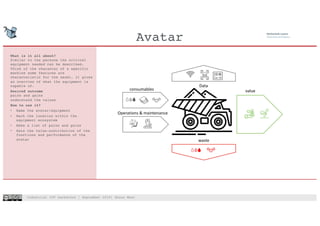
What is it all about?
Similar to the persona the critical
equipment needed can be described.
Think of the character of a specific
machine some features are
characteristic for the asset. It gives
an overview of what the equipment is
capable of.
Desired outcome
pains and gains
understand the values
How to use it?
• Name the avatar/equipment
• Mark the location within the
equipment ecosystem
• Make a list of pains and gains
• Rate the value-contribution of the
functions and performance of the
avatar
Data
Operations & maintenance
consumables
waste
value
Industrial IOT hackathon | September 2018| Shaun West
Avatar / Customer journey mapping
8
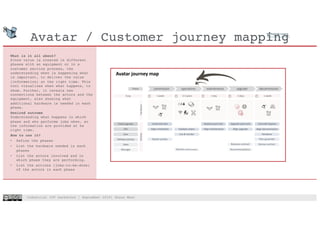
What is it all about?
Since value is created in different
phases with an equipment or in a
customer service process, the
understanding when is happening what
is important, to deliver the value
(information) at the right time. This
tool visualizes when what happens, to
whom. Further, it reveals new
connections between the actors and the
equipment, also showing what
additional hardware is needed in each
phase.
Desired outcome
Understanding what happens in which
phase and who performs jobs when, so
the information are provided at he
right time.
How to use it?
• Define the phases
• List the hardware needed in each
phases
• List the actors involved and in
which phase they are performing.
• List the actions (jobs-to-be-done)
of the actors in each phase
Use & reorder
Deliver printer
Reassess contract
Recommendations
Install and test
Align installation
Replace parts testField engineer
Actions
Phase
Hardware
Time
commission operations maintenance upgrade decommission
1 week 2-3 years 1 day 2 days 1 week
SOC
User
Delivery service
Sales
Manager
Upgrade parts test Uninstall dispose
Validate orders Align maintenance Align upgrade Align decommission
Handover
Pick-up printer
Renew contract
Monitor performance
Avatar journey map
Industrial IOT hackathon | September 2018| Shaun West
Case Actor Matrix
9
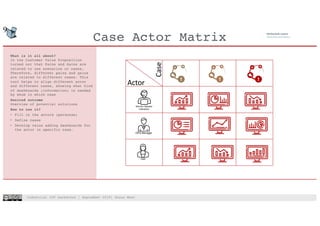
What is it all about?
In the Customer Value Proposition
turned out that Pains and Gains are
related to use scenarios or cases.
Therefore, different pains and gains
are related to different cases. This
tool helps to align different actor
and different cases, showing what kind
of dashboards (information) is needed
by whom in which case
Desired outcome
Overview of potential solutions
How to use it?
• Fill in the actors (personas)
• Define cases
• Develop value adding dashboards for
the actor in specific case.
Service Operator
Callcentre
OPS Manager
User
Case
Actor
Industrial IOT hackathon | September 2018| Shaun West
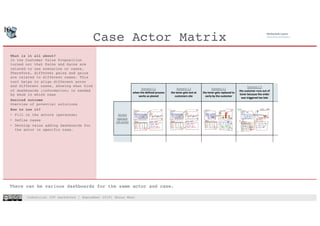
Case Actor Matrix
10
What is it all about?
In the Customer Value Proposition
turned out that Pains and Gains are
related to use scenarios or cases.
Therefore, different pains and gains
are related to different cases. This
tool helps to align different actor
and different cases, showing what kind
of dashboards (information) is needed
by whom in which case
Desired outcome
Overview of potential solutions
How to use it?
• Fill in the actors (personas)
• Define cases
• Develop value adding dashboards for
the actor in specific case.
There can be various dashboards for the same actor and case.
Scenario 1.1
when the defined process
works as planed
Scenario 1.2
the toner gets lost at
customers site
Scenario 2.1
the toner gets replaced to
early by the customer
Scenario 2.2
the customer runs out of
toner because the order
was triggered too late
Service
operator
call-center
Industrial IOT hackathon | September 2018| Shaun West
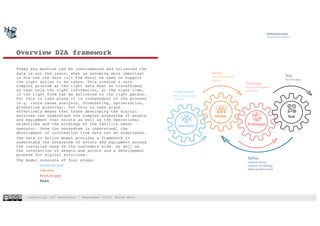
Overview D2A framework
Today any machine can be instrumented and collected the
data is not the issue, what is becoming more important
is how can the data (all the data) be used to support
the right action to be taken. This creates a very
complex problem as the right data must be transformed
so that only the right information, at the right time,
in the right form can be delivered to the right person.
For this to take place it is independent of the process
(e.g. route cause analysis, forecasting, optimisation,
production planning). For this to take place
effectively means that those developing the digital
services can understand the complex ecosystem of people
and equipment that exists as well as the operational
objectives and the strategy of the facility owner
operator. Once the ecosystem is understood, the
development of information from data can be undertaken.
The Data to Action model provides a framework to
understand the ecosystem of actors and equipment around
the installed base on the customers side, as well as
the interaction of assets and actors and a development
process for digital solutions.
The model consists of four steps:
Understand
Ideate
Prototype
Test
Ideate
Ideate
Come up with new
solutions
Prototype
Build representation
of the idea
Test
Test the ideas.
Understand
What is the actual
problem?
Refine
Combine all the
research and findings
where problems exist
Prototype
Test
Understand
11

Why service design

  • 1.
    Service Design Thinking Anew approach to deliver: ... the right information, WHY Service Design CDR, Stanford University Shaun West Technik & Architektur Lucerne University of Applied Sciences and Arts Discussion prompt
  • 2.
    Industrial IOT hackathon| September 2018| Shaun West Service Design Thinking Service Design Thinking (SDT) is an approach that aims at designing services by applying different tools to gain a proper understanding of customer needs. Thereby optimising their experience with the given service. SDT often enable the creation of new user-experiences with products. These experiences can be perceived as added-value from customers and offers various new differentiation/customization opportunities for manufactures. “service design is an interdisciplinary approach that combines different methods and tools from various disciplines. It is a new way of thinking as opposed to a new stand-alone academic discipline. Service design is an evolving approach, this is particularly apparent in the fact that, as yet, there is no common definition or clearly articulated language of service design.” (Stickdorn & Schneider, (2015)) SDT should be user-centred. •Service should be experienced through the customers eyes. Due to the often intangible nature of value in services. SDT should be co-creative. •All actors should be involved in the service-design process. There are many actors and equipment involved in a service process. To design excellent services, the consideration of the most important parties is vital for the success. SDT should be sequencing. •Services should be visualized in sequences to display the time of actions, as services are very dynamic processes. SDT should be evidencing. •The intangible nature of services (e.g. services which are not noticed by customers) should be overcome by adding a physical component, thus, the customer perceived value increases. SDT should be holistic. •Successful service-design needs to see the user experience in a wider context. 2
  • 3.
    Industrial IOT hackathon| September 2018| Shaun West WHY Service Design In order to carry out the 5 Whys analysis properly, the following advice should be followed:[citation needed] i. It is necessary to engage the management in the 5 Whys process in the company. For the analysis itself, consider what is the right working group. Also consider bringing in a facilitator for more difficult topics. ii. Use paper or whiteboard instead of computers. iii. Write down the problem and make sure that all people understand it. iv. Distinguish causes from symptoms. v. Pay attention to the logic of cause-and-effect relationship. vi. Make sure that root causes certainly lead to the mistake by reversing the sentences created as a result of the analysis with the use of the expression "and therefore". vii. Try to make our answers more precise. viii.Look for the cause step by step. Don't jump to conclusions. ix. Base our statements on facts and knowledge. x. Assess the process, not people. xi. Never leave "human error", "worker's inattention", "blame John", etc. as the root cause. xii. Foster an atmosphere of trust and sincerity. xiii.Ask the question "Why?" until the root cause is determined, i.e. the cause the elimination of which will prevent the error from occurring again.[10] xiv. When you form the answer to the question "Why?" it should be from the customer's point of view. -Why… …is only the first step, you can ask more questions to understand the context -Who -What -When -Where … you can then move to -Why–because analysis
  • 4.
    Industrial IOT hackathon| September 2018| Shaun West Value 4 Since products generate value to a company only while being used, the value aspect is directly linked to the usage of the equipment. Further, business market customers are looking for solutions which provide the best long-term benefits for their organisation. The customer assesses the value and he adds a subjective component of denotation to it. Value is also linked to specific business cases, meaning that it has a contextual component. Value is also future oriented, since benefits and sacrifices will occur in the future and value can change over time. Important is the fact that value has different aspects and they differ a lot depending on stakeholders/actors and/or use cases. The definition of value has to be uniform among the actors involved in the project and in the value assessment of something.
  • 5.
    Industrial IOT hackathon| September 2018| Shaun West Ecosystems 5 What is it all about? The ecosystem identifies the actors within the network clearly. This includes companies but allow individuals within the firms who may be able to capture value from the information or data. The equipment ecosystem must be understood in detail as well, clearly identifying the most important equipment needed. Desired outcome Map of the actors and equipment within your business environment. How to use it? • start with a list of actors you already know • Place the actors on the map. First, determine if the actor is in the field of my firm/customer/supplier/community. Second, determine if the actor is a core/direct/indirect stakeholder focus on the customer job-to-be-done defined previously. • Connect the actors with the different transactions (e.g. information/money/goods/services/etc .)
  • 6.
    Industrial IOT hackathon| September 2018| Shaun West Personas 6 What is it all about? The Persona Description tool helps to develop the key actors by taking their point of view. Seeing through the eyes of the key actor leads to a better understanding of what they are trying to achieve and where they are having difficulties/bad experiences. The pains and gains start to appear. Those can also be seen as risks and value of an actor/persona. This also allows to discover their personal motivation, preferences, behavior. Further it clarifies why the specific actor is important (power within the organisation/JTBD company or skills). Desired outcome pains and gains understand their values How to use it? • Give the persona a name (can be a function e.g. pilot) • This could describe your persona’s attitude in one sentence. Ask yourself: What would help team members to empathize with this fictional person? • Make a list of pains and gains • Rate the actors power within the organisation/JTBD company or skills. • Mark where the persona is located in the ecosystem Gains Pains Job to be done Support processes Skills Power Service Operator Call-center • Customer information • Installed base information • Provide ETA for customer • Yield “traffic light” • Not knowing what the installed base is • Uncertainty of amount needed (validation) • Inability to help the customer You call… We help! Answer the call Analyse Take action Confirm • Validation tool Microsoft ACCESS • ERP system / CRM • @remote • E-commerce • Siebel cleaning system • Warehouse • UPS information Communication ERP Supply chain Influence on the supply chain process Influence on the consumables consumption Influence on the printer • Order • Problem solution • Next steps • Customer request • Call CAF Intelligence for decision making which is not with in data but he/she knows it… e.g. seasonality There are special B2B operators make separate persona?
  • 7.
    Industrial IOT hackathon| September 2018| Shaun West Avatar 7 What is it all about? Similar to the persona the critical equipment needed can be described. Think of the character of a specific machine some features are characteristic for the asset. It gives an overview of what the equipment is capable of. Desired outcome pains and gains understand the values How to use it? • Name the avatar/equipment • Mark the location within the equipment ecosystem • Make a list of pains and gains • Rate the value-contribution of the functions and performance of the avatar Data Operations & maintenance consumables waste value
  • 8.
    Industrial IOT hackathon| September 2018| Shaun West Avatar / Customer journey mapping 8 What is it all about? Since value is created in different phases with an equipment or in a customer service process, the understanding when is happening what is important, to deliver the value (information) at the right time. This tool visualizes when what happens, to whom. Further, it reveals new connections between the actors and the equipment, also showing what additional hardware is needed in each phase. Desired outcome Understanding what happens in which phase and who performs jobs when, so the information are provided at he right time. How to use it? • Define the phases • List the hardware needed in each phases • List the actors involved and in which phase they are performing. • List the actions (jobs-to-be-done) of the actors in each phase Use & reorder Deliver printer Reassess contract Recommendations Install and test Align installation Replace parts testField engineer Actions Phase Hardware Time commission operations maintenance upgrade decommission 1 week 2-3 years 1 day 2 days 1 week SOC User Delivery service Sales Manager Upgrade parts test Uninstall dispose Validate orders Align maintenance Align upgrade Align decommission Handover Pick-up printer Renew contract Monitor performance Avatar journey map
  • 9.
    Industrial IOT hackathon| September 2018| Shaun West Case Actor Matrix 9 What is it all about? In the Customer Value Proposition turned out that Pains and Gains are related to use scenarios or cases. Therefore, different pains and gains are related to different cases. This tool helps to align different actor and different cases, showing what kind of dashboards (information) is needed by whom in which case Desired outcome Overview of potential solutions How to use it? • Fill in the actors (personas) • Define cases • Develop value adding dashboards for the actor in specific case. Service Operator Callcentre OPS Manager User Case Actor
  • 10.
    Industrial IOT hackathon| September 2018| Shaun West Case Actor Matrix 10 What is it all about? In the Customer Value Proposition turned out that Pains and Gains are related to use scenarios or cases. Therefore, different pains and gains are related to different cases. This tool helps to align different actor and different cases, showing what kind of dashboards (information) is needed by whom in which case Desired outcome Overview of potential solutions How to use it? • Fill in the actors (personas) • Define cases • Develop value adding dashboards for the actor in specific case. There can be various dashboards for the same actor and case. Scenario 1.1 when the defined process works as planed Scenario 1.2 the toner gets lost at customers site Scenario 2.1 the toner gets replaced to early by the customer Scenario 2.2 the customer runs out of toner because the order was triggered too late Service operator call-center
  • 11.
    Industrial IOT hackathon| September 2018| Shaun West Overview D2A framework Today any machine can be instrumented and collected the data is not the issue, what is becoming more important is how can the data (all the data) be used to support the right action to be taken. This creates a very complex problem as the right data must be transformed so that only the right information, at the right time, in the right form can be delivered to the right person. For this to take place it is independent of the process (e.g. route cause analysis, forecasting, optimisation, production planning). For this to take place effectively means that those developing the digital services can understand the complex ecosystem of people and equipment that exists as well as the operational objectives and the strategy of the facility owner operator. Once the ecosystem is understood, the development of information from data can be undertaken. The Data to Action model provides a framework to understand the ecosystem of actors and equipment around the installed base on the customers side, as well as the interaction of assets and actors and a development process for digital solutions. The model consists of four steps: Understand Ideate Prototype Test Ideate Ideate Come up with new solutions Prototype Build representation of the idea Test Test the ideas. Understand What is the actual problem? Refine Combine all the research and findings where problems exist Prototype Test Understand 11