Designing a Digital Service Concept for a Professional 
Business Service – 
Case Työeläkelakipalvelu 
Master Thesis presentation 
Sofia Nyyssönen
Background of the thesis 
o Organizational challenges. 
o The dynamic nature of knowledge creation. 
o Service design approach could potentially identify inefficiencies and make 
communication and collaboration between departments more important. 
o Innovations a consequence of customer specific solutions, in which the 
knowledge base may evolve constantly. 
o Customer experience.
Description of the case organization 
o Providing legal guidance services relating to earnings-related pension 
provision; 
o Providing planning, training and communication services related to earnings-related 
pension matters; 
o Providing support in the preparation of guidelines and legislation; 
o Providing services relating to the implementation of pension provision, e.g. 
allocation of costs and actuarial services;
Main research question and sub questions 
 How to design a digital service concept for a professional business service? 
The sub-questions: 
What does the innovative service concept accomplish? 
How can value creation be facilitated with the service concept? 
How to design user-centered content?
Theoretical framework 1/2 
 Professional service organization 
The professional and knowledge-intensive service organizations are the concepts that are 
sometimes used interchangeably. 
 Service design 
Service design in this research is considered to to improve the delivery, the process and the 
strategy to provide services in a more user-centric fashion.
Theoretical framework 2/2 
 Value creation 
Value creation is a process: every customer has its own value creation through which it 
creates value in its business operations. 
 User-centered design 
User-centered design in this thesis is considered to be an iterative development cycle 
where the specifications of the service account for both user needs and organizational 
objectives as well as specifying the context in which the service is to be used.
Service design process
Elements of user experience
Collection and analysis of empirical data 
 Expert Interviews: aim of understanding organizational challenges and gaining 
perspective on customer experience. 
 Focus groups: Focus groups were used to gather information about users' experiences 
and preferences. 
 The viewpoint of research was to learn and emphasize users and business rather than technology.
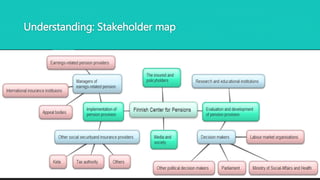
Understanding: Stakeholder map
Thinking: Affinity diagram
Filtering: SWOT
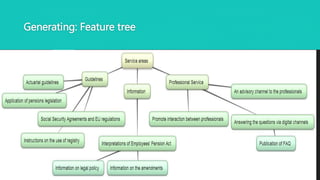
Generating: Feature tree
Explaining: Rough prototyping/UI
Realising: Use case: customer
Use case: content creator/service provider
Conclusion 
 A service concept that creates value for both service provider and service user. 
 The service concept aims to be a platform for creating exchanges and contact between staff and 
users as well as other service users in the field of earnings-related pensions. 
 User experience design focuses mainly on the individual digital touch points. 
 The underlying view is that service design is a way to bridge the gap across the silos and 
develop services in a more user-centered way. 
 However, as both disciplines have a user-centered approach to designing a service, they were 
complementary.

Master thesis presentation

  • 1.
    Designing a DigitalService Concept for a Professional Business Service – Case Työeläkelakipalvelu Master Thesis presentation Sofia Nyyssönen
  • 2.
    Background of thethesis o Organizational challenges. o The dynamic nature of knowledge creation. o Service design approach could potentially identify inefficiencies and make communication and collaboration between departments more important. o Innovations a consequence of customer specific solutions, in which the knowledge base may evolve constantly. o Customer experience.
  • 3.
    Description of thecase organization o Providing legal guidance services relating to earnings-related pension provision; o Providing planning, training and communication services related to earnings-related pension matters; o Providing support in the preparation of guidelines and legislation; o Providing services relating to the implementation of pension provision, e.g. allocation of costs and actuarial services;
  • 4.
    Main research questionand sub questions  How to design a digital service concept for a professional business service? The sub-questions: What does the innovative service concept accomplish? How can value creation be facilitated with the service concept? How to design user-centered content?
  • 5.
    Theoretical framework 1/2  Professional service organization The professional and knowledge-intensive service organizations are the concepts that are sometimes used interchangeably.  Service design Service design in this research is considered to to improve the delivery, the process and the strategy to provide services in a more user-centric fashion.
  • 6.
    Theoretical framework 2/2  Value creation Value creation is a process: every customer has its own value creation through which it creates value in its business operations.  User-centered design User-centered design in this thesis is considered to be an iterative development cycle where the specifications of the service account for both user needs and organizational objectives as well as specifying the context in which the service is to be used.
  • 7.
  • 8.
    Elements of userexperience
  • 9.
    Collection and analysisof empirical data  Expert Interviews: aim of understanding organizational challenges and gaining perspective on customer experience.  Focus groups: Focus groups were used to gather information about users' experiences and preferences.  The viewpoint of research was to learn and emphasize users and business rather than technology.
  • 10.
  • 11.
  • 12.
  • 13.
  • 14.
  • 15.
  • 16.
    Use case: contentcreator/service provider
  • 17.
    Conclusion  Aservice concept that creates value for both service provider and service user.  The service concept aims to be a platform for creating exchanges and contact between staff and users as well as other service users in the field of earnings-related pensions.  User experience design focuses mainly on the individual digital touch points.  The underlying view is that service design is a way to bridge the gap across the silos and develop services in a more user-centered way.  However, as both disciplines have a user-centered approach to designing a service, they were complementary.