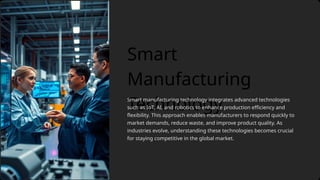
Smart
Manufacturing
Technology
Smart manufacturing technologyintegrates advanced technologies
such as IoT, AI, and robotics to enhance production efficiency and
flexibility. This approach enables manufacturers to respond quickly to
market demands, reduce waste, and improve product quality. As
industries evolve, understanding these technologies becomes crucial
for staying competitive in the global market.
Big Data in
Manufacturing
FutureTrends
Robotics and
Automation
CONTENTS(2)
Conclusion
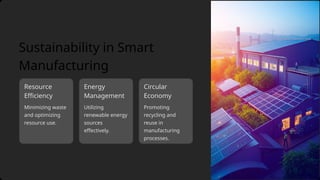
Sustainability
in Smart
Manufacturing
Workforce
Transformatio
n
Case Studies
4.
Enhance efficiency,
reduce costs,and
improve quality.
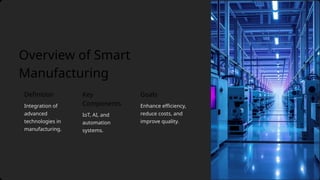
Integration of
advanced
technologies in
manufacturing.
Definition
IoT, AI, and
automation
systems.
Overview of Smart
Manufacturing
Goals
Key
Components
5.
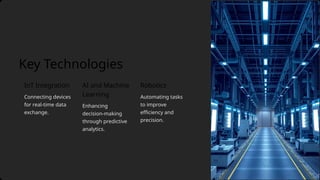
IoT Integration
Automating tasks
toimprove
efficiency and
precision.
AI and Machine
Learning
Enhancing
decision-making
through predictive
analytics.
Key Technologies
Connecting devices
for real-time data
exchange.
Robotics
6.
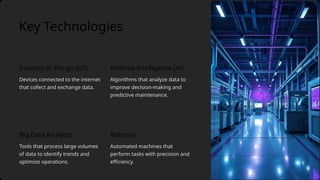
Artificial Intelligence (AI)
KeyTechnologies
Algorithms that analyze data to
improve decision-making and
predictive maintenance.
Devices connected to the internet
that collect and exchange data.
Tools that process large volumes
of data to identify trends and
optimize operations.
Robotics
Internet of Things (IoT)
Big Data Analytics
Automated machines that
perform tasks with precision and
efficiency.
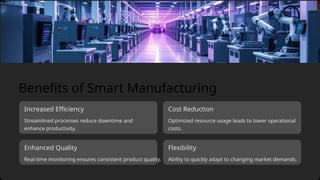
Cost Reduction
Enhanced Quality
Optimizedresource usage leads to lower operational
costs.
Increased Efficiency
Flexibility
Streamlined processes reduce downtime and
enhance productivity.
Real-time monitoring ensures consistent product quality.
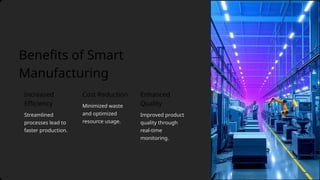
Benefits of Smart Manufacturing
Ability to quickly adapt to changing market demands.
9.
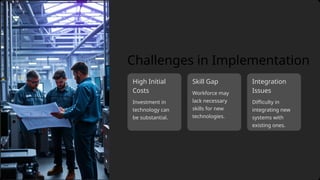
Skill Gap
Investment in
technologycan
be substantial.
Challenges in Implementation
Difficulty in
integrating new
systems with
existing ones.
Workforce may
lack necessary
skills for new
technologies.
Integration
Issues
High Initial
Costs
10.
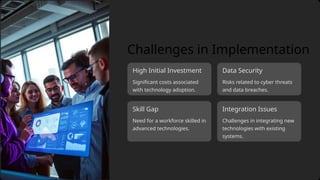
Integration Issues
Need fora workforce skilled in
advanced technologies.
Data Security
High Initial Investment
Challenges in integrating new
technologies with existing
systems.
Risks related to cyber threats
and data breaches.
Skill Gap
Challenges in Implementation
Significant costs associated
with technology adoption.
11.
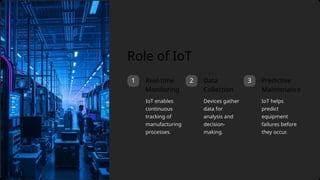
3
1 2 Predictive
Maintenance
IoTenables
continuous
tracking of
manufacturing
processes.
Devices gather
data for
analysis and
decision-
making.
Real-time
Monitoring
IoT helps
predict
equipment
failures before
they occur.
Role of IoT
Data
Collection
12.
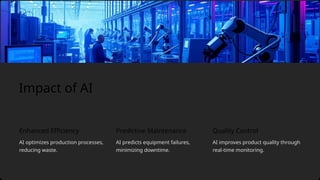
Quality Control
Enhanced Efficiency
Impactof AI
AI predicts equipment failures,
minimizing downtime.
AI improves product quality through
real-time monitoring.
AI optimizes production processes,
reducing waste.
Predictive Maintenance
13.
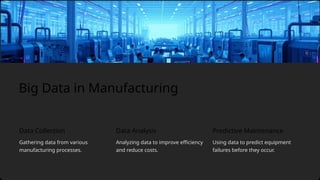
Analyzing data toimprove efficiency
and reduce costs.
Big Data in Manufacturing
Data Collection
Gathering data from various
manufacturing processes.
Data Analysis
Using data to predict equipment
failures before they occur.
Predictive Maintenance
14.
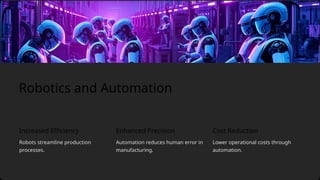
Increased Efficiency
Automation reduceshuman error in
manufacturing.
Robots streamline production
processes.
Lower operational costs through
automation.
Robotics and Automation
Enhanced Precision Cost Reduction
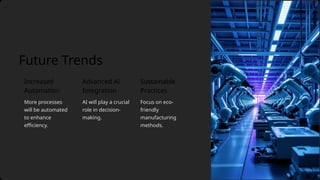
Advanced AI
Integration
More processes
willbe automated
to enhance
efficiency.
Future Trends
AI will play a crucial
role in decision-
making.
Sustainable
Practices
Focus on eco-
friendly
manufacturing
methods.
Increased
Automation
17.
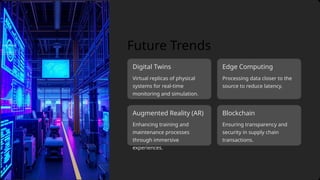
Digital Twins
Ensuring transparencyand
security in supply chain
transactions.
Blockchain
Edge Computing
Processing data closer to the
source to reduce latency.
Future Trends
Virtual replicas of physical
systems for real-time
monitoring and simulation.
Enhancing training and
maintenance processes
through immersive
experiences.
Augmented Reality (AR)
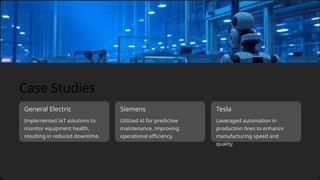
Implemented IoT solutionsto
monitor equipment health,
resulting in reduced downtime.
General Electric Tesla
Siemens
Utilized AI for predictive
maintenance, improving
operational efficiency.
Leveraged automation in
production lines to enhance
manufacturing speed and
quality.
Case Studies
20.
Enhancing
employee skills for
newtechnologies.
Collaboration
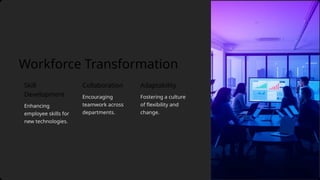
Workforce Transformation
Skill
Development Encouraging
teamwork across
departments.
Fostering a culture
of flexibility and
change.
Adaptability
21.
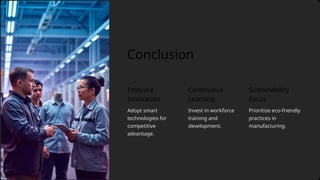
Conclusion
Invest in workforce
trainingand
development.
Continuous
Learning
Sustainability
Focus
Embrace
Innovation
Prioritize eco-friendly
practices in
manufacturing.
Adopt smart
technologies for
competitive
advantage.
22.
Thank You
Feedback
Thank youfor your attention. Feel free to ask any questions.
Appreciation Questions
Your feedback is valuable to us.