International Research Journal of Engineering and Technology (IRJET) e-ISSN: 2395 -0056
Volume: 04 Issue: 03 | Mar -2017 www.irjet.net p-ISSN: 2395-0072
© 2017, IRJET | Impact Factor value: 5.181 | ISO 9001:2008 Certified Journal | Page 1662
SMART HELMET USING GSM AND GPS
Aditi Varade1, Neha Gajbhiye2, Mousam3, Assistant. Prof. V.V.Panchbhai4
1Student, Dept. of Electronics and Telecommunication Engineering, Priyadarshini College of Engineering, Nagpur
2Student, Dept. of Electronics and Telecommunication Engineering, Priyadarshini College of Engineering, Nagpur
3Student, Dept. of Electronics and Telecommunication Engineering, Priyadarshini College of Engineering, Nagpur
4 Assistant Professor, Dept. of Electronics and Telecommunication Engineering, Priyadarshini College of
Engineering, Nagpur, Maharashtra, India
---------------------------------------------------------------------***---------------------------------------------------------------------
Abstract - Everyday around theworldalargepercentageof
people die from road accident. An effective approach is made
to solve the problem by using smart helmet band. Smart
helmet band is an idea which make motorcycle driving safer
than before. The working of this smart helmet band is very
simple, Limit switch is placed inside the helmet, which will
detect whether the rider has worn the helmet or not, if not
then the bike will not start. Smart helmet band provides help
in case of accident by using GSM and GPS technology.
Key Words: SIM808(GSM, GPS), Limit Switch, Bluetooth,
Accelerometer,MicrocontrollerATMEGA16,Microcontroller
ATMEGA8(SMD).
1. Introduction
Now a day bikers in our country are increasing and road
mishaps are also increasing day by day. Many casualties
occur due to the negligence of wearing helmet. The project
makes compulsory to wear the helmet, if the person met
with an accident then in such situation a message alongwith
the location is sent to the ambulance or family member to
rescue him. The project aims at intelligence security band
providing awareness for wearing helmet and also provides
prevention for human life safety.
2. Related Work
Many authors presented their work regarding safety against
road accident. Some of them are described below:
Accident prevention and Reporting System Using
GSM(sim900D) and GPS(NMEA 0183),has been described in
[1].The presented system includes SONAR ranging modules,
vibration sensor, three modules GPS receiver(NMEA),
Microcontroller(AT89S51),GSMmodem(SIM900D)ANDAN
Alarm. It enables intelligent detection of an accident at any
place and reports about the accident on predefined number.
When the distance is too short between the vehicle and
obstacle then alarm will be “ON” as an indicator to move
vehicle in other direction which is safer but when a vehicle
faces accident despite of alarm, immediate vibration sensor
will detect the signal and Microcontroller sends the alert
message through the GSM model includingthelocationtothe
predefined number. This provides an automatic accident
prevention and reporting system.
The research paper [2] aims at finding the occurrence of any
accident and reporting the location of accident to the
previously coded numbers so that immediate help can be
provided by ambulance or the relative concerned. GSM
technology is used to intimatethevehiclepositionintheform
of latitude and longitude coordinates through sms. The
location spot is retrieved using GPS which is navigational
system using a networkofsatelliteorbitingtheearth.Sensors
such as vibration, alcohol and fire detectors detect signal in
case of an accident occurrence and send a signal to the
connected microcontroller. The controller in turn operates
the relay to glow the airbag and automatically lock the
brakes. This paper gives a design which have many benefits
like low cost, small size.
Real TimeVehicleDetectionandTrackingUsingGPSandGSM
[3]. This paper presents review on the accident detection
techniques and some future possibilities in this field. The
purpose of the project is to find the vehicle and locate the
vehicle by means of sending a message using a system which
is placed inside a vehicle. The project is designed for vehicle
accident detection and tracking system by using GSM and
GPS.
International Research Journal of Engineering and Technology (IRJET) e-ISSN: 2395 -0056
Volume: 04 Issue: 03 | Mar -2017 www.irjet.net p-ISSN: 2395-0072
© 2017, IRJET | Impact Factor value: 5.181 | ISO 9001:2008 Certified Journal | Page 1663
3. Proposed System
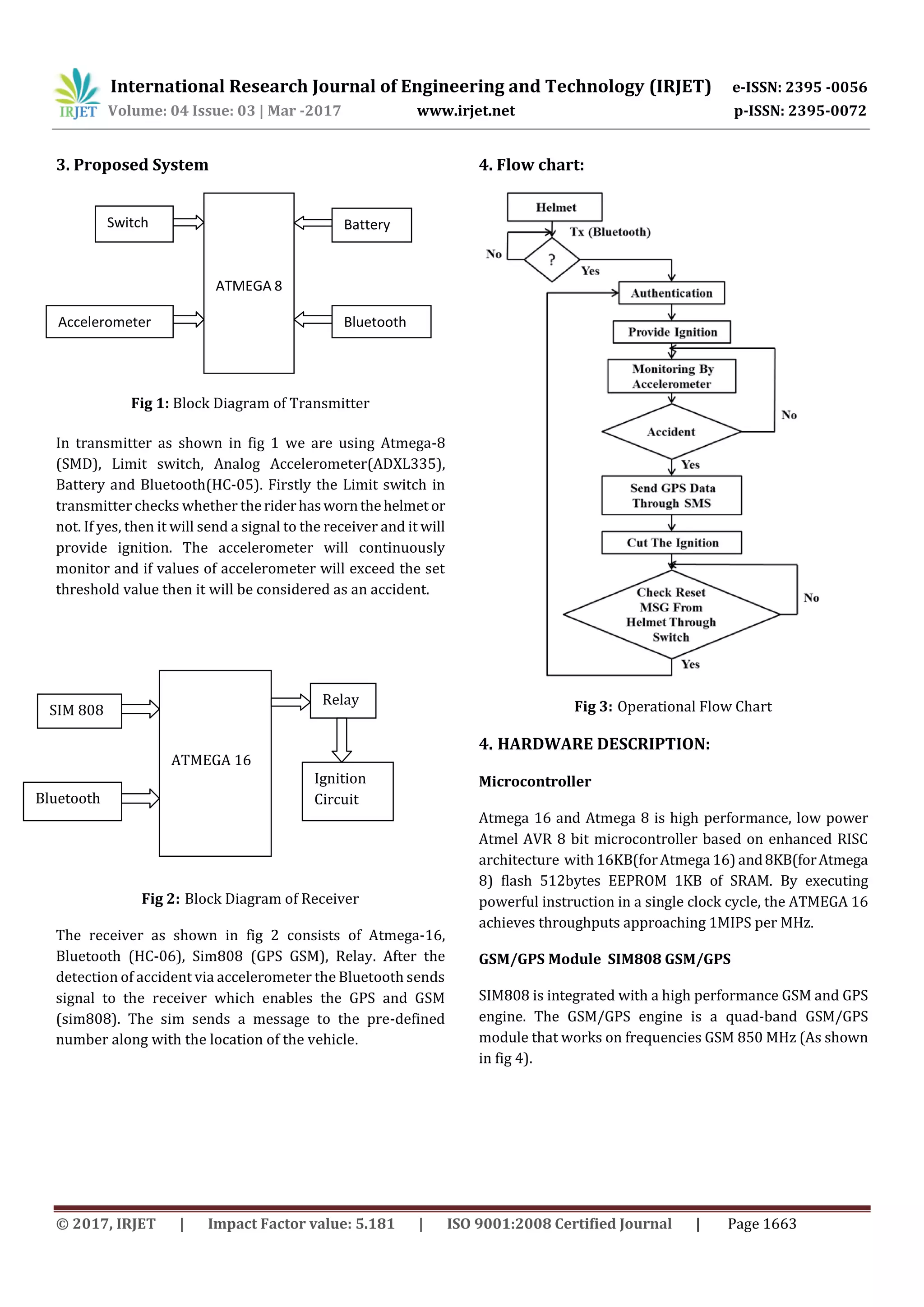
Fig 1: Block Diagram of Transmitter
In transmitter as shown in fig 1 we are using Atmega-8
(SMD), Limit switch, Analog Accelerometer(ADXL335),
Battery and Bluetooth(HC-05). Firstly the Limit switch in
transmitter checks whether theriderhaswornthehelmet or
not. If yes, then it will send a signal to the receiver and it will
provide ignition. The accelerometer will continuously
monitor and if values of accelerometer will exceed the set
threshold value then it will be considered as an accident.
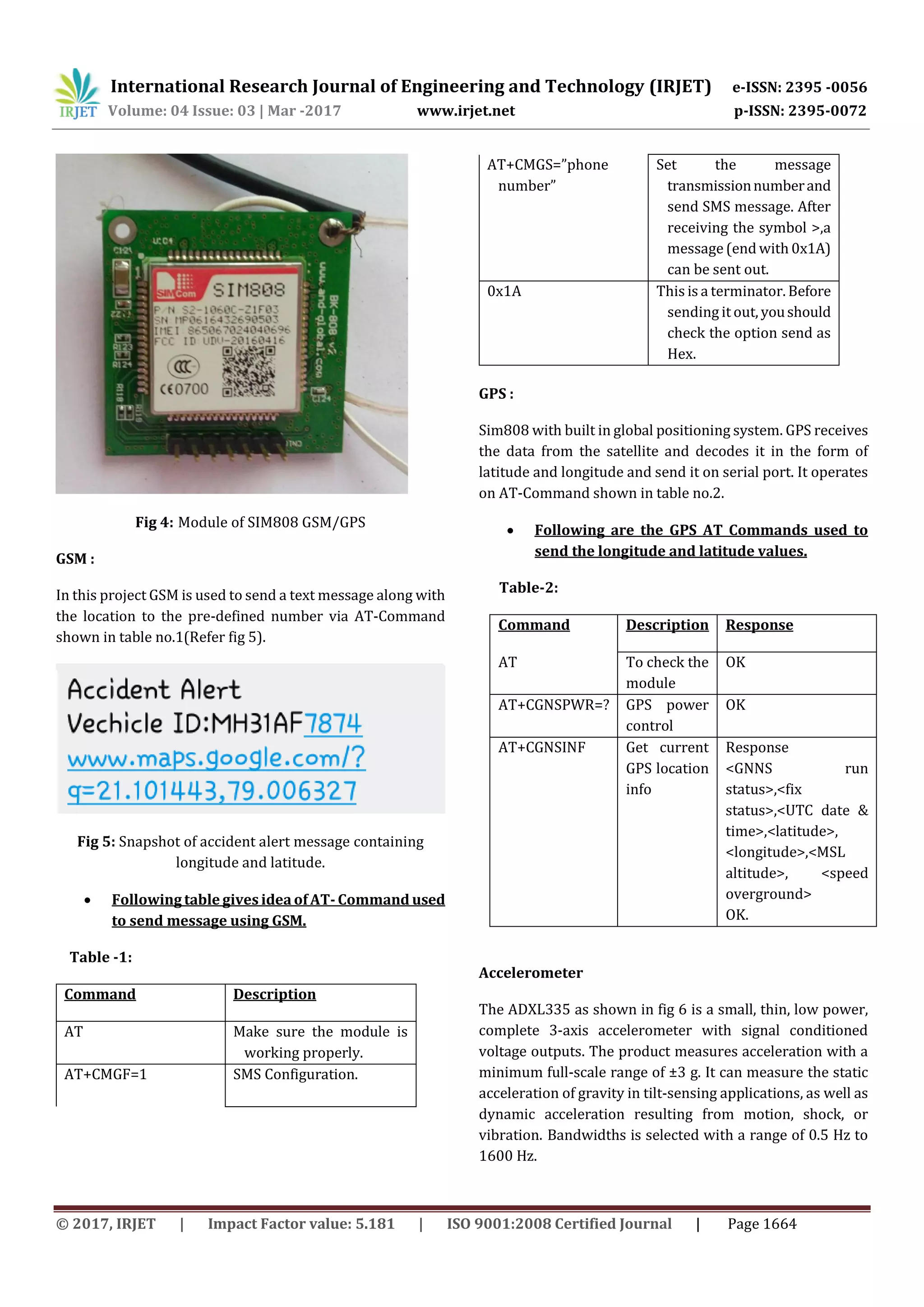
Fig 2: Block Diagram of Receiver
The receiver as shown in fig 2 consists of Atmega-16,
Bluetooth (HC-06), Sim808 (GPS GSM), Relay. After the
detection of accident via accelerometer the Bluetooth sends
signal to the receiver which enables the GPS and GSM
(sim808). The sim sends a message to the pre-defined
number along with the location of the vehicle.
4. Flow chart:
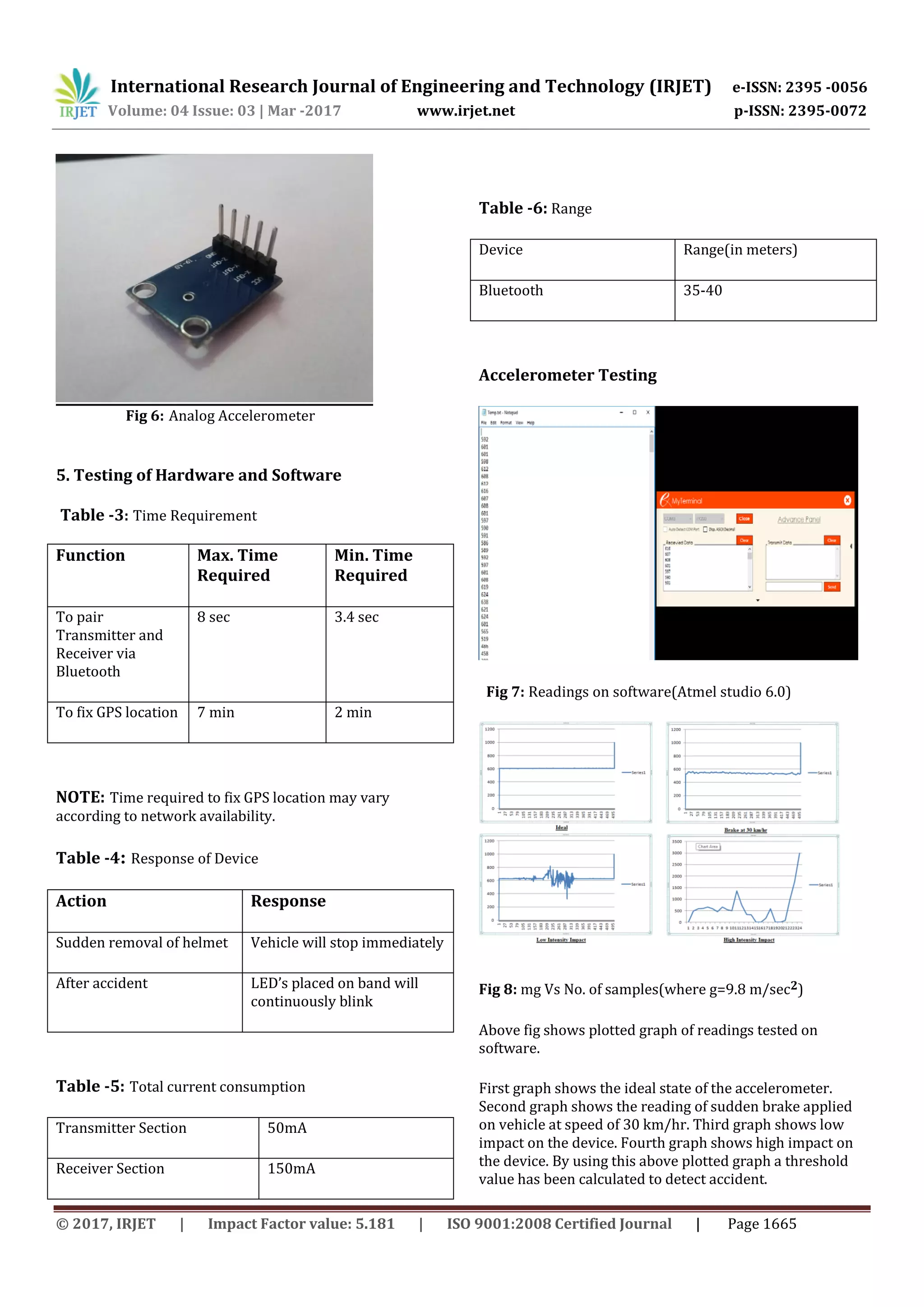
Fig 3: Operational Flow Chart
4. HARDWARE DESCRIPTION:
Microcontroller
Atmega 16 and Atmega 8 is high performance, low power
Atmel AVR 8 bit microcontroller based on enhanced RISC
architecture with 16KB(forAtmega 16) and8KB(forAtmega
8) flash 512bytes EEPROM 1KB of SRAM. By executing
powerful instruction in a single clock cycle, the ATMEGA 16
achieves throughputs approaching 1MIPS per MHz.
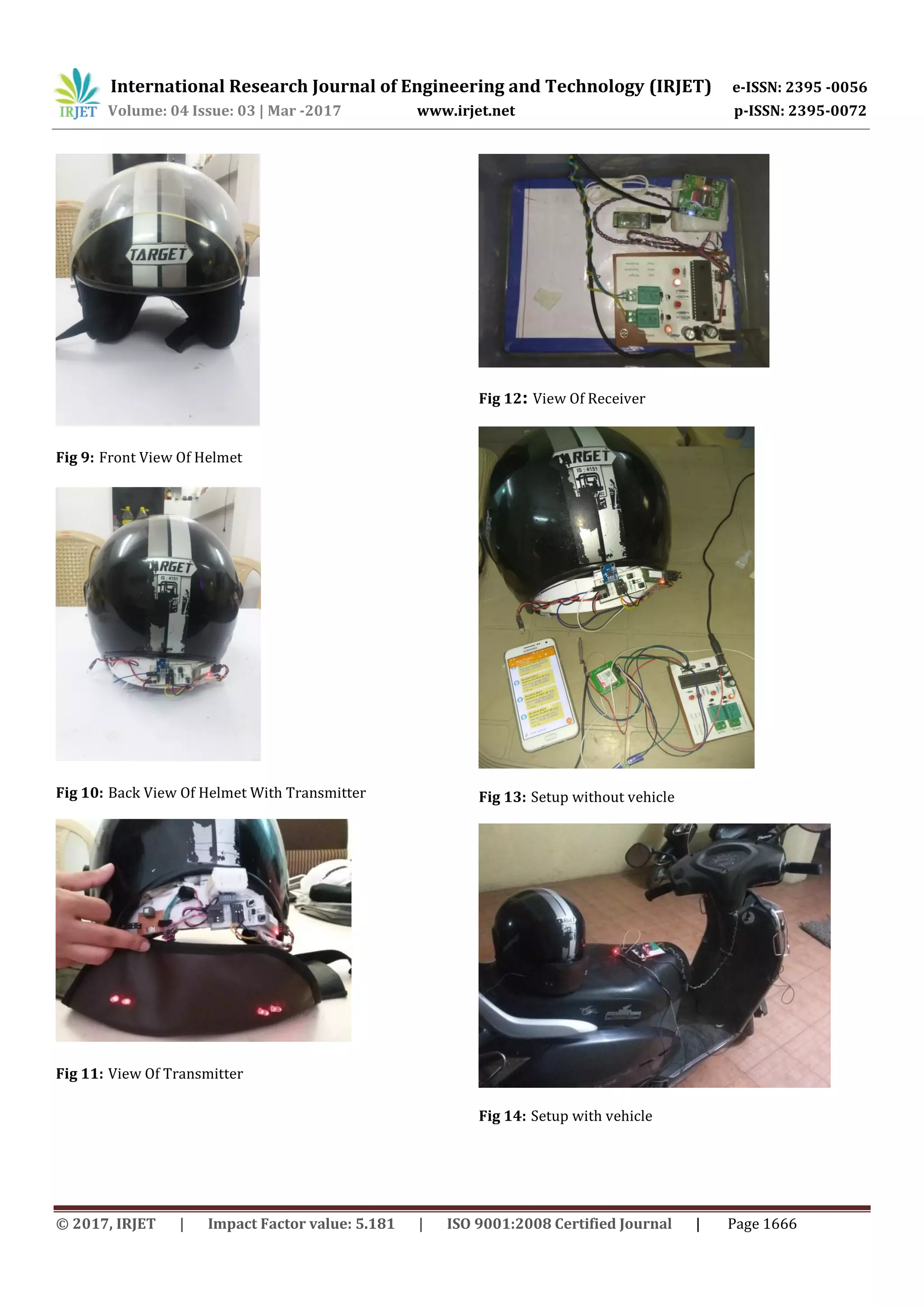
GSM/GPS Module SIM808 GSM/GPS
SIM808 is integrated with a high performance GSM and GPS
engine. The GSM/GPS engine is a quad-band GSM/GPS
module that works on frequencies GSM 850 MHz (As shown
in fig 4).
ATMEGA 8
Switch
Accelerometer
Battery
Bluetooth
SIM 808
ATMEGA 16
Relay
Ignition
CircuitBluetooth
International Research Journal of Engineering and Technology (IRJET) e-ISSN: 2395 -0056
Volume: 04 Issue: 03 | Mar -2017 www.irjet.net p-ISSN: 2395-0072
© 2017, IRJET | Impact Factor value: 5.181 | ISO 9001:2008 Certified Journal | Page 1664
Fig 4: Module of SIM808 GSM/GPS
GSM :
In this project GSM is used to send a text message along with
the location to the pre-defined number via AT-Command
shown in table no.1(Refer fig 5).
Fig 5: Snapshot of accident alert message containing
longitude and latitude.
 Following table gives idea of AT- Command used
to send message using GSM.
Table -1:
Command Description
AT Make sure the module is
working properly.
AT+CMGF=1 SMS Configuration.
AT+CMGS=”phone
number”
Set the message
transmissionnumberand
send SMS message. After
receiving the symbol >,a
message (end with 0x1A)
can be sent out.
0x1A This is a terminator. Before
sending it out, youshould
check the option send as
Hex.
GPS :
Sim808 with built in global positioning system. GPS receives
the data from the satellite and decodes it in the form of
latitude and longitude and send it on serial port. It operates
on AT-Command shown in table no.2.
 Following are the GPS AT Commands used to
send the longitude and latitude values.
Table-2:
Command Description Response
AT To check the
module
OK
AT+CGNSPWR=? GPS power
control
OK
AT+CGNSINF Get current
GPS location
info
Response
<GNNS run
status>,<fix
status>,<UTC date &
time>,<latitude>,
<longitude>,<MSL
altitude>, <speed
overground>
OK.
Accelerometer
The ADXL335 as shown in fig 6 is a small, thin, low power,
complete 3-axis accelerometer with signal conditioned
voltage outputs. The product measures acceleration with a
minimum full-scale range of ±3 g. It can measure the static
acceleration of gravity in tilt-sensing applications, as well as
dynamic acceleration resulting from motion, shock, or
vibration. Bandwidths is selected with a range of 0.5 Hz to
1600 Hz.
International Research Journal of Engineering and Technology (IRJET) e-ISSN: 2395 -0056
Volume: 04 Issue: 03 | Mar -2017 www.irjet.net p-ISSN: 2395-0072
© 2017, IRJET | Impact Factor value: 5.181 | ISO 9001:2008 Certified Journal | Page 1665
Fig 6: Analog Accelerometer
5. Testing of Hardware and Software
Table -3: Time Requirement
Function Max. Time
Required
Min. Time
Required
To pair
Transmitter and
Receiver via
Bluetooth
8 sec 3.4 sec
To fix GPS location 7 min 2 min
NOTE: Time required to fix GPS location may vary
according to network availability.
Table -4: Response of Device
Action Response
Sudden removal of helmet Vehicle will stop immediately
After accident LED’s placed on band will
continuously blink
Table -5: Total current consumption
Transmitter Section 50mA
Receiver Section 150mA
Table -6: Range
Device Range(in meters)
Bluetooth 35-40
Accelerometer Testing
Fig 7: Readings on software(Atmel studio 6.0)
Fig 8: mg Vs No. of samples(where g=9.8 m/sec2)
Above fig shows plotted graph of readings tested on
software.
First graph shows the ideal state of the accelerometer.
Second graph shows the reading of sudden brake applied
on vehicle at speed of 30 km/hr. Third graph shows low
impact on the device. Fourth graph shows high impact on
the device. By using this above plotted graph a threshold
value has been calculated to detect accident.
International Research Journal of Engineering and Technology (IRJET) e-ISSN: 2395 -0056
Volume: 04 Issue: 03 | Mar -2017 www.irjet.net p-ISSN: 2395-0072
© 2017, IRJET | Impact Factor value: 5.181 | ISO 9001:2008 Certified Journal | Page 1666
Fig 9: Front View Of Helmet
Fig 10: Back View Of Helmet With Transmitter
Fig 11: View Of Transmitter
Fig 12: View Of Receiver
Fig 13: Setup without vehicle
Fig 14: Setup with vehicle
International Research Journal of Engineering and Technology (IRJET) e-ISSN: 2395 -0056
Volume: 04 Issue: 03 | Mar -2017 www.irjet.net p-ISSN: 2395-0072
© 2017, IRJET | Impact Factor value: 5.181 | ISO 9001:2008 Certified Journal | Page 1667
6. CONCLUSIONS
In this project we have successfullydesigneda smarthelmet
band using GSM and GPS technology. The project made
compulsory of wear helmet to start the ignition of vehicle
and while riding if any sudden changeinvelocity occursthen
accelerometer will monitor the change and a short message
with the location of rider will be send to the predefined
number using GSM module. This is a situation where we
found some solution to the problem of increaseddeath ratio.
REFERENCES
[1] R.Nazir, A.Tariq, S.Murawwat, S.Rabbani “Accident
Prevention and Reporting System Using GSM (SIM
900D) and GPS (NMEA 0183)” Dept. of Electrical
Engineering, Lahore College for Women University,
Lahore, Pakistan, Accepted 30 July 2014.
[2] D.Kumar, S.Gupta, S.Kumar, S.Srivastava “Accident
Detection and Reporting System Using GPS and GSM
Module” Dept. of Electronics and Instrumentation
Engineering, Galgotias College of Engineering and
Technology, Greater Noida,India, Volume2,Issue5,May
2015.
[3] N.sane, D.Patil, S.Thakare, A.Rokade “Real Time Vehicle
Accident Detection and Tracking Using GPS and GSM”
International Journal on Recent and Innovation Trends
in Computing and Communication, Volume 4, Issue 4,
April 2016.
[4] C.Prabha, R.Sunita, R.Anita “Automatic Vehicle Accident
Detection and Messaging System Using GSM and GPS
Modem”,Assistant professor, Dept. of ECE, Bellari
Institute of Technology and Management, Bellary,
Karnataka, Volume 3,Issue 7, July 2014.
[5] Manjesh N, Prof . Sudarshan Raj “Smart Helmet Using
GSM and GPS Technology for Accident Detection and
Reporting System” , M tech , ECE –DSCE ,JNTUA
Hindupur, HOD and Ass. Prof. BIT-IT, Hindupur, India,
Volume 2, Issue 4, pp:(122-127), Oct –Dec 2014.
[6] Jennifer William, Kaustubh Padwal , Nexon Samuel,
Akshay Bawkar, Smita Rukhande,”Intelligent
Helmet”,International Journal of Scientific and
Engineering Research,Volume 2,Issue 3,March 2016.
BIOGRAPHIES
Aditi Varade, B.E final year
student, Dept. of Electronics
and Telecommunication
Engineering, Priyadarshini
College of Engineering,
Nagpur.
Neha Gajbhiye, B.E final year
student, Dept. of Electronics
and Telecommunication
Engineering, Priyadarshini
College of Engineering,
Nagpur.
Mousam, B.E final year
student, Dept. of Electronics
and Telecommunication
Engineering, Priyadarshini
College of Engineering,
Nagpur.
Mr.V.V.Panchbhai, Assistant
Professor, Dept. of Electronics
and Telecommunication
Engineering, Priyadarshini
College of Engineering,
Nagpur He is having 10 years
of teaching experience. He
has more than 6 papers in
National / International
journals to his credit.

Smart Helmet using GSM and GPS

  • 1.
    International Research Journalof Engineering and Technology (IRJET) e-ISSN: 2395 -0056 Volume: 04 Issue: 03 | Mar -2017 www.irjet.net p-ISSN: 2395-0072 © 2017, IRJET | Impact Factor value: 5.181 | ISO 9001:2008 Certified Journal | Page 1662 SMART HELMET USING GSM AND GPS Aditi Varade1, Neha Gajbhiye2, Mousam3, Assistant. Prof. V.V.Panchbhai4 1Student, Dept. of Electronics and Telecommunication Engineering, Priyadarshini College of Engineering, Nagpur 2Student, Dept. of Electronics and Telecommunication Engineering, Priyadarshini College of Engineering, Nagpur 3Student, Dept. of Electronics and Telecommunication Engineering, Priyadarshini College of Engineering, Nagpur 4 Assistant Professor, Dept. of Electronics and Telecommunication Engineering, Priyadarshini College of Engineering, Nagpur, Maharashtra, India ---------------------------------------------------------------------***--------------------------------------------------------------------- Abstract - Everyday around theworldalargepercentageof people die from road accident. An effective approach is made to solve the problem by using smart helmet band. Smart helmet band is an idea which make motorcycle driving safer than before. The working of this smart helmet band is very simple, Limit switch is placed inside the helmet, which will detect whether the rider has worn the helmet or not, if not then the bike will not start. Smart helmet band provides help in case of accident by using GSM and GPS technology. Key Words: SIM808(GSM, GPS), Limit Switch, Bluetooth, Accelerometer,MicrocontrollerATMEGA16,Microcontroller ATMEGA8(SMD). 1. Introduction Now a day bikers in our country are increasing and road mishaps are also increasing day by day. Many casualties occur due to the negligence of wearing helmet. The project makes compulsory to wear the helmet, if the person met with an accident then in such situation a message alongwith the location is sent to the ambulance or family member to rescue him. The project aims at intelligence security band providing awareness for wearing helmet and also provides prevention for human life safety. 2. Related Work Many authors presented their work regarding safety against road accident. Some of them are described below: Accident prevention and Reporting System Using GSM(sim900D) and GPS(NMEA 0183),has been described in [1].The presented system includes SONAR ranging modules, vibration sensor, three modules GPS receiver(NMEA), Microcontroller(AT89S51),GSMmodem(SIM900D)ANDAN Alarm. It enables intelligent detection of an accident at any place and reports about the accident on predefined number. When the distance is too short between the vehicle and obstacle then alarm will be “ON” as an indicator to move vehicle in other direction which is safer but when a vehicle faces accident despite of alarm, immediate vibration sensor will detect the signal and Microcontroller sends the alert message through the GSM model includingthelocationtothe predefined number. This provides an automatic accident prevention and reporting system. The research paper [2] aims at finding the occurrence of any accident and reporting the location of accident to the previously coded numbers so that immediate help can be provided by ambulance or the relative concerned. GSM technology is used to intimatethevehiclepositionintheform of latitude and longitude coordinates through sms. The location spot is retrieved using GPS which is navigational system using a networkofsatelliteorbitingtheearth.Sensors such as vibration, alcohol and fire detectors detect signal in case of an accident occurrence and send a signal to the connected microcontroller. The controller in turn operates the relay to glow the airbag and automatically lock the brakes. This paper gives a design which have many benefits like low cost, small size. Real TimeVehicleDetectionandTrackingUsingGPSandGSM [3]. This paper presents review on the accident detection techniques and some future possibilities in this field. The purpose of the project is to find the vehicle and locate the vehicle by means of sending a message using a system which is placed inside a vehicle. The project is designed for vehicle accident detection and tracking system by using GSM and GPS.
  • 2.
    International Research Journalof Engineering and Technology (IRJET) e-ISSN: 2395 -0056 Volume: 04 Issue: 03 | Mar -2017 www.irjet.net p-ISSN: 2395-0072 © 2017, IRJET | Impact Factor value: 5.181 | ISO 9001:2008 Certified Journal | Page 1663 3. Proposed System Fig 1: Block Diagram of Transmitter In transmitter as shown in fig 1 we are using Atmega-8 (SMD), Limit switch, Analog Accelerometer(ADXL335), Battery and Bluetooth(HC-05). Firstly the Limit switch in transmitter checks whether theriderhaswornthehelmet or not. If yes, then it will send a signal to the receiver and it will provide ignition. The accelerometer will continuously monitor and if values of accelerometer will exceed the set threshold value then it will be considered as an accident. Fig 2: Block Diagram of Receiver The receiver as shown in fig 2 consists of Atmega-16, Bluetooth (HC-06), Sim808 (GPS GSM), Relay. After the detection of accident via accelerometer the Bluetooth sends signal to the receiver which enables the GPS and GSM (sim808). The sim sends a message to the pre-defined number along with the location of the vehicle. 4. Flow chart: Fig 3: Operational Flow Chart 4. HARDWARE DESCRIPTION: Microcontroller Atmega 16 and Atmega 8 is high performance, low power Atmel AVR 8 bit microcontroller based on enhanced RISC architecture with 16KB(forAtmega 16) and8KB(forAtmega 8) flash 512bytes EEPROM 1KB of SRAM. By executing powerful instruction in a single clock cycle, the ATMEGA 16 achieves throughputs approaching 1MIPS per MHz. GSM/GPS Module SIM808 GSM/GPS SIM808 is integrated with a high performance GSM and GPS engine. The GSM/GPS engine is a quad-band GSM/GPS module that works on frequencies GSM 850 MHz (As shown in fig 4). ATMEGA 8 Switch Accelerometer Battery Bluetooth SIM 808 ATMEGA 16 Relay Ignition CircuitBluetooth
  • 3.
    International Research Journalof Engineering and Technology (IRJET) e-ISSN: 2395 -0056 Volume: 04 Issue: 03 | Mar -2017 www.irjet.net p-ISSN: 2395-0072 © 2017, IRJET | Impact Factor value: 5.181 | ISO 9001:2008 Certified Journal | Page 1664 Fig 4: Module of SIM808 GSM/GPS GSM : In this project GSM is used to send a text message along with the location to the pre-defined number via AT-Command shown in table no.1(Refer fig 5). Fig 5: Snapshot of accident alert message containing longitude and latitude.  Following table gives idea of AT- Command used to send message using GSM. Table -1: Command Description AT Make sure the module is working properly. AT+CMGF=1 SMS Configuration. AT+CMGS=”phone number” Set the message transmissionnumberand send SMS message. After receiving the symbol >,a message (end with 0x1A) can be sent out. 0x1A This is a terminator. Before sending it out, youshould check the option send as Hex. GPS : Sim808 with built in global positioning system. GPS receives the data from the satellite and decodes it in the form of latitude and longitude and send it on serial port. It operates on AT-Command shown in table no.2.  Following are the GPS AT Commands used to send the longitude and latitude values. Table-2: Command Description Response AT To check the module OK AT+CGNSPWR=? GPS power control OK AT+CGNSINF Get current GPS location info Response <GNNS run status>,<fix status>,<UTC date & time>,<latitude>, <longitude>,<MSL altitude>, <speed overground> OK. Accelerometer The ADXL335 as shown in fig 6 is a small, thin, low power, complete 3-axis accelerometer with signal conditioned voltage outputs. The product measures acceleration with a minimum full-scale range of ±3 g. It can measure the static acceleration of gravity in tilt-sensing applications, as well as dynamic acceleration resulting from motion, shock, or vibration. Bandwidths is selected with a range of 0.5 Hz to 1600 Hz.
  • 4.
    International Research Journalof Engineering and Technology (IRJET) e-ISSN: 2395 -0056 Volume: 04 Issue: 03 | Mar -2017 www.irjet.net p-ISSN: 2395-0072 © 2017, IRJET | Impact Factor value: 5.181 | ISO 9001:2008 Certified Journal | Page 1665 Fig 6: Analog Accelerometer 5. Testing of Hardware and Software Table -3: Time Requirement Function Max. Time Required Min. Time Required To pair Transmitter and Receiver via Bluetooth 8 sec 3.4 sec To fix GPS location 7 min 2 min NOTE: Time required to fix GPS location may vary according to network availability. Table -4: Response of Device Action Response Sudden removal of helmet Vehicle will stop immediately After accident LED’s placed on band will continuously blink Table -5: Total current consumption Transmitter Section 50mA Receiver Section 150mA Table -6: Range Device Range(in meters) Bluetooth 35-40 Accelerometer Testing Fig 7: Readings on software(Atmel studio 6.0) Fig 8: mg Vs No. of samples(where g=9.8 m/sec2) Above fig shows plotted graph of readings tested on software. First graph shows the ideal state of the accelerometer. Second graph shows the reading of sudden brake applied on vehicle at speed of 30 km/hr. Third graph shows low impact on the device. Fourth graph shows high impact on the device. By using this above plotted graph a threshold value has been calculated to detect accident.
  • 5.
    International Research Journalof Engineering and Technology (IRJET) e-ISSN: 2395 -0056 Volume: 04 Issue: 03 | Mar -2017 www.irjet.net p-ISSN: 2395-0072 © 2017, IRJET | Impact Factor value: 5.181 | ISO 9001:2008 Certified Journal | Page 1666 Fig 9: Front View Of Helmet Fig 10: Back View Of Helmet With Transmitter Fig 11: View Of Transmitter Fig 12: View Of Receiver Fig 13: Setup without vehicle Fig 14: Setup with vehicle
  • 6.
    International Research Journalof Engineering and Technology (IRJET) e-ISSN: 2395 -0056 Volume: 04 Issue: 03 | Mar -2017 www.irjet.net p-ISSN: 2395-0072 © 2017, IRJET | Impact Factor value: 5.181 | ISO 9001:2008 Certified Journal | Page 1667 6. CONCLUSIONS In this project we have successfullydesigneda smarthelmet band using GSM and GPS technology. The project made compulsory of wear helmet to start the ignition of vehicle and while riding if any sudden changeinvelocity occursthen accelerometer will monitor the change and a short message with the location of rider will be send to the predefined number using GSM module. This is a situation where we found some solution to the problem of increaseddeath ratio. REFERENCES [1] R.Nazir, A.Tariq, S.Murawwat, S.Rabbani “Accident Prevention and Reporting System Using GSM (SIM 900D) and GPS (NMEA 0183)” Dept. of Electrical Engineering, Lahore College for Women University, Lahore, Pakistan, Accepted 30 July 2014. [2] D.Kumar, S.Gupta, S.Kumar, S.Srivastava “Accident Detection and Reporting System Using GPS and GSM Module” Dept. of Electronics and Instrumentation Engineering, Galgotias College of Engineering and Technology, Greater Noida,India, Volume2,Issue5,May 2015. [3] N.sane, D.Patil, S.Thakare, A.Rokade “Real Time Vehicle Accident Detection and Tracking Using GPS and GSM” International Journal on Recent and Innovation Trends in Computing and Communication, Volume 4, Issue 4, April 2016. [4] C.Prabha, R.Sunita, R.Anita “Automatic Vehicle Accident Detection and Messaging System Using GSM and GPS Modem”,Assistant professor, Dept. of ECE, Bellari Institute of Technology and Management, Bellary, Karnataka, Volume 3,Issue 7, July 2014. [5] Manjesh N, Prof . Sudarshan Raj “Smart Helmet Using GSM and GPS Technology for Accident Detection and Reporting System” , M tech , ECE –DSCE ,JNTUA Hindupur, HOD and Ass. Prof. BIT-IT, Hindupur, India, Volume 2, Issue 4, pp:(122-127), Oct –Dec 2014. [6] Jennifer William, Kaustubh Padwal , Nexon Samuel, Akshay Bawkar, Smita Rukhande,”Intelligent Helmet”,International Journal of Scientific and Engineering Research,Volume 2,Issue 3,March 2016. BIOGRAPHIES Aditi Varade, B.E final year student, Dept. of Electronics and Telecommunication Engineering, Priyadarshini College of Engineering, Nagpur. Neha Gajbhiye, B.E final year student, Dept. of Electronics and Telecommunication Engineering, Priyadarshini College of Engineering, Nagpur. Mousam, B.E final year student, Dept. of Electronics and Telecommunication Engineering, Priyadarshini College of Engineering, Nagpur. Mr.V.V.Panchbhai, Assistant Professor, Dept. of Electronics and Telecommunication Engineering, Priyadarshini College of Engineering, Nagpur He is having 10 years of teaching experience. He has more than 6 papers in National / International journals to his credit.