PROF RAM MEGHE COLLEGE OF
ENGINEERING & MANAGEMENT,
BADNERA
A
Seminar
On
SMART GRID TECHNOLOGY
Guided by: Presented By:
Prof V.R. Gupta Anurag A. Segekar
Department of
Electrical & Electronics Engineering
2015-16
Department of
Electrical & Electronics Engineering
2015-16
CONTENT
• Introduction
• Related work
• Smart Grid
• Working
• Components
• Features
• Comparison
• Advantages
• Disadvantages
• Conclusion
• Future scope
• References
Introduction
•Delivers power from plants to consumers [4]
• Manage power, communicate with consumers & use
renewable energy sources [4]
Reference
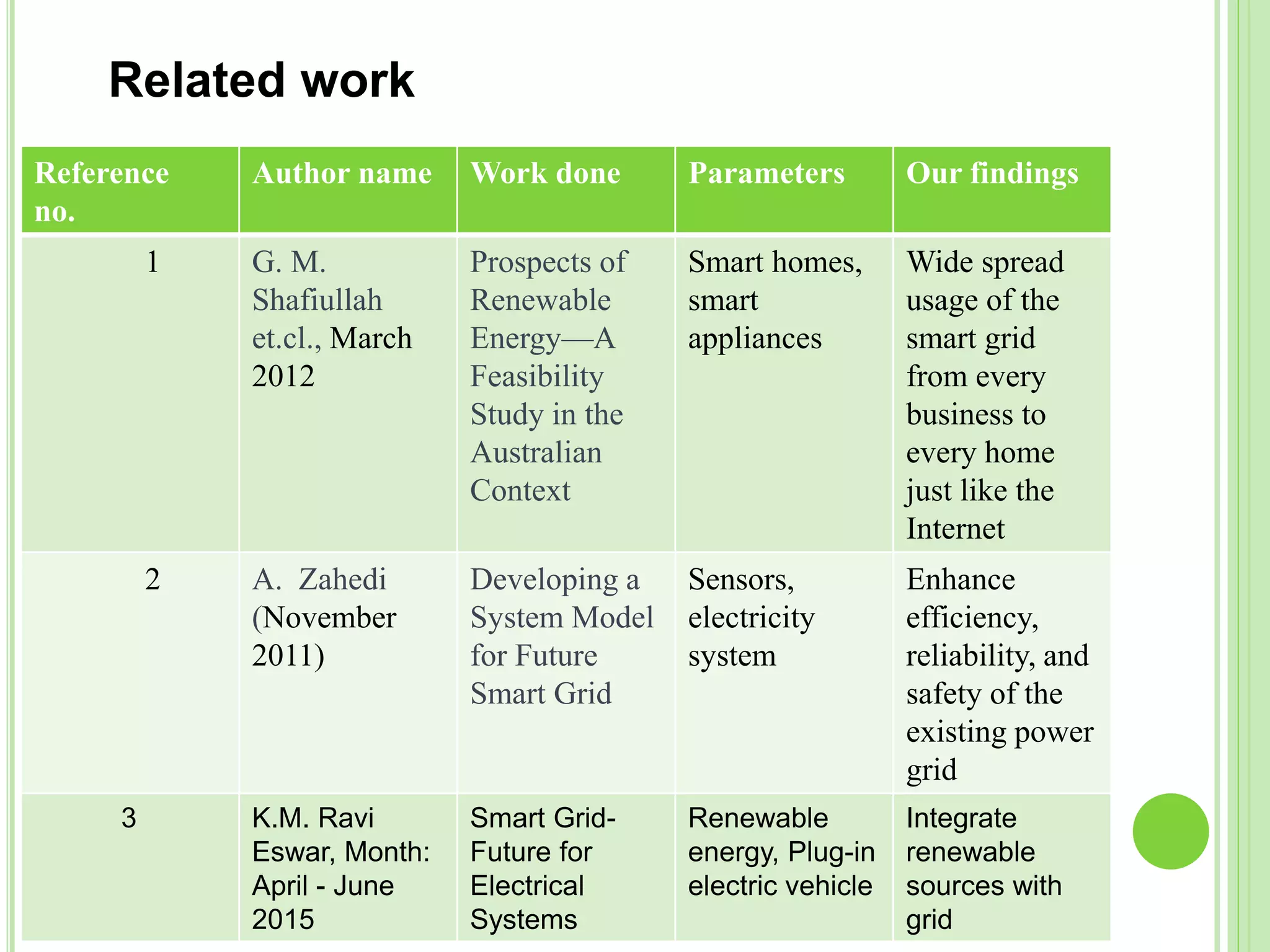
no.
Author name Work done Parameters Our findings
1 G. M.
Shafiullah
et.cl., March
2012
Prospects of
Renewable
Energy—A
Feasibility
Study in the
Australian
Context
Smart homes,
smart
appliances
Wide spread
usage of the
smart grid
from every
business to
every home
just like the
Internet
2 A. Zahedi
(November
2011)
Developing a
System Model
for Future
Smart Grid
Sensors,
electricity
system
Enhance
efficiency,
reliability, and
safety of the
existing power
grid
3 K.M. Ravi
Eswar, Month:
April - June
2015
Smart Grid-
Future for
Electrical
Systems
Renewable
energy, Plug-in
electric vehicle
Integrate
renewable
sources with
grid
Related work
SMART GRID
 Integration of electrical, digital, communication & IT
technology [1]
 Intelligent future electricity system which delivers
electricity to consumers using two way transmission
technology [2]
WORKING
TWO WAY COMMUNICATION
 Communication between smart meter & central
system [3]
 People can generate own power from renewable
sources
 Send energy back to grid which enhance supply
 Minimizes dependence on fossil fuels
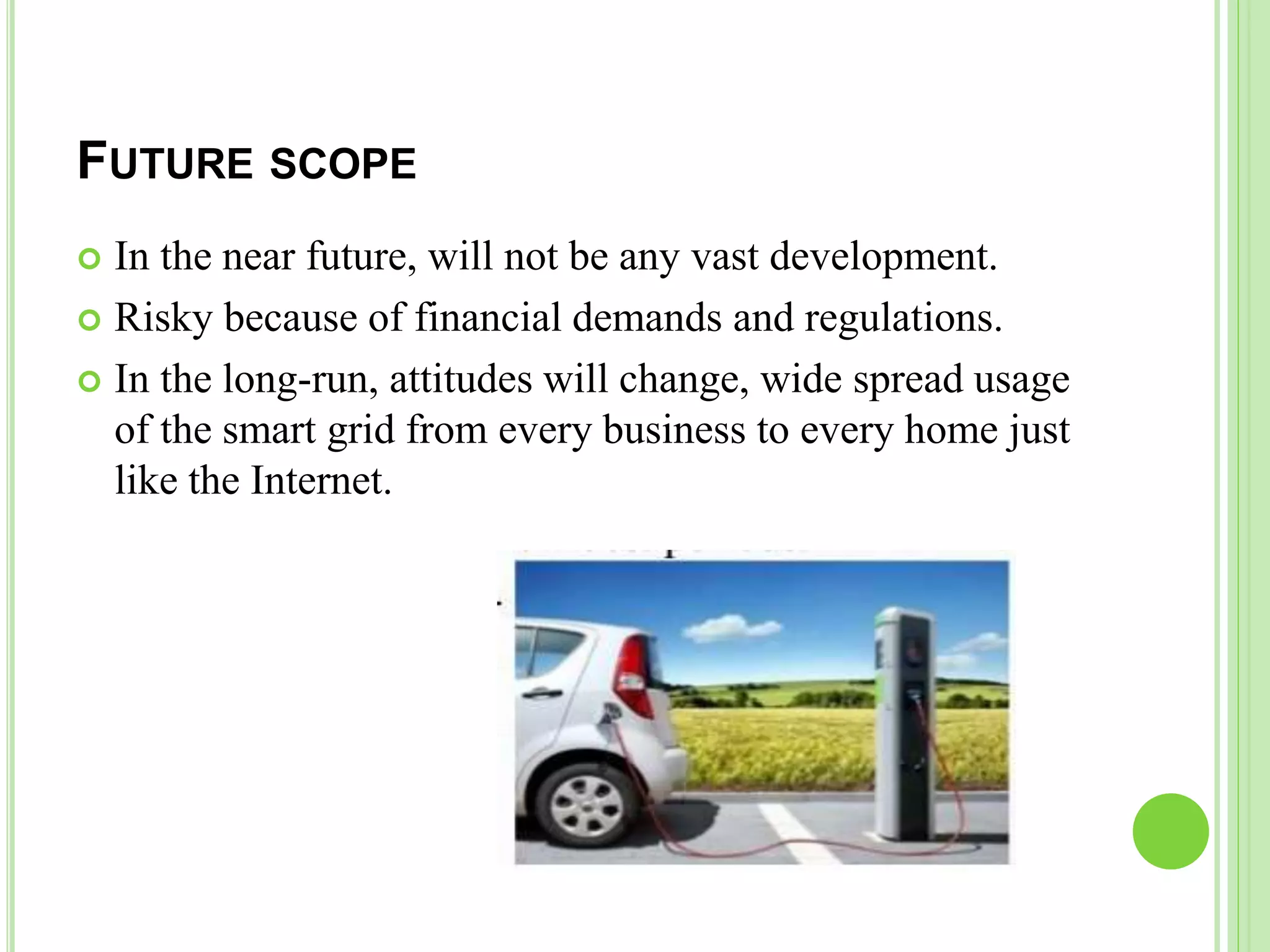
 Charging of electric cars only when sufficient
renewable energy is present
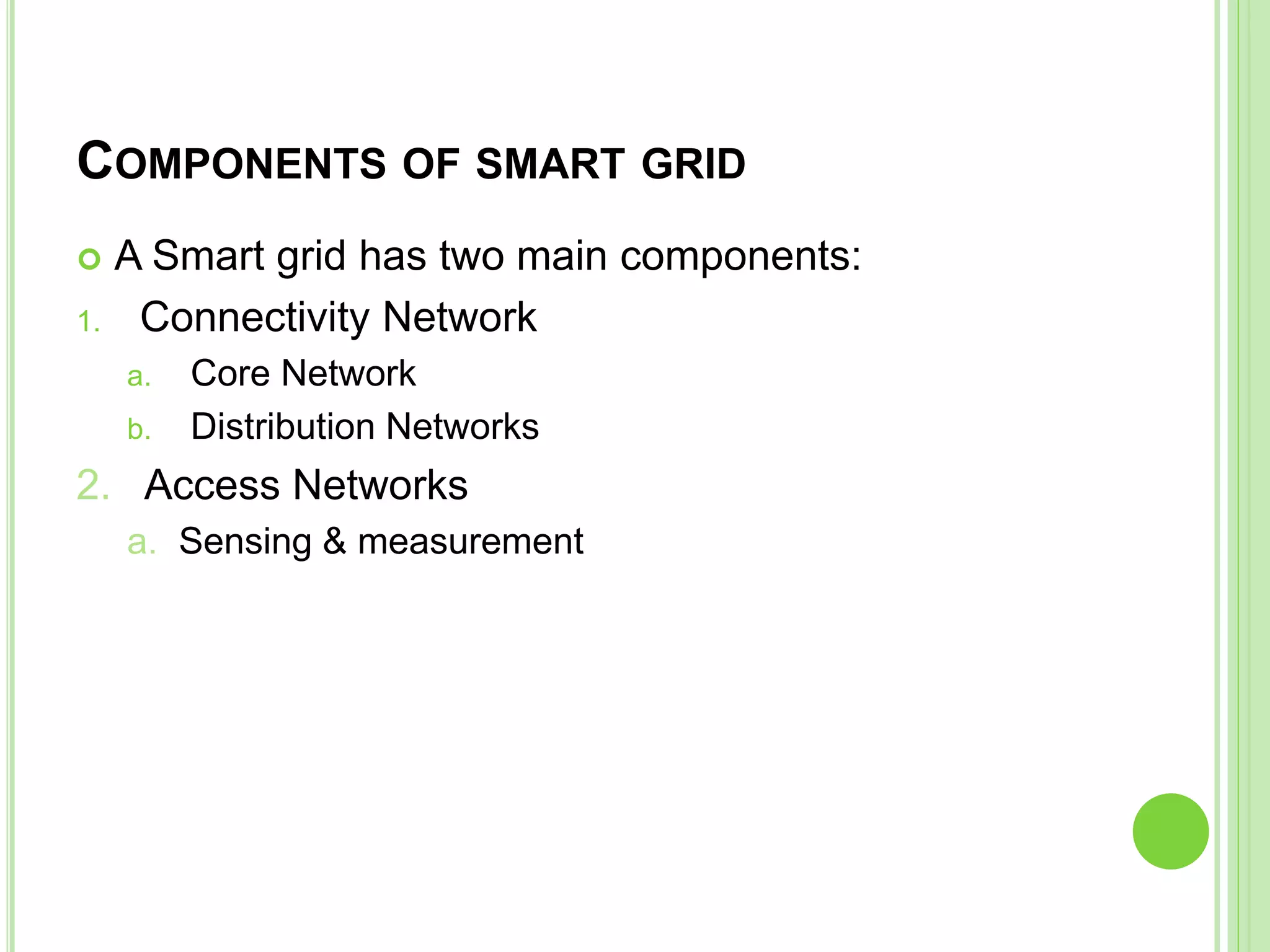
COMPONENTS OF SMART GRID
 A Smart grid has two main components:
1. Connectivity Network
a. Core Network
b. Distribution Networks
2. Access Networks
a. Sensing & measurement
CORE NETWORK
 Core network handles connectivity between
substations & utility’s head office [2]
 Technologies used for core network implementation
include:
a. Wire line technologies
b. Fiber optics
c. Wireless technologies
d. WiMax
DISTRIBUTION NETWORK
 Handles broadband connectivity for transmitting
data collected by Smart Power Grid concentrators
& distribution automation devices[2]
 Technologies used are:
a. Wire line technologies
b. Fiber optics
c. Broadband over power lines(BPL)
d. Wireless technologies
e. WiMax
f. GSM
SENSING & MEASUREMENT
 Smart meter is used
 Electricity usage
 Costing
 Contribution of CO2 to greenhouse effect
FEATURES OF SMART GRID
 Reduce global warming
 Repairing & maintenance
 Reliability
 Security
 Socio-economic development
 Technology
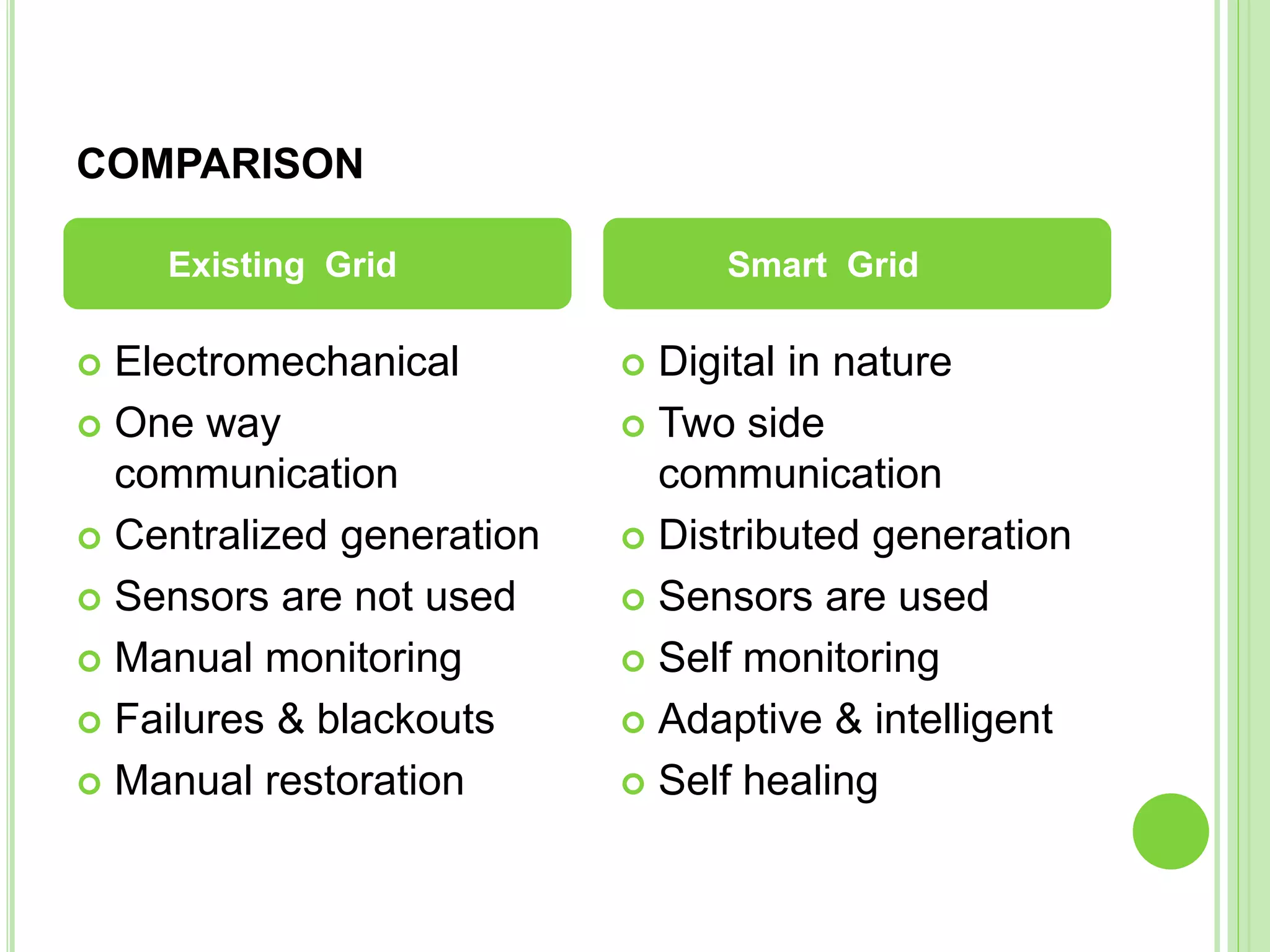
COMPARISON
 Digital in nature
 Two side
communication
 Distributed generation
 Sensors are used
 Self monitoring
 Adaptive & intelligent
 Self healing
Existing Grid Smart Grid
 Electromechanical
 One way
communication
 Centralized generation
 Sensors are not used
 Manual monitoring
 Failures & blackouts
 Manual restoration
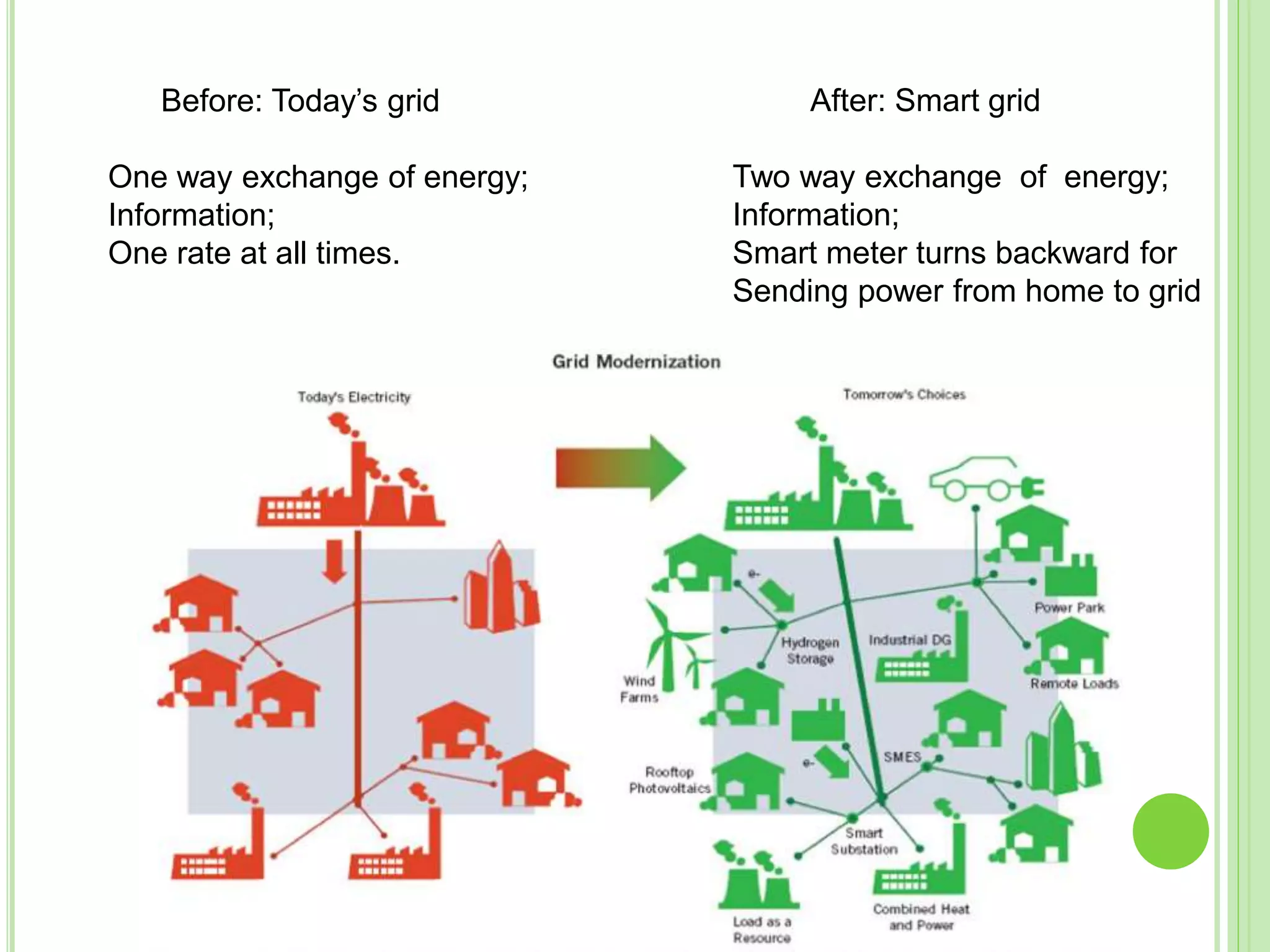
Before: Today’s grid
One way exchange of energy;
Information;
One rate at all times.
After: Smart grid
Two way exchange of energy;
Information;
Smart meter turns backward for
Sending power from home to grid
ADVANTAGES
 Reduce carbon foot prints
 Self healing
 Automated control for distribution
 Sensing & measurement technologies
 Increased efficiency
 Self monitoring
 Reduction in losses
DISADVANTAGES
 Most renewable sources are intermittent
 Present infrastructure is inadequate & requires
augmentation
 Two ways communication fails in some manners
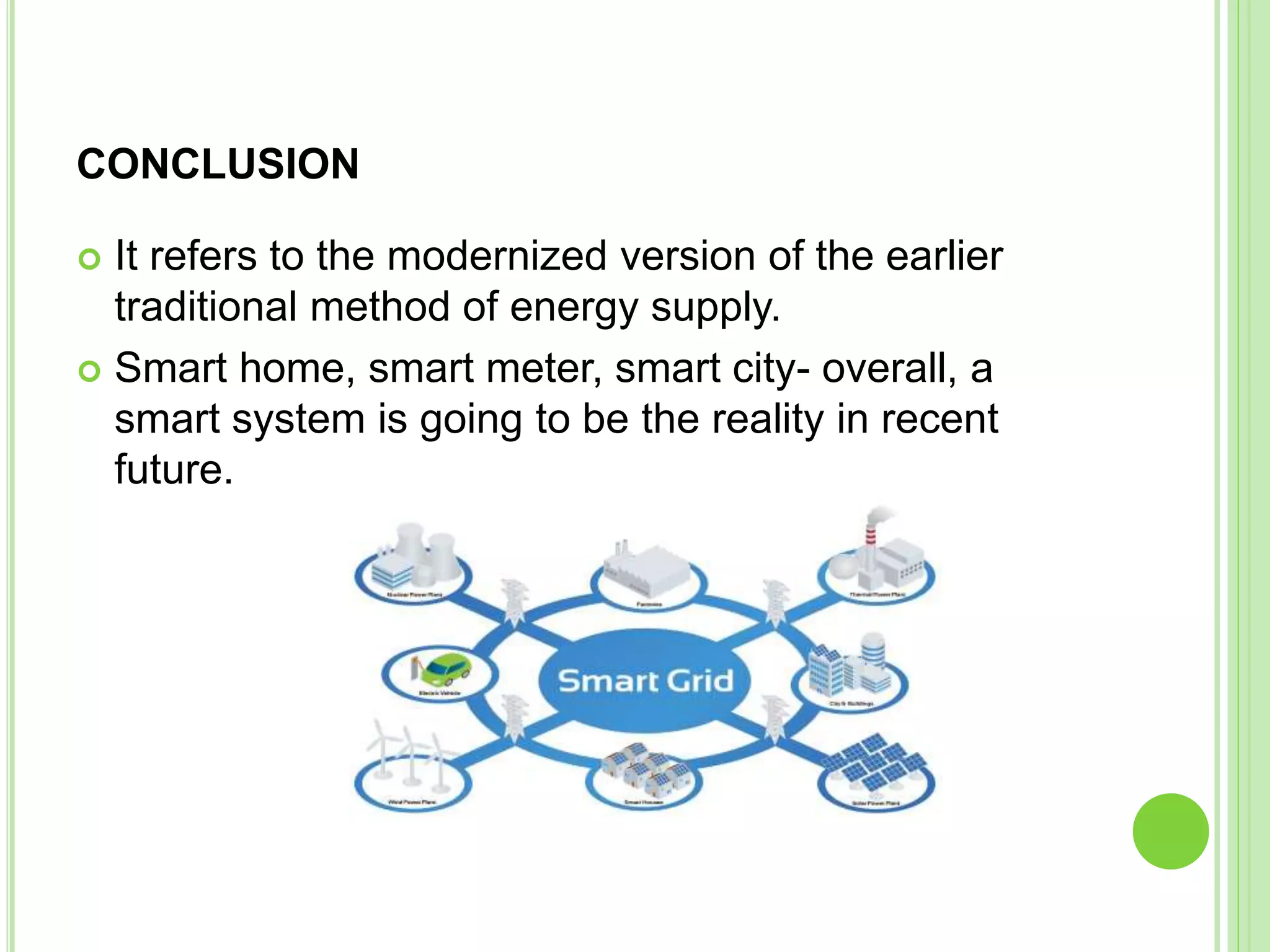
CONCLUSION
 It refers to the modernized version of the earlier
traditional method of energy supply.
 Smart home, smart meter, smart city- overall, a
smart system is going to be the reality in recent
future.
FUTURE SCOPE
 In the near future, will not be any vast development.
 Risky because of financial demands and regulations.
 In the long-run, attitudes will change, wide spread usage
of the smart grid from every business to every home just
like the Internet.
Some companies working on Smart grid
technology for betterment of future grid
on national & international level.
REFERENCES
1. G. M. Shafiullah, A. T. Oo, D. Jarvis, S. Ali and P. Wolfs,“ Prospects
of Renewable Energy—A Feasibility Study in the Australian
Context,” Journal of Renewable Energy, Elsevier, Vol. 39, No. 1,
March 2012.
2. A. Zahedi, “Developing a System Model for Future Smart Grid,”
Proceedings in 2011 IEEE PES Innovative Smart Grid
Technologies Conference, ISGT Asia 2011, Perth,13-16 November
2011, pp. 1-5.
3. K.M. Ravi Eswar, “Smart Grid-Future for Electrical Systems”,
International Journal of Electrical and Electronics Research,
Vol. 3, Issue 2, pp: (603-612), Month: April - June 2015,
ISSN 2348-6988.
4. https://en.wikipedia.org/wiki/Smart_grid
SMART GRID TECHNOLOGY

SMART GRID TECHNOLOGY

  • 1.
    PROF RAM MEGHECOLLEGE OF ENGINEERING & MANAGEMENT, BADNERA A Seminar On SMART GRID TECHNOLOGY Guided by: Presented By: Prof V.R. Gupta Anurag A. Segekar Department of Electrical & Electronics Engineering 2015-16 Department of Electrical & Electronics Engineering 2015-16
  • 2.
    CONTENT • Introduction • Relatedwork • Smart Grid • Working • Components • Features • Comparison • Advantages • Disadvantages • Conclusion • Future scope • References
  • 3.
    Introduction •Delivers power fromplants to consumers [4] • Manage power, communicate with consumers & use renewable energy sources [4]
  • 4.
    Reference no. Author name Workdone Parameters Our findings 1 G. M. Shafiullah et.cl., March 2012 Prospects of Renewable Energy—A Feasibility Study in the Australian Context Smart homes, smart appliances Wide spread usage of the smart grid from every business to every home just like the Internet 2 A. Zahedi (November 2011) Developing a System Model for Future Smart Grid Sensors, electricity system Enhance efficiency, reliability, and safety of the existing power grid 3 K.M. Ravi Eswar, Month: April - June 2015 Smart Grid- Future for Electrical Systems Renewable energy, Plug-in electric vehicle Integrate renewable sources with grid Related work
  • 5.
    SMART GRID  Integrationof electrical, digital, communication & IT technology [1]  Intelligent future electricity system which delivers electricity to consumers using two way transmission technology [2]
  • 6.
    WORKING TWO WAY COMMUNICATION Communication between smart meter & central system [3]  People can generate own power from renewable sources  Send energy back to grid which enhance supply  Minimizes dependence on fossil fuels  Charging of electric cars only when sufficient renewable energy is present
  • 7.
    COMPONENTS OF SMARTGRID  A Smart grid has two main components: 1. Connectivity Network a. Core Network b. Distribution Networks 2. Access Networks a. Sensing & measurement
  • 8.
    CORE NETWORK  Corenetwork handles connectivity between substations & utility’s head office [2]  Technologies used for core network implementation include: a. Wire line technologies b. Fiber optics c. Wireless technologies d. WiMax
  • 9.
    DISTRIBUTION NETWORK  Handlesbroadband connectivity for transmitting data collected by Smart Power Grid concentrators & distribution automation devices[2]  Technologies used are: a. Wire line technologies b. Fiber optics c. Broadband over power lines(BPL) d. Wireless technologies e. WiMax f. GSM
  • 10.
    SENSING & MEASUREMENT Smart meter is used  Electricity usage  Costing  Contribution of CO2 to greenhouse effect
  • 11.
    FEATURES OF SMARTGRID  Reduce global warming  Repairing & maintenance  Reliability  Security  Socio-economic development  Technology
  • 12.
    COMPARISON  Digital innature  Two side communication  Distributed generation  Sensors are used  Self monitoring  Adaptive & intelligent  Self healing Existing Grid Smart Grid  Electromechanical  One way communication  Centralized generation  Sensors are not used  Manual monitoring  Failures & blackouts  Manual restoration
  • 13.
    Before: Today’s grid Oneway exchange of energy; Information; One rate at all times. After: Smart grid Two way exchange of energy; Information; Smart meter turns backward for Sending power from home to grid
  • 14.
    ADVANTAGES  Reduce carbonfoot prints  Self healing  Automated control for distribution  Sensing & measurement technologies  Increased efficiency  Self monitoring  Reduction in losses
  • 15.
    DISADVANTAGES  Most renewablesources are intermittent  Present infrastructure is inadequate & requires augmentation  Two ways communication fails in some manners
  • 16.
    CONCLUSION  It refersto the modernized version of the earlier traditional method of energy supply.  Smart home, smart meter, smart city- overall, a smart system is going to be the reality in recent future.
  • 17.
    FUTURE SCOPE  Inthe near future, will not be any vast development.  Risky because of financial demands and regulations.  In the long-run, attitudes will change, wide spread usage of the smart grid from every business to every home just like the Internet.
  • 18.
    Some companies workingon Smart grid technology for betterment of future grid on national & international level.
  • 19.
    REFERENCES 1. G. M.Shafiullah, A. T. Oo, D. Jarvis, S. Ali and P. Wolfs,“ Prospects of Renewable Energy—A Feasibility Study in the Australian Context,” Journal of Renewable Energy, Elsevier, Vol. 39, No. 1, March 2012. 2. A. Zahedi, “Developing a System Model for Future Smart Grid,” Proceedings in 2011 IEEE PES Innovative Smart Grid Technologies Conference, ISGT Asia 2011, Perth,13-16 November 2011, pp. 1-5. 3. K.M. Ravi Eswar, “Smart Grid-Future for Electrical Systems”, International Journal of Electrical and Electronics Research, Vol. 3, Issue 2, pp: (603-612), Month: April - June 2015, ISSN 2348-6988. 4. https://en.wikipedia.org/wiki/Smart_grid