11
Smart Grid, Smart Metering and Cybersecurity
Prof David Wallom
Energy and Environmental ICT Group
UK Electricity network
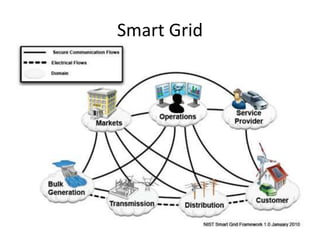
Smart Grid
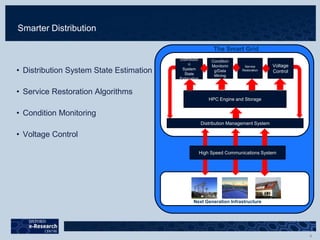
HPC Engine and Storage
Next Generation Infrastructure
The Smart Grid
High Speed Communications System
Service
Restoration
Voltage
Control
Condition
Monitorin
g/Data
Mining
Distributio
n
System
State
Estimation
Distribution Management System
Smarter Distribution
• Distribution System State Estimation
• Service Restoration Algorithms
• Condition Monitoring
• Voltage Control
myTrustedCloud
• Network topographical detail is exchanged between Distribution and Transmission operators
• Network changes infrequent and normally minor
• Regulator requirement for availability of single overall network map with NationalGrid
• Currently an email is sent from DNO -> TNO…
• Introduction of widespread distributed generation will change the requirements
• Network changes could be significant and frequent [within minutes or even real-time]
• What systems can we use to share data securely for critical national infrastructure?
• Cloud computing as a paradigm is extremely attractive for activities which have variable loads
• Considerable security concerns for the use of shared resources
• Trusted computing allows the use of hardware based security mechanisms to measure and
guarantee system state to a user
• Prove that a mix of Cloud & Trusted Computing provide a system with the security and privacy
guarantees that serious safety critical industries such as energy will find attractive enough to
make use of?
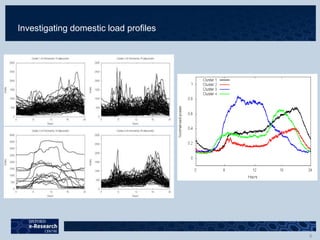
Investigating domestic load profiles
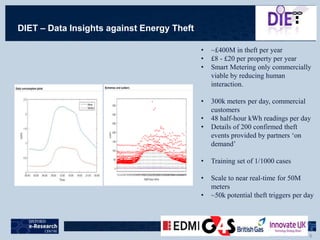
DIET – Data Insights against Energy Theft
• ~£400M in theft per year
• £8 - £20 per property per year
• Smart Metering only commercially
viable by reducing human
interaction.
• 300k meters per day, commercial
customers
• 48 half-hour kWh readings per day
• Details of 200 confirmed theft
events provided by partners ‘on
demand’
• Training set of 1/1000 cases
• Scale to near real-time for 50M
meters
• ~50k potential theft triggers per day
Conclusions
• Moving to ‘Smarter Grid’ will be a gradual rather than big bang process
– Making the Distribution Network Smart is the first step
– Realising all the new and possibly different use cases for smart grid data usage is an
evolving process
• Communication between partners will greatly increase with new network utilisation
usecases
• Cryptographically secure Cloud computing is ideally placed to support sharing of
information between the many and varied stakeholders within Smart Grid
• The clustering analytics done on domestic and non-domestic data has also opened
opportunities with other functions that are necessary to make smart Grid and smart
metering a success.

Smart Grid, Smart Metering and Cybersecurity

  • 1.
    11 Smart Grid, SmartMetering and Cybersecurity Prof David Wallom Energy and Environmental ICT Group
  • 2.
  • 3.
  • 4.
    HPC Engine andStorage Next Generation Infrastructure The Smart Grid High Speed Communications System Service Restoration Voltage Control Condition Monitorin g/Data Mining Distributio n System State Estimation Distribution Management System Smarter Distribution • Distribution System State Estimation • Service Restoration Algorithms • Condition Monitoring • Voltage Control
  • 5.
    myTrustedCloud • Network topographicaldetail is exchanged between Distribution and Transmission operators • Network changes infrequent and normally minor • Regulator requirement for availability of single overall network map with NationalGrid • Currently an email is sent from DNO -> TNO… • Introduction of widespread distributed generation will change the requirements • Network changes could be significant and frequent [within minutes or even real-time] • What systems can we use to share data securely for critical national infrastructure? • Cloud computing as a paradigm is extremely attractive for activities which have variable loads • Considerable security concerns for the use of shared resources • Trusted computing allows the use of hardware based security mechanisms to measure and guarantee system state to a user • Prove that a mix of Cloud & Trusted Computing provide a system with the security and privacy guarantees that serious safety critical industries such as energy will find attractive enough to make use of?
  • 6.
  • 8.
    DIET – DataInsights against Energy Theft • ~£400M in theft per year • £8 - £20 per property per year • Smart Metering only commercially viable by reducing human interaction. • 300k meters per day, commercial customers • 48 half-hour kWh readings per day • Details of 200 confirmed theft events provided by partners ‘on demand’ • Training set of 1/1000 cases • Scale to near real-time for 50M meters • ~50k potential theft triggers per day
  • 9.
    Conclusions • Moving to‘Smarter Grid’ will be a gradual rather than big bang process – Making the Distribution Network Smart is the first step – Realising all the new and possibly different use cases for smart grid data usage is an evolving process • Communication between partners will greatly increase with new network utilisation usecases • Cryptographically secure Cloud computing is ideally placed to support sharing of information between the many and varied stakeholders within Smart Grid • The clustering analytics done on domestic and non-domestic data has also opened opportunities with other functions that are necessary to make smart Grid and smart metering a success.

Editor's Notes

  • #6 Emergent behaviour that can be identified from such potentially complex systems Cloud and/or cluster computing High speed communications technology platforms Large-scale learning machines
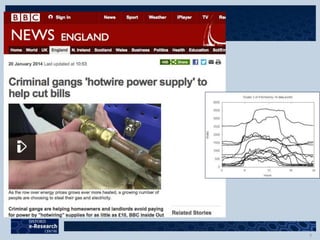
  • #7 Here we have clustered domestic smart meter data from small scale trials, also utilised commercial datasets to establish the impact of the introduction of real-time pricing on different types of business Estimated that energy theft is a £500M/year problem.