Financing Infrastructure Projects in Cities
Avoiding Traps and Achieving Sustainability
Global Infrastructure Basel Foundation (©)
1
GIB, May 2014 | André Schneider
Guiding Principles for Sustainable
Infrastructure
2
• Promote sustainable development to assure that
– ensure that all activities are environmentally sound, socially desirable, economically viable,
and in compliance with applicable law;
– ensure that multi-stakeholder processes for the resolution of conflicts are in place.
• Assure equitable participatory processes to implement that
– there is adequate stakeholder participation in the critical stages of the project;
– there are stable, reliable and equitable partnership based on mutual trust and respect;
– all consumers (men and women) will be actively informed about the sustainable infrastructure
and the ensuing services;
– all consumers (domestic, governmental, industrial) are treated equitably and have easy, non-
discriminatory access to independent consumer rights offices assuring equitable treatment of
complaints and prejudices due to non-compliance;
– workers’ rights are respected.
• Assure that the sustainable infrastructure and services that are safe and affordable
for all parts of the population.
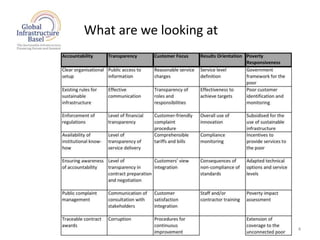
The 10 Principles
3
• Based on the guiding principles, we have derived the following ten
themes, which we can easily demonstrate that they clearly affect
the performance of sustainable infrastructure projects and their
governance:
– Accountability
– Transparency
– Customer Focus
– Results Orientation
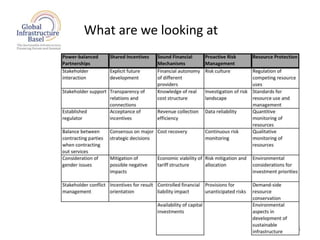
– Poverty Responsiveness
– Power-Balanced Partnerships
– Shared Incentives
– Sound Financing Mechanisms
– Proactive Risk Management
– Resource Protection
What are we looking at
4
What are we looking at
5
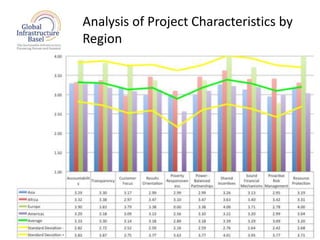
Analysis of Project Characteristics by
Region
6
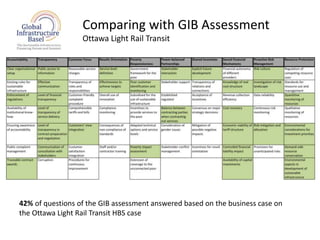
Comparing with GIB Assessment
Ottawa Light Rail Transit
7
42% of questions of the GIB assessment answered based on the business case on
the Ottawa Light Rail Transit HBS case
Comparing with GIB Assessment
TransMilenio, Bogota
8
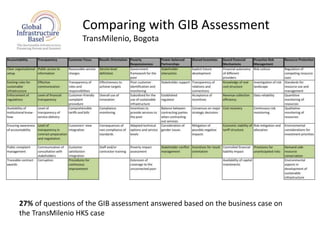
27% of questions of the GIB assessment answered based on the business case on
the TransMilenio HKS case
Comparing with GIB Assessment
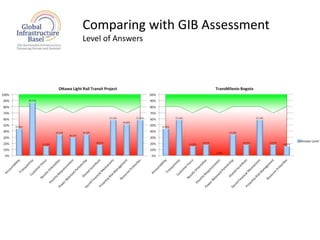
Level of Answers
9
Comparing with GIB Assessment
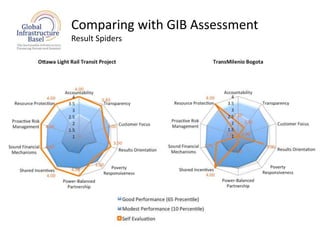
Result Spiders
10
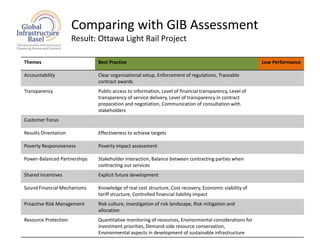
Comparing with GIB Assessment
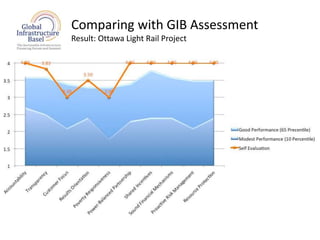
Result: Ottawa Light Rail Project
11
Comparing with GIB Assessment
Result: Ottawa Light Rail Project
12
Themes Best Practise Low Performance
Accountability Clear organisational setup, Enforcement of regulations, Traceable
contract awards
Transparency Public access to information, Level of financial transparency, Level of
transparency of service delivery, Level of transparency in contract
preparation and negotiation, Communication of consultation with
stakeholders
Customer Focus
Results Orientation Effectiveness to achieve targets
Poverty Responsiveness Poverty impact assessment
Power-Balanced Partnerships Stakeholder interaction, Balance between contracting parties when
contracting out services
Shared Incentives Explicit future development
Sound Financial Mechanisms Knowledge of real cost structure, Cost recovery, Economic viability of
tariff structure, Controlled financial liability impact
Proactive Risk Management Risk culture, Investigation of risk landscape, Risk mitigation and
allocation
Resource Protection Quantitative monitoring of resources, Environmental considerations for
investment priorities, Demand-side resource conservation,
Environmental aspects in development of sustainable infrastructure
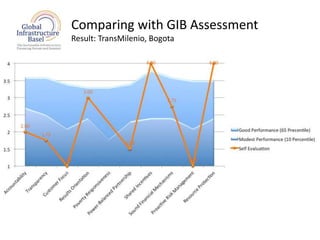
Comparing with GIB Assessment
Result: TransMilenio, Bogota
13
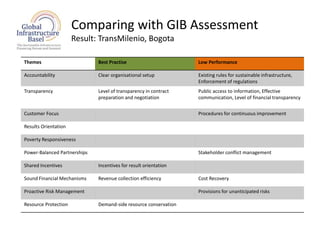
Comparing with GIB Assessment
Result: TransMilenio, Bogota
14
Themes Best Practise Low Performance
Accountability Clear organisational setup Existing rules for sustainable infrastructure,
Enforcement of regulations
Transparency Level of transparency in contract
preparation and negotiation
Public access to information, Effective
communication, Level of financial transparency
Customer Focus Procedures for continuous improvement
Results Orientation
Poverty Responsiveness
Power-Balanced Partnerships Stakeholder conflict management
Shared Incentives Incentives for result orientation
Sound Financial Mechanisms Revenue collection efficiency Cost Recovery
Proactive Risk Management Provisions for unanticipated risks
Resource Protection Demand-side resource conservation
Insights and Best Practises
15
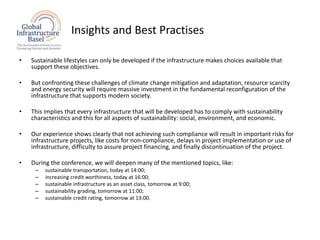
• Sustainable lifestyles can only be developed if the infrastructure makes choices available that
support these objectives.
• But confronting these challenges of climate change mitigation and adaptation, resource scarcity
and energy security will require massive investment in the fundamental reconfiguration of the
infrastructure that supports modern society.
• This implies that every infrastructure that will be developed has to comply with sustainability
characteristics and this for all aspects of sustainability: social, environment, and economic.
• Our experience shows clearly that not achieving such compliance will result in important risks for
infrastructure projects, like costs for non-compliance, delays in project implementation or use of
infrastructure, difficulty to assure project financing, and finally discontinuation of the project.
• During the conference, we will deepen many of the mentioned topics, like:
– sustainable transportation, today at 14:00;
– increasing credit worthiness, today at 16:00;
– sustainable infrastructure as an asset class, tomorrow at 9:00;
– sustainability grading, tomorrow at 11:00;
– sustainable credit rating, tomorrow at 13:00.

GIB Foundation - Financing Infrastructure Projects in Cities by André Schneider at GIB Summit

  • 1.
    Financing Infrastructure Projectsin Cities Avoiding Traps and Achieving Sustainability Global Infrastructure Basel Foundation (©) 1 GIB, May 2014 | André Schneider
  • 2.
    Guiding Principles forSustainable Infrastructure 2 • Promote sustainable development to assure that – ensure that all activities are environmentally sound, socially desirable, economically viable, and in compliance with applicable law; – ensure that multi-stakeholder processes for the resolution of conflicts are in place. • Assure equitable participatory processes to implement that – there is adequate stakeholder participation in the critical stages of the project; – there are stable, reliable and equitable partnership based on mutual trust and respect; – all consumers (men and women) will be actively informed about the sustainable infrastructure and the ensuing services; – all consumers (domestic, governmental, industrial) are treated equitably and have easy, non- discriminatory access to independent consumer rights offices assuring equitable treatment of complaints and prejudices due to non-compliance; – workers’ rights are respected. • Assure that the sustainable infrastructure and services that are safe and affordable for all parts of the population.
  • 3.
    The 10 Principles 3 •Based on the guiding principles, we have derived the following ten themes, which we can easily demonstrate that they clearly affect the performance of sustainable infrastructure projects and their governance: – Accountability – Transparency – Customer Focus – Results Orientation – Poverty Responsiveness – Power-Balanced Partnerships – Shared Incentives – Sound Financing Mechanisms – Proactive Risk Management – Resource Protection
  • 4.
    What are welooking at 4
  • 5.
    What are welooking at 5
  • 6.
    Analysis of ProjectCharacteristics by Region 6
  • 7.
    Comparing with GIBAssessment Ottawa Light Rail Transit 7 42% of questions of the GIB assessment answered based on the business case on the Ottawa Light Rail Transit HBS case
  • 8.
    Comparing with GIBAssessment TransMilenio, Bogota 8 27% of questions of the GIB assessment answered based on the business case on the TransMilenio HKS case
  • 9.
    Comparing with GIBAssessment Level of Answers 9
  • 10.
    Comparing with GIBAssessment Result Spiders 10
  • 11.
    Comparing with GIBAssessment Result: Ottawa Light Rail Project 11
  • 12.
    Comparing with GIBAssessment Result: Ottawa Light Rail Project 12 Themes Best Practise Low Performance Accountability Clear organisational setup, Enforcement of regulations, Traceable contract awards Transparency Public access to information, Level of financial transparency, Level of transparency of service delivery, Level of transparency in contract preparation and negotiation, Communication of consultation with stakeholders Customer Focus Results Orientation Effectiveness to achieve targets Poverty Responsiveness Poverty impact assessment Power-Balanced Partnerships Stakeholder interaction, Balance between contracting parties when contracting out services Shared Incentives Explicit future development Sound Financial Mechanisms Knowledge of real cost structure, Cost recovery, Economic viability of tariff structure, Controlled financial liability impact Proactive Risk Management Risk culture, Investigation of risk landscape, Risk mitigation and allocation Resource Protection Quantitative monitoring of resources, Environmental considerations for investment priorities, Demand-side resource conservation, Environmental aspects in development of sustainable infrastructure
  • 13.
    Comparing with GIBAssessment Result: TransMilenio, Bogota 13
  • 14.
    Comparing with GIBAssessment Result: TransMilenio, Bogota 14 Themes Best Practise Low Performance Accountability Clear organisational setup Existing rules for sustainable infrastructure, Enforcement of regulations Transparency Level of transparency in contract preparation and negotiation Public access to information, Effective communication, Level of financial transparency Customer Focus Procedures for continuous improvement Results Orientation Poverty Responsiveness Power-Balanced Partnerships Stakeholder conflict management Shared Incentives Incentives for result orientation Sound Financial Mechanisms Revenue collection efficiency Cost Recovery Proactive Risk Management Provisions for unanticipated risks Resource Protection Demand-side resource conservation
  • 15.
    Insights and BestPractises 15 • Sustainable lifestyles can only be developed if the infrastructure makes choices available that support these objectives. • But confronting these challenges of climate change mitigation and adaptation, resource scarcity and energy security will require massive investment in the fundamental reconfiguration of the infrastructure that supports modern society. • This implies that every infrastructure that will be developed has to comply with sustainability characteristics and this for all aspects of sustainability: social, environment, and economic. • Our experience shows clearly that not achieving such compliance will result in important risks for infrastructure projects, like costs for non-compliance, delays in project implementation or use of infrastructure, difficulty to assure project financing, and finally discontinuation of the project. • During the conference, we will deepen many of the mentioned topics, like: – sustainable transportation, today at 14:00; – increasing credit worthiness, today at 16:00; – sustainable infrastructure as an asset class, tomorrow at 9:00; – sustainability grading, tomorrow at 11:00; – sustainable credit rating, tomorrow at 13:00.

Editor's Notes

  • #2 Im Programm stehen wir mit dem Titel: Financing Infrastructure towards sustainable consumption. Sollen sie das im Programm anpassen?
  • #5 Why a grading and self-evaluation system? When we look at current and past Sustainable Infrastructure projects, we can easily see that there are recurring challenges. These are: Unmanaged or underestimated risks Challenges in financing Community involvement and acceptance Hence the GEB grading and self-evaluation approach helps to: Facilitate financing by giving a common language and understanding of project quality between project developers, general entrepreneurs, and the financers Reduce risks for all stakeholders by making them visible early on and hence allow to address them in an appropriate fashion Reduce intrinsic operational risks to the project leaders by allowing them to have a common and inclusive approach assuring support of all stakeholders
  • #6 Why a grading and self-evaluation system? When we look at current and past Sustainable Infrastructure projects, we can easily see that there are recurring challenges. These are: Unmanaged or underestimated risks Challenges in financing Community involvement and acceptance Hence the GEB grading and self-evaluation approach helps to: Facilitate financing by giving a common language and understanding of project quality between project developers, general entrepreneurs, and the financers Reduce risks for all stakeholders by making them visible early on and hence allow to address them in an appropriate fashion Reduce intrinsic operational risks to the project leaders by allowing them to have a common and inclusive approach assuring support of all stakeholders