Smart Card<br />The Most Innovative Pre-Paid Public Transportation Card<br />Table of Contents<br />Executive Summary<br />Business Description……………………………………4
Mission Statement………………………………………5
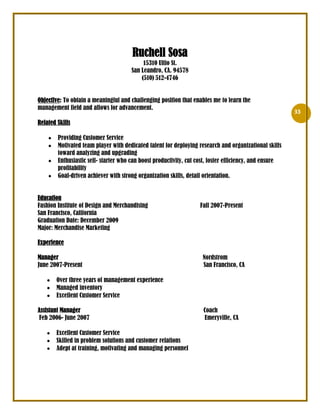
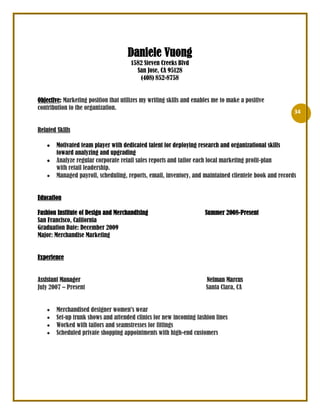
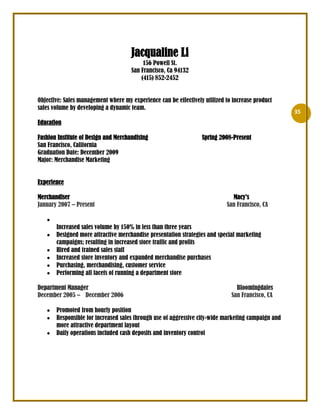
Management & Ownership…………………………… 5-6
Product of Service……………………………………... 7-8
Market Overview/ Competition/ Market Share……... 9-13
Customer Profile………………………………………. 14 -15
Financial Summary / Sales Forecast…………………. 16
Objectives & Strategy…………………………………. 17-19
Advertising & Promotion………………………………20-23
Current & Future Outlook…………………………….24
Survey…………………………………………………...25-26Financial Plan<br />Start- up Cost …………………………………………. ii
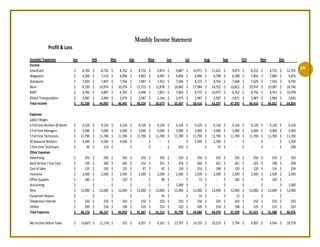
Income Statement – One year by month……………...iii
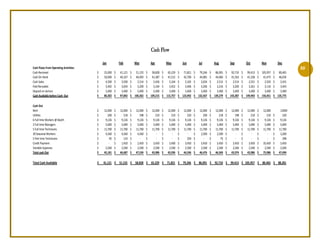
Cash Flow Statement – One year by month…………..iv
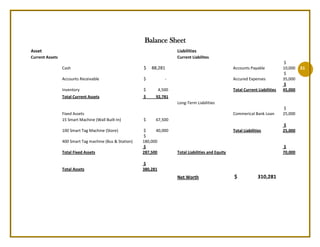
Balance Sheet – End of  year…………………………..vAppendix<br />Resume of all partners…………………………………33-35
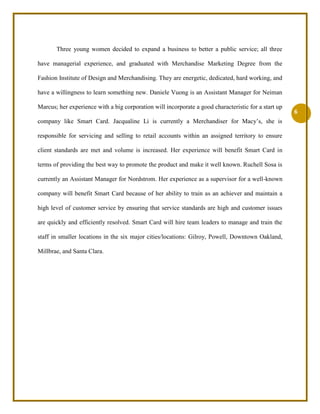
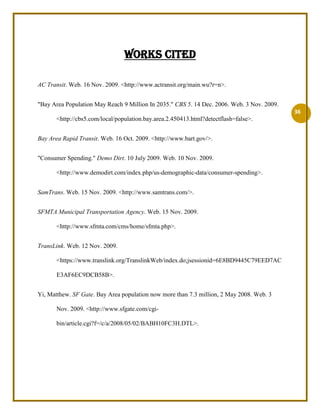
Bibliography…………………………………………….364087495438785<br />EXECUTIVE SUMMARY<br />-426085440690<br />Business Description<br />26555704730115           Smart Card is an innovative, convenient pre-paid public transportation card for those who use public transportation in their daily life. Because of Smart Card, consumers will not have to carry around loose change in order to buy their ticket to get around. Smart Card wants their customers to experience the new technology; they will be able to travel around many different cities in the Bay Area without having to worry if they have enough money or not. We carry public transportation services with SFMTA (Muni), BART, Cal Train, AC Transit and Sam Trans in addition, this card works within more than nine different cities and counties. We also have a contract with BART and Cal Train parking; by doing so, our customers can pay their parking fee without carrying change with them. Smart Card has collaborate with Walgreens and Starbucks, thus allowing consumers to easily get their coffee and grocery services.Our Mission Statement<br />    Designed to make your daily commute easy, convenient and secure, Smart Card can be used in all transit systems in the nine-county Bay Area. The new Smart Card allows you to take transit without worrying about having the exact change, carrying papers passes or tickets. Smart Card, designed to make life easier.             -293370332740<br /> <br />Management & Ownership<br />The top three founders will run Smart Card and financial decisions will be made by Daniele Vuong, Jacqualine Li, and Ruchell Sosa. We are in partnership with Bart, Muni, Cal Train, Sam Trans, AC Transit, Walgreen’s, Starbucks, Visa and MasterCard Company. There will be 30 workers hired part time in which they will earn $9.50 per hour. There will be five part time and five full time hired as technicians in which they will earn $15-$18 per hour. Advertising agency, MintSF will help Smart Card get promoted through billboards, magazines, posters and media ads. The website management company, Delta Decision Inc. will manage all the transactions and purchase orders online, and will also update and maintain the Smart Card website. Smart Card will have its own private lawyer, accountant, and banker.  <br />Three young women decided to expand a business to better a public service; all three have managerial experience, and graduated with Merchandise Marketing Degree from the Fashion Institute of Design and Merchandising. They are energetic, dedicated, hard working, and have a willingness to learn something new. Daniele Vuong is an Assistant Manager for Neiman Marcus; her experience with a big corporation will incorporate a good characteristic for a start up company like Smart Card. Jacqualine Li is currently a Merchandiser for Macy’s, she is responsible for servicing and selling to retail accounts within an assigned territory to ensure client standards are met and volume is increased. Her experience will benefit Smart Card in terms of providing the best way to promote the product and make it well known. Ruchell Sosa is currently an Assistant Manager for Nordstrom. Her experience as a supervisor for a well-known company will benefit Smart Card because of her ability to train as an achiever and maintain a high level of customer service by ensuring that service standards are high and customer issues are quickly and efficiently resolved. Smart Card will hire team leaders to manage and train the staff in smaller locations in the six major cities/locations: Gilroy, Powell, Downtown Oakland, Millbrae, and Santa Clara.<br />Product of Service<br />           Smart Card is pre-paid transportation card that provide an easier way for transportation and grocery every day. Smart Card is made in Black and Gold color with the logo on the top. The card has a built-in sensor computer chip inside to recognize each card like our Visa Card.  We sell Smart Card for $3 individually and $20 for customers who add $20 value in the card at the first time, they will get the card for free. We also provide customized card design in our official website for customers to differentiate their card, such as choosing a provided pattern or adding their own photos on the card.
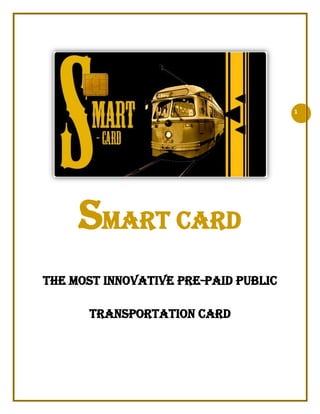
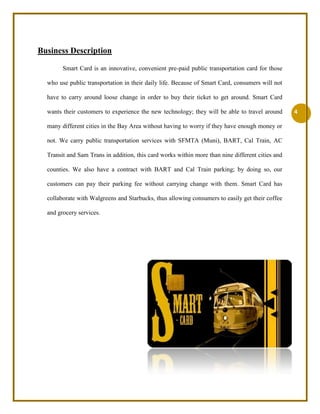
           Smart Card carries services with SFMTA (Muni), BART, Cal Trans, AC Transit and Sam Trans with more than nine different cities and counties; customers may also pay for their BART and Cal Train parking.  Customers can buy grocery in Walgreens and purchase beverages with Starbucks using our Smart Card. The wonderful thing about these cards is that each one has a built-in sensor chip; this is convenient for the consumer so that they won’t have to show their card every time they pass the gate. They can simply put it in their wallets and purses, and then tag it on our Smart Card machine and go.
              For security purpose, we have a Smart Card register program which is free for the customer to register their card online. Each card has a serial number on the back of the card that verifies the owner therefore; the customer can create their profile in our official website. When logged into their account, they can easily check their balance, add values, and sign up for service for auto load values with their credit card when the balance has less than $3. If the customer reports a loss of their card, our system will block the card immediately and replace a new card for them to pick it up in our booth locations and/or mail it directly to their home.
         When customers add value to the card, they can add money from our machines which are located in 6 main station booths, 15 other stations with Smart Card built-in Add Value Machines, and in Walgreens. Moreover, Smart Card service is not only for people who travel around with public transportation, but they are to provide grocery service for our customers too. Customers can buy grocery in Walgreens and beverages in Starbucks by simply tagging the card on our Smart Card’s machines.Market Overview / Competition / Market Share<br />Industry Analysis
Nearly every company, business, government and consumer in the world is, to some degree, dependent on the transportation industry. As such, the shipping of supplies, products and consumer goods is essential to the domestic and international economic system. Since 1998, the transportation industry has accounted for 3% of the U.S. GDP each year. The transportation industry can be broken down into three major groups of companies: Shipping, passenger transport, and equipment manufacturers. In some cases, particularly within shipping and passenger transport, companies provide services in multiple areas of the industry. Shipping companies are responsible for the transportation of supplies, and products to businesses, governments and individual consumers and operate on a global basis. The passenger transport segment provides people with the means to get anywhere on the planet, whether it is by air, sea or land. Finally, the manufacturing segment produces the trucks, planes, ships and railcars along with all the technology that allow transportation to exist in its current form. These manufacturers are just as essential to the transportation of materials and people as are the companies that transport them.
Marketplace Analysis
The San Francisco Bay Area is a metropolitan region that surrounds the San Francisco and San Pablo estuaries in Northern California. The region encompasses large cities such as San Francisco, Oakland, and San Jose, along with smaller urban and rural areas. Overall, the Bay Area consists of nine counties, 101 cities, and 7,000 square miles. The nine counties are Alameda, Contra Costa, Marin, Napa, San Francisco, San Mateo, Santa Clara, Solano, and Sonoma The Bay Area when defined as a Combined Statistical Area, is the sixth largest in the country, with approximately 7.4 million people. It encompasses the metropolitan areas of San Francisco (12th largest in the country) and San Jose (31st largest in the country), as well as four other smaller, surrounding metropolitan areas. The Bay Area hosts many cities, towns, military bases, airports, and associated regional, state, and national parks, connected by a massive network of roads, highways, railroads, bridges, tunnels and commuter rail. The combined urban area of San Francisco and San Jose is the 46th largest urban area in the world. San Francisco is the cultural and financial center of the Bay Area, and has the second highest population density of any major city in North America after New York City. San Jose is the largest city in terms of population, land area, and industrial development. Oakland is a major manufacturing and distribution center, rail terminus/hub, and has the fourth largest container shipping port in the United States. The Bay Area is renowned for its natural beauty, liberal politics, affluence, diversity, and new age reputation. The nine-county Bay Area region grew at a slightly faster rate of 1.4 percent, adding 100,443 residents for a total of more than 7.3 million people. San Francisco's population of 824,525 is the city's biggest ever, the state figures show. San Jose, which grew by 1.8 percent last year, now numbers just a shade under 1 million people - 989,496. The city of Dublin's 7.7 percent growth was the highest in the Bay Area in 2007. Only three cities in the region saw their populations shrink: St. Helena (down 0.3 percent), Yountville (0.3 percent) and Sebastopol (0.2 percent). California's overall growth means 1 in 8 Americans now lives in the state.
Competition
TransLink is a new transit fare payment system being implemented in the San Francisco Bay Area.  It utilizes a reloadable card with a dual interface, making it capable of both contact and contactless transactions. TransLink was introduced as a pilot program in 2002 by the Metropolitan Transportation Commission (MTC) to reduce the number of fare systems and help integrate transit systems in the Bay Area. TransLink is being rolled out in phases; currently five transit agencies, AC Transit, BART, Cal rain, Golden Gate Transit, and Muni accept the card on all routes except for Muni's San Francisco cable cars. TransLink is fully functional for five transit agencies:
AC Transit (including its subsidiary, Dumbarton Express) - Starting October 1, 2009, passengers will no longer be able to use paper 10-Ride and 31-Day Transbay tickets for rides across the Bay. Passengers can only obtain an AC Transit Transbay pass via TransLink, or they may pay their fares in cash. Transbay magnetic-stripe tickets will no long be accepted throughout the AC Transit service area, including lines operating over the Dumbarton and San Mateo Bridge.
Golden Gate Bridge, Highway and Transportation District's public transportation services: Golden Gate Transit & Golden Gate Ferry.
Muni (SFMTA - San Francisco Municipal Transportation Agency) - TransLink is accepted for payment throughout the Muni system except for cable cars. Customers can load both e-cash and a monthly Fast Pass onto their TransLink card. A TransLink card with a Fast Pass loaded is also good for free trips on BART within San Francisco.
BART - BART has begun a rollout of TransLink to its customers, which started on August 3, 2009 and will last for approximately five months. All TransLink cardholders are now able to use their cards on BART.
Cal Train – Cal Train has also begun use of TransLink as of August 17, 2009 with a select group of customers. While the commuter rail agency encourages people to register to participate in surveys, TransLink welcomes all cardholders to use the rail system.
The TransLink system's expansion will continue in 2010 to include the VTA network, part of which participated in the pilot program, and the SamTrans bus network, which did not participate in the pilot program at all. Finally, WHEELS, Tri-Delta Transit, WestCAT, County Connection and other smaller transit agencies which did not participate in the pilot program are expected to install TransLink on their bus and ferry lines in 2011 or later.
Important transit agencies that will not install TransLink capability include Amtrak and the Altamont Commuter Express (ACE), both of which provide rail links between Fremont and San Jose. Some VTA bus lines serving this corridor, however, have been TransLink-equipped since the start of the pilot program.
Statistics
Approximately 182,000 cards have been distributed throughout the region as of August 2009. The average number of weekday transactions in that month was 31,850. AC Transit riders accounted for about 44% of the riders using TransLink, Golden Gate Transit and Ferry accounted for 31%, Muni riders 21%, and BART and Cal Train together under 4% (both systems began accepting TransLink in August 2009).
Each transit agency has conducted surveys of its customers to determine customer satisfaction. Below are some highlights of the findings:
AC Transit: 89.9% of customers surveyed would recommend TransLink to a friend. (May 2008)
Golden Gate Transit: 85.5% of customers surveyed are satisfied or very satisfied. (October 2008)
Muni: 82.9% of customers surveyed are satisfied or very satisfied, and 92.1% would recommend TransLink to a friend. (Summer 2009)Customer Profile<br />Male/Female Age: 18-45Location: SF, Bay Area Income: $25,000Education: High school degreeAttend cultural/arts eventsOwns an Apple/Mac PCOwns an iPodOwns a smart cellularRunning/jogging as a hobby

Smart Card Business Plan

  • 1.
    Smart Card<br />TheMost Innovative Pre-Paid Public Transportation Card<br />Table of Contents<br />Executive Summary<br />Business Description……………………………………4
  • 2.
  • 3.
  • 4.
  • 5.
    Market Overview/ Competition/Market Share……... 9-13
  • 6.
  • 7.
    Financial Summary /Sales Forecast…………………. 16
  • 8.
  • 9.
  • 10.
    Current & FutureOutlook…………………………….24
  • 11.
  • 12.
    Income Statement –One year by month……………...iii
  • 13.
    Cash Flow Statement– One year by month…………..iv
  • 14.
    Balance Sheet –End of year…………………………..vAppendix<br />Resume of all partners…………………………………33-35
  • 15.
    Bibliography…………………………………………….364087495438785<br />EXECUTIVE SUMMARY<br/>-426085440690<br />Business Description<br />26555704730115 Smart Card is an innovative, convenient pre-paid public transportation card for those who use public transportation in their daily life. Because of Smart Card, consumers will not have to carry around loose change in order to buy their ticket to get around. Smart Card wants their customers to experience the new technology; they will be able to travel around many different cities in the Bay Area without having to worry if they have enough money or not. We carry public transportation services with SFMTA (Muni), BART, Cal Train, AC Transit and Sam Trans in addition, this card works within more than nine different cities and counties. We also have a contract with BART and Cal Train parking; by doing so, our customers can pay their parking fee without carrying change with them. Smart Card has collaborate with Walgreens and Starbucks, thus allowing consumers to easily get their coffee and grocery services.Our Mission Statement<br /> Designed to make your daily commute easy, convenient and secure, Smart Card can be used in all transit systems in the nine-county Bay Area. The new Smart Card allows you to take transit without worrying about having the exact change, carrying papers passes or tickets. Smart Card, designed to make life easier. -293370332740<br /> <br />Management & Ownership<br />The top three founders will run Smart Card and financial decisions will be made by Daniele Vuong, Jacqualine Li, and Ruchell Sosa. We are in partnership with Bart, Muni, Cal Train, Sam Trans, AC Transit, Walgreen’s, Starbucks, Visa and MasterCard Company. There will be 30 workers hired part time in which they will earn $9.50 per hour. There will be five part time and five full time hired as technicians in which they will earn $15-$18 per hour. Advertising agency, MintSF will help Smart Card get promoted through billboards, magazines, posters and media ads. The website management company, Delta Decision Inc. will manage all the transactions and purchase orders online, and will also update and maintain the Smart Card website. Smart Card will have its own private lawyer, accountant, and banker. <br />Three young women decided to expand a business to better a public service; all three have managerial experience, and graduated with Merchandise Marketing Degree from the Fashion Institute of Design and Merchandising. They are energetic, dedicated, hard working, and have a willingness to learn something new. Daniele Vuong is an Assistant Manager for Neiman Marcus; her experience with a big corporation will incorporate a good characteristic for a start up company like Smart Card. Jacqualine Li is currently a Merchandiser for Macy’s, she is responsible for servicing and selling to retail accounts within an assigned territory to ensure client standards are met and volume is increased. Her experience will benefit Smart Card in terms of providing the best way to promote the product and make it well known. Ruchell Sosa is currently an Assistant Manager for Nordstrom. Her experience as a supervisor for a well-known company will benefit Smart Card because of her ability to train as an achiever and maintain a high level of customer service by ensuring that service standards are high and customer issues are quickly and efficiently resolved. Smart Card will hire team leaders to manage and train the staff in smaller locations in the six major cities/locations: Gilroy, Powell, Downtown Oakland, Millbrae, and Santa Clara.<br />Product of Service<br /> Smart Card is pre-paid transportation card that provide an easier way for transportation and grocery every day. Smart Card is made in Black and Gold color with the logo on the top. The card has a built-in sensor computer chip inside to recognize each card like our Visa Card. We sell Smart Card for $3 individually and $20 for customers who add $20 value in the card at the first time, they will get the card for free. We also provide customized card design in our official website for customers to differentiate their card, such as choosing a provided pattern or adding their own photos on the card.
  • 16.
    Smart Card carries services with SFMTA (Muni), BART, Cal Trans, AC Transit and Sam Trans with more than nine different cities and counties; customers may also pay for their BART and Cal Train parking. Customers can buy grocery in Walgreens and purchase beverages with Starbucks using our Smart Card. The wonderful thing about these cards is that each one has a built-in sensor chip; this is convenient for the consumer so that they won’t have to show their card every time they pass the gate. They can simply put it in their wallets and purses, and then tag it on our Smart Card machine and go.
  • 17.
    For security purpose, we have a Smart Card register program which is free for the customer to register their card online. Each card has a serial number on the back of the card that verifies the owner therefore; the customer can create their profile in our official website. When logged into their account, they can easily check their balance, add values, and sign up for service for auto load values with their credit card when the balance has less than $3. If the customer reports a loss of their card, our system will block the card immediately and replace a new card for them to pick it up in our booth locations and/or mail it directly to their home.
  • 18.
    When customers add value to the card, they can add money from our machines which are located in 6 main station booths, 15 other stations with Smart Card built-in Add Value Machines, and in Walgreens. Moreover, Smart Card service is not only for people who travel around with public transportation, but they are to provide grocery service for our customers too. Customers can buy grocery in Walgreens and beverages in Starbucks by simply tagging the card on our Smart Card’s machines.Market Overview / Competition / Market Share<br />Industry Analysis
  • 19.
    Nearly every company,business, government and consumer in the world is, to some degree, dependent on the transportation industry. As such, the shipping of supplies, products and consumer goods is essential to the domestic and international economic system. Since 1998, the transportation industry has accounted for 3% of the U.S. GDP each year. The transportation industry can be broken down into three major groups of companies: Shipping, passenger transport, and equipment manufacturers. In some cases, particularly within shipping and passenger transport, companies provide services in multiple areas of the industry. Shipping companies are responsible for the transportation of supplies, and products to businesses, governments and individual consumers and operate on a global basis. The passenger transport segment provides people with the means to get anywhere on the planet, whether it is by air, sea or land. Finally, the manufacturing segment produces the trucks, planes, ships and railcars along with all the technology that allow transportation to exist in its current form. These manufacturers are just as essential to the transportation of materials and people as are the companies that transport them.
  • 20.
  • 21.
    The San FranciscoBay Area is a metropolitan region that surrounds the San Francisco and San Pablo estuaries in Northern California. The region encompasses large cities such as San Francisco, Oakland, and San Jose, along with smaller urban and rural areas. Overall, the Bay Area consists of nine counties, 101 cities, and 7,000 square miles. The nine counties are Alameda, Contra Costa, Marin, Napa, San Francisco, San Mateo, Santa Clara, Solano, and Sonoma The Bay Area when defined as a Combined Statistical Area, is the sixth largest in the country, with approximately 7.4 million people. It encompasses the metropolitan areas of San Francisco (12th largest in the country) and San Jose (31st largest in the country), as well as four other smaller, surrounding metropolitan areas. The Bay Area hosts many cities, towns, military bases, airports, and associated regional, state, and national parks, connected by a massive network of roads, highways, railroads, bridges, tunnels and commuter rail. The combined urban area of San Francisco and San Jose is the 46th largest urban area in the world. San Francisco is the cultural and financial center of the Bay Area, and has the second highest population density of any major city in North America after New York City. San Jose is the largest city in terms of population, land area, and industrial development. Oakland is a major manufacturing and distribution center, rail terminus/hub, and has the fourth largest container shipping port in the United States. The Bay Area is renowned for its natural beauty, liberal politics, affluence, diversity, and new age reputation. The nine-county Bay Area region grew at a slightly faster rate of 1.4 percent, adding 100,443 residents for a total of more than 7.3 million people. San Francisco's population of 824,525 is the city's biggest ever, the state figures show. San Jose, which grew by 1.8 percent last year, now numbers just a shade under 1 million people - 989,496. The city of Dublin's 7.7 percent growth was the highest in the Bay Area in 2007. Only three cities in the region saw their populations shrink: St. Helena (down 0.3 percent), Yountville (0.3 percent) and Sebastopol (0.2 percent). California's overall growth means 1 in 8 Americans now lives in the state.
  • 22.
  • 23.
    TransLink is anew transit fare payment system being implemented in the San Francisco Bay Area. It utilizes a reloadable card with a dual interface, making it capable of both contact and contactless transactions. TransLink was introduced as a pilot program in 2002 by the Metropolitan Transportation Commission (MTC) to reduce the number of fare systems and help integrate transit systems in the Bay Area. TransLink is being rolled out in phases; currently five transit agencies, AC Transit, BART, Cal rain, Golden Gate Transit, and Muni accept the card on all routes except for Muni's San Francisco cable cars. TransLink is fully functional for five transit agencies:
  • 24.
    AC Transit (includingits subsidiary, Dumbarton Express) - Starting October 1, 2009, passengers will no longer be able to use paper 10-Ride and 31-Day Transbay tickets for rides across the Bay. Passengers can only obtain an AC Transit Transbay pass via TransLink, or they may pay their fares in cash. Transbay magnetic-stripe tickets will no long be accepted throughout the AC Transit service area, including lines operating over the Dumbarton and San Mateo Bridge.
  • 25.
    Golden Gate Bridge,Highway and Transportation District's public transportation services: Golden Gate Transit & Golden Gate Ferry.
  • 26.
    Muni (SFMTA -San Francisco Municipal Transportation Agency) - TransLink is accepted for payment throughout the Muni system except for cable cars. Customers can load both e-cash and a monthly Fast Pass onto their TransLink card. A TransLink card with a Fast Pass loaded is also good for free trips on BART within San Francisco.
  • 27.
    BART - BARThas begun a rollout of TransLink to its customers, which started on August 3, 2009 and will last for approximately five months. All TransLink cardholders are now able to use their cards on BART.
  • 28.
    Cal Train –Cal Train has also begun use of TransLink as of August 17, 2009 with a select group of customers. While the commuter rail agency encourages people to register to participate in surveys, TransLink welcomes all cardholders to use the rail system.
  • 29.
    The TransLink system'sexpansion will continue in 2010 to include the VTA network, part of which participated in the pilot program, and the SamTrans bus network, which did not participate in the pilot program at all. Finally, WHEELS, Tri-Delta Transit, WestCAT, County Connection and other smaller transit agencies which did not participate in the pilot program are expected to install TransLink on their bus and ferry lines in 2011 or later.
  • 30.
    Important transit agenciesthat will not install TransLink capability include Amtrak and the Altamont Commuter Express (ACE), both of which provide rail links between Fremont and San Jose. Some VTA bus lines serving this corridor, however, have been TransLink-equipped since the start of the pilot program.
  • 31.
  • 32.
    Approximately 182,000 cardshave been distributed throughout the region as of August 2009. The average number of weekday transactions in that month was 31,850. AC Transit riders accounted for about 44% of the riders using TransLink, Golden Gate Transit and Ferry accounted for 31%, Muni riders 21%, and BART and Cal Train together under 4% (both systems began accepting TransLink in August 2009).
  • 33.
    Each transit agencyhas conducted surveys of its customers to determine customer satisfaction. Below are some highlights of the findings:
  • 34.
    AC Transit: 89.9%of customers surveyed would recommend TransLink to a friend. (May 2008)
  • 35.
    Golden Gate Transit:85.5% of customers surveyed are satisfied or very satisfied. (October 2008)
  • 36.
    Muni: 82.9% ofcustomers surveyed are satisfied or very satisfied, and 92.1% would recommend TransLink to a friend. (Summer 2009)Customer Profile<br />Male/Female Age: 18-45Location: SF, Bay Area Income: $25,000Education: High school degreeAttend cultural/arts eventsOwns an Apple/Mac PCOwns an iPodOwns a smart cellularRunning/jogging as a hobby