<<S-MArT Buddy>>DW1-05Don Sim jianqiang U065371MLin Yongqing U082431NKong Yiting U091324JXu Yifeng U098844BSee Zhi Xiang Daryl U081958J
Overview and reasonTechnology description:     To inculcate healthy eating habits via raising awareness of user’s food choices Reason for this technology:What it should help with?Unhealthy eating trend among SingaporeansWhy it is important?Colon Cancer
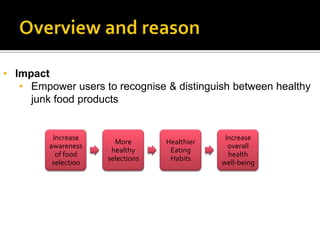
Overview and reasonImpact
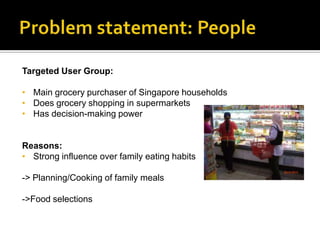
Empower users to recognise & distinguish between healthy junk food productsProblem statement: People	Targeted User Group:Main grocery purchaser of Singapore households
Does grocery shopping in supermarkets
Has decision-making powerReasons:Strong influence over family eating habits-> Planning/Cooking of family meals ->Food selections
Problem statement: ActivitiesTargeted Activity: Buying any food from the supermarket.
Happens on a regular basis.
Activity that can be interrupted
Can be carried out alone or with othersReasonsSingaporeans are taking in an excess of unhealthy nutrients
By giving relevant information on what they buy, there is greater chance of changing their dieting habits.
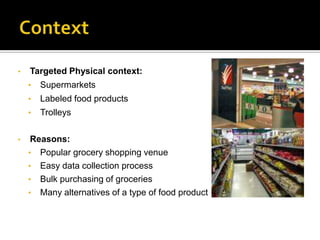
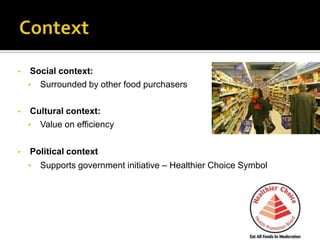
Difficulty in making healthier choices. ContextTargeted Physical context:
Supermarkets
Labeled food products

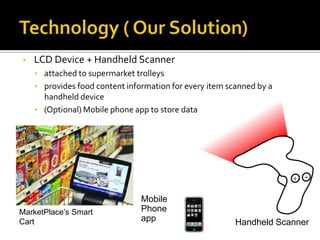
S-MART BUDDY

Editor's Notes

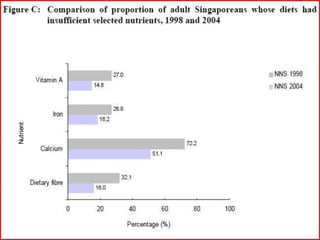
  • #3 Our mHealth device is something that promotes healthy eating, by helping users choose what&apos;s healthy and what&apos;s not when they&apos;re shopping in the supermarkets. Unhealthy eating habits can lead to health problems, such as colon cancer and gout. But as you can see, Singaporeans don&apos;t exactly have the healthiest diets. (graphs on excess intake, and too little nutrients)We either take too much of certain nutrients, or too little. Our device will help with this problem, by alerting users if the stuff they&apos;ve selected doesn&apos;t reflect a balanced diet, whether there&apos;s too much junk food, or too much fat, etc.
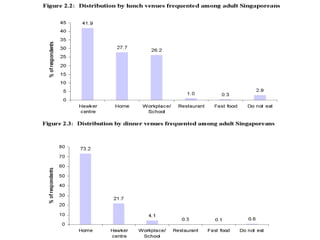
  • #4 · Targeted user group:Our device is targeted at adults who are the main grocery purchasers in their households. They do their shopping in supermarkets, and from what they buy, determine what their family members will be consuming at home.· Reasons:Strong Influence Over Family Eating Habits – The HPB did a survey in 2004 that showed that the majority of Singaporeans take their meals at home, especially for breakfast and dinner. So the main grocery purchaser has great influence on what their families are eating, and if we&apos;re able to help them select healthy foods in the supermarkets, as well as recommend healthy recipes, we&apos;ll be making substantial impact on Singaporeans&apos; diets.
  • #5 · Targeted user group:Our device is targeted at adults who are the main grocery purchasers in their households. They do their shopping in supermarkets, and from what they buy, determine what their family members will be consuming at home.· Reasons:Strong Influence Over Family Eating Habits – The HPB did a survey in 2004 that showed that the majority of Singaporeans take their meals at home, especially for breakfast and dinner. So the main grocery purchaser has great influence on what their families are eating, and if we&apos;re able to help them select healthy foods in the supermarkets, as well as recommend healthy recipes, we&apos;ll be making substantial impact on Singaporeans&apos; diets.
  • #6 You may ask what link is there healthy food selections and health eating habits? According to the 2004 Nutrition Survey by Health Promotion Board, a large proportion of Singaporeans take their meals at home especially for breakfast and dinner (as shown by these 2 graphs). This shows if healthier food selections are made, a great influence will be exerted over Singaporean’s eating habits.
  • #7 Description of targeted activityWe have noticed that shoppers in supermarkets tend to buy processed food without looking at the nutrition labels or take special note whether the product has been labeled with the healthier choice label. Our device is targeted at the activity of making choices when buying food in the supermarket. This activity can be frequent or infrequent depending on the habits of the users. The activity of shopping is one that can be interrupted, therefore the device has to be able to allow the user to resume even after being interrupted. When shopping, the user can either be alone or with their families, thus this activity does involve a certain amount of awareness of the other members of their family, the need to shop for their family also applies in this instance. Reasons1) Singaporeans are taking in an excess of unhealthy nutrientsAs can be seen from this graph taken from the Health Promotion Board’s 2004 Nutrition Survey, there is a trend towards people eating too much of unhealthy nutrients like Fats and Cholesterol. On the other side of the spectrum, they are taking in insufficient amounts of nutrients that are healthy. 2) By giving guidance for what they buy, there is greater chance of changing their dieting habits. From a previous slide, it can be seen that a large number of Singaporeans eat at least 2 meals at home. By changing the buying habits of consumers, we hope that it will change their eating habits as well. 3) Difficulty in making healthier choices. 94% of the people we surveyed indicated that they do not look for the healthier choice labeling when shopping for food. The problems within this activity being that they are unable to make well-informed choices due to the fact that it is sometimes difficult to comprehend the information presented.
  • #8 Description of targeted activityWe have noticed that shoppers in supermarkets tend to buy processed food without looking at the nutrition labels or take special note whether the product has been labeled with the healthier choice label. Our device is targeted at the activity of making choices when buying food in the supermarket. This activity can be frequent or infrequent depending on the habits of the users. The activity of shopping is one that can be interrupted, therefore the device has to be able to allow the user to resume even after being interrupted. When shopping, the user can either be alone or with their families, thus this activity does involve a certain amount of awareness of the other members of their family, the need to shop for their family also applies in this instance. Reasons1) Singaporeans are taking in an excess of unhealthy nutrientsAs can be seen from this graph taken from the Health Promotion Board’s 2004 Nutrition Survey, there is a trend towards people eating too much of unhealthy nutrients like Fats and Cholesterol. On the other side of the spectrum, they are taking in insufficient amounts of nutrients that are healthy. 2) By giving guidance for what they buy, there is greater chance of changing their dieting habits. From a previous slide, it can be seen that a large number of Singaporeans eat at least 2 meals at home. By changing the buying habits of consumers, we hope that it will change their eating habits as well. 3) Difficulty in making healthier choices. 94% of the people we surveyed indicated that they do not look for the healthier choice labeling when shopping for food. The problems within this activity being that they are unable to make well-informed choices due to the fact that it is sometimes difficult to comprehend the information presented.