ANATOMY OF INGUINAL CANAL
Dr.Avinash.D
DNB RESIDENT (GEN.SURGERY)
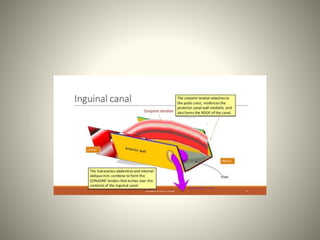
Inguinal canal
• It is an oblique intermuscular passage in the
lower part of the anterior abdominal wall ,
Situated just above medial half of inguinal
ligament .
• The canals are approximately 3.75 to 4 cm
long.
• It is directed downward, forward & medially:
• Extending from deep inguinal ring to
superficial inguinal ring.
• Deep (Internal) inguinal ring : oval shaped opening in
fascia transversalis - Situated 1/2 inch above mid point of
inguinal ligament lateral to inferior epigastric artery .
• Superficial inguinal ring :
• Is a triangular gap in the external oblique aponeurosis .
• It is shaped like an obtuse angled triangle .
It is found within the aponeurosis of the external oblique,
immediately above the pubic crest, 1 centimeter above and
superolateral to the pubic tubercle. It has the following
boundaries—medial crura by pubic crest, lateral crura by
pubic tubercle and inferiorly by inguinal ligament
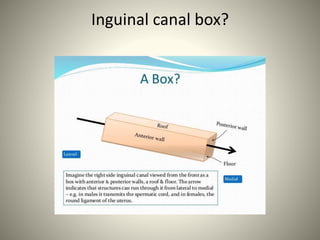
Inguinal canal box?
Anterior wall of inguinal canal
• In its whole extent
– Skin
– Superficial fascia
– External oblique aponeurosis
• In its lateral one-third
– The fleshy fibres of the internal oblique muscle
Roof of Inguinal Canal
• It is formed by the arched fibres of the
internal oblique and transverse abdominis
muscles.
Floor of the inguinal canal
• The floor is formed by an incurving of the
inguinal ligament, which is part of the external
oblique muscle, forming a gutter. (Medially it
forms the lacunar ligament).
The Posterior Wall
1. In its whole extent
• a. The fascia transversalis
• b. The extra peritoneal tissue
• c. The parietal peritoneum.
2. In its medial two-thirds
• a. The conjoint tendon
• b. At its medial end by the reflected part of
the inguinal ligament.
Structures passing through inguinal
canal
• The spermatic cord in males, or the round
ligament of the uterus in females, enters the
inguinal canal through the deep inguinal ring and
passes out through the superficial inguinal ring.
• The ilioinguinal nerve enters the canal through
the interval between the external and internal
oblique muscles and passes out through the
superficial inguinal ring.
Constituents of Spermatic Cord
• Vas Deferens
• Arteries
– Testicular Artery
– Cremasteric Artery
– Artery of Vas Deferens
• Pampiniform plexus of veins
• Lymph Vessels from Testis
• Genital Branch of Genitofemoral Nerve
• Sympathetic Nerve Plexus around Artery of Vas
Deferens
Coverings of Spermatic Cord
• The spermatic cord is ensheathed in three layers
of tissue:
• external spermatic fascia, an extension of
the innominate fascia that overlies
the aponeurosis of the external oblique muscle
• cremasteric muscle and fascia, formed from a
continuation of the internal oblique muscle and
its fascia
• internal spermatic fascia, continuous with
the transversalis fascia
Mechanisms maintaining integrity of
canal
Anatomical :
• 1. Obliquity of the canal as the superficial ring
&the deep ring don't lie opposite each other so
when intra-abdominal pressure increases
approximation of anterior & posterior wall
closure of the canal — flap valve mechanism
• 2. The superficial ring supported posterior by
conjoint tendon &reflected ligament.
• 3. The deep ring supported anterior by fleshy
fibers of internal oblique muscles
B. Physiological :
• 1.Contraction of the external oblique results in
approximation of the 2 crura of the superficial
ring - slit valve mechanism.
• 2. Contraction of the arching fibers of internal
oblique makes it straight & approximated to the
fibers of the canal like a shutter -shutter
mechanism.
• 3. Contraction of the cremastric muscle helps the
spermatic cord to plug the superficial inguinal
ring — ball valve mechanism.
• Disturbance of these factors - predispose to
inguinal hernia
Why inguinal canal ?
• Allows communication of scrotal contents
with the abdomen .
• Prevents mobile inta abdominal contents from
entering scrotum and possibility of damage .
Hesselbacks triangle
Thank you all !

inguinal hernia anatomy

  • 1.
    ANATOMY OF INGUINALCANAL Dr.Avinash.D DNB RESIDENT (GEN.SURGERY)
  • 3.
    Inguinal canal • Itis an oblique intermuscular passage in the lower part of the anterior abdominal wall , Situated just above medial half of inguinal ligament .
  • 4.
    • The canalsare approximately 3.75 to 4 cm long. • It is directed downward, forward & medially: • Extending from deep inguinal ring to superficial inguinal ring.
  • 5.
    • Deep (Internal)inguinal ring : oval shaped opening in fascia transversalis - Situated 1/2 inch above mid point of inguinal ligament lateral to inferior epigastric artery . • Superficial inguinal ring : • Is a triangular gap in the external oblique aponeurosis . • It is shaped like an obtuse angled triangle . It is found within the aponeurosis of the external oblique, immediately above the pubic crest, 1 centimeter above and superolateral to the pubic tubercle. It has the following boundaries—medial crura by pubic crest, lateral crura by pubic tubercle and inferiorly by inguinal ligament
  • 6.
  • 8.
    Anterior wall ofinguinal canal • In its whole extent – Skin – Superficial fascia – External oblique aponeurosis • In its lateral one-third – The fleshy fibres of the internal oblique muscle
  • 10.
    Roof of InguinalCanal • It is formed by the arched fibres of the internal oblique and transverse abdominis muscles.
  • 12.
    Floor of theinguinal canal • The floor is formed by an incurving of the inguinal ligament, which is part of the external oblique muscle, forming a gutter. (Medially it forms the lacunar ligament).
  • 14.
    The Posterior Wall 1.In its whole extent • a. The fascia transversalis • b. The extra peritoneal tissue • c. The parietal peritoneum. 2. In its medial two-thirds • a. The conjoint tendon • b. At its medial end by the reflected part of the inguinal ligament.
  • 16.
    Structures passing throughinguinal canal • The spermatic cord in males, or the round ligament of the uterus in females, enters the inguinal canal through the deep inguinal ring and passes out through the superficial inguinal ring. • The ilioinguinal nerve enters the canal through the interval between the external and internal oblique muscles and passes out through the superficial inguinal ring.
  • 17.
    Constituents of SpermaticCord • Vas Deferens • Arteries – Testicular Artery – Cremasteric Artery – Artery of Vas Deferens • Pampiniform plexus of veins • Lymph Vessels from Testis • Genital Branch of Genitofemoral Nerve • Sympathetic Nerve Plexus around Artery of Vas Deferens
  • 18.
    Coverings of SpermaticCord • The spermatic cord is ensheathed in three layers of tissue: • external spermatic fascia, an extension of the innominate fascia that overlies the aponeurosis of the external oblique muscle • cremasteric muscle and fascia, formed from a continuation of the internal oblique muscle and its fascia • internal spermatic fascia, continuous with the transversalis fascia
  • 20.
    Mechanisms maintaining integrityof canal Anatomical : • 1. Obliquity of the canal as the superficial ring &the deep ring don't lie opposite each other so when intra-abdominal pressure increases approximation of anterior & posterior wall closure of the canal — flap valve mechanism • 2. The superficial ring supported posterior by conjoint tendon &reflected ligament. • 3. The deep ring supported anterior by fleshy fibers of internal oblique muscles
  • 21.
    B. Physiological : •1.Contraction of the external oblique results in approximation of the 2 crura of the superficial ring - slit valve mechanism. • 2. Contraction of the arching fibers of internal oblique makes it straight & approximated to the fibers of the canal like a shutter -shutter mechanism. • 3. Contraction of the cremastric muscle helps the spermatic cord to plug the superficial inguinal ring — ball valve mechanism.
  • 22.
    • Disturbance ofthese factors - predispose to inguinal hernia
  • 23.
    Why inguinal canal? • Allows communication of scrotal contents with the abdomen . • Prevents mobile inta abdominal contents from entering scrotum and possibility of damage .
  • 24.
  • 25.