BY: A1 GROUP
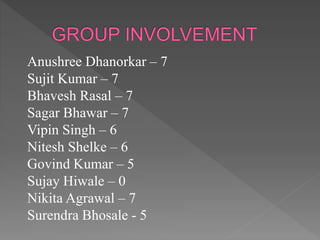
Anushree Dhanorkar – 7
Sujit Kumar – 7
Bhavesh Rasal – 7
Sagar Bhawar – 7
Vipin Singh – 6
Nitesh Shelke – 6
Govind Kumar – 5
Sujay Hiwale – 0
Nikita Agrawal – 7
Surendra Bhosale - 5
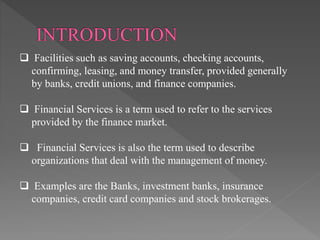
 Facilities such as saving accounts, checking accounts,
confirming, leasing, and money transfer, provided generally
by banks, credit unions, and finance companies.
 Financial Services is a term used to refer to the services
provided by the finance market.
 Financial Services is also the term used to describe
organizations that deal with the management of money.
 Examples are the Banks, investment banks, insurance
companies, credit card companies and stock brokerages.
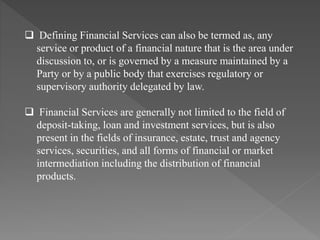
 Defining Financial Services can also be termed as, any
service or product of a financial nature that is the area under
discussion to, or is governed by a measure maintained by a
Party or by a public body that exercises regulatory or
supervisory authority delegated by law.
 Financial Services are generally not limited to the field of
deposit-taking, loan and investment services, but is also
present in the fields of insurance, estate, trust and agency
services, securities, and all forms of financial or market
intermediation including the distribution of financial
products.
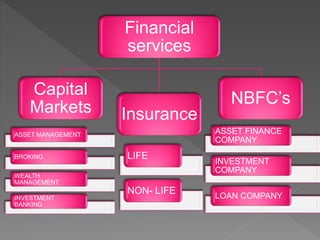
Financial
services
Capital
Markets Insurance
NBFC’s
ASSET MANAGEMENT
BROKING
WEALTH
MANAGEMENT
INVESTMENT
BANKING
ASSET FINANCE
COMPANY
INVESTMENT
COMPANY
LOAN COMPANY
LIFE
NON- LIFE
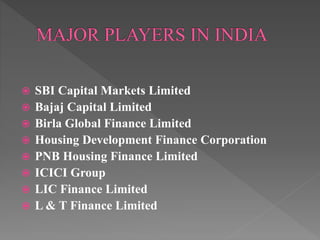
 SBI Capital Markets Limited
 Bajaj Capital Limited
 Birla Global Finance Limited
 Housing Development Finance Corporation
 PNB Housing Finance Limited
 ICICI Group
 LIC Finance Limited
 L & T Finance Limited
 FISHER INVESTMENTS
 SUSQUEHANNA INTERNATIONAL GROUP
 GOLDMAN SACHS
 AMERICAN EXPRESS
 GENERAL ELECTRIC
 MERRILL LYNCH
 T. ROWE PRICE
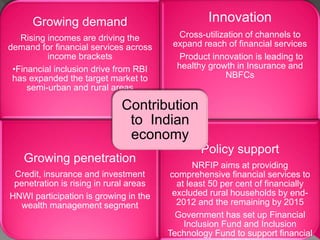
Growing demand
Rising incomes are driving the
demand for financial services across
income brackets
•Financial inclusion drive from RBI
has expanded the target market to
semi-urban and rural areas
Innovation
Cross-utilization of channels to
expand reach of financial services
Product innovation is leading to
healthy growth in Insurance and
NBFCs
Growing penetration
Credit, insurance and investment
penetration is rising in rural areas
HNWI participation is growing in the
wealth management segment
Policy support
NRFIP aims at providing
comprehensive financial services to
at least 50 per cent of financially
excluded rural households by end-
2012 and the remaining by 2015
Government has set up Financial
Inclusion Fund and Inclusion
Technology Fund to support financial
Contribution
to Indian
economy
 RESERVE BANK OF INDIA
 SECURITY EXCHANGE BOARD OF INDIA
 FORWARD MARKET COMMISSION IN
INDIA
 INSURANCE REGULATORYAND
DEVELOPMENT AUTHORITY IN INDIA
 PENSION FUND REGULATORYAND
DEVELOPMENT AUTHORITY
 Present market scenario of Financial planning services in India - In
emerging phase... No regulator, No act, only professional body
FPSB India is present for CFP ( Analysis by Financial planner )
 Presently in India, in case you want to sell financial products like
mutual funds, Insurance you need to have appropriate
license/certification from regulators like SEBI/AMFI, IRDA etc.
 Many such license holders have started promoting themselves as
Financial Planner without any financial planning certification/s,
education, as there is no regulation, government body, or act in
India (which can be observed in above picture ) to promote
financial planning service.
 Professional body - FPSB India has brought CFP certification
in India, which is known as gold standard in financial
planning globally.
 Just for information to get CFP certification ( 5 modules -
Insurance planning, Retirement planning & employee
benefits, Investment planning, Tax & estate planning,
Advanced financial planning ), one has to spend nearly
Rs.50,000 for education & examination.
 One of the diversified financial service company of U.S. (
having revenue of Rs.60,000 crores ) have also started
operation in India (Jan-2012) to offer Financial planning and
advisory services.There target clients are having income of
Rs. 20 lacs and Rs. 60 lacs. They serve client who can save
from Rs.5 lacs to Rs. 1 crore! There revenue streams are fees
plus commission.
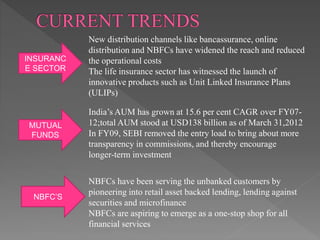
INSURANC
E SECTOR
MUTUAL
FUNDS
NBFC’S
New distribution channels like bancassurance, online
distribution and NBFCs have widened the reach and reduced
the operational costs
The life insurance sector has witnessed the launch of
innovative products such as Unit Linked Insurance Plans
(ULIPs)
India’s AUM has grown at 15.6 per cent CAGR over FY07-
12;total AUM stood at USD138 billion as of March 31,2012
In FY09, SEBI removed the entry load to bring about more
transparency in commissions, and thereby encourage
longer-term investment
NBFCs have been serving the unbanked customers by
pioneering into retail asset backed lending, lending against
securities and microfinance
NBFCs are aspiring to emerge as a one-stop shop for all
financial services
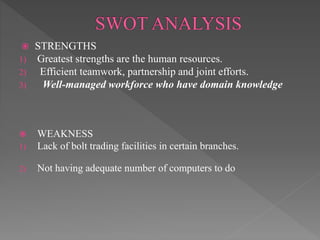
 STRENGTHS
1) Greatest strengths are the human resources.
2) Efficient teamwork, partnership and joint efforts.
3) Well-managed workforce who have domain knowledge
 WEAKNESS
1) Lack of bolt trading facilities in certain branches.
2) Not having adequate number of computers to do
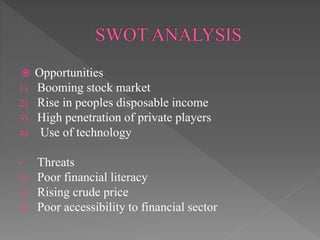
 Opportunities
1) Booming stock market
2) Rise in peoples disposable income
3) High penetration of private players
4) Use of technology
• Threats
1) Poor financial literacy
2) Rising crude price
3) Poor accessibility to financial sector
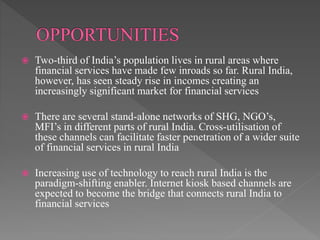
 Two-third of India’s population lives in rural areas where
financial services have made few inroads so far. Rural India,
however, has seen steady rise in incomes creating an
increasingly significant market for financial services
 There are several stand-alone networks of SHG, NGO’s,
MFI’s in different parts of rural India. Cross-utilisation of
these channels can facilitate faster penetration of a wider suite
of financial services in rural India
 Increasing use of technology to reach rural India is the
paradigm-shifting enabler. Internet kiosk based channels are
expected to become the bridge that connects rural India to
financial services
 Rural credit segment is a large market, which can be
tapped by ensuring timely loans which are critical to
agricultural sector
 Self Help Groups and NGOs are useful vehicles to make
inroads into rural India Safe investment options have a
potential to tap into rural household savings
 Safe investment options have a potential to tap into rural
household savings
 Some private players are coming up with innovative
products like third-party money market mutual funds to
cater to rural investment needs
 Agricultural, livestock and weather insurance are
potentially large markets in rural India
Harnessing existing networks of MFIs, NGOs can speed
up the process
India is one of the fastest growing wealth management markets in the world
→The HNWI population in India is young and therefore more receptive towards
sophisticated financial products
→In addition to over 50,000 HNWIs with USD200 billion worth of assets, India
has over 2.5 million wealthy individuals whose liquid assets are close to another
USD500 billion
The regulatory environment for fiduciary duties in wealth management is
evolving; players will benefit greatly from quickly adopting new investor
protection measures
•Brand building coupled with partnership based model will improve the advisory
penetration. Greater focus on transparency will speed up the process
•Investment in required technologies, imbibing state-of-the-art best practices of
advisory and creating customized and innovative products will enable growth
 Stock Market, Brokerage House & Mutual Funds
Lead Job Providers …….
 Financial services outpaced the IT sector in Tier II and Tier
III cities in terms of providing maximum jobs to young
aspirants.
- ASSOCHAM
 The financial services is also the second highest job offering
sector among the total top ten sectors in the total 60 cities
tracked for the study comprising Tier I, Tier II and Tier III
cities. It has contributed a share of 26.35 per cent in providing
maximum employment opportunities.
 TOTAL % OF JOBS CREATED IN FINANCIAL SERVICE
SECTOR - 26.35 % JOBS
 THE STOCK MARKET, BROKERAGE HOUSES AND
MUTUAL FUNDS - 35.44 % JOBS
 INSURANCE SECTOR - 34.22 % JOBS
 BANKING SECTOR - 30.34 % JOBS
THANK YOU

Financial Services in India

  • 1.
  • 2.
    Anushree Dhanorkar –7 Sujit Kumar – 7 Bhavesh Rasal – 7 Sagar Bhawar – 7 Vipin Singh – 6 Nitesh Shelke – 6 Govind Kumar – 5 Sujay Hiwale – 0 Nikita Agrawal – 7 Surendra Bhosale - 5
  • 3.
     Facilities suchas saving accounts, checking accounts, confirming, leasing, and money transfer, provided generally by banks, credit unions, and finance companies.  Financial Services is a term used to refer to the services provided by the finance market.  Financial Services is also the term used to describe organizations that deal with the management of money.  Examples are the Banks, investment banks, insurance companies, credit card companies and stock brokerages.
  • 4.
     Defining FinancialServices can also be termed as, any service or product of a financial nature that is the area under discussion to, or is governed by a measure maintained by a Party or by a public body that exercises regulatory or supervisory authority delegated by law.  Financial Services are generally not limited to the field of deposit-taking, loan and investment services, but is also present in the fields of insurance, estate, trust and agency services, securities, and all forms of financial or market intermediation including the distribution of financial products.
  • 5.
  • 6.
     SBI CapitalMarkets Limited  Bajaj Capital Limited  Birla Global Finance Limited  Housing Development Finance Corporation  PNB Housing Finance Limited  ICICI Group  LIC Finance Limited  L & T Finance Limited
  • 7.
     FISHER INVESTMENTS SUSQUEHANNA INTERNATIONAL GROUP  GOLDMAN SACHS  AMERICAN EXPRESS  GENERAL ELECTRIC  MERRILL LYNCH  T. ROWE PRICE
  • 8.
    Growing demand Rising incomesare driving the demand for financial services across income brackets •Financial inclusion drive from RBI has expanded the target market to semi-urban and rural areas Innovation Cross-utilization of channels to expand reach of financial services Product innovation is leading to healthy growth in Insurance and NBFCs Growing penetration Credit, insurance and investment penetration is rising in rural areas HNWI participation is growing in the wealth management segment Policy support NRFIP aims at providing comprehensive financial services to at least 50 per cent of financially excluded rural households by end- 2012 and the remaining by 2015 Government has set up Financial Inclusion Fund and Inclusion Technology Fund to support financial Contribution to Indian economy
  • 9.
     RESERVE BANKOF INDIA  SECURITY EXCHANGE BOARD OF INDIA  FORWARD MARKET COMMISSION IN INDIA  INSURANCE REGULATORYAND DEVELOPMENT AUTHORITY IN INDIA  PENSION FUND REGULATORYAND DEVELOPMENT AUTHORITY
  • 10.
     Present marketscenario of Financial planning services in India - In emerging phase... No regulator, No act, only professional body FPSB India is present for CFP ( Analysis by Financial planner )  Presently in India, in case you want to sell financial products like mutual funds, Insurance you need to have appropriate license/certification from regulators like SEBI/AMFI, IRDA etc.  Many such license holders have started promoting themselves as Financial Planner without any financial planning certification/s, education, as there is no regulation, government body, or act in India (which can be observed in above picture ) to promote financial planning service.
  • 11.
     Professional body- FPSB India has brought CFP certification in India, which is known as gold standard in financial planning globally.  Just for information to get CFP certification ( 5 modules - Insurance planning, Retirement planning & employee benefits, Investment planning, Tax & estate planning, Advanced financial planning ), one has to spend nearly Rs.50,000 for education & examination.  One of the diversified financial service company of U.S. ( having revenue of Rs.60,000 crores ) have also started operation in India (Jan-2012) to offer Financial planning and advisory services.There target clients are having income of Rs. 20 lacs and Rs. 60 lacs. They serve client who can save from Rs.5 lacs to Rs. 1 crore! There revenue streams are fees plus commission.
  • 12.
    INSURANC E SECTOR MUTUAL FUNDS NBFC’S New distributionchannels like bancassurance, online distribution and NBFCs have widened the reach and reduced the operational costs The life insurance sector has witnessed the launch of innovative products such as Unit Linked Insurance Plans (ULIPs) India’s AUM has grown at 15.6 per cent CAGR over FY07- 12;total AUM stood at USD138 billion as of March 31,2012 In FY09, SEBI removed the entry load to bring about more transparency in commissions, and thereby encourage longer-term investment NBFCs have been serving the unbanked customers by pioneering into retail asset backed lending, lending against securities and microfinance NBFCs are aspiring to emerge as a one-stop shop for all financial services
  • 13.
     STRENGTHS 1) Greateststrengths are the human resources. 2) Efficient teamwork, partnership and joint efforts. 3) Well-managed workforce who have domain knowledge  WEAKNESS 1) Lack of bolt trading facilities in certain branches. 2) Not having adequate number of computers to do
  • 14.
     Opportunities 1) Boomingstock market 2) Rise in peoples disposable income 3) High penetration of private players 4) Use of technology • Threats 1) Poor financial literacy 2) Rising crude price 3) Poor accessibility to financial sector
  • 15.
     Two-third ofIndia’s population lives in rural areas where financial services have made few inroads so far. Rural India, however, has seen steady rise in incomes creating an increasingly significant market for financial services  There are several stand-alone networks of SHG, NGO’s, MFI’s in different parts of rural India. Cross-utilisation of these channels can facilitate faster penetration of a wider suite of financial services in rural India  Increasing use of technology to reach rural India is the paradigm-shifting enabler. Internet kiosk based channels are expected to become the bridge that connects rural India to financial services
  • 16.
     Rural creditsegment is a large market, which can be tapped by ensuring timely loans which are critical to agricultural sector  Self Help Groups and NGOs are useful vehicles to make inroads into rural India Safe investment options have a potential to tap into rural household savings  Safe investment options have a potential to tap into rural household savings  Some private players are coming up with innovative products like third-party money market mutual funds to cater to rural investment needs  Agricultural, livestock and weather insurance are potentially large markets in rural India Harnessing existing networks of MFIs, NGOs can speed up the process
  • 17.
    India is oneof the fastest growing wealth management markets in the world →The HNWI population in India is young and therefore more receptive towards sophisticated financial products →In addition to over 50,000 HNWIs with USD200 billion worth of assets, India has over 2.5 million wealthy individuals whose liquid assets are close to another USD500 billion The regulatory environment for fiduciary duties in wealth management is evolving; players will benefit greatly from quickly adopting new investor protection measures •Brand building coupled with partnership based model will improve the advisory penetration. Greater focus on transparency will speed up the process •Investment in required technologies, imbibing state-of-the-art best practices of advisory and creating customized and innovative products will enable growth
  • 18.
     Stock Market,Brokerage House & Mutual Funds Lead Job Providers …….  Financial services outpaced the IT sector in Tier II and Tier III cities in terms of providing maximum jobs to young aspirants. - ASSOCHAM
  • 19.
     The financialservices is also the second highest job offering sector among the total top ten sectors in the total 60 cities tracked for the study comprising Tier I, Tier II and Tier III cities. It has contributed a share of 26.35 per cent in providing maximum employment opportunities.  TOTAL % OF JOBS CREATED IN FINANCIAL SERVICE SECTOR - 26.35 % JOBS  THE STOCK MARKET, BROKERAGE HOUSES AND MUTUAL FUNDS - 35.44 % JOBS  INSURANCE SECTOR - 34.22 % JOBS  BANKING SECTOR - 30.34 % JOBS
  • 20.