MODULE 3: NON-BANKING
FINANCIAL INSTITUTIONS
• Meaning, Registration, Principal Business of NBFCs, Structure,
Supervision, RBI
• Measures for NBFCs, Other Measures.
Meaning
• A Non-Banking Financial Company (NBFC) is a company registered under the
Companies Act, 1956 engaged in the business of loans and advances,
acquisition of shares/stocks/bonds/debentures/securities issued by
Government or local authority or other marketable securities of a like
nature, leasing, hire-purchase, insurance business, chit business but does not
include any institution whose principal business is that of agriculture activity,
industrial activity, purchase or sale of any goods (other than securities) or
providing any services and sale/purchase/construction of immovable
property. A non-banking institution which is a company and has principal
business of receiving deposits under any scheme or arrangement in one
lump sum or in installments by way of contributions or in any other manner,
is also a non-banking financial company (Residuary non-banking company).
NBFCs are doing functions similar to banks.
What is difference between banks & NBFCs?
NBFCs lend and make investments and hence their activities are akin to
that of banks; however there are a few differences as given below:
• i. NBFC cannot accept demand deposits;
• ii. NBFCs do not form part of the payment and settlement system and
cannot issue cheques drawn on itself;
• iii. deposit insurance facility of Deposit Insurance and Credit
Guarantee Corporation is not available to depositors of NBFCs, unlike
in case of banks.
Principal Business of NBFCs
• Financial activity as principal business is when a company’s financial assets
constitute more than 50 per cent of the total assets and income from financial
assets constitute more than 50 per cent of the gross income. A company which
fulfils both these criteria will be registered as NBFC by RBI. The term 'principal
business' is not defined by the Reserve Bank of India Act. The Reserve Bank has
defined it so as to ensure that only companies predominantly engaged in financial
activity get registered with it and are regulated and supervised by it. Hence if
there are companies engaged in agricultural operations, industrial activity,
purchase and sale of goods, providing services or purchase, sale or construction of
immovable property as their principal business and are doing some financial
business in a small way, they will not be regulated by the Reserve Bank.
Interestingly, this test is popularly known as 50-50 test and is applied to determine
whether or not a company is into financial business.
Registration
• In terms of Section 45-IA of the RBI Act, 1934, no Non-banking Financial company
can commence or carry on business of a non-banking financial institution without
a) obtaining a certificate of registration from the Bank and without having a Net
Owned Funds of ₹ 25 lakhs (₹ Two crore since April 1999). However, in terms of
the powers given to the Bank, to obviate dual regulation, certain categories of
NBFCs which are regulated by other regulators are exempted from the
requirement of registration with RBI viz. Venture Capital Fund/Merchant Banking
companies/Stock broking companies registered with SEBI, Insurance Company
holding a valid Certificate of Registration issued by IRDA, Nidhi companies as
notified under Section 620A of the Companies Act, 1956, Chit companies as
defined in clause (b) of Section 2 of the Chit Funds Act, 1982,Housing Finance
Companies regulated by National Housing Bank, Stock Exchange or a Mutual
Benefit company.
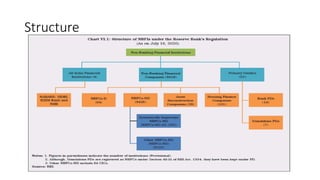
Structure
D= Deposits: ND: No Deposits
• Asset Finance Company (AFC) : An AFC is a company which is a financial institution
carrying on as its principal business the financing of physical assets supporting
productive/economic activity, such as automobiles, tractors, lathe machines, generator
sets, earth moving and material handling equipments, moving on own power and
general purpose industrial machines. Principal business for this purpose is defined as
aggregate of financing real/physical assets supporting economic activity and income
arising therefrom is not less than 60% of its total assets and total income respectively.
• II. Investment Company (IC) : IC means any company which is a financial institution
carrying on as its principal business the acquisition of securities,
• III. Loan Company (LC): LC means any company which is a financial institution carrying
on as its principal business the providing of finance whether by making loans or
advances or otherwise for any activity other than its own but does not include an Asset
Finance Company.
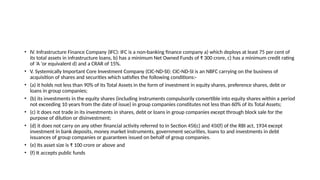
• IV. Infrastructure Finance Company (IFC): IFC is a non-banking finance company a) which deploys at least 75 per cent of
its total assets in infrastructure loans, b) has a minimum Net Owned Funds of ₹ 300 crore, c) has a minimum credit rating
of ‘A ‘or equivalent d) and a CRAR of 15%.
• V. Systemically Important Core Investment Company (CIC-ND-SI): CIC-ND-SI is an NBFC carrying on the business of
acquisition of shares and securities which satisfies the following conditions:-
• (a) it holds not less than 90% of its Total Assets in the form of investment in equity shares, preference shares, debt or
loans in group companies;
• (b) its investments in the equity shares (including instruments compulsorily convertible into equity shares within a period
not exceeding 10 years from the date of issue) in group companies constitutes not less than 60% of its Total Assets;
• (c) it does not trade in its investments in shares, debt or loans in group companies except through block sale for the
purpose of dilution or disinvestment;
• (d) it does not carry on any other financial activity referred to in Section 45I(c) and 45I(f) of the RBI act, 1934 except
investment in bank deposits, money market instruments, government securities, loans to and investments in debt
issuances of group companies or guarantees issued on behalf of group companies.
• (e) Its asset size is ₹ 100 crore or above and
• (f) It accepts public funds
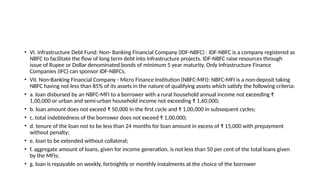
• VI. Infrastructure Debt Fund: Non- Banking Financial Company (IDF-NBFC) : IDF-NBFC is a company registered as
NBFC to facilitate the flow of long term debt into infrastructure projects. IDF-NBFC raise resources through
issue of Rupee or Dollar denominated bonds of minimum 5 year maturity. Only Infrastructure Finance
Companies (IFC) can sponsor IDF-NBFCs.
• VII. Non-Banking Financial Company - Micro Finance Institution (NBFC-MFI): NBFC-MFI is a non-deposit taking
NBFC having not less than 85% of its assets in the nature of qualifying assets which satisfy the following criteria:
• a. loan disbursed by an NBFC-MFI to a borrower with a rural household annual income not exceeding ₹
1,00,000 or urban and semi-urban household income not exceeding ₹ 1,60,000;
• b. loan amount does not exceed ₹ 50,000 in the first cycle and ₹ 1,00,000 in subsequent cycles;
• c. total indebtedness of the borrower does not exceed ₹ 1,00,000;
• d. tenure of the loan not to be less than 24 months for loan amount in excess of ₹ 15,000 with prepayment
without penalty;
• e. loan to be extended without collateral;
• f. aggregate amount of loans, given for income generation, is not less than 50 per cent of the total loans given
by the MFIs;
• g. loan is repayable on weekly, fortnightly or monthly instalments at the choice of the borrower
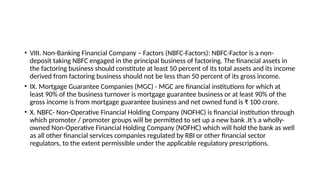
• VIII. Non-Banking Financial Company – Factors (NBFC-Factors): NBFC-Factor is a non-
deposit taking NBFC engaged in the principal business of factoring. The financial assets in
the factoring business should constitute at least 50 percent of its total assets and its income
derived from factoring business should not be less than 50 percent of its gross income.
• IX. Mortgage Guarantee Companies (MGC) - MGC are financial institutions for which at
least 90% of the business turnover is mortgage guarantee business or at least 90% of the
gross income is from mortgage guarantee business and net owned fund is ₹ 100 crore.
• X. NBFC- Non-Operative Financial Holding Company (NOFHC) is financial institution through
which promoter / promoter groups will be permitted to set up a new bank .It’s a wholly-
owned Non-Operative Financial Holding Company (NOFHC) which will hold the bank as well
as all other financial services companies regulated by RBI or other financial sector
regulators, to the extent permissible under the applicable regulatory prescriptions.
RBI supervision
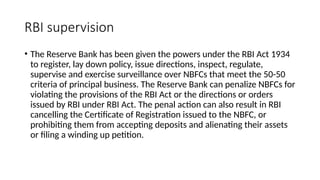
• The Reserve Bank has been given the powers under the RBI Act 1934
to register, lay down policy, issue directions, inspect, regulate,
supervise and exercise surveillance over NBFCs that meet the 50-50
criteria of principal business. The Reserve Bank can penalize NBFCs for
violating the provisions of the RBI Act or the directions or orders
issued by RBI under RBI Act. The penal action can also result in RBI
cancelling the Certificate of Registration issued to the NBFC, or
prohibiting them from accepting deposits and alienating their assets
or filing a winding up petition.
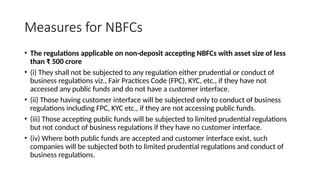
Measures for NBFCs
• The regulations applicable on non-deposit accepting NBFCs with asset size of less
than ₹ 500 crore
• (i) They shall not be subjected to any regulation either prudential or conduct of
business regulations viz., Fair Practices Code (FPC), KYC, etc., if they have not
accessed any public funds and do not have a customer interface.
• (ii) Those having customer interface will be subjected only to conduct of business
regulations including FPC, KYC etc., if they are not accessing public funds.
• (iii) Those accepting public funds will be subjected to limited prudential regulations
but not conduct of business regulations if they have no customer interface.
• (iv) Where both public funds are accepted and customer interface exist, such
companies will be subjected both to limited prudential regulations and conduct of
business regulations.
• All NBFCs are not entitled to accept public deposits. Only those NBFCs to which the Bank had given a specific
authorization and have an investment grade rating are allowed to accept/ hold public deposits to a limit of
1.5 times of its Net Owned Funds. All existing unrated AFCs that have been allowed to accept deposits shall
have to get themselves rated by March 31, 2016. Those AFCs that do not get an investment grade rating by
March 31, 2016, will not be allowed to renew existing or accept fresh deposits thereafter. In the intervening
period, i.e. till March 31, 2016, unrated AFCs or those with a sub-investment grade rating can only renew
existing deposits on maturity, and not accept fresh deposits, till they obtain an investment grade rating.
• However, as a matter of public policy, Reserve Bank has decided that only banks should be allowed to accept
public deposits and as such has since 1997 not issued any Certificate of Registration (CoR) to new NBFCs for
acceptance of public deposits.
• Presently, the maximum rate of interest an NBFC can offer is 12.5%. The interest may be paid or
compounded at rests not shorter than monthly rests. The NBFCs are allowed to accept/renew public
deposits for a minimum period of 12 months and maximum period of 60 months. They cannot accept
deposits repayable on demand.
• AFC – Asset finance company
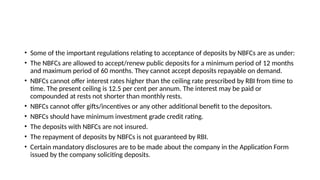
• Some of the important regulations relating to acceptance of deposits by NBFCs are as under:
• The NBFCs are allowed to accept/renew public deposits for a minimum period of 12 months
and maximum period of 60 months. They cannot accept deposits repayable on demand.
• NBFCs cannot offer interest rates higher than the ceiling rate prescribed by RBI from time to
time. The present ceiling is 12.5 per cent per annum. The interest may be paid or
compounded at rests not shorter than monthly rests.
• NBFCs cannot offer gifts/incentives or any other additional benefit to the depositors.
• NBFCs should have minimum investment grade credit rating.
• The deposits with NBFCs are not insured.
• The repayment of deposits by NBFCs is not guaranteed by RBI.
• Certain mandatory disclosures are to be made about the company in the Application Form
issued by the company soliciting deposits.
module 3- Non banking Financial institutions

module 3- Non banking Financial institutions

  • 1.
  • 2.
    • Meaning, Registration,Principal Business of NBFCs, Structure, Supervision, RBI • Measures for NBFCs, Other Measures.
  • 3.
    Meaning • A Non-BankingFinancial Company (NBFC) is a company registered under the Companies Act, 1956 engaged in the business of loans and advances, acquisition of shares/stocks/bonds/debentures/securities issued by Government or local authority or other marketable securities of a like nature, leasing, hire-purchase, insurance business, chit business but does not include any institution whose principal business is that of agriculture activity, industrial activity, purchase or sale of any goods (other than securities) or providing any services and sale/purchase/construction of immovable property. A non-banking institution which is a company and has principal business of receiving deposits under any scheme or arrangement in one lump sum or in installments by way of contributions or in any other manner, is also a non-banking financial company (Residuary non-banking company).
  • 4.
    NBFCs are doingfunctions similar to banks. What is difference between banks & NBFCs? NBFCs lend and make investments and hence their activities are akin to that of banks; however there are a few differences as given below: • i. NBFC cannot accept demand deposits; • ii. NBFCs do not form part of the payment and settlement system and cannot issue cheques drawn on itself; • iii. deposit insurance facility of Deposit Insurance and Credit Guarantee Corporation is not available to depositors of NBFCs, unlike in case of banks.
  • 5.
    Principal Business ofNBFCs • Financial activity as principal business is when a company’s financial assets constitute more than 50 per cent of the total assets and income from financial assets constitute more than 50 per cent of the gross income. A company which fulfils both these criteria will be registered as NBFC by RBI. The term 'principal business' is not defined by the Reserve Bank of India Act. The Reserve Bank has defined it so as to ensure that only companies predominantly engaged in financial activity get registered with it and are regulated and supervised by it. Hence if there are companies engaged in agricultural operations, industrial activity, purchase and sale of goods, providing services or purchase, sale or construction of immovable property as their principal business and are doing some financial business in a small way, they will not be regulated by the Reserve Bank. Interestingly, this test is popularly known as 50-50 test and is applied to determine whether or not a company is into financial business.
  • 6.
    Registration • In termsof Section 45-IA of the RBI Act, 1934, no Non-banking Financial company can commence or carry on business of a non-banking financial institution without a) obtaining a certificate of registration from the Bank and without having a Net Owned Funds of ₹ 25 lakhs (₹ Two crore since April 1999). However, in terms of the powers given to the Bank, to obviate dual regulation, certain categories of NBFCs which are regulated by other regulators are exempted from the requirement of registration with RBI viz. Venture Capital Fund/Merchant Banking companies/Stock broking companies registered with SEBI, Insurance Company holding a valid Certificate of Registration issued by IRDA, Nidhi companies as notified under Section 620A of the Companies Act, 1956, Chit companies as defined in clause (b) of Section 2 of the Chit Funds Act, 1982,Housing Finance Companies regulated by National Housing Bank, Stock Exchange or a Mutual Benefit company.
  • 7.
  • 8.
    D= Deposits: ND:No Deposits • Asset Finance Company (AFC) : An AFC is a company which is a financial institution carrying on as its principal business the financing of physical assets supporting productive/economic activity, such as automobiles, tractors, lathe machines, generator sets, earth moving and material handling equipments, moving on own power and general purpose industrial machines. Principal business for this purpose is defined as aggregate of financing real/physical assets supporting economic activity and income arising therefrom is not less than 60% of its total assets and total income respectively. • II. Investment Company (IC) : IC means any company which is a financial institution carrying on as its principal business the acquisition of securities, • III. Loan Company (LC): LC means any company which is a financial institution carrying on as its principal business the providing of finance whether by making loans or advances or otherwise for any activity other than its own but does not include an Asset Finance Company.
  • 9.
    • IV. InfrastructureFinance Company (IFC): IFC is a non-banking finance company a) which deploys at least 75 per cent of its total assets in infrastructure loans, b) has a minimum Net Owned Funds of ₹ 300 crore, c) has a minimum credit rating of ‘A ‘or equivalent d) and a CRAR of 15%. • V. Systemically Important Core Investment Company (CIC-ND-SI): CIC-ND-SI is an NBFC carrying on the business of acquisition of shares and securities which satisfies the following conditions:- • (a) it holds not less than 90% of its Total Assets in the form of investment in equity shares, preference shares, debt or loans in group companies; • (b) its investments in the equity shares (including instruments compulsorily convertible into equity shares within a period not exceeding 10 years from the date of issue) in group companies constitutes not less than 60% of its Total Assets; • (c) it does not trade in its investments in shares, debt or loans in group companies except through block sale for the purpose of dilution or disinvestment; • (d) it does not carry on any other financial activity referred to in Section 45I(c) and 45I(f) of the RBI act, 1934 except investment in bank deposits, money market instruments, government securities, loans to and investments in debt issuances of group companies or guarantees issued on behalf of group companies. • (e) Its asset size is ₹ 100 crore or above and • (f) It accepts public funds
  • 10.
    • VI. InfrastructureDebt Fund: Non- Banking Financial Company (IDF-NBFC) : IDF-NBFC is a company registered as NBFC to facilitate the flow of long term debt into infrastructure projects. IDF-NBFC raise resources through issue of Rupee or Dollar denominated bonds of minimum 5 year maturity. Only Infrastructure Finance Companies (IFC) can sponsor IDF-NBFCs. • VII. Non-Banking Financial Company - Micro Finance Institution (NBFC-MFI): NBFC-MFI is a non-deposit taking NBFC having not less than 85% of its assets in the nature of qualifying assets which satisfy the following criteria: • a. loan disbursed by an NBFC-MFI to a borrower with a rural household annual income not exceeding ₹ 1,00,000 or urban and semi-urban household income not exceeding ₹ 1,60,000; • b. loan amount does not exceed ₹ 50,000 in the first cycle and ₹ 1,00,000 in subsequent cycles; • c. total indebtedness of the borrower does not exceed ₹ 1,00,000; • d. tenure of the loan not to be less than 24 months for loan amount in excess of ₹ 15,000 with prepayment without penalty; • e. loan to be extended without collateral; • f. aggregate amount of loans, given for income generation, is not less than 50 per cent of the total loans given by the MFIs; • g. loan is repayable on weekly, fortnightly or monthly instalments at the choice of the borrower
  • 11.
    • VIII. Non-BankingFinancial Company – Factors (NBFC-Factors): NBFC-Factor is a non- deposit taking NBFC engaged in the principal business of factoring. The financial assets in the factoring business should constitute at least 50 percent of its total assets and its income derived from factoring business should not be less than 50 percent of its gross income. • IX. Mortgage Guarantee Companies (MGC) - MGC are financial institutions for which at least 90% of the business turnover is mortgage guarantee business or at least 90% of the gross income is from mortgage guarantee business and net owned fund is ₹ 100 crore. • X. NBFC- Non-Operative Financial Holding Company (NOFHC) is financial institution through which promoter / promoter groups will be permitted to set up a new bank .It’s a wholly- owned Non-Operative Financial Holding Company (NOFHC) which will hold the bank as well as all other financial services companies regulated by RBI or other financial sector regulators, to the extent permissible under the applicable regulatory prescriptions.
  • 12.
    RBI supervision • TheReserve Bank has been given the powers under the RBI Act 1934 to register, lay down policy, issue directions, inspect, regulate, supervise and exercise surveillance over NBFCs that meet the 50-50 criteria of principal business. The Reserve Bank can penalize NBFCs for violating the provisions of the RBI Act or the directions or orders issued by RBI under RBI Act. The penal action can also result in RBI cancelling the Certificate of Registration issued to the NBFC, or prohibiting them from accepting deposits and alienating their assets or filing a winding up petition.
  • 13.
    Measures for NBFCs •The regulations applicable on non-deposit accepting NBFCs with asset size of less than ₹ 500 crore • (i) They shall not be subjected to any regulation either prudential or conduct of business regulations viz., Fair Practices Code (FPC), KYC, etc., if they have not accessed any public funds and do not have a customer interface. • (ii) Those having customer interface will be subjected only to conduct of business regulations including FPC, KYC etc., if they are not accessing public funds. • (iii) Those accepting public funds will be subjected to limited prudential regulations but not conduct of business regulations if they have no customer interface. • (iv) Where both public funds are accepted and customer interface exist, such companies will be subjected both to limited prudential regulations and conduct of business regulations.
  • 14.
    • All NBFCsare not entitled to accept public deposits. Only those NBFCs to which the Bank had given a specific authorization and have an investment grade rating are allowed to accept/ hold public deposits to a limit of 1.5 times of its Net Owned Funds. All existing unrated AFCs that have been allowed to accept deposits shall have to get themselves rated by March 31, 2016. Those AFCs that do not get an investment grade rating by March 31, 2016, will not be allowed to renew existing or accept fresh deposits thereafter. In the intervening period, i.e. till March 31, 2016, unrated AFCs or those with a sub-investment grade rating can only renew existing deposits on maturity, and not accept fresh deposits, till they obtain an investment grade rating. • However, as a matter of public policy, Reserve Bank has decided that only banks should be allowed to accept public deposits and as such has since 1997 not issued any Certificate of Registration (CoR) to new NBFCs for acceptance of public deposits. • Presently, the maximum rate of interest an NBFC can offer is 12.5%. The interest may be paid or compounded at rests not shorter than monthly rests. The NBFCs are allowed to accept/renew public deposits for a minimum period of 12 months and maximum period of 60 months. They cannot accept deposits repayable on demand. • AFC – Asset finance company
  • 15.
    • Some ofthe important regulations relating to acceptance of deposits by NBFCs are as under: • The NBFCs are allowed to accept/renew public deposits for a minimum period of 12 months and maximum period of 60 months. They cannot accept deposits repayable on demand. • NBFCs cannot offer interest rates higher than the ceiling rate prescribed by RBI from time to time. The present ceiling is 12.5 per cent per annum. The interest may be paid or compounded at rests not shorter than monthly rests. • NBFCs cannot offer gifts/incentives or any other additional benefit to the depositors. • NBFCs should have minimum investment grade credit rating. • The deposits with NBFCs are not insured. • The repayment of deposits by NBFCs is not guaranteed by RBI. • Certain mandatory disclosures are to be made about the company in the Application Form issued by the company soliciting deposits.