TRIM – Outcomes(Refer Chap16 Ship Stability for Mates and Masters)
1. Explain that trim is the difference in forward and aft drafts of a ship
2. Understand that trim is affected by the movement of
masses and these masses may be solid or liquid.
3. Understand
• Loading of masses results in “Bodily Sinkage” and increase in draft
• Discharge of masses results in “Bodily Rise” and reduction in draft
4. TPC is related to the given draft/displacement
5. MCTC - Moment to Change the Trim by ONE Centimeter
6. Change of Trim is proportioned to fwd and aft in proportion to the location of LCF
7. Understand problems associated with trim and the ship structure and operation
2.
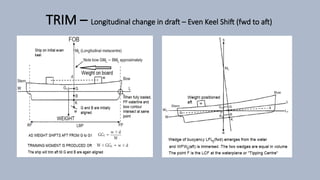
TRIM – Longitudinalchange in draft
Trim can be considered as the equivalent of transverse “LIST” angle but in
the longitudinal direction that results in a change in drafts fwd and aft.
Mean draft remains the same provided no mass is added or discharged.
Similarly as Vertical GM changes in the transverse direction when masses
are shifted from port to starboard, Longitudinal GM changes in the
Forward and aft directions.
COG (Centre of Gravity) and COB (Centre of Buoyancy) have dimensions in
the transverse (port to starboard), longitudinal (fwd to aft) and vertical
direction (Keel to Deck) so CANNOT be seen in isolation.
The longitudinal measurement is taken from the AP (Aft Perpendiular) and
The Transverse measurement is from the C/L (bow to stern) while vertical
is keel from the keel at MBL (Moulded Base Line).
3.
TRIM – Longitudinalchange in draft
1. A ship can be described as being on
• “even keel” i.e. drafts are equal forward and aft
• “down by the head” i.e. the draft forward is more than aft
• “down by the stern” i.e. the draft aft is more than forward
2. Movements are around the waterplane and LCF not around LCOG
3. “Mean draft” is the average of the forward and aft drafts.
4. Movements of mass already on board DOES NOT change mean
draft
4.
TRIM – Longitudinalchange in draft
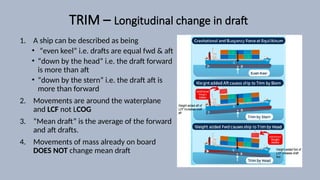
1. A ship can be described as being
• “even keel” i.e. drafts are equal fwd & aft
• “down by the head” i.e. the draft forward
is more than aft
• “down by the stern” i.e. the draft aft is
more than forward
2. Movements are around the waterplane
and LCF not LCOG
3. “Mean draft” is the average of the forward
and aft drafts.
4. Movements of mass already on board
DOES NOT change mean draft
5.
TRIM – Longitudinalchange in draft
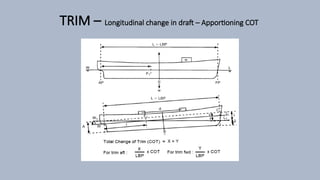
5. The total change of trim (COT) must be apportioned according to
the distances of the masses relative to their distance from the
LCF, NOT THE LCOG. Note that the LCF and LCOG DOES NOT
necessarily coincide. When apportioning final trim, take the LCF
as a ratio of LBP (Length between Perpendiulars)
1. Refer to the following for further information relating to TRIM
• Chapter 16 – Ship Stability for Mates and Masters
• Page 128 – Ship Stability – Martin A Rhodes for derivation of MCTC.
• Work through the examples then complete the exercises.
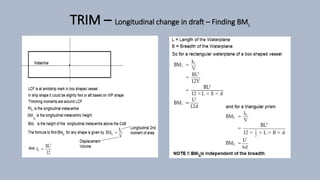
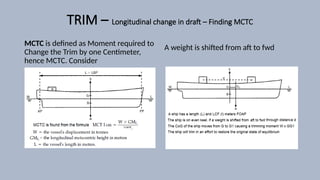
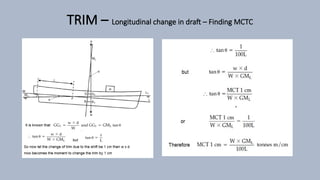
TRIM – Longitudinalchange in draft – Finding MCTC
MCTC is defined as Moment required to
Change the Trim by one Centimeter,
hence MCTC. Consider
A weight is shifted from aft to fwd
TRIM – Longitudinalchange in draft
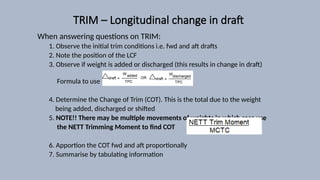
When answering questions on TRIM:
1. Observe the initial trim conditions i.e. fwd and aft drafts
2. Note the position of the LCF
3. Observe if weight is added or discharged (this results in change in draft)
Formula to use :
4. Determine the Change of Trim (COT). This is the total due to the weight
being added, discharged or shifted
5. NOTE!! There may be multiple movements of weights in which case use
the NETT Trimming Moment to find COT
6. Apportion the COT fwd and aft proportionally
7. Summarise by tabulating information
12.
CALCULATIONS – Shiftingof a weight
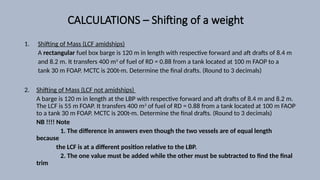
1. Shifting of Mass (LCF amidships)
A rectangular fuel box barge is 120 m in length with respective forward and aft drafts of 8.4 m
and 8.2 m. It transfers 400 m3
of fuel of RD = 0.88 from a tank located at 100 m FAOP to a
tank 30 m FOAP. MCTC is 200t-m. Determine the final drafts. (Round to 3 decimals)
2. Shifting of Mass (LCF not amidships)
A barge is 120 m in length at the LBP with respective forward and aft drafts of 8.4 m and 8.2 m.
The LCF is 55 m FOAP. It transfers 400 m3
of fuel of RD = 0.88 from a tank located at 100 m FAOP
to a tank 30 m FOAP. MCTC is 200t-m. Determine the final drafts. (Round to 3 decimals)
NB !!!! Note
1. The difference in answers even though the two vessels are of equal length
because
the LCF is at a different position relative to the LBP.
2. The one value must be added while the other must be subtracted to find the final
trim
13.
CALCULATIONS – Loadingof a Weight
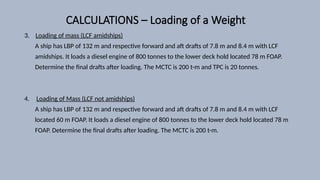
3. Loading of mass (LCF amidships)
A ship has LBP of 132 m and respective forward and aft drafts of 7.8 m and 8.4 m with LCF
amidships. It loads a diesel engine of 800 tonnes to the lower deck hold located 78 m FOAP.
Determine the final drafts after loading. The MCTC is 200 t-m and TPC is 20 tonnes.
4. Loading of Mass (LCF not amidships)
A ship has LBP of 132 m and respective forward and aft drafts of 7.8 m and 8.4 m with LCF
located 60 m FOAP. It loads a diesel engine of 800 tonnes to the lower deck hold located 78 m
FOAP. Determine the final drafts after loading. The MCTC is 200 t-m.
14.
CALCULATIONS – Dischargingof a Weight
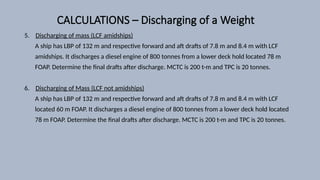
5. Discharging of mass (LCF amidships)
A ship has LBP of 132 m and respective forward and aft drafts of 7.8 m and 8.4 m with LCF
amidships. It discharges a diesel engine of 800 tonnes from a lower deck hold located 78 m
FOAP. Determine the final drafts after discharge. MCTC is 200 t-m and TPC is 20 tonnes.
6. Discharging of Mass (LCF not amidships)
A ship has LBP of 132 m and respective forward and aft drafts of 7.8 m and 8.4 m with LCF
located 60 m FOAP. It discharges a diesel engine of 800 tonnes from a lower deck hold located
78 m FOAP. Determine the final drafts after discharge. MCTC is 200 t-m and TPC is 20 tonnes.

![[7] trim](https://cdn.slidesharecdn.com/ss_thumbnails/7trim-120403043947-phpapp02-thumbnail.jpg?width=640&height=640&fit=bounds)


