Subject: Sports
Area: Physical education and Sports games
Thematic unit: Running
Topic: Physical education
Target group (class): 5th grade (10-11 years)
Time required: 2 lesson (90 min)
Content standard: Olympic games , history, 8-minute road race over a 150m route
Performance standard: The pupils should get to know the history of the Olympic Games, the
events and the importance they had both in Ancient Greece and in the modern era, as a model
of cooperation, peace and solidarity of peoples through sports. Also, The promotion of health
one of the main goals of all sports activities should be to encourage children to play and to
use their energy reserves in order to protect their health. Sports are designed to meet this
challenge with the variety of the nature of the actions and the physical characteristics
required. The increasing demands (in relation to age) of the types of games contribute to their
general and harmonious development.
Educational standard: Pupils will discover basic motor actions: speed, endurance, jumping,
throwing in virtually any space (stadium, courtyard, indoor stadium, any sports facility). This
social interaction is a positive factor in the interaction of children in a social background. In
team competitions in which everyone contributes and participates in the game, children are
given the opportunity to learn to know and accept their differences. The simplicity of the rules
of the games and the harmless nature of the competitions offered, allow children to
sometimes even take on the role of judges or even team coaches. These responsibilities when
undertaken are distinct moments with an indirect impact on the shaping socialization and
responsibility as they develop at a young age.
Set out: Excel, padlet,computer, data projector, interactive whiteboard, tablets, pupils' own
equipment.
Digital skills: Information (browsing, creating, sorting, evaluation), Communication (through
technologies, sharing information, cooperation via digital technologies, Digital content
creating (copyright and licenses), creative use of digital technology).
Cross-curricular relations: sports and health, mathematics, history,
Education forms and methods: Group work, Activating methods.
Lesson structure:
Evocation (45 minutes):
1. Pupils will become familiar with the objective of the lesson.
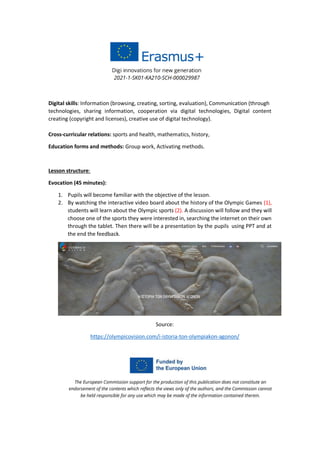
2. By watching the interactive video board about the history of the Olympic Games (1),
students will learn about the Olympic sports (2). A discussion will follow and they will
choose one of the sports they were interested in, searching the internet on their own
through the tablet. Then there will be a presentation by the pupils using PPT and at
the end the feedback.
Source:
https://olympicovision.com/i-istoria-ton-olympiakon-agonon/
(1) https://www.worldhistory.org/trans/el/1-440/
(2) https://www.youtube.com/watch?v=mQ94xbXnYu4
Activity (30 minutes):
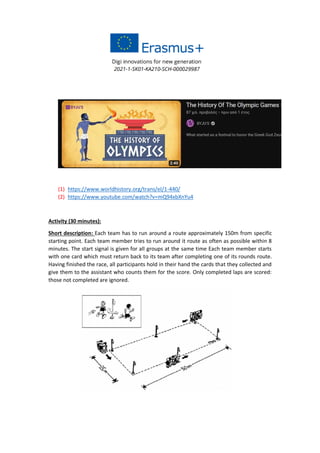
Short description: Each team has to run around a route approximately 150m from specific
starting point. Each team member tries to run around it route as often as possible within 8
minutes. The start signal is given for all groups at the same time Each team member starts
with one card which must return back to its team after completing one of its rounds route.
Having finished the race, all participants hold in their hand the cards that they collected and
give them to the assistant who counts them for the score. Only completed laps are scored:
those not completed are ignored.
Times and measurements:
1. All students wear smart watches on their hands to monitor their heartbeats.
2. The teacher records each student's time.
Reflection (15 minutes):
1. All data is presented in excel format to the students both collectively and
individually.
2. The teacher shares online the results of the lesson (notes, padlet, teaching material)
3. At the end a questionnaire is given to the students for feedback.
4. The data will be saved for future use.

Lesson suggestion - Sports.pdf

  • 1.
    Subject: Sports Area: Physicaleducation and Sports games Thematic unit: Running Topic: Physical education Target group (class): 5th grade (10-11 years) Time required: 2 lesson (90 min) Content standard: Olympic games , history, 8-minute road race over a 150m route Performance standard: The pupils should get to know the history of the Olympic Games, the events and the importance they had both in Ancient Greece and in the modern era, as a model of cooperation, peace and solidarity of peoples through sports. Also, The promotion of health one of the main goals of all sports activities should be to encourage children to play and to use their energy reserves in order to protect their health. Sports are designed to meet this challenge with the variety of the nature of the actions and the physical characteristics required. The increasing demands (in relation to age) of the types of games contribute to their general and harmonious development. Educational standard: Pupils will discover basic motor actions: speed, endurance, jumping, throwing in virtually any space (stadium, courtyard, indoor stadium, any sports facility). This social interaction is a positive factor in the interaction of children in a social background. In team competitions in which everyone contributes and participates in the game, children are given the opportunity to learn to know and accept their differences. The simplicity of the rules of the games and the harmless nature of the competitions offered, allow children to sometimes even take on the role of judges or even team coaches. These responsibilities when undertaken are distinct moments with an indirect impact on the shaping socialization and responsibility as they develop at a young age. Set out: Excel, padlet,computer, data projector, interactive whiteboard, tablets, pupils' own equipment.
  • 2.
    Digital skills: Information(browsing, creating, sorting, evaluation), Communication (through technologies, sharing information, cooperation via digital technologies, Digital content creating (copyright and licenses), creative use of digital technology). Cross-curricular relations: sports and health, mathematics, history, Education forms and methods: Group work, Activating methods. Lesson structure: Evocation (45 minutes): 1. Pupils will become familiar with the objective of the lesson. 2. By watching the interactive video board about the history of the Olympic Games (1), students will learn about the Olympic sports (2). A discussion will follow and they will choose one of the sports they were interested in, searching the internet on their own through the tablet. Then there will be a presentation by the pupils using PPT and at the end the feedback. Source: https://olympicovision.com/i-istoria-ton-olympiakon-agonon/
  • 3.
    (1) https://www.worldhistory.org/trans/el/1-440/ (2) https://www.youtube.com/watch?v=mQ94xbXnYu4 Activity(30 minutes): Short description: Each team has to run around a route approximately 150m from specific starting point. Each team member tries to run around it route as often as possible within 8 minutes. The start signal is given for all groups at the same time Each team member starts with one card which must return back to its team after completing one of its rounds route. Having finished the race, all participants hold in their hand the cards that they collected and give them to the assistant who counts them for the score. Only completed laps are scored: those not completed are ignored.
  • 4.
    Times and measurements: 1.All students wear smart watches on their hands to monitor their heartbeats. 2. The teacher records each student's time. Reflection (15 minutes): 1. All data is presented in excel format to the students both collectively and individually. 2. The teacher shares online the results of the lesson (notes, padlet, teaching material) 3. At the end a questionnaire is given to the students for feedback. 4. The data will be saved for future use.