Lathyrus sativus induced
Neurolathyrism
Presented by : Maheshwor Yadav
Bachelor of Pharmacy
Nobel College, Kathmandu
Pokhara University
Introduction
 Lathyrus sativus
• Lathyrus sativus, also known as Khesari dal(in
India) or grass pea has been a saviour for vast
populations since decades.
• It has been serving as a staple food for the
poor farmers in countries like India,
Bangladesh, Nepal, China and Ethiopia.
• Mostly during droughts and famines it is
major food as it sustains the harshest of
agroclimatic conditions.
• It is a nutritious legume , which is rich in
protein and with good quantities of essential
amino acids.
• Although it has much nutritional value, the
presence of the neurotoxic chemical restricts
its use as a daily food.
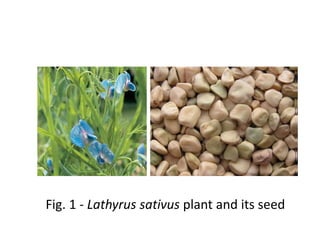
Fig. 1 - Lathyrus sativus plant and its seed
 Neurolathyrism
• Excessive consumption of LS causes a neuro-
degenerative disease – Neurolathyrism.
• Neurolathyrism is an incurable neurological
disorder clinically manifested by paralysis of the
lower limbs.
• It progresses slowly the spastic paraplegia
involving degeneration of the upper part of spinal
cord causing stiffness and paralysis of muscle of
the lower extremities.
• During the last two decades, the outbreaks of
Lathyrism have been reported from the India,
China, Bangladesh, Ethiopia, Nepal, Israel and
Spain.
• Neurolathyrism has always surfaced only
during extreme situations such as famine and
drought when other food crops are in short
supply resulting in an exclusive consumption of
the pulse for prolonged periods lasting as long as
3-6 months.
Which chemical is causing this?
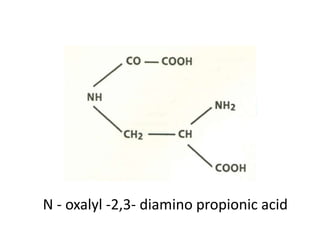
• An unusual highly neurotoxic amino acid
ODAP (N - Oxalyl - 2, 3 - diamino propionic
acid) or BOAA (Beta-Oxalyl-aminoalanine) has
been isolated from Lathyrus sativus seed.
• It is characterized and proved to be
responsible for causing neurological
manifestations in a variety of experimental
animals. .
N - oxalyl -2,3- diamino propionic acid
Clinical studies on Neurolathyrism
• The CNS distribution and toxicity of L-ODAP was
studied in rat neonates after parenteral
administration. L-ODAP was detected in the
spinal cord as well as in the pons/medulla
oblongata.
• Repeated injection of L-ODAP resulted in rats
with paraparesis of the legs.
• These paralyzed rats displayed degenerations of
motor neuron. The rats were useful models for
the study of motor neuron degeneration in the
spinal cord.
• Studies have found that even horse gets
lathyrism after consumption of Lathyrus
sativus to larger extent, and paralysis occurs
to hind limb.
• Three modes of presentation of neuro-
lathyrism have been found in human.
– the commonest being a sudden onset of leg
weakness when going to sleep or when awakening
from sleep.
– some patients complain of a subacute onset of
walking difficulty.
– whereas others experience an gradual progression
of spastic paraparesis extending over months.
• In study conducted on farmers in India, the
muscle spasm restricted movements at the
knee and ankle joints, resulting in a spastic
gait (spastic walk) and scissoring gait in some
people.
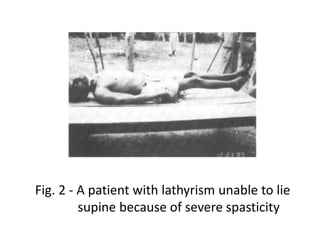
• A patient was unable to lie supine
because of severe spasticity .
• This degree of spasticity is not commonly seen
in other neurological disorders.
• Stiffness and walking difficulty in most
patients was more serious during the winter.
Fig. 2 - A patient with lathyrism unable to lie
supine because of severe spasticity
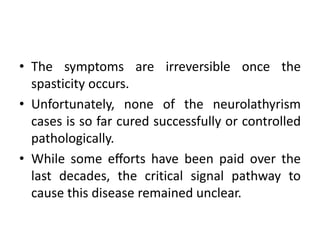
• The symptoms are irreversible once the
spasticity occurs.
• Unfortunately, none of the neurolathyrism
cases is so far cured successfully or controlled
pathologically.
• While some efforts have been paid over the
last decades, the critical signal pathway to
cause this disease remained unclear.
Risk management of Neurolathyrism
• The western countries have got rid of the
disease by stopping the production of
Lathyrus sativus.
• However in India, considering the fact
that Lathyrus sativus finds a place in the
cropping pattern, only the sale of the seed has
been banned.
• The ODAP levels in Lathyrus sativus are highly
variable and depend on variety of factors such
as growth location, soil, fertilization, plant
part and age.
• Soil nature also affects amount of ODAP in
seeds as the presence of cadmium in the
soil can increase the ODAP level up to six-fold.
Food processing techniques are
employed
• Food processing plays an important role in the
elimination of ODAP in Lathyrus sativus.
• The toxic amino acids get readily soluble in water
and can be easily leached.
• The food processing methods including roasting,
soaking prior to boiling, germination, and
autoclaving greatly influence the nutritive values
of legumes.
• It was found that soaking of the seed in water
could lower β-ODAP content but not
sufficiently for continuous safe human
consumption.
Conclusion
• Lathyrus sativus if taken in large amount as a
staple food, there is a large chance of
neurodegenarative disease called Neuro-
lathyrism.
• But it has large nutritious value so can also be
used as normal diet after processing.
• In many countries its cultivation for diet has
stopped and is only cultivated to increase fertility
of soil.
• After cultivation it is destroyed and other crops
are cultivated .
References
1. Singh SS, Rao SLN. Lessons from neurolathyrism: A disease
of the past & the future of Lathyrus sativus (Khesari dal).
Indian J Med Res. July 2013; 138: 32-37
2. Yerra S, Putta S, Kilari EK. The Role of food processing
techniques in the detoxification of ODAP in Lathyrus
sativus. International Journal of Information Research and
Review. Aug 2016; Vol. 03. (Issue 08): 2818-2822
3. Tan RY, Xing GY, Zhou GM, Li FM, Hu WT et al. Plant toxin
β-ODAP activates integrin β1 and focal adhesion: A critical
pathway to cause neurolathyrism. Scientific Reports. 17
Jan 2017
4. Misra UKSharma VP, Singh VP. Clinical aspects of
neurolathyrism in Unnao, India. International Medical
Society of Paraplegia. 1993; 31: 249-254
5. Eguchi KK, Ikegami F, Kusama T, Suda A, Ogawa Y, et al. A
rat model of neurolathyrism: repeated injection of L-b-
ODAP induces the paraparesis of the hind legs. Springer-
Verlag. 18 Feb 2005; 28: 139–143
6. Rao PA, Bhatt R, Mandapaka RT. Lathyrism in South
Central India: Lathyrus sativus Cultivation and its
Consumption. EC Nutrition. 7 Sept 2016; 1017-1020
THANK YOU

Lathyrus sativus - a path to Neurolathyrism

  • 1.
    Lathyrus sativus induced Neurolathyrism Presentedby : Maheshwor Yadav Bachelor of Pharmacy Nobel College, Kathmandu Pokhara University
  • 2.
    Introduction  Lathyrus sativus •Lathyrus sativus, also known as Khesari dal(in India) or grass pea has been a saviour for vast populations since decades. • It has been serving as a staple food for the poor farmers in countries like India, Bangladesh, Nepal, China and Ethiopia. • Mostly during droughts and famines it is major food as it sustains the harshest of agroclimatic conditions.
  • 3.
    • It isa nutritious legume , which is rich in protein and with good quantities of essential amino acids. • Although it has much nutritional value, the presence of the neurotoxic chemical restricts its use as a daily food.
  • 4.
    Fig. 1 -Lathyrus sativus plant and its seed
  • 5.
     Neurolathyrism • Excessiveconsumption of LS causes a neuro- degenerative disease – Neurolathyrism. • Neurolathyrism is an incurable neurological disorder clinically manifested by paralysis of the lower limbs. • It progresses slowly the spastic paraplegia involving degeneration of the upper part of spinal cord causing stiffness and paralysis of muscle of the lower extremities.
  • 6.
    • During thelast two decades, the outbreaks of Lathyrism have been reported from the India, China, Bangladesh, Ethiopia, Nepal, Israel and Spain. • Neurolathyrism has always surfaced only during extreme situations such as famine and drought when other food crops are in short supply resulting in an exclusive consumption of the pulse for prolonged periods lasting as long as 3-6 months.
  • 7.
    Which chemical iscausing this? • An unusual highly neurotoxic amino acid ODAP (N - Oxalyl - 2, 3 - diamino propionic acid) or BOAA (Beta-Oxalyl-aminoalanine) has been isolated from Lathyrus sativus seed. • It is characterized and proved to be responsible for causing neurological manifestations in a variety of experimental animals. .
  • 8.
    N - oxalyl-2,3- diamino propionic acid
  • 9.
    Clinical studies onNeurolathyrism • The CNS distribution and toxicity of L-ODAP was studied in rat neonates after parenteral administration. L-ODAP was detected in the spinal cord as well as in the pons/medulla oblongata. • Repeated injection of L-ODAP resulted in rats with paraparesis of the legs. • These paralyzed rats displayed degenerations of motor neuron. The rats were useful models for the study of motor neuron degeneration in the spinal cord.
  • 10.
    • Studies havefound that even horse gets lathyrism after consumption of Lathyrus sativus to larger extent, and paralysis occurs to hind limb. • Three modes of presentation of neuro- lathyrism have been found in human. – the commonest being a sudden onset of leg weakness when going to sleep or when awakening from sleep.
  • 11.
    – some patientscomplain of a subacute onset of walking difficulty. – whereas others experience an gradual progression of spastic paraparesis extending over months. • In study conducted on farmers in India, the muscle spasm restricted movements at the knee and ankle joints, resulting in a spastic gait (spastic walk) and scissoring gait in some people.
  • 12.
    • A patientwas unable to lie supine because of severe spasticity . • This degree of spasticity is not commonly seen in other neurological disorders. • Stiffness and walking difficulty in most patients was more serious during the winter.
  • 13.
    Fig. 2 -A patient with lathyrism unable to lie supine because of severe spasticity
  • 14.
    • The symptomsare irreversible once the spasticity occurs. • Unfortunately, none of the neurolathyrism cases is so far cured successfully or controlled pathologically. • While some efforts have been paid over the last decades, the critical signal pathway to cause this disease remained unclear.
  • 15.
    Risk management ofNeurolathyrism • The western countries have got rid of the disease by stopping the production of Lathyrus sativus. • However in India, considering the fact that Lathyrus sativus finds a place in the cropping pattern, only the sale of the seed has been banned.
  • 16.
    • The ODAPlevels in Lathyrus sativus are highly variable and depend on variety of factors such as growth location, soil, fertilization, plant part and age. • Soil nature also affects amount of ODAP in seeds as the presence of cadmium in the soil can increase the ODAP level up to six-fold.
  • 17.
    Food processing techniquesare employed • Food processing plays an important role in the elimination of ODAP in Lathyrus sativus. • The toxic amino acids get readily soluble in water and can be easily leached. • The food processing methods including roasting, soaking prior to boiling, germination, and autoclaving greatly influence the nutritive values of legumes.
  • 18.
    • It wasfound that soaking of the seed in water could lower β-ODAP content but not sufficiently for continuous safe human consumption.
  • 19.
    Conclusion • Lathyrus sativusif taken in large amount as a staple food, there is a large chance of neurodegenarative disease called Neuro- lathyrism. • But it has large nutritious value so can also be used as normal diet after processing. • In many countries its cultivation for diet has stopped and is only cultivated to increase fertility of soil. • After cultivation it is destroyed and other crops are cultivated .
  • 20.
    References 1. Singh SS,Rao SLN. Lessons from neurolathyrism: A disease of the past & the future of Lathyrus sativus (Khesari dal). Indian J Med Res. July 2013; 138: 32-37 2. Yerra S, Putta S, Kilari EK. The Role of food processing techniques in the detoxification of ODAP in Lathyrus sativus. International Journal of Information Research and Review. Aug 2016; Vol. 03. (Issue 08): 2818-2822 3. Tan RY, Xing GY, Zhou GM, Li FM, Hu WT et al. Plant toxin β-ODAP activates integrin β1 and focal adhesion: A critical pathway to cause neurolathyrism. Scientific Reports. 17 Jan 2017
  • 21.
    4. Misra UKSharmaVP, Singh VP. Clinical aspects of neurolathyrism in Unnao, India. International Medical Society of Paraplegia. 1993; 31: 249-254 5. Eguchi KK, Ikegami F, Kusama T, Suda A, Ogawa Y, et al. A rat model of neurolathyrism: repeated injection of L-b- ODAP induces the paraparesis of the hind legs. Springer- Verlag. 18 Feb 2005; 28: 139–143 6. Rao PA, Bhatt R, Mandapaka RT. Lathyrism in South Central India: Lathyrus sativus Cultivation and its Consumption. EC Nutrition. 7 Sept 2016; 1017-1020
  • 22.