Soutenance de thèse
Du typage vectoriel
  Alejandro Díaz-Caro
                CAPP Team


     Adviser:               Co-adviser:

 Pablo Arrighi          Frédéric Prost

                23 – 09 – 2011
Lambda calculus [Church’36]
Formal system to study the defini-
tion of function
               f (x)     ∼   tx
          x → f (x)      ∼   λx.tx
      (x → f (x))r       ∼   (λx.tx ) r
 (x → f (x))r = f (r )   ∼   (λx.tx ) r → tx [r /x]


        t, r ::= x | λx.t | (t) r
           (λx.t) r → t[r/x]


                                                      2 / 24
Lambda calculus [Church’36]                           Type system [Church’40]
Formal system to study the defini-                     “a tractable syntactic framework
tion of function                                      for classifying phrases according to
               f (x)     ∼   tx                       the kinds of values they compute”
          x → f (x)      ∼   λx.tx                    –[Pierce’02]
      (x → f (x))r       ∼   (λx.tx ) r
 (x → f (x))r = f (r )   ∼   (λx.tx ) r → tx [r /x]       λx.tx : T → R           r:T

        t, r ::= x | λx.t | (t) r                                (λx.tx ) r : R
           (λx.t) r → t[r/x]


                                                                                             2 / 24
Lambda calculus [Church’36]                           Type system [Church’40]
Formal system to study the defini-                     “a tractable syntactic framework
tion of function                                      for classifying phrases according to
               f (x)     ∼   tx                       the kinds of values they compute”
          x → f (x)      ∼   λx.tx                    –[Pierce’02]
      (x → f (x))r       ∼   (λx.tx ) r
 (x → f (x))r = f (r )   ∼   (λx.tx ) r → tx [r /x]       λx.tx : T → R           r:T

        t, r ::= x | λx.t | (t) r                                (λx.tx ) r : R
           (λx.t) r → t[r/x]


System F [Girard’71]
TS with a universal quantification
over types

             λx.x : Int → Int
             λx.x : Bool → Bool
                    ...

             λx.x : ∀X .X → X


                                                                                             2 / 24
Lambda calculus [Church’36]                           Type system [Church’40]
Formal system to study the defini-                     “a tractable syntactic framework
tion of function                                      for classifying phrases according to
               f (x)     ∼   tx                       the kinds of values they compute”
          x → f (x)      ∼   λx.tx                    –[Pierce’02]
      (x → f (x))r       ∼   (λx.tx ) r
 (x → f (x))r = f (r )   ∼   (λx.tx ) r → tx [r /x]       λx.tx : T → R           r:T

        t, r ::= x | λx.t | (t) r                                (λx.tx ) r : R
           (λx.t) r → t[r/x]


System F [Girard’71]                                  Curry-Howard correspondence
TS with a universal quantification                     Correspondence between type sys-
over types                                            tems and logic

             λx.x : Int → Int                             λx.tx : T → R           r:T
             λx.x : Bool → Bool                                  (λx.tx ) r : R
                    ...
                                                                T ⇒R         T
             λx.x : ∀X .X → X
                                                                       R


                                                                                             2 / 24
Lambda calculus [Church’36]                           Type system [Church’40]
 Formal system to study the defini-                     “a tractable syntactic framework
 tion of function                                      for classifying phrases according to
                f (x)     ∼   tx                       the kinds of values they compute”
           x → f (x)      ∼   λx.tx                    –[Pierce’02]
       (x → f (x))r       ∼   (λx.tx ) r
  (x → f (x))r = f (r )   ∼   (λx.tx ) r → tx [r /x]       λx.tx : T → R           r:T

         t, r ::= x | λx.t | (t) r                                (λx.tx ) r : R
            (λx.t) r → t[r/x]


 System F [Girard’71]                                  Curry-Howard correspondence
 TS with a universal quantification                     Correspondence between type sys-
 over types                                            tems and logic

           λx Int .x : Int → Int                           λx.tx : T → R           r:T
           λx Bool .x : Bool → Bool                               (λx.tx ) r : R
                    ...
                                                                 T ⇒R         T
           ΛX .λx X .x : ∀X .X → X
                                                                        R
Church vs. Curry style whether the types are part of the terms or not
                                                                                              2 / 24
To capture probabilistic/quantum/quantitative constructions:
                             algebraic extensions

t, r ::= x | λx.t | (t) r | t + r | α.t | 0               α ∈ (S, +, ×), a ring.
Two origins:
     Differential λ-calculus    [Ehrhard’03]:   linearity à la Linear Logic
     Removing the differential operator : Algebraic λ-calculus (λalg )     [Vaux’09]

     Quantum computing: superposition of programs
     Linearity as in algebra: Linear-algebraic λ-calculus (λlin )   [Arrighi,Dowek’08]


                                                                                         3 / 24
To capture probabilistic/quantum/quantitative constructions:
                             algebraic extensions

t, r ::= x | λx.t | (t) r | t + r | α.t | 0               α ∈ (S, +, ×), a ring.
Two origins:
     Differential λ-calculus    [Ehrhard’03]:   linearity à la Linear Logic
     Removing the differential operator : Algebraic λ-calculus (λalg )     [Vaux’09]

     Quantum computing: superposition of programs
     Linearity as in algebra: Linear-algebraic λ-calculus (λlin )   [Arrighi,Dowek’08]


            Beta reduction:
           (λx.t) r → t[r/x]
        “Algebraic” reductions:
      α.t + β.t → (α + β).t,
           α.β.t → (α × β).t,
   (t) (r1 + r2 ) → (t) r1 + (t) r2 ,
     (t1 + t2 ) r → (t1 ) r + (t2 ) r,
                   ...
   (oriented version of the axioms of
   vectorial spaces)[Arrighi,Dowek’07]
                                                                                         3 / 24
To capture probabilistic/quantum/quantitative constructions:
                             algebraic extensions

t, r ::= x | λx.t | (t) r | t + r | α.t | 0                α ∈ (S, +, ×), a ring.
Two origins:
     Differential λ-calculus    [Ehrhard’03]:   linearity à la Linear Logic
     Removing the differential operator : Algebraic λ-calculus (λalg )      [Vaux’09]

     Quantum computing: superposition of programs
     Linearity as in algebra: Linear-algebraic λ-calculus (λlin )   [Arrighi,Dowek’08]


            Beta reduction:
           (λx.t) r → t[r/x]
        “Algebraic” reductions:
      α.t + β.t → (α + β).t,                   Vectorial space of values
           α.β.t → (α × β).t,                  B = {ti : ti var. or abs. }
   (t) (r1 + r2 ) → (t) r1 + (t) r2 ,
     (t1 + t2 ) r → (t1 ) r + (t2 ) r,         Set of values ::= Span(B)
                   ...
   (oriented version of the axioms of
   vectorial spaces)[Arrighi,Dowek’07]
                                                                                         3 / 24
To capture probabilistic/quantum/quantitative constructions:
                             algebraic extensions

t, r ::= x | λx.t | (t) r | t + r | α.t | 0               α ∈ (S, +, ×), a ring.
                                 λalg                  λlin
              Origin        Linear Logic        Quantum computing
 Evaluation strategy        Call-by-name           Call-by-base
      Algebraic part         Equalities           Rewrite system

Contribution:   CPS simulation   [Díaz-Caro,Perdrix,Tasson,Valiron’10]


            Beta reduction:
           (λx.t) r → t[r/x]
        “Algebraic” reductions:
      α.t + β.t → (α + β).t,                  Vectorial space of values
           α.β.t → (α × β).t,                 B = {ti : ti var. or abs. }
   (t) (r1 + r2 ) → (t) r1 + (t) r2 ,
     (t1 + t2 ) r → (t1 ) r + (t2 ) r,        Set of values ::= Span(B)
                   ...
   (oriented version of the axioms of
   vectorial spaces)[Arrighi,Dowek’07]
                                                                                   3 / 24
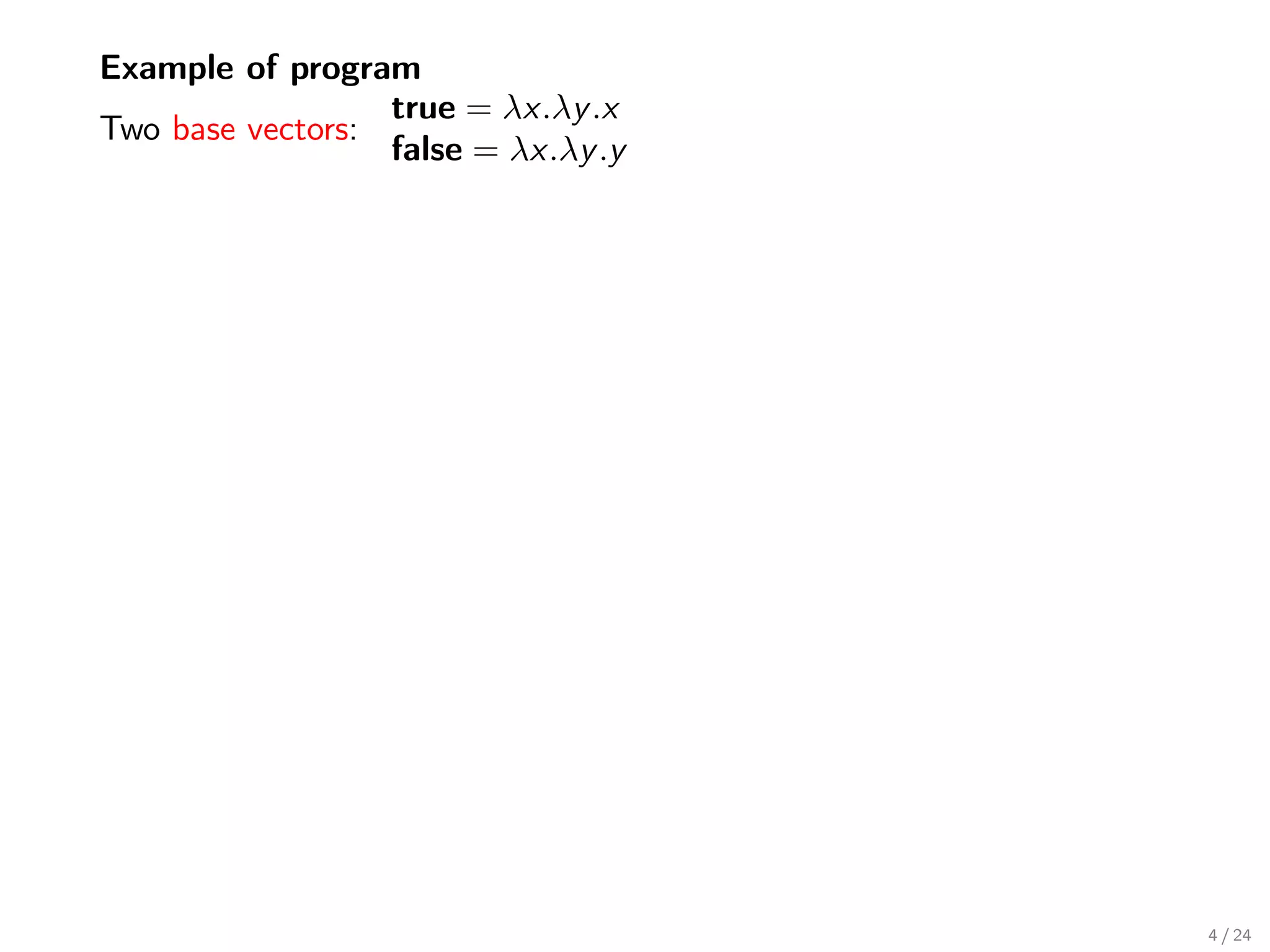
Example of program
                  true = λx.λy .x
Two base vectors:
                  false = λx.λy .y


                                     4 / 24
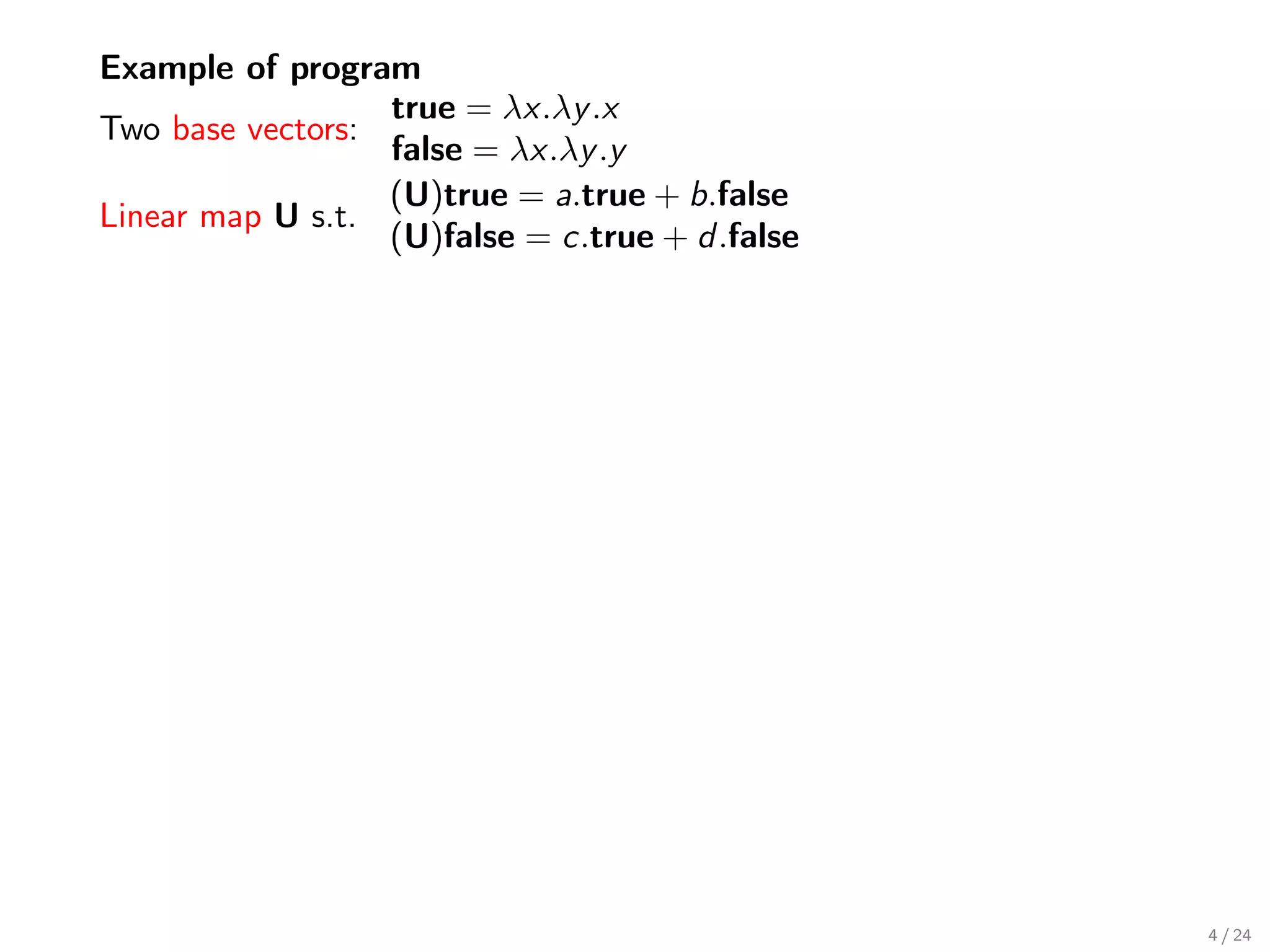
Example of program
                  true = λx.λy .x
Two base vectors:
                  false = λx.λy .y
                  (U)true = a.true + b.false
Linear map U s.t.
                  (U)false = c.true + d .false


                                                 4 / 24
Example of program
                  true = λx.λy .x
Two base vectors:
                  false = λx.λy .y
                  (U)true = a.true + b.false
Linear map U s.t.
                  (U)false = c.true + d .false
       U := λx.{((x) [a.true + b.false]) [c.true + d .false]}


                                                                4 / 24
Example of program
                  true = λx.λy .x
Two base vectors:
                  false = λx.λy .y
                  (U)true = a.true + b.false
Linear map U s.t.
                  (U)false = c.true + d .false
       U := λx.{((x) [a.true + b.false]) [c.true + d .false]}

Aim:
To provide a type system capturing the “vectorial” structure of terms
          . . . to check for properties of probabilistic processes
          . . . to check for properties of quantum processes
          . . . or whatever application needing the structure of the vector
                in normal form
          . . . understand what it means “linear combination of types”
          . . . a Curry-Howard approach to defining
                Fuzzy/Quantum/Probabilistic logics from
                Fuzzy/Quantum/Probabilistic programming languages.

                                                                              4 / 24
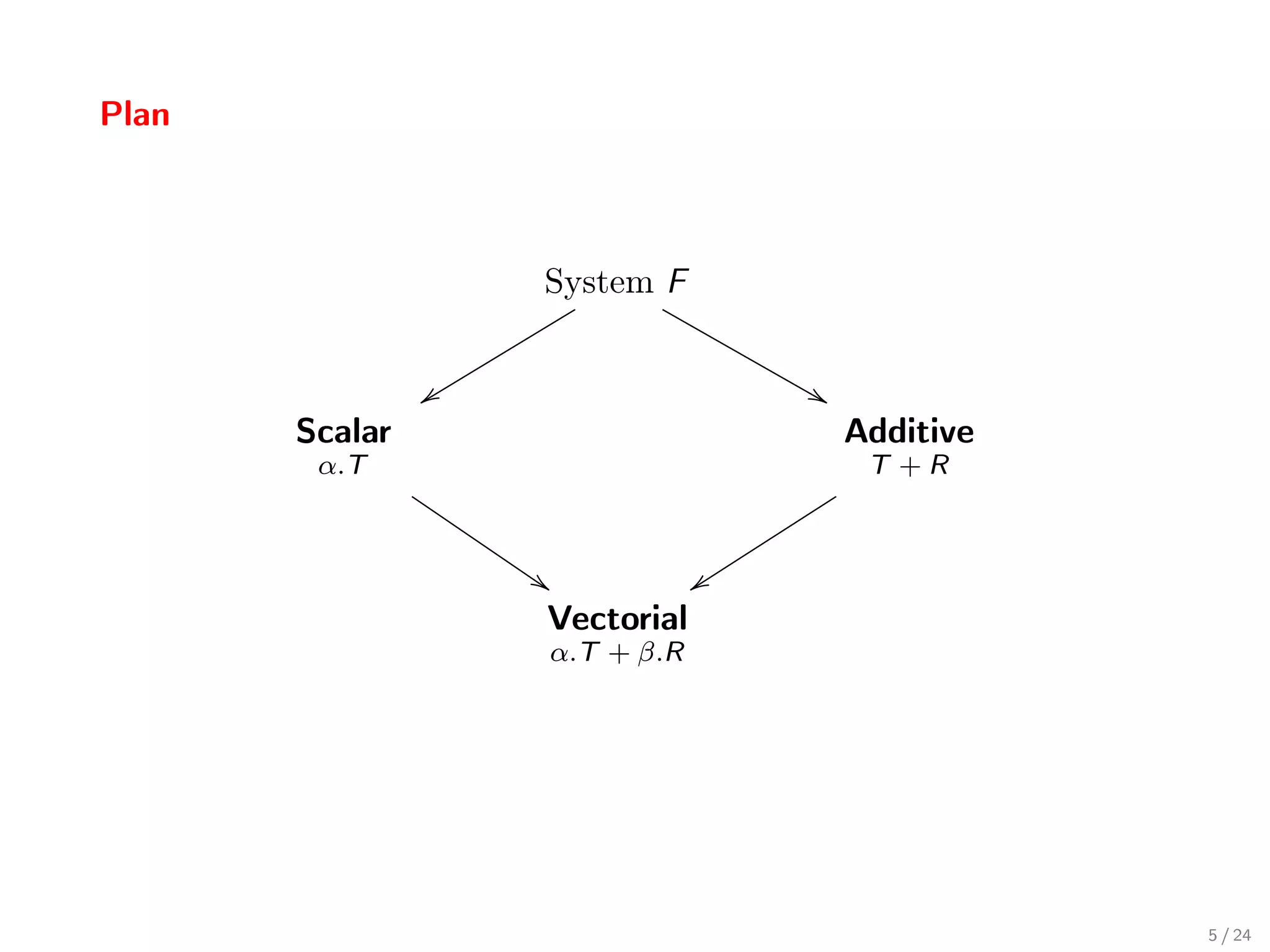
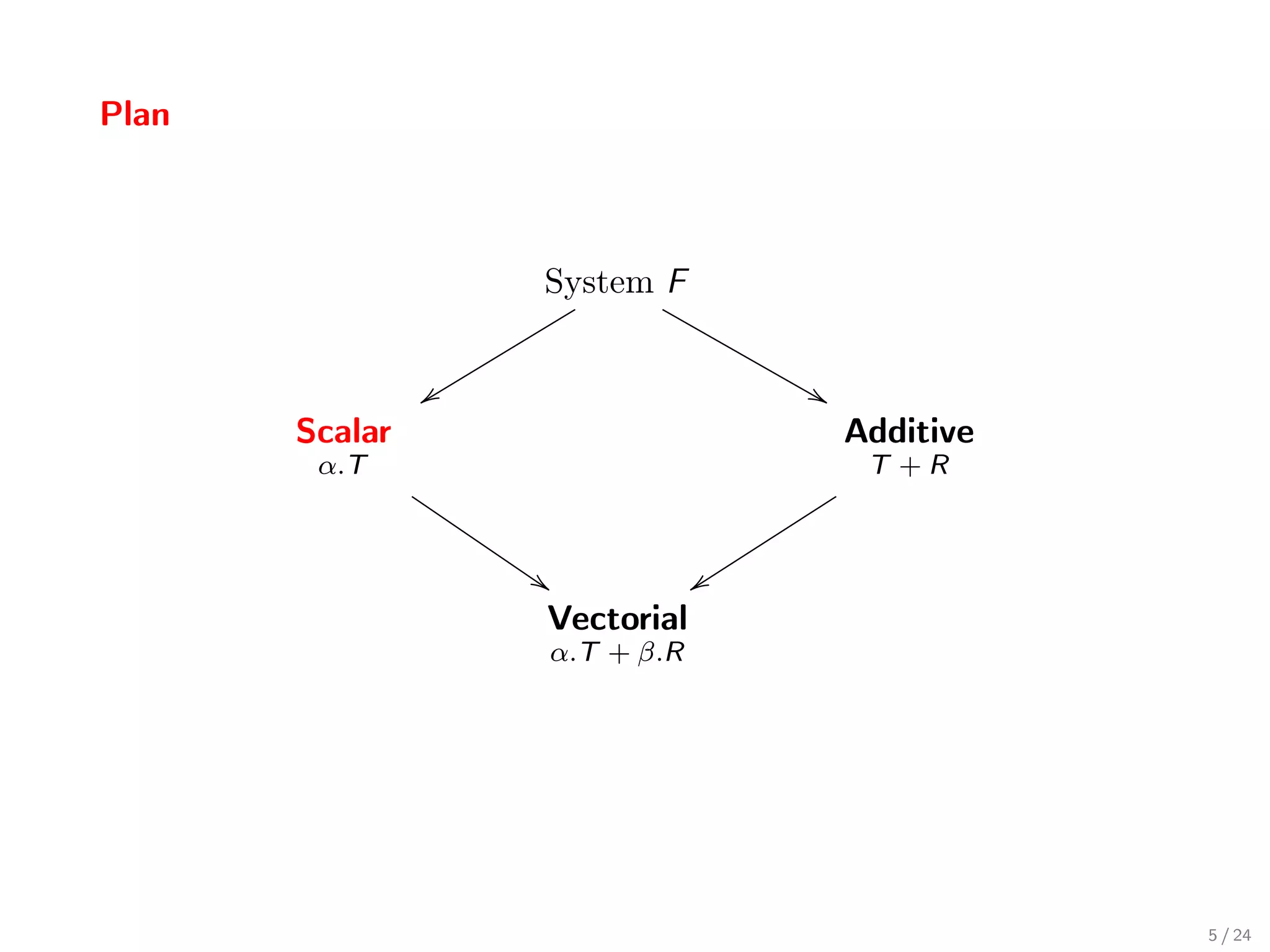
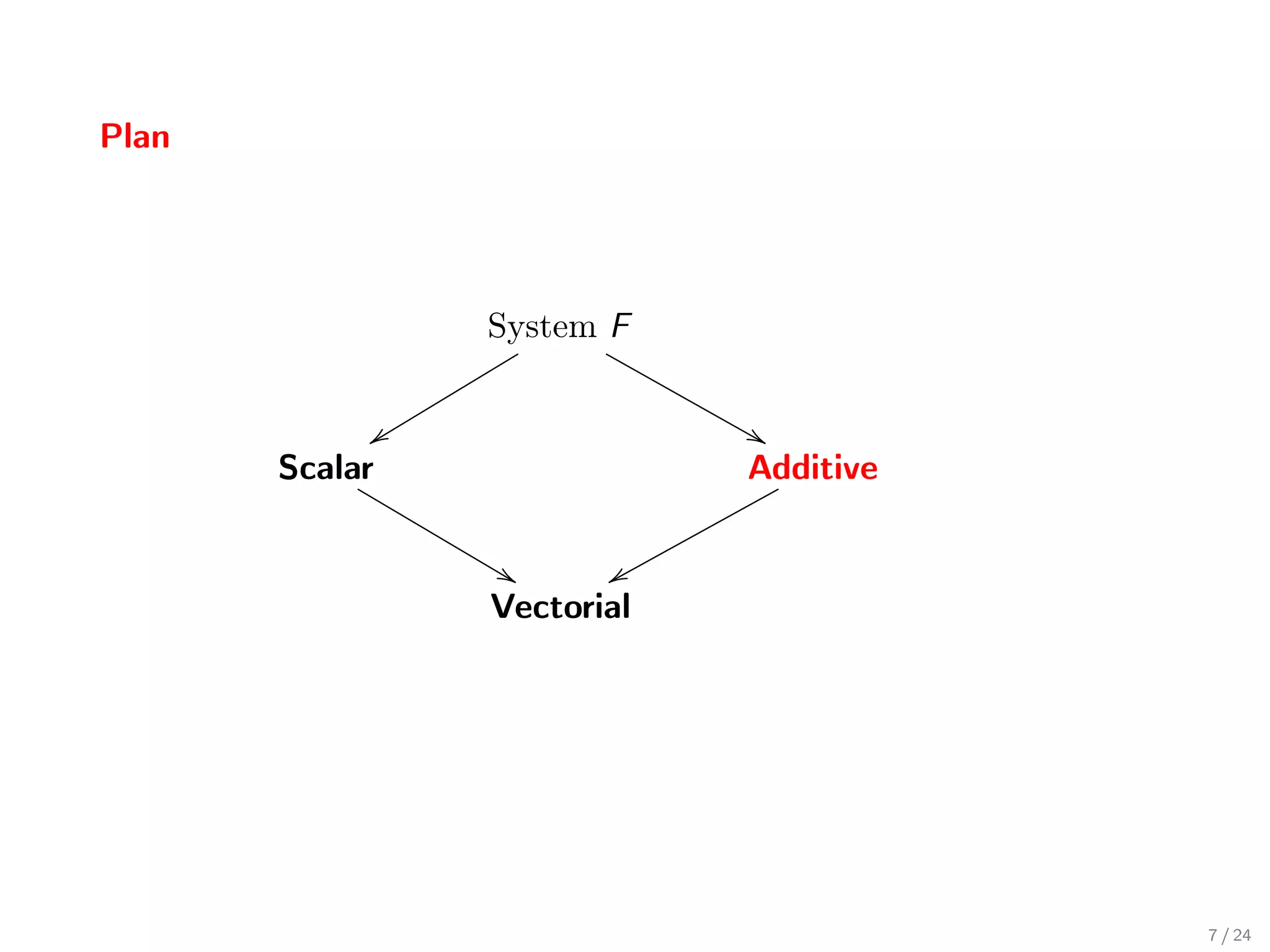
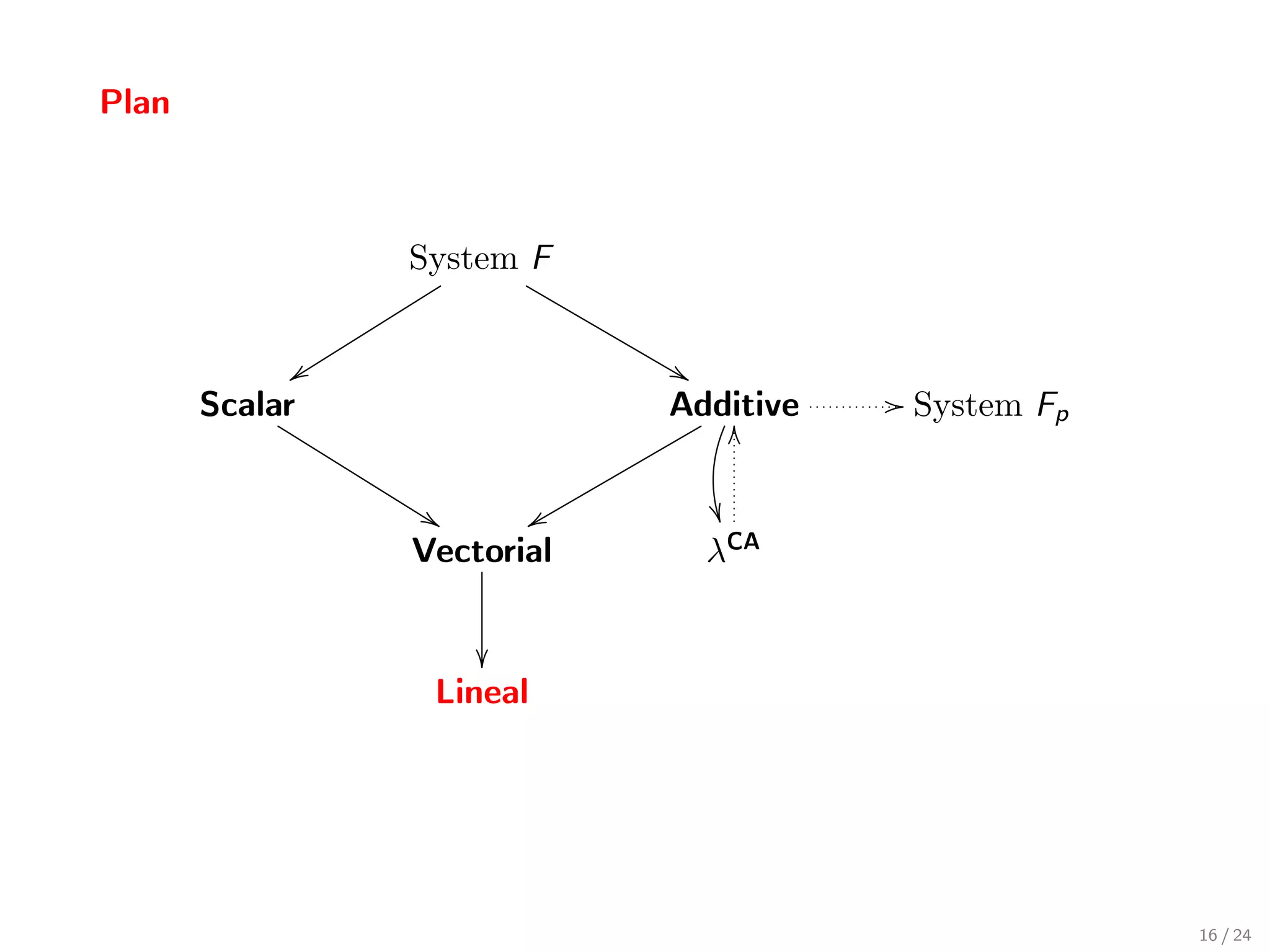
Plan


                    System F


                y                 &
       Scalar                         Additive
        α.T                            T +R


                    $         y
                    Vectorial
                    α.T + β.R


                                                 5 / 24
Plan


                    System F


                y                 &
       Scalar                         Additive
        α.T                            T +R


                    $         y
                    Vectorial
                    α.T + β.R


                                                 5 / 24
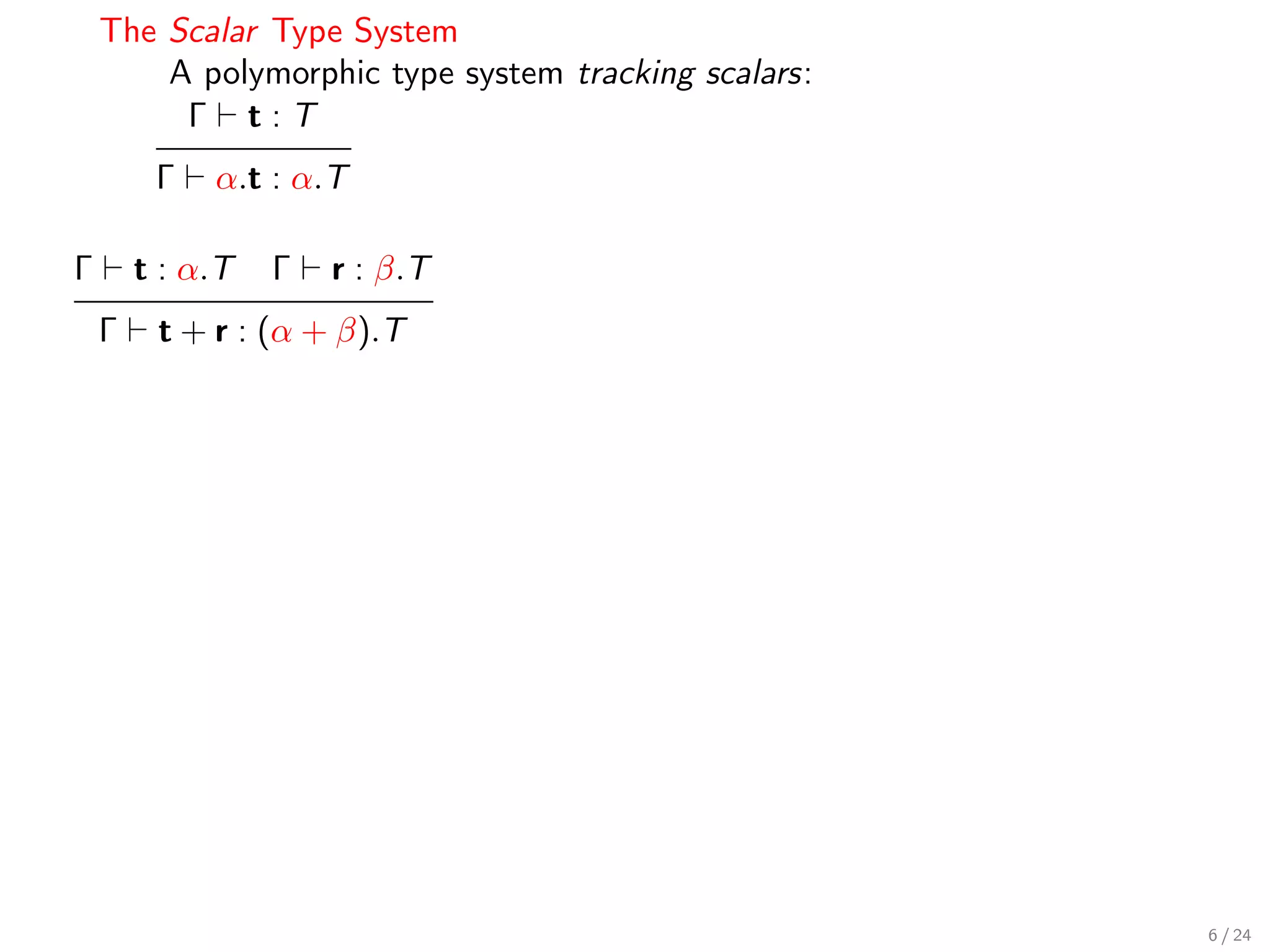
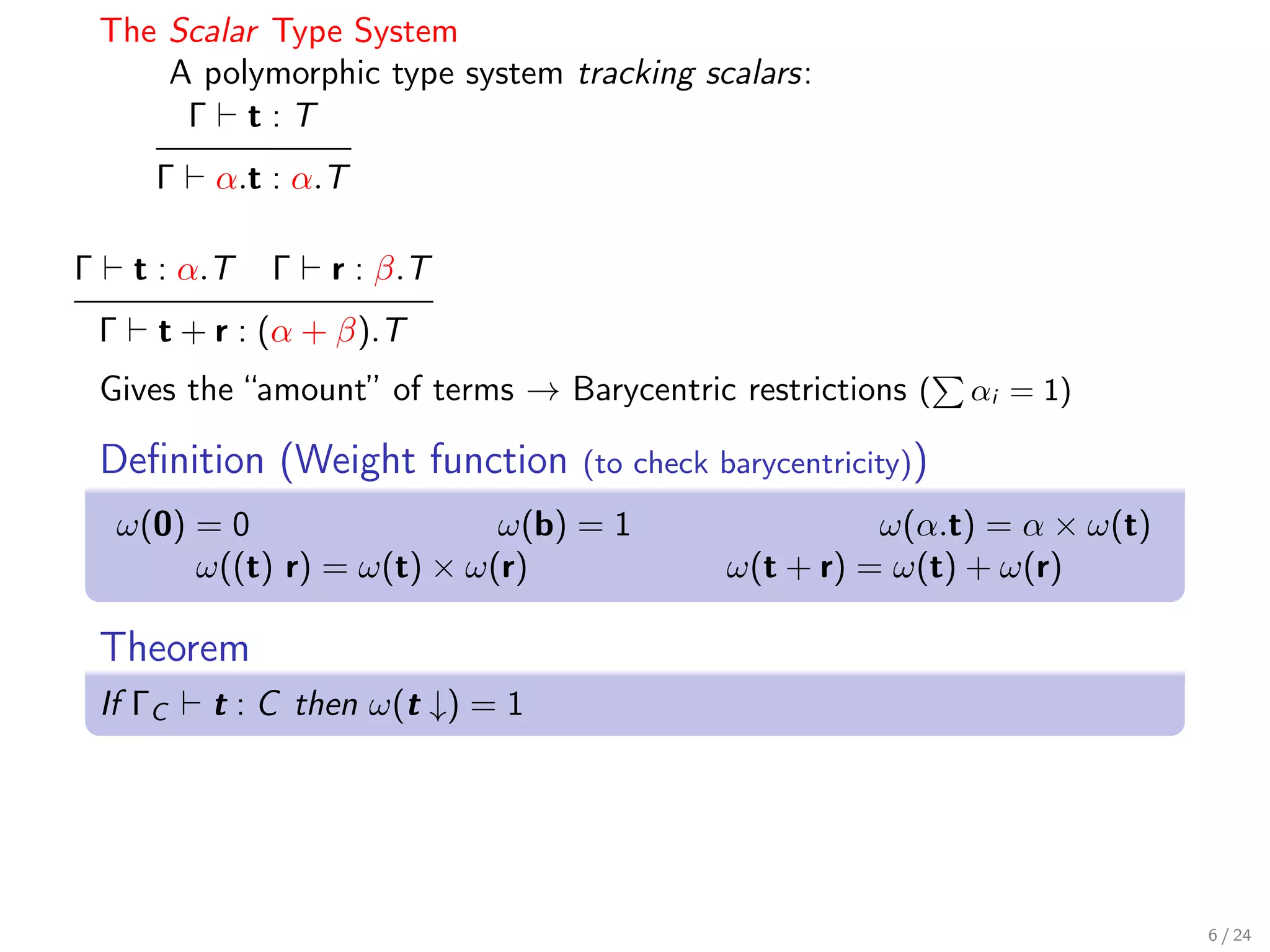
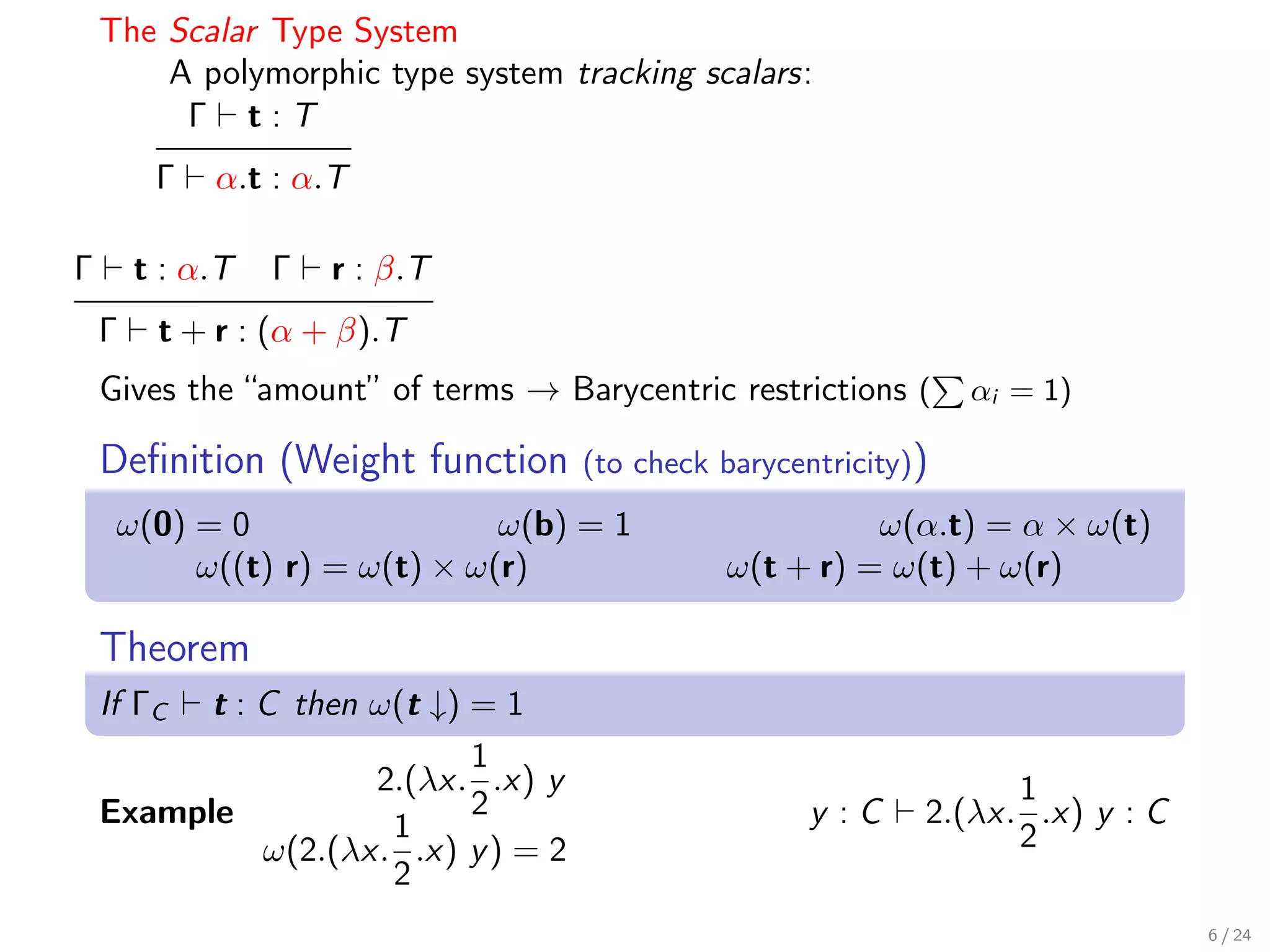
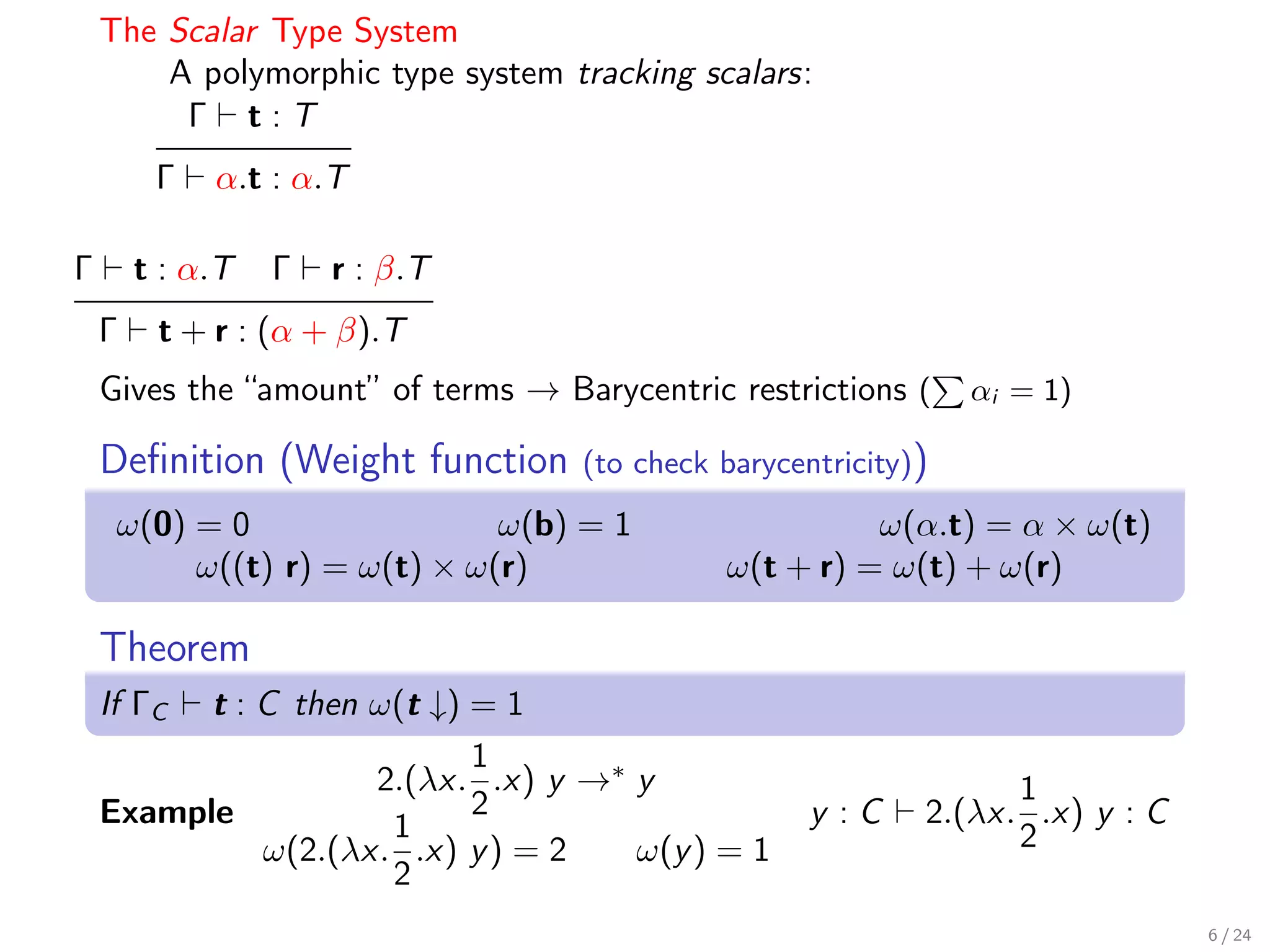
The Scalar Type System
        A polymorphic type system tracking scalars:
         Γ t:T
         Γ   α.t : α.T

Γ       t : α.T   Γ   r : β.T
    Γ    t + r : (α + β).T


                                                      6 / 24
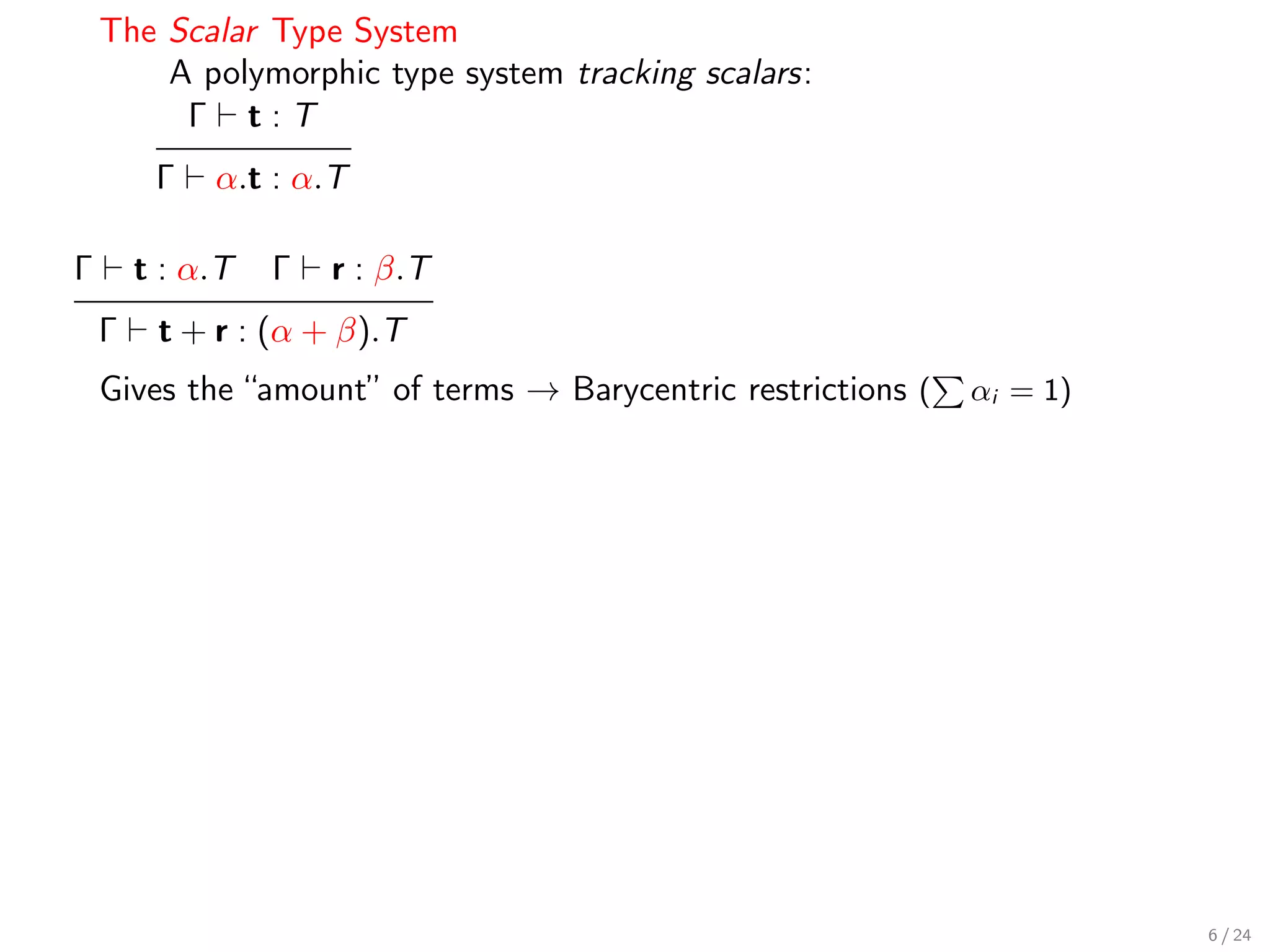
The Scalar Type System
        A polymorphic type system tracking scalars:
         Γ t:T
         Γ   α.t : α.T

Γ       t : α.T   Γ   r : β.T
    Γ    t + r : (α + β).T
    Gives the “amount” of terms → Barycentric restrictions (   αi = 1)


                                                                         6 / 24
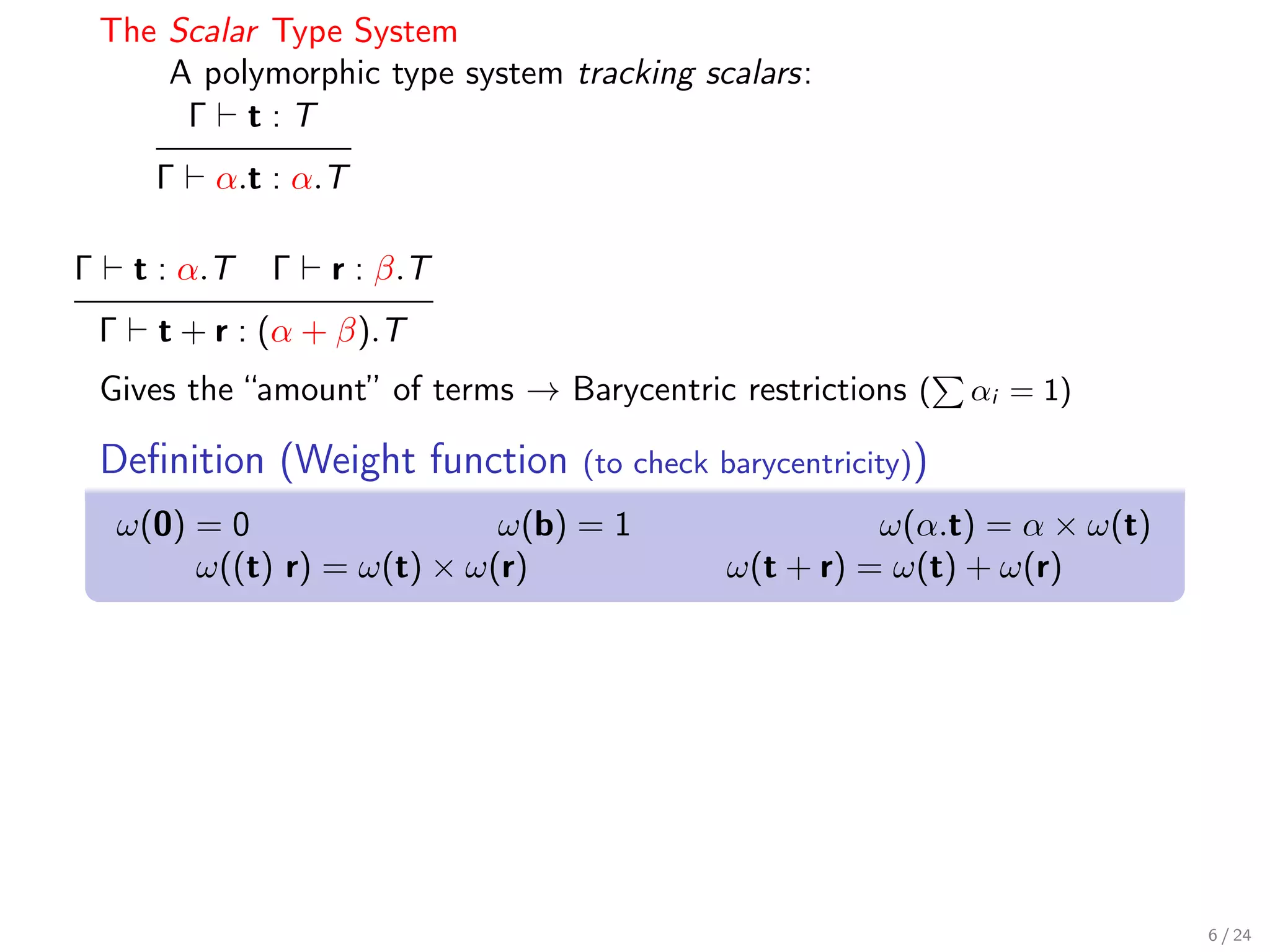
The Scalar Type System
        A polymorphic type system tracking scalars:
         Γ t:T
         Γ   α.t : α.T

Γ       t : α.T   Γ   r : β.T
    Γ    t + r : (α + β).T
    Gives the “amount” of terms → Barycentric restrictions (     αi = 1)

    Definition (Weight function      (to check barycentricity))
     ω(0) = 0                 ω(b) = 1                  ω(α.t) = α × ω(t)
          ω((t) r) = ω(t) × ω(r)              ω(t + r) = ω(t) + ω(r)


                                                                            6 / 24
The Scalar Type System
        A polymorphic type system tracking scalars:
         Γ t:T
         Γ   α.t : α.T

Γ       t : α.T   Γ   r : β.T
    Γ    t + r : (α + β).T
    Gives the “amount” of terms → Barycentric restrictions (      αi = 1)

    Definition (Weight function       (to check barycentricity))
     ω(0) = 0                 ω(b) = 1                   ω(α.t) = α × ω(t)
          ω((t) r) = ω(t) × ω(r)               ω(t + r) = ω(t) + ω(r)

    Theorem
    If ΓC    t : C then ω(t ↓) = 1


                                                                             6 / 24
The Scalar Type System
        A polymorphic type system tracking scalars:
         Γ t:T
         Γ   α.t : α.T

Γ       t : α.T   Γ   r : β.T
    Γ    t + r : (α + β).T
    Gives the “amount” of terms → Barycentric restrictions (      αi = 1)

    Definition (Weight function       (to check barycentricity))
     ω(0) = 0                 ω(b) = 1                   ω(α.t) = α × ω(t)
          ω((t) r) = ω(t) × ω(r)               ω(t + r) = ω(t) + ω(r)

    Theorem
    If ΓC t : C then ω(t ↓) = 1
                            1
                     2.(λx. .x) y                                   1
    Example                 2                         y :C    2.(λx. .x) y : C
                      1                                             2
              ω(2.(λx. .x) y ) = 2
                      2
                                                                                 6 / 24
The Scalar Type System
        A polymorphic type system tracking scalars:
         Γ t:T
         Γ   α.t : α.T

Γ       t : α.T   Γ   r : β.T
    Γ    t + r : (α + β).T
    Gives the “amount” of terms → Barycentric restrictions (     αi = 1)

    Definition (Weight function      (to check barycentricity))
     ω(0) = 0                 ω(b) = 1                  ω(α.t) = α × ω(t)
          ω((t) r) = ω(t) × ω(r)              ω(t + r) = ω(t) + ω(r)

    Theorem
    If ΓC t : C then ω(t ↓) = 1
                            1
                     2.(λx. .x) y →∗ y                             1
    Example                 2                        y :C    2.(λx. .x) y : C
                      1                                            2
              ω(2.(λx. .x) y ) = 2   ω(y ) = 1
                      2
                                                                                6 / 24
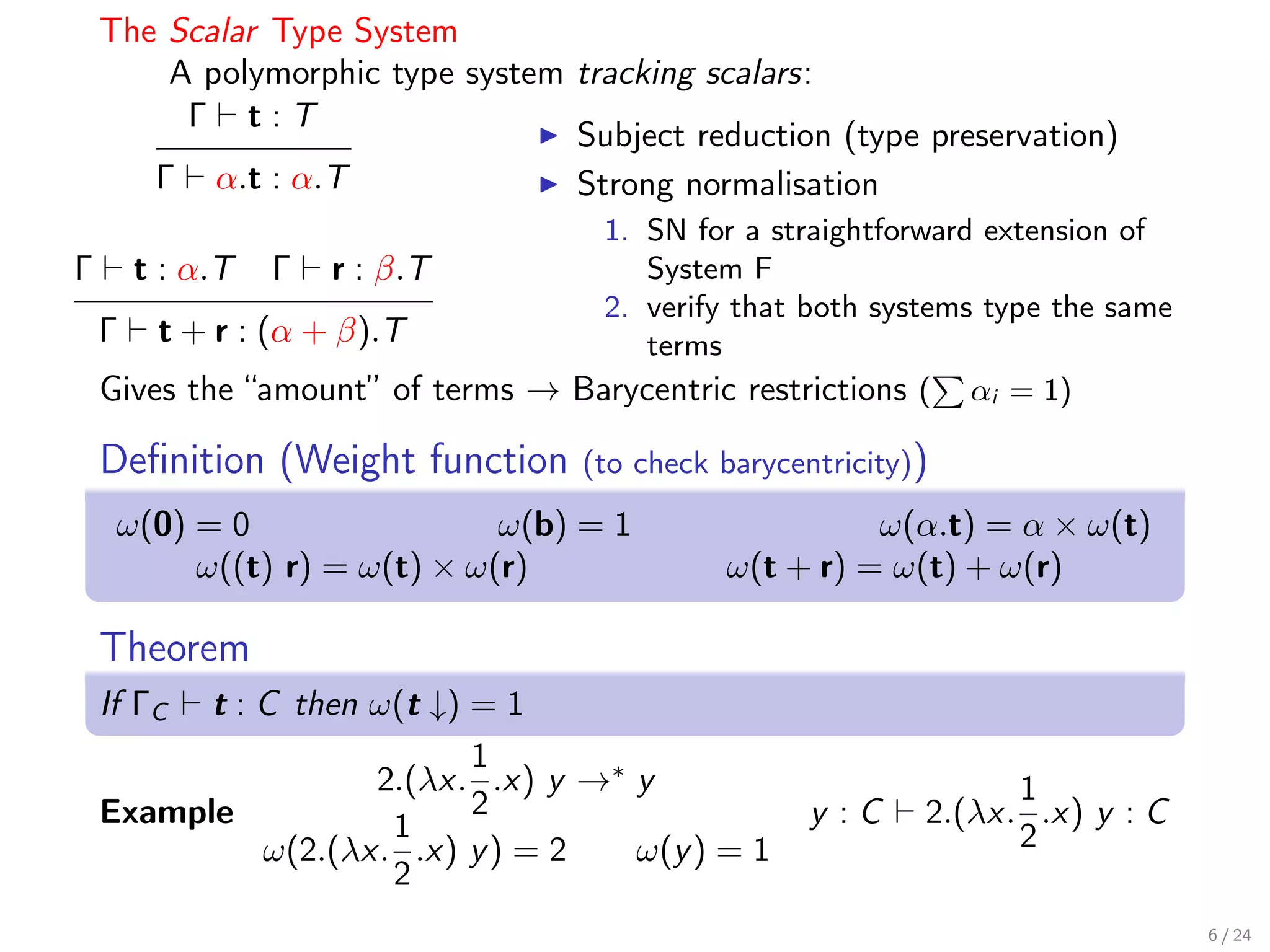
The Scalar Type System
        A polymorphic type system tracking scalars:
         Γ t:T
                                  Subject reduction (type preservation)
       Γ α.t : α.T                Strong normalisation
                                    1. SN for a straightforward extension of
Γ     t : α.T   Γ   r : β.T            System F
                                    2. verify that both systems type the same
    Γ t + r : (α + β).T                terms
    Gives the “amount” of terms → Barycentric restrictions ( αi = 1)

    Definition (Weight function      (to check barycentricity))
     ω(0) = 0                 ω(b) = 1                  ω(α.t) = α × ω(t)
          ω((t) r) = ω(t) × ω(r)              ω(t + r) = ω(t) + ω(r)

    Theorem
    If ΓC t : C then ω(t ↓) = 1
                            1
                     2.(λx. .x) y →∗ y                             1
    Example                 2                        y :C    2.(λx. .x) y : C
                      1                                            2
              ω(2.(λx. .x) y ) = 2   ω(y ) = 1
                      2
                                                                                6 / 24
The Scalar Type System
        A polymorphic type system tracking scalars:
         Γ t:T
                                  Subject reduction (type preservation)
       Γ α.t : α.T                Strong normalisation
                                    1. SN for a straightforward extension of
Γ     t : α.T    Γ    r : β.T          System F
                                    2. verify that both systems type the same
    Γ t + r : (α + β).T                terms
    Gives the “amount” of terms → Barycentric restrictions ( αi = 1)

    Definition (Weight function             (to check barycentricity))
     ω(0) = 0                 ω(b) = 1                         ω(α.t) = α × ω(t)
          ω((t) r) = ω(t) × ω(r)                     ω(t + r) = ω(t) + ω(r)

    Theorem
    If ΓC t : C then ω(t ↓) = 1
                            1
                     2.(λx. .x) y →∗ y                                    1
    Example                 2                               y :C    2.(λx. .x) y : C
                      1                                                   2
              ω(2.(λx. .x) y ) = 2   ω(y ) = 1
                      2
    Contribution: [Arrighi,Díaz-Caro’09]
                                                                                       6 / 24
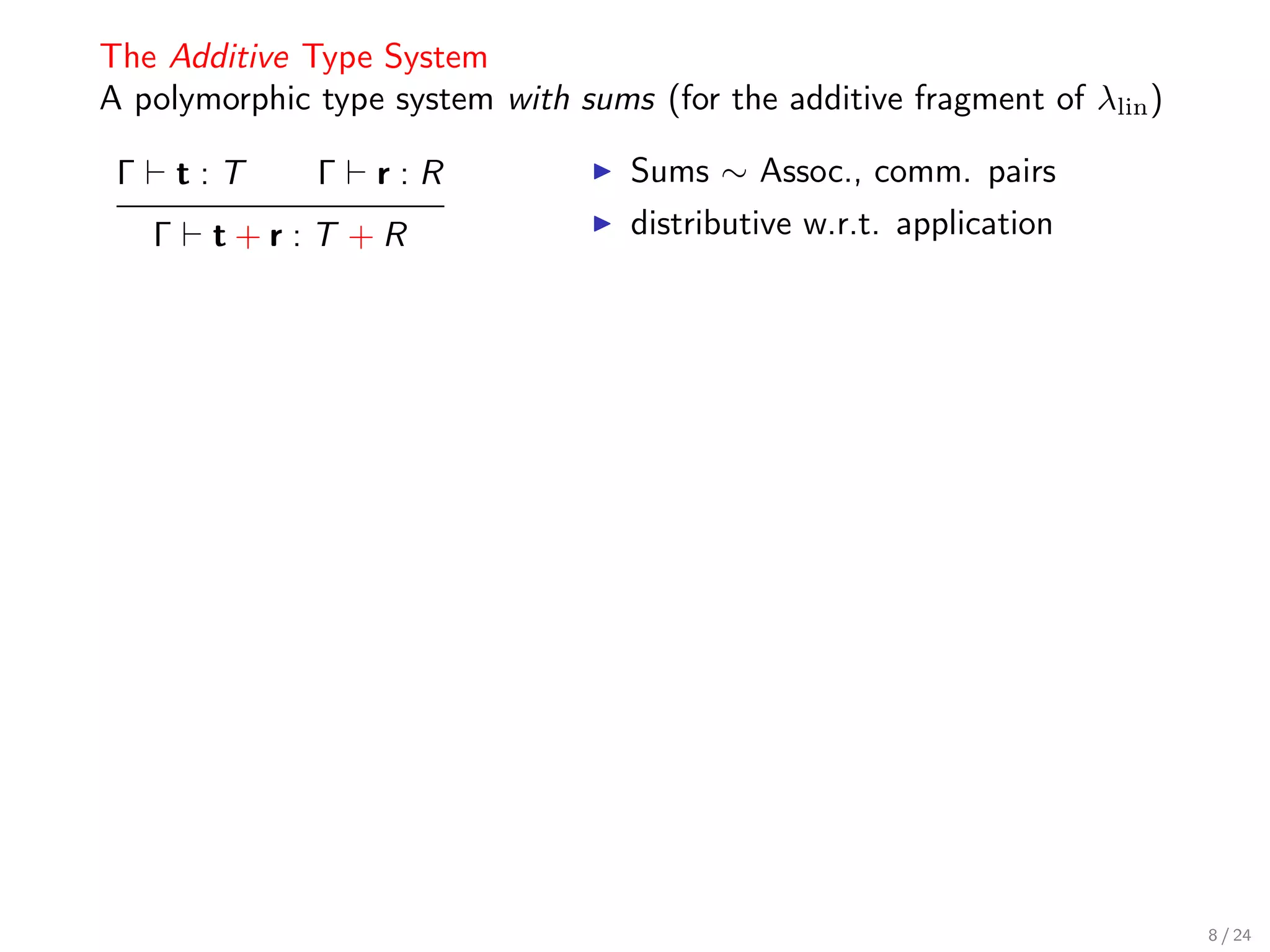
Plan


                 System F


             y                &
       Scalar                Additive

                  &     x
                 Vectorial


                                        7 / 24
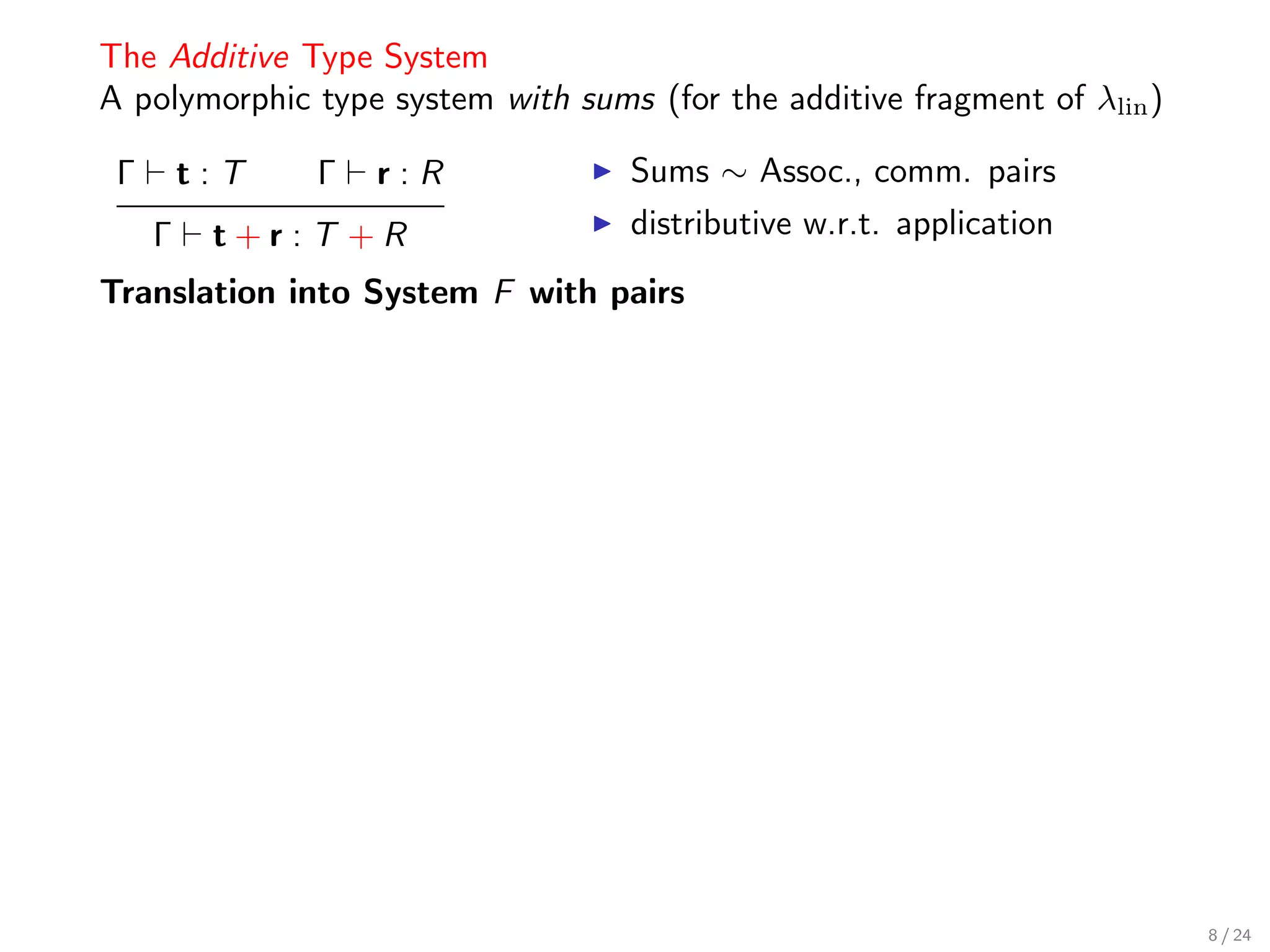
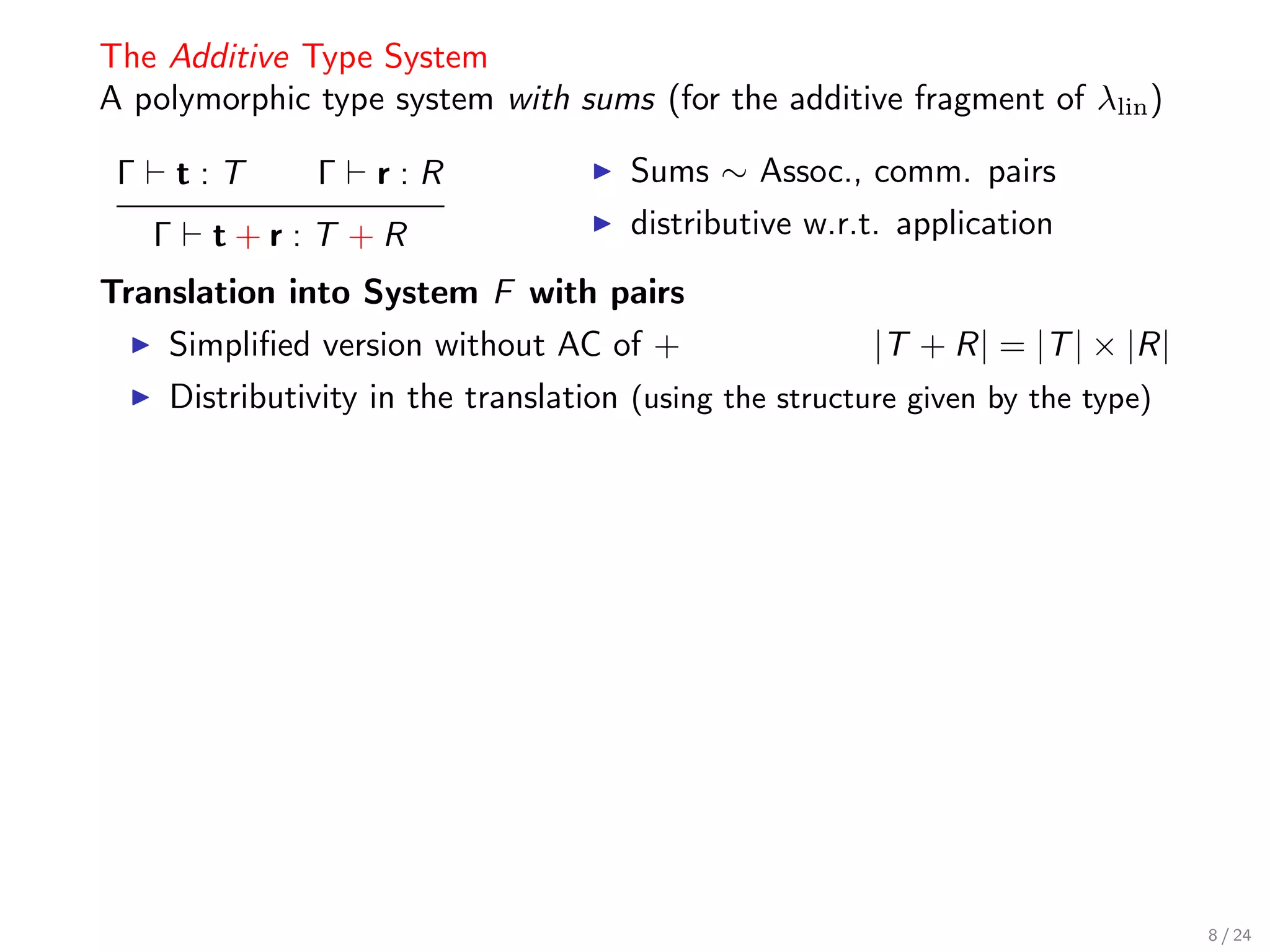
The Additive Type System
A polymorphic type system with sums (for the additive fragment of λlin )

 Γ       t:T   Γ   r:R             Sums ∼ Assoc., comm. pairs
     Γ    t+r:T +R                 distributive w.r.t. application


                                                                           8 / 24
The Additive Type System
A polymorphic type system with sums (for the additive fragment of λlin )

 Γ       t:T   Γ   r:R             Sums ∼ Assoc., comm. pairs
     Γ    t+r:T +R                 distributive w.r.t. application
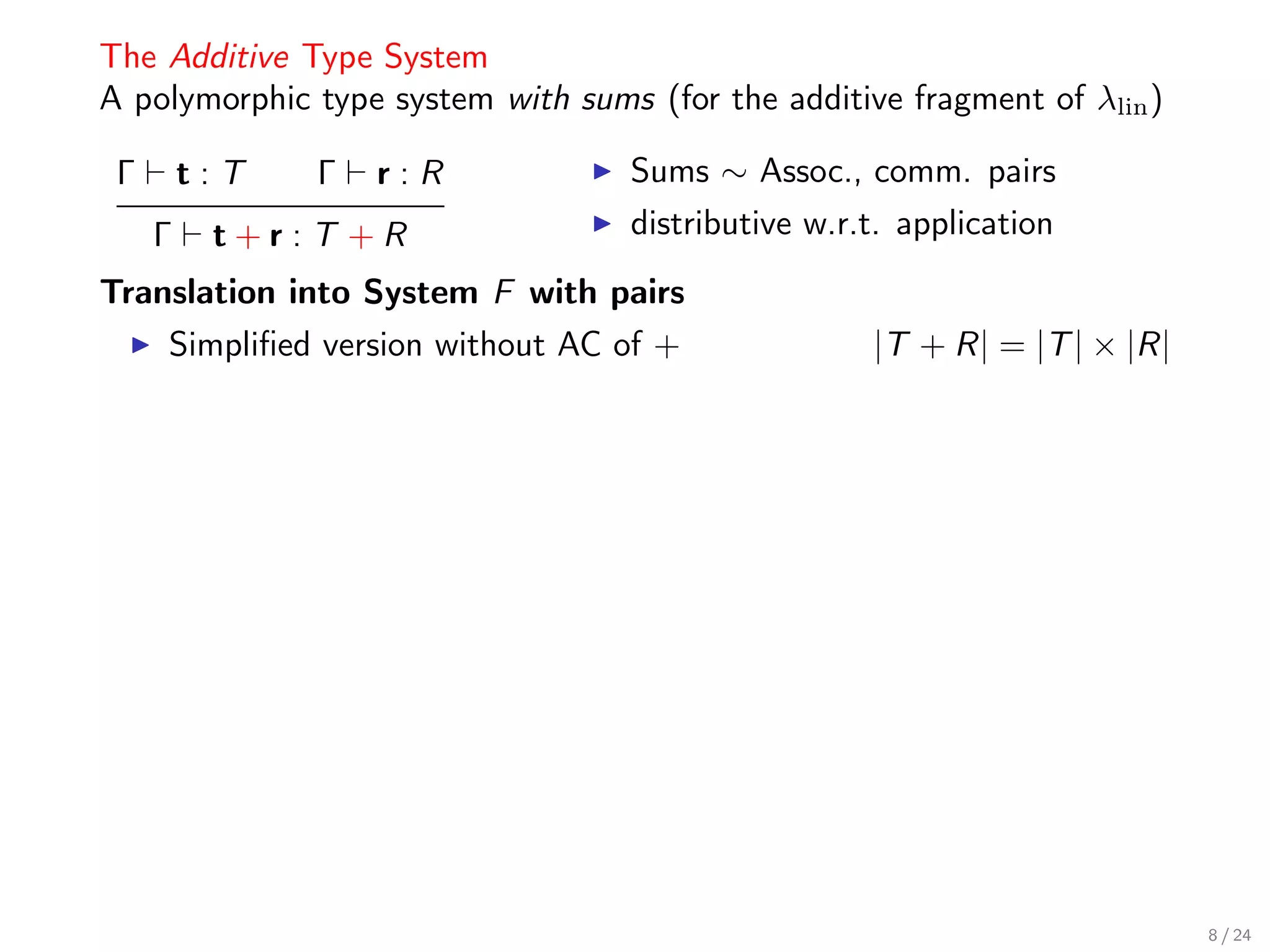
Translation into System F with pairs


                                                                           8 / 24
The Additive Type System
A polymorphic type system with sums (for the additive fragment of λlin )

 Γ       t:T   Γ   r:R             Sums ∼ Assoc., comm. pairs
     Γ    t+r:T +R                 distributive w.r.t. application
Translation into System F with pairs
     Simplified version without AC of +              |T + R| = |T | × |R|


                                                                           8 / 24
The Additive Type System
A polymorphic type system with sums (for the additive fragment of λlin )

 Γ       t:T    Γ   r:R                Sums ∼ Assoc., comm. pairs
     Γ    t+r:T +R                     distributive w.r.t. application
Translation into System F with pairs
     Simplified version without AC of +                   |T + R| = |T | × |R|
     Distributivity in the translation (using the structure given by the type)


                                                                                 8 / 24
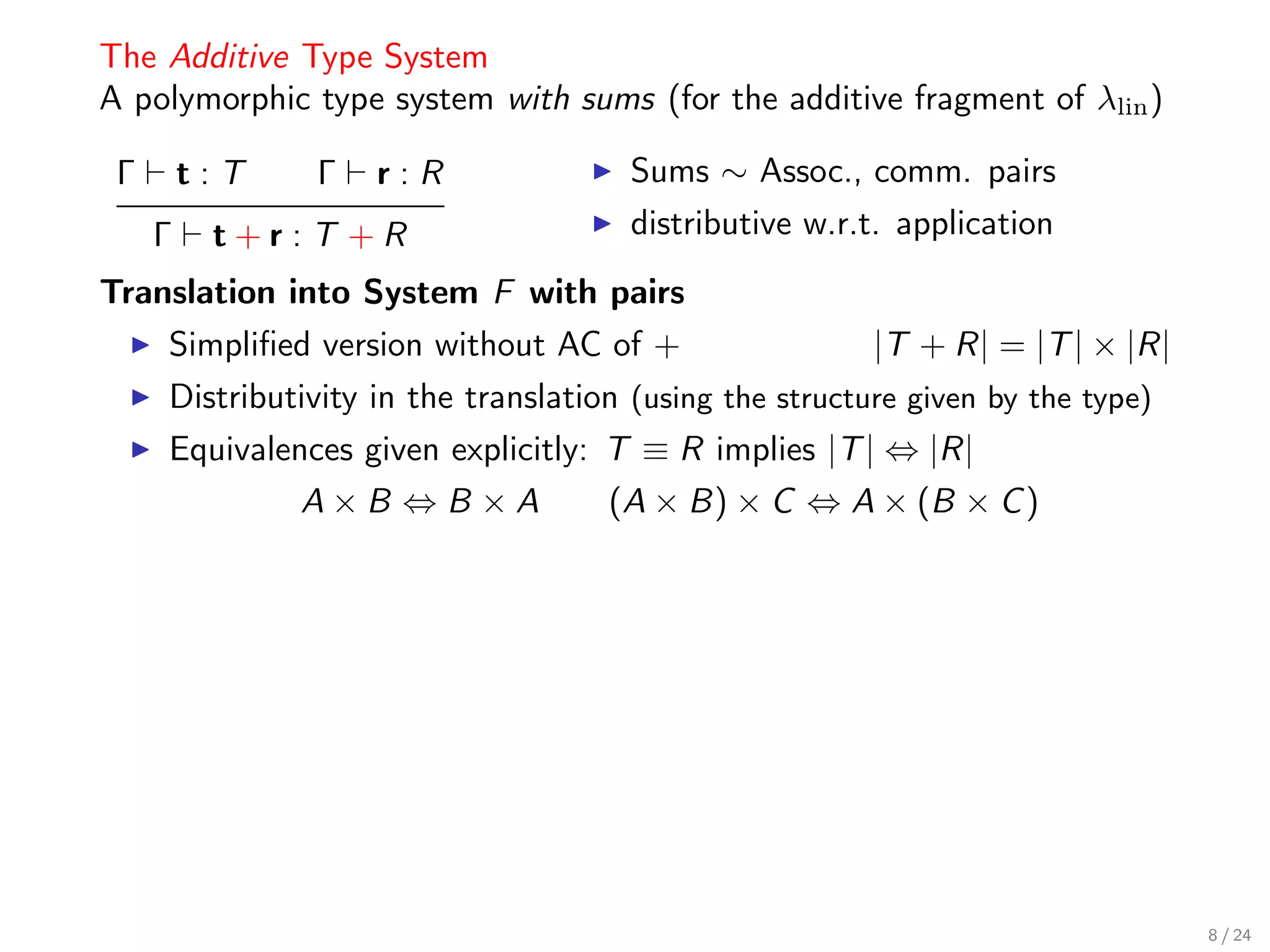
The Additive Type System
A polymorphic type system with sums (for the additive fragment of λlin )

 Γ       t:T    Γ   r:R                Sums ∼ Assoc., comm. pairs
     Γ    t+r:T +R                     distributive w.r.t. application
Translation into System F with pairs
     Simplified version without AC of +                   |T + R| = |T | × |R|
     Distributivity in the translation (using the structure given by the type)
     Equivalences given explicitly: T ≡ R implies |T | ⇔ |R|
               A×B ⇔B ×A             (A × B) × C ⇔ A × (B × C )


                                                                                 8 / 24
The Additive Type System
A polymorphic type system with sums (for the additive fragment of λlin )

 Γ         t:T     Γ   r:R               Sums ∼ Assoc., comm. pairs
       Γ    t+r:T +R                     distributive w.r.t. application
Translation into System F with pairs
       Simplified version without AC of +                    |T + R| = |T | × |R|
       Distributivity in the translation (using the structure given by the type)
       Equivalences given explicitly: T ≡ R implies |T | ⇔ |R|
                  A×B ⇔B ×A            (A × B) × C ⇔ A × (B × C )

Theorem
If Γ       t : T and exists T ≡ T then |Γ|    F   [t]D : |T |

Also we set up an inverse translation showing that it is non-trivial


                                                                                   8 / 24
The Additive Type System
A polymorphic type system with sums (for the additive fragment of λlin )

 Γ         t:T     Γ   r:R               Sums ∼ Assoc., comm. pairs
       Γ    t+r:T +R                     distributive w.r.t. application
Translation into System F with pairs
       Simplified version without AC of +                    |T + R| = |T | × |R|
       Distributivity in the translation (using the structure given by the type)
       Equivalences given explicitly: T ≡ R implies |T | ⇔ |R|
                  A×B ⇔B ×A            (A × B) × C ⇔ A × (B × C )

Theorem
If Γ       t : T and exists T ≡ T then |Γ|    F   [t]D : |T |

Also we set up an inverse translation showing that it is non-trivial
Subject reduction
Strong normalisation (using the one from System Fp )
Contribution: [Díaz-Caro,Petit’10]

                                                                                   8 / 24
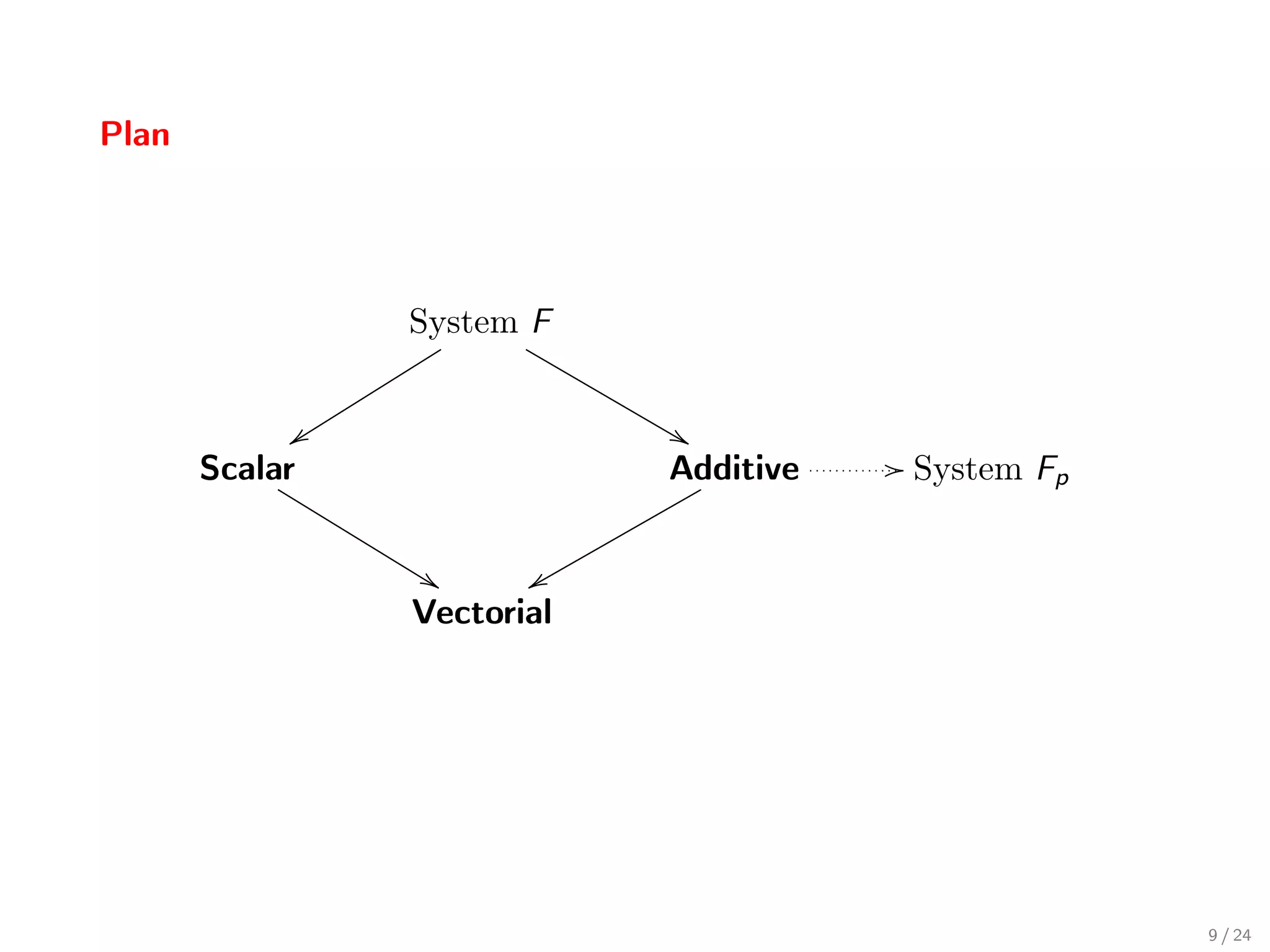
Plan


                 System F


             y                &
       Scalar                Additive   / System Fp


                  %     x
                 Vectorial


                                                      9 / 24
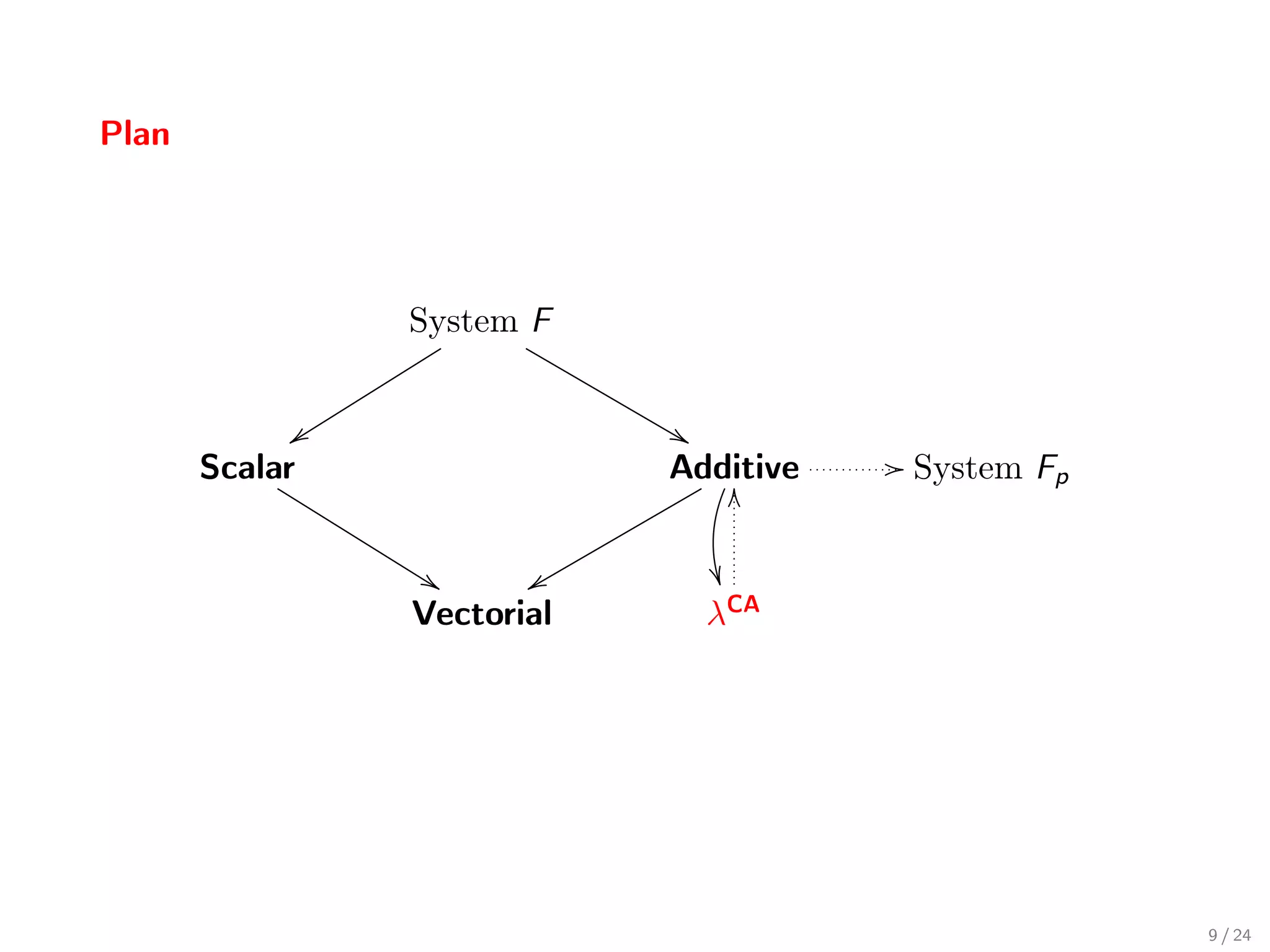
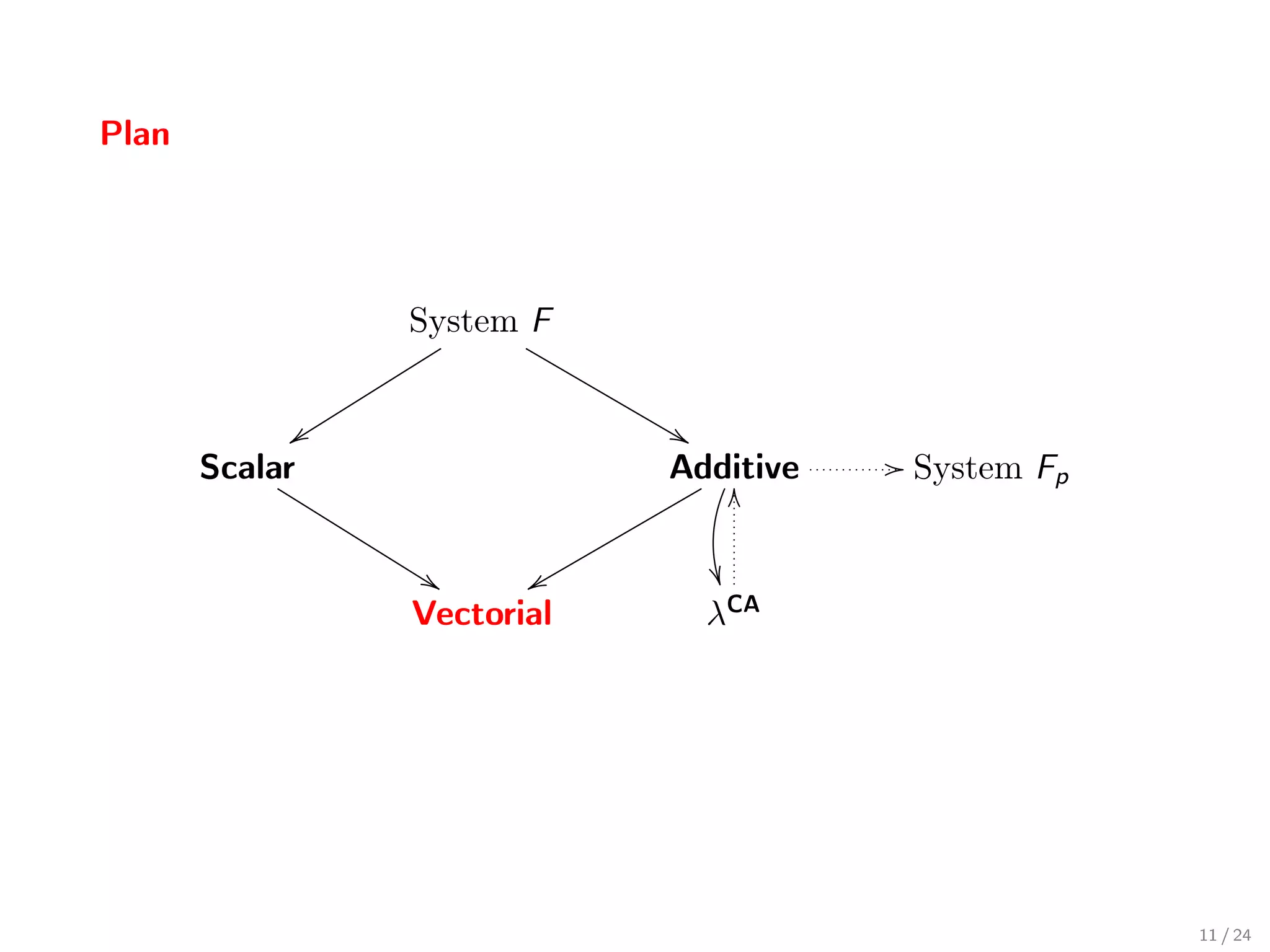
Plan


                 System F


             y                &
       Scalar                Additive   / System Fp
                                O

                  %     x       
                 Vectorial     λCA


                                                      9 / 24
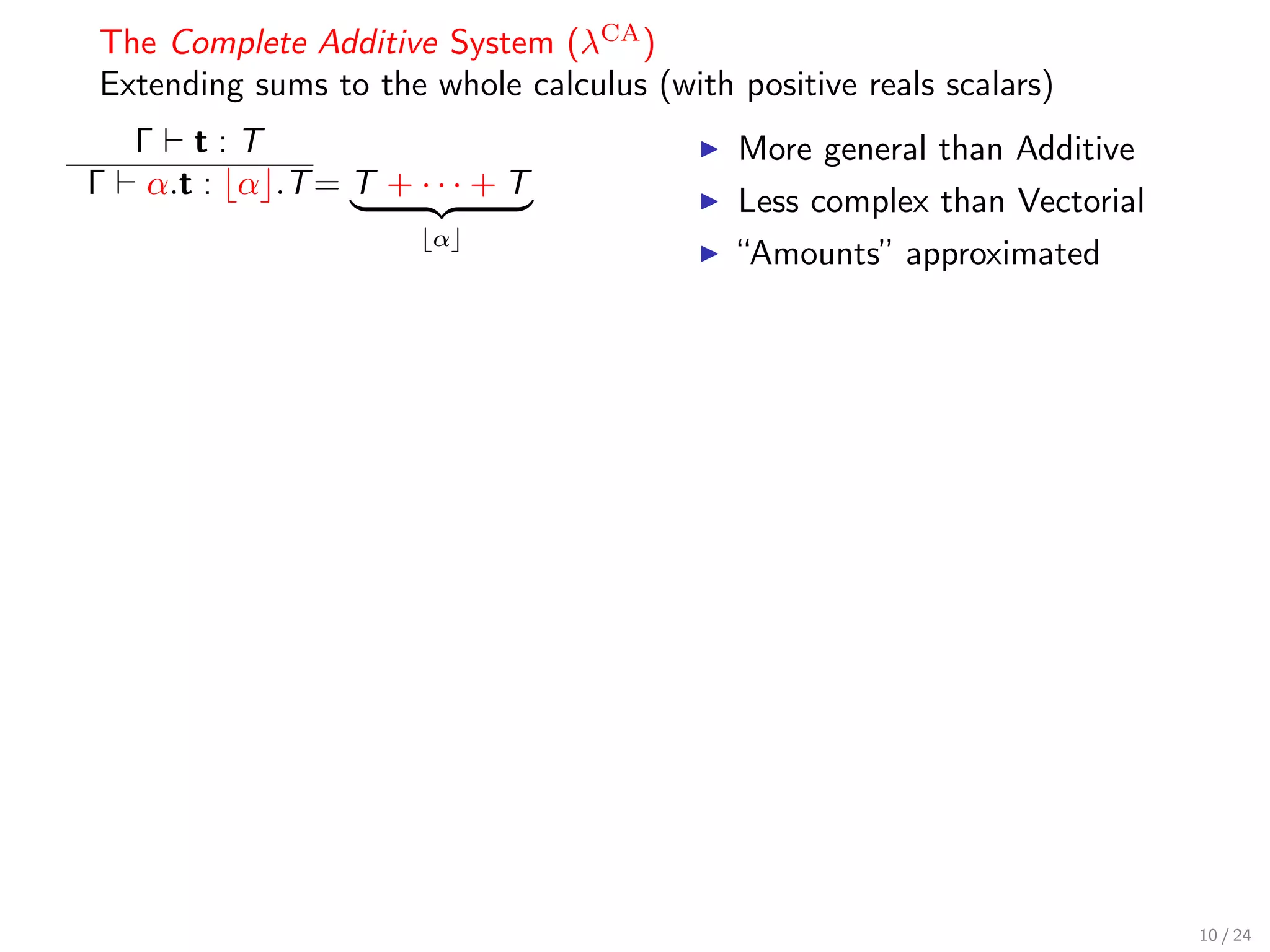
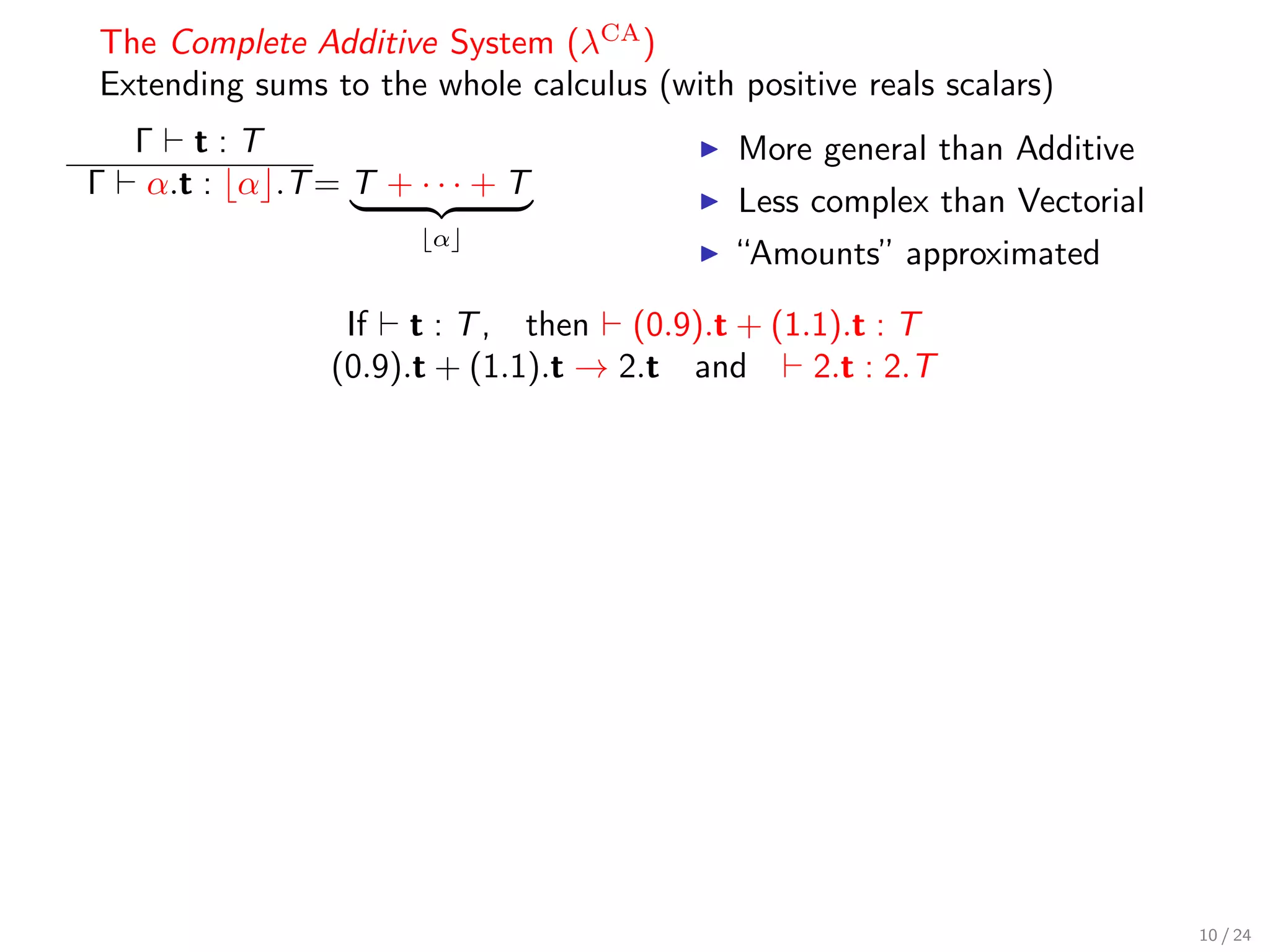
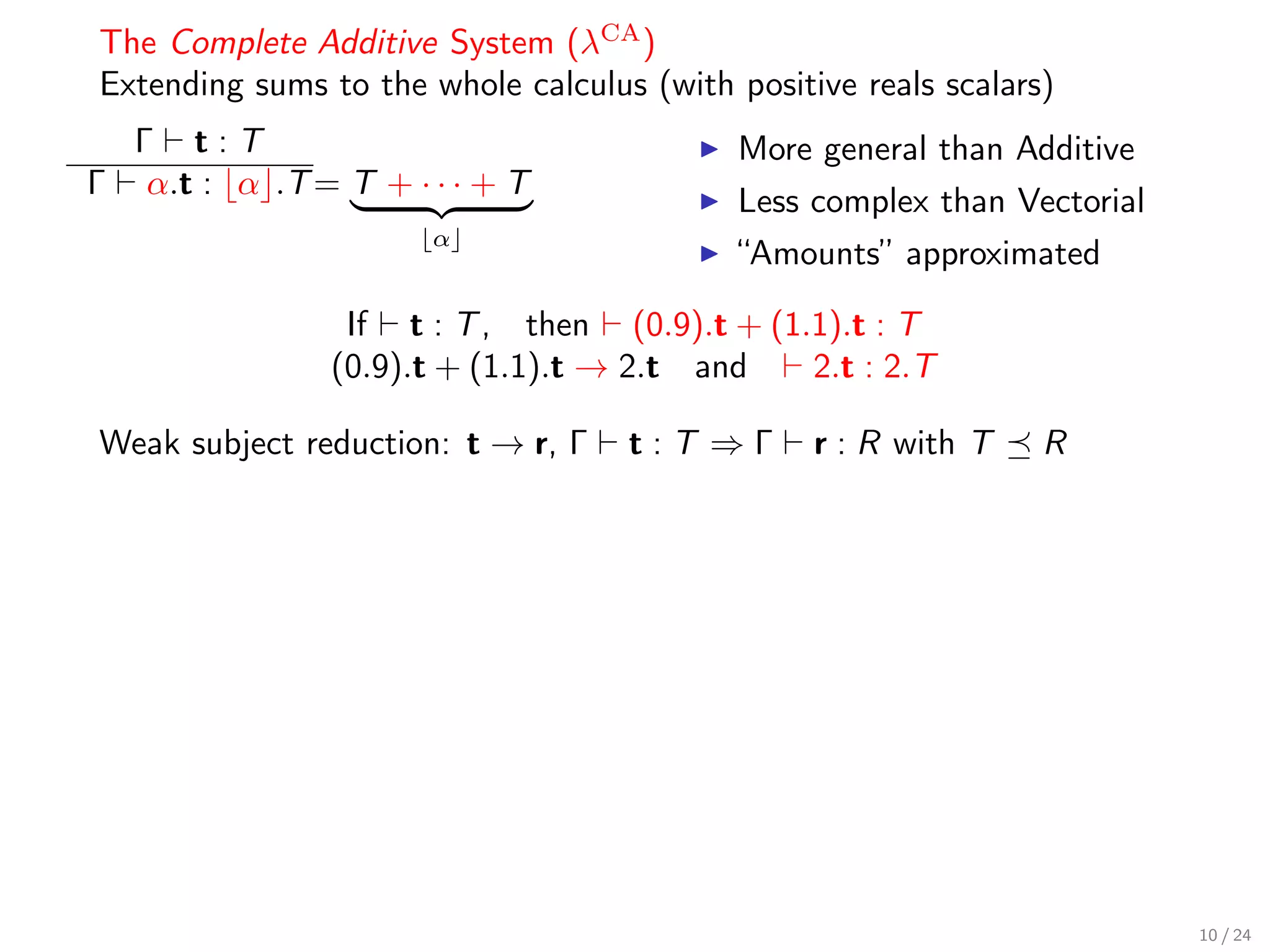
The Complete Additive System (λCA )
Extending sums to the whole calculus (with positive reals scalars)
    Γ t:T                                   More general than Additive
Γ    α.t : α .T = T + · · · + T
                                            Less complex than Vectorial
                        α
                                            “Amounts” approximated


                                                                          10 / 24
The Complete Additive System (λCA )
Extending sums to the whole calculus (with positive reals scalars)
    Γ t:T                                   More general than Additive
Γ    α.t : α .T = T + · · · + T
                                            Less complex than Vectorial
                        α
                                            “Amounts” approximated

                  If t : T , then (0.9).t + (1.1).t : T
                 (0.9).t + (1.1).t → 2.t and   2.t : 2.T


                                                                          10 / 24
The Complete Additive System (λCA )
Extending sums to the whole calculus (with positive reals scalars)
    Γ t:T                                   More general than Additive
Γ    α.t : α .T = T + · · · + T
                                            Less complex than Vectorial
                        α
                                            “Amounts” approximated

                  If t : T , then (0.9).t + (1.1).t : T
                 (0.9).t + (1.1).t → 2.t and   2.t : 2.T

Weak subject reduction: t → r, Γ    t:T ⇒Γ       r : R with T    R


                                                                          10 / 24
The Complete Additive System (λCA )
Extending sums to the whole calculus (with positive reals scalars)
    Γ t:T                                          More general than Additive
Γ    α.t : α .T = T + · · · + T
                                                   Less complex than Vectorial
                           α
                                                   “Amounts” approximated

                  If t : T , then (0.9).t + (1.1).t : T
                 (0.9).t + (1.1).t → 2.t and   2.t : 2.T

Weak subject reduction: t → r, Γ t : T ⇒ Γ               r : R with T   R
Abstract interpretation (theorem)

                                                 [·]
                      λCA
                                  τ   / λadd            / Fp

                       ↓                    ↓a               ↓F
                                     ( )             ( ) 
                      λCA             / λadd            / Fp
                                  τ              [·]


                                                                                 10 / 24
The Complete Additive System (λCA )
Extending sums to the whole calculus (with positive reals scalars)
    Γ t:T                                          More general than Additive
Γ    α.t : α .T = T + · · · + T
                                                   Less complex than Vectorial
                            α
                                                   “Amounts” approximated

                   If t : T , then (0.9).t + (1.1).t : T
                  (0.9).t + (1.1).t → 2.t and   2.t : 2.T

Weak subject reduction: t → r, Γ t : T ⇒ Γ               r : R with T   R
Abstract interpretation (theorem)

                                                 [·]
                        λCA
                                  τ   / λadd            / Fp

                        ↓                   ↓a               ↓F
                                     ( )             ( ) 
                        λCA           / λadd            / Fp
                                  τ              [·]


Strong normalisation (using Additive)
Contribution: [Buiras,Díaz-Caro,Jaskelioff’11]
                                                                                 10 / 24
Plan


                 System F


             y                
       Scalar                Additive   / System Fp
                                O

                  %     x       
                 Vectorial     λCA


                                                      11 / 24
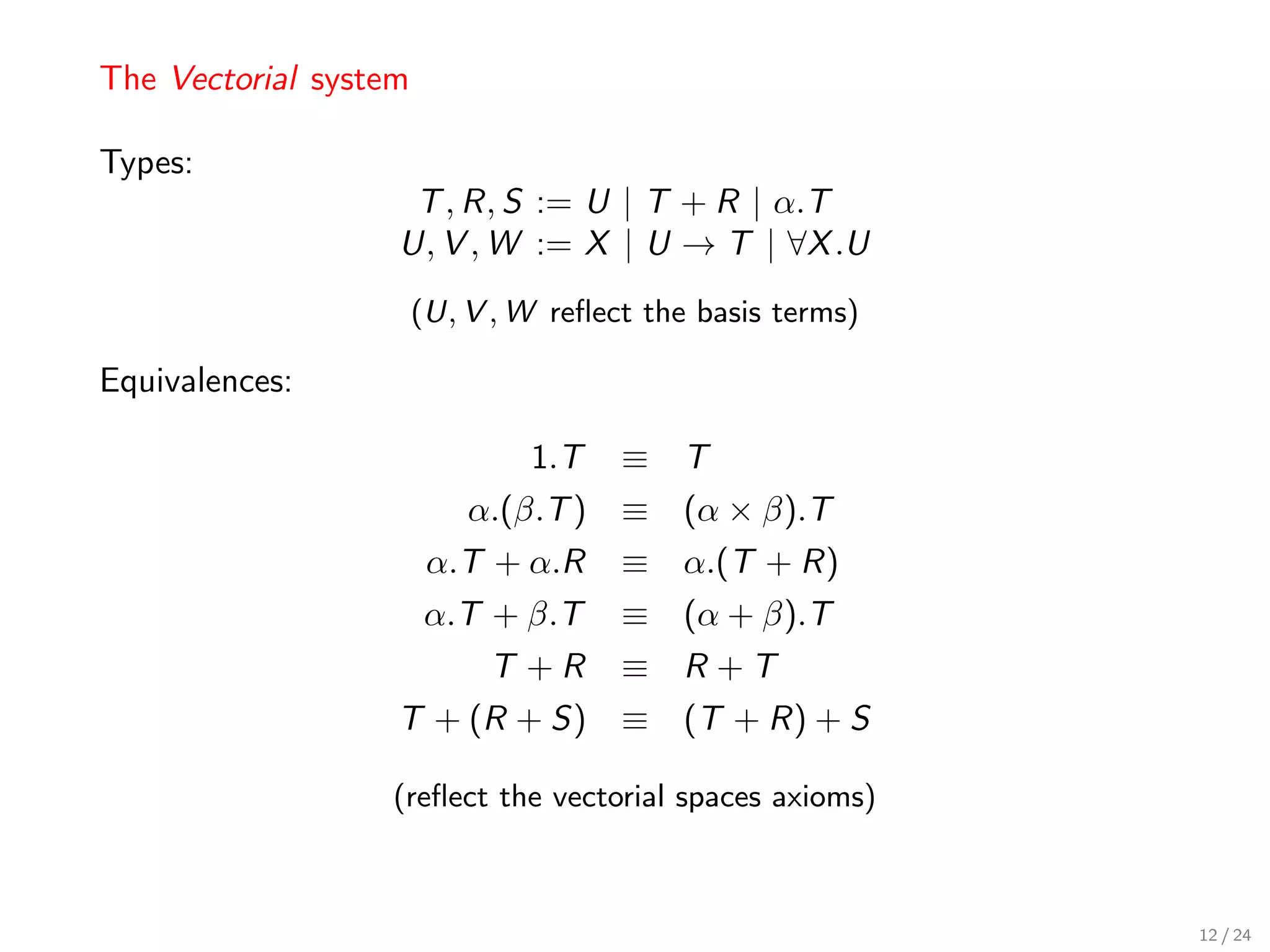
The Vectorial system

Types:
                    T , R, S := U | T + R | α.T
                   U, V , W := X | U → T | ∀X .U
                       (U, V , W reflect the basis terms)

Equivalences:

                               1.T    ≡ T
                           α.(β.T ) ≡ (α × β).T
                        α.T + α.R     ≡ α.(T + R)
                       α.T + β.T      ≡ (α + β).T
                            T +R      ≡ R +T
                   T + (R + S) ≡ (T + R) + S

                  (reflect the vectorial spaces axioms)


                                                           12 / 24
Typing rules
                                                     Γ     t:T                               Γ      t:T
                                         ax                                0I                                   sI
           Γ, x : U           x :U                   Γ    0 : 0.T                     Γ          α.t : α.T
                 n                                                         m
                                                                                                  ∀Vj , ∃Wj /
       Γ   t:           αi .∀X .(U → Ti )                 Γ       r:            βj .Vj            U[Wj /X ] = Vj
                i=1                                                    j=1
                                                                                                                     →E
                                                 n   m
                             Γ        (t) r :             αi × βj .Ti [Wj /X ]
                                                i=1 j=1

                    Γ, x : U           t:T                    Γ        t:T                Γ        r:R
                                                →I                                                         +I
                Γ       λx.t : U → T                              Γ         t+r:T +R

                         n                                                               n
           Γ    t:            αi .Ui       X ∈ FV (Γ)
                                             /                          Γ        t:              αi .∀X .Ui
                        i=1                                                           i=1
                                                           ∀I                                                   ∀E
                                  n                                                   n
                    Γ    t:            αi .∀X .Ui                      Γ        t:           αi .Ui [V /X ]
                                 i=1                                                 i=1


                                                                                                                          13 / 24
Typing rules
                                                     Γ     t:T                               Γ      t:T
                                         ax                                0I                                   sI
           Γ, x : U           x :U                   Γ    0 : 0.T                     Γ          α.t : α.T
                 n                                                         m
                                                                                                  ∀Vj , ∃Wj /
       Γ   t:           αi .∀X .(U → Ti )                 Γ       r:            βj .Vj            U[Wj /X ] = Vj
                i=1                                                    j=1
                                                                                                                     →E
                                                 n   m
                             Γ        (t) r :             αi × βj .Ti [Wj /X ]
                                                i=1 j=1

                    Γ, x : U           t:T                    Γ        t:T                Γ        r:R
                                                →I                                                         +I
                Γ       λx.t : U → T                              Γ         t+r:T +R

                         n                                                               n
           Γ    t:            αi .Ui       X ∈ FV (Γ)
                                             /                          Γ        t:              αi .∀X .Ui
                        i=1                                                           i=1
                                                           ∀I                                                   ∀E
                                  n                                                   n
                    Γ    t:            αi .∀X .Ui                      Γ        t:           αi .Ui [V /X ]
                                 i=1                                                 i=1

Strong normalisation: Reducibility candidates
Main difficulty: show that {ti }i SN ⇒ i ti SN (algebraic measure)

                                                                                                                          13 / 24
Typing rules
                                                     Γ     t:T                               Γ      t:T
                                         ax                                0I                                   sI
           Γ, x : U           x :U                   Γ    0 : 0.T                     Γ          α.t : α.T
                 n                                                         m
                                                                                                  ∀Vj , ∃Wj /
       Γ   t:           αi .∀X .(U → Ti )                 Γ       r:            βj .Vj            U[Wj /X ] = Vj
                i=1                                                    j=1
                                                                                                                     →E
                                                 n   m
                             Γ        (t) r :             αi × βj .Ti [Wj /X ]
                                                i=1 j=1

                    Γ, x : U           t:T                    Γ        t:T                Γ        r:R
                                                →I                                                         +I
                Γ       λx.t : U → T                              Γ         t+r:T +R

                         n                                                               n
           Γ    t:            αi .Ui       X ∈ FV (Γ)
                                             /                          Γ        t:              αi .∀X .Ui
                        i=1                                                           i=1
                                                           ∀I                                                   ∀E
                                  n                                                   n
                    Γ    t:            αi .∀X .Ui                      Γ        t:           αi .Ui [V /X ]
                                 i=1                                                 i=1

Strong normalisation: Reducibility candidates
Main difficulty: show that {ti }i SN ⇒ i ti SN (algebraic measure)
Subject reduction a challenge
                                                                                                                          13 / 24
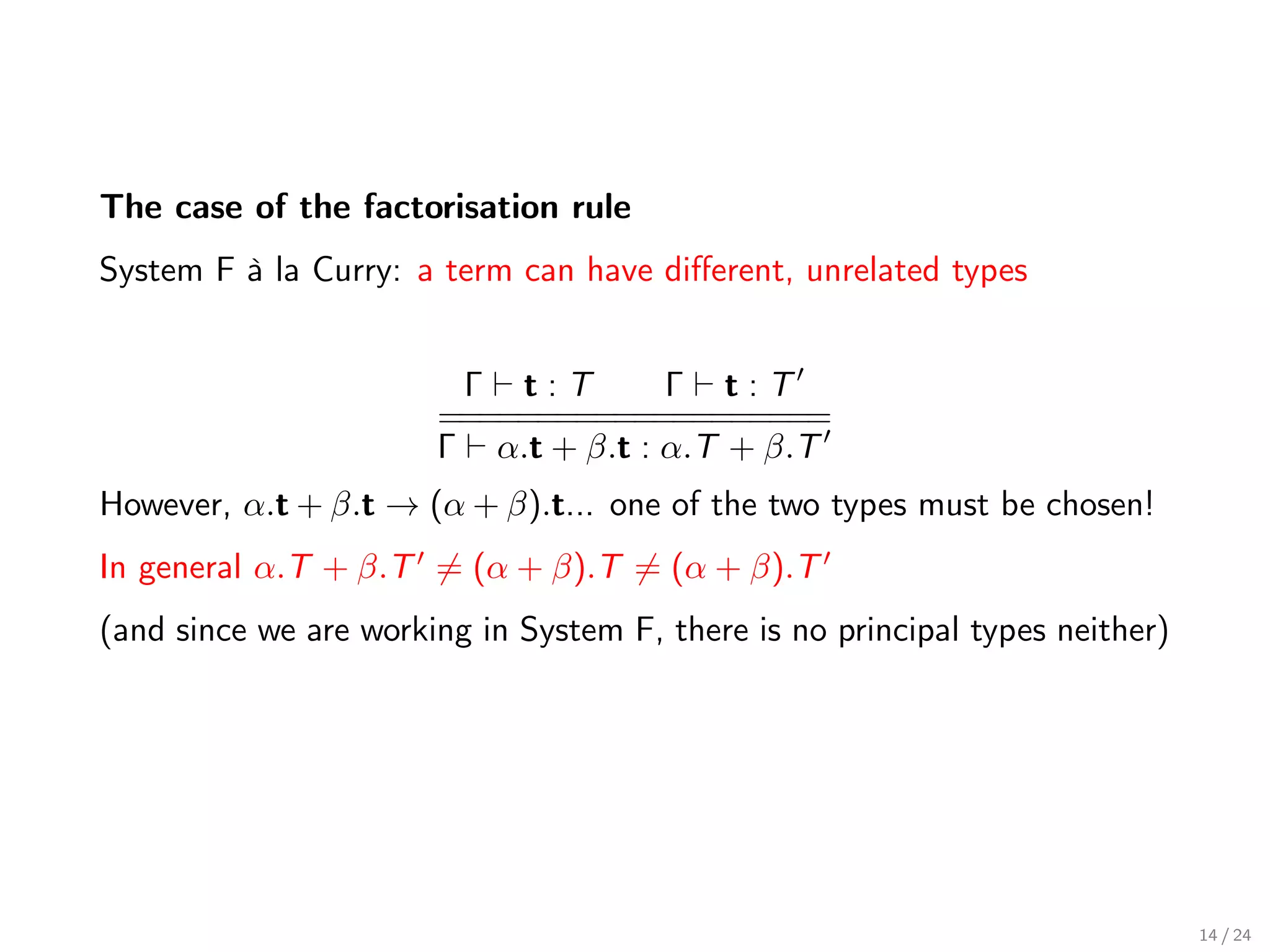
The case of the factorisation rule
System F à la Curry: a term can have different, unrelated types


                        Γ t:T        Γ t:T
                       ==========
                        ==========
                       Γ α.t + β.t : α.T + β.T
However, α.t + β.t → (α + β).t... one of the two types must be chosen!
In general α.T + β.T = (α + β).T = (α + β).T
(and since we are working in System F, there is no principal types neither)


                                                                              14 / 24
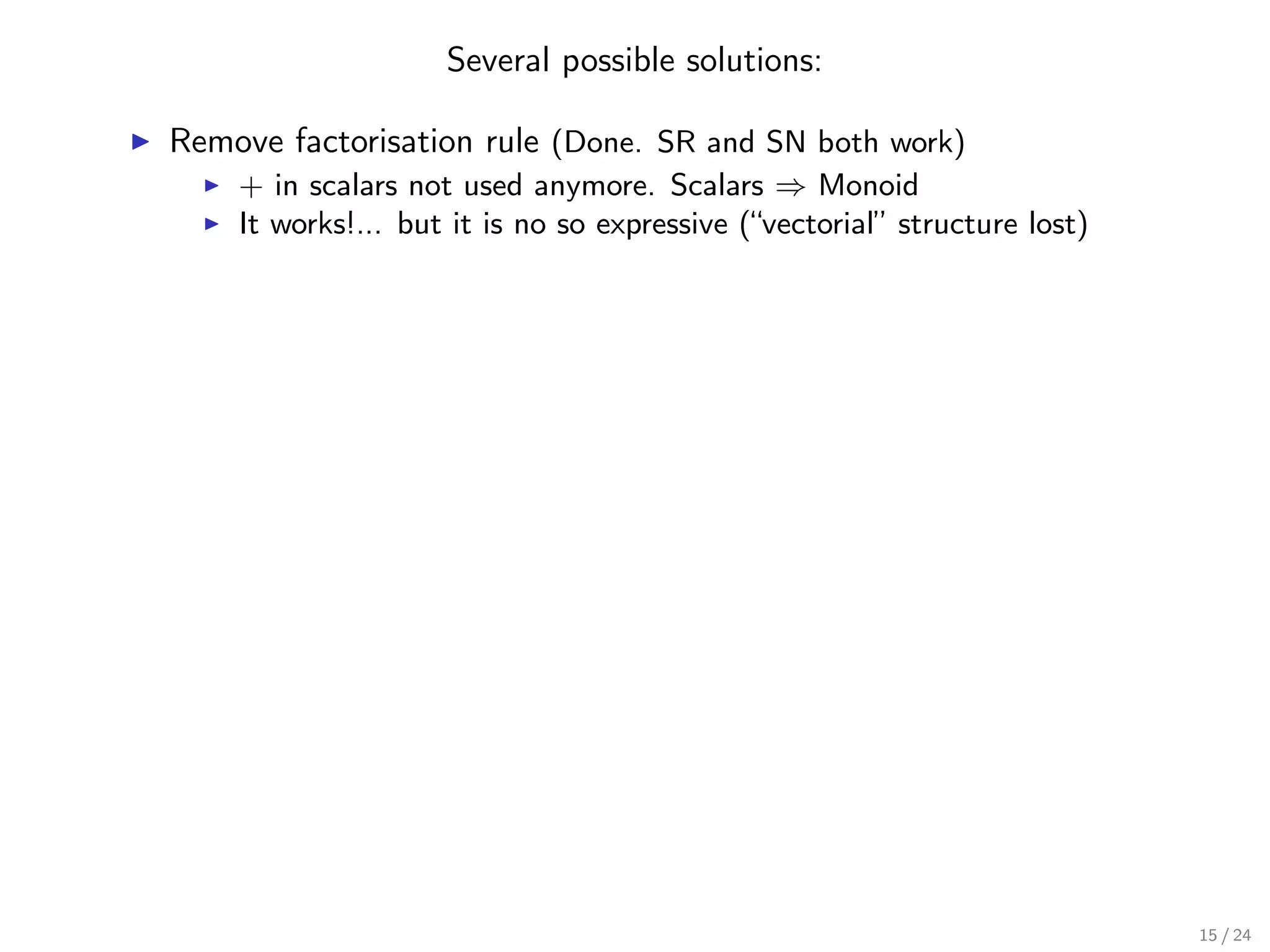
Several possible solutions:

Remove factorisation rule (Done. SR and SN both work)
    + in scalars not used anymore. Scalars ⇒ Monoid
    It works!... but it is no so expressive (“vectorial” structure lost)


                                                                           15 / 24
Several possible solutions:

Remove factorisation rule (Done. SR and SN both work)
     + in scalars not used anymore. Scalars ⇒ Monoid
     It works!... but it is no so expressive (“vectorial” structure lost)

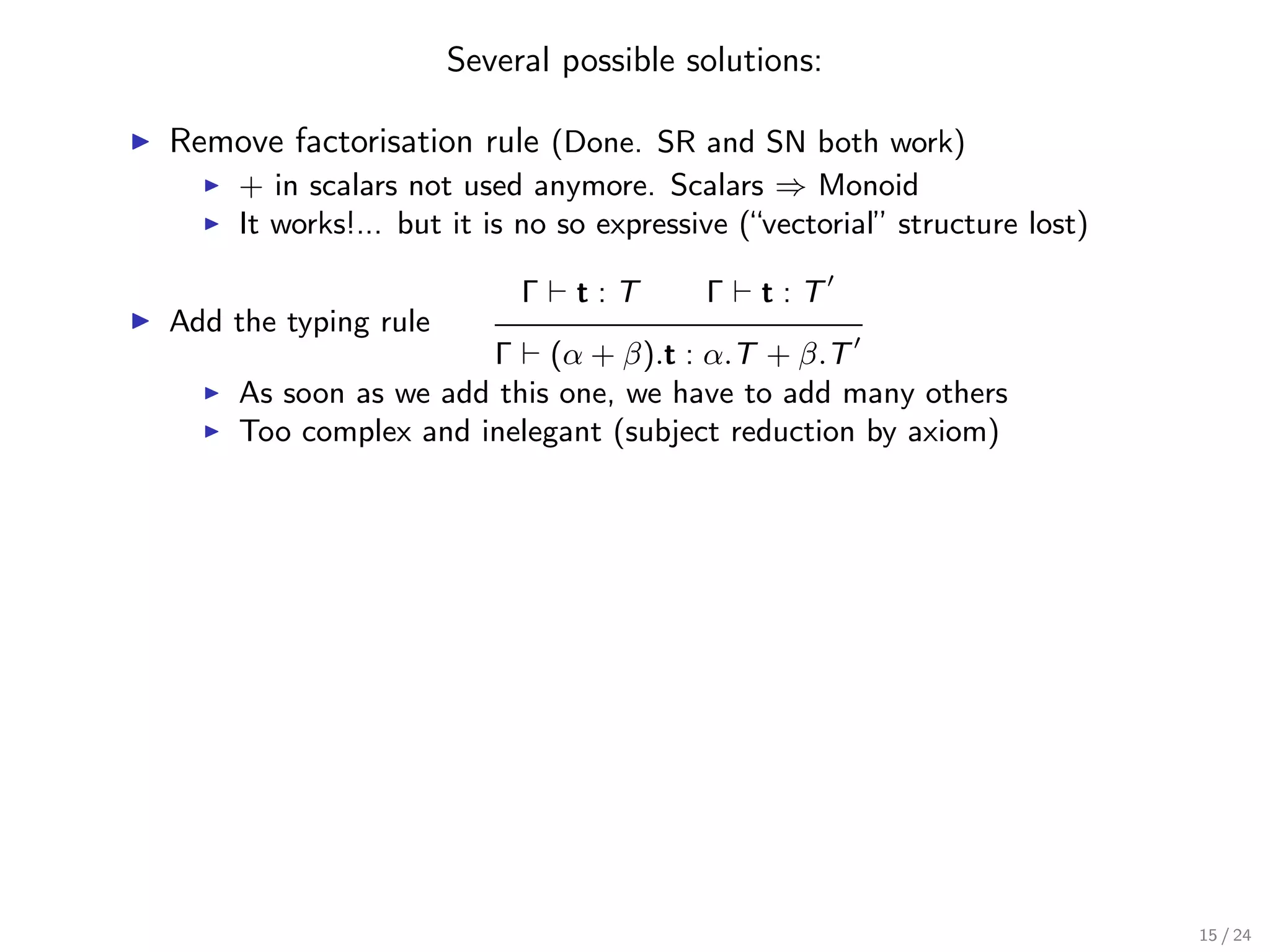
                           Γ   t:T        Γ   t:T
Add the typing rule
                      Γ (α + β).t : α.T + β.T
     As soon as we add this one, we have to add many others
     Too complex and inelegant (subject reduction by axiom)


                                                                            15 / 24
Several possible solutions:

Remove factorisation rule (Done. SR and SN both work)
     + in scalars not used anymore. Scalars ⇒ Monoid
     It works!... but it is no so expressive (“vectorial” structure lost)

                           Γ   t:T        Γ    t:T
Add the typing rule
                      Γ (α + β).t : α.T + β.T
     As soon as we add this one, we have to add many others
     Too complex and inelegant (subject reduction by axiom)

Weak subject reduction
    If Γ t : T and t →R r, then
          if R is not the factorisation rule: Γ r : T
          if R is the factorisation rule: ∃S   T /Γ r:S
     where (α + β).T      α.T + β.T if ∃t / Γ        t : T and Γ   t:T
Contribution: [Arrighi,Díaz-Caro,Valiron’11]


                                                                            15 / 24
Several possible solutions:

Remove factorisation rule (Done. SR and SN both work)
     + in scalars not used anymore. Scalars ⇒ Monoid
     It works!... but it is no so expressive (“vectorial” structure lost)

                           Γ   t:T        Γ    t:T
Add the typing rule
                      Γ (α + β).t : α.T + β.T
     As soon as we add this one, we have to add many others
     Too complex and inelegant (subject reduction by axiom)

Weak subject reduction
    If Γ t : T and t →R r, then
          if R is not the factorisation rule: Γ r : T
          if R is the factorisation rule: ∃S   T /Γ r:S
     where (α + β).T      α.T + β.T if ∃t / Γ        t : T and Γ   t:T
Contribution: [Arrighi,Díaz-Caro,Valiron’11]

Church style
    Seems to be the natural solution: the type is part of the term, if the
    types are different, the terms are different (no factorisation rule)

                                                                             15 / 24
Plan


                 System F


             y                
       Scalar                Additive   / System Fp
                                O

                  %     x       
                 Vectorial     λCA


                  Lineal


                                                      16 / 24
The system Lineal

Types:
                 T , R, S := U | T + R | α.T
                U, V , W := X | U → T | ∀X .U | U@(         i   Vi )
                      (U, V , W reflect the basis terms)

Equivalences:

                               1.T   ≡ T
                          α.(β.T ) ≡ (α × β).T
                       α.T + α.R     ≡ α.(T + R)
                       α.T + β.T     ≡ (α + β).T
                            T +R     ≡ R +T
                     T + (R + S) ≡ (T + R) + S
                       (∀X .U)@V     ≡ U[V /X ]

                     (reflect the vectorial spaces axioms)


                                                                       17 / 24
Typing rules
                                                          Γ        t:T                              Γ      t:T
                                             ax                                 0I                                    sI
                       Γ, x : U       x :U               Γ     0 : 0.T                        Γ         α.t : α.T
             n                                         m+δ                               m
                                                                                                              ∀Vj , ∃j1 , . . . , jk /
Γ   t:            αi .( ∀X k .(U → Ti ))@                     Wj   k       Γ        r:         βj .Vj         U [Wj /X ]       = Vj
                                                                                                                            k
            i=1                                         j=1                              j=1
                                                                                                                                          →E
                                                   n     m
                                  Γ    (t) r :                αi × βj .Ti [Wj /X ] k
                                                  i=1 j=1

                            Γ, x : U     t:T                           Γ        t:T                 Γ       r:R
                                                         →I                                                          +I
                        Γ   λx : U.t : U → T                                Γ        t+r:T +R

                   n                                                                           n
    Γ       t:          αi .Ui     X ∈ FV (Γ)
                                     /                                          Γ        t:             αi .∀X .Ui
                  i=1                                                                         i=1
                                                   ∀I                                                                                    @I
                             n                                             m                  n                            m
        Γ        ΛX .t :          αi .∀X .Ui              Γ        t@(           Vj ) :             αi .(∀X .Ui )@(              Vj )
                            i=1                                            j=1                i=1                          j=1

Subject reduction
Strong normalisation (using Vectorial)

                                                                                                                                               18 / 24
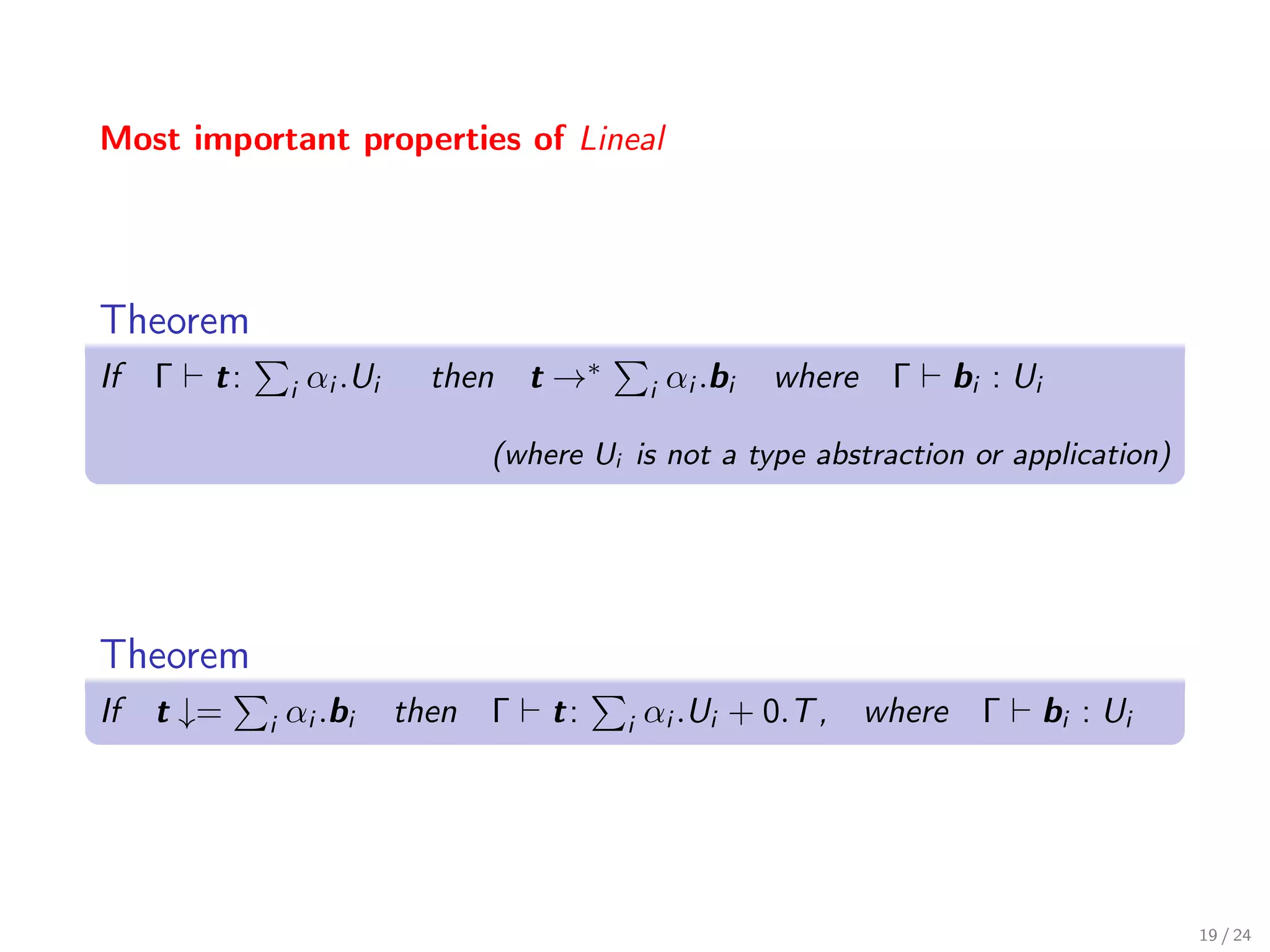
Most important properties of Lineal


Theorem
If Γ   t:       i   αi .Ui    then t →∗         i   αi .bi   where Γ   bi : Ui

                                  (where Ui is not a type abstraction or application)


Theorem
If t ↓=     i   αi .bi       then Γ   t:    i   αi .Ui + 0.T , where Γ           bi : Ui


                                                                                           19 / 24
Confluence as a side effect


                            20 / 24
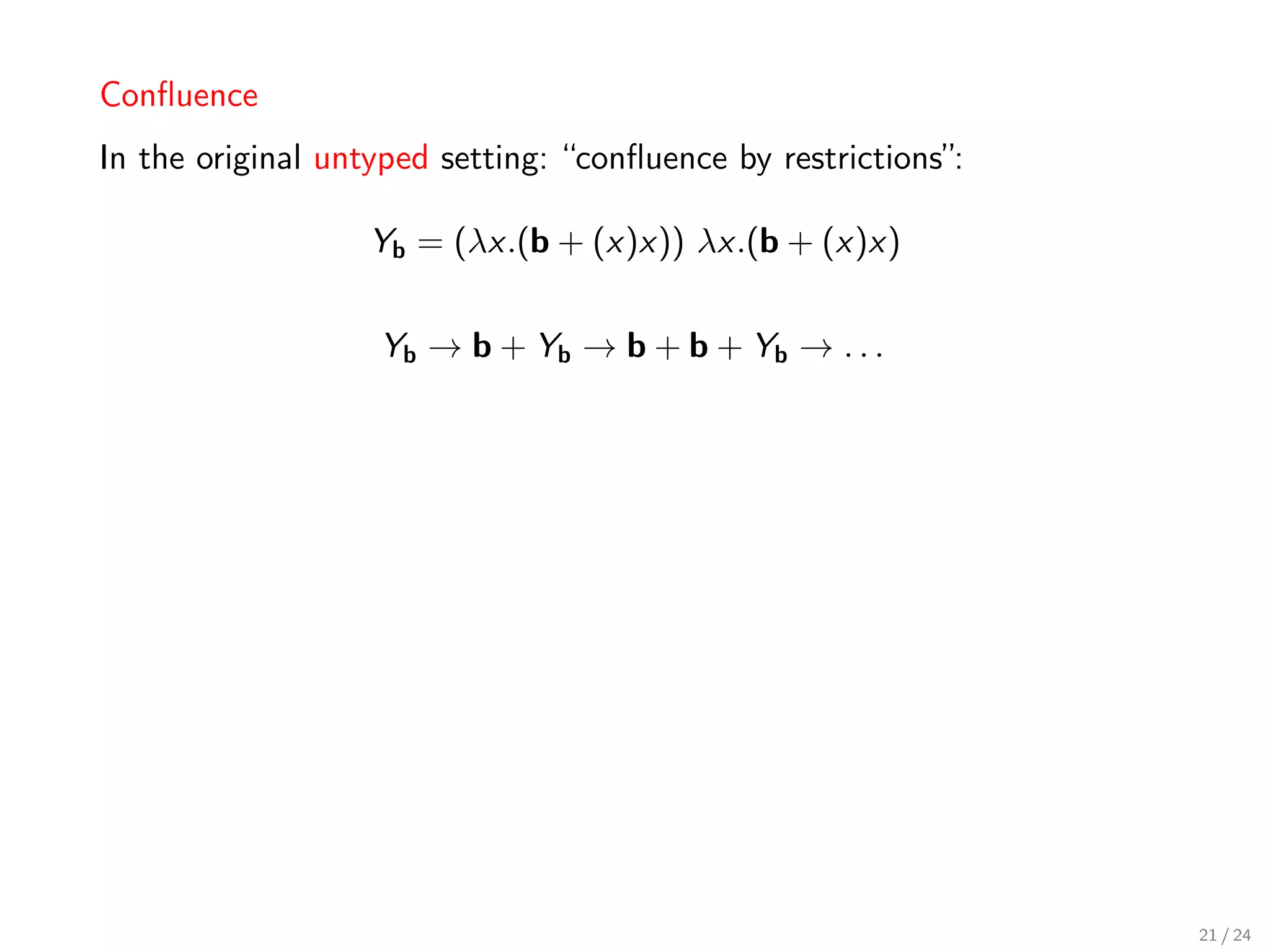
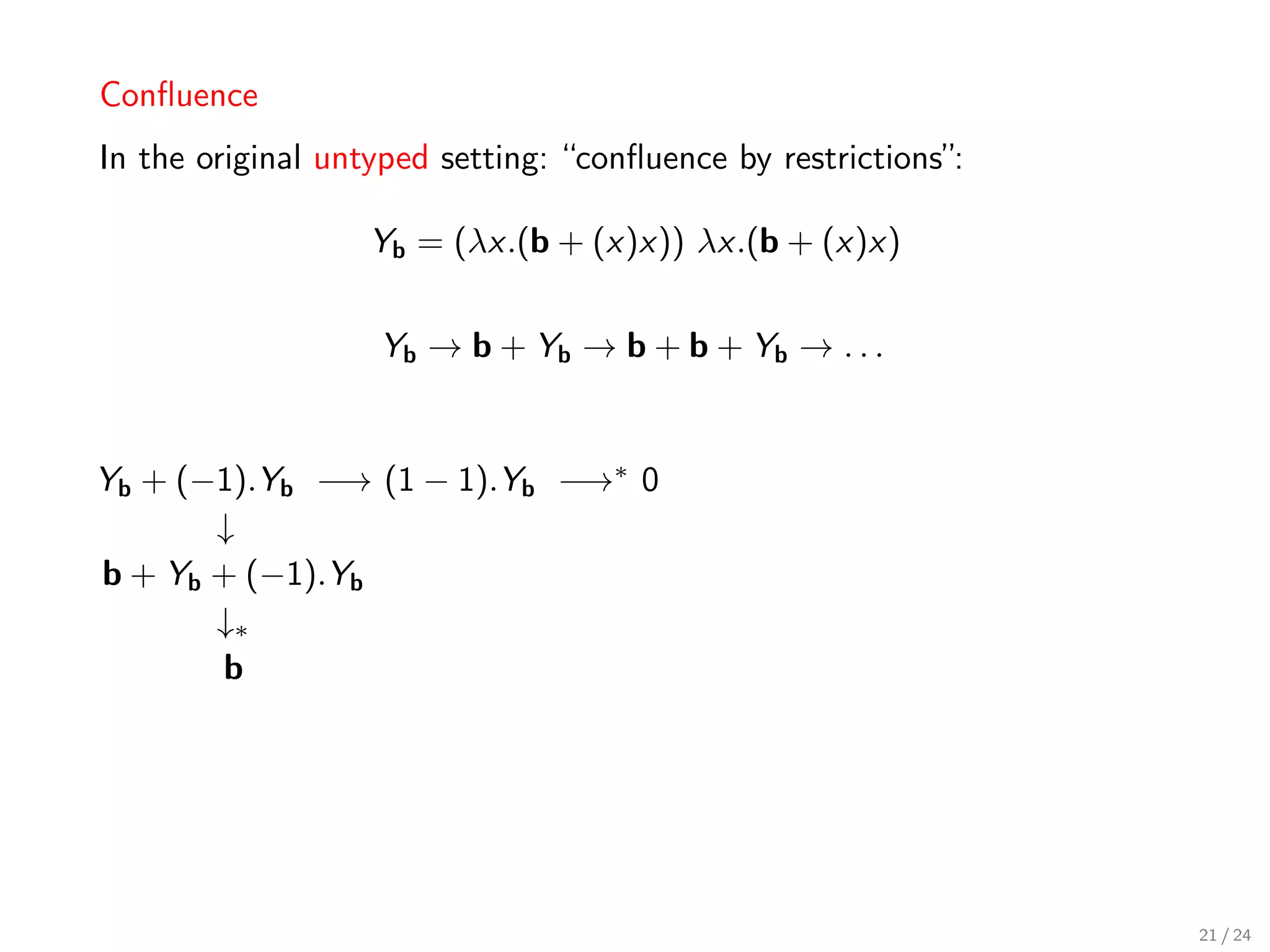
Confluence
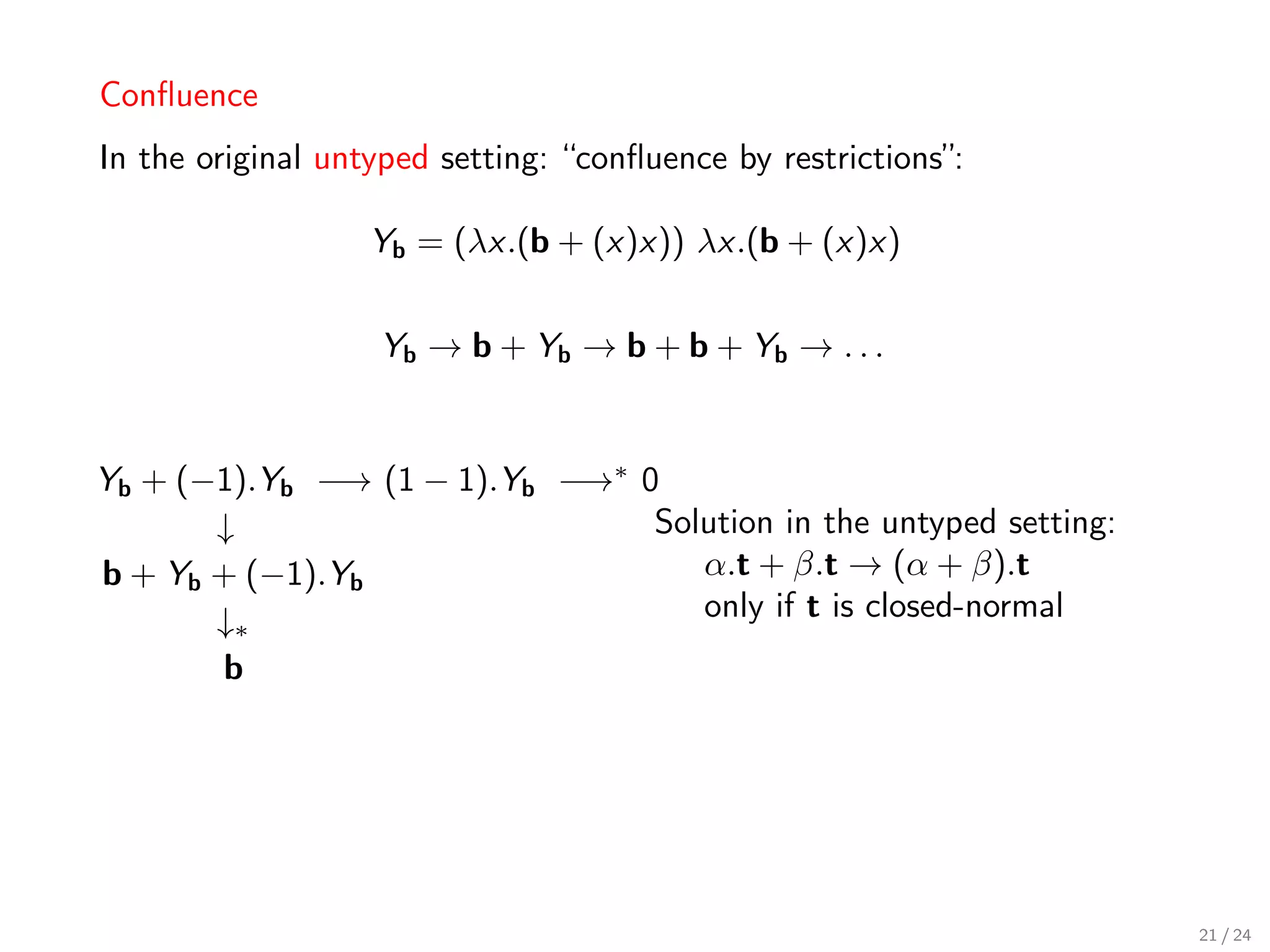
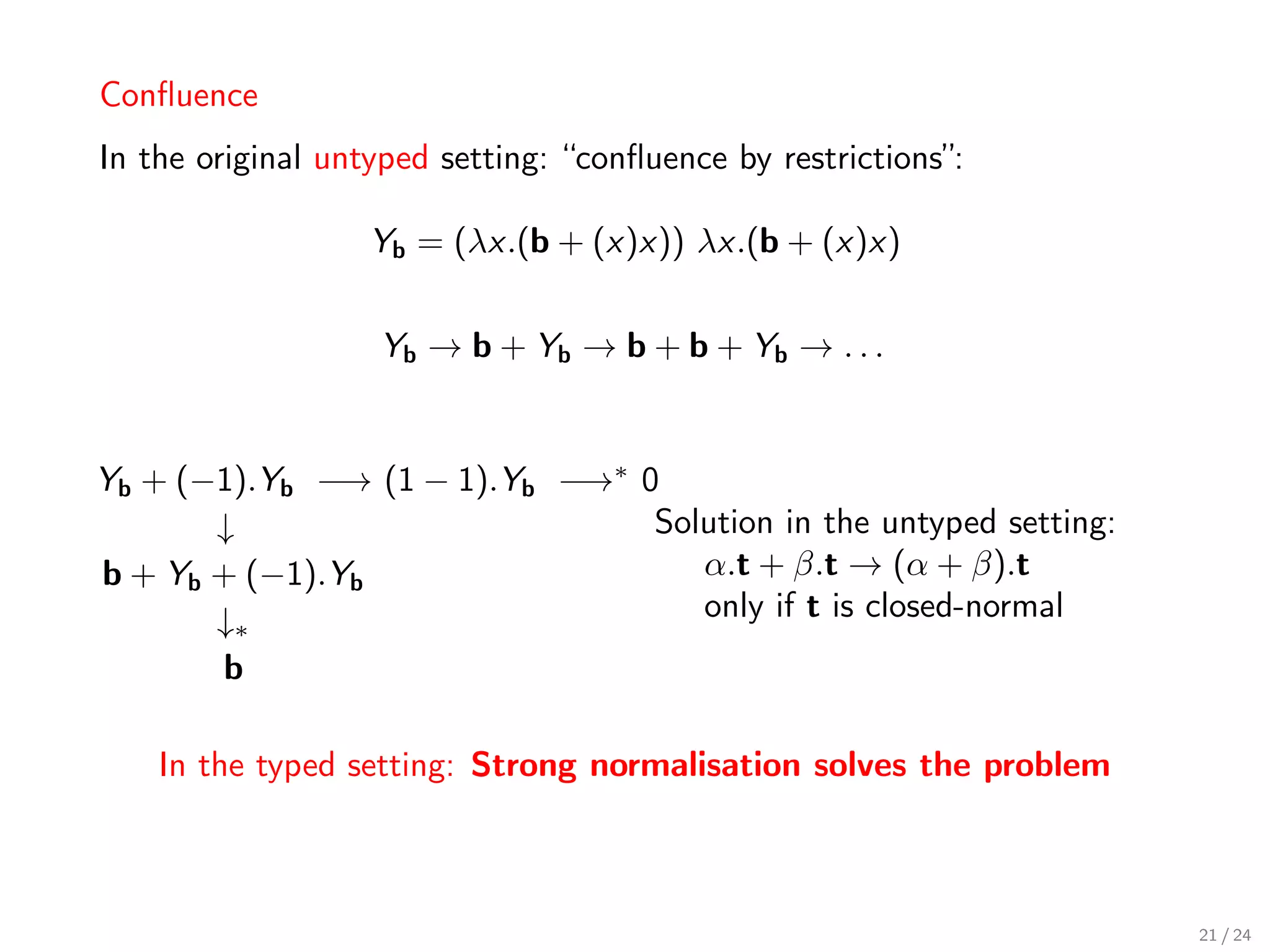
In the original untyped setting: “confluence by restrictions”:

                   Yb = (λx.(b + (x)x)) λx.(b + (x)x)


                   Yb → b + Yb → b + b + Yb → . . .


                                                                21 / 24
Confluence
In the original untyped setting: “confluence by restrictions”:

                   Yb = (λx.(b + (x)x)) λx.(b + (x)x)


                   Yb → b + Yb → b + b + Yb → . . .


Yb + (−1).Yb −→ (1 − 1).Yb −→∗ 0
       ↓
b + Yb + (−1).Yb
       ↓∗
       b


                                                                21 / 24
Confluence
In the original untyped setting: “confluence by restrictions”:

                   Yb = (λx.(b + (x)x)) λx.(b + (x)x)


                   Yb → b + Yb → b + b + Yb → . . .


Yb + (−1).Yb −→ (1 − 1).Yb −→∗ 0
       ↓                        Solution in the untyped setting:
b + Yb + (−1).Yb                   α.t + β.t → (α + β).t
       ↓∗                          only if t is closed-normal
       b


                                                                   21 / 24
Confluence
In the original untyped setting: “confluence by restrictions”:

                   Yb = (λx.(b + (x)x)) λx.(b + (x)x)


                   Yb → b + Yb → b + b + Yb → . . .


Yb + (−1).Yb −→ (1 − 1).Yb −→∗ 0
       ↓                        Solution in the untyped setting:
b + Yb + (−1).Yb                   α.t + β.t → (α + β).t
       ↓∗                          only if t is closed-normal
       b

    In the typed setting: Strong normalisation solves the problem


                                                                    21 / 24
Theorem (Confluence)
∀t / Γ   t:T     ∗
                        t            ∗
                                        
               r1                            r2
                    ∗       ~        ∗
                        s

Proof.
1) local confluence:                               t
                                                         
                                r1                            r2
                                     ∗                ~   ∗
                                                  s
    Algebraic fragment: Coq proof                              [Valiron’10]

    Beta-reduction: Straightforward extension
    Commutation: Induction

2) Local confluence + Strong normalisation ⇒ Confluence


                                                                              22 / 24
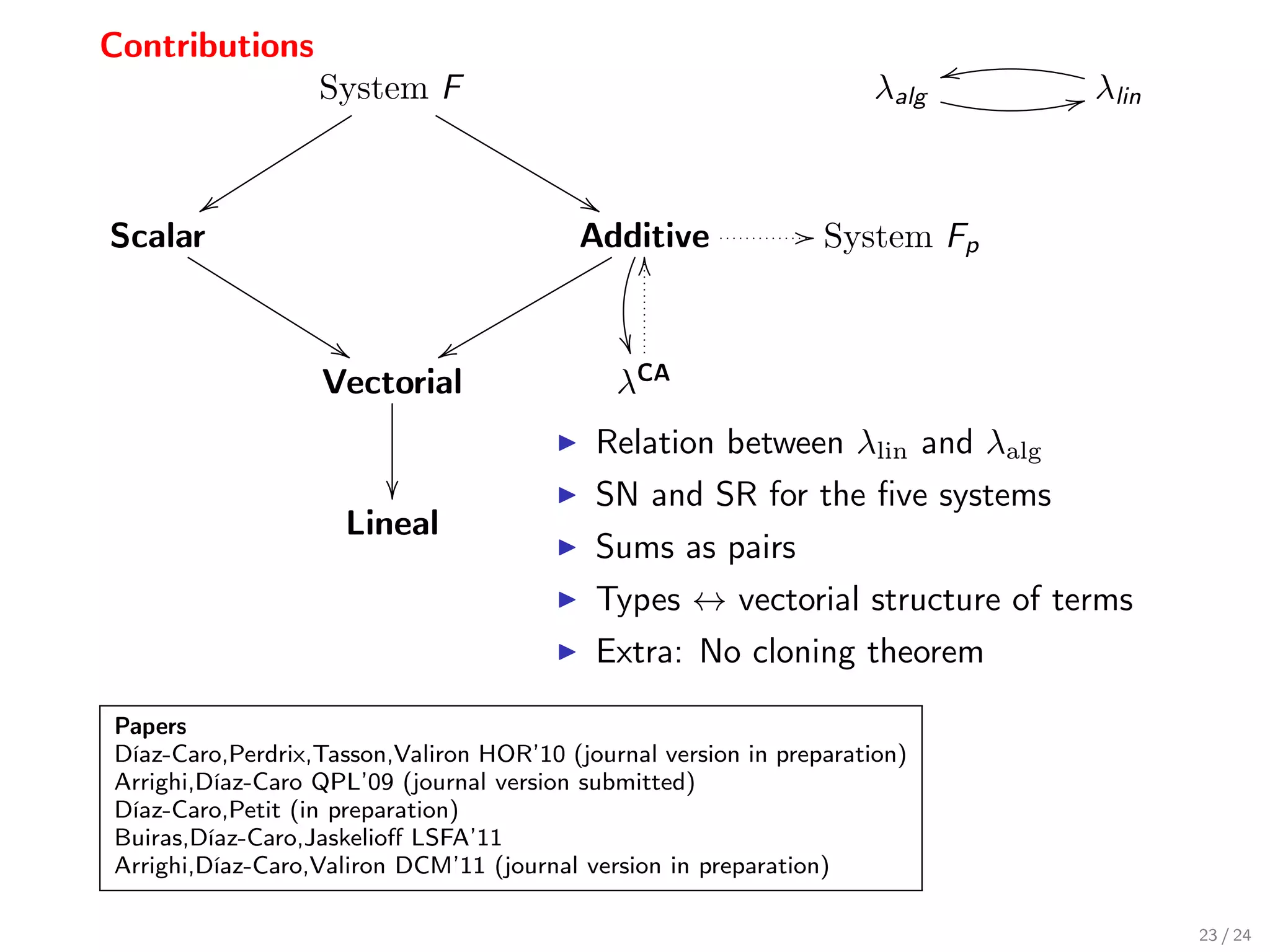
Contributions
                                                                           s
                  System F                                          λalg       3 λlin


      y                                    
Scalar                                    Additive             / System Fp
                                             O

                   %     x                    
                  Vectorial                  λCA
                                           Relation between λlin and λalg
                                          SN and SR for the five systems
                    Lineal
                                           Sums as pairs
                                           Types ↔ vectorial structure of terms
                                           Extra: No cloning theorem

Papers
Díaz-Caro,Perdrix,Tasson,Valiron HOR’10 (journal version in preparation)
Arrighi,Díaz-Caro QPL’09 (journal version submitted)
Díaz-Caro,Petit (in preparation)
Buiras,Díaz-Caro,Jaskelioff LSFA’11
Arrighi,Díaz-Caro,Valiron DCM’11 (journal version in preparation)

                                                                                        23 / 24
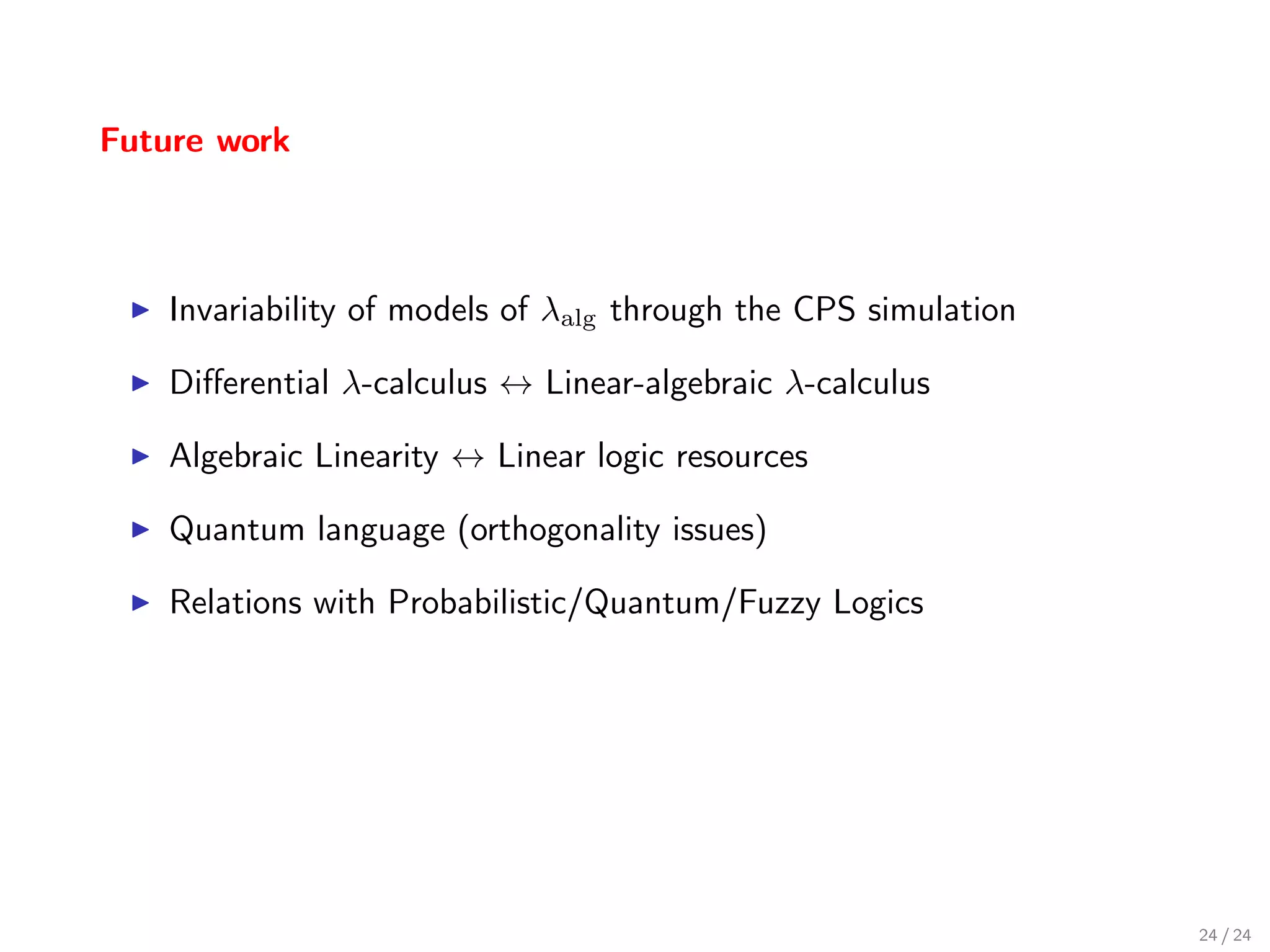
Future work


    Invariability of models of λalg through the CPS simulation

    Differential λ-calculus ↔ Linear-algebraic λ-calculus

    Algebraic Linearity ↔ Linear logic resources

    Quantum language (orthogonality issues)

    Relations with Probabilistic/Quantum/Fuzzy Logics


                                                                 24 / 24

Slides used during my thesis defense "Du typage vectoriel"

  • 1.
    Soutenance de thèse Dutypage vectoriel Alejandro Díaz-Caro CAPP Team Adviser: Co-adviser: Pablo Arrighi Frédéric Prost 23 – 09 – 2011
  • 2.
    Lambda calculus [Church’36] Formalsystem to study the defini- tion of function f (x) ∼ tx x → f (x) ∼ λx.tx (x → f (x))r ∼ (λx.tx ) r (x → f (x))r = f (r ) ∼ (λx.tx ) r → tx [r /x] t, r ::= x | λx.t | (t) r (λx.t) r → t[r/x] 2 / 24
  • 3.
    Lambda calculus [Church’36] Type system [Church’40] Formal system to study the defini- “a tractable syntactic framework tion of function for classifying phrases according to f (x) ∼ tx the kinds of values they compute” x → f (x) ∼ λx.tx –[Pierce’02] (x → f (x))r ∼ (λx.tx ) r (x → f (x))r = f (r ) ∼ (λx.tx ) r → tx [r /x] λx.tx : T → R r:T t, r ::= x | λx.t | (t) r (λx.tx ) r : R (λx.t) r → t[r/x] 2 / 24
  • 4.
    Lambda calculus [Church’36] Type system [Church’40] Formal system to study the defini- “a tractable syntactic framework tion of function for classifying phrases according to f (x) ∼ tx the kinds of values they compute” x → f (x) ∼ λx.tx –[Pierce’02] (x → f (x))r ∼ (λx.tx ) r (x → f (x))r = f (r ) ∼ (λx.tx ) r → tx [r /x] λx.tx : T → R r:T t, r ::= x | λx.t | (t) r (λx.tx ) r : R (λx.t) r → t[r/x] System F [Girard’71] TS with a universal quantification over types λx.x : Int → Int λx.x : Bool → Bool ... λx.x : ∀X .X → X 2 / 24
  • 5.
    Lambda calculus [Church’36] Type system [Church’40] Formal system to study the defini- “a tractable syntactic framework tion of function for classifying phrases according to f (x) ∼ tx the kinds of values they compute” x → f (x) ∼ λx.tx –[Pierce’02] (x → f (x))r ∼ (λx.tx ) r (x → f (x))r = f (r ) ∼ (λx.tx ) r → tx [r /x] λx.tx : T → R r:T t, r ::= x | λx.t | (t) r (λx.tx ) r : R (λx.t) r → t[r/x] System F [Girard’71] Curry-Howard correspondence TS with a universal quantification Correspondence between type sys- over types tems and logic λx.x : Int → Int λx.tx : T → R r:T λx.x : Bool → Bool (λx.tx ) r : R ... T ⇒R T λx.x : ∀X .X → X R 2 / 24
  • 6.
    Lambda calculus [Church’36] Type system [Church’40] Formal system to study the defini- “a tractable syntactic framework tion of function for classifying phrases according to f (x) ∼ tx the kinds of values they compute” x → f (x) ∼ λx.tx –[Pierce’02] (x → f (x))r ∼ (λx.tx ) r (x → f (x))r = f (r ) ∼ (λx.tx ) r → tx [r /x] λx.tx : T → R r:T t, r ::= x | λx.t | (t) r (λx.tx ) r : R (λx.t) r → t[r/x] System F [Girard’71] Curry-Howard correspondence TS with a universal quantification Correspondence between type sys- over types tems and logic λx Int .x : Int → Int λx.tx : T → R r:T λx Bool .x : Bool → Bool (λx.tx ) r : R ... T ⇒R T ΛX .λx X .x : ∀X .X → X R Church vs. Curry style whether the types are part of the terms or not 2 / 24
  • 7.
    To capture probabilistic/quantum/quantitativeconstructions: algebraic extensions t, r ::= x | λx.t | (t) r | t + r | α.t | 0 α ∈ (S, +, ×), a ring. Two origins: Differential λ-calculus [Ehrhard’03]: linearity à la Linear Logic Removing the differential operator : Algebraic λ-calculus (λalg ) [Vaux’09] Quantum computing: superposition of programs Linearity as in algebra: Linear-algebraic λ-calculus (λlin ) [Arrighi,Dowek’08] 3 / 24
  • 8.
    To capture probabilistic/quantum/quantitativeconstructions: algebraic extensions t, r ::= x | λx.t | (t) r | t + r | α.t | 0 α ∈ (S, +, ×), a ring. Two origins: Differential λ-calculus [Ehrhard’03]: linearity à la Linear Logic Removing the differential operator : Algebraic λ-calculus (λalg ) [Vaux’09] Quantum computing: superposition of programs Linearity as in algebra: Linear-algebraic λ-calculus (λlin ) [Arrighi,Dowek’08] Beta reduction: (λx.t) r → t[r/x] “Algebraic” reductions: α.t + β.t → (α + β).t, α.β.t → (α × β).t, (t) (r1 + r2 ) → (t) r1 + (t) r2 , (t1 + t2 ) r → (t1 ) r + (t2 ) r, ... (oriented version of the axioms of vectorial spaces)[Arrighi,Dowek’07] 3 / 24
  • 9.
    To capture probabilistic/quantum/quantitativeconstructions: algebraic extensions t, r ::= x | λx.t | (t) r | t + r | α.t | 0 α ∈ (S, +, ×), a ring. Two origins: Differential λ-calculus [Ehrhard’03]: linearity à la Linear Logic Removing the differential operator : Algebraic λ-calculus (λalg ) [Vaux’09] Quantum computing: superposition of programs Linearity as in algebra: Linear-algebraic λ-calculus (λlin ) [Arrighi,Dowek’08] Beta reduction: (λx.t) r → t[r/x] “Algebraic” reductions: α.t + β.t → (α + β).t, Vectorial space of values α.β.t → (α × β).t, B = {ti : ti var. or abs. } (t) (r1 + r2 ) → (t) r1 + (t) r2 , (t1 + t2 ) r → (t1 ) r + (t2 ) r, Set of values ::= Span(B) ... (oriented version of the axioms of vectorial spaces)[Arrighi,Dowek’07] 3 / 24
  • 10.
    To capture probabilistic/quantum/quantitativeconstructions: algebraic extensions t, r ::= x | λx.t | (t) r | t + r | α.t | 0 α ∈ (S, +, ×), a ring. λalg λlin Origin Linear Logic Quantum computing Evaluation strategy Call-by-name Call-by-base Algebraic part Equalities Rewrite system Contribution: CPS simulation [Díaz-Caro,Perdrix,Tasson,Valiron’10] Beta reduction: (λx.t) r → t[r/x] “Algebraic” reductions: α.t + β.t → (α + β).t, Vectorial space of values α.β.t → (α × β).t, B = {ti : ti var. or abs. } (t) (r1 + r2 ) → (t) r1 + (t) r2 , (t1 + t2 ) r → (t1 ) r + (t2 ) r, Set of values ::= Span(B) ... (oriented version of the axioms of vectorial spaces)[Arrighi,Dowek’07] 3 / 24
  • 11.
    Example of program true = λx.λy .x Two base vectors: false = λx.λy .y 4 / 24
  • 12.
    Example of program true = λx.λy .x Two base vectors: false = λx.λy .y (U)true = a.true + b.false Linear map U s.t. (U)false = c.true + d .false 4 / 24
  • 13.
    Example of program true = λx.λy .x Two base vectors: false = λx.λy .y (U)true = a.true + b.false Linear map U s.t. (U)false = c.true + d .false U := λx.{((x) [a.true + b.false]) [c.true + d .false]} 4 / 24
  • 14.
    Example of program true = λx.λy .x Two base vectors: false = λx.λy .y (U)true = a.true + b.false Linear map U s.t. (U)false = c.true + d .false U := λx.{((x) [a.true + b.false]) [c.true + d .false]} Aim: To provide a type system capturing the “vectorial” structure of terms . . . to check for properties of probabilistic processes . . . to check for properties of quantum processes . . . or whatever application needing the structure of the vector in normal form . . . understand what it means “linear combination of types” . . . a Curry-Howard approach to defining Fuzzy/Quantum/Probabilistic logics from Fuzzy/Quantum/Probabilistic programming languages. 4 / 24
  • 15.
    Plan System F y & Scalar Additive α.T T +R $ y Vectorial α.T + β.R 5 / 24
  • 16.
    Plan System F y & Scalar Additive α.T T +R $ y Vectorial α.T + β.R 5 / 24
  • 17.
    The Scalar TypeSystem A polymorphic type system tracking scalars: Γ t:T Γ α.t : α.T Γ t : α.T Γ r : β.T Γ t + r : (α + β).T 6 / 24
  • 18.
    The Scalar TypeSystem A polymorphic type system tracking scalars: Γ t:T Γ α.t : α.T Γ t : α.T Γ r : β.T Γ t + r : (α + β).T Gives the “amount” of terms → Barycentric restrictions ( αi = 1) 6 / 24
  • 19.
    The Scalar TypeSystem A polymorphic type system tracking scalars: Γ t:T Γ α.t : α.T Γ t : α.T Γ r : β.T Γ t + r : (α + β).T Gives the “amount” of terms → Barycentric restrictions ( αi = 1) Definition (Weight function (to check barycentricity)) ω(0) = 0 ω(b) = 1 ω(α.t) = α × ω(t) ω((t) r) = ω(t) × ω(r) ω(t + r) = ω(t) + ω(r) 6 / 24
  • 20.
    The Scalar TypeSystem A polymorphic type system tracking scalars: Γ t:T Γ α.t : α.T Γ t : α.T Γ r : β.T Γ t + r : (α + β).T Gives the “amount” of terms → Barycentric restrictions ( αi = 1) Definition (Weight function (to check barycentricity)) ω(0) = 0 ω(b) = 1 ω(α.t) = α × ω(t) ω((t) r) = ω(t) × ω(r) ω(t + r) = ω(t) + ω(r) Theorem If ΓC t : C then ω(t ↓) = 1 6 / 24
  • 21.
    The Scalar TypeSystem A polymorphic type system tracking scalars: Γ t:T Γ α.t : α.T Γ t : α.T Γ r : β.T Γ t + r : (α + β).T Gives the “amount” of terms → Barycentric restrictions ( αi = 1) Definition (Weight function (to check barycentricity)) ω(0) = 0 ω(b) = 1 ω(α.t) = α × ω(t) ω((t) r) = ω(t) × ω(r) ω(t + r) = ω(t) + ω(r) Theorem If ΓC t : C then ω(t ↓) = 1 1 2.(λx. .x) y 1 Example 2 y :C 2.(λx. .x) y : C 1 2 ω(2.(λx. .x) y ) = 2 2 6 / 24
  • 22.
    The Scalar TypeSystem A polymorphic type system tracking scalars: Γ t:T Γ α.t : α.T Γ t : α.T Γ r : β.T Γ t + r : (α + β).T Gives the “amount” of terms → Barycentric restrictions ( αi = 1) Definition (Weight function (to check barycentricity)) ω(0) = 0 ω(b) = 1 ω(α.t) = α × ω(t) ω((t) r) = ω(t) × ω(r) ω(t + r) = ω(t) + ω(r) Theorem If ΓC t : C then ω(t ↓) = 1 1 2.(λx. .x) y →∗ y 1 Example 2 y :C 2.(λx. .x) y : C 1 2 ω(2.(λx. .x) y ) = 2 ω(y ) = 1 2 6 / 24
  • 23.
    The Scalar TypeSystem A polymorphic type system tracking scalars: Γ t:T Subject reduction (type preservation) Γ α.t : α.T Strong normalisation 1. SN for a straightforward extension of Γ t : α.T Γ r : β.T System F 2. verify that both systems type the same Γ t + r : (α + β).T terms Gives the “amount” of terms → Barycentric restrictions ( αi = 1) Definition (Weight function (to check barycentricity)) ω(0) = 0 ω(b) = 1 ω(α.t) = α × ω(t) ω((t) r) = ω(t) × ω(r) ω(t + r) = ω(t) + ω(r) Theorem If ΓC t : C then ω(t ↓) = 1 1 2.(λx. .x) y →∗ y 1 Example 2 y :C 2.(λx. .x) y : C 1 2 ω(2.(λx. .x) y ) = 2 ω(y ) = 1 2 6 / 24
  • 24.
    The Scalar TypeSystem A polymorphic type system tracking scalars: Γ t:T Subject reduction (type preservation) Γ α.t : α.T Strong normalisation 1. SN for a straightforward extension of Γ t : α.T Γ r : β.T System F 2. verify that both systems type the same Γ t + r : (α + β).T terms Gives the “amount” of terms → Barycentric restrictions ( αi = 1) Definition (Weight function (to check barycentricity)) ω(0) = 0 ω(b) = 1 ω(α.t) = α × ω(t) ω((t) r) = ω(t) × ω(r) ω(t + r) = ω(t) + ω(r) Theorem If ΓC t : C then ω(t ↓) = 1 1 2.(λx. .x) y →∗ y 1 Example 2 y :C 2.(λx. .x) y : C 1 2 ω(2.(λx. .x) y ) = 2 ω(y ) = 1 2 Contribution: [Arrighi,Díaz-Caro’09] 6 / 24
  • 25.
    Plan System F y & Scalar Additive & x Vectorial 7 / 24
  • 26.
    The Additive TypeSystem A polymorphic type system with sums (for the additive fragment of λlin ) Γ t:T Γ r:R Sums ∼ Assoc., comm. pairs Γ t+r:T +R distributive w.r.t. application 8 / 24
  • 27.
    The Additive TypeSystem A polymorphic type system with sums (for the additive fragment of λlin ) Γ t:T Γ r:R Sums ∼ Assoc., comm. pairs Γ t+r:T +R distributive w.r.t. application Translation into System F with pairs 8 / 24
  • 28.
    The Additive TypeSystem A polymorphic type system with sums (for the additive fragment of λlin ) Γ t:T Γ r:R Sums ∼ Assoc., comm. pairs Γ t+r:T +R distributive w.r.t. application Translation into System F with pairs Simplified version without AC of + |T + R| = |T | × |R| 8 / 24
  • 29.
    The Additive TypeSystem A polymorphic type system with sums (for the additive fragment of λlin ) Γ t:T Γ r:R Sums ∼ Assoc., comm. pairs Γ t+r:T +R distributive w.r.t. application Translation into System F with pairs Simplified version without AC of + |T + R| = |T | × |R| Distributivity in the translation (using the structure given by the type) 8 / 24
  • 30.
    The Additive TypeSystem A polymorphic type system with sums (for the additive fragment of λlin ) Γ t:T Γ r:R Sums ∼ Assoc., comm. pairs Γ t+r:T +R distributive w.r.t. application Translation into System F with pairs Simplified version without AC of + |T + R| = |T | × |R| Distributivity in the translation (using the structure given by the type) Equivalences given explicitly: T ≡ R implies |T | ⇔ |R| A×B ⇔B ×A (A × B) × C ⇔ A × (B × C ) 8 / 24
  • 31.
    The Additive TypeSystem A polymorphic type system with sums (for the additive fragment of λlin ) Γ t:T Γ r:R Sums ∼ Assoc., comm. pairs Γ t+r:T +R distributive w.r.t. application Translation into System F with pairs Simplified version without AC of + |T + R| = |T | × |R| Distributivity in the translation (using the structure given by the type) Equivalences given explicitly: T ≡ R implies |T | ⇔ |R| A×B ⇔B ×A (A × B) × C ⇔ A × (B × C ) Theorem If Γ t : T and exists T ≡ T then |Γ| F [t]D : |T | Also we set up an inverse translation showing that it is non-trivial 8 / 24
  • 32.
    The Additive TypeSystem A polymorphic type system with sums (for the additive fragment of λlin ) Γ t:T Γ r:R Sums ∼ Assoc., comm. pairs Γ t+r:T +R distributive w.r.t. application Translation into System F with pairs Simplified version without AC of + |T + R| = |T | × |R| Distributivity in the translation (using the structure given by the type) Equivalences given explicitly: T ≡ R implies |T | ⇔ |R| A×B ⇔B ×A (A × B) × C ⇔ A × (B × C ) Theorem If Γ t : T and exists T ≡ T then |Γ| F [t]D : |T | Also we set up an inverse translation showing that it is non-trivial Subject reduction Strong normalisation (using the one from System Fp ) Contribution: [Díaz-Caro,Petit’10] 8 / 24
  • 33.
    Plan System F y & Scalar Additive / System Fp % x Vectorial 9 / 24
  • 34.
    Plan System F y & Scalar Additive / System Fp O % x Vectorial λCA 9 / 24
  • 35.
    The Complete AdditiveSystem (λCA ) Extending sums to the whole calculus (with positive reals scalars) Γ t:T More general than Additive Γ α.t : α .T = T + · · · + T Less complex than Vectorial α “Amounts” approximated 10 / 24
  • 36.
    The Complete AdditiveSystem (λCA ) Extending sums to the whole calculus (with positive reals scalars) Γ t:T More general than Additive Γ α.t : α .T = T + · · · + T Less complex than Vectorial α “Amounts” approximated If t : T , then (0.9).t + (1.1).t : T (0.9).t + (1.1).t → 2.t and 2.t : 2.T 10 / 24
  • 37.
    The Complete AdditiveSystem (λCA ) Extending sums to the whole calculus (with positive reals scalars) Γ t:T More general than Additive Γ α.t : α .T = T + · · · + T Less complex than Vectorial α “Amounts” approximated If t : T , then (0.9).t + (1.1).t : T (0.9).t + (1.1).t → 2.t and 2.t : 2.T Weak subject reduction: t → r, Γ t:T ⇒Γ r : R with T R 10 / 24
  • 38.
    The Complete AdditiveSystem (λCA ) Extending sums to the whole calculus (with positive reals scalars) Γ t:T More general than Additive Γ α.t : α .T = T + · · · + T Less complex than Vectorial α “Amounts” approximated If t : T , then (0.9).t + (1.1).t : T (0.9).t + (1.1).t → 2.t and 2.t : 2.T Weak subject reduction: t → r, Γ t : T ⇒ Γ r : R with T R Abstract interpretation (theorem) [·] λCA τ / λadd / Fp ↓ ↓a ↓F ( ) ( ) λCA / λadd / Fp τ [·] 10 / 24
  • 39.
    The Complete AdditiveSystem (λCA ) Extending sums to the whole calculus (with positive reals scalars) Γ t:T More general than Additive Γ α.t : α .T = T + · · · + T Less complex than Vectorial α “Amounts” approximated If t : T , then (0.9).t + (1.1).t : T (0.9).t + (1.1).t → 2.t and 2.t : 2.T Weak subject reduction: t → r, Γ t : T ⇒ Γ r : R with T R Abstract interpretation (theorem) [·] λCA τ / λadd / Fp ↓ ↓a ↓F ( ) ( ) λCA / λadd / Fp τ [·] Strong normalisation (using Additive) Contribution: [Buiras,Díaz-Caro,Jaskelioff’11] 10 / 24
  • 40.
    Plan System F y Scalar Additive / System Fp O % x Vectorial λCA 11 / 24
  • 41.
    The Vectorial system Types: T , R, S := U | T + R | α.T U, V , W := X | U → T | ∀X .U (U, V , W reflect the basis terms) Equivalences: 1.T ≡ T α.(β.T ) ≡ (α × β).T α.T + α.R ≡ α.(T + R) α.T + β.T ≡ (α + β).T T +R ≡ R +T T + (R + S) ≡ (T + R) + S (reflect the vectorial spaces axioms) 12 / 24
  • 42.
    Typing rules Γ t:T Γ t:T ax 0I sI Γ, x : U x :U Γ 0 : 0.T Γ α.t : α.T n m ∀Vj , ∃Wj / Γ t: αi .∀X .(U → Ti ) Γ r: βj .Vj U[Wj /X ] = Vj i=1 j=1 →E n m Γ (t) r : αi × βj .Ti [Wj /X ] i=1 j=1 Γ, x : U t:T Γ t:T Γ r:R →I +I Γ λx.t : U → T Γ t+r:T +R n n Γ t: αi .Ui X ∈ FV (Γ) / Γ t: αi .∀X .Ui i=1 i=1 ∀I ∀E n n Γ t: αi .∀X .Ui Γ t: αi .Ui [V /X ] i=1 i=1 13 / 24
  • 43.
    Typing rules Γ t:T Γ t:T ax 0I sI Γ, x : U x :U Γ 0 : 0.T Γ α.t : α.T n m ∀Vj , ∃Wj / Γ t: αi .∀X .(U → Ti ) Γ r: βj .Vj U[Wj /X ] = Vj i=1 j=1 →E n m Γ (t) r : αi × βj .Ti [Wj /X ] i=1 j=1 Γ, x : U t:T Γ t:T Γ r:R →I +I Γ λx.t : U → T Γ t+r:T +R n n Γ t: αi .Ui X ∈ FV (Γ) / Γ t: αi .∀X .Ui i=1 i=1 ∀I ∀E n n Γ t: αi .∀X .Ui Γ t: αi .Ui [V /X ] i=1 i=1 Strong normalisation: Reducibility candidates Main difficulty: show that {ti }i SN ⇒ i ti SN (algebraic measure) 13 / 24
  • 44.
    Typing rules Γ t:T Γ t:T ax 0I sI Γ, x : U x :U Γ 0 : 0.T Γ α.t : α.T n m ∀Vj , ∃Wj / Γ t: αi .∀X .(U → Ti ) Γ r: βj .Vj U[Wj /X ] = Vj i=1 j=1 →E n m Γ (t) r : αi × βj .Ti [Wj /X ] i=1 j=1 Γ, x : U t:T Γ t:T Γ r:R →I +I Γ λx.t : U → T Γ t+r:T +R n n Γ t: αi .Ui X ∈ FV (Γ) / Γ t: αi .∀X .Ui i=1 i=1 ∀I ∀E n n Γ t: αi .∀X .Ui Γ t: αi .Ui [V /X ] i=1 i=1 Strong normalisation: Reducibility candidates Main difficulty: show that {ti }i SN ⇒ i ti SN (algebraic measure) Subject reduction a challenge 13 / 24
  • 45.
    The case ofthe factorisation rule System F à la Curry: a term can have different, unrelated types Γ t:T Γ t:T ========== ========== Γ α.t + β.t : α.T + β.T However, α.t + β.t → (α + β).t... one of the two types must be chosen! In general α.T + β.T = (α + β).T = (α + β).T (and since we are working in System F, there is no principal types neither) 14 / 24
  • 46.
    Several possible solutions: Removefactorisation rule (Done. SR and SN both work) + in scalars not used anymore. Scalars ⇒ Monoid It works!... but it is no so expressive (“vectorial” structure lost) 15 / 24
  • 47.
    Several possible solutions: Removefactorisation rule (Done. SR and SN both work) + in scalars not used anymore. Scalars ⇒ Monoid It works!... but it is no so expressive (“vectorial” structure lost) Γ t:T Γ t:T Add the typing rule Γ (α + β).t : α.T + β.T As soon as we add this one, we have to add many others Too complex and inelegant (subject reduction by axiom) 15 / 24
  • 48.
    Several possible solutions: Removefactorisation rule (Done. SR and SN both work) + in scalars not used anymore. Scalars ⇒ Monoid It works!... but it is no so expressive (“vectorial” structure lost) Γ t:T Γ t:T Add the typing rule Γ (α + β).t : α.T + β.T As soon as we add this one, we have to add many others Too complex and inelegant (subject reduction by axiom) Weak subject reduction If Γ t : T and t →R r, then if R is not the factorisation rule: Γ r : T if R is the factorisation rule: ∃S T /Γ r:S where (α + β).T α.T + β.T if ∃t / Γ t : T and Γ t:T Contribution: [Arrighi,Díaz-Caro,Valiron’11] 15 / 24
  • 49.
    Several possible solutions: Removefactorisation rule (Done. SR and SN both work) + in scalars not used anymore. Scalars ⇒ Monoid It works!... but it is no so expressive (“vectorial” structure lost) Γ t:T Γ t:T Add the typing rule Γ (α + β).t : α.T + β.T As soon as we add this one, we have to add many others Too complex and inelegant (subject reduction by axiom) Weak subject reduction If Γ t : T and t →R r, then if R is not the factorisation rule: Γ r : T if R is the factorisation rule: ∃S T /Γ r:S where (α + β).T α.T + β.T if ∃t / Γ t : T and Γ t:T Contribution: [Arrighi,Díaz-Caro,Valiron’11] Church style Seems to be the natural solution: the type is part of the term, if the types are different, the terms are different (no factorisation rule) 15 / 24
  • 50.
    Plan System F y Scalar Additive / System Fp O % x Vectorial λCA Lineal 16 / 24
  • 51.
    The system Lineal Types: T , R, S := U | T + R | α.T U, V , W := X | U → T | ∀X .U | U@( i Vi ) (U, V , W reflect the basis terms) Equivalences: 1.T ≡ T α.(β.T ) ≡ (α × β).T α.T + α.R ≡ α.(T + R) α.T + β.T ≡ (α + β).T T +R ≡ R +T T + (R + S) ≡ (T + R) + S (∀X .U)@V ≡ U[V /X ] (reflect the vectorial spaces axioms) 17 / 24
  • 52.
    Typing rules Γ t:T Γ t:T ax 0I sI Γ, x : U x :U Γ 0 : 0.T Γ α.t : α.T n m+δ m ∀Vj , ∃j1 , . . . , jk / Γ t: αi .( ∀X k .(U → Ti ))@ Wj k Γ r: βj .Vj U [Wj /X ] = Vj k i=1 j=1 j=1 →E n m Γ (t) r : αi × βj .Ti [Wj /X ] k i=1 j=1 Γ, x : U t:T Γ t:T Γ r:R →I +I Γ λx : U.t : U → T Γ t+r:T +R n n Γ t: αi .Ui X ∈ FV (Γ) / Γ t: αi .∀X .Ui i=1 i=1 ∀I @I n m n m Γ ΛX .t : αi .∀X .Ui Γ t@( Vj ) : αi .(∀X .Ui )@( Vj ) i=1 j=1 i=1 j=1 Subject reduction Strong normalisation (using Vectorial) 18 / 24
  • 53.
    Most important propertiesof Lineal Theorem If Γ t: i αi .Ui then t →∗ i αi .bi where Γ bi : Ui (where Ui is not a type abstraction or application) Theorem If t ↓= i αi .bi then Γ t: i αi .Ui + 0.T , where Γ bi : Ui 19 / 24
  • 54.
    Confluence as aside effect 20 / 24
  • 55.
    Confluence In the originaluntyped setting: “confluence by restrictions”: Yb = (λx.(b + (x)x)) λx.(b + (x)x) Yb → b + Yb → b + b + Yb → . . . 21 / 24
  • 56.
    Confluence In the originaluntyped setting: “confluence by restrictions”: Yb = (λx.(b + (x)x)) λx.(b + (x)x) Yb → b + Yb → b + b + Yb → . . . Yb + (−1).Yb −→ (1 − 1).Yb −→∗ 0 ↓ b + Yb + (−1).Yb ↓∗ b 21 / 24
  • 57.
    Confluence In the originaluntyped setting: “confluence by restrictions”: Yb = (λx.(b + (x)x)) λx.(b + (x)x) Yb → b + Yb → b + b + Yb → . . . Yb + (−1).Yb −→ (1 − 1).Yb −→∗ 0 ↓ Solution in the untyped setting: b + Yb + (−1).Yb α.t + β.t → (α + β).t ↓∗ only if t is closed-normal b 21 / 24
  • 58.
    Confluence In the originaluntyped setting: “confluence by restrictions”: Yb = (λx.(b + (x)x)) λx.(b + (x)x) Yb → b + Yb → b + b + Yb → . . . Yb + (−1).Yb −→ (1 − 1).Yb −→∗ 0 ↓ Solution in the untyped setting: b + Yb + (−1).Yb α.t + β.t → (α + β).t ↓∗ only if t is closed-normal b In the typed setting: Strong normalisation solves the problem 21 / 24
  • 59.
    Theorem (Confluence) ∀t /Γ t:T ∗ t ∗  r1 r2 ∗ ~ ∗ s Proof. 1) local confluence: t  r1 r2 ∗ ~ ∗ s Algebraic fragment: Coq proof [Valiron’10] Beta-reduction: Straightforward extension Commutation: Induction 2) Local confluence + Strong normalisation ⇒ Confluence 22 / 24
  • 60.
    Contributions s System F λalg 3 λlin y Scalar Additive / System Fp O % x Vectorial λCA Relation between λlin and λalg SN and SR for the five systems Lineal Sums as pairs Types ↔ vectorial structure of terms Extra: No cloning theorem Papers Díaz-Caro,Perdrix,Tasson,Valiron HOR’10 (journal version in preparation) Arrighi,Díaz-Caro QPL’09 (journal version submitted) Díaz-Caro,Petit (in preparation) Buiras,Díaz-Caro,Jaskelioff LSFA’11 Arrighi,Díaz-Caro,Valiron DCM’11 (journal version in preparation) 23 / 24
  • 61.
    Future work Invariability of models of λalg through the CPS simulation Differential λ-calculus ↔ Linear-algebraic λ-calculus Algebraic Linearity ↔ Linear logic resources Quantum language (orthogonality issues) Relations with Probabilistic/Quantum/Fuzzy Logics 24 / 24