Basic Probability
• Definition & Terminologies
• Basic Laws
• Independent, Dependent,
Conditional
• Bayes theorem
Coverage:
Probability
• Probability is simply how likely
something is to happen.
• Many events can't be predicted with total certainty.
The best we can say is how likely they are to happen,
using the idea of probability.
• How likely tossing a coin I will get ‘head’?
• How likely it will rain everyday in the month of
‘shrawan next year?
• How likely you will be a “happy” person in your life?
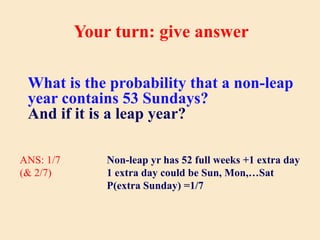
Your turn: give answer
What is the probability that a non-leap
year contains 53 Sundays?
And if it is a leap year?
ANS: 1/7
(& 2/7)
Non-leap yr has 52 full weeks +1 extra day
1 extra day could be Sun, Mon,…Sat
P(extra Sunday) =1/7
58-4
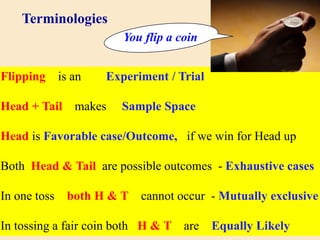
Flipping is an Experiment / Trial
Head + Tail makes Sample Space
Head is Favorable case/Outcome, if we win for Head up
Both Head & Tail are possible outcomes - Exhaustive cases
In one toss both H & T cannot occur - Mutually exclusive
In tossing a fair coin both H & T are Equally Likely
Terminologies
You flip a coin
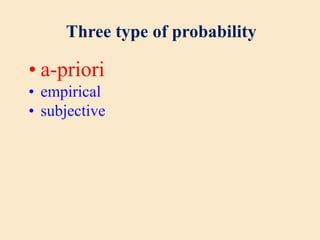
Three type of probability
• a-priori
• empirical
• subjective
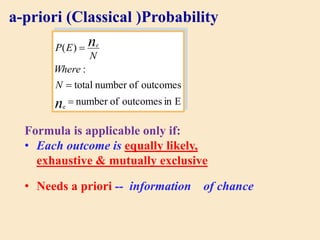
a-priori (Classical )Probability
E
in
outcomes
of
number
outcomes
of
number
total
:
)
(
e



n
n
N
Where
N
E
P e
Formula is applicable only if:
• Each outcome is equally likely,
exhaustive & mutually exclusive
• Needs a priori -- information of chance
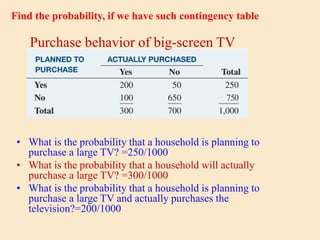
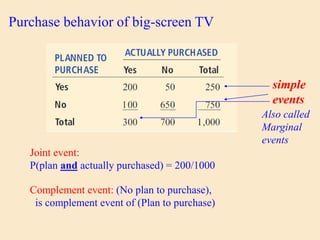
Find the probability, if we have such contingency table
• What is the probability that a household is planning to
purchase a large TV? =250/1000
• What is the probability that a household will actually
purchase a large TV? =300/1000
• What is the probability that a household is planning to
purchase a large TV and actually purchases the
television?=200/1000
Purchase behavior of big-screen TV
Probability of 2 or more events
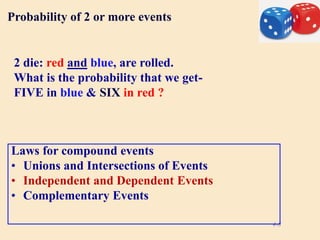
2 die: red and blue, are rolled.
What is the probability that we get-
FIVE in blue & SIX in red ?
4-8
Laws for compound events
• Unions and Intersections of Events
• Independent and Dependent Events
• Complementary Events
Purchase behavior of big-screen TV
simple
events
Also called
Marginal
events
Joint event:
P(plan and actually purchased) = 200/1000
Complement event: (No plan to purchase),
is complement event of (Plan to purchase)
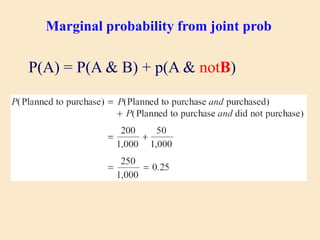
Marginal probability from joint prob
P(A) = P(A & B) + p(A & notB)
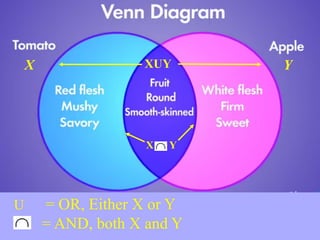
U = OR, Either X or Y
= AND, both X and Y
X Y
XUY
X Y
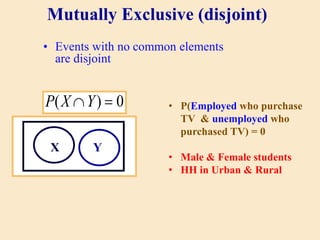
Mutually Exclusive (disjoint)
• Events with no common elements
are disjoint
Y
X
P X Y
( )
  0 • P(Employed who purchase
TV & unemployed who
purchased TV) = 0
• Male & Female students
• HH in Urban & Rural
Independent & Dependent Events
Probability laws differ when
events are independent or when
dependent
#
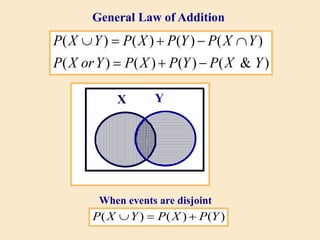
General Law of Addition
)
&
(
)
(
)
(
)
(
)
(
)
(
)
(
)
(
Y
X
P
Y
P
X
P
Y
or
X
P
Y
X
P
Y
P
X
P
Y
X
P








Y
X
When events are disjoint
)
(
)
(
)
( Y
P
X
P
Y
X
P 


Example: Law of Addition [ X OR Y ]
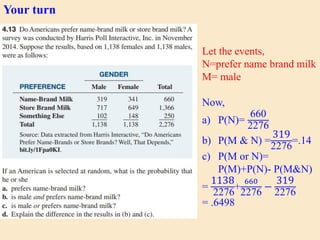
Your turn
Let the events,
N=prefer name brand milk
M= male
Now,
a) P(N)=
660
2276
b) P(M & N) =
319
2276
=.14
c) P(M or N)=
P(M)+P(N)- P(M&N)
=
1138
2276
+
660
2276
−
319
2276
= .6498
Break
4-17
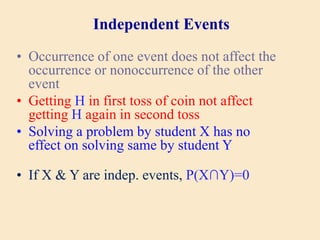
Independent Events
• Occurrence of one event does not affect the
occurrence or nonoccurrence of the other
event
• Getting H in first toss of coin not affect
getting H again in second toss
• Solving a problem by student X has no
effect on solving same by student Y
• If X & Y are indep. events, P(X∩Y)=0
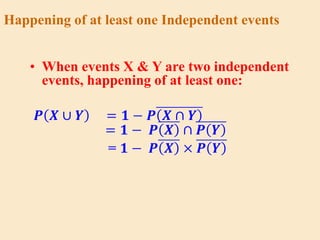
Happening of at least one Independent events
• When events X & Y are two independent
events, happening of at least one:
𝑷 𝑿 ∪ 𝒀 = 𝟏 − 𝑷 𝑿 ∩ 𝒀
= 𝟏 − 𝑷 𝑿 ∩ 𝑷 𝒀
= 𝟏 − 𝑷 𝑿 × 𝑷 𝒀
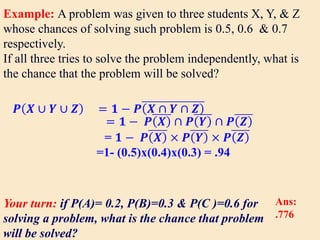
Example: A problem was given to three students X, Y, & Z
whose chances of solving such problem is 0.5, 0.6 & 0.7
respectively.
If all three tries to solve the problem independently, what is
the chance that the problem will be solved?
𝑷 𝑿 ∪ 𝒀 ∪ 𝒁 = 𝟏 − 𝑷 𝑿 ∩ 𝒀 ∩ 𝒁
= 𝟏 − 𝑷 𝑿 ∩ 𝑷 𝒀 ∩ 𝑷 𝒁
= 𝟏 − 𝑷 𝑿 × 𝑷 𝒀 × 𝑷 𝒁
=1- (0.5)x(0.4)x(0.3) = .94
Your turn: if P(A)= 0.2, P(B)=0.3 & P(C )=0.6 for
solving a problem, what is the chance that problem
will be solved?
Ans:
.776
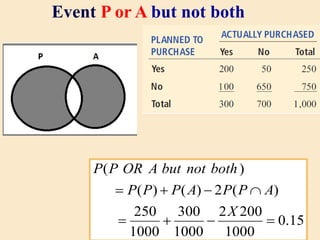
Event P or A but not both
4-21 15
.
0
1000
200
2
1000
300
1000
250
)
(
2
)
(
)
(
)
(








X
A
P
P
A
P
P
P
both
not
but
A
OR
P
P
P
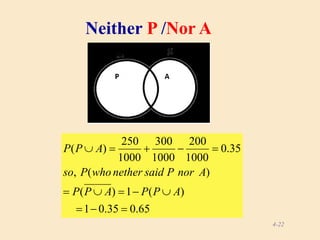
Neither P /Nor A
4-22
65
.
0
35
.
0
1
)
(
1
)
(
)
(
,
35
.
0
1000
200
1000
300
1000
250
)
(













A
P
P
A
P
P
A
nor
P
said
nether
who
P
so
A
P
P
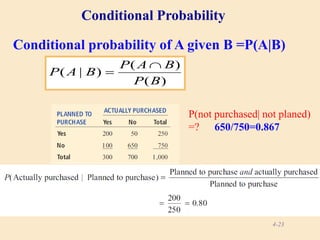
Conditional Probability
Conditional probability of A given B =P(A|B)
)
(
)
(
)
|
(
B
P
B
A
P
B
A
P


4-23
P(not purchased| not planed)
=? 650/750=0.867
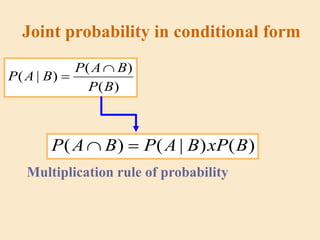
Joint probability in conditional form
Multiplication rule of probability
)
(
)
(
)
|
(
B
P
B
A
P
B
A
P


)
(
)
|
(
)
( B
xP
B
A
P
B
A
P 

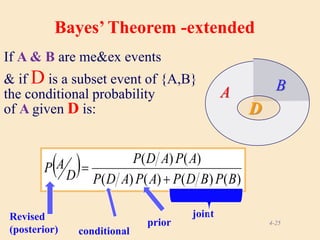
Bayes’ Theorem -extended
4-25
  )
(
)
(
)
(
)
(
)
(
)
(
B
P
B
D
P
A
P
A
D
P
A
P
A
D
P
D
A
P


If A & B are me&ex events
& if D is a subset event of {A,B}
the conditional probability
of A given D is:
A B
D
Revised
(posterior)
prior
conditional
joint
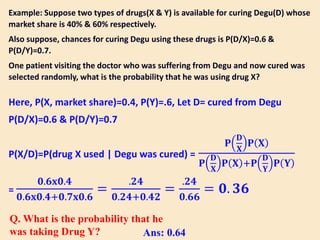
Example: Suppose two types of drugs(X & Y) is available for curing Degu(D) whose
market share is 40% & 60% respectively.
Also suppose, chances for curing Degu using these drugs is P(D/X)=0.6 &
P(D/Y)=0.7.
One patient visiting the doctor who was suffering from Degu and now cured was
selected randomly, what is the probability that he was using drug X?
Here, P(X, market share)=0.4, P(Y)=.6, Let D= cured from Degu
P(D/X)=0.6 & P(D/Y)=0.7
P(X/D)=P(drug X used | Degu was cured) =
𝐏
𝐃
𝐗
𝐏 𝐗
𝐏
𝐃
𝐗
𝐏 𝐗 +𝐏
𝐃
𝐘
𝐏 𝐘
=
𝟎.𝟔𝐱𝟎.𝟒
𝟎.𝟔𝐱𝟎.𝟒+𝟎.𝟕𝐱𝟎.𝟔
=
.𝟐𝟒
𝟎.𝟐𝟒+𝟎.𝟒𝟐
=
.𝟐𝟒
𝟎.𝟔𝟔
= 𝟎. 𝟑𝟔
Q. What is the probability that he
was taking Drug Y? Ans: 0.64
Thanks

Slide 2 (Basic probabilityjhhhhhhhhhhh).pdf

  • 1.
    Basic Probability • Definition& Terminologies • Basic Laws • Independent, Dependent, Conditional • Bayes theorem Coverage:
  • 2.
    Probability • Probability issimply how likely something is to happen. • Many events can't be predicted with total certainty. The best we can say is how likely they are to happen, using the idea of probability. • How likely tossing a coin I will get ‘head’? • How likely it will rain everyday in the month of ‘shrawan next year? • How likely you will be a “happy” person in your life?
  • 3.
    Your turn: giveanswer What is the probability that a non-leap year contains 53 Sundays? And if it is a leap year? ANS: 1/7 (& 2/7) Non-leap yr has 52 full weeks +1 extra day 1 extra day could be Sun, Mon,…Sat P(extra Sunday) =1/7
  • 4.
    58-4 Flipping is anExperiment / Trial Head + Tail makes Sample Space Head is Favorable case/Outcome, if we win for Head up Both Head & Tail are possible outcomes - Exhaustive cases In one toss both H & T cannot occur - Mutually exclusive In tossing a fair coin both H & T are Equally Likely Terminologies You flip a coin
  • 5.
    Three type ofprobability • a-priori • empirical • subjective
  • 6.
    a-priori (Classical )Probability E in outcomes of number outcomes of number total : ) ( e    n n N Where N E Pe Formula is applicable only if: • Each outcome is equally likely, exhaustive & mutually exclusive • Needs a priori -- information of chance
  • 7.
    Find the probability,if we have such contingency table • What is the probability that a household is planning to purchase a large TV? =250/1000 • What is the probability that a household will actually purchase a large TV? =300/1000 • What is the probability that a household is planning to purchase a large TV and actually purchases the television?=200/1000 Purchase behavior of big-screen TV
  • 8.
    Probability of 2or more events 2 die: red and blue, are rolled. What is the probability that we get- FIVE in blue & SIX in red ? 4-8 Laws for compound events • Unions and Intersections of Events • Independent and Dependent Events • Complementary Events
  • 9.
    Purchase behavior ofbig-screen TV simple events Also called Marginal events Joint event: P(plan and actually purchased) = 200/1000 Complement event: (No plan to purchase), is complement event of (Plan to purchase)
  • 10.
    Marginal probability fromjoint prob P(A) = P(A & B) + p(A & notB)
  • 11.
    U = OR,Either X or Y = AND, both X and Y X Y XUY X Y
  • 12.
    Mutually Exclusive (disjoint) •Events with no common elements are disjoint Y X P X Y ( )   0 • P(Employed who purchase TV & unemployed who purchased TV) = 0 • Male & Female students • HH in Urban & Rural
  • 13.
    Independent & DependentEvents Probability laws differ when events are independent or when dependent #
  • 14.
    General Law ofAddition ) & ( ) ( ) ( ) ( ) ( ) ( ) ( ) ( Y X P Y P X P Y or X P Y X P Y P X P Y X P         Y X When events are disjoint ) ( ) ( ) ( Y P X P Y X P   
  • 15.
    Example: Law ofAddition [ X OR Y ]
  • 16.
    Your turn Let theevents, N=prefer name brand milk M= male Now, a) P(N)= 660 2276 b) P(M & N) = 319 2276 =.14 c) P(M or N)= P(M)+P(N)- P(M&N) = 1138 2276 + 660 2276 − 319 2276 = .6498
  • 17.
  • 18.
    Independent Events • Occurrenceof one event does not affect the occurrence or nonoccurrence of the other event • Getting H in first toss of coin not affect getting H again in second toss • Solving a problem by student X has no effect on solving same by student Y • If X & Y are indep. events, P(X∩Y)=0
  • 19.
    Happening of atleast one Independent events • When events X & Y are two independent events, happening of at least one: 𝑷 𝑿 ∪ 𝒀 = 𝟏 − 𝑷 𝑿 ∩ 𝒀 = 𝟏 − 𝑷 𝑿 ∩ 𝑷 𝒀 = 𝟏 − 𝑷 𝑿 × 𝑷 𝒀
  • 20.
    Example: A problemwas given to three students X, Y, & Z whose chances of solving such problem is 0.5, 0.6 & 0.7 respectively. If all three tries to solve the problem independently, what is the chance that the problem will be solved? 𝑷 𝑿 ∪ 𝒀 ∪ 𝒁 = 𝟏 − 𝑷 𝑿 ∩ 𝒀 ∩ 𝒁 = 𝟏 − 𝑷 𝑿 ∩ 𝑷 𝒀 ∩ 𝑷 𝒁 = 𝟏 − 𝑷 𝑿 × 𝑷 𝒀 × 𝑷 𝒁 =1- (0.5)x(0.4)x(0.3) = .94 Your turn: if P(A)= 0.2, P(B)=0.3 & P(C )=0.6 for solving a problem, what is the chance that problem will be solved? Ans: .776
  • 21.
    Event P orA but not both 4-21 15 . 0 1000 200 2 1000 300 1000 250 ) ( 2 ) ( ) ( ) (         X A P P A P P P both not but A OR P P P
  • 22.
    Neither P /NorA 4-22 65 . 0 35 . 0 1 ) ( 1 ) ( ) ( , 35 . 0 1000 200 1000 300 1000 250 ) (              A P P A P P A nor P said nether who P so A P P
  • 23.
    Conditional Probability Conditional probabilityof A given B =P(A|B) ) ( ) ( ) | ( B P B A P B A P   4-23 P(not purchased| not planed) =? 650/750=0.867
  • 24.
    Joint probability inconditional form Multiplication rule of probability ) ( ) ( ) | ( B P B A P B A P   ) ( ) | ( ) ( B xP B A P B A P  
  • 25.
    Bayes’ Theorem -extended 4-25  ) ( ) ( ) ( ) ( ) ( ) ( B P B D P A P A D P A P A D P D A P   If A & B are me&ex events & if D is a subset event of {A,B} the conditional probability of A given D is: A B D Revised (posterior) prior conditional joint
  • 26.
    Example: Suppose twotypes of drugs(X & Y) is available for curing Degu(D) whose market share is 40% & 60% respectively. Also suppose, chances for curing Degu using these drugs is P(D/X)=0.6 & P(D/Y)=0.7. One patient visiting the doctor who was suffering from Degu and now cured was selected randomly, what is the probability that he was using drug X? Here, P(X, market share)=0.4, P(Y)=.6, Let D= cured from Degu P(D/X)=0.6 & P(D/Y)=0.7 P(X/D)=P(drug X used | Degu was cured) = 𝐏 𝐃 𝐗 𝐏 𝐗 𝐏 𝐃 𝐗 𝐏 𝐗 +𝐏 𝐃 𝐘 𝐏 𝐘 = 𝟎.𝟔𝐱𝟎.𝟒 𝟎.𝟔𝐱𝟎.𝟒+𝟎.𝟕𝐱𝟎.𝟔 = .𝟐𝟒 𝟎.𝟐𝟒+𝟎.𝟒𝟐 = .𝟐𝟒 𝟎.𝟔𝟔 = 𝟎. 𝟑𝟔 Q. What is the probability that he was taking Drug Y? Ans: 0.64
  • 27.