Aprincess sleeps for years in an
isolated tower. Then, one day,
a knight arrives … and everyone
lives happily ever after. That tale of
reawakening is not just the plot of a
classic fairy tale, it’s also a story time
version of the work done by scientific
knight errant Perry Hackett, aided
in his work by what he describes as
“dedicated bench work by teams of
hard-working young folks who shared
a vision.” Hackett is a professor in the
Department of Genetics, Cell Biology
and Development; a member of the
Center for Genome Engineering and
the Masonic Cancer Center's Genetic
Mechanisms of Cancer Program; and
co-founder of two Twin Cities-based
biotech companies — Discovery
Genomics, Inc., and Recombinetics, Inc.
His Sleeping Beauty (SB) transposon,
reconstructed from a fish DNA
sequence that went extinct 13 million
years ago, proved to be a game-
changer in non-viral cancer gene
therapy. The result of his work to
awaken long-sleeping potential from
genetic material may lead to faster,
less expensive and potentially safer
methods to deliver DNA at a cellular
level. The technology was licensed
for use in treating cancer to the M.D.
Anderson Cancer Center in Texas and
to Boston-based company, Ziopharm.
Sleeping Beauty was just the
beginning, Hackett says. With
several teams of scientists now in
place at the University along with
the launch of several small biotech
companies, he’s more excited about
the impact of the combined work of
many colleagues with the potential
to increase food, nutrition and
animal welfare for a growing global
population. In recognition of his work
and for his contributions toward
making the University and the state
of Minnesota a genomics and gene-
editing powerhouse, Hackett received
the University of Minnesota Office
for Technology Commercialization’s
biennial Impact Award. The award
recognizes a researcher whose work
has had a broad, positive impact on
society and improved quality of life.
“The story is so much bigger than one
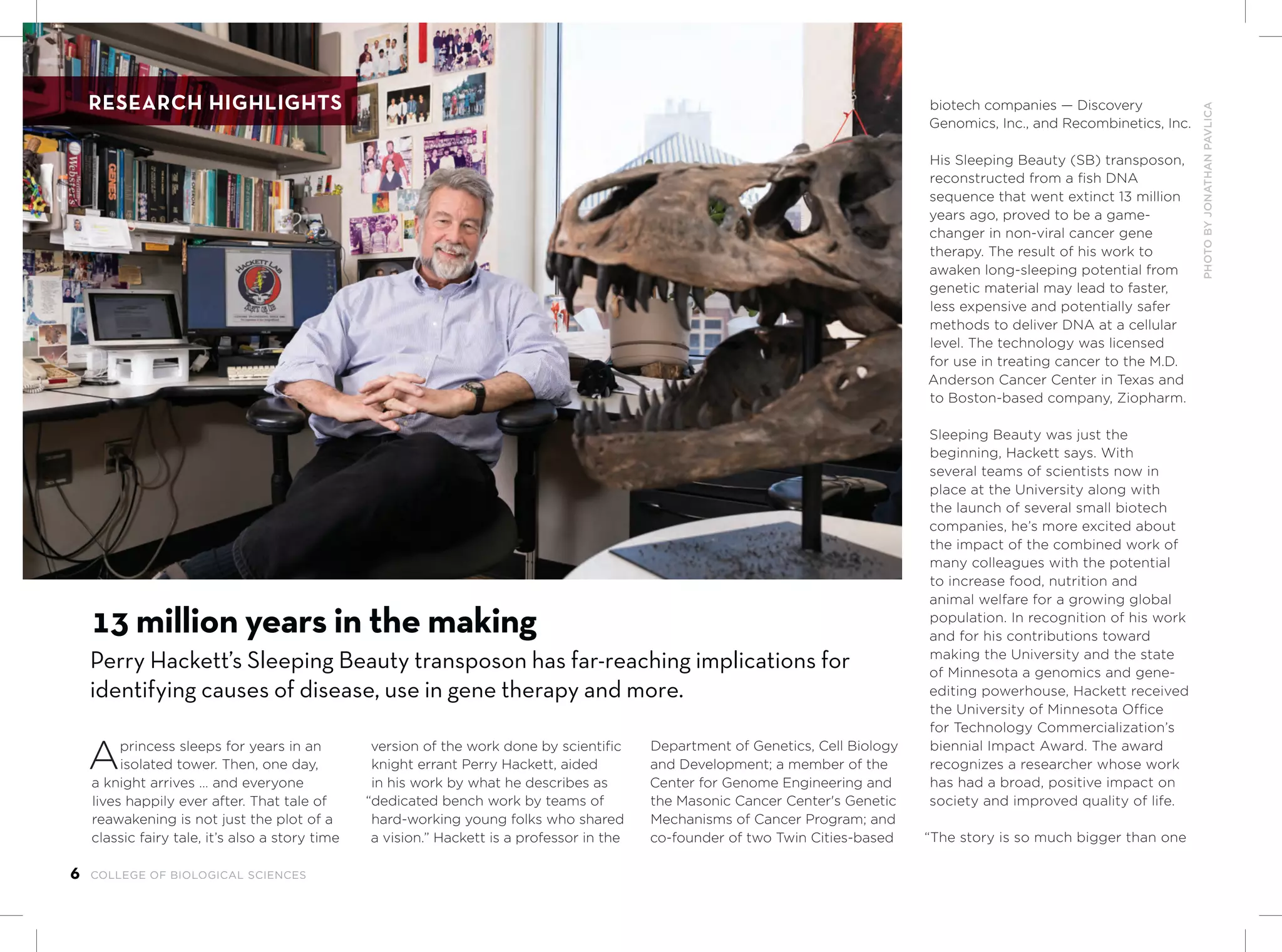
Perry Hackett’s Sleeping Beauty transposon has far-reaching implications for
identifying causes of disease, use in gene therapy and more.
13 million years in the making
RESEARCH HIGHLIGHTS
PHOTOBYJONATHANPAVLICA
6 COLLEGE OF BIOLOGICAL SCIENCES
person,” Hackett says. “We started
a snowball rolling down a slope, and
it has accumulated considerable
mass and momentum, gaining an
enormous potential.”
He was nominated for the award by
Dan Voytas, professor of genetics,
cell biology and development, and
director of the Center for Genome
Engineering, which Hackett helped
found. “One of the reasons I came
to the University was because I was
excited about the work Perry was
doing here,” says Voytas. “There
is an energy and a great sense of
possibility among the scientists.”
In addition to being an esteemed
researcher, Hackett has contributed to
the advancement of his field through
significant financial support. He was
instrumental in creating multi-million-
dollar research funds to support
innovation and entrepreneurship in
the field of biotechnology. “As director
of this center, we’ve benefited from
funding from the Hackett Fund for
Genome Engineering,” says Voytas,
“and we recognize that Perry has been
a great philanthropist for the work of
his fellow scientists.” —JULIE KENDRICK
WHAT’S AHEAD:
From medicine to agriculture
While the Sleeping Beauty transposon
is known for its impact on biomedical
science, Hackett predicts that he and
his colleagues are poised to tackle an
even greater challenge — feeding a
growing population.
Hackett cites Norman Borlaug, one of
the University’s most celebrated alums,
who said that genetic engineering
will be needed to meet the growing
demand for food going forward.
Companies like Recombinetics and
Calyxt, a biotech startup launched
by Voytas, are already making
strides in this area. “[Calyxt] is using
genome editing to develop crops
with healthier characteristics, and
Recombinetics is doing the same in
animals,” says Hackett.
“The Center for Genome Engineering is
going to be the leader in 21st century
agriculture for the entire world,” he
predicts. “We are becoming the hub
of genome engineering agriculture
research. Within a decade, people will
recognize how truly important the
work being done here has been.”
“We are becoming the hub of genome engineering
agriculture research for the world. Within a decade,
people will recognize how truly important the work
being done here has been.”
Findings
Female Cope’s gray tree frogs tune out the cacophony of frog calls and
home in on calls from potential mates by discerning — and selectively
ignoring — patterns in background noise. This finding could contribute to
better designs for hearing aids and voice recognition software.
(Associate Professor Mark Bee, postdoctoral fellow Norman Lee and colleagues in the March 2017 edition of
Current Biology)
Households are the main culprit when it comes to nutrient pollutants in
the Twin Cities urban watershed. Lawn fertilizers and pet waste are the
dominant sources of nitrogen and phosphorus pollutants in the Mississippi
River. (Professor Sarah Hobbie and colleagues in the April 2017 edition of the Proceedings of the National
Academy of Sciences)
When species such as Asian elephants and bluefin tuna decline in number,
the geographic areas they inhabit also shrink. Where populations manage
to remain locally abundant they become increasingly easy targets for
hunters and fishermen, making them more vulnerable to extinction.
(Assistant Professor Allison Shaw, postdoctoral fellow Lauren Sullivan and colleagues in the April 2017 edition of
the Proceedings of the National Academy of Sciences)
Molecular chaperone TorsinA plays a key role in establishing and maintaining
cell polarity, highlighting the potential connection between defective cell
polarity and the human neurological movement disorder DYT1 dystonia.
(Assistant Professor G.W. Gant Luxton and colleagues in the February 2017 edition of The Journal of Cell Biology)
“PREVIOUS STUDIES OF ANIMAL
COMMUNICATION HAVE GENERALLY
REGARDED NOISE AS A RELATIVELY STATIC
FEATURE OF AN ANIMAL'S ACOUSTIC
ENVIRONMENT. WHAT THIS NEW WORK
SHOWS IS NOT ONLY THAT NOISY ACOUSTIC
SCENES ARE, IN FACT, DYNAMIC, BUT ALSO
THAT THEY ARE DYNAMIC IN PREDICTABLE
WAYS THAT ANIMALS HAVE EVOLVED
TO AVOID NOISE-INDUCED ERRORS IN
COMMUNICATION.” - DR. MARK BEE
BIO MAGAZINE 7

Sleeping Beauty Transposon: Awakening a new approach to cancer treatment

  • 1.
    Aprincess sleeps foryears in an isolated tower. Then, one day, a knight arrives … and everyone lives happily ever after. That tale of reawakening is not just the plot of a classic fairy tale, it’s also a story time version of the work done by scientific knight errant Perry Hackett, aided in his work by what he describes as “dedicated bench work by teams of hard-working young folks who shared a vision.” Hackett is a professor in the Department of Genetics, Cell Biology and Development; a member of the Center for Genome Engineering and the Masonic Cancer Center's Genetic Mechanisms of Cancer Program; and co-founder of two Twin Cities-based biotech companies — Discovery Genomics, Inc., and Recombinetics, Inc. His Sleeping Beauty (SB) transposon, reconstructed from a fish DNA sequence that went extinct 13 million years ago, proved to be a game- changer in non-viral cancer gene therapy. The result of his work to awaken long-sleeping potential from genetic material may lead to faster, less expensive and potentially safer methods to deliver DNA at a cellular level. The technology was licensed for use in treating cancer to the M.D. Anderson Cancer Center in Texas and to Boston-based company, Ziopharm. Sleeping Beauty was just the beginning, Hackett says. With several teams of scientists now in place at the University along with the launch of several small biotech companies, he’s more excited about the impact of the combined work of many colleagues with the potential to increase food, nutrition and animal welfare for a growing global population. In recognition of his work and for his contributions toward making the University and the state of Minnesota a genomics and gene- editing powerhouse, Hackett received the University of Minnesota Office for Technology Commercialization’s biennial Impact Award. The award recognizes a researcher whose work has had a broad, positive impact on society and improved quality of life. “The story is so much bigger than one Perry Hackett’s Sleeping Beauty transposon has far-reaching implications for identifying causes of disease, use in gene therapy and more. 13 million years in the making RESEARCH HIGHLIGHTS PHOTOBYJONATHANPAVLICA 6 COLLEGE OF BIOLOGICAL SCIENCES
  • 2.
    person,” Hackett says.“We started a snowball rolling down a slope, and it has accumulated considerable mass and momentum, gaining an enormous potential.” He was nominated for the award by Dan Voytas, professor of genetics, cell biology and development, and director of the Center for Genome Engineering, which Hackett helped found. “One of the reasons I came to the University was because I was excited about the work Perry was doing here,” says Voytas. “There is an energy and a great sense of possibility among the scientists.” In addition to being an esteemed researcher, Hackett has contributed to the advancement of his field through significant financial support. He was instrumental in creating multi-million- dollar research funds to support innovation and entrepreneurship in the field of biotechnology. “As director of this center, we’ve benefited from funding from the Hackett Fund for Genome Engineering,” says Voytas, “and we recognize that Perry has been a great philanthropist for the work of his fellow scientists.” —JULIE KENDRICK WHAT’S AHEAD: From medicine to agriculture While the Sleeping Beauty transposon is known for its impact on biomedical science, Hackett predicts that he and his colleagues are poised to tackle an even greater challenge — feeding a growing population. Hackett cites Norman Borlaug, one of the University’s most celebrated alums, who said that genetic engineering will be needed to meet the growing demand for food going forward. Companies like Recombinetics and Calyxt, a biotech startup launched by Voytas, are already making strides in this area. “[Calyxt] is using genome editing to develop crops with healthier characteristics, and Recombinetics is doing the same in animals,” says Hackett. “The Center for Genome Engineering is going to be the leader in 21st century agriculture for the entire world,” he predicts. “We are becoming the hub of genome engineering agriculture research. Within a decade, people will recognize how truly important the work being done here has been.” “We are becoming the hub of genome engineering agriculture research for the world. Within a decade, people will recognize how truly important the work being done here has been.” Findings Female Cope’s gray tree frogs tune out the cacophony of frog calls and home in on calls from potential mates by discerning — and selectively ignoring — patterns in background noise. This finding could contribute to better designs for hearing aids and voice recognition software. (Associate Professor Mark Bee, postdoctoral fellow Norman Lee and colleagues in the March 2017 edition of Current Biology) Households are the main culprit when it comes to nutrient pollutants in the Twin Cities urban watershed. Lawn fertilizers and pet waste are the dominant sources of nitrogen and phosphorus pollutants in the Mississippi River. (Professor Sarah Hobbie and colleagues in the April 2017 edition of the Proceedings of the National Academy of Sciences) When species such as Asian elephants and bluefin tuna decline in number, the geographic areas they inhabit also shrink. Where populations manage to remain locally abundant they become increasingly easy targets for hunters and fishermen, making them more vulnerable to extinction. (Assistant Professor Allison Shaw, postdoctoral fellow Lauren Sullivan and colleagues in the April 2017 edition of the Proceedings of the National Academy of Sciences) Molecular chaperone TorsinA plays a key role in establishing and maintaining cell polarity, highlighting the potential connection between defective cell polarity and the human neurological movement disorder DYT1 dystonia. (Assistant Professor G.W. Gant Luxton and colleagues in the February 2017 edition of The Journal of Cell Biology) “PREVIOUS STUDIES OF ANIMAL COMMUNICATION HAVE GENERALLY REGARDED NOISE AS A RELATIVELY STATIC FEATURE OF AN ANIMAL'S ACOUSTIC ENVIRONMENT. WHAT THIS NEW WORK SHOWS IS NOT ONLY THAT NOISY ACOUSTIC SCENES ARE, IN FACT, DYNAMIC, BUT ALSO THAT THEY ARE DYNAMIC IN PREDICTABLE WAYS THAT ANIMALS HAVE EVOLVED TO AVOID NOISE-INDUCED ERRORS IN COMMUNICATION.” - DR. MARK BEE BIO MAGAZINE 7