SLEEP PATTERN AND ITS
DISTURBANCES
INTRODUCTION
Nearly one third of our life is spent in sleep. Every
day we voluntarily go to bed and transit into an easily
reversible state of relative unresponsive and
tranquility. This state occurs almost regularly and
repetitively each day. Sleep has long been assumed
to have restorative function and recently many
people believed sleep to be a passive state of
decreased stimulation.
DEFINITION
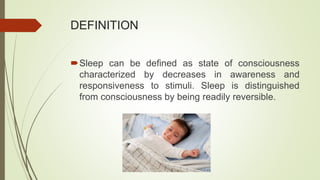
Sleep can be defined as state of consciousness
characterized by decreases in awareness and
responsiveness to stimuli. Sleep is distinguished
from consciousness by being readily reversible.
INCIDENCE
Almost a third of the general population has some
problems with sleep during any given year. More
than half of the 9000 participants in a study of sleep
in elderly persons (65 years or older) reported the
following as sleep pattern disturbance that they
experience most of the time:
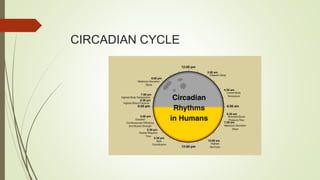
CIRCADIAN CYCLE
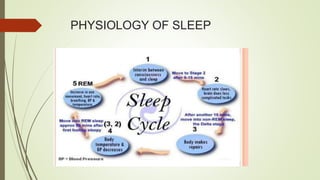
PHYSIOLOGY OF SLEEP
STAGES OF SLEEP
POLYSOMNIGRAPHIC PROFILES TWO STATES OF SLEEP
 RAPID EYE MOVEMENT SLEEP OR D- SLEEP
(DESYNCHRONIZED SLEEP OR DREAMING SLEEP OR
ACTIVE SLEEP
 NON-RAPID EYE MOVEMENT SLEEP (NREM), OR S-
SLEEP (SYNCHRONIZED SLEEP) PR QUITE SLEEP OR
ORTHODOX SLEEP.
NREM DEVISION OF SLEEP
STAGE I
STAGE II
STAGE III
STAGE IV
STAGE I
 includes lightest level of sleep
 stage lasts a few minutes
 decreased physiological activity begins with gradual fall in
vital signs and metabolism
 sensory stimuli such as noise, easily arouse sleeper
 if awakened, person feels as though daydreaming has
occurred
STAGE II
 includes period of sound sleep
 relaxation progresses
 arousal is still relatively easy
 stage lasts 10 – 20 mts
 body functions continue to slow
 the brain waves are frequently mixed and low voltage in
pattern, with bursts of activity called sleep spindles and large
amplitude waves called K complexes
STAGE III
 it involves initial stages of deep sleep
 sleeper is difficult to arouse and rarely moves
 oxygen consumption
 muscles are completely relaxed
 vital signs decline, but remain regular
 stage lasts 15 – 30 mts
STAGE IV
 it is deepest stage of sleep
 it is very difficult to arouse sleeper
 If sleep loss has occurred, sleeper will spend considerable
portion of night in this stage.
 Vital signs are significantly lower than during waking hours
 Stage lasts approximately 15 – 30 mts
 Sleep walking and enuresis sometimes occur
 Stage 3 and 4 known as slow wave sleep, named for the
characteristic high voltage and low – frequency delta waves
SLEEP CYCLE
FUNCTION OF SLEEP
It is a time of restoration and preparation for the next
period of wakefulness
During NREM stage 4 body releases human growth
hormone for the repair and renewal of epithelial and
specialized cells such as brain cells
Protein synthesis and cell division for the renewal of
tissues occur during rest and sleep
REM sleep appears to be important for cognitive
restoration
NORMAL SLEEP REQUIREMENT
 Infants 16 Hours /Day
 Toddlers 12 Hours /Day
 Preschoolers 11 Hours /Day
 Schoolers 9 - 10 hours /day
 Adolescents 8 – 9 hours /day
 Adults 6 – 8 hours /day
FACTOERS AFFECTING SLEEP
A number of factors affect the quality and quantity of sleep. Often more
than one factor combined to cause a sleep problem.
 Physical illness (eg. Nausea, mood disorders, breathing difficulty, pain)
 Drugs and substances (eg. Tryptophan)
 Lifestyle (eg. Daily routines, exercises)
 Usual sleep patterns and excessive daytime sleepiness
 Emotional stress
 Environment ( ventilation)
Continue…
Sound
Exercise and fatigue
Food and caloric intake
ICD 10 SLEEP DISORDER
CLASSIFICATION
 G47 Sleep disorders
 G47.0 Insomnia
 G47.00 …… unspecified
 G47.01 …… due to medical condition
 G47.09 Other insomnia
 G47.1 Hypersomnia
 G47.10 …… unspecified
 G47.11 Idiopathic hypersomnia with long sleep time
 G47.12 Idiopathic hypersomnia without long sleep time
 G47.13 Recurrent hypersomnia
 G47.14 …… due to medical condition
 G47.19 Other hypersomnia
 G47.2 Circadian rhythm sleep disorders
 G47.20 Circadian rhythm sleep disorder, unspecified type
 G47.21 Circadian rhythm sleep disorder, delayed sleep phase type
 G47.22 Circadian rhythm sleep disorder, advanced sleep phase type
 G47.23 Circadian rhythm sleep disorder, irregular sleep wake type
 G47.24 Circadian rhythm sleep disorder, free running type
 G47.25 Circadian rhythm sleep disorder, jet lag type
 G47.26 Circadian rhythm sleep disorder, shift work type
 G47.27 Circadian rhythm sleep disorder in conditions
classified
elsewhere
 G47.29 Other circadian rhythm sleep disorder
 G47.3 Sleep apnea
 G47.30 …… unspecified
 G47.31 Primary central sleep apnea
 G47.32 High altitude periodic breathing
 G47.33 Obstructive sleep apnea (adult) (pediatric)
 G47.34 Idiopathic sleep related nonobstructive alveolar hypoventilation
 G47.35 Congenital central alveolar hypoventilation syndrome
 G47.36 Sleep related hypoventilation in conditions classified elsewhere
 G47.37 Central sleep apnea in conditions classified elsewhere
 G47.39 Other sleep apnea
 G47.4 Narcolepsy and cataplexy
 G47.41 Narcolepsy
 G47.411 …… with cataplexy
 G47.419 …… without cataplexy
 G47.42 Narcolepsy in conditions classified elsewhere
 G47.421 …… with cataplexy
 G47.429 …… without cataplexy
 G47.5 Parasomnia
 G47.50 …… unspecified
 G47.51 Confusional arousals
 G47.52 REM sleep behavior disorder
 G47.53 Recurrent isolated sleep paralysis
 G47.54 …… in conditions classified elsewhere
 G47.59 Other parasomnia
 G47.6 Sleep related movement disorders
 G47.61 Periodic limb movement disorder
 G47.62 Sleep related leg cramps
 G47.63 Sleep related bruxism
 G47.69 Other sleep related movement disorders
 G47.8 Other sleep disorders
 G47.9 Sleep disorder, unspecified
SLEEP DISORDER
Sleep pattern disturbance is a nursing diagnosis that
is defined as a disruption of sleep time that causes
discomfort or interferes with a desired life cycle. A
sleep pattern disturbance may be related to one of
more than 80 sleep disorders identified in the
international classification of sleep disorders, a partial
list of which is given below:
The Dyssomnias include sleep disorders characterized
by difficulty in initiating or maintaining sleep (insomnia)
or by excessive sleepiness. These disorders may arise
predominantly from within the body (intrinsic), from
external sources (extrinsic), or from disruption of
circadian rhythm.
INTRINSIC SLEEP DISORDER
EXTRINSIC SLEEP DISORDER
1. DYSSOMNIAS
INTRINSIC SLEEP DISORDER
1. INSOMNIA
2. NACRCOLEPSY
3. SLEEP APNEA SYNDROME
a) OBSTRUCTIVE SLEEP APNEA
b) CENTRAL SLEEP APNEA SYNDROME
4. PERIODIC LIMB MOVEMENT DISORDER
5. RESTLESS LEG SYNDROME
EXTRINSIC SLEEP DISORDER
1.CIRCADIAN RHYTHM SLEEP DISORDER
2.PARASOMNIAS
a.AROUSAL DISORDER
b.SLEEP-WAKE TRANSITION DISORDERS
c. PARASOMNIAS USUALLY ASSOCIATED WITH REM
SLEEP
d.OTHER PARASOMNIAS
3.SLEEP DISORDES ASSOCIATED WITH
MEDICAL OR PSYCHIATRIC DISORDERS
A. NEUROTRANSMITTER IMBALANCES
B. HEAD INJURY
C.HORMONAL IMBALANCES
D.RESPIRATORY DISORDERS
E. CARDIOVASCULAR DISORDERS
F. GASTROINTESTINAL DISORDERS
G.OTHER DISORDERS
G.OTHER DISORDERS
Numerous Other disorders such as, skin conditions (atopic
eczema), fibromyalgia, and seizures seem to have an effect on
or an association with sleep.
4.HOSPITAL ACQUIRED SLEEP DISTURBANCES
A.SLEEP ONSET DIFFICULTY
B.SLEEP MAINTENANCE DISTURBANCE
C.EARLY MORNING AWAKENING
D.SLEEP DEPRIVATION
ASSESSMENT AND MANAGEMENT
Diagnostic assessment:
Polysomnography
Electroencephalogram
Multiple sleep latency test (MSLT)
MSLT is performed to assess the impairment of
daytime alertness. It is performed a day after a
standard polysomnogram. The time required for
clients to fall asleep when in a relaxed state is
evaluated at 2 hour intervals, with each nap limited
to 20 minutes. The type of sleep also is assessed.
SLEEP MEASUREMENT
 Electroencephalogram (EEG) measures the electrical
changes in the brain. The electrodes are placed on the scalp.
The wavy lines recorded by the EEG are called brain waves.
 Electrooculogram (EOG) measures the electrical changes
as the eyes rotate in its socket. The electrodes are placed
either above and below the eye or left and right of the eye.
Electromyogram (EMG) measures the electrical
changes generated during muscle contraction. The
electrodes are placed under the chin.
EEG, EOG and EMG are recorded simultaneously
and the patterns of activity in these three systems
provide basic classification for the different types of
sleep.
SLEEP MEASUREMENT TOOL
National Sleep Foundation’s Sleep Diary
The National Sleep Foundation’s Sleep Diary is easy to use
and takes just a few minutes each day to complete. It asks
about things that can help, or hinder, a good night’s sleep,
including the person’s bedroom environment, sleep habits,
and caffeine consumption. Completing the Sleep Diary every
morning and evening for a week or more captures valuable
information that assists individuals and their health care
providers to identify patterns and practices that foster.
THANK YOU FOR
CONCENTRATING
WITHOUT FALLING
ASLEEP!!!

Sleep pattern and its disturbances

  • 1.
    SLEEP PATTERN ANDITS DISTURBANCES
  • 3.
    INTRODUCTION Nearly one thirdof our life is spent in sleep. Every day we voluntarily go to bed and transit into an easily reversible state of relative unresponsive and tranquility. This state occurs almost regularly and repetitively each day. Sleep has long been assumed to have restorative function and recently many people believed sleep to be a passive state of decreased stimulation.
  • 4.
    DEFINITION Sleep can bedefined as state of consciousness characterized by decreases in awareness and responsiveness to stimuli. Sleep is distinguished from consciousness by being readily reversible.
  • 5.
    INCIDENCE Almost a thirdof the general population has some problems with sleep during any given year. More than half of the 9000 participants in a study of sleep in elderly persons (65 years or older) reported the following as sleep pattern disturbance that they experience most of the time:
  • 6.
  • 7.
  • 8.
    STAGES OF SLEEP POLYSOMNIGRAPHICPROFILES TWO STATES OF SLEEP  RAPID EYE MOVEMENT SLEEP OR D- SLEEP (DESYNCHRONIZED SLEEP OR DREAMING SLEEP OR ACTIVE SLEEP  NON-RAPID EYE MOVEMENT SLEEP (NREM), OR S- SLEEP (SYNCHRONIZED SLEEP) PR QUITE SLEEP OR ORTHODOX SLEEP.
  • 9.
    NREM DEVISION OFSLEEP STAGE I STAGE II STAGE III STAGE IV
  • 10.
    STAGE I  includeslightest level of sleep  stage lasts a few minutes  decreased physiological activity begins with gradual fall in vital signs and metabolism  sensory stimuli such as noise, easily arouse sleeper  if awakened, person feels as though daydreaming has occurred
  • 11.
    STAGE II  includesperiod of sound sleep  relaxation progresses  arousal is still relatively easy  stage lasts 10 – 20 mts  body functions continue to slow  the brain waves are frequently mixed and low voltage in pattern, with bursts of activity called sleep spindles and large amplitude waves called K complexes
  • 12.
    STAGE III  itinvolves initial stages of deep sleep  sleeper is difficult to arouse and rarely moves  oxygen consumption  muscles are completely relaxed  vital signs decline, but remain regular  stage lasts 15 – 30 mts
  • 13.
    STAGE IV  itis deepest stage of sleep  it is very difficult to arouse sleeper  If sleep loss has occurred, sleeper will spend considerable portion of night in this stage.  Vital signs are significantly lower than during waking hours  Stage lasts approximately 15 – 30 mts  Sleep walking and enuresis sometimes occur  Stage 3 and 4 known as slow wave sleep, named for the characteristic high voltage and low – frequency delta waves
  • 14.
  • 15.
    FUNCTION OF SLEEP Itis a time of restoration and preparation for the next period of wakefulness During NREM stage 4 body releases human growth hormone for the repair and renewal of epithelial and specialized cells such as brain cells Protein synthesis and cell division for the renewal of tissues occur during rest and sleep REM sleep appears to be important for cognitive restoration
  • 16.
    NORMAL SLEEP REQUIREMENT Infants 16 Hours /Day  Toddlers 12 Hours /Day  Preschoolers 11 Hours /Day  Schoolers 9 - 10 hours /day  Adolescents 8 – 9 hours /day  Adults 6 – 8 hours /day
  • 17.
    FACTOERS AFFECTING SLEEP Anumber of factors affect the quality and quantity of sleep. Often more than one factor combined to cause a sleep problem.  Physical illness (eg. Nausea, mood disorders, breathing difficulty, pain)  Drugs and substances (eg. Tryptophan)  Lifestyle (eg. Daily routines, exercises)  Usual sleep patterns and excessive daytime sleepiness  Emotional stress  Environment ( ventilation)
  • 18.
  • 19.
    ICD 10 SLEEPDISORDER CLASSIFICATION  G47 Sleep disorders  G47.0 Insomnia  G47.00 …… unspecified  G47.01 …… due to medical condition  G47.09 Other insomnia  G47.1 Hypersomnia  G47.10 …… unspecified
  • 20.
     G47.10 ……unspecified  G47.11 Idiopathic hypersomnia with long sleep time  G47.12 Idiopathic hypersomnia without long sleep time  G47.13 Recurrent hypersomnia  G47.14 …… due to medical condition  G47.19 Other hypersomnia  G47.2 Circadian rhythm sleep disorders  G47.20 Circadian rhythm sleep disorder, unspecified type
  • 21.
     G47.21 Circadianrhythm sleep disorder, delayed sleep phase type  G47.22 Circadian rhythm sleep disorder, advanced sleep phase type  G47.23 Circadian rhythm sleep disorder, irregular sleep wake type  G47.24 Circadian rhythm sleep disorder, free running type  G47.25 Circadian rhythm sleep disorder, jet lag type  G47.26 Circadian rhythm sleep disorder, shift work type  G47.27 Circadian rhythm sleep disorder in conditions classified
  • 22.
    elsewhere  G47.29 Othercircadian rhythm sleep disorder  G47.3 Sleep apnea  G47.30 …… unspecified  G47.31 Primary central sleep apnea  G47.32 High altitude periodic breathing  G47.33 Obstructive sleep apnea (adult) (pediatric)  G47.34 Idiopathic sleep related nonobstructive alveolar hypoventilation
  • 23.
     G47.35 Congenitalcentral alveolar hypoventilation syndrome  G47.36 Sleep related hypoventilation in conditions classified elsewhere  G47.37 Central sleep apnea in conditions classified elsewhere  G47.39 Other sleep apnea  G47.4 Narcolepsy and cataplexy  G47.41 Narcolepsy  G47.411 …… with cataplexy
  • 24.
     G47.419 ……without cataplexy  G47.42 Narcolepsy in conditions classified elsewhere  G47.421 …… with cataplexy  G47.429 …… without cataplexy  G47.5 Parasomnia  G47.50 …… unspecified  G47.51 Confusional arousals  G47.52 REM sleep behavior disorder  G47.53 Recurrent isolated sleep paralysis
  • 25.
     G47.54 ……in conditions classified elsewhere  G47.59 Other parasomnia  G47.6 Sleep related movement disorders  G47.61 Periodic limb movement disorder  G47.62 Sleep related leg cramps  G47.63 Sleep related bruxism  G47.69 Other sleep related movement disorders  G47.8 Other sleep disorders  G47.9 Sleep disorder, unspecified
  • 26.
    SLEEP DISORDER Sleep patterndisturbance is a nursing diagnosis that is defined as a disruption of sleep time that causes discomfort or interferes with a desired life cycle. A sleep pattern disturbance may be related to one of more than 80 sleep disorders identified in the international classification of sleep disorders, a partial list of which is given below:
  • 27.
    The Dyssomnias includesleep disorders characterized by difficulty in initiating or maintaining sleep (insomnia) or by excessive sleepiness. These disorders may arise predominantly from within the body (intrinsic), from external sources (extrinsic), or from disruption of circadian rhythm. INTRINSIC SLEEP DISORDER EXTRINSIC SLEEP DISORDER 1. DYSSOMNIAS
  • 28.
    INTRINSIC SLEEP DISORDER 1.INSOMNIA 2. NACRCOLEPSY 3. SLEEP APNEA SYNDROME a) OBSTRUCTIVE SLEEP APNEA b) CENTRAL SLEEP APNEA SYNDROME 4. PERIODIC LIMB MOVEMENT DISORDER 5. RESTLESS LEG SYNDROME
  • 29.
    EXTRINSIC SLEEP DISORDER 1.CIRCADIANRHYTHM SLEEP DISORDER 2.PARASOMNIAS a.AROUSAL DISORDER b.SLEEP-WAKE TRANSITION DISORDERS c. PARASOMNIAS USUALLY ASSOCIATED WITH REM SLEEP d.OTHER PARASOMNIAS
  • 30.
    3.SLEEP DISORDES ASSOCIATEDWITH MEDICAL OR PSYCHIATRIC DISORDERS A. NEUROTRANSMITTER IMBALANCES B. HEAD INJURY C.HORMONAL IMBALANCES D.RESPIRATORY DISORDERS E. CARDIOVASCULAR DISORDERS F. GASTROINTESTINAL DISORDERS G.OTHER DISORDERS
  • 31.
    G.OTHER DISORDERS Numerous Otherdisorders such as, skin conditions (atopic eczema), fibromyalgia, and seizures seem to have an effect on or an association with sleep.
  • 32.
    4.HOSPITAL ACQUIRED SLEEPDISTURBANCES A.SLEEP ONSET DIFFICULTY B.SLEEP MAINTENANCE DISTURBANCE C.EARLY MORNING AWAKENING D.SLEEP DEPRIVATION
  • 33.
    ASSESSMENT AND MANAGEMENT Diagnosticassessment: Polysomnography Electroencephalogram Multiple sleep latency test (MSLT)
  • 34.
    MSLT is performedto assess the impairment of daytime alertness. It is performed a day after a standard polysomnogram. The time required for clients to fall asleep when in a relaxed state is evaluated at 2 hour intervals, with each nap limited to 20 minutes. The type of sleep also is assessed.
  • 35.
    SLEEP MEASUREMENT  Electroencephalogram(EEG) measures the electrical changes in the brain. The electrodes are placed on the scalp. The wavy lines recorded by the EEG are called brain waves.  Electrooculogram (EOG) measures the electrical changes as the eyes rotate in its socket. The electrodes are placed either above and below the eye or left and right of the eye.
  • 36.
    Electromyogram (EMG) measuresthe electrical changes generated during muscle contraction. The electrodes are placed under the chin. EEG, EOG and EMG are recorded simultaneously and the patterns of activity in these three systems provide basic classification for the different types of sleep.
  • 37.
    SLEEP MEASUREMENT TOOL NationalSleep Foundation’s Sleep Diary The National Sleep Foundation’s Sleep Diary is easy to use and takes just a few minutes each day to complete. It asks about things that can help, or hinder, a good night’s sleep, including the person’s bedroom environment, sleep habits, and caffeine consumption. Completing the Sleep Diary every morning and evening for a week or more captures valuable information that assists individuals and their health care providers to identify patterns and practices that foster.
  • 39.