CHEMICAL PEEL
BY – NIHARIKA VERMA
CHEMICAL PEEL
 It is the application of a chemical substance to the
skin, which accelerates the process of exfoliation.
 It leads to exfoliation and removal of superficial
lesions (hyper pigmentation, uneven skin, and acne
scars, sun damaged skin etc) followed by
regeneration of new epidermal and dermal tissue.
MEDICINES TO BE STOPPED
 BENZOYL PEROXIDE –
 SALICYLIC ACID- - Tubes for Acne
 RESORCINOL –
 ACCUTANE – - Medicine for Nodules and
Cyts. Can be advised by
Doctors.
 ISOTRETINOIN -
MECHANISM OF ACTION
 The penetration of the chemical substances
loosens the bonds between the cells and helps to
remove the superficial dead cells along with the
blemishes. (Desmosomes)
 This creates a controlled injury over the skin
surface which leads to inflammation.
 An inflammation is rise in temperature , Vaso
dilation which shows erythema on the skin, swelling
and sensation ( here as slight tingling or burning
sensation).
INDICATIONS
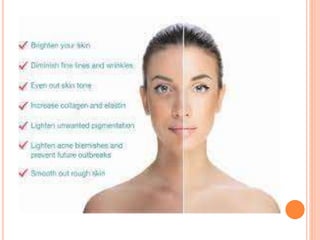
 Improves the complextion.
 Improves and smoothens the texture and even out
the skin tone.
 Correction of pigmentary disorders like tan, freckles
and post inflammatory hyperpigmentation.
 Helps control mild Rosacea.
 Treatment of active acne (pimples) helps to control
excessive sebum production especially those with
blackheads and whiteheads.
 Softens mild/superficial acne scars.
 Mimimize fine lines resulting from sun damage .
CONTRA-INDICATION
 Open cuts ( can proceed with the peel after the
infection is controlled)
 Any infection (viral/bacterial/ fungal)
 Photosensitising conditions or medications.
 Pregnancy and lactation.
PROCEDURE TO BE FOLLOWED
BEFORE PEEL
 Consultation
 Expectation alignment
 Informed consent
 Pre and post instructions
 Explanation of procdure
 Patch Test
 Priming and actual peel service (post 10 days or 1
week of priming)
PRIMING
 Must be followed for at least 10 days or 1 weeek
prior to the first peel.
 Acclimatizes the skin to the peel.
 Helps better, deeper and even penetration of the
peel.
AGENTS USED FOR PRIMING
 AHA 3%, Glyco 6-10, Glyco 12 (under doctor’s
supervision)
 Kojic acid 2% with Arbutin 1.5% (pigmentation, dull
skin) or kojic acid 2% with vitamin C (rejuvenation)
 Hydroquinone 2% with tretinion 0.025% or
Hydroquinone 2% alone.
 Priming cream should be stopped 3 days before
peel.
 Broad spectrum sunscreen (SPF 30 and above)
must be used daily as advised.
WHAT TO EXPECT AFTER A CHEMICAL PEEL
 Erythema or mild redness may result after the peel
and which may persist for 24-48 hours.
 Ski might be dry after the peel.
 The peelong of the skin may start within 3-7 days,
the peeling may or may not be visible.
 Over the next 1 to 14 days, rejuvenation and new
cell regenration happens.
COMPLICATIONS
 Frosting ( may result on post inflammatory
pigmentation if not treated promptly)
 Post inflammatory hyper pigmenatation.
FACTORS DETERMINING THE DEPTH OF THE
PEEL
 PH of the peel.
 Concentration of the peel
 The amount of solution used.
 The time taken to apply
 Time of contactt on the skin
 The number of layers
 Other associated factors like dryness.
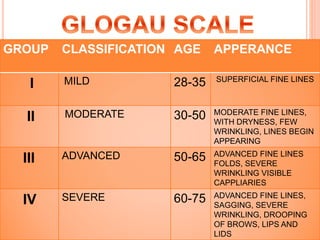
GROUP CLASSIFICATION AGE APPERANCE
I MILD 28-35 SUPERFICIAL FINE LINES
II MODERATE 30-50 MODERATE FINE LINES,
WITH DRYNESS, FEW
WRINKLING, LINES BEGIN
APPEARING
III ADVANCED 50-65 ADVANCED FINE LINES
FOLDS, SEVERE
WRINKLING VISIBLE
CAPPLIARIES
IV SEVERE 60-75 ADVANCED FINE LINES,
SAGGING, SEVERE
WRINKLING, DROOPING
OF BROWS, LIPS AND
LIDS
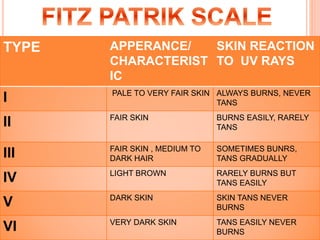
TYPE APPERANCE/
CHARACTERIST
IC
SKIN REACTION
TO UV RAYS
I PALE TO VERY FAIR SKIN ALWAYS BURNS, NEVER
TANS
II FAIR SKIN BURNS EASILY, RARELY
TANS
III FAIR SKIN , MEDIUM TO
DARK HAIR
SOMETIMES BUNRS,
TANS GRADUALLY
IV LIGHT BROWN RARELY BURNS BUT
TANS EASILY
V DARK SKIN SKIN TANS NEVER
BURNS
VI VERY DARK SKIN TANS EASILY NEVER
BURNS
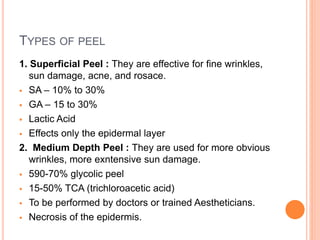
TYPES OF PEEL
1. Superficial Peel : They are effective for fine wrinkles,
sun damage, acne, and rosace.
 SA – 10% to 30%
 GA – 15 to 30%
 Lactic Acid
 Effects only the epidermal layer
2. Medium Depth Peel : They are used for more obvious
wrinkles, more exntensive sun damage.
 590-70% glycolic peel
 15-50% TCA (trichloroacetic acid)
 To be performed by doctors or trained Aestheticians.
 Necrosis of the epidermis.
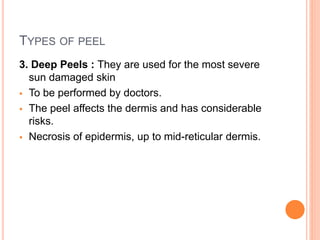
TYPES OF PEEL
3. Deep Peels : They are used for the most severe
sun damaged skin
 To be performed by doctors.
 The peel affects the dermis and has considerable
risks.
 Necrosis of epidermis, up to mid-reticular dermis.
LACTIC PEEL
 It is a gentle but effective AHA that increases
moisture levels by stimulating the production of
glycosaminoglycans.
 By accelerating the cell renewal process,
stimulating collagen synthesis, and improving
elastin fibres in the dermis.
 It gives smooth, clear, and rejuvenated skin. It is
best suited for sensitive skin.
 It acts by removing the dead cells from the outer
layers of skin.
 It also helps your skin retain water as a natural
moisturizer agent.
INDICATIONS FOR LACTIC PEEL
 Sensitivee skin
 Dry skin
 Instant brightness
 Moisterizing effect
 It has a clearing effect on the color of the skin to
promote a more homogenous dispersion of
melanin.
GLYCOLIC PEEL
 Glycolic acid is one of the AHA, a group of naturally
occuring substances often referred to as “fruit
acids” because they are found naturally in various
fruits and other foods.
 It is derived from sugarcane.
 It is multi purpose peel.
 Available as 20, 30, 50, & 70 concentration.
INDICATIONS FOR GLYCOLIC PEEL
 Mild acne and mild acne scars.
 Improve complextion and evens out the skin tone.
 Tan
 Freckles
 Melasma
 Post inflammatory and evens out skin tone.
 Fine lines wrinkles
 Photo- ageing (sun damaged skin).
 Loosen the bond between the cell.
 Stimulates the basal keratinocytes.
 Decrease the Melanin production.
SALICYLIC PEEL
 It is a lipid soluble BHA that penetrates pores to
dissolve sebum and cellular debris.
 It is also called self nutrilizing peel.
 By accelerating the cell renewal process,
stimulating collagen synthesis, and improving
elastin fibres in the dermis.
 It is derived from bark of the willow bark.
 Excellent pore cleanser with anti acne properties.
 Anti – inflammatory therefore useful for rosacea.
 It is oil absorbent and hence appropriate for oily
skin.
INDICATIONS OF SALICYLIC PEEL
 Rosacea
 Acne
COMBINATION PEEL (PARTY PEEL)
 Can be AHA+AHA or AHA+BHA.
 Salicylic with Mandelic – Superficial Peel
 Modified Jessener’s – Medium Peel
 Cosmelan – Deep Peel
MODIFIED JESSENER’S PEEL
 It is medium depth peel which consists of multiple
peeling agents. These agents penetrate deeper into
the skin and result in greater exfoliation of the outer
skin layers.
 This peel is designed for more extensive damage
than AHA’s can improve. It is made from 14%
salicylic acid (BHA) , 14% Lactic acid (AHA) , 14%
resorcinol.
 It can cause the top layers of skin to flake off.
These top layers of the skin are most sun-
damaged, wrinkled, unattractive layers of the skin.
ENZYME PEEL
 It is a beauty product that is used to deeply cleanse and
resurface the skin on the face by treating the upper
layers of the skin tissue.
 This product is called a peel because it helps to peel
dead skin cells off the skin.
 By removing the dead cells from the skin, these peels
help to promote renewal within healthy skin cells.
 They can also help to diminish the visiblitityof scars, age
spots, and wrinkles.
 This peel is often made with fruit enzymes that both
nourish the skin and help to slough off the dead skin
cells. The most popular enzyme are found in papayas.
The skin benefiting properties are also found in
pineapple, pumpkin, and aloe.
 Sometimes these kinds of peel are called restorative
eznyme peels.
BODY PEEL
 It is possible to do a chemical peel on your body,
but it should be done in series.
 Glycolic and salicylic peel 60%.
Chemical peel
Chemical peel

Chemical peel

  • 1.
    CHEMICAL PEEL BY –NIHARIKA VERMA
  • 2.
    CHEMICAL PEEL  Itis the application of a chemical substance to the skin, which accelerates the process of exfoliation.  It leads to exfoliation and removal of superficial lesions (hyper pigmentation, uneven skin, and acne scars, sun damaged skin etc) followed by regeneration of new epidermal and dermal tissue.
  • 3.
    MEDICINES TO BESTOPPED  BENZOYL PEROXIDE –  SALICYLIC ACID- - Tubes for Acne  RESORCINOL –  ACCUTANE – - Medicine for Nodules and Cyts. Can be advised by Doctors.  ISOTRETINOIN -
  • 4.
    MECHANISM OF ACTION The penetration of the chemical substances loosens the bonds between the cells and helps to remove the superficial dead cells along with the blemishes. (Desmosomes)  This creates a controlled injury over the skin surface which leads to inflammation.  An inflammation is rise in temperature , Vaso dilation which shows erythema on the skin, swelling and sensation ( here as slight tingling or burning sensation).
  • 5.
    INDICATIONS  Improves thecomplextion.  Improves and smoothens the texture and even out the skin tone.  Correction of pigmentary disorders like tan, freckles and post inflammatory hyperpigmentation.  Helps control mild Rosacea.  Treatment of active acne (pimples) helps to control excessive sebum production especially those with blackheads and whiteheads.  Softens mild/superficial acne scars.  Mimimize fine lines resulting from sun damage .
  • 6.
    CONTRA-INDICATION  Open cuts( can proceed with the peel after the infection is controlled)  Any infection (viral/bacterial/ fungal)  Photosensitising conditions or medications.  Pregnancy and lactation.
  • 7.
    PROCEDURE TO BEFOLLOWED BEFORE PEEL  Consultation  Expectation alignment  Informed consent  Pre and post instructions  Explanation of procdure  Patch Test  Priming and actual peel service (post 10 days or 1 week of priming)
  • 8.
    PRIMING  Must befollowed for at least 10 days or 1 weeek prior to the first peel.  Acclimatizes the skin to the peel.  Helps better, deeper and even penetration of the peel.
  • 9.
    AGENTS USED FORPRIMING  AHA 3%, Glyco 6-10, Glyco 12 (under doctor’s supervision)  Kojic acid 2% with Arbutin 1.5% (pigmentation, dull skin) or kojic acid 2% with vitamin C (rejuvenation)  Hydroquinone 2% with tretinion 0.025% or Hydroquinone 2% alone.  Priming cream should be stopped 3 days before peel.  Broad spectrum sunscreen (SPF 30 and above) must be used daily as advised.
  • 10.
    WHAT TO EXPECTAFTER A CHEMICAL PEEL  Erythema or mild redness may result after the peel and which may persist for 24-48 hours.  Ski might be dry after the peel.  The peelong of the skin may start within 3-7 days, the peeling may or may not be visible.  Over the next 1 to 14 days, rejuvenation and new cell regenration happens.
  • 11.
    COMPLICATIONS  Frosting (may result on post inflammatory pigmentation if not treated promptly)  Post inflammatory hyper pigmenatation.
  • 12.
    FACTORS DETERMINING THEDEPTH OF THE PEEL  PH of the peel.  Concentration of the peel  The amount of solution used.  The time taken to apply  Time of contactt on the skin  The number of layers  Other associated factors like dryness.
  • 13.
    GROUP CLASSIFICATION AGEAPPERANCE I MILD 28-35 SUPERFICIAL FINE LINES II MODERATE 30-50 MODERATE FINE LINES, WITH DRYNESS, FEW WRINKLING, LINES BEGIN APPEARING III ADVANCED 50-65 ADVANCED FINE LINES FOLDS, SEVERE WRINKLING VISIBLE CAPPLIARIES IV SEVERE 60-75 ADVANCED FINE LINES, SAGGING, SEVERE WRINKLING, DROOPING OF BROWS, LIPS AND LIDS
  • 14.
    TYPE APPERANCE/ CHARACTERIST IC SKIN REACTION TOUV RAYS I PALE TO VERY FAIR SKIN ALWAYS BURNS, NEVER TANS II FAIR SKIN BURNS EASILY, RARELY TANS III FAIR SKIN , MEDIUM TO DARK HAIR SOMETIMES BUNRS, TANS GRADUALLY IV LIGHT BROWN RARELY BURNS BUT TANS EASILY V DARK SKIN SKIN TANS NEVER BURNS VI VERY DARK SKIN TANS EASILY NEVER BURNS
  • 15.
    TYPES OF PEEL 1.Superficial Peel : They are effective for fine wrinkles, sun damage, acne, and rosace.  SA – 10% to 30%  GA – 15 to 30%  Lactic Acid  Effects only the epidermal layer 2. Medium Depth Peel : They are used for more obvious wrinkles, more exntensive sun damage.  590-70% glycolic peel  15-50% TCA (trichloroacetic acid)  To be performed by doctors or trained Aestheticians.  Necrosis of the epidermis.
  • 16.
    TYPES OF PEEL 3.Deep Peels : They are used for the most severe sun damaged skin  To be performed by doctors.  The peel affects the dermis and has considerable risks.  Necrosis of epidermis, up to mid-reticular dermis.
  • 17.
    LACTIC PEEL  Itis a gentle but effective AHA that increases moisture levels by stimulating the production of glycosaminoglycans.  By accelerating the cell renewal process, stimulating collagen synthesis, and improving elastin fibres in the dermis.  It gives smooth, clear, and rejuvenated skin. It is best suited for sensitive skin.  It acts by removing the dead cells from the outer layers of skin.  It also helps your skin retain water as a natural moisturizer agent.
  • 18.
    INDICATIONS FOR LACTICPEEL  Sensitivee skin  Dry skin  Instant brightness  Moisterizing effect  It has a clearing effect on the color of the skin to promote a more homogenous dispersion of melanin.
  • 19.
    GLYCOLIC PEEL  Glycolicacid is one of the AHA, a group of naturally occuring substances often referred to as “fruit acids” because they are found naturally in various fruits and other foods.  It is derived from sugarcane.  It is multi purpose peel.  Available as 20, 30, 50, & 70 concentration.
  • 20.
    INDICATIONS FOR GLYCOLICPEEL  Mild acne and mild acne scars.  Improve complextion and evens out the skin tone.  Tan  Freckles  Melasma  Post inflammatory and evens out skin tone.  Fine lines wrinkles  Photo- ageing (sun damaged skin).  Loosen the bond between the cell.  Stimulates the basal keratinocytes.  Decrease the Melanin production.
  • 21.
    SALICYLIC PEEL  Itis a lipid soluble BHA that penetrates pores to dissolve sebum and cellular debris.  It is also called self nutrilizing peel.  By accelerating the cell renewal process, stimulating collagen synthesis, and improving elastin fibres in the dermis.  It is derived from bark of the willow bark.  Excellent pore cleanser with anti acne properties.  Anti – inflammatory therefore useful for rosacea.  It is oil absorbent and hence appropriate for oily skin.
  • 22.
    INDICATIONS OF SALICYLICPEEL  Rosacea  Acne
  • 23.
    COMBINATION PEEL (PARTYPEEL)  Can be AHA+AHA or AHA+BHA.  Salicylic with Mandelic – Superficial Peel  Modified Jessener’s – Medium Peel  Cosmelan – Deep Peel
  • 24.
    MODIFIED JESSENER’S PEEL It is medium depth peel which consists of multiple peeling agents. These agents penetrate deeper into the skin and result in greater exfoliation of the outer skin layers.  This peel is designed for more extensive damage than AHA’s can improve. It is made from 14% salicylic acid (BHA) , 14% Lactic acid (AHA) , 14% resorcinol.  It can cause the top layers of skin to flake off. These top layers of the skin are most sun- damaged, wrinkled, unattractive layers of the skin.
  • 25.
    ENZYME PEEL  Itis a beauty product that is used to deeply cleanse and resurface the skin on the face by treating the upper layers of the skin tissue.  This product is called a peel because it helps to peel dead skin cells off the skin.  By removing the dead cells from the skin, these peels help to promote renewal within healthy skin cells.  They can also help to diminish the visiblitityof scars, age spots, and wrinkles.  This peel is often made with fruit enzymes that both nourish the skin and help to slough off the dead skin cells. The most popular enzyme are found in papayas. The skin benefiting properties are also found in pineapple, pumpkin, and aloe.  Sometimes these kinds of peel are called restorative eznyme peels.
  • 26.
    BODY PEEL  Itis possible to do a chemical peel on your body, but it should be done in series.  Glycolic and salicylic peel 60%.