“I've come to realize that life is not a
musical comedy, it's a Greek tragedy.”
                             -Billy Joel
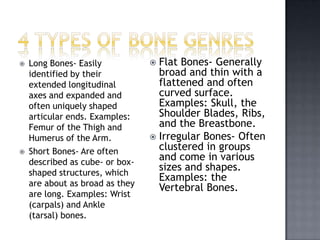
   Long Bones- Easily            Flat Bones- Generally
    identified by their            broad and thin with a
    extended longitudinal          flattened and often
    axes and expanded and          curved surface.
    often uniquely shaped          Examples: Skull, the
    articular ends. Examples:      Shoulder Blades, Ribs,
    Femur of the Thigh and         and the Breastbone.
    Humerus of the Arm.           Irregular Bones- Often
   Short Bones- Are often         clustered in groups
    described as cube- or box-
                                   and come in various
    shaped structures, which
                                   sizes and shapes.
                                   Examples: the
    are about as broad as they
                                   Vertebral Bones.
    are long. Examples: Wrist
    (carpals) and Ankle
    (tarsal) bones.
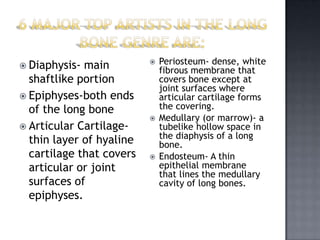
 Diaphysis- main            Periosteum- dense, white
                              fibrous membrane that
  shaftlike portion           covers bone except at
                              joint surfaces where
 Epiphyses-both ends         articular cartilage forms
  of the long bone            the covering.
                             Medullary (or marrow)- a
 Articular Cartilage-        tubelike hollow space in
                              the diaphysis of a long
  thin layer of hyaline       bone.
  cartilage that covers      Endosteum- A thin
  articular or joint          epithelial membrane
                              that lines the medullary
  surfaces of                 cavity of long bones.
  epiphyses.
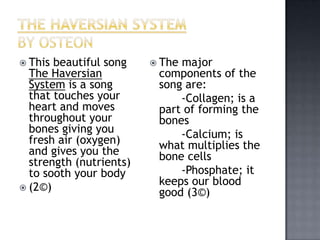
 This beautiful song     Themajor
  The Haversian           components of the
  System is a song        song are:
  that touches your           -Collagen; is a
  heart and moves         part of forming the
  throughout your         bones
  bones giving you            -Calcium; is
  fresh air (oxygen)      what multiplies the
  and gives you the       bone cells
  strength (nutrients)
  to sooth your body          -Phosphate; it
 (2©)
                          keeps our blood
                          good (3©)
1.   mechanical support of soft tissues
2.   levers for muscle action
3.   protection of the central nervous system
4.   release of calcium and other ions for the maintenance of a constant ionic
     environment in the extracellular fluid
5.   housing and support of hemopoiesis
     Compare and contrast the development of intramembranous and
     endochondral bone.
     · Endochondral ossification is the gradual replacement of cartilage by bone
     during development. This process is responsible for formation of most of the
     skeleton of vertebrate animals. In this process, actively dividing bone-forming
     cells (osteoblasts) arise in regions of cartilage called ossification centers. The
     osteoblasts then develop into osteocytes, which are mature bone cells
     embedded in the calcified (hardened) part of the bone known as the matrix.
     · Intramembranous ossification is the transformation of the mesenchyme, cells
     of an embryo into bone. During early development of vertebrate animals, the
     embryo consists of three primary cell layers: ectoderm on the outside,
     mesoderm in the middle, and endoderm on the inside. Mesenchyme cells
     constitute part of the embryo's mesoderm and develop into connective tissue
     such as bone and blood. The bones of the skull derive directly from
     mesenchyme cells by intramembranous ossification
 Fracturehealing is considered the prototype
 of bone repair. The complex bone
 tissuerepair process that follows a fracture is
 apparently initiated by bone death or by
 damage to persiosteal and haversian system
 blood vessel.
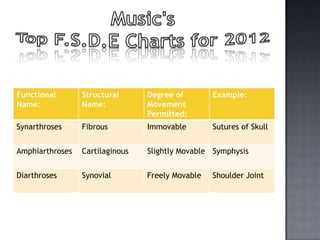
Classifications of Joints- Joints can be classified as
  three major categories using structural or a
  functional scheme. If a “structural classification” is
  employed, joints are named according to the type of
  connective tissue that joins the bones together. For
  example: The fibrous or cartilaginous joints. OR the
  synovial joints. If a “functional classification” scheme
  is used, joints are divided into three classes
  according to the degree of movement they permit.
For Example: Synarthroses (immovable, Like when you
  do the robot and have to keep your joints stiff as if
  they are immovable) , or amphiarthroses (slightly
  movable, Like when you do the wave through your
  body and limbs) and Diarthroses (freely, Like when
  you do the Bernie Lean)
Functional       Structural      Degree of        Example:
Name:            Name:           Movement
                                 Permitted:
Synarthroses     Fibrous         Immovable        Sutures of Skull


Amphiarthroses   Cartilaginous   Slightly Movable Symphysis


Diarthroses      Synovial        Freely Movable   Shoulder Joint
Synovial Joints- Synovial Joints are freely movable joints. they are also
   most anatomically most complex Joints. A Majority of the joints are
   between the appendicular skeleton are synovial joints. There are 4 Major
   Joints in the synovial Joint. ( Humeroscapular, Hip, Kee, and Vertebral).
   The types of movement possible at synovial joints depend on the shapes
   of articulating surfaces of the bones and the position of the joints’
   ligaments and nearby muscles and tendons. All synovial Joints, however
   permit one or more of the following types of movements.
   The range of motion is often one of the first
    assessment techniques employed by health care
    provider to determine the degree of damage in an
    injured joint.
    Angular Movements change the size of the angle
    between articulating bones. flexion, extension,
    abduction, and adduction are some of the different
    types of angular movements.
    Circular Movements result in the arclike rotation of a
    structure around axis
    Gliding Movements are the simplest of all
    movements. The articular surface of one bone moves
    over the articular surface of another without any
    angular or circular movement.
“Treatment for certain kinds of cancer have a side affect that
   causes bone marrow to be broken and if this happens, blood cells
   won’t be able to be made.”      -Caller 1
“When Osteoporosis occurs, it stops calcium from doing it’s job to
  help bone growth”
  -Caller 1
“The Epiphyseal Plate fracture is most common in young adults and
  children cause they are located at the ends of a long bone and
  harden while the young person grows through their life, so they
  fracture cause they don’t harden right away”
  -Caller (4©)
“The skeletal framework affect adults because bones grow and if
  adults don’t take in the nutrients that they need, then they can
  have weak bones and could cause fractures more easily.”
  -Caller 3

Skeletal goes musical artifact 2

  • 1.
    “I've come torealize that life is not a musical comedy, it's a Greek tragedy.” -Billy Joel
  • 2.
     Long Bones- Easily  Flat Bones- Generally identified by their broad and thin with a extended longitudinal flattened and often axes and expanded and curved surface. often uniquely shaped Examples: Skull, the articular ends. Examples: Shoulder Blades, Ribs, Femur of the Thigh and and the Breastbone. Humerus of the Arm.  Irregular Bones- Often  Short Bones- Are often clustered in groups described as cube- or box- and come in various shaped structures, which sizes and shapes. Examples: the are about as broad as they Vertebral Bones. are long. Examples: Wrist (carpals) and Ankle (tarsal) bones.
  • 3.
     Diaphysis- main  Periosteum- dense, white fibrous membrane that shaftlike portion covers bone except at joint surfaces where  Epiphyses-both ends articular cartilage forms of the long bone the covering.  Medullary (or marrow)- a  Articular Cartilage- tubelike hollow space in the diaphysis of a long thin layer of hyaline bone. cartilage that covers  Endosteum- A thin articular or joint epithelial membrane that lines the medullary surfaces of cavity of long bones. epiphyses.
  • 4.
     This beautifulsong  Themajor The Haversian components of the System is a song song are: that touches your -Collagen; is a heart and moves part of forming the throughout your bones bones giving you -Calcium; is fresh air (oxygen) what multiplies the and gives you the bone cells strength (nutrients) to sooth your body -Phosphate; it  (2©) keeps our blood good (3©)
  • 5.
    1. mechanical support of soft tissues 2. levers for muscle action 3. protection of the central nervous system 4. release of calcium and other ions for the maintenance of a constant ionic environment in the extracellular fluid 5. housing and support of hemopoiesis Compare and contrast the development of intramembranous and endochondral bone. · Endochondral ossification is the gradual replacement of cartilage by bone during development. This process is responsible for formation of most of the skeleton of vertebrate animals. In this process, actively dividing bone-forming cells (osteoblasts) arise in regions of cartilage called ossification centers. The osteoblasts then develop into osteocytes, which are mature bone cells embedded in the calcified (hardened) part of the bone known as the matrix. · Intramembranous ossification is the transformation of the mesenchyme, cells of an embryo into bone. During early development of vertebrate animals, the embryo consists of three primary cell layers: ectoderm on the outside, mesoderm in the middle, and endoderm on the inside. Mesenchyme cells constitute part of the embryo's mesoderm and develop into connective tissue such as bone and blood. The bones of the skull derive directly from mesenchyme cells by intramembranous ossification
  • 6.
     Fracturehealing isconsidered the prototype of bone repair. The complex bone tissuerepair process that follows a fracture is apparently initiated by bone death or by damage to persiosteal and haversian system blood vessel.
  • 8.
    Classifications of Joints-Joints can be classified as three major categories using structural or a functional scheme. If a “structural classification” is employed, joints are named according to the type of connective tissue that joins the bones together. For example: The fibrous or cartilaginous joints. OR the synovial joints. If a “functional classification” scheme is used, joints are divided into three classes according to the degree of movement they permit. For Example: Synarthroses (immovable, Like when you do the robot and have to keep your joints stiff as if they are immovable) , or amphiarthroses (slightly movable, Like when you do the wave through your body and limbs) and Diarthroses (freely, Like when you do the Bernie Lean)
  • 9.
    Functional Structural Degree of Example: Name: Name: Movement Permitted: Synarthroses Fibrous Immovable Sutures of Skull Amphiarthroses Cartilaginous Slightly Movable Symphysis Diarthroses Synovial Freely Movable Shoulder Joint
  • 10.
    Synovial Joints- SynovialJoints are freely movable joints. they are also most anatomically most complex Joints. A Majority of the joints are between the appendicular skeleton are synovial joints. There are 4 Major Joints in the synovial Joint. ( Humeroscapular, Hip, Kee, and Vertebral). The types of movement possible at synovial joints depend on the shapes of articulating surfaces of the bones and the position of the joints’ ligaments and nearby muscles and tendons. All synovial Joints, however permit one or more of the following types of movements.
  • 11.
     The range of motion is often one of the first assessment techniques employed by health care provider to determine the degree of damage in an injured joint. Angular Movements change the size of the angle between articulating bones. flexion, extension, abduction, and adduction are some of the different types of angular movements. Circular Movements result in the arclike rotation of a structure around axis Gliding Movements are the simplest of all movements. The articular surface of one bone moves over the articular surface of another without any angular or circular movement.
  • 12.
    “Treatment for certainkinds of cancer have a side affect that causes bone marrow to be broken and if this happens, blood cells won’t be able to be made.” -Caller 1 “When Osteoporosis occurs, it stops calcium from doing it’s job to help bone growth” -Caller 1 “The Epiphyseal Plate fracture is most common in young adults and children cause they are located at the ends of a long bone and harden while the young person grows through their life, so they fracture cause they don’t harden right away” -Caller (4©) “The skeletal framework affect adults because bones grow and if adults don’t take in the nutrients that they need, then they can have weak bones and could cause fractures more easily.” -Caller 3