6 Traits of Writing


The 6 Traits of Writing highlights six key characteristics of ‘strong” writing...

                                  • Idea
                               • Organization
                                 • Voice
                               • Word Choice
                             • Sentence Fluency
                               • Conventions
The strategies used to create this PowerPoint are based
upon Posner’s method of organizing using a “content
structure” in which instruction is organized by skills or
concepts to be learned. You will find a list of skills, to be
taught and learned, related to each of the Six Traits. I further
used Smith & Ragan’s “events of instruction” to present each
Trait using an introduction, a body (variety of activities), a
conclusion, and an assessment. (Brown, Abbie & Green,
Timothy, The Essentials of Instructional Design: connecting
Fundamental Principles with Process and Practice, pg. 103)


               PROJECT BY: LESLIE BUSSEY
Strong writers need an idea!
Let’s list what we know a lot
                 about…





    Choose one idea to write about.
• Did I write using an idea I know a lot
  about?


   • Do all of my sentences tell about my
     idea?

         • Did I add lots of details about
           my idea?
What is the main idea of the story?
• Click on the picture and follow the link. Be
  a detective and figure out each main idea!
Writing about an idea that I know a lot about
is important because…

•   it makes the story more interesting and meaningful.


•   It helps the reader remember what the story was about.
Use this checklist to check your
     writing for a strong idea…

 I wrote using an idea I know a lot about.

    All of my sentences tell about my idea.

          I added lots of details about my idea.
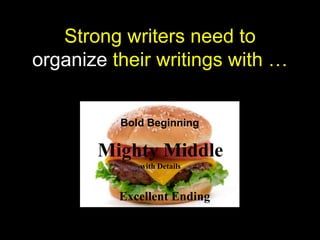
Strong writers need to
organize their writings with …


          Bold Beginning

       Mighty Middle
             with Details


          Excellent Ending
You can write a bold beginning by…

 using words that create a picture in the reader’s mind.

    asking a question.

           telling your opinion.


Organize your writing by using a bold beginning.
You can write a mighty middle by…

 telling details that help the reader feel like they were
  there!

     using connecting words like first, then, next, last,
      after that, suddenly, last...

           using your senses to tell lots of details.


Organize your writing by using a mighty middle.
You can write an exciting ending by…


 reminding us why the story is important.

    telling a wise thought.

          with a “Maybe you… ” challenge


Organize your writing by using an exciting ending.
• Did I organize by writing a bold
  beginning?


   • Did I organize by writing a mighty
     middle?

         • Did I organize by writing an
           exciting ending?
Let’s think about how
         to organize a story?

• Let’s explore! Click on each picture and
  follow the link to find out more about
  beginnings, middles and ends.
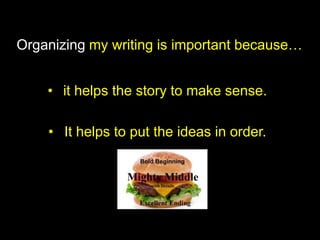
Organizing my writing is important because…


    • it helps the story to make sense.

    • It helps to put the ideas in order.
Use this checklist to check your
 writing for a strong organization…

I wrote a bold beginning.

    I wrote a mighty middle.

         I wrote an exciting ending.
Strong writers use voice
   in their writings …
You can show voice by…

 Writing like you sound.

    Telling your feelings.

           Using words that tell the mood of the story.


              Add voice to your writing.
• Does my writing sound like me?


   • Did I show my mood in my story?
Let’s think about how
   to show voice in our writings…

• Let’s read Alice the Fairy and
  look for voice in this story!


• Let’s explore voice some more.
  Click on the picture…
Using voice in my writing is important
because…

     • it shows I care about the topic.

      • It makes my story interesting and
                  meaningful.
Use this checklist to check your
    writing for strong voice…


My writing sounds like me.


    I showed my mood in my story.
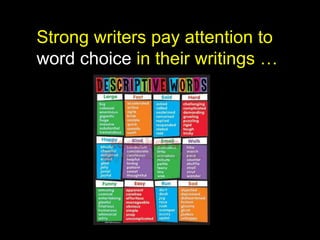
Strong writers pay attention to
word choice in their writings …
You can show word choice by…

 Beginning sentences different ways.

    Using a variety of words instead of the same words
     over and over.

          Using sensory words.


                Add word choice to your writing.
• Did I begin my sentences different
  ways?


   • Did I use interesting words instead of
     ordinary words?
Let’s think about how to show
word choice in our writings…


• Let’s explore word choice some
  more. Click on the picture…
Using word choice in my writing is important
because…

 • it creates a picture in the reader’s mind.

    • It makes my story really interesting!
Use this checklist to check your
 writing for strong word choice…


I began my sentences different ways.


    I used interesting words instead of
     ordinary words.
Strong writers pay attention to
sentence fluency in their writings…
You can show sentence fluency by…

 Making sure your writing can be read aloud easily.

    Seeing if your writing sounds smooth. Does it flow
     like music?

           Starting your sentences different ways.


              Add sentence fluency to your writing.
• Did I begin my sentences different ways?


    • Does my writing sound smooth and flow
      like music?


          • Can my writing be read aloud
            easily?
Let’s think about how to show
sentence fluency in our writings…


• Let’s explore sentence fluency
  some more. Click on the
  picture…
Using sentence fluency in my writing is
important because…

• my sentences sound smooth and
  interesting.

• It makes my story interesting!
Use this checklist to check your writing
   for strong sentence fluency…


 I began my sentences different ways.


    My writing sound smooth and flows like music.


          My writing can be read aloud easily.
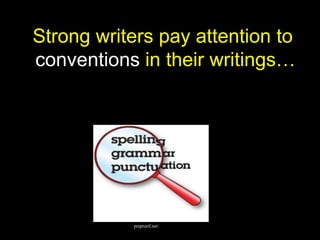
Strong writers pay attention to
conventions in their writings…


           prsproof.net
You can show strong conventions by…

 Spelling the “NO Excuse” words correctly.

    Beginning all sentences with capital letters.

          Using end punctuation for all sentences.

                 Rereading my writing.


            Check the conventions in your writing.
• Did I spell the “NO Excuse” words
  correctly?


   • Did I begin all sentences with capitals
     and end all with the correct
     punctuation?


         • Did I reread my story?
Let’s think about how to show strong
conventions in our writings…


• Let’s explore using conventions
  some more. Click on the
  picture…
Using strong conventions in my writing is
important because…

• It helps the reader read and
  understand my story.

        • It helps my story make sense.
Use this checklist to check your writing
      for strong conventions…


 I began my sentences with capital letters and ended
  with punctuation.


    I spelled the „NO Excuse” words correctly.


           I reread my story.
Happy Writing!
References

Images
school.discoveryeducation.com
http://office.microsoft.com/en-us/images/?CTT=977
graceot.com.au
clipart-for-free.blogspot.com
teachersparadise.com

Web sites
http://www.studyzone.org/testprep/ela4/a/personalvoicel.cfm
http://www.beaconlearningcenter.com/weblessons/gettheidea/default.htm#page3
http://www.studyzone.org/testprep/ela4/g/storybegmidendl.cfm
http://www.oswego.org/ocsd-web/quiz/mquiz.asp?filename=msmith5begmidend2
http://jc-schools.net/write/I-Trouble_files/frame.htm
http://www.edina.k12.mn.us/concord/teacherlinks/sixtraits/sentencefluency.htm
http://www.oswego.org/ocsd-web/quiz/mquiz.asp?filename=msmith5punctuation
http://www.studyzone.org/testprep/ela4/a/personalvoicel.cfm

Six traits edtech project