DR.EDWARD DE BONO’S
SIX THINKING HATS
An aid to decision making and problem
solving.
Illustrated by
Ph.samer al-eid
“THINKING--
THE ULTIMATE HUMAN RESOURCE”
 We can always improve our thinking skills.
 Confused thinking arises from trying to do too
much at once.
3
THE BASICS
 There are six different imaginary hats that
you can put on or take off.
 Think of the “hats” as thinking icons.
 Each hat is a different color and represents
a different type or mode of thinking.
 We all wear the same hat (do the same
type of thinking) at the same time.
 When we change hats - we change our
thinking.
RESULTS OF SIX HAT THINKING
 Deriving power from focused thinking
 Saving time
 Improve Creativity & Innovation
 Removing ego from decisions
 Doing one thing at a time
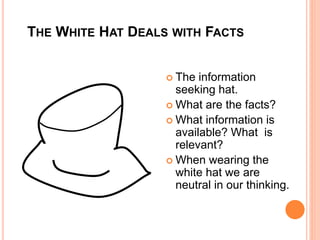
THE WHITE HAT DEALS WITH FACTS
 The information
seeking hat.
 What are the facts?
 What information is
available? What is
relevant?
 When wearing the
white hat we are
neutral in our thinking.
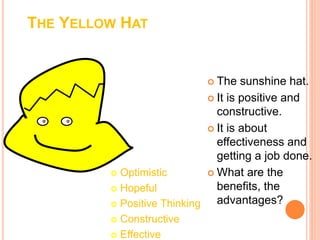
THE YELLOW HAT
 The sunshine hat.
 It is positive and
constructive.
 It is about
effectiveness and
getting a job done.
 What are the
benefits, the
advantages?
 Optimistic
 Hopeful
 Positive Thinking
 Constructive
 Effective
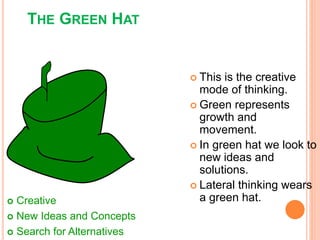
 This is the creative
mode of thinking.
 Green represents
growth and
movement.
 In green hat we look to
new ideas and
solutions.
 Lateral thinking wears
a green hat.
THE GREEN HAT
 Creative
 New Ideas and Concepts
 Search for Alternatives
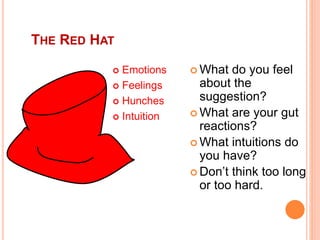
THE RED HAT
 What do you feel
about the
suggestion?
 What are your gut
reactions?
 What intuitions do
you have?
 Don’t think too long
or too hard.
 Emotions
 Feelings
 Hunches
 Intuition
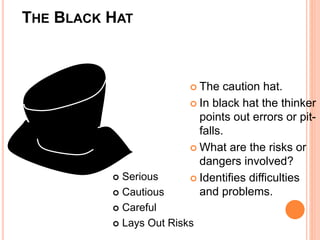
THE BLACK HAT
 The caution hat.
 In black hat the thinker
points out errors or pit-
falls.
 What are the risks or
dangers involved?
 Identifies difficulties
and problems.
 Serious
 Cautious
 Careful
 Lays Out Risks
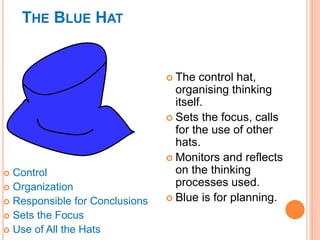
 The control hat,
organising thinking
itself.
 Sets the focus, calls
for the use of other
hats.
 Monitors and reflects
on the thinking
processes used.
 Blue is for planning.
THE BLUE HAT
 Control
 Organization
 Responsible for Conclusions
 Sets the Focus
 Use of All the Hats
RESULTS OF SIX HAT THINKING
Decisions Seem to Make
Themselves!
12
FACILITATOR’S ROLE
 Define the focus of your thinking
 Plan the sequence and timing of the
thinking
 Ask for changes in the thinking if needed
 Handle requests from the group for
changes in the thinking
 Form periodic or final summaries of the
thinking for consideration by the team
x
13
PARTICIPANT’S ROLE
Follow the lead of trained Six
Thinking Hats facilitator
Stick to the hat (type of thinking)
that is in current use
Try to work within the time limits
Contribute honestly & fully under
each of the hats
‫الموضوع‬ ‫على‬ ‫ل‬ّ‫ف‬‫ق‬!
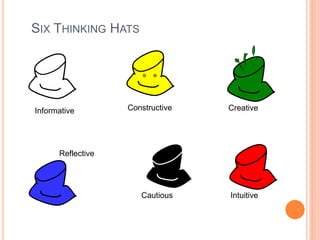
SIX THINKING HATS
Intuitive
Informative
Cautious
Reflective
CreativeConstructive
THANK U FOR LISTENING

Six hats of thinking

  • 1.
    DR.EDWARD DE BONO’S SIXTHINKING HATS An aid to decision making and problem solving. Illustrated by Ph.samer al-eid
  • 2.
    “THINKING-- THE ULTIMATE HUMANRESOURCE”  We can always improve our thinking skills.  Confused thinking arises from trying to do too much at once.
  • 3.
    3 THE BASICS  Thereare six different imaginary hats that you can put on or take off.  Think of the “hats” as thinking icons.  Each hat is a different color and represents a different type or mode of thinking.  We all wear the same hat (do the same type of thinking) at the same time.  When we change hats - we change our thinking.
  • 4.
    RESULTS OF SIXHAT THINKING  Deriving power from focused thinking  Saving time  Improve Creativity & Innovation  Removing ego from decisions  Doing one thing at a time
  • 5.
    THE WHITE HATDEALS WITH FACTS  The information seeking hat.  What are the facts?  What information is available? What is relevant?  When wearing the white hat we are neutral in our thinking.
  • 6.
    THE YELLOW HAT The sunshine hat.  It is positive and constructive.  It is about effectiveness and getting a job done.  What are the benefits, the advantages?  Optimistic  Hopeful  Positive Thinking  Constructive  Effective
  • 7.
     This isthe creative mode of thinking.  Green represents growth and movement.  In green hat we look to new ideas and solutions.  Lateral thinking wears a green hat. THE GREEN HAT  Creative  New Ideas and Concepts  Search for Alternatives
  • 8.
    THE RED HAT What do you feel about the suggestion?  What are your gut reactions?  What intuitions do you have?  Don’t think too long or too hard.  Emotions  Feelings  Hunches  Intuition
  • 9.
    THE BLACK HAT The caution hat.  In black hat the thinker points out errors or pit- falls.  What are the risks or dangers involved?  Identifies difficulties and problems.  Serious  Cautious  Careful  Lays Out Risks
  • 10.
     The controlhat, organising thinking itself.  Sets the focus, calls for the use of other hats.  Monitors and reflects on the thinking processes used.  Blue is for planning. THE BLUE HAT  Control  Organization  Responsible for Conclusions  Sets the Focus  Use of All the Hats
  • 11.
    RESULTS OF SIXHAT THINKING Decisions Seem to Make Themselves!
  • 12.
    12 FACILITATOR’S ROLE  Definethe focus of your thinking  Plan the sequence and timing of the thinking  Ask for changes in the thinking if needed  Handle requests from the group for changes in the thinking  Form periodic or final summaries of the thinking for consideration by the team x
  • 13.
    13 PARTICIPANT’S ROLE Follow thelead of trained Six Thinking Hats facilitator Stick to the hat (type of thinking) that is in current use Try to work within the time limits Contribute honestly & fully under each of the hats
  • 14.
  • 15.
  • 16.
    THANK U FORLISTENING