Tools for Access to 
Multimedia in the 
Classroom & Home 
bit.ly/multimediaa11y 
Yue-Ting Siu, TVI 
SFSU and UC Berkeley 
Twitter: @TVI_ting 
ysiu@berkeley.edu 
Mary Ann Siller, M.Ed 
CTVI – Texas 
dmasiller@sbcglobal.net 
Twitter: @dcmp_tweets 
#AERIntlConf
Principles of Media Accessibility 
● Every student deserves equal access to 
learning opportunities. 
● For students with vision loss: 
o Media in the classroom = hurdle 
o Lack of accessible technology 
• Access is necessary to: 
o Enhance communication 
o Create language opportunities 
o Expand educational options 
o Enrich lives 
#AERIntlConf
Principals of Media Accessiblity 
(cont’d) 
● Description and captioning make educational media 
accessible to blind, low vision, deaf, and hearing impaired 
students. 
● 15% of educational content = captioned 
● 1% of educational content = described 
● Description: 
o Takes into account and targets the unique learning styles of 
children with visual impairments 
o Supports the connection to how lessons align with needs of 
diverse learners. 
● DCMP Tip Sheet: 
http://www.dcmp.org/descriptionkey 
#AERIntlConf
About DCMP 
The Described and Captioned Media Program 
(DCMP): 
● Believes accessible media is an integral tool in the 
teaching and learning process for all stakeholders in the 
educational community. 
● Promotes and provides equal access to communication 
and learning for students who are blind, visually 
impaired, deaf, hard of hearing, or deaf-blind. 
● Provides an online catalog that allows members to 
browse by topic or perform a keyword search. 
#AERIntlConf @DCMP_tweets
About DCMP (cont’d) 
● Lesson guides available for a large number of titles, 
inclusion of caption and description scripts. 
● Provides a collection of free 4,200 described and 
captioned educational media that is online or as 
free-loan media. 
● Information and research about accessible media. 
● Offers a free monthly newsletter with key educational 
resources. 
#AERIntlConf @DCMP_tweets
Case Study: 
The “flipped” classroom 
● Multimedia incorporated into lesson plans 
● Aligned to Common Core materials 
● Independent vs. dependent study 
● Immediacy of access! 
#AERIntlConf @TVI_ting
Tools: What Can They Do? 
Promote 
o Equal Access! 
o Independent Access! 
o Social Inclusion! 
o Digital Inclusion! 
Uses 
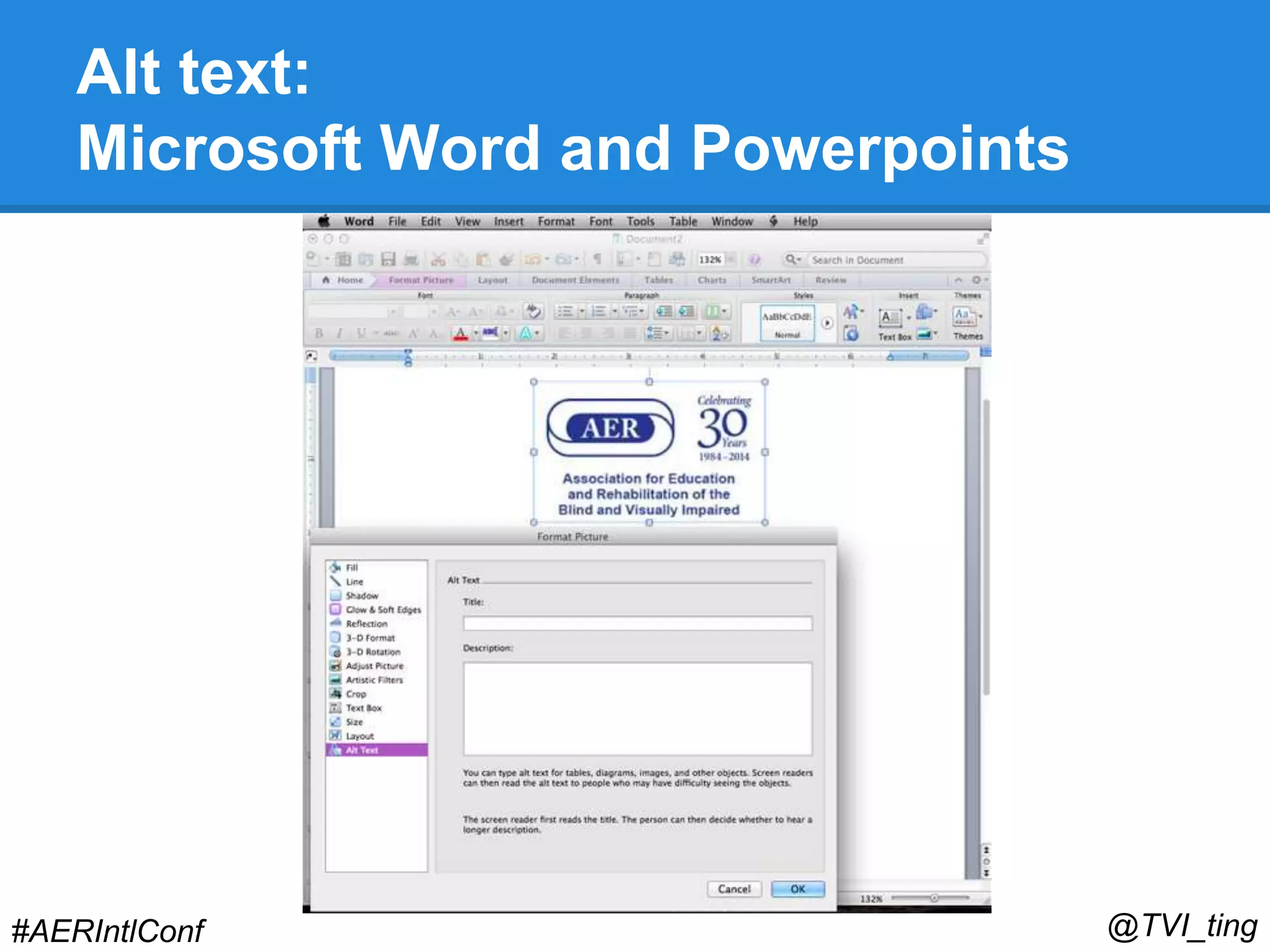
o Alt text versus captions 
o Image description 
o Audio (video) description 
#AERIntlConf @TVI_ting
Alt text: 
Microsoft Word and Powerpoints 
#AERIntlConf @TVI_ting
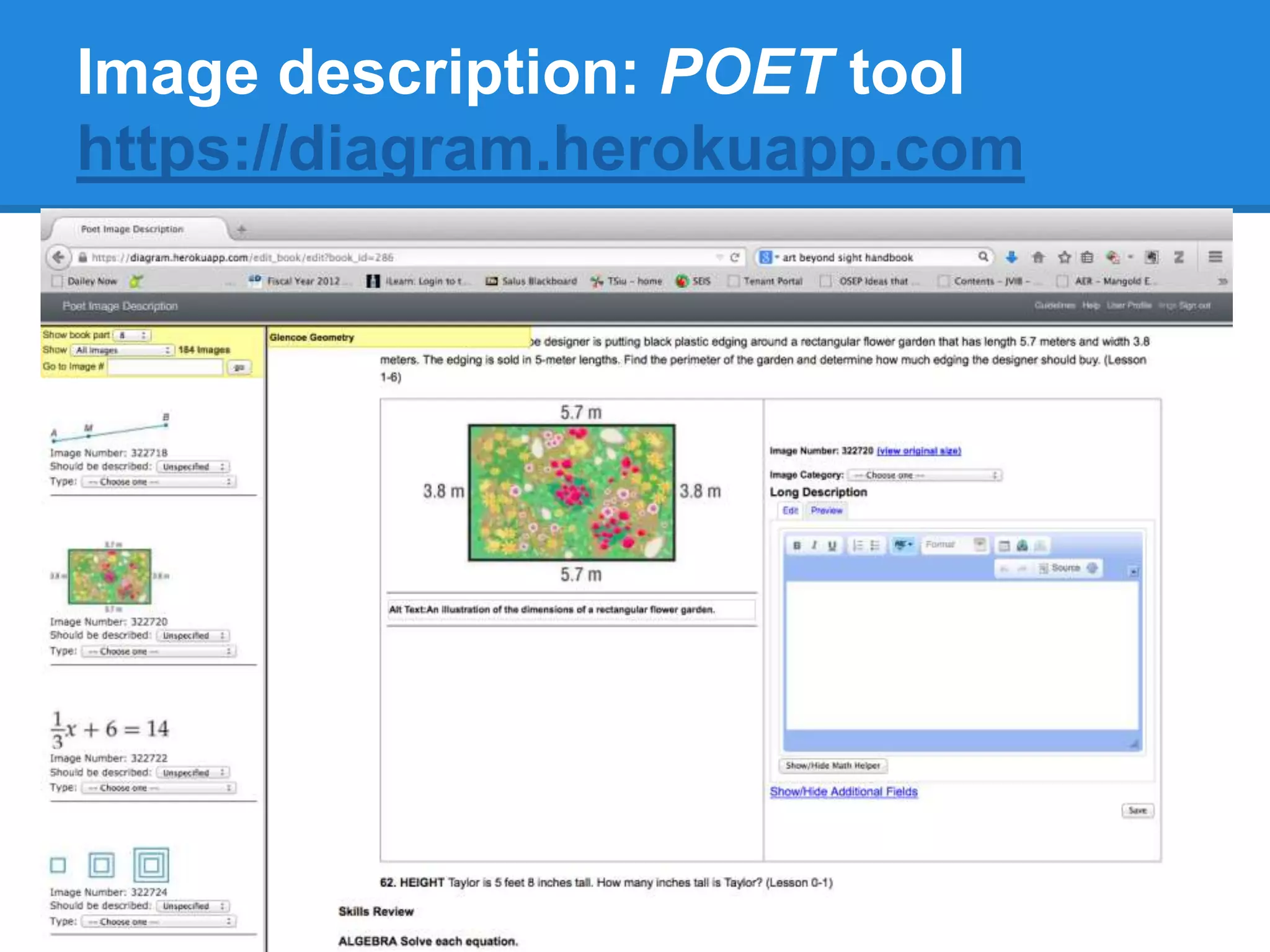
Image description: POET tool 
https://diagram.herokuapp.com
Video description: YouDescribe 
www.youdescribe.org 
#AERIntlConf @TVI_ting
Description Guidelines 
Three Key Steps: Observe, Analyze, and Communicate 
Step 1. Describe what you see and don’t infer 
● Identify elements of the work by segments-- objects, people, 
setting, arrangement 
● Descriptive Elements-- Color, Shape, Line, Texture…. 
● Use Vivid Language 
● Do not try to fill every pause 
Step 2. Analyze/understand the work to be 
described 
● What is happening, what is emphasized, what are possible 
meanings 
● Goal/Purpose: Object/scene to be described 
● Be careful not to infer….note mood, meaning, main idea/message 
#AERIntlConf
Description Guidelines 
(cont’d) 
Step 3. Communicate 
● Clear, Precise Thoughts 
● Orderly Flow (General to Specific) 
● Concise, Prioritize Description 
● Vivid/Descriptive Words 
★ Eliminate extra information/language 
● Consistent vocabulary 
★ Use present tense (walks vs. walking) 
#AERIntlConf
The Meadows Museum at SMU: 
Portrait of Ilya Ehrenburg—1915 
Diego María Rivera 
#AERIntlConf
Resources 
http://bit.ly/aermultimediahandouts 
bit.ly/multimediaa11y 
• DCMP Description Key (Guidelines for K-12) 
http://www.dcmp.org/descriptionkey/ 
• DCMP Description Tip Sheet 
http://www.dcmp.org/ai/227/ 
Guidelines & Tutorials for: 
• STEM image descriptions 
• DIAGRAM Poet tool 
• Video descriptions 
• YouDescribe 
• Handbook for museums & educators for accessible programs 
#AERIntlConf
Contact Us! 
Yue-Ting Siu, TVI 
NLCSD Fellow and Doctoral Candidate 
ysiu@berkeley.edu 
Twitter: @TVI_ting 
www.facebook.com/yuetingsiu 
Mary Ann Siller, M.Ed. CTVI 
Teacher of Students with Visual Impairments, 
Description Leadership Network, and 
DCMP and VDRDC Committee Member 
dmasiller@sbcglobal.net 
#AERIntlConf

Tools for Access to Multimedia in the Classroom & Home

  • 1.
    Tools for Accessto Multimedia in the Classroom & Home bit.ly/multimediaa11y Yue-Ting Siu, TVI SFSU and UC Berkeley Twitter: @TVI_ting ysiu@berkeley.edu Mary Ann Siller, M.Ed CTVI – Texas dmasiller@sbcglobal.net Twitter: @dcmp_tweets #AERIntlConf
  • 2.
    Principles of MediaAccessibility ● Every student deserves equal access to learning opportunities. ● For students with vision loss: o Media in the classroom = hurdle o Lack of accessible technology • Access is necessary to: o Enhance communication o Create language opportunities o Expand educational options o Enrich lives #AERIntlConf
  • 3.
    Principals of MediaAccessiblity (cont’d) ● Description and captioning make educational media accessible to blind, low vision, deaf, and hearing impaired students. ● 15% of educational content = captioned ● 1% of educational content = described ● Description: o Takes into account and targets the unique learning styles of children with visual impairments o Supports the connection to how lessons align with needs of diverse learners. ● DCMP Tip Sheet: http://www.dcmp.org/descriptionkey #AERIntlConf
  • 4.
    About DCMP TheDescribed and Captioned Media Program (DCMP): ● Believes accessible media is an integral tool in the teaching and learning process for all stakeholders in the educational community. ● Promotes and provides equal access to communication and learning for students who are blind, visually impaired, deaf, hard of hearing, or deaf-blind. ● Provides an online catalog that allows members to browse by topic or perform a keyword search. #AERIntlConf @DCMP_tweets
  • 5.
    About DCMP (cont’d) ● Lesson guides available for a large number of titles, inclusion of caption and description scripts. ● Provides a collection of free 4,200 described and captioned educational media that is online or as free-loan media. ● Information and research about accessible media. ● Offers a free monthly newsletter with key educational resources. #AERIntlConf @DCMP_tweets
  • 6.
    Case Study: The“flipped” classroom ● Multimedia incorporated into lesson plans ● Aligned to Common Core materials ● Independent vs. dependent study ● Immediacy of access! #AERIntlConf @TVI_ting
  • 7.
    Tools: What CanThey Do? Promote o Equal Access! o Independent Access! o Social Inclusion! o Digital Inclusion! Uses o Alt text versus captions o Image description o Audio (video) description #AERIntlConf @TVI_ting
  • 8.
    Alt text: MicrosoftWord and Powerpoints #AERIntlConf @TVI_ting
  • 9.
    Image description: POETtool https://diagram.herokuapp.com
  • 10.
    Video description: YouDescribe www.youdescribe.org #AERIntlConf @TVI_ting
  • 11.
    Description Guidelines ThreeKey Steps: Observe, Analyze, and Communicate Step 1. Describe what you see and don’t infer ● Identify elements of the work by segments-- objects, people, setting, arrangement ● Descriptive Elements-- Color, Shape, Line, Texture…. ● Use Vivid Language ● Do not try to fill every pause Step 2. Analyze/understand the work to be described ● What is happening, what is emphasized, what are possible meanings ● Goal/Purpose: Object/scene to be described ● Be careful not to infer….note mood, meaning, main idea/message #AERIntlConf
  • 12.
    Description Guidelines (cont’d) Step 3. Communicate ● Clear, Precise Thoughts ● Orderly Flow (General to Specific) ● Concise, Prioritize Description ● Vivid/Descriptive Words ★ Eliminate extra information/language ● Consistent vocabulary ★ Use present tense (walks vs. walking) #AERIntlConf
  • 13.
    The Meadows Museumat SMU: Portrait of Ilya Ehrenburg—1915 Diego María Rivera #AERIntlConf
  • 14.
    Resources http://bit.ly/aermultimediahandouts bit.ly/multimediaa11y • DCMP Description Key (Guidelines for K-12) http://www.dcmp.org/descriptionkey/ • DCMP Description Tip Sheet http://www.dcmp.org/ai/227/ Guidelines & Tutorials for: • STEM image descriptions • DIAGRAM Poet tool • Video descriptions • YouDescribe • Handbook for museums & educators for accessible programs #AERIntlConf
  • 15.
    Contact Us! Yue-TingSiu, TVI NLCSD Fellow and Doctoral Candidate ysiu@berkeley.edu Twitter: @TVI_ting www.facebook.com/yuetingsiu Mary Ann Siller, M.Ed. CTVI Teacher of Students with Visual Impairments, Description Leadership Network, and DCMP and VDRDC Committee Member dmasiller@sbcglobal.net #AERIntlConf

Editor's Notes

  • #3 Integration of media into the classroom has historically represented yet another hurdle to contend with the maze of access to the general education curriculum. The National Agenda for the Education of Children and Youths with Visual Impairments, Including Those with Multiple Disabilities indicated there is a lack of accessible technology for students to enhance communication and language opportunities, expand their educational options, or enrich their lives. Lesson planning, instruction, and progress monitoring are key pieces of teaching…….and I believe YouDescribe will fit well in any lesson.
  • #4 Description = Takes into account and targets the unique learning styles of children with visual impairments, who often don’t realize the same opportunities for learning through imitation and incidental experience as do their sighted peers.
  • #6 • Selected after research of national curricular priorities and user input. • Formally evaluated by teachers.
  • #13 Consistent…….Example Patio, Terrace, Veranda; Walks, Strolls, Saunter Communication…. Expressive properties, Dynamics, Mood, Statement, Purpose
  • #14 Power of Description--  Introduction: This is an abstract portrait. It represents a person, but is comprised of geometric shapes, various paint textures and mostly flat, muted colors. The subject sits facing us; his face is near the center of the painting. The face is a white, trapezoid shape and appears mask-like, with slanted eyes and a nose comprised of two intersecting curved lines. He has a simple V-shaped mouth, from which a brown pipe extends down to our right. The pipe is heavily textured to create a kind of high relief on the surface of the canvas. Above the face, is a flesh-colored semi-circle representing the forehead. Shoulder-length, black wavy hair frames the face and forehead; it is also created using heavily-textured paint. On his head, he wears a tall, wide-brimmed, gray hat.   The subject’s body is composed of brown, blue and gray rectangles with a yellow cone-shaped patch beneath his chin. Extending down along the right side of his body (our left), is an L-shape that represents the subject’s right arm. He holds a black fountain pen in his right hand, and he is poised to write in a yellow book which lies open on his lap. Like the pipe, the pen is so fully modeled that it resembles an actual object attached to the canvas.   The background is also comprised of rectangular shapes. A roughly textured reddish-brown rectangles rises above the figure’s right shoulder and a golden- colored rectangle rises above him on his left.