July 2017
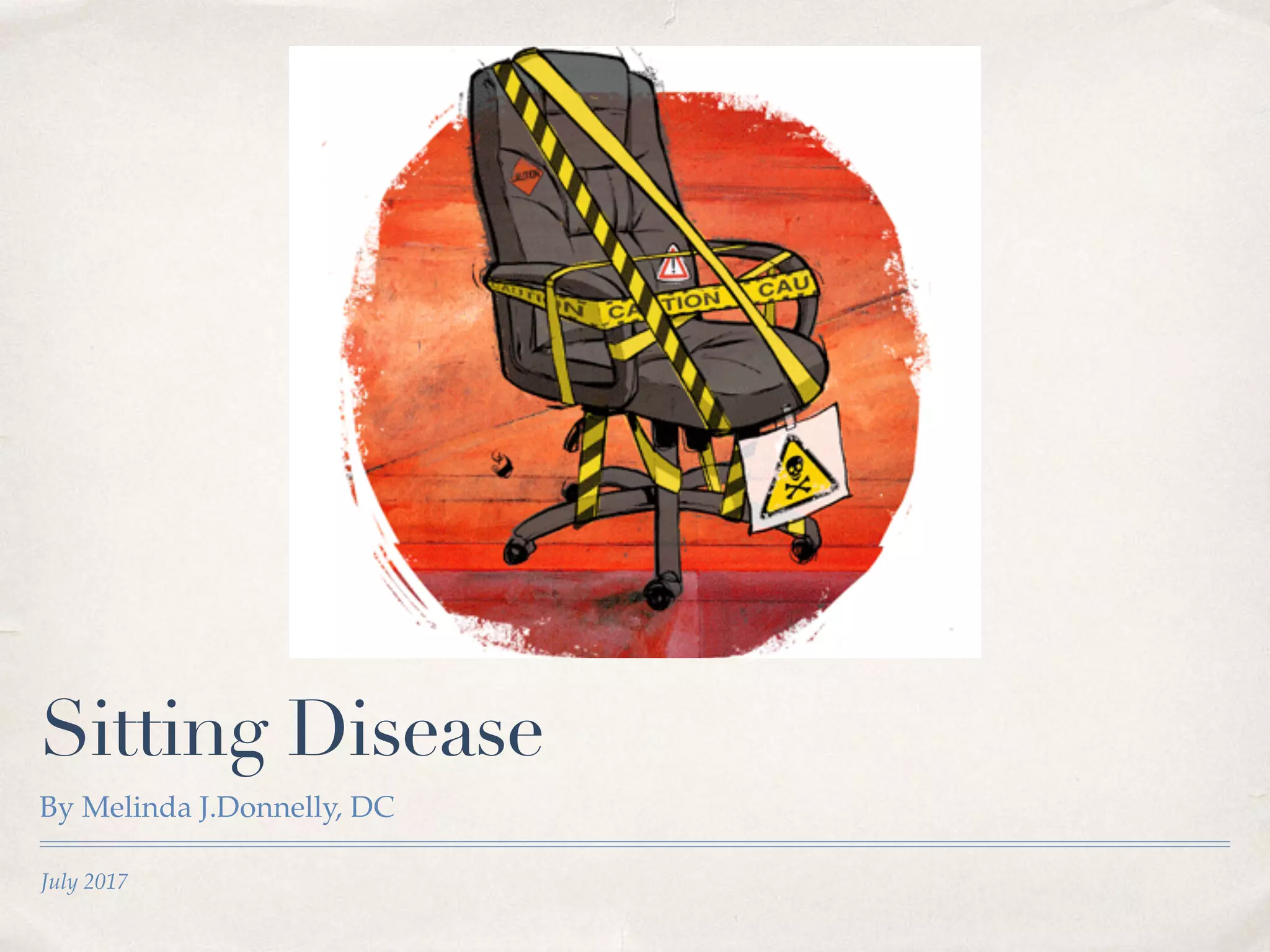
Sitting Disease
By Melinda J. Donnelly, DC
Sitting Disease
✤ What is Sitting Disease
✤ What effects do prolonged sitting have on the body
✤ Ways to prevent
Sitting Disease~What is it?
“Sitting Disease” is a diagnosis that is described as
“Overexertion from prolonged static or awkward postures”1.
Put more simply, Sitting Disease is prolonged sitting that
leads to death.
Prolonged sitting is sitting for longer than 8-12 hours in one
day. Here is a great link to help you calculate how much time
you spend sitting:
Sitting-Time Calculator|JustStand.org
Sitting Disease~Effects on body?
Harvard Health Publication-Prolonged sitting is
associated with2:
✤ Increase risk of heart disease
✤ Increase risk of type 2 Diabetes
Harmful effects on sugar and fat metabolism occur when
the body is sedentary for long periods of time, leading to
an increased risk of cardiovascular disease and diabetes.
Sitting Disease~Effects continued
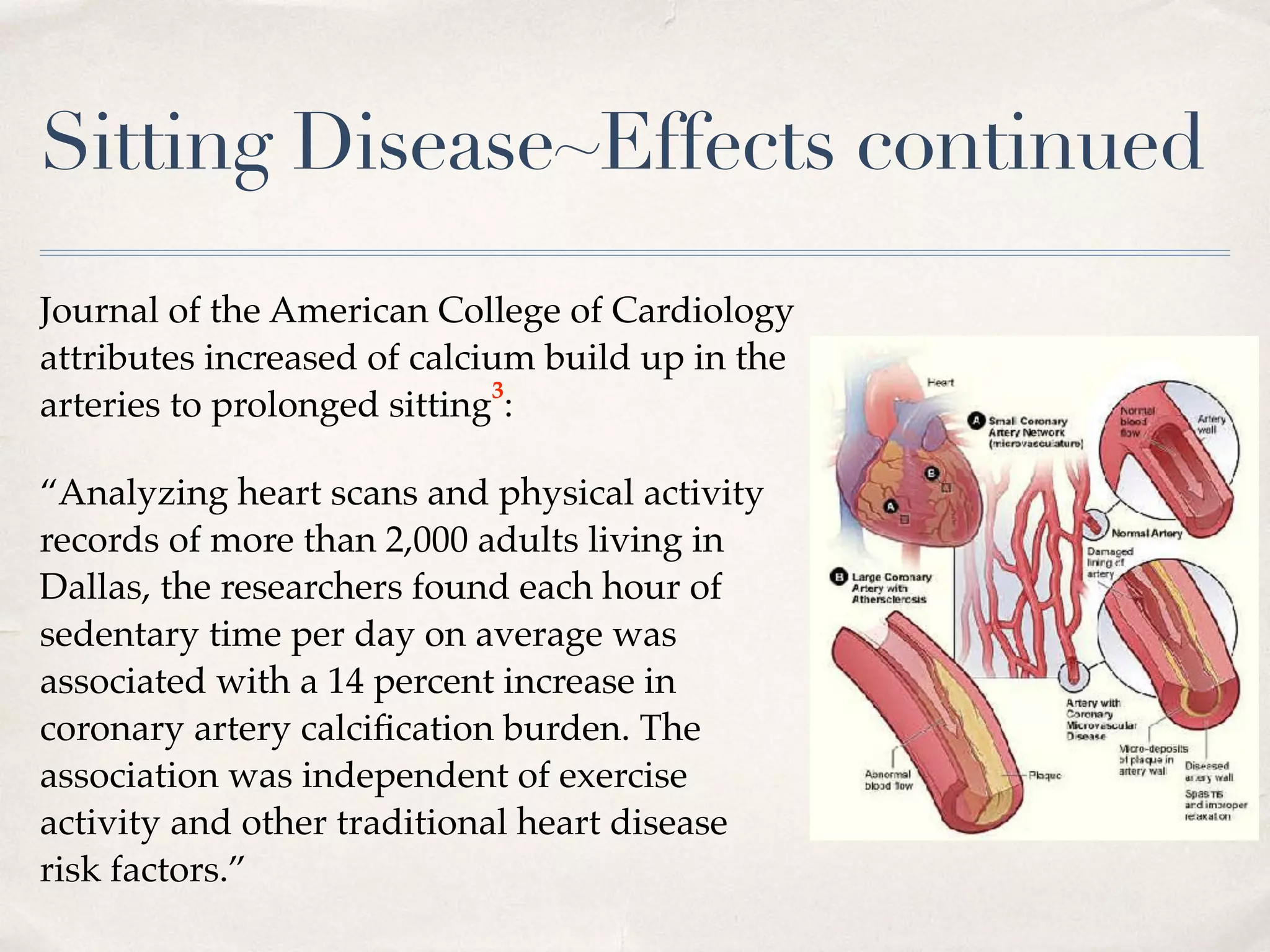
Journal of the American College of Cardiology
attributes increased of calcium build up in the
arteries to prolonged sitting
3
:
“Analyzing heart scans and physical activity
records of more than 2,000 adults living in
Dallas, the researchers found each hour of
sedentary time per day on average was
associated with a 14 percent increase in
coronary artery calcification burden. The
association was independent of exercise
activity and other traditional heart disease
risk factors.”
Sitting Disease~Effects continued
The pancreas is responsible for
making insulin. Insulin
provides glucose to the cell to
produce energy. Idle muscle
cells do not uptake insulin
resulting in an over production
of insulin leading to type 2
diabetes. One study found that
only after 1 day of prolong
sitting, response to insulin
decreased.4
Sitting Disease~Effects continued
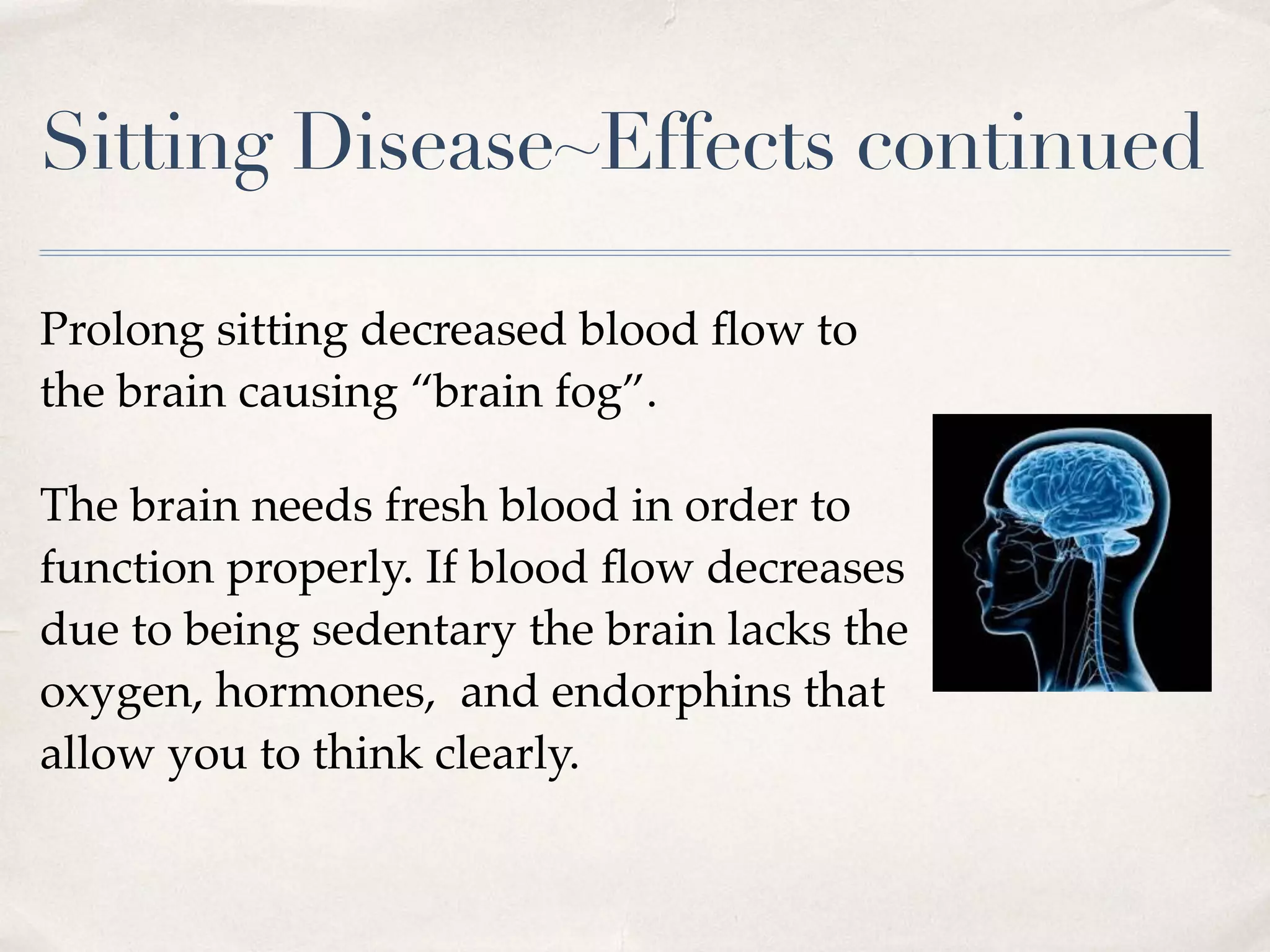
Prolonged sitting decreased blood flow to
the brain causing “brain fog”.
The brain needs fresh blood in order to
function properly. If blood flow decreases
due to being sedentary the brain lacks the
oxygen, hormones, and endorphins that
allow you to think clearly.
Sitting Disease~Effects continued
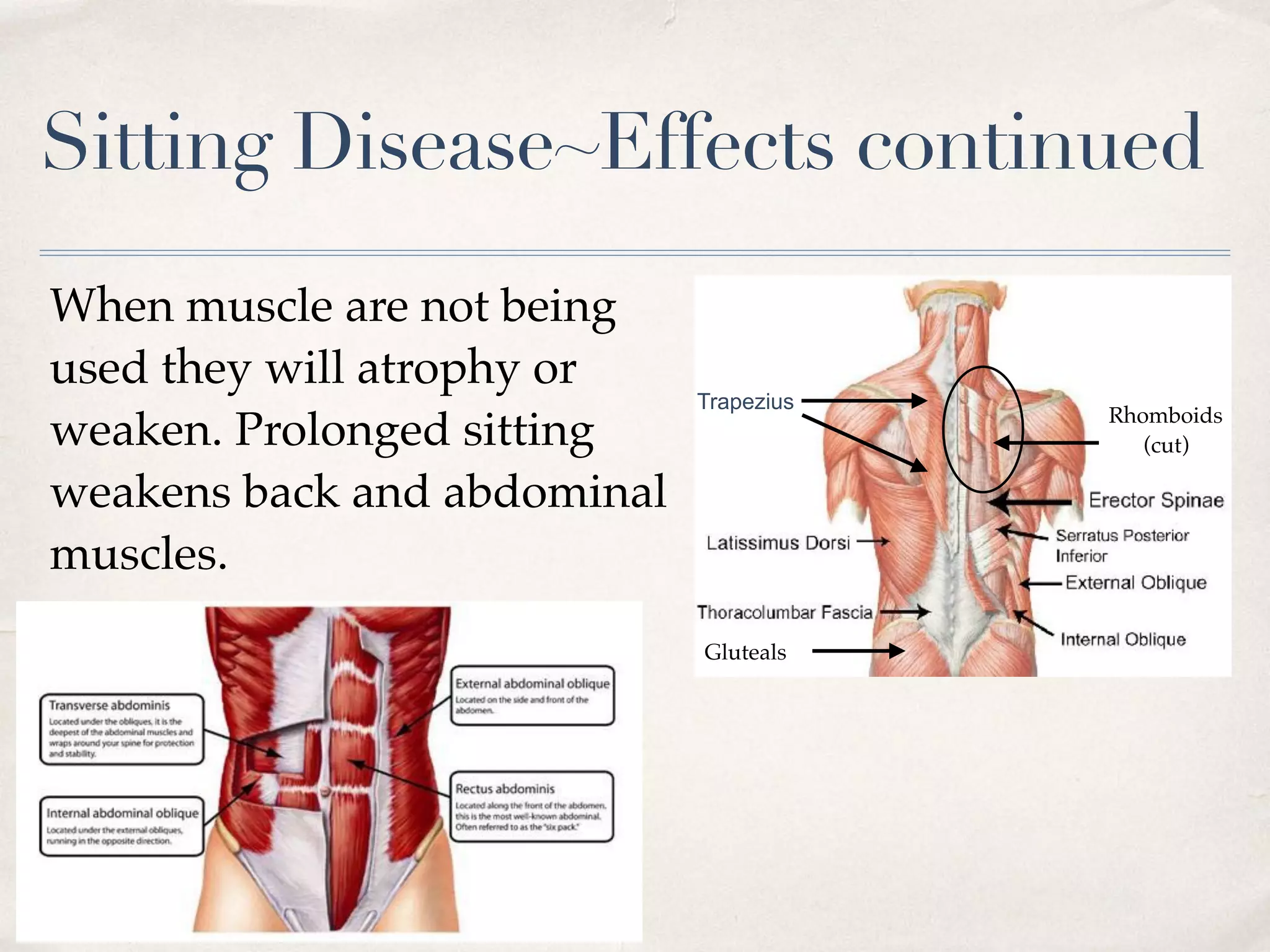
When muscle are not being
used they will atrophy or
weaken. Prolonged sitting
weakens back and abdominal
muscles.
Trapezius
Rhomboids
(cut)
Gluteals
Sitting Disease~Ways to Prevent
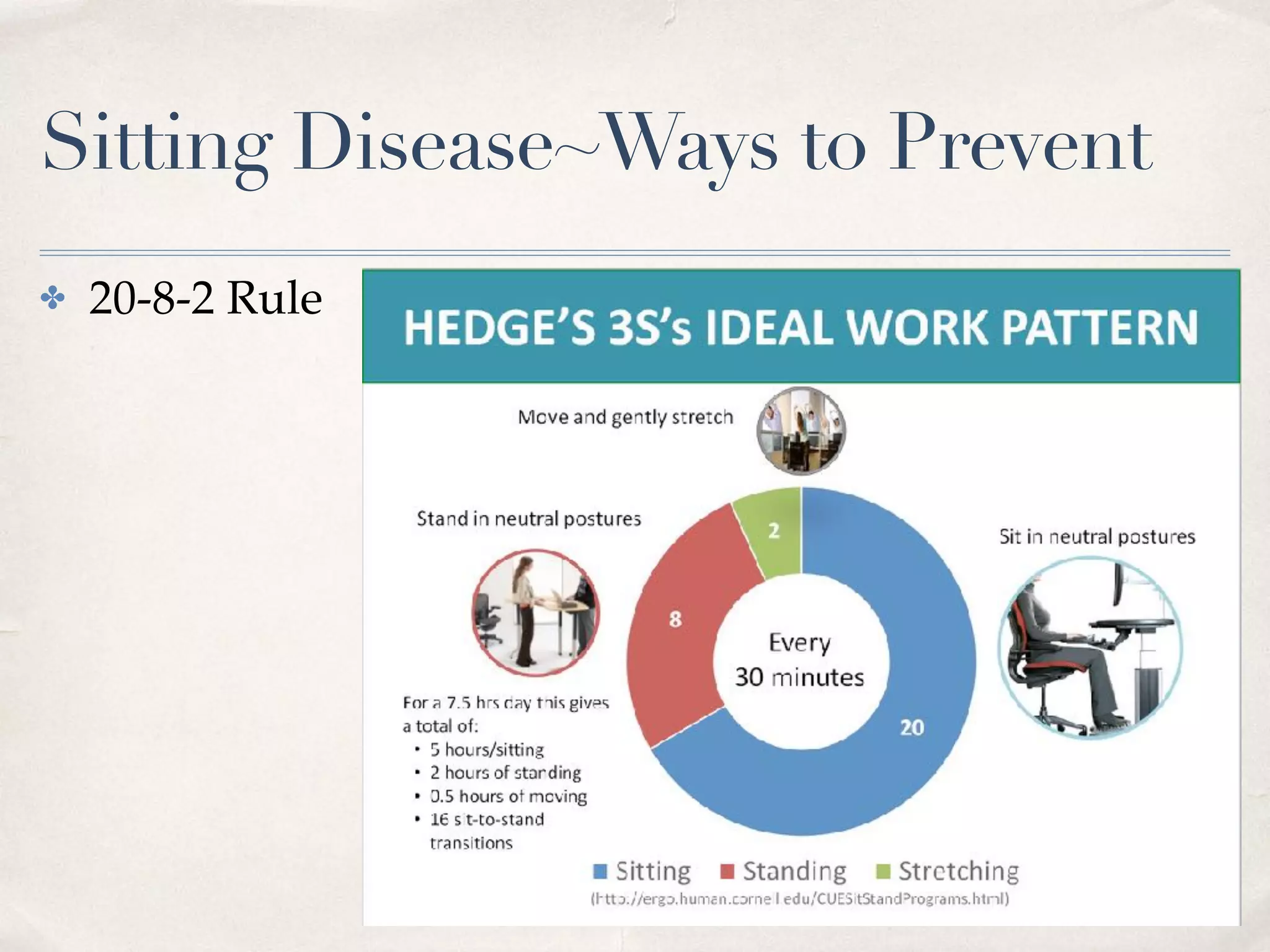
✤ 20-8-2 Rule
Sitting Disease~Ways to Prevent
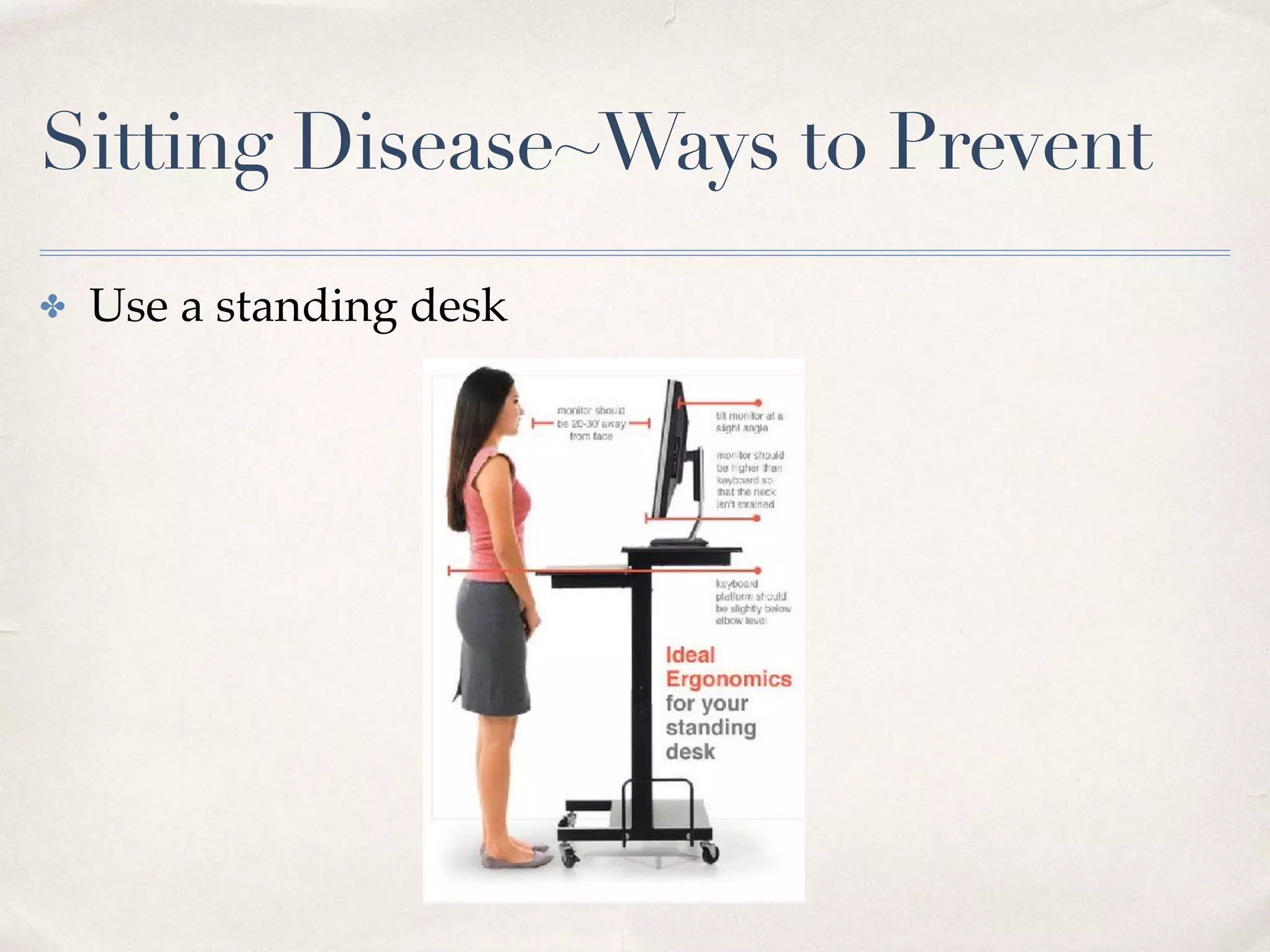
✤ Use a standing desk
Sitting Disease~Ways to Prevent
✤ Have “walking”meeting
Sitting Disease~Ways to Prevent
✤ Use a portable peddle bike under your desk.
Sitting Disease
✤ 1. 2017 !CD-10-CM Diagnosis Code x50.1
✤ 2. “Too much sitting linked to heart disease, diabetes, premature death” Harvard Health Publication, by Julie
Corliss, Executive Editor, Harvard Heart Letter, January 22, 2015
✤ 3. American College of Cardiology, “Study Bolsters Link Between Heart Disease, Excessive Sitting”, March 5, 2015
✤ 4. Metabolism. 2011 Jul;60(7):941-9. doi: 10.1016/j.metabol.2010.08.014. Epub 2010 Nov 10

Sitting Disease

  • 1.
    July 2017 Sitting Disease ByMelinda J. Donnelly, DC
  • 2.
    Sitting Disease ✤ Whatis Sitting Disease ✤ What effects do prolonged sitting have on the body ✤ Ways to prevent
  • 3.
    Sitting Disease~What isit? “Sitting Disease” is a diagnosis that is described as “Overexertion from prolonged static or awkward postures”1. Put more simply, Sitting Disease is prolonged sitting that leads to death. Prolonged sitting is sitting for longer than 8-12 hours in one day. Here is a great link to help you calculate how much time you spend sitting: Sitting-Time Calculator|JustStand.org
  • 4.
    Sitting Disease~Effects onbody? Harvard Health Publication-Prolonged sitting is associated with2: ✤ Increase risk of heart disease ✤ Increase risk of type 2 Diabetes Harmful effects on sugar and fat metabolism occur when the body is sedentary for long periods of time, leading to an increased risk of cardiovascular disease and diabetes.
  • 5.
    Sitting Disease~Effects continued Journalof the American College of Cardiology attributes increased of calcium build up in the arteries to prolonged sitting 3 : “Analyzing heart scans and physical activity records of more than 2,000 adults living in Dallas, the researchers found each hour of sedentary time per day on average was associated with a 14 percent increase in coronary artery calcification burden. The association was independent of exercise activity and other traditional heart disease risk factors.”
  • 6.
    Sitting Disease~Effects continued Thepancreas is responsible for making insulin. Insulin provides glucose to the cell to produce energy. Idle muscle cells do not uptake insulin resulting in an over production of insulin leading to type 2 diabetes. One study found that only after 1 day of prolong sitting, response to insulin decreased.4
  • 7.
    Sitting Disease~Effects continued Prolongedsitting decreased blood flow to the brain causing “brain fog”. The brain needs fresh blood in order to function properly. If blood flow decreases due to being sedentary the brain lacks the oxygen, hormones, and endorphins that allow you to think clearly.
  • 8.
    Sitting Disease~Effects continued Whenmuscle are not being used they will atrophy or weaken. Prolonged sitting weakens back and abdominal muscles. Trapezius Rhomboids (cut) Gluteals
  • 9.
    Sitting Disease~Ways toPrevent ✤ 20-8-2 Rule
  • 10.
    Sitting Disease~Ways toPrevent ✤ Use a standing desk
  • 11.
    Sitting Disease~Ways toPrevent ✤ Have “walking”meeting
  • 12.
    Sitting Disease~Ways toPrevent ✤ Use a portable peddle bike under your desk.
  • 13.
    Sitting Disease ✤ 1.2017 !CD-10-CM Diagnosis Code x50.1 ✤ 2. “Too much sitting linked to heart disease, diabetes, premature death” Harvard Health Publication, by Julie Corliss, Executive Editor, Harvard Heart Letter, January 22, 2015 ✤ 3. American College of Cardiology, “Study Bolsters Link Between Heart Disease, Excessive Sitting”, March 5, 2015 ✤ 4. Metabolism. 2011 Jul;60(7):941-9. doi: 10.1016/j.metabol.2010.08.014. Epub 2010 Nov 10