


Improving Surgical Planning
with Augmented Reality
Confidential. Not for Distribution.
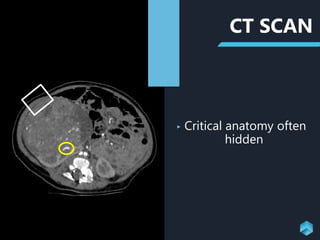
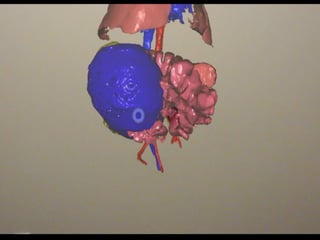
CT SCAN
‣ Critical anatomy often
hidden
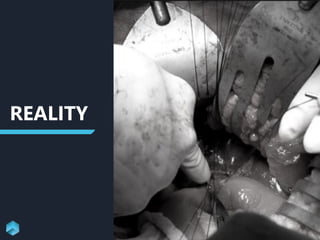
REALITY
Did You Know?
>50% of Technical Errors in Surgery are
Related to “Unexpected” Anatomy
Confidential. Not for Distribution. rick.beberman@siramedical.com
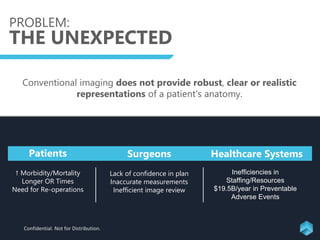
PROBLEM:
THE UNEXPECTED
Conventional imaging does not provide robust, clear or realistic
representations of a patient’s anatomy.
Patients
↑ Morbidity/Mortality
Longer OR Times
Need for Re-operations
Healthcare Systems
Inefficiencies in
Staffing/Resources
$19.5B/year in Preventable
Adverse Events
Surgeons
Lack of confidence in plan
Inaccurate measurements
Inefficient image review
Confidential. Not for Distribution.
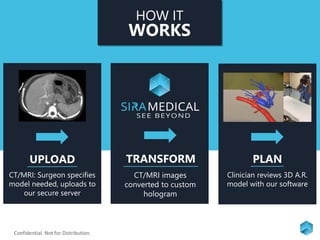
CT/MRI: Surgeon specifies
model needed, uploads to
our secure server
Clinician reviews 3D A.R.
model with our software
CT/MRI images
converted to custom
hologram
HOW IT
WORKS
UPLOAD TRANSFORM PLAN
Confidential. Not for Distribution.
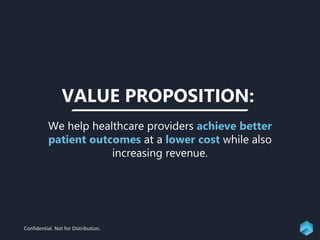
VALUE PROPOSITION:
Confidential. Not for Distribution.
We help healthcare providers achieve better
patient outcomes at a lower cost while also
increasing revenue.
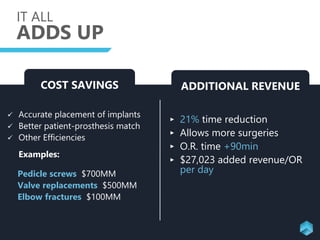
✓ Accurate placement of implants
✓ Better patient-prosthesis match
✓ Other Efficiencies
Examples:
Pedicle screws $700MM
Valve replacements $500MM
Elbow fractures $100MM
IT ALL
ADDS UP
COST SAVINGS ADDITIONAL REVENUE
‣ 21% time reduction
‣ Allows more surgeries
‣ O.R. time +90min
‣ $27,023 added revenue/OR
per day
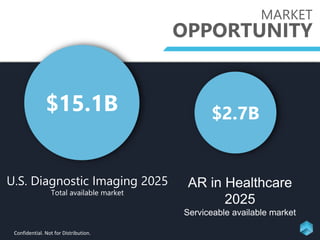
MARKET
OPPORTUNITY
$15.1B $2.7B
U.S. Diagnostic Imaging 2025
Total available market
AR in Healthcare
2025
Serviceable available market
Confidential. Not for Distribution.
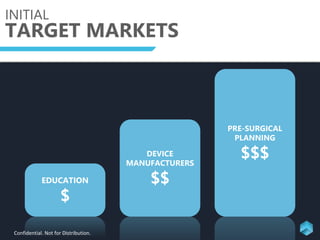
INITIAL
TARGET MARKETS
EDUCATION
$
DEVICE
MANUFACTURERS
$$
PRE-SURGICAL
PLANNING
$$$
Confidential. Not for Distribution.
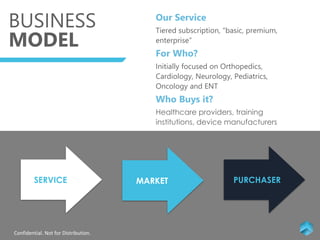
BUSINESS
MODEL
Our Service
Tiered subscription, “basic, premium,
enterprise”
For Who?
Initially focused on Orthopedics,
Cardiology, Neurology, Pediatrics,
Oncology and ENT
Who Buys it?
Healthcare providers, training
institutions, device manufacturers
SERVICE MARKET PURCHASER
Confidential. Not for Distribution.
ACCURACY &
PRECISION
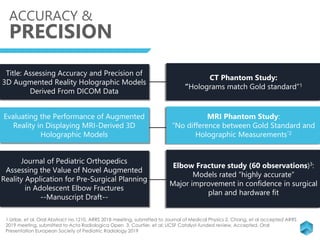
Title: Assessing Accuracy and Precision of
3D Augmented Reality Holographic Models
Derived From DICOM Data
CT Phantom Study:
“Holograms match Gold standard”1
Evaluating the Performance of Augmented
Reality in Displaying MRI-Derived 3D
Holographic Models
Journal of Pediatric Orthopedics
Assessing the Value of Novel Augmented
Reality Application for Pre-Surgical Planning
in Adolescent Elbow Fractures
--Manuscript Draft--
MRI Phantom Study:
“No difference between Gold Standard and
Holographic Measurements”2
Elbow Fracture study (60 observations)3:
Models rated ”highly accurate”
Major improvement in confidence in surgical
plan and hardware fit
1.Uribe, et al. Oral Abstract no.1210, ARRS 2018 meeting, submitted to Journal of Medical Physics 2. Chang, et al accepted ARRS
2019 meeting, submitted to Acta Radiologica Open 3. Courtier, et al: UCSF Catalyst-funded review, Accepted, Oral
Presentation European Society of Pediatric Radiology 2019
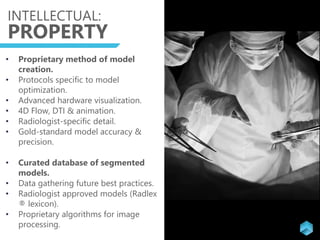
INTELLECTUAL:
PROPERTY
• Proprietary method of model
creation.
• Protocols specific to model
optimization.
• Advanced hardware visualization.
• 4D Flow, DTI & animation.
• Radiologist-specific detail.
• Gold-standard model accuracy &
precision.
• Curated database of segmented
models.
• Data gathering future best practices.
• Radiologist approved models (Radlex
® lexicon).
• Proprietary algorithms for image
processing.
RESEARCH
SITES
CORPORATE
PARTNERS
TRANSLATIONAL
PROGRAMS
Confidential. Not for Distribution.
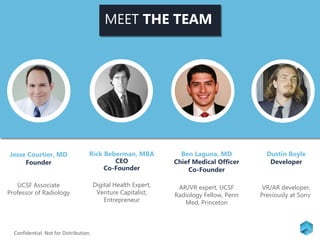
MEET THE TEAM
Jesse Courtier, MD
Founder
UCSF Associate
Professor of Radiology
Rick Beberman, MBA
CEO
Co-Founder
Digital Health Expert,
Venture Capitalist,
Entrepreneur
Ben Laguna, MD
Chief Medical Officer
Co-Founder
AR/VR expert, UCSF
Radiology Fellow, Penn
Med, Princeton
Dustin Boyle
Developer
VR/AR developer,
Previously at Sony
Confidential. Not for Distribution.
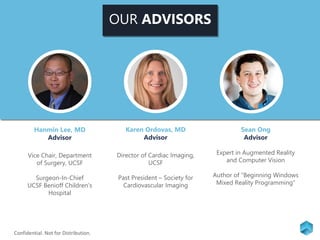
OUR ADVISORS
Hanmin Lee, MD
Advisor
Vice Chair, Department
of Surgery, UCSF
Surgeon-In-Chief
UCSF Benioff Children’s
Hospital
Karen Ordovas, MD
Advisor
Director of Cardiac Imaging,
UCSF
Past President – Society for
Cardiovascular Imaging
Sean Ong
Advisor
Expert in Augmented Reality
and Computer Vision
Author of “Beginning Windows
Mixed Reality Programming”
Confidential. Not for Distribution.
AWARD WINNING
TECHNOLOGY
WINNER
Two time Catalyst Award in Digital Health
FINALIST
2018 SXSW Interactive Innovation Awards
FINALIST
2019 ACC.19 Innovation Challenge
FINALIST
Medical Capital Innovation Competition
FINALIST
Health 2.0 VentureConnect Competition
Safer, more efficient surgery with
Augmented Reality
rick.beberman@siramedical.com
Confidential. Not for Distribution.
APPENDIX
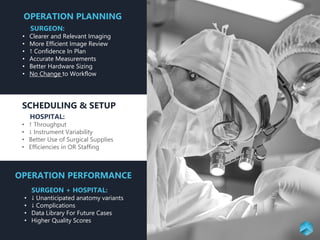
SURGEON:
• Clearer and Relevant Imaging
• More Efficient Image Review
• ↑ Confidence In Plan
• Accurate Measurements
• Better Hardware Sizing
• No Change to Workflow
HOSPITAL:
• ↑ Throughput
• ↓ Instrument Variability
• Better Use of Surgical Supplies
• Efficiencies in OR Staffing
SCHEDULING & SETUP
OPERATION PERFORMANCE
SURGEON + HOSPITAL:
• ↓ Unanticipated anatomy variants
• ↓ Complications
• Data Library For Future Cases
• Higher Quality Scores
OPERATION PLANNING
FUTURE PRODUCT
DEVELOPMENT
ML PIPELINE- DATA ANALYTICS,
IMAGE PROCESSING
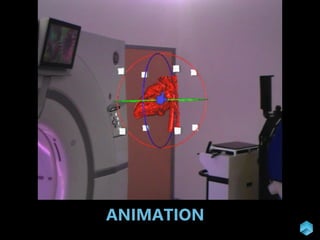
ANIMATION
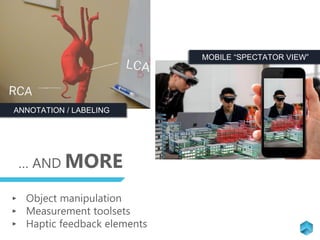
… AND MORE
MOBILE “SPECTATOR VIEW”
ANNOTATION / LABELING
‣ Object manipulation
‣ Measurement toolsets
‣ Haptic feedback elements
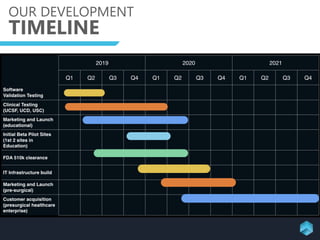
OUR DEVELOPMENT
TIMELINE
PILOT STUDY : UCSF
‣ Retrospective study – complex elbow fractures – 60 observations
‣ Impact on:
• Confidence in surgical planning (high)
• Hardware selection and fit (increased)
• Intra-operative time saving (projected at 20%)
• Quality of models (high)
“Would change how I’d approach; looking at this makes it more likely I’d have
recognized need for bone grafting”
“Improves confidence in treatment plan”
“Based on CT would have done CT and gone posterior; based on model would have
gone anterior and used some absorbable fixation”
“Complex intra-articular with a bad CT, [this] gives you more info on how it will fit
together, relationships of fragments”
“Know what to look for for retractor positioning, incision location”
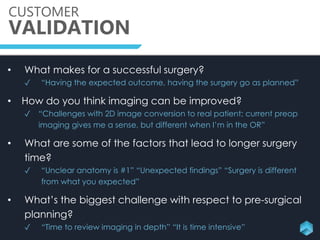
CUSTOMER
VALIDATION
• What makes for a successful surgery?
✓ “Having the expected outcome, having the surgery go as planned”
• How do you think imaging can be improved?
✓ “Challenges with 2D image conversion to real patient; current preop
imaging gives me a sense, but different when I’m in the OR”
• What are some of the factors that lead to longer surgery
time?
✓ “Unclear anatomy is #1” “Unexpected findings” “Surgery is different
from what you expected”
• What’s the biggest challenge with respect to pre-surgical
planning?
✓ “Time to review imaging in depth” “It is time intensive”
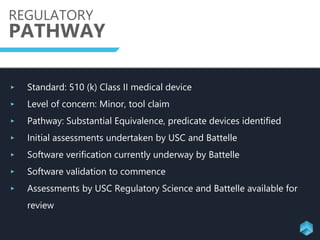
REGULATORY
PATHWAY
‣ Standard: 510 (k) Class II medical device
‣ Level of concern: Minor, tool claim
‣ Pathway: Substantial Equivalence, predicate devices identified
‣ Initial assessments undertaken by USC and Battelle
‣ Software verification currently underway by Battelle
‣ Software validation to commence
‣ Assessments by USC Regulatory Science and Battelle available for
review
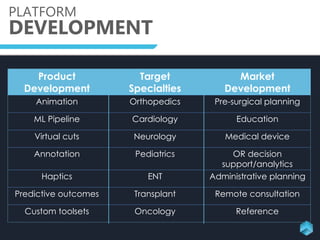
PLATFORM
DEVELOPMENT
Product
Development
Target
Specialties
Market
Development
Animation Orthopedics Pre-surgical planning
ML Pipeline Cardiology Education
Virtual cuts Neurology Medical device
Annotation Pediatrics OR decision
support/analytics
Haptics ENT Administrative planning
Predictive outcomes Transplant Remote consultation
Custom toolsets Oncology Reference
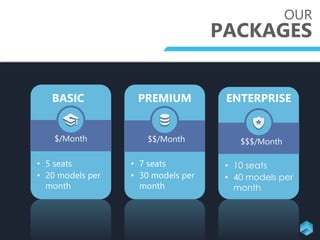
OUR
PACKAGES
BASIC PREMIUM ENTERPRISE
$/Month $$/Month $$$/Month
• 5 seats
• 20 models per
month
• 7 seats
• 30 models per
month
• 10 seats
• 40 models per
month
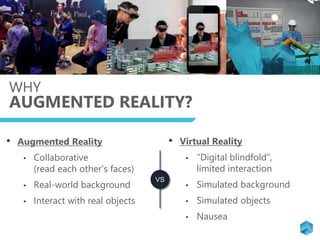
WHY
AUGMENTED REALITY?
VS
• Augmented Reality
• Collaborative
(read each other’s faces)
• Real-world background
• Interact with real objects
• Virtual Reality
• “Digital blindfold”,
limited interaction
• Simulated background
• Simulated objects
• Nausea
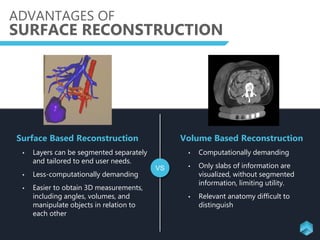
ADVANTAGES OF
SURFACE RECONSTRUCTION
VS
Surface Based Reconstruction
• Layers can be segmented separately
and tailored to end user needs.
• Less-computationally demanding
• Easier to obtain 3D measurements,
including angles, volumes, and
manipulate objects in relation to
each other
Volume Based Reconstruction
• Computationally demanding
• Only slabs of information are
visualized, without segmented
information, limiting utility.
• Relevant anatomy difficult to
distinguish
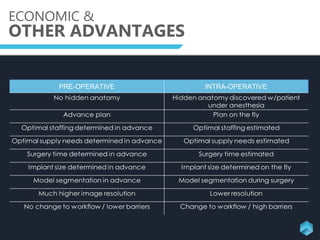
ECONOMIC &
OTHER ADVANTAGES
PRE-OPERATIVE INTRA-OPERATIVE
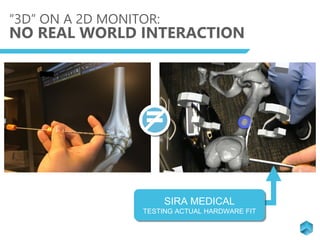
“3D” ON A 2D MONITOR:
NO REAL WORLD INTERACTION
=
SIRA MEDICAL
TESTING ACTUAL HARDWARE FIT
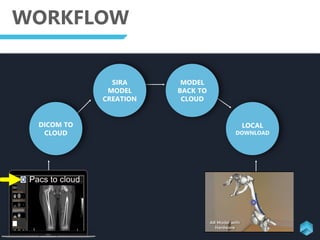
WORKFLOW
DICOM TO
CLOUD
Pacs to cloud
SIRA
MODEL
CREATION
MODEL
BACK TO
CLOUD
LOCAL
DOWNLOAD

Sira Medical pitch deck

  • 1.
    Improving Surgical Planning withAugmented Reality Confidential. Not for Distribution.
  • 2.
    CT SCAN ‣ Criticalanatomy often hidden
  • 3.
  • 4.
    Did You Know? >50%of Technical Errors in Surgery are Related to “Unexpected” Anatomy Confidential. Not for Distribution. rick.beberman@siramedical.com
  • 5.
    PROBLEM: THE UNEXPECTED Conventional imagingdoes not provide robust, clear or realistic representations of a patient’s anatomy. Patients ↑ Morbidity/Mortality Longer OR Times Need for Re-operations Healthcare Systems Inefficiencies in Staffing/Resources $19.5B/year in Preventable Adverse Events Surgeons Lack of confidence in plan Inaccurate measurements Inefficient image review Confidential. Not for Distribution.
  • 7.
    CT/MRI: Surgeon specifies modelneeded, uploads to our secure server Clinician reviews 3D A.R. model with our software CT/MRI images converted to custom hologram HOW IT WORKS UPLOAD TRANSFORM PLAN Confidential. Not for Distribution.
  • 8.
    VALUE PROPOSITION: Confidential. Notfor Distribution. We help healthcare providers achieve better patient outcomes at a lower cost while also increasing revenue.
  • 9.
    ✓ Accurate placementof implants ✓ Better patient-prosthesis match ✓ Other Efficiencies Examples: Pedicle screws $700MM Valve replacements $500MM Elbow fractures $100MM IT ALL ADDS UP COST SAVINGS ADDITIONAL REVENUE ‣ 21% time reduction ‣ Allows more surgeries ‣ O.R. time +90min ‣ $27,023 added revenue/OR per day
  • 10.
    MARKET OPPORTUNITY $15.1B $2.7B U.S. DiagnosticImaging 2025 Total available market AR in Healthcare 2025 Serviceable available market Confidential. Not for Distribution.
  • 11.
  • 12.
    BUSINESS MODEL Our Service Tiered subscription,“basic, premium, enterprise” For Who? Initially focused on Orthopedics, Cardiology, Neurology, Pediatrics, Oncology and ENT Who Buys it? Healthcare providers, training institutions, device manufacturers SERVICE MARKET PURCHASER Confidential. Not for Distribution.
  • 13.
    ACCURACY & PRECISION Title: AssessingAccuracy and Precision of 3D Augmented Reality Holographic Models Derived From DICOM Data CT Phantom Study: “Holograms match Gold standard”1 Evaluating the Performance of Augmented Reality in Displaying MRI-Derived 3D Holographic Models Journal of Pediatric Orthopedics Assessing the Value of Novel Augmented Reality Application for Pre-Surgical Planning in Adolescent Elbow Fractures --Manuscript Draft-- MRI Phantom Study: “No difference between Gold Standard and Holographic Measurements”2 Elbow Fracture study (60 observations)3: Models rated ”highly accurate” Major improvement in confidence in surgical plan and hardware fit 1.Uribe, et al. Oral Abstract no.1210, ARRS 2018 meeting, submitted to Journal of Medical Physics 2. Chang, et al accepted ARRS 2019 meeting, submitted to Acta Radiologica Open 3. Courtier, et al: UCSF Catalyst-funded review, Accepted, Oral Presentation European Society of Pediatric Radiology 2019
  • 14.
    INTELLECTUAL: PROPERTY • Proprietary methodof model creation. • Protocols specific to model optimization. • Advanced hardware visualization. • 4D Flow, DTI & animation. • Radiologist-specific detail. • Gold-standard model accuracy & precision. • Curated database of segmented models. • Data gathering future best practices. • Radiologist approved models (Radlex ® lexicon). • Proprietary algorithms for image processing.
  • 15.
  • 16.
    MEET THE TEAM JesseCourtier, MD Founder UCSF Associate Professor of Radiology Rick Beberman, MBA CEO Co-Founder Digital Health Expert, Venture Capitalist, Entrepreneur Ben Laguna, MD Chief Medical Officer Co-Founder AR/VR expert, UCSF Radiology Fellow, Penn Med, Princeton Dustin Boyle Developer VR/AR developer, Previously at Sony Confidential. Not for Distribution.
  • 17.
    OUR ADVISORS Hanmin Lee,MD Advisor Vice Chair, Department of Surgery, UCSF Surgeon-In-Chief UCSF Benioff Children’s Hospital Karen Ordovas, MD Advisor Director of Cardiac Imaging, UCSF Past President – Society for Cardiovascular Imaging Sean Ong Advisor Expert in Augmented Reality and Computer Vision Author of “Beginning Windows Mixed Reality Programming” Confidential. Not for Distribution.
  • 18.
    AWARD WINNING TECHNOLOGY WINNER Two timeCatalyst Award in Digital Health FINALIST 2018 SXSW Interactive Innovation Awards FINALIST 2019 ACC.19 Innovation Challenge FINALIST Medical Capital Innovation Competition FINALIST Health 2.0 VentureConnect Competition
  • 19.
    Safer, more efficientsurgery with Augmented Reality rick.beberman@siramedical.com Confidential. Not for Distribution.
  • 20.
  • 21.
    SURGEON: • Clearer andRelevant Imaging • More Efficient Image Review • ↑ Confidence In Plan • Accurate Measurements • Better Hardware Sizing • No Change to Workflow HOSPITAL: • ↑ Throughput • ↓ Instrument Variability • Better Use of Surgical Supplies • Efficiencies in OR Staffing SCHEDULING & SETUP OPERATION PERFORMANCE SURGEON + HOSPITAL: • ↓ Unanticipated anatomy variants • ↓ Complications • Data Library For Future Cases • Higher Quality Scores OPERATION PLANNING
  • 22.
  • 23.
    ML PIPELINE- DATAANALYTICS, IMAGE PROCESSING
  • 24.
  • 25.
    … AND MORE MOBILE“SPECTATOR VIEW” ANNOTATION / LABELING ‣ Object manipulation ‣ Measurement toolsets ‣ Haptic feedback elements
  • 26.
  • 27.
    PILOT STUDY :UCSF ‣ Retrospective study – complex elbow fractures – 60 observations ‣ Impact on: • Confidence in surgical planning (high) • Hardware selection and fit (increased) • Intra-operative time saving (projected at 20%) • Quality of models (high) “Would change how I’d approach; looking at this makes it more likely I’d have recognized need for bone grafting” “Improves confidence in treatment plan” “Based on CT would have done CT and gone posterior; based on model would have gone anterior and used some absorbable fixation” “Complex intra-articular with a bad CT, [this] gives you more info on how it will fit together, relationships of fragments” “Know what to look for for retractor positioning, incision location”
  • 28.
    CUSTOMER VALIDATION • What makesfor a successful surgery? ✓ “Having the expected outcome, having the surgery go as planned” • How do you think imaging can be improved? ✓ “Challenges with 2D image conversion to real patient; current preop imaging gives me a sense, but different when I’m in the OR” • What are some of the factors that lead to longer surgery time? ✓ “Unclear anatomy is #1” “Unexpected findings” “Surgery is different from what you expected” • What’s the biggest challenge with respect to pre-surgical planning? ✓ “Time to review imaging in depth” “It is time intensive”
  • 29.
    REGULATORY PATHWAY ‣ Standard: 510(k) Class II medical device ‣ Level of concern: Minor, tool claim ‣ Pathway: Substantial Equivalence, predicate devices identified ‣ Initial assessments undertaken by USC and Battelle ‣ Software verification currently underway by Battelle ‣ Software validation to commence ‣ Assessments by USC Regulatory Science and Battelle available for review
  • 30.
    PLATFORM DEVELOPMENT Product Development Target Specialties Market Development Animation Orthopedics Pre-surgicalplanning ML Pipeline Cardiology Education Virtual cuts Neurology Medical device Annotation Pediatrics OR decision support/analytics Haptics ENT Administrative planning Predictive outcomes Transplant Remote consultation Custom toolsets Oncology Reference
  • 31.
    OUR PACKAGES BASIC PREMIUM ENTERPRISE $/Month$$/Month $$$/Month • 5 seats • 20 models per month • 7 seats • 30 models per month • 10 seats • 40 models per month
  • 32.
    WHY AUGMENTED REALITY? VS • AugmentedReality • Collaborative (read each other’s faces) • Real-world background • Interact with real objects • Virtual Reality • “Digital blindfold”, limited interaction • Simulated background • Simulated objects • Nausea
  • 33.
    ADVANTAGES OF SURFACE RECONSTRUCTION VS SurfaceBased Reconstruction • Layers can be segmented separately and tailored to end user needs. • Less-computationally demanding • Easier to obtain 3D measurements, including angles, volumes, and manipulate objects in relation to each other Volume Based Reconstruction • Computationally demanding • Only slabs of information are visualized, without segmented information, limiting utility. • Relevant anatomy difficult to distinguish
  • 34.
  • 35.
    “3D” ON A2D MONITOR: NO REAL WORLD INTERACTION = SIRA MEDICAL TESTING ACTUAL HARDWARE FIT
  • 36.
    WORKFLOW DICOM TO CLOUD Pacs tocloud SIRA MODEL CREATION MODEL BACK TO CLOUD LOCAL DOWNLOAD