Design for performance,
Single and Multicore Processor
Designing Processors For Performance
• Progression
• Price
• Requirements:
• Image processing
• Speech recognition
• Video Conferencing
• Multimedia authoring
• Voice and video explanation of files
• Simulation modeling.
Usage Of Processors
• Simulation Systems.
• Workstation Systems.
• Servers.
Concept of Moore’s law
• Number of transistors in a dense IC doubles
approximately every two years
• Plus 4 times the DRAM power
Progressing Techniques
1. Branch prediction
2. Data flow analysis
3. Speculative execution;
(hybrid of branch prediction and data flow analysis)
Performance Balance
An adjusting of the organization and architecture to
compensate for the mismatch among the capabilities of the
various components.
• Increase bits by making DRAMs “wider” rather than “deeper” and by
using wide bus data paths.
• Including a cache.
• Higher-speed buses.
Improvements in Chip Organization and Architecture
• Hardware speed of the processor
• (more gates packed together more tightly)
• Size and Speed of Caches
• Changing Processor organization and architecture
• (parallelism)
Adjusting Factors
• Power
• RC delay
• Memory latency
Single Core Processors
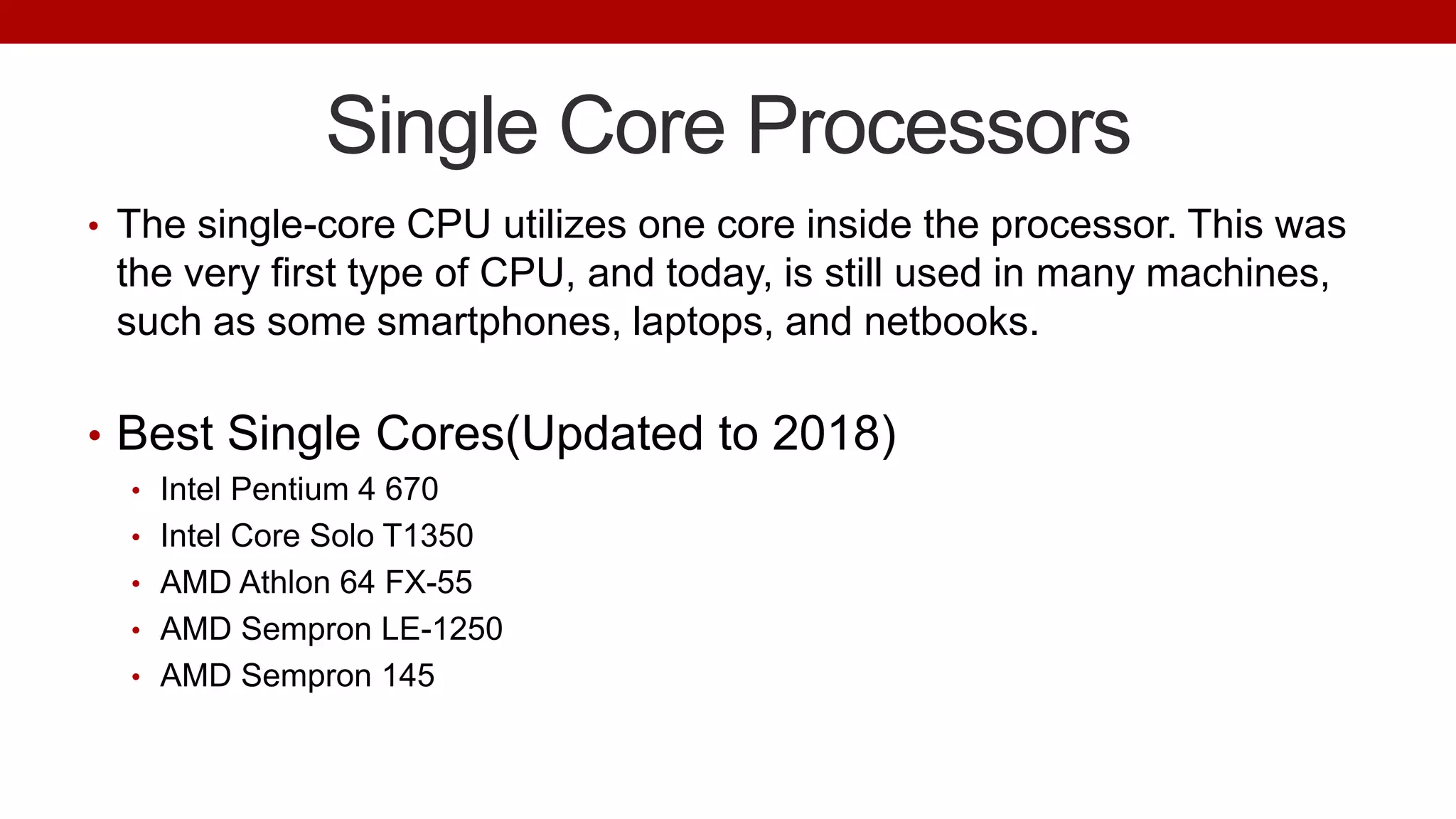
• The single-core CPU utilizes one core inside the processor. This was
the very first type of CPU, and today, is still used in many machines,
such as some smartphones, laptops, and netbooks.
• Best Single Cores(Updated to 2018)
• Intel Pentium 4 670
• Intel Core Solo T1350
• AMD Athlon 64 FX-55
• AMD Sempron LE-1250
• AMD Sempron 145
Usage
• Word processing;
• Checking email;
• Surfing the Internet;
• Watching videos, etc.
Multi Core Processors
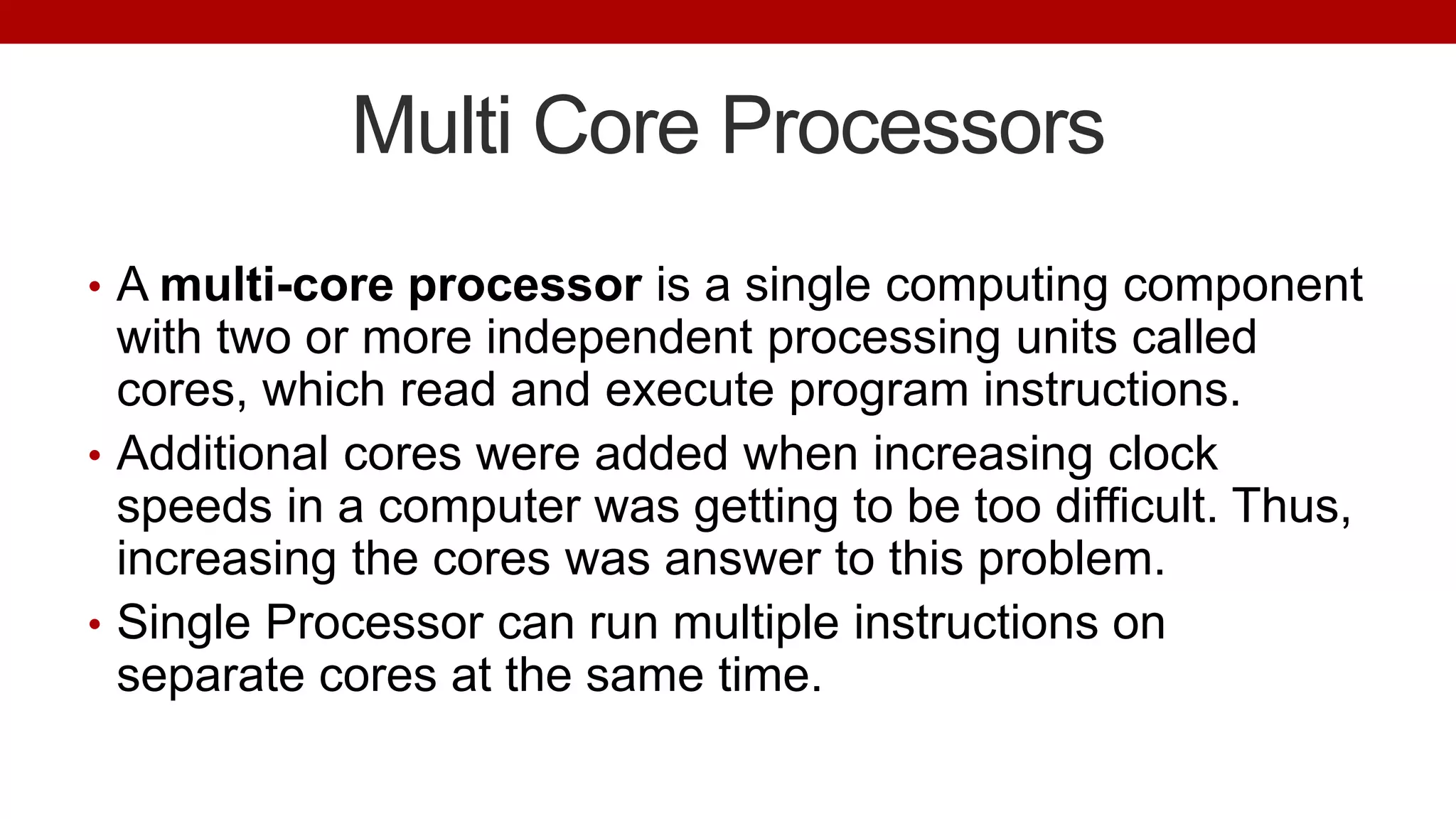
• A multi-core processor is a single computing component
with two or more independent processing units called
cores, which read and execute program instructions.
• Additional cores were added when increasing clock
speeds in a computer was getting to be too difficult. Thus,
increasing the cores was answer to this problem.
• Single Processor can run multiple instructions on
separate cores at the same time.
Usage
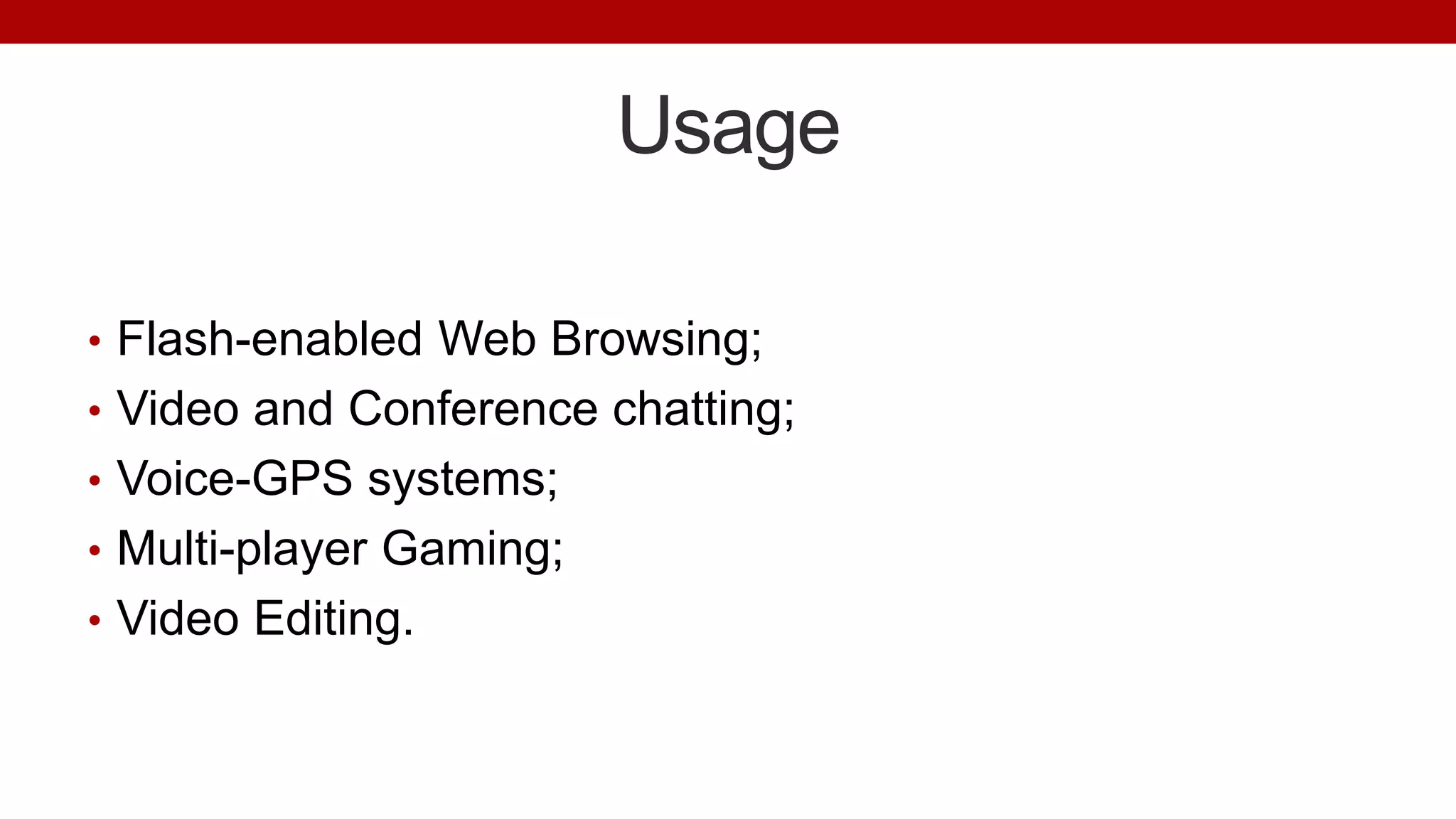
• Flash-enabled Web Browsing;
• Video and Conference chatting;
• Voice-GPS systems;
• Multi-player Gaming;
• Video Editing.
Examples (Updated to 2018);
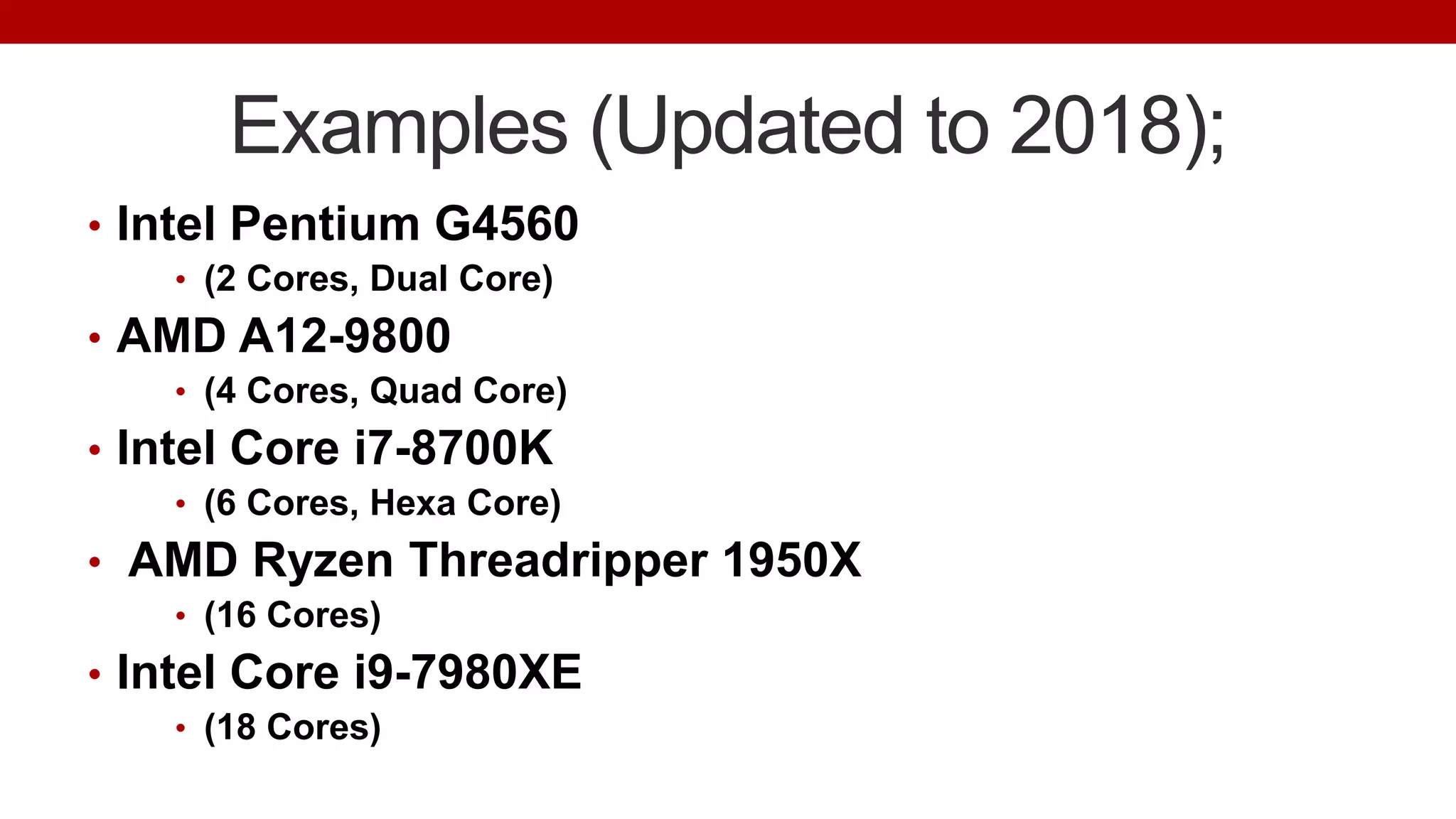
• Intel Pentium G4560
• (2 Cores, Dual Core)
• AMD A12-9800
• (4 Cores, Quad Core)
• Intel Core i7-8700K
• (6 Cores, Hexa Core)
• AMD Ryzen Threadripper 1950X
• (16 Cores)
• Intel Core i9-7980XE
• (18 Cores)
THANK YOU.

Single and Multi core processor

  • 1.
    Design for performance, Singleand Multicore Processor
  • 2.
    Designing Processors ForPerformance • Progression • Price • Requirements: • Image processing • Speech recognition • Video Conferencing • Multimedia authoring • Voice and video explanation of files • Simulation modeling.
  • 3.
    Usage Of Processors •Simulation Systems. • Workstation Systems. • Servers.
  • 4.
    Concept of Moore’slaw • Number of transistors in a dense IC doubles approximately every two years • Plus 4 times the DRAM power
  • 5.
    Progressing Techniques 1. Branchprediction 2. Data flow analysis 3. Speculative execution; (hybrid of branch prediction and data flow analysis)
  • 6.
    Performance Balance An adjustingof the organization and architecture to compensate for the mismatch among the capabilities of the various components. • Increase bits by making DRAMs “wider” rather than “deeper” and by using wide bus data paths. • Including a cache. • Higher-speed buses.
  • 7.
    Improvements in ChipOrganization and Architecture • Hardware speed of the processor • (more gates packed together more tightly) • Size and Speed of Caches • Changing Processor organization and architecture • (parallelism)
  • 8.
    Adjusting Factors • Power •RC delay • Memory latency
  • 9.
    Single Core Processors •The single-core CPU utilizes one core inside the processor. This was the very first type of CPU, and today, is still used in many machines, such as some smartphones, laptops, and netbooks. • Best Single Cores(Updated to 2018) • Intel Pentium 4 670 • Intel Core Solo T1350 • AMD Athlon 64 FX-55 • AMD Sempron LE-1250 • AMD Sempron 145
  • 10.
    Usage • Word processing; •Checking email; • Surfing the Internet; • Watching videos, etc.
  • 11.
    Multi Core Processors •A multi-core processor is a single computing component with two or more independent processing units called cores, which read and execute program instructions. • Additional cores were added when increasing clock speeds in a computer was getting to be too difficult. Thus, increasing the cores was answer to this problem. • Single Processor can run multiple instructions on separate cores at the same time.
  • 12.
    Usage • Flash-enabled WebBrowsing; • Video and Conference chatting; • Voice-GPS systems; • Multi-player Gaming; • Video Editing.
  • 13.
    Examples (Updated to2018); • Intel Pentium G4560 • (2 Cores, Dual Core) • AMD A12-9800 • (4 Cores, Quad Core) • Intel Core i7-8700K • (6 Cores, Hexa Core) • AMD Ryzen Threadripper 1950X • (16 Cores) • Intel Core i9-7980XE • (18 Cores)
  • 14.