GROUP DISCUSSION
DEFINITION Group discussion is a technique, art and comprehensive tool to judge the worthiness of students and their appropriateness for the job. It is a systematic and purposeful interactive process. It reflects the inherent qualities of an individual.
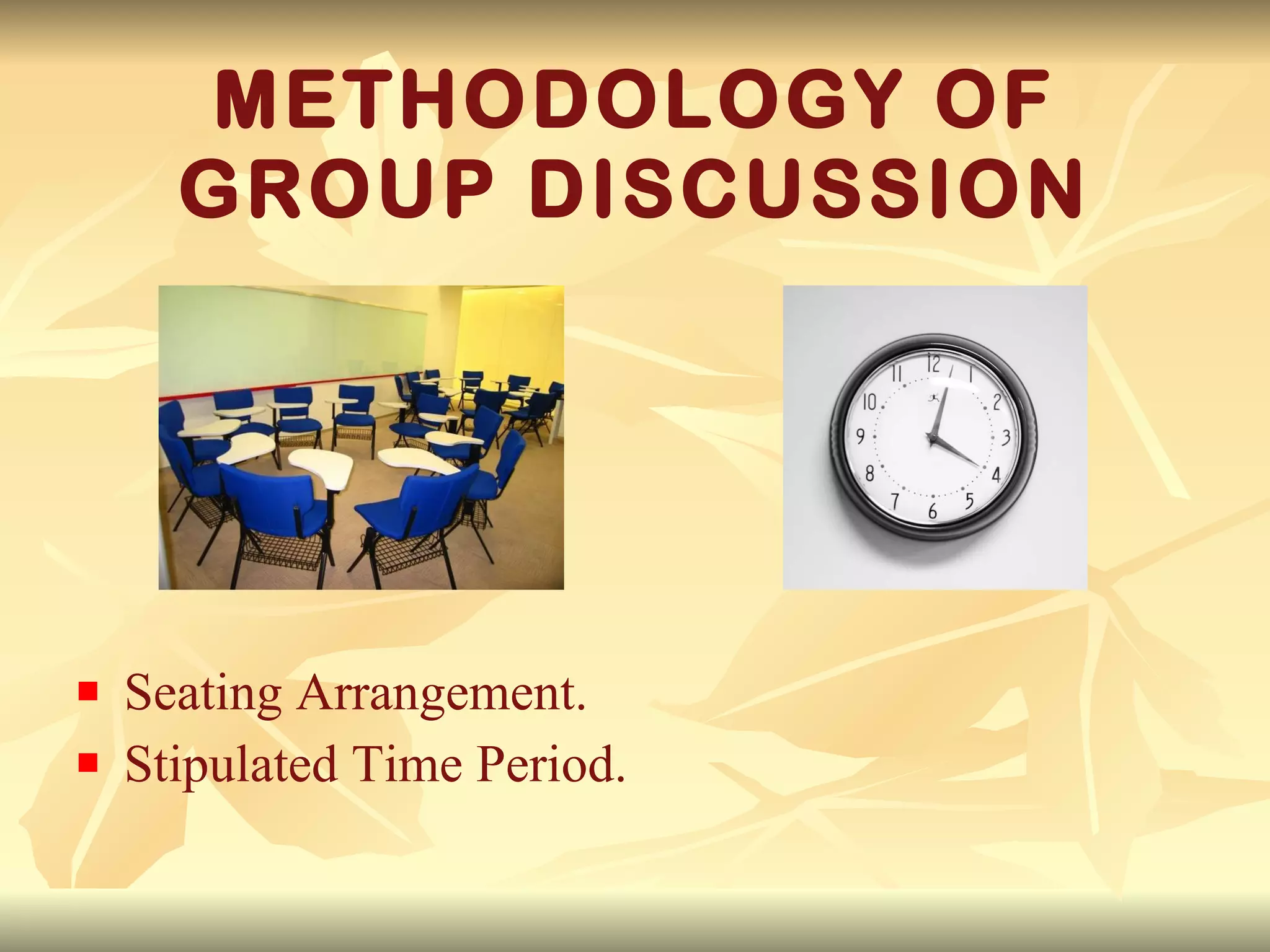
METHODOLOGY OF GROUP DISCUSSION Seating Arrangement. Stipulated Time Period.
IMPORTANCE OF GROUP DISCUSSION Problem Solving. Critical Thinking. Personality Assessment. Decision Making.
PERSONALITY TRAITS Ability To Work In A Team. Reasoning Ability. Assertiveness. Flexibility. Attitude And Confidence. Communication. Leadership. Listening.
CHARACTERISTICS OF SUCCESSFUL GROUP DISCUSSION Agreement On Group Goals. Goal Oriented Interaction. Agreement On Procedures. Co-operative And Friendly Atmosphere. Effective Communicative Techniques. Equitable Distribution Of Participation. Shared Leadership.
TYPES OF GROUP DISCUSSION Topic Based Group Discussion.  Case Based Group Discussion.
TOPIC BASED GROUP DISCUSSION Single Topic Based. Multiple Topic Based (2-3 In Number).
BASED ON THE NATURE OF TOPICS Factual. Controversial. Abstract.
FACTUAL Education Status In India. Software Scenario. State Of Aged In India. India’s GDP. Public Sector In India.
CONTROVERSIAL Reservations Should Be Removed. Women Make Better Manager. Marijuana Has A Medical Value.
ABSTRACT Blue Dot. The Number 10. Z Is The Last Alphabet Of English Language.
GOLDEN RULES FOR DISCUSSION Courtesy is required at all times. Discussion of other members’ motives is never allowed. No one may speak a second time until everyone wishes to do so have spoken once.
GUIDELINES Discuss About Ideas And Issues And Not Personalities. Listen And Reflect To What Others Are Saying.
Be Aware Of One’s Own Feelings. Trust Others Self-restraint And Civility. When Someone Says In A Sexist, Racist, Homophobic Or In An Inappropriate Way, Gently Invite Him\Her To Self Correct.
SELECTION GROUP DISCUSSION Subject Knowledge Oral Communication Skills Leadership Skills Team Management Skills Problem Solving Skills Interpersonal Skills
KASH  STRATEGIES K- KNOWLEDGE A- ATTITUDE S- SKILLS H- HONESTY
PREPARATION FOR A GROUP DISCUSSION Topic Analysis Discussing Opinions Discussing Problems Discussing Case Studies
GROUP DISCUSSION STRATEGIES
Getting the GD started Contributing Systematically Creating A Friendly Atmosphere Moving the Discussion Along Promoting Optimal Participation Handling Conflict Effective Closure
FACING GROUP DISCUSSION EFFECTIVELY
Initiation Main Discussion Summarizing Mock Group Discussion Evaluating Your Group Discussion Performance
GROUP INTERACTION STRATEGIES Exchanging Opinions Exchanging Suggestions And Proposals
EXCHANGING OPINIONS Asking For Opinions Giving Opinions Supporting Opinions Balancing Points Of View Agreeing And Disagreeing
EXCHANGING SUGGESTIONS AND PROPOSALS Requesting Suggestions Making Suggestions Accepting And Rejecting Proposals
DO’S FOR A GROUP DISCUSSION Define The Topic Or The Issue. Analyze Its Scope And Implications. Listen To the Views Of Others Intently. Encourage And Provide Reticent Members To Speak. Be Brief And To The Point In Presenting Your Views. Maintain Proper Body Language.
DONT’S FOR A GROUP DISCUSSION Don’t Be Assertive In Presenting Your Views. Don’t Monopolize The Discussion. Don’t Make Any Personal Remarks. Don’t Jump To Conclusions. Don’t Speak Continuously For A Long Time. Don’t Speak In Monotone.
 

Sindhuja group discussion

  • 1.
  • 2.
    DEFINITION Group discussionis a technique, art and comprehensive tool to judge the worthiness of students and their appropriateness for the job. It is a systematic and purposeful interactive process. It reflects the inherent qualities of an individual.
  • 3.
    METHODOLOGY OF GROUPDISCUSSION Seating Arrangement. Stipulated Time Period.
  • 4.
    IMPORTANCE OF GROUPDISCUSSION Problem Solving. Critical Thinking. Personality Assessment. Decision Making.
  • 5.
    PERSONALITY TRAITS AbilityTo Work In A Team. Reasoning Ability. Assertiveness. Flexibility. Attitude And Confidence. Communication. Leadership. Listening.
  • 6.
    CHARACTERISTICS OF SUCCESSFULGROUP DISCUSSION Agreement On Group Goals. Goal Oriented Interaction. Agreement On Procedures. Co-operative And Friendly Atmosphere. Effective Communicative Techniques. Equitable Distribution Of Participation. Shared Leadership.
  • 7.
    TYPES OF GROUPDISCUSSION Topic Based Group Discussion. Case Based Group Discussion.
  • 8.
    TOPIC BASED GROUPDISCUSSION Single Topic Based. Multiple Topic Based (2-3 In Number).
  • 9.
    BASED ON THENATURE OF TOPICS Factual. Controversial. Abstract.
  • 10.
    FACTUAL Education StatusIn India. Software Scenario. State Of Aged In India. India’s GDP. Public Sector In India.
  • 11.
    CONTROVERSIAL Reservations ShouldBe Removed. Women Make Better Manager. Marijuana Has A Medical Value.
  • 12.
    ABSTRACT Blue Dot.The Number 10. Z Is The Last Alphabet Of English Language.
  • 13.
    GOLDEN RULES FORDISCUSSION Courtesy is required at all times. Discussion of other members’ motives is never allowed. No one may speak a second time until everyone wishes to do so have spoken once.
  • 14.
    GUIDELINES Discuss AboutIdeas And Issues And Not Personalities. Listen And Reflect To What Others Are Saying.
  • 15.
    Be Aware OfOne’s Own Feelings. Trust Others Self-restraint And Civility. When Someone Says In A Sexist, Racist, Homophobic Or In An Inappropriate Way, Gently Invite Him\Her To Self Correct.
  • 16.
    SELECTION GROUP DISCUSSIONSubject Knowledge Oral Communication Skills Leadership Skills Team Management Skills Problem Solving Skills Interpersonal Skills
  • 17.
    KASH STRATEGIESK- KNOWLEDGE A- ATTITUDE S- SKILLS H- HONESTY
  • 18.
    PREPARATION FOR AGROUP DISCUSSION Topic Analysis Discussing Opinions Discussing Problems Discussing Case Studies
  • 19.
  • 20.
    Getting the GDstarted Contributing Systematically Creating A Friendly Atmosphere Moving the Discussion Along Promoting Optimal Participation Handling Conflict Effective Closure
  • 21.
  • 22.
    Initiation Main DiscussionSummarizing Mock Group Discussion Evaluating Your Group Discussion Performance
  • 23.
    GROUP INTERACTION STRATEGIESExchanging Opinions Exchanging Suggestions And Proposals
  • 24.
    EXCHANGING OPINIONS AskingFor Opinions Giving Opinions Supporting Opinions Balancing Points Of View Agreeing And Disagreeing
  • 25.
    EXCHANGING SUGGESTIONS ANDPROPOSALS Requesting Suggestions Making Suggestions Accepting And Rejecting Proposals
  • 26.
    DO’S FOR AGROUP DISCUSSION Define The Topic Or The Issue. Analyze Its Scope And Implications. Listen To the Views Of Others Intently. Encourage And Provide Reticent Members To Speak. Be Brief And To The Point In Presenting Your Views. Maintain Proper Body Language.
  • 27.
    DONT’S FOR AGROUP DISCUSSION Don’t Be Assertive In Presenting Your Views. Don’t Monopolize The Discussion. Don’t Make Any Personal Remarks. Don’t Jump To Conclusions. Don’t Speak Continuously For A Long Time. Don’t Speak In Monotone.
  • 28.