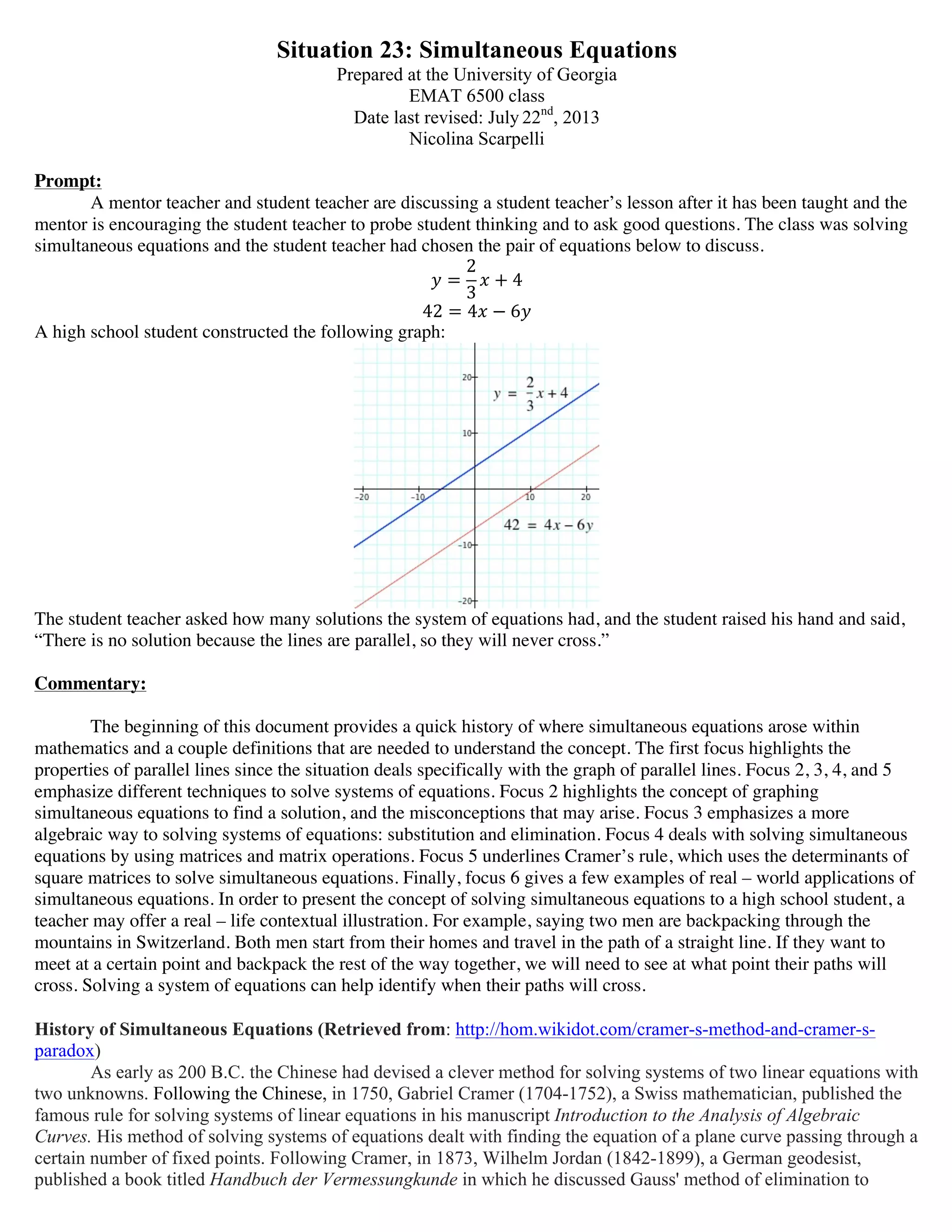
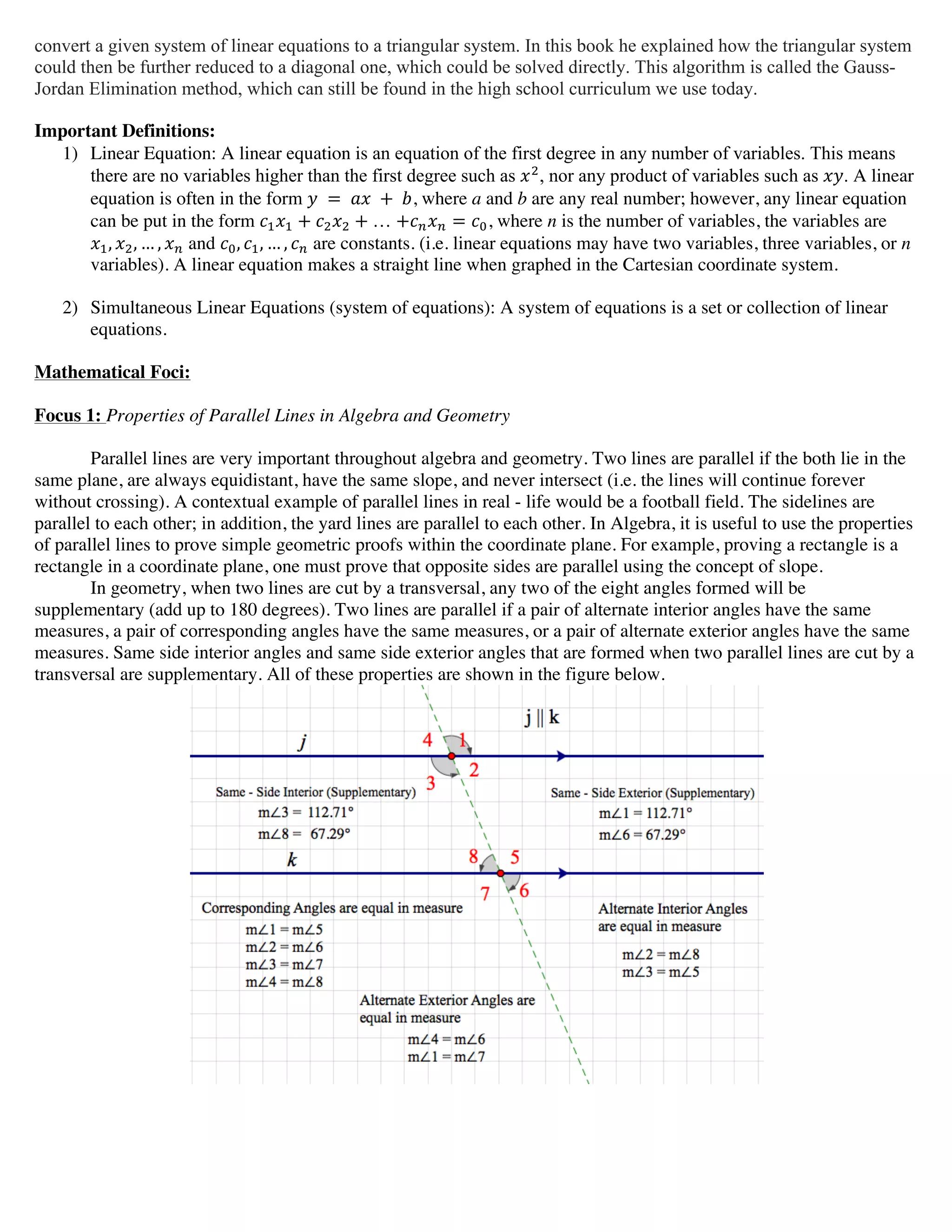
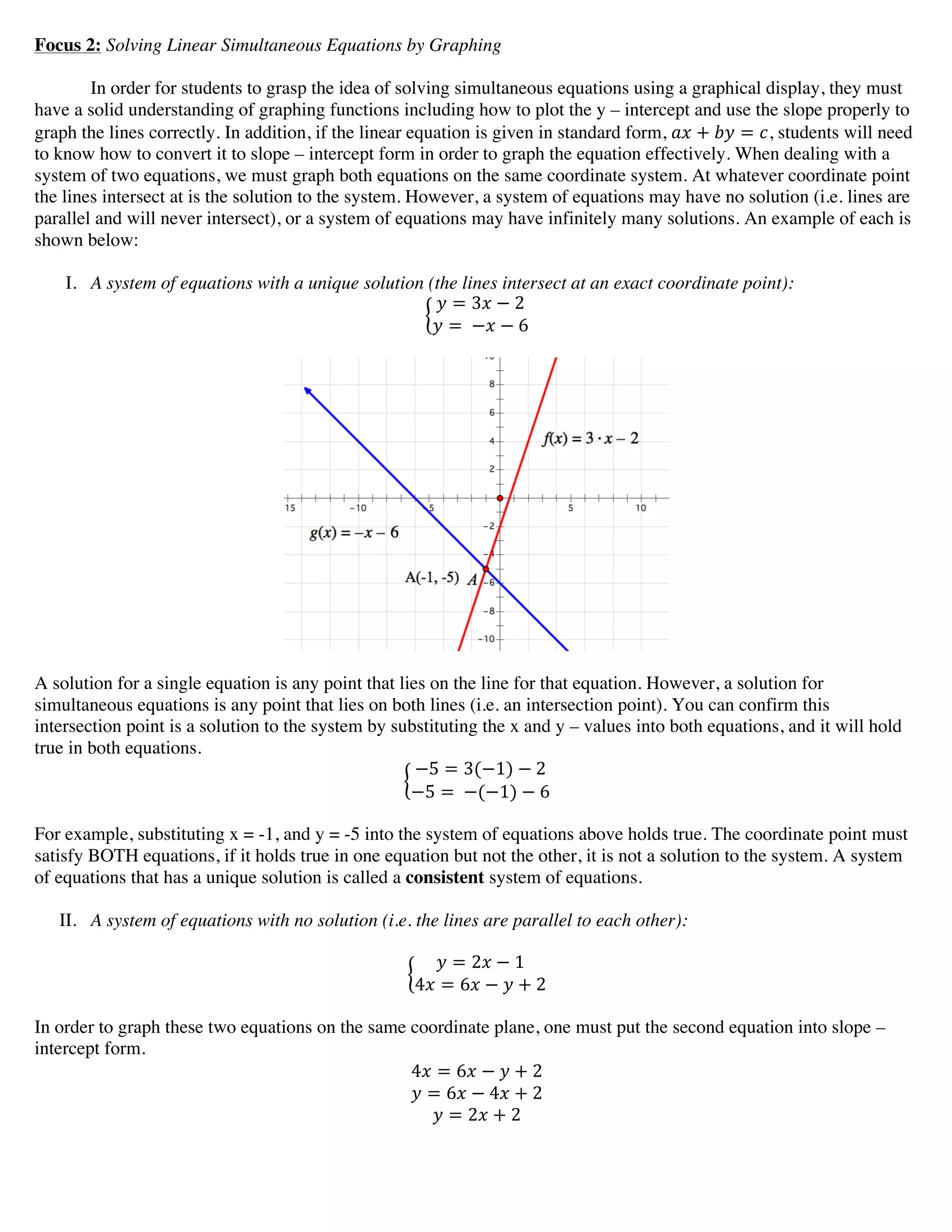
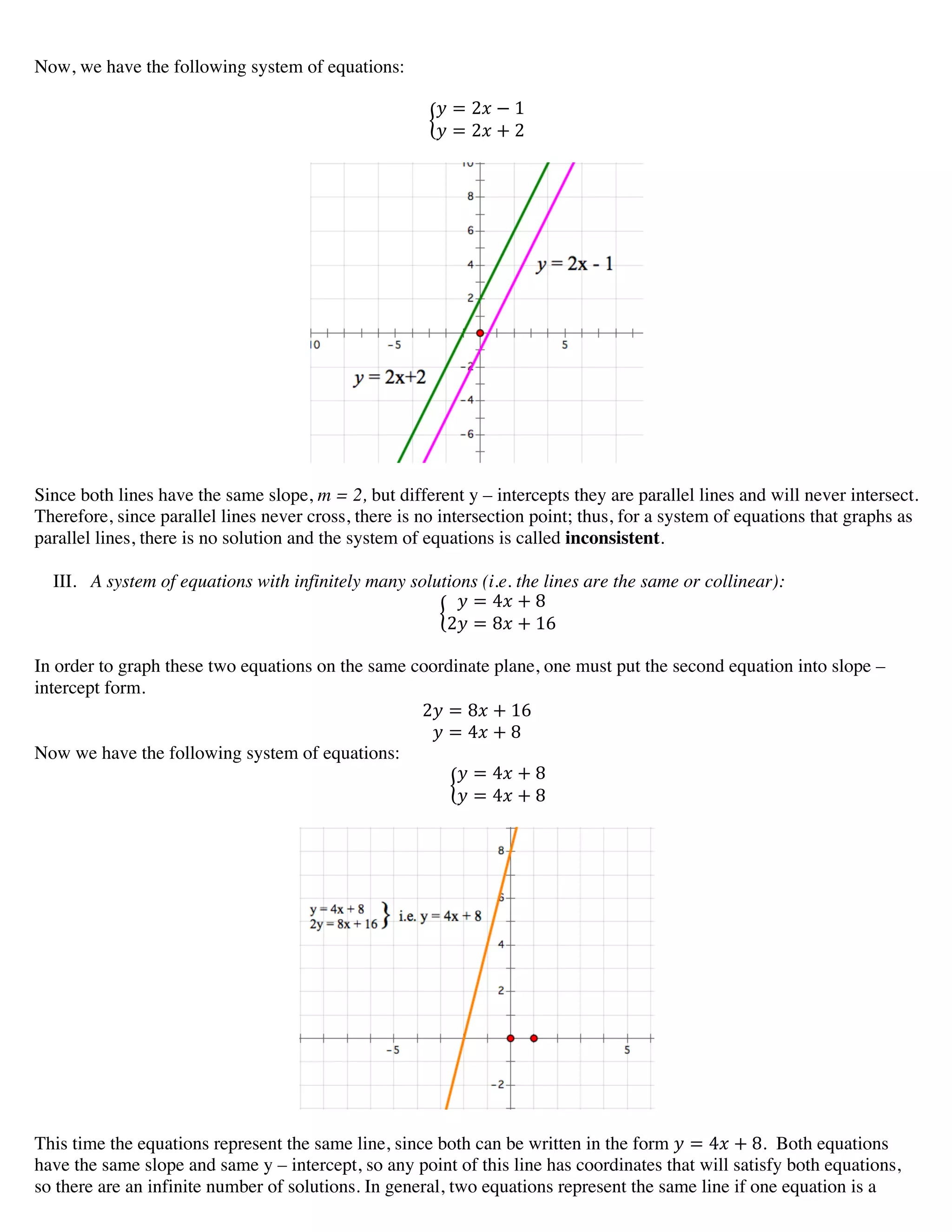
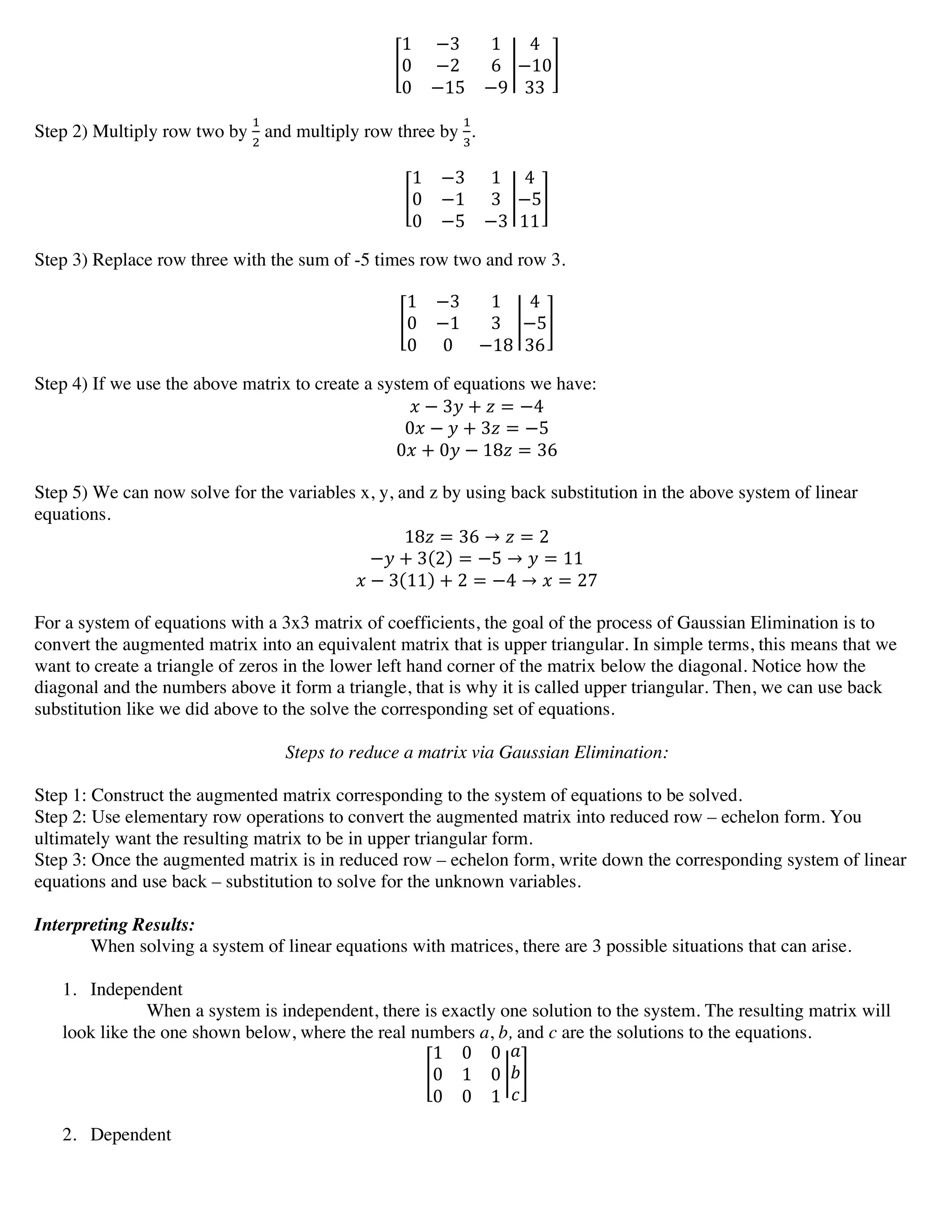
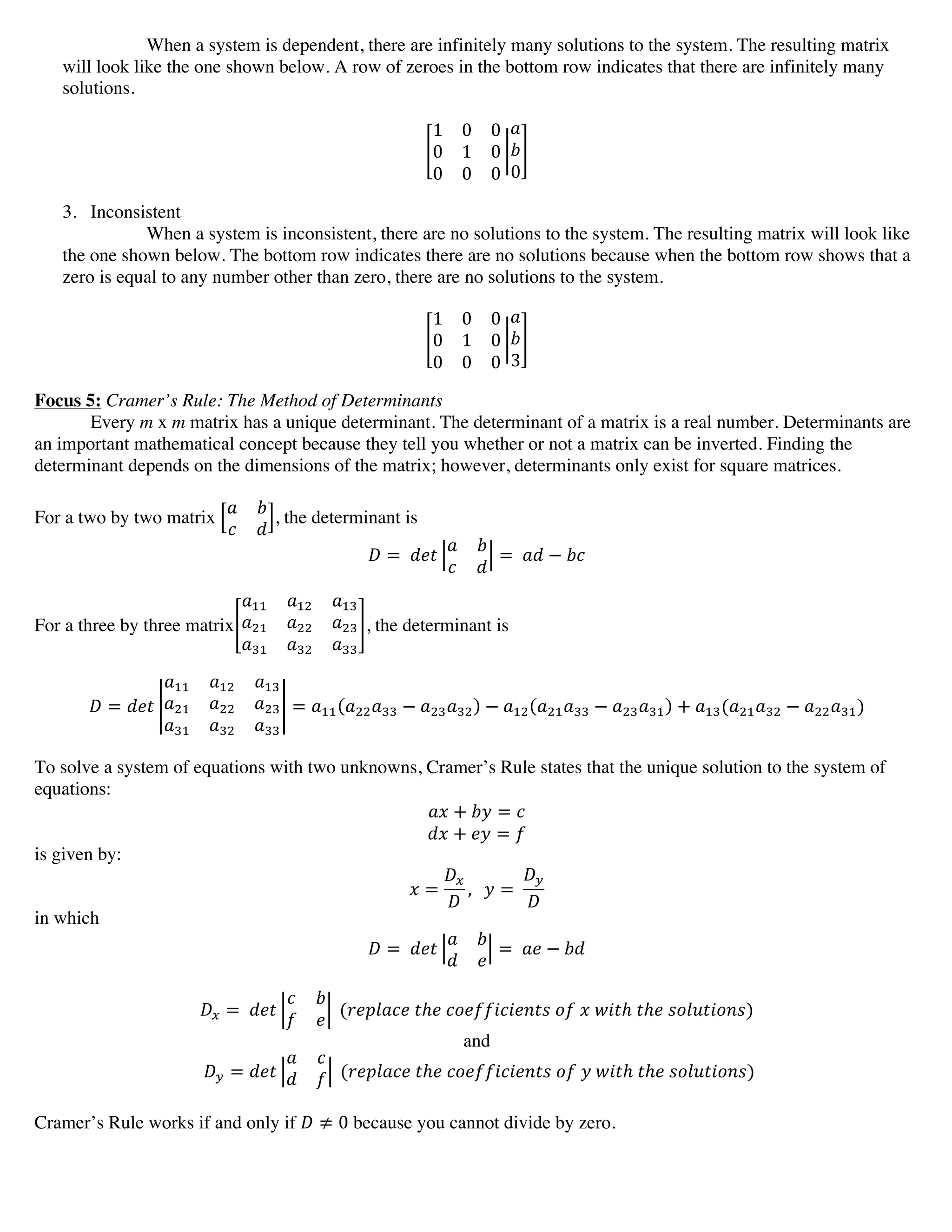
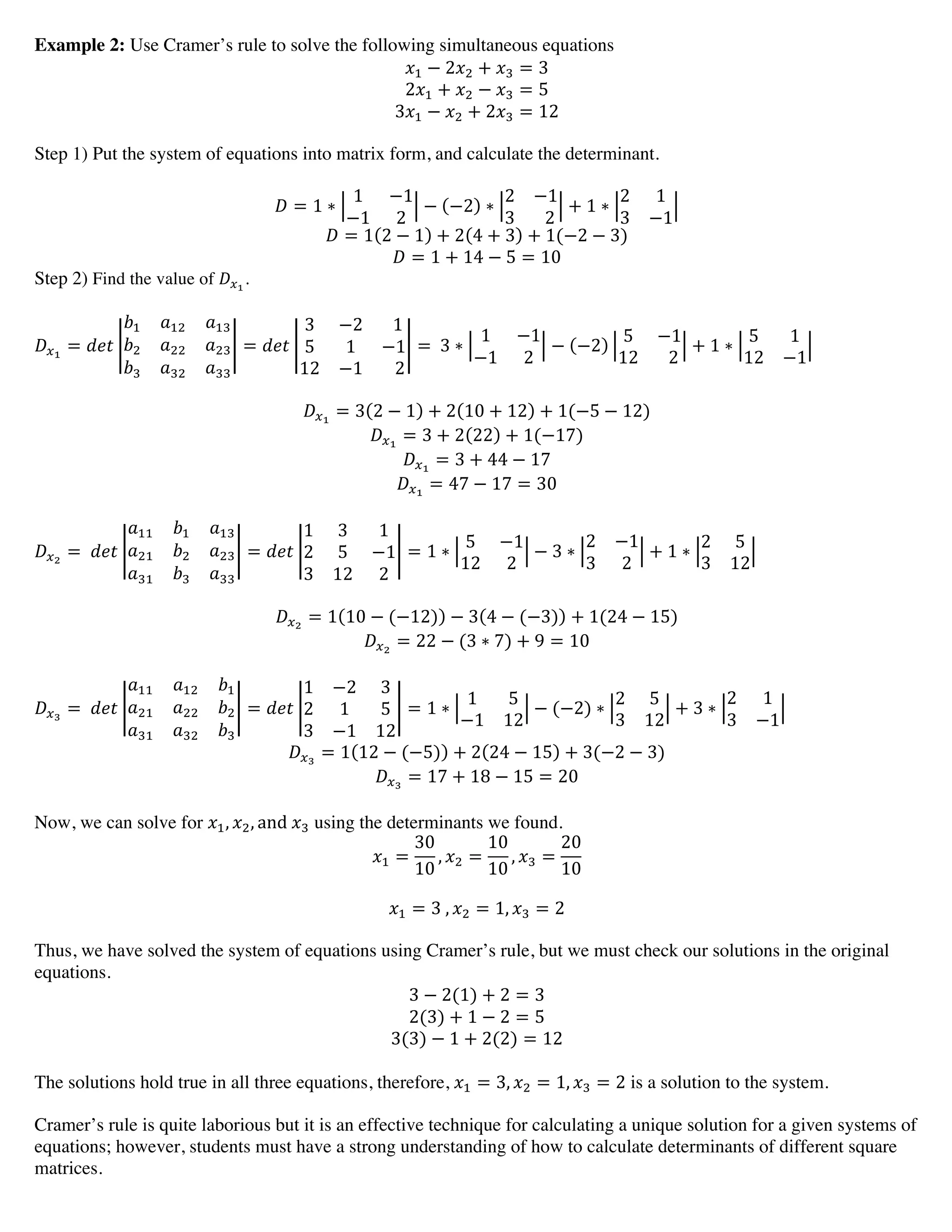
The document discusses solving simultaneous equations through various methods. It begins by providing context about the history of simultaneous equations and important definitions. It then focuses on 6 key techniques: 1) using properties of parallel lines to determine the number of solutions, 2) graphing the lines to find their point of intersection, 3) using substitution and elimination to solve algebraically, 4) applying matrix operations like Gauss-Jordan elimination, 5) using Cramer's rule with determinants, and 6) examples of real-world applications. The student had correctly identified that the lines in the given system of equations were parallel based on having the same slope, indicating no solution.
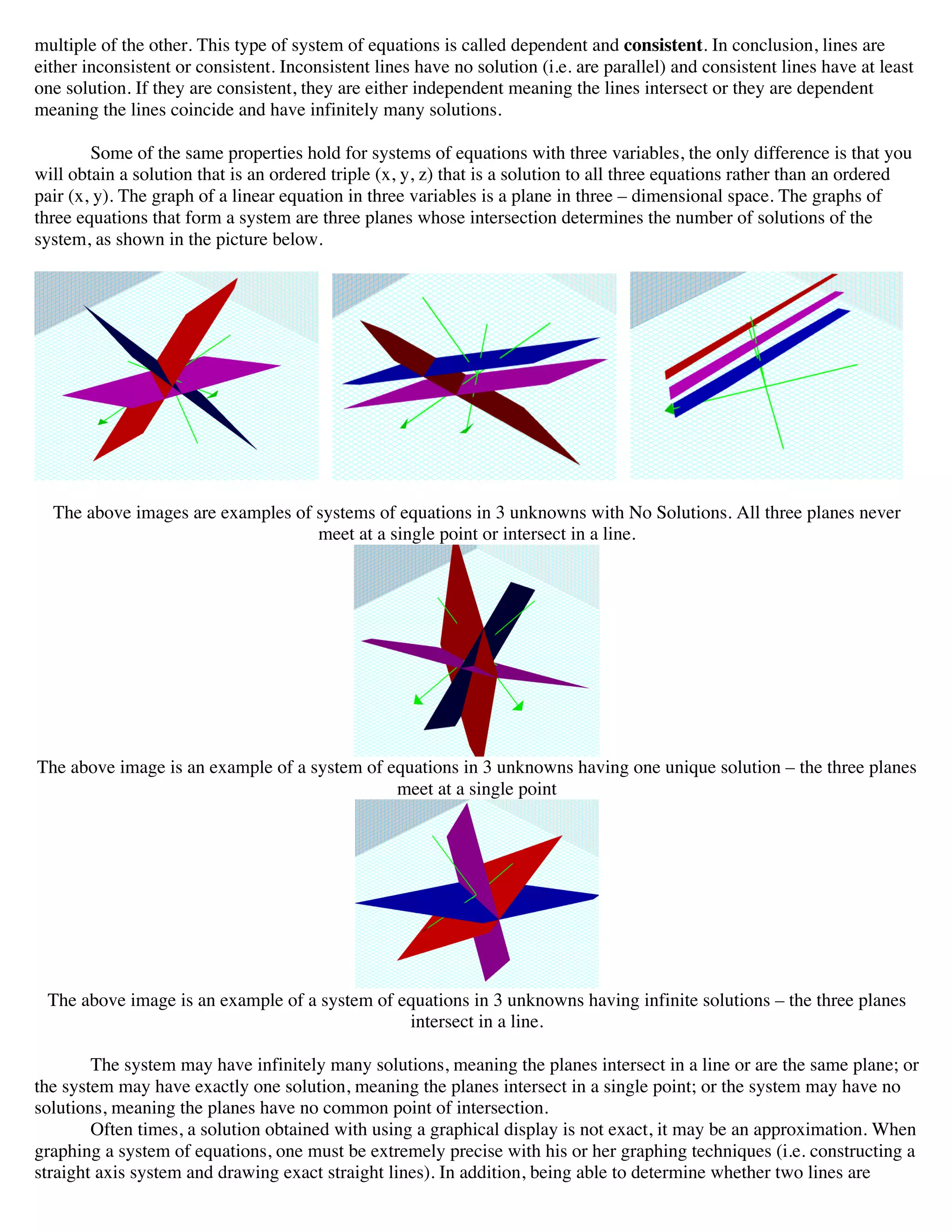
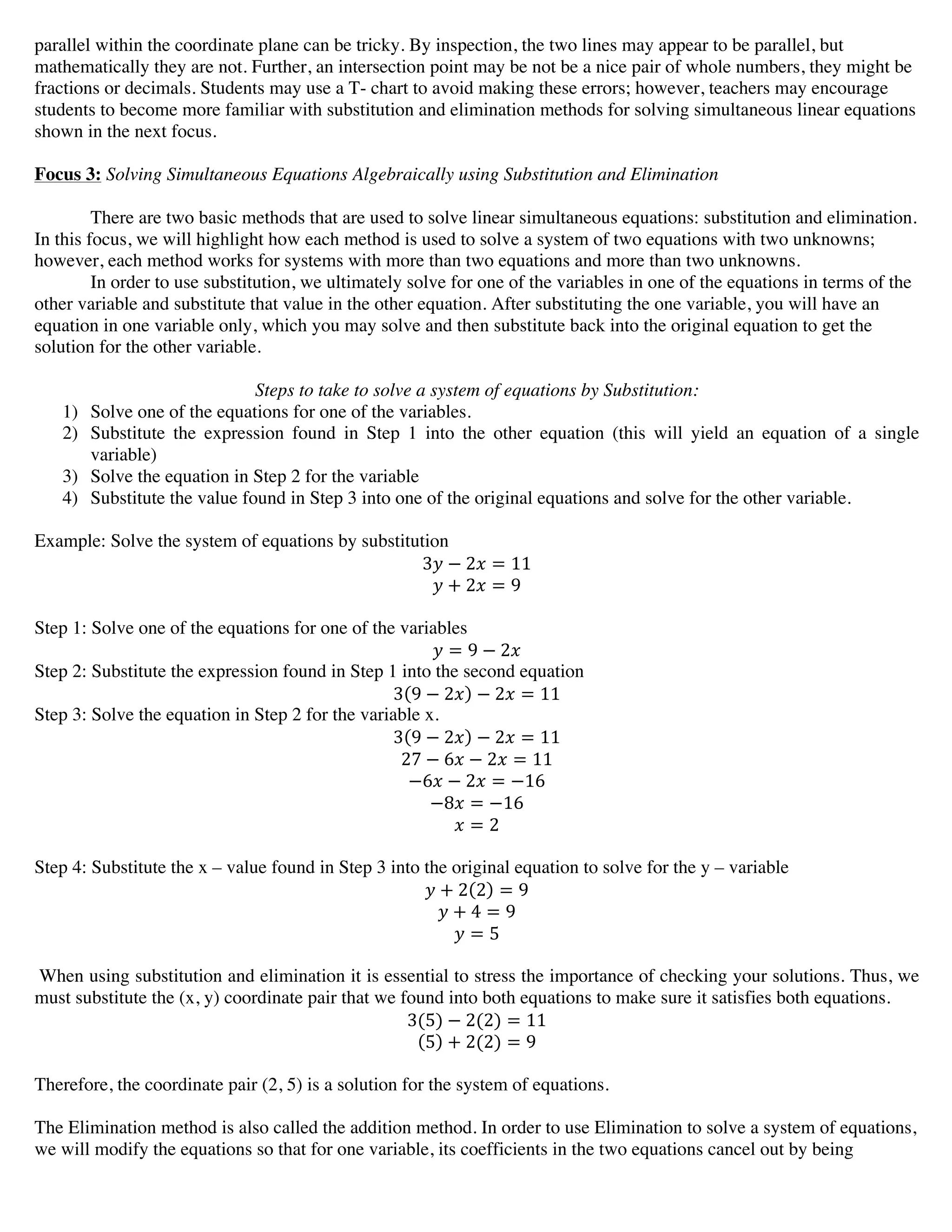
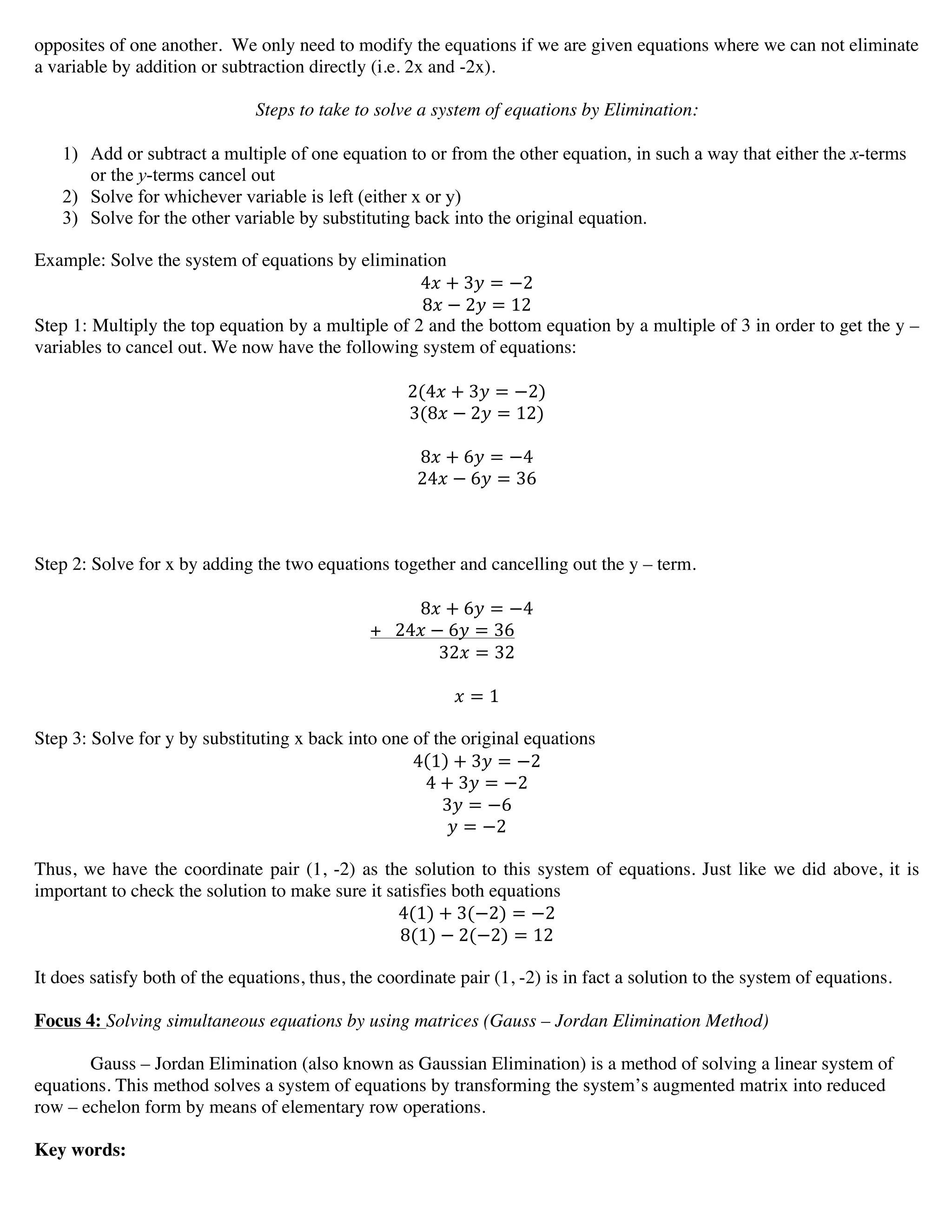
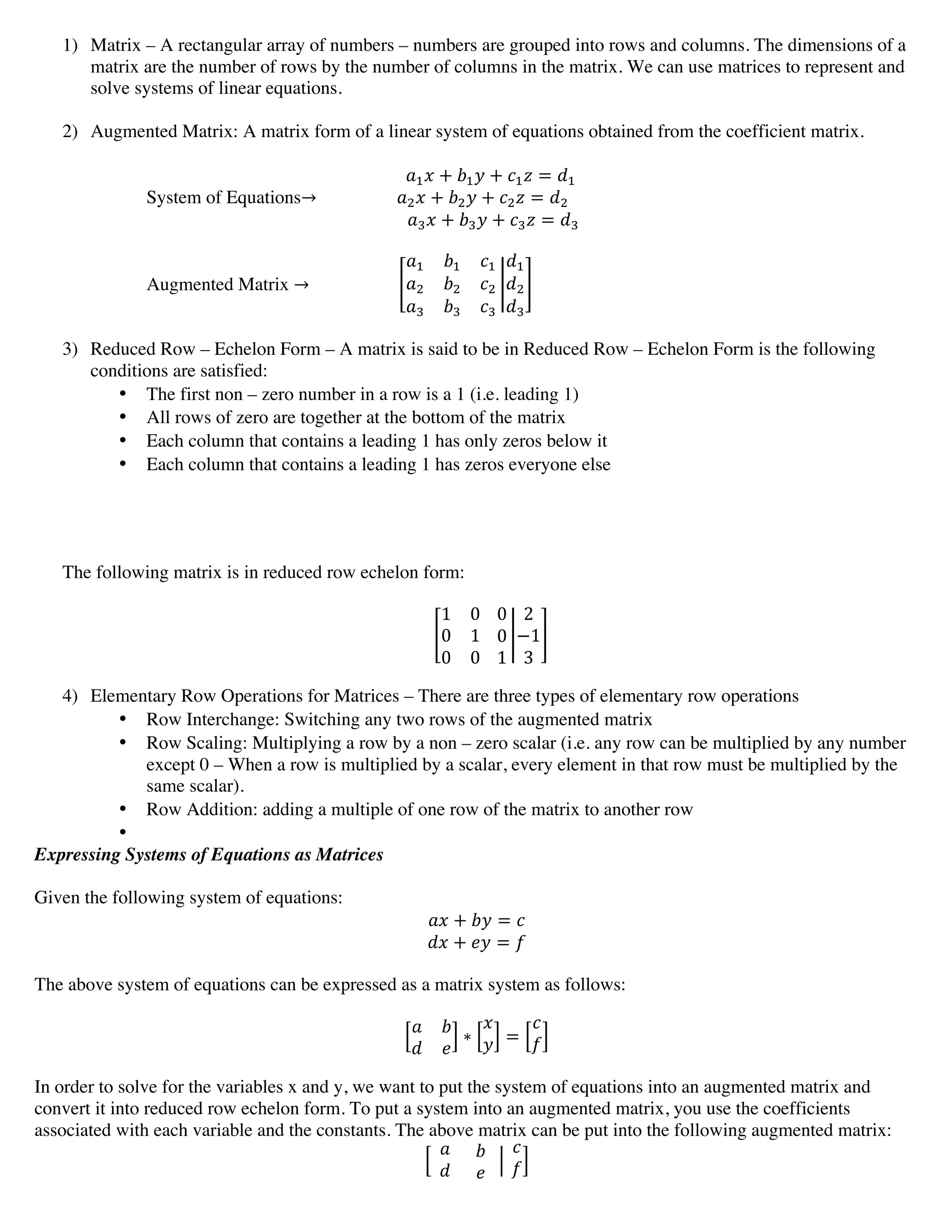


![! = 23
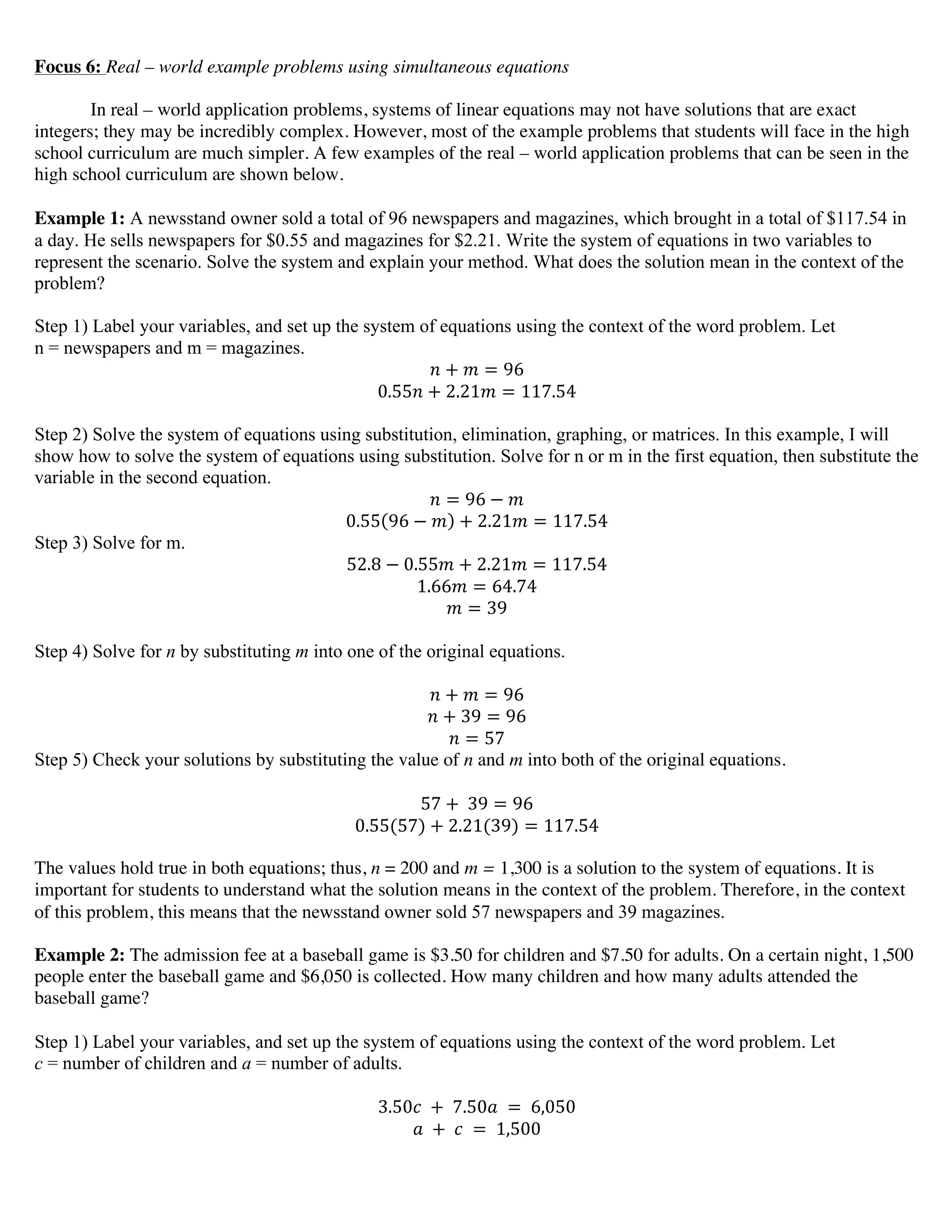
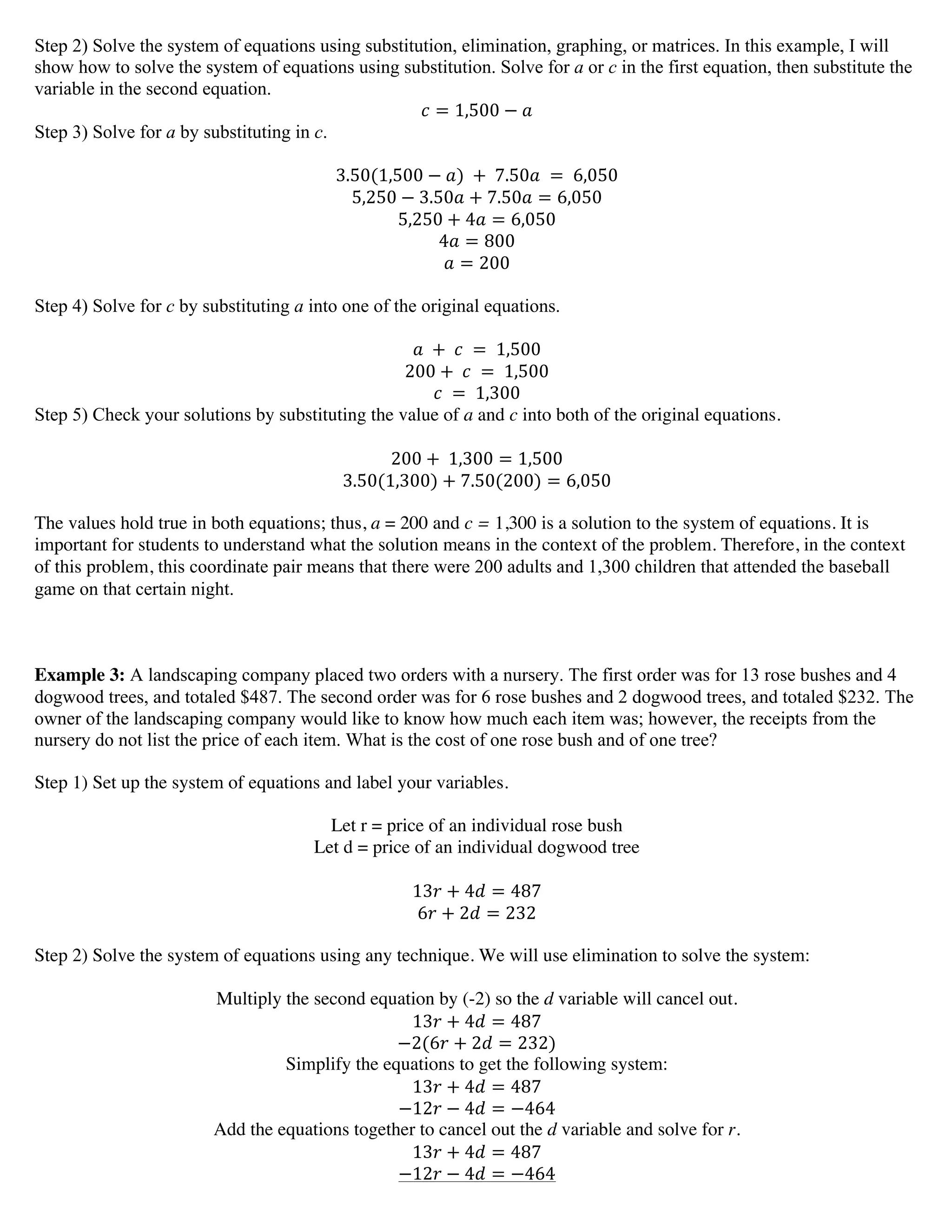
Step 3) Substitute r into one of the original equations and solve for d.
13(23) + 4! = 487
299 + 4! = 487
4! = 188
! = 47
Step 4) Check your solutions by substituting the value of r and d into both of the original equations.
13(23) + 4(47) = 487
6 23 + 2(47) = 232
The values hold true in both equations; thus, r = 23 and d = 47 is a solution to the system of equations. It is important
for students to understand what the solution means in the context of the problem. Therefore, in the context of this
problem, this solution means that the price for one rose bush was 23 dollars and the price for one dogwood tree was
47 dollars.
Post Commentary:
In mathematics, linear systems serve as a fundamental basis for linear algebra. Having a strong understanding
of how to manipulate variables and simplify equations is needed for higher-level mathematics. A few topics that were
not emphasized throughout this document were the inverses of matrices, eigenvalues, eigenvectors, and how the
determinant is related to each of these concepts. Each of these concepts is stressed within higher mathematics; thus,
these topics may serve as extensions to this situation. Further, not only are systems of equations taught in the high
school curriculum but also systems of inequalities are an important concept. Thus, having solid background
knowledge of the properties of systems of inequalities may be helpful in teaching this situation as well. Additionally,
a concept that was not covered within this document is the concept of equivalent systems. Two linear systems using
the same set of variables are equivalent if each of the equations in the second system can be derived algebraically
from the equations in the first system, and vice-versa. In addition, two linear systems are equivalent if and only if they
have the same solution set. Therefore, these topics could be discussed in further detail.
References:
Binegar, B. (n.d.). Solving systems of linear equations. [PDF document]. Retrieved from Lecture 5 Notes Online
Website: http://www.math.okstate.edu/~binegar/3013-S99/3013-l05.pdf, accessed 6 July, 2013.
Joyce, D. (1996). Simultaneous linear equations. [html document]. Retrieved from Lecture Notes Online Website:
http://www.clarku.edu/~djoyce/ma105/simultaneous.html , accessed 9 July, 2013.
Missouri Western State University. (2013). Solving systems of equations using matrices with the TI – 83 or TI – 84.
Retrieved from: http://www.missouriwestern.edu/cas/documents/MatricesonTI2013.pdf,accessed 8 July, 2013.
Spector, L. (2013). Simultaneous equations: Cramer’s rule - the method of determinants.
Retrieved from http://www.themathpage.com/alg/simultaneous-equations-2.htm , accessed 5 July, 2013.
Stein, A. (2013). Solving systems of linear equations. [PDF document]. Retrieved from Lecture Notes Online
Website: http://www.math.uconn.edu/~stein/math1070/Slides/math1070-130notes.pdf, accessed 9 July, 2013.
Webb, S. (1999). Cramer’s rule for solving simultaneous linear equations. [PDF document]. Retrieved from
Loughborough University Online Website:
http://www3.ul.ie/~mlc/support/Loughborough%20website/chap8/8_1.pdf, accessed 11 July, 2013.](https://image.slidesharecdn.com/simultaneousequationsfinal2-230215152716-9ef98a38/75/SimultaneousEquationsFINAL2-pdf-16-2048.jpg)


