Linear Equations In
Two Variables
Class-09
FA-3 (2014-2015)
Linear Equations In
Two Variables
“ The principal use of the analytic art is
to bring mathematical problem to
equations and to exhibit those
equations in the most simple terms
that can be .”
Contents
• Introduction
• Linear equations
• Points for solving a linear equation
• Solution of a linear equation
• Graph of a linear equation in two variables
• Equations of lines parallel to x-axis and
y-axis
• Examples and solutions
• Summary
Introduction
• An excellent characteristic
of equations in two
variables is their adaptability
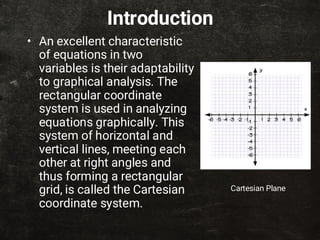
to graphical analysis. The
rectangular coordinate
system is used in analyzing
equations graphically. This
system of horizontal and
vertical lines, meeting each
other at right angles and
thus forming a rectangular
grid, is called the Cartesian
coordinate system.
Cartesian Plane
Introduction
• A simple linear equation is
an equality between two
algebraic expressions
involving an unknown
value called the variable.
In a linear equation the
exponent of the variable is
always equal to 1. The
two sides of an equation
are called Right Hand Side
(RHS) and Left-Hand Side
(LHS). They are written on
either side of equal sign.
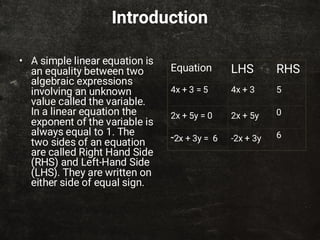
Equation LHS RHS
4x + 3 = 5 4x + 3 5
2x + 5y = 0 2x + 5y 0
-2x + 3y = 6 -2x + 3y 6
Cont…
• A linear equation in
two variables can be
written in the form of
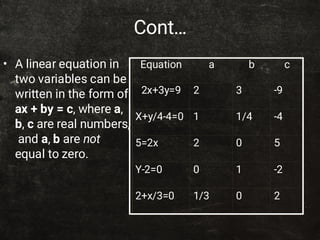
ax + by = c, where a,
b, c are real numbers,
and a, b are
equal to zero.
Equation a b c
2x+3y=9 2 3 -9
X+y/4-4=0 1 1/4 -4
5=2x 2 0 5
Y-2=0 0 1 -2
2+x/3=0 1/3 0 2
Linear equation :-
• A linear equation is an algebraic equation in which each
term is either a constant or the product of a constant and
a single variable. Linear equations can have one or more
variables. Linear equations occur with great regularity in
applied mathematics. While they arise quite naturally
when modeling many phenomena, they are particularly
useful since many non-linear equations may be reduced
to linear equations by assuming that quantities of interest
vary to only a small extent from some "background" state
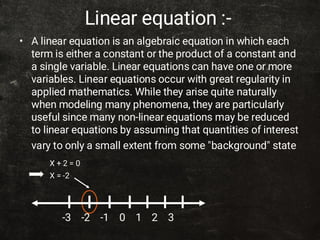
-3 -2 -1 0 1 2 3
X + 2 = 0
X = -2
Solution of a linear equation
Every linear equation has a unique
solution as there is a single
variable in the equation to be
solved but in a linear equation
involving two variables in the
equation, a solution means a pair
of values, one for x and one for y
which satisfy the given equation
Example- p (x)=2x+3y (1)
y in terms of x
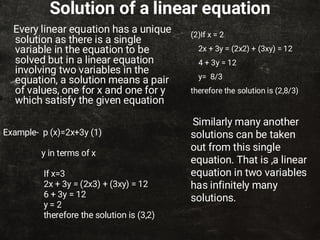
If x=3
2x + 3y = (2x3) + (3xy) = 12
6 + 3y = 12
y = 2
therefore the solution is (3,2)
(2)If x = 2
2x + 3y = (2x2) + (3xy) = 12
4 + 3y = 12
y= 8/3
therefore the solution is (2,8/3)
Similarly many another
solutions can be taken
out from this single
equation. That is ,a linear
equation in two variables
has infinitely many
solutions.
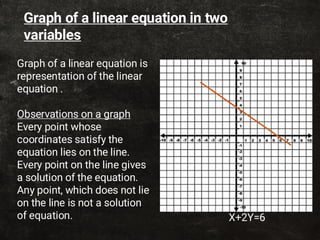
Graph of a linear equation is
representation of the linear
equation .
Observations on a graph
Every point whose
coordinates satisfy the
equation lies on the line.
Every point on the line gives
a solution of the equation.
Any point, which does not lie
on the line is not a solution
of equation. X+2Y=6
Graph of a linear equation in two
variables
A linear equation in one variable
represents a point on a number
line and a straight line parallel to
any of the axes in a coordinate
plane.
• Example 1:
Represent the equation 2 + 3 = 0 graphically
on the number line in the Cartesian plane
• Solution:
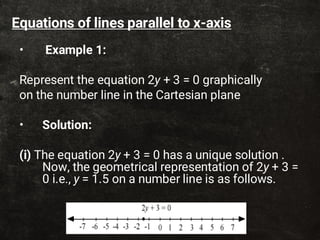
(i) The equation 2 + 3 = 0 has a unique solution .
Now, the geometrical representation of 2 + 3 =
0 i.e., = 1.5 on a number line is as follows.
Equations of lines parallel to x-axis
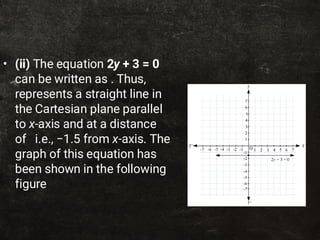
• (ii) The equation 2 + 3 = 0
can be written as . Thus,
represents a straight line in
the Cartesian plane parallel
to -axis and at a distance
of i.e., −1.5 from -axis. The
graph of this equation has
been shown in the following
figure
Equations of lines parallel to y-axis
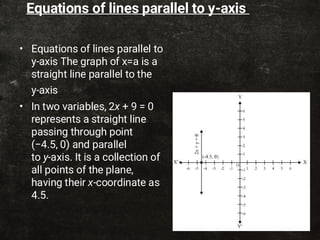
• Equations of lines parallel to
y-axis The graph of x=a is a
straight line parallel to the
y-axis
• In two variables, 2 + 9 = 0
represents a straight line
passing through point
(−4.5, 0) and parallel
to -axis. It is a collection of
all points of the plane,
having their -coordinate as
4.5.
Summary
• An equation of the form ax +by + c =0,wherea,b and c are real
numbers, such that a and b are not both zero, is called a linear
equation in two variables.
• A linear equation in two variables has infinitely many solutions.
• The graph of every linear equation in two variables is a straight line.
• X=0 is the equation of the y-axis and y=0 is the equation of the x-axis
• The graph of x=a is a straight line parallel to the y-axis.
• The graph of y=a is a straight line parallel to the x-axis.
• An equation of the type y=mx represents a line passing through the
origin.
• Every point on the graph of a linear equation in two variables is a
solution of the linear equation.
• Every solution of the linear equation is a point on the graph of the
linear equation.
Thank You
Done by: IX
MANOJ GOWDA.M.L

Linear equation in one variable PPT.pdf

  • 1.
    Linear Equations In TwoVariables Class-09 FA-3 (2014-2015)
  • 2.
    Linear Equations In TwoVariables “ The principal use of the analytic art is to bring mathematical problem to equations and to exhibit those equations in the most simple terms that can be .”
  • 3.
    Contents • Introduction • Linearequations • Points for solving a linear equation • Solution of a linear equation • Graph of a linear equation in two variables • Equations of lines parallel to x-axis and y-axis • Examples and solutions • Summary
  • 4.
    Introduction • An excellentcharacteristic of equations in two variables is their adaptability to graphical analysis. The rectangular coordinate system is used in analyzing equations graphically. This system of horizontal and vertical lines, meeting each other at right angles and thus forming a rectangular grid, is called the Cartesian coordinate system. Cartesian Plane
  • 5.
    Introduction • A simplelinear equation is an equality between two algebraic expressions involving an unknown value called the variable. In a linear equation the exponent of the variable is always equal to 1. The two sides of an equation are called Right Hand Side (RHS) and Left-Hand Side (LHS). They are written on either side of equal sign. Equation LHS RHS 4x + 3 = 5 4x + 3 5 2x + 5y = 0 2x + 5y 0 -2x + 3y = 6 -2x + 3y 6
  • 6.
    Cont… • A linearequation in two variables can be written in the form of ax + by = c, where a, b, c are real numbers, and a, b are equal to zero. Equation a b c 2x+3y=9 2 3 -9 X+y/4-4=0 1 1/4 -4 5=2x 2 0 5 Y-2=0 0 1 -2 2+x/3=0 1/3 0 2
  • 7.
    Linear equation :- •A linear equation is an algebraic equation in which each term is either a constant or the product of a constant and a single variable. Linear equations can have one or more variables. Linear equations occur with great regularity in applied mathematics. While they arise quite naturally when modeling many phenomena, they are particularly useful since many non-linear equations may be reduced to linear equations by assuming that quantities of interest vary to only a small extent from some "background" state -3 -2 -1 0 1 2 3 X + 2 = 0 X = -2
  • 8.
    Solution of alinear equation Every linear equation has a unique solution as there is a single variable in the equation to be solved but in a linear equation involving two variables in the equation, a solution means a pair of values, one for x and one for y which satisfy the given equation Example- p (x)=2x+3y (1) y in terms of x If x=3 2x + 3y = (2x3) + (3xy) = 12 6 + 3y = 12 y = 2 therefore the solution is (3,2) (2)If x = 2 2x + 3y = (2x2) + (3xy) = 12 4 + 3y = 12 y= 8/3 therefore the solution is (2,8/3) Similarly many another solutions can be taken out from this single equation. That is ,a linear equation in two variables has infinitely many solutions.
  • 9.
    Graph of alinear equation is representation of the linear equation . Observations on a graph Every point whose coordinates satisfy the equation lies on the line. Every point on the line gives a solution of the equation. Any point, which does not lie on the line is not a solution of equation. X+2Y=6 Graph of a linear equation in two variables
  • 10.
    A linear equationin one variable represents a point on a number line and a straight line parallel to any of the axes in a coordinate plane.
  • 11.
    • Example 1: Representthe equation 2 + 3 = 0 graphically on the number line in the Cartesian plane • Solution: (i) The equation 2 + 3 = 0 has a unique solution . Now, the geometrical representation of 2 + 3 = 0 i.e., = 1.5 on a number line is as follows. Equations of lines parallel to x-axis
  • 12.
    • (ii) Theequation 2 + 3 = 0 can be written as . Thus, represents a straight line in the Cartesian plane parallel to -axis and at a distance of i.e., −1.5 from -axis. The graph of this equation has been shown in the following figure
  • 13.
    Equations of linesparallel to y-axis • Equations of lines parallel to y-axis The graph of x=a is a straight line parallel to the y-axis • In two variables, 2 + 9 = 0 represents a straight line passing through point (−4.5, 0) and parallel to -axis. It is a collection of all points of the plane, having their -coordinate as 4.5.
  • 14.
    Summary • An equationof the form ax +by + c =0,wherea,b and c are real numbers, such that a and b are not both zero, is called a linear equation in two variables. • A linear equation in two variables has infinitely many solutions. • The graph of every linear equation in two variables is a straight line. • X=0 is the equation of the y-axis and y=0 is the equation of the x-axis • The graph of x=a is a straight line parallel to the y-axis. • The graph of y=a is a straight line parallel to the x-axis. • An equation of the type y=mx represents a line passing through the origin. • Every point on the graph of a linear equation in two variables is a solution of the linear equation. • Every solution of the linear equation is a point on the graph of the linear equation.
  • 15.
    Thank You Done by:IX MANOJ GOWDA.M.L