IJRET: International Journal of Research in Engineering and Technology eISSN: 2319-1163 | pISSN: 2321-7308
_______________________________________________________________________________________
Volume: 03 Issue: 06 | Jun-2014, Available @ http://www.ijret.org 36
SIMULATION OF SOLAR INTENSITY IN PERFORMANCE OF FLAT
PLATE COLLECTOR
A.Ponshanmugakumar1
, A. Aldrich Vincent2
Abstract
Solar collectors behave differently at different radiations and temperatures. The system consists of solar thermal collectors, a
storage and circulation pump of water to carry the heat to its applications. The results of the simulations show that, the efficiency
of flat plate collectors can be used for domestic purposes in Tamil Nadu at different geographic locations by adjusting the
characteristics of system components to obtain results. It also helps in determining the location which generates optimum solar
energy. This study intends to focus on the performance of flat plate collectors in a simulation environment using TRNSYS and
solar radiation data collected for 7 stations in Tamil Nadu
Keywords: Flat Plate Collector (FPC), TRNSYS, Solar Intensity
---------------------------------------------------------------------***-------------------------------------------------------------------
1. INTRODUCTION
In the recent years the energy production is the major
problem. Their cost and the pollution while consuming
fossil fuels. The depreciation of fuels is also a major
frightening issue. But fossil fuels are the most commonly
used and depend fuels. So in order to reduce the problem the
rulers has encouraging for the alternative energy sources. It
is most commonly called as renewable energy sources and it
has no pollution, regenerative type and also safe generation
of power. Among all the alternative energy sources solar
energy has a high impact on energy production
1.1 Solar Radiation
The spectrum of electromagnetic wave radiation produced
by sun is solar radiation. The earth’s atmosphere deflects or
filters the majority of the sun’s damaging radiation. About
part of the radiation is in the observable short-wave division
of the electromagnetic range. The other half is mostly in the
infrared part, with some in the ultraviolet.
1.2 Characteristics of Solar Radiation
The part of solar radiation is intercepted by the earth’s outer
atmosphere. The statistical relation formulated between the
daily duration of sunshine N and the daily total global solar
radiation G is of the form,
𝑮
𝑮 𝒐
= 𝒂 + 𝟏 − 𝒂
𝒏
𝑵
(1.1)
Where, Go is the daily global solar radiation with cloud free
atmosphere, ‘a’ is mean proportion of radiation on an
entirely overcast day, and N; maximum period of sunshine.
Due to the difficulties in the defined estimation of Go in the
above equation, Go was replaced by the celestial radiation
(ECR), it is given by,
𝐺
𝐸𝑇𝑅
= 𝑎 + 𝑏
𝑛
𝑁
(1.2)
1.3 Flat Plate Collectors
The flat plate collectors ar5e most commonly used in the
domestic hot water system on the roof tops. They consist of
a black coated absorber, a transparent acrylic cover that
reduces heat losses, a heat transfer fluid to extract heat from
the absorber, and a heat insulating packing. In water heat
panels, fluid is usually circulated through tubes to transfer
heat from the absorber to an insulated storage tank. This
may be achieved directly or through a heat exchanger.
Fig 1 Flat plate collectors
Hilmer et al. 1999 presented a method to calculate
numerically the solar collector with varying parameters [1].
Zuefa and Magiera 2001 published an experimental study in
the more uniform for the flow distribution, the higher the
collector efficiency. But uniform flow distributions are not
possible in solar collectors [2]. Fan et al. 2007 investigated
both experimentally and theoretically the finned tube flat
plate collector. They analyzed numerically by CFD and got
results which oriented with experiment results [3].
Augustus and Kumar 2006 developed mathematical model
for an unglazed perforated flat plate collector. They
developed an empirical relation for various components.
They proved the improved results of absorptivity, heat
transfer and air flow rate[4]. Molero et al. 2009 presented a
IJRET: International Journal of Research in Engineering and Technology eISSN: 2319-1163 | pISSN: 2321-7308
_______________________________________________________________________________________
Volume: 03 Issue: 06 | Jun-2014, Available @ http://www.ijret.org 37
3-D numerical model for flat-plate solar collector
considering the transient conditions like flow characteristics.
But this un-uniform flow does not make huge effect in
collector efficiency. When the dimensions of the tube
increases with the flow increases with due change in
collector efficiency [5].
Anderson et al 2009[6] examined the performance by
changing the colours of solar collector. Based on the
transmittance-absorptance result of various colored
collectors the hypothetical performances of these collectors
were calculated using the Hottel-Whillier-Bliss 1-D steady-
state model given by Duffie and Beckmann 2006[7]. By
these experiments they concluded that the colour of the
collector plays a major role in thermal efficiencies of the
collectors.
Fig 2 Irradiation data of Flat plate collector
1.4 Domestic Hot Water System (DHWS)
Fig 3 Schematic diagram of solar water heating system
The various day of the year weather data’s are absorbed by
the solar collector (A). Flat Plate Collector (FPC) were
connected in array in parallel arrangements. To improve the
hot water system performance and to study the stratification
of the storage tank a hot water storage tank (B) was used
here. As a outcome, a temperature variation between the top
and the bottom parts of the tank arises the density variation
between top and bottom. The high density fluid come to the
bottom side and the low density fluid to the top of the tank.
An on/off differential controller (C) is use to control the
temperature variation between TOColl and TBottom. Controlling
the temperature can have a significant effect on the final
result. In this case, the TOColl is adjusted as the Upper input
temperature Th, TBottom is adjusted as Lower input
temperature Tl and TTOP is adjusted as Monitoring
temperature Tin. The temperature data’s from hot and cold
water side sends the appropriate signal to the pump
according to the dead bands. There is a high limit cut out
temperature that can be defined as desired.
2. SYSTEM AND MATHEMATICAL MODEL
2.1 Solar Collectors
The flat plate collector (quadratic efficiency) Type 1b is
selected from TRNSYS component libraries. This
component models the thermal performance of a flat- plate
solar collector. The number of modules in series and the
characteristics of each module determine the thermal
performance of the collector array. Equation 1 gives the
solar collector thermal efficiency.
ηcol = m .cp (To-col - Ti-col) / Acol It (i)
TRNSYS models of solar collectors have different types of
functions named parameters, inputs and outputs. A
parameter value function is specifically related to the
manufacturer (Thermo Dynamics Ltd.). These values need
to be input according to manufacturer specifications. An
input value function has a value that depends upon the test
conditions, such as collector slope, orientation, etc. Some
inputs and all outputs have a ‘linked’ value, which means
that this function has values, which are linked to other
components and will be determined by the real time flow.
2.2Theoretical Flat-Plate Collector
The energy compilation of each component in an array of Ns
modules in series is modeled according to the Hottel-
Whillier equation such that (j is the module number):
Qu =
A
Ns
FRj
Ns
j=1 IT ταa − ULj Tij − Ta (ii)
Where FR,j can be explained as follows:
𝐹𝑅𝑗 =
𝑁 𝑠 𝑚 𝑐 𝐶 𝑝𝑐
𝐴𝑈 𝐿𝑗
1 − 𝑒𝑥𝑝 −
𝐹𝑈 𝐿𝑗 𝐴
𝑁 𝑠 𝑚 𝑐 𝐶 𝑝𝑐
(iii)
The following expression, developed by Klein, is used to
approximate UL,j(in KJ/h-m2-K). Equation (iii) is described
as:
𝐔 𝐋𝐣 =
𝟑.𝟔
𝐍 𝐆
𝐂
𝐓 𝐩𝐣
𝐓 𝐚𝐯𝐣−𝐓 𝐚
𝐍 𝐆+𝐟
.𝟑𝟑
+
𝟏
𝐡 𝐰
+
𝟑.𝟔𝛔 𝐓 𝐚𝐯𝐣
𝟐
+𝐓 𝐚
𝟐 𝐓 𝐚𝐯𝐣+𝐓 𝐚
𝟏
𝛆 𝐩+.𝟎𝟓𝐍 𝐆 𝟏−𝛆 𝐩
+
𝟐𝐍 𝐆+𝐟−𝟏
𝛆 𝐠
−𝐍 𝐆
+ 𝐔 𝐛𝐞(iv)
And
Hw=5.7 +3.8 W (W/m2 – K) (v)
f = (1-0.04 hw + 0.0005 hw2) (1+0.091 NG) (vi)
IJRET: International Journal of Research in Engineering and Technology eISSN: 2319-1163 | pISSN: 2321-7308
_______________________________________________________________________________________
Volume: 03 Issue: 06 | Jun-2014, Available @ http://www.ijret.org 38
The overall transmittance – absorptance product is
determined as:
𝛕𝛂 𝐚 =
𝐈 𝐛𝐭 𝛕𝛂 𝐚 𝐛+𝐈 𝐝
𝟏+𝐜𝐨𝐬𝛃
𝟐
𝛕𝛂 𝐚 𝐬+𝛒𝐈
𝟏−𝐜𝐨𝐬𝛃
𝟐
𝛕𝛂 𝐚 𝐠
𝐈 𝐓
(vii)
Where Ibt is beam radiation incident on the solar collector, Id
is diffuse horizontal radiation and IT is global radiation
incident on the solar collector (Tilted surface). The outlet
temperature of one module is used as the inlet to the next
and is given as:
𝐓𝐨,𝐣 =
𝐀𝐅 𝐑𝐣 𝐈 𝐓 𝛕𝛂 𝐚 −𝐔 𝐋,𝐣 𝐓𝐢,𝐣−𝐓 𝐚
𝐍 𝐬 𝐦 𝐜 𝐂 𝐩𝐜
+ 𝐓𝐢 (viii)
If the collector flow is zero, the collector stagnation
temperature is:
𝑇𝑝 =
𝐼 𝑇 𝜏𝛼 𝑎
𝑈 𝐿
+ 𝑇𝑎 (ix)
2.3 Solar Radiation on a Tilted Surface
The amount of solar radiation incident on a tilted component
plane is the element of the incident solar radiation which is
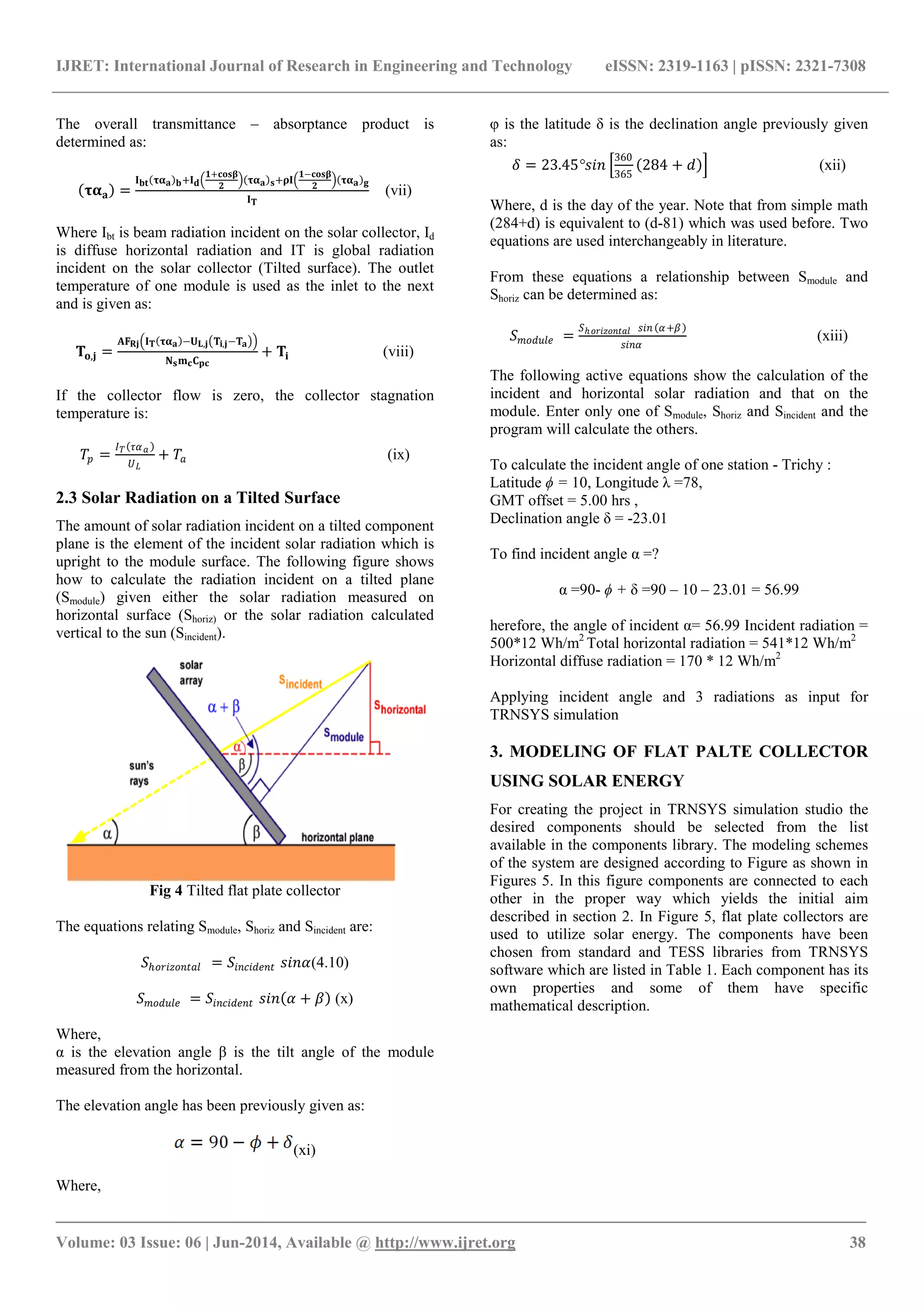
upright to the module surface. The following figure shows
how to calculate the radiation incident on a tilted plane
(Smodule) given either the solar radiation measured on
horizontal surface (Shoriz) or the solar radiation calculated
vertical to the sun (Sincident).
Fig 4 Tilted flat plate collector
The equations relating Smodule, Shoriz and Sincident are:
𝑆ℎ𝑜𝑟𝑖𝑧𝑜𝑛𝑡𝑎𝑙 = 𝑆𝑖𝑛𝑐𝑖𝑑𝑒𝑛𝑡 𝑠𝑖𝑛𝛼(4.10)
𝑆 𝑚𝑜𝑑𝑢𝑙𝑒 = 𝑆𝑖𝑛𝑐𝑖𝑑𝑒𝑛𝑡 𝑠𝑖𝑛 𝛼 + 𝛽 (x)
Where,
α is the elevation angle β is the tilt angle of the module
measured from the horizontal.
The elevation angle has been previously given as:
(xi)
Where,
φ is the latitude δ is the declination angle previously given
as:
𝛿 = 23.45°𝑠𝑖𝑛
360
365
284 + 𝑑 (xii)
Where, d is the day of the year. Note that from simple math
(284+d) is equivalent to (d-81) which was used before. Two
equations are used interchangeably in literature.
From these equations a relationship between Smodule and
Shoriz can be determined as:
𝑆 𝑚𝑜𝑑𝑢𝑙𝑒 =
𝑆ℎ 𝑜𝑟𝑖𝑧𝑜𝑛𝑡𝑎𝑙 𝑠𝑖𝑛 𝛼+𝛽
𝑠𝑖𝑛𝛼
(xiii)
The following active equations show the calculation of the
incident and horizontal solar radiation and that on the
module. Enter only one of Smodule, Shoriz and Sincident and the
program will calculate the others.
To calculate the incident angle of one station - Trichy :
Latitude ϕ = 10, Longitude λ =78,
GMT offset = 5.00 hrs ,
Declination angle δ = -23.01
To find incident angle α =?
α =90- ϕ + δ =90 – 10 – 23.01 = 56.99
herefore, the angle of incident α= 56.99 Incident radiation =
500*12 Wh/m2
Total horizontal radiation = 541*12 Wh/m2
Horizontal diffuse radiation = 170 * 12 Wh/m2
Applying incident angle and 3 radiations as input for
TRNSYS simulation
3. MODELING OF FLAT PALTE COLLECTOR
USING SOLAR ENERGY
For creating the project in TRNSYS simulation studio the
desired components should be selected from the list
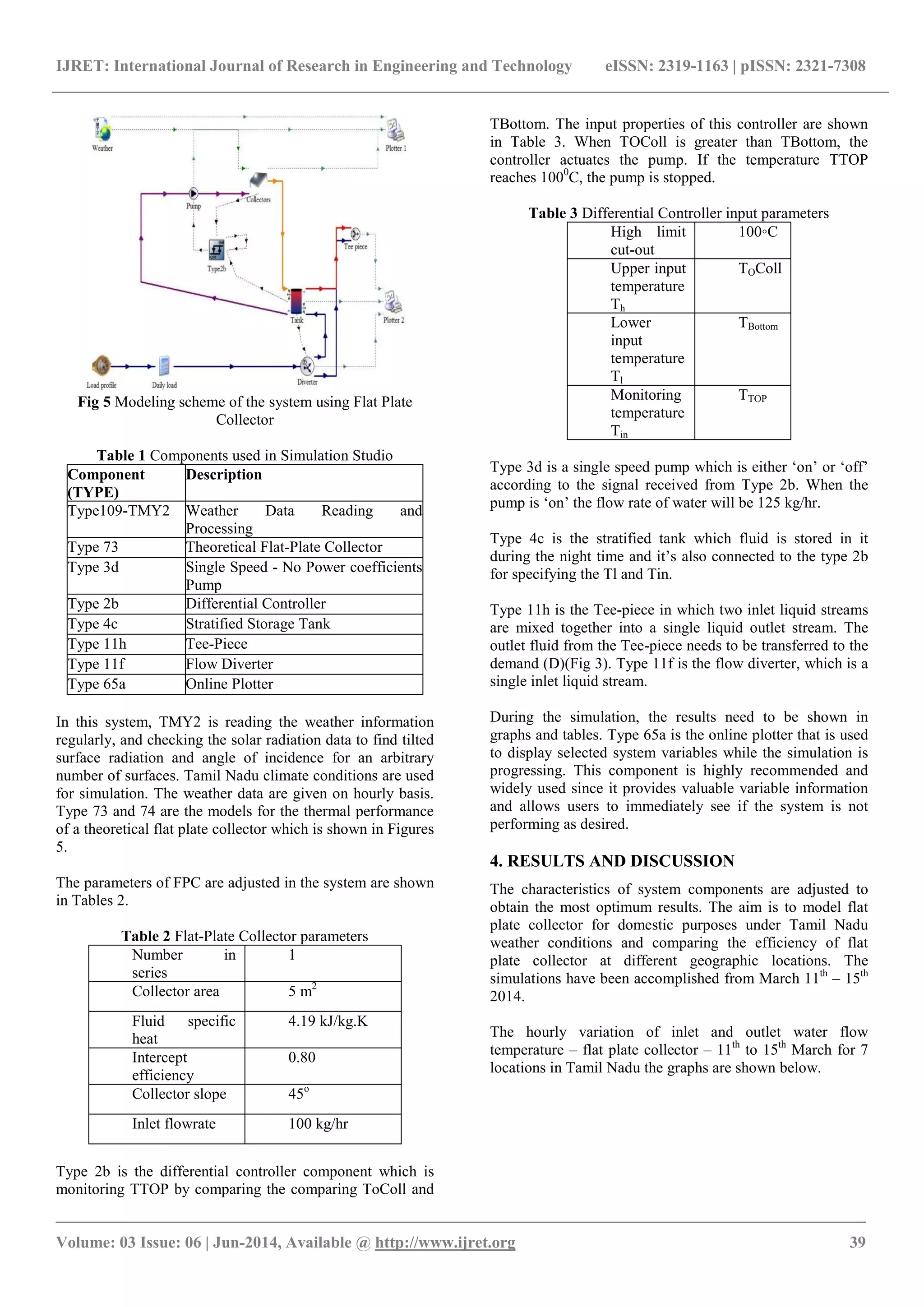
available in the components library. The modeling schemes
of the system are designed according to Figure as shown in
Figures 5. In this figure components are connected to each
other in the proper way which yields the initial aim
described in section 2. In Figure 5, flat plate collectors are
used to utilize solar energy. The components have been
chosen from standard and TESS libraries from TRNSYS
software which are listed in Table 1. Each component has its
own properties and some of them have specific
mathematical description.
IJRET: International Journal of Research in Engineering and Technology eISSN: 2319-1163 | pISSN: 2321-7308
_______________________________________________________________________________________
Volume: 03 Issue: 06 | Jun-2014, Available @ http://www.ijret.org 39
Fig 5 Modeling scheme of the system using Flat Plate
Collector
Table 1 Components used in Simulation Studio
Component
(TYPE)
Description
Type109-TMY2 Weather Data Reading and
Processing
Type 73 Theoretical Flat-Plate Collector
Type 3d Single Speed - No Power coefficients
Pump
Type 2b Differential Controller
Type 4c Stratified Storage Tank
Type 11h Tee-Piece
Type 11f Flow Diverter
Type 65a Online Plotter
In this system, TMY2 is reading the weather information
regularly, and checking the solar radiation data to find tilted
surface radiation and angle of incidence for an arbitrary
number of surfaces. Tamil Nadu climate conditions are used
for simulation. The weather data are given on hourly basis.
Type 73 and 74 are the models for the thermal performance
of a theoretical flat plate collector which is shown in Figures
5.
The parameters of FPC are adjusted in the system are shown
in Tables 2.
Table 2 Flat-Plate Collector parameters
Number in
series
1
Collector area 5 m2
Fluid specific
heat
4.19 kJ/kg.K
Intercept
efficiency
0.80
Collector slope 45o
Inlet flowrate 100 kg/hr
Type 2b is the differential controller component which is
monitoring TTOP by comparing the comparing ToColl and
TBottom. The input properties of this controller are shown
in Table 3. When TOColl is greater than TBottom, the
controller actuates the pump. If the temperature TTOP
reaches 1000
C, the pump is stopped.
Table 3 Differential Controller input parameters
High limit
cut-out
100◦C
Upper input
temperature
Th
TOColl
Lower
input
temperature
Tl
TBottom
Monitoring
temperature
Tin
TTOP
Type 3d is a single speed pump which is either ‘on’ or ‘off’
according to the signal received from Type 2b. When the
pump is ‘on’ the flow rate of water will be 125 kg/hr.
Type 4c is the stratified tank which fluid is stored in it
during the night time and it’s also connected to the type 2b
for specifying the Tl and Tin.
Type 11h is the Tee-piece in which two inlet liquid streams
are mixed together into a single liquid outlet stream. The
outlet fluid from the Tee-piece needs to be transferred to the
demand (D)(Fig 3). Type 11f is the flow diverter, which is a
single inlet liquid stream.
During the simulation, the results need to be shown in
graphs and tables. Type 65a is the online plotter that is used
to display selected system variables while the simulation is
progressing. This component is highly recommended and
widely used since it provides valuable variable information
and allows users to immediately see if the system is not
performing as desired.
4. RESULTS AND DISCUSSION
The characteristics of system components are adjusted to
obtain the most optimum results. The aim is to model flat
plate collector for domestic purposes under Tamil Nadu
weather conditions and comparing the efficiency of flat
plate collector at different geographic locations. The
simulations have been accomplished from March 11th
– 15th
2014.
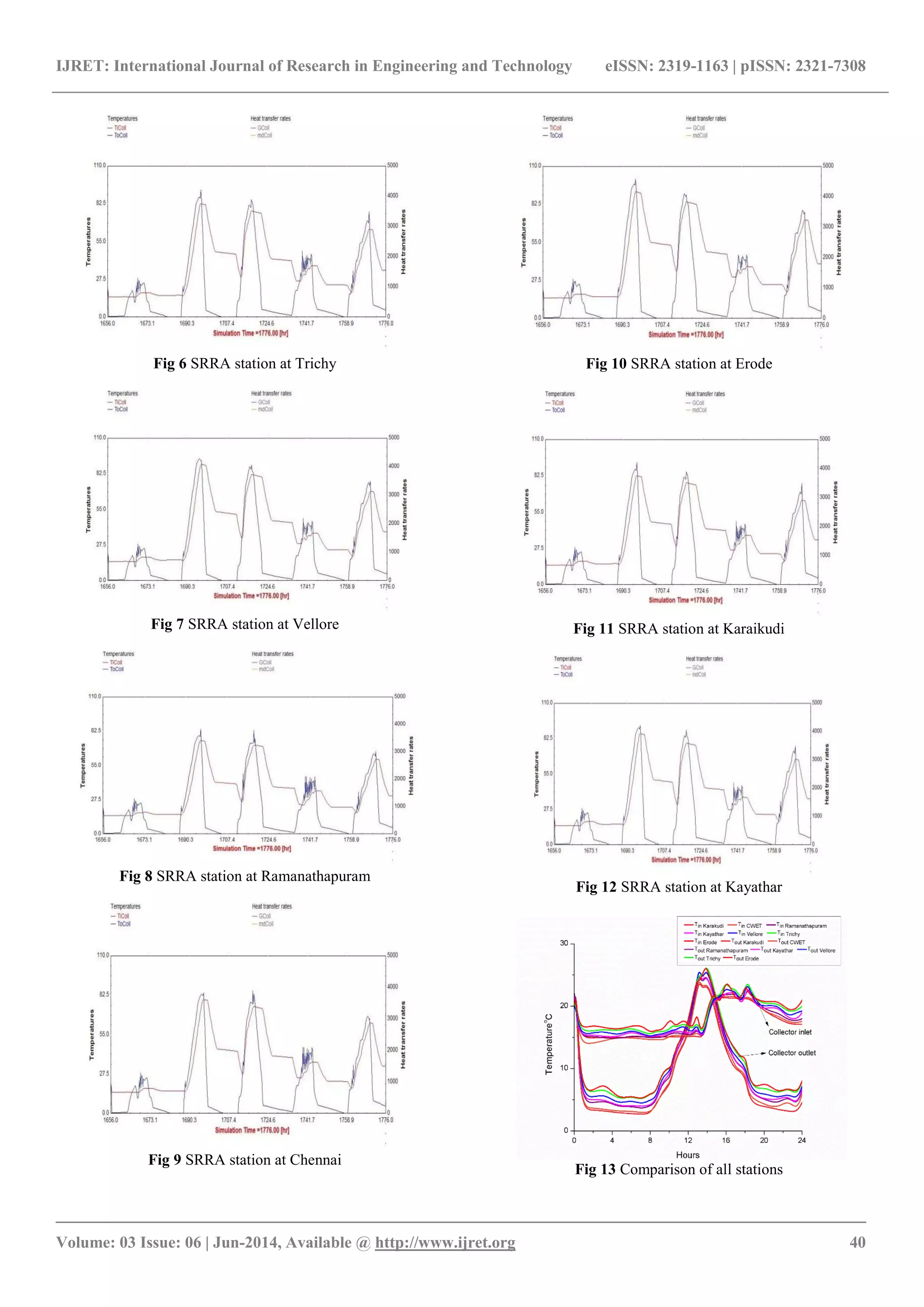
The hourly variation of inlet and outlet water flow
temperature – flat plate collector – 11th
to 15th
March for 7
locations in Tamil Nadu the graphs are shown below.
IJRET: International Journal of Research in Engineering and Technology eISSN: 2319-1163 | pISSN: 2321-7308
_______________________________________________________________________________________
Volume: 03 Issue: 06 | Jun-2014, Available @ http://www.ijret.org 40
Fig 6 SRRA station at Trichy
Fig 7 SRRA station at Vellore
Fig 8 SRRA station at Ramanathapuram
Fig 9 SRRA station at Chennai
Fig 10 SRRA station at Erode
Fig 11 SRRA station at Karaikudi
Fig 12 SRRA station at Kayathar
Fig 13 Comparison of all stations
IJRET: International Journal of Research in Engineering and Technology eISSN: 2319-1163 | pISSN: 2321-7308
_______________________________________________________________________________________
Volume: 03 Issue: 06 | Jun-2014, Available @ http://www.ijret.org 41
5. CONCLUSIONS
Solar energy is important to meet the increasing demand of
energy required for daily domestic needs. Therefore, an
extensive research has been done to model the flat plate
collector and predict the performance of different locations
in Tamil Nadu. The aim of this study is to simulate the
maximum use of solar radiation in 7 geographic locations in
Tamil Nadu using TRNSYS software. The hourly
investigations are performed for five days from 11th
– 15th
March and radiations are taken for the various locations.
The results were simulated and the graphs were compared. It
was observed that Erode had the maximum output
performance using flat plate collector which can be used to
replace the energy consumption of non-renewable resources.
ACKNOWLEDGMENTS
This work was supported by Center for Wind Energy
Technology (CWET), Chennai for data Collection.
REFERENCES
[1]. f. Hilmer, k.Vajen,a.Ratka, h.Ackermann, w.Fuhs,
o.Melsheimer, Numerical solution and validation of a
dynamic model of solar collectors working with varying
fluid flow rate, solarenergy,volume65,issue5,1999, 305-321.
[2]. Zueva G. and Magiera J., 2001, Mathematical model of
heat transfer in solar collector and its experimental
validation, Theoretical Foundations of Chemical
Engineering, 35, 6, 604-608.
[3]. Fan J., Shah L., and Furbo S., 2007, Flow distribution in
a solar collector panel with horizontally inclined absorber
strips, Solar Energy, 81, 1501-1511.
[4]. Augustus M. and Kumar S., 2007, Mathematical
modeling and thermal performance analysis of unglazed
transpired solar collectors, Solar Energy, 81, 62-75.
[5]. Molero Villar N., Cejudo Lopez J., and Dominguez
Munoz F., 2009, Numerical 3-D heat flux simulations on
flat plate solar collectors, 83, 1086-1092.
[6]. Anderson T., Duke M., and Carson J., 2010, The effect
of color on the thermal performance of building integrated
solar collectors, Solar Energy Materials & solar cells, 94,
350-354.
[7]. Duffie J. and Beckmann W., 1991, Solar engineering of
thermal processes, 2nd edition (Wiley Interscience, New
York).

Simulation of solar intensity in performance of flat

  • 1.
    IJRET: International Journalof Research in Engineering and Technology eISSN: 2319-1163 | pISSN: 2321-7308 _______________________________________________________________________________________ Volume: 03 Issue: 06 | Jun-2014, Available @ http://www.ijret.org 36 SIMULATION OF SOLAR INTENSITY IN PERFORMANCE OF FLAT PLATE COLLECTOR A.Ponshanmugakumar1 , A. Aldrich Vincent2 Abstract Solar collectors behave differently at different radiations and temperatures. The system consists of solar thermal collectors, a storage and circulation pump of water to carry the heat to its applications. The results of the simulations show that, the efficiency of flat plate collectors can be used for domestic purposes in Tamil Nadu at different geographic locations by adjusting the characteristics of system components to obtain results. It also helps in determining the location which generates optimum solar energy. This study intends to focus on the performance of flat plate collectors in a simulation environment using TRNSYS and solar radiation data collected for 7 stations in Tamil Nadu Keywords: Flat Plate Collector (FPC), TRNSYS, Solar Intensity ---------------------------------------------------------------------***------------------------------------------------------------------- 1. INTRODUCTION In the recent years the energy production is the major problem. Their cost and the pollution while consuming fossil fuels. The depreciation of fuels is also a major frightening issue. But fossil fuels are the most commonly used and depend fuels. So in order to reduce the problem the rulers has encouraging for the alternative energy sources. It is most commonly called as renewable energy sources and it has no pollution, regenerative type and also safe generation of power. Among all the alternative energy sources solar energy has a high impact on energy production 1.1 Solar Radiation The spectrum of electromagnetic wave radiation produced by sun is solar radiation. The earth’s atmosphere deflects or filters the majority of the sun’s damaging radiation. About part of the radiation is in the observable short-wave division of the electromagnetic range. The other half is mostly in the infrared part, with some in the ultraviolet. 1.2 Characteristics of Solar Radiation The part of solar radiation is intercepted by the earth’s outer atmosphere. The statistical relation formulated between the daily duration of sunshine N and the daily total global solar radiation G is of the form, 𝑮 𝑮 𝒐 = 𝒂 + 𝟏 − 𝒂 𝒏 𝑵 (1.1) Where, Go is the daily global solar radiation with cloud free atmosphere, ‘a’ is mean proportion of radiation on an entirely overcast day, and N; maximum period of sunshine. Due to the difficulties in the defined estimation of Go in the above equation, Go was replaced by the celestial radiation (ECR), it is given by, 𝐺 𝐸𝑇𝑅 = 𝑎 + 𝑏 𝑛 𝑁 (1.2) 1.3 Flat Plate Collectors The flat plate collectors ar5e most commonly used in the domestic hot water system on the roof tops. They consist of a black coated absorber, a transparent acrylic cover that reduces heat losses, a heat transfer fluid to extract heat from the absorber, and a heat insulating packing. In water heat panels, fluid is usually circulated through tubes to transfer heat from the absorber to an insulated storage tank. This may be achieved directly or through a heat exchanger. Fig 1 Flat plate collectors Hilmer et al. 1999 presented a method to calculate numerically the solar collector with varying parameters [1]. Zuefa and Magiera 2001 published an experimental study in the more uniform for the flow distribution, the higher the collector efficiency. But uniform flow distributions are not possible in solar collectors [2]. Fan et al. 2007 investigated both experimentally and theoretically the finned tube flat plate collector. They analyzed numerically by CFD and got results which oriented with experiment results [3]. Augustus and Kumar 2006 developed mathematical model for an unglazed perforated flat plate collector. They developed an empirical relation for various components. They proved the improved results of absorptivity, heat transfer and air flow rate[4]. Molero et al. 2009 presented a
  • 2.
    IJRET: International Journalof Research in Engineering and Technology eISSN: 2319-1163 | pISSN: 2321-7308 _______________________________________________________________________________________ Volume: 03 Issue: 06 | Jun-2014, Available @ http://www.ijret.org 37 3-D numerical model for flat-plate solar collector considering the transient conditions like flow characteristics. But this un-uniform flow does not make huge effect in collector efficiency. When the dimensions of the tube increases with the flow increases with due change in collector efficiency [5]. Anderson et al 2009[6] examined the performance by changing the colours of solar collector. Based on the transmittance-absorptance result of various colored collectors the hypothetical performances of these collectors were calculated using the Hottel-Whillier-Bliss 1-D steady- state model given by Duffie and Beckmann 2006[7]. By these experiments they concluded that the colour of the collector plays a major role in thermal efficiencies of the collectors. Fig 2 Irradiation data of Flat plate collector 1.4 Domestic Hot Water System (DHWS) Fig 3 Schematic diagram of solar water heating system The various day of the year weather data’s are absorbed by the solar collector (A). Flat Plate Collector (FPC) were connected in array in parallel arrangements. To improve the hot water system performance and to study the stratification of the storage tank a hot water storage tank (B) was used here. As a outcome, a temperature variation between the top and the bottom parts of the tank arises the density variation between top and bottom. The high density fluid come to the bottom side and the low density fluid to the top of the tank. An on/off differential controller (C) is use to control the temperature variation between TOColl and TBottom. Controlling the temperature can have a significant effect on the final result. In this case, the TOColl is adjusted as the Upper input temperature Th, TBottom is adjusted as Lower input temperature Tl and TTOP is adjusted as Monitoring temperature Tin. The temperature data’s from hot and cold water side sends the appropriate signal to the pump according to the dead bands. There is a high limit cut out temperature that can be defined as desired. 2. SYSTEM AND MATHEMATICAL MODEL 2.1 Solar Collectors The flat plate collector (quadratic efficiency) Type 1b is selected from TRNSYS component libraries. This component models the thermal performance of a flat- plate solar collector. The number of modules in series and the characteristics of each module determine the thermal performance of the collector array. Equation 1 gives the solar collector thermal efficiency. ηcol = m .cp (To-col - Ti-col) / Acol It (i) TRNSYS models of solar collectors have different types of functions named parameters, inputs and outputs. A parameter value function is specifically related to the manufacturer (Thermo Dynamics Ltd.). These values need to be input according to manufacturer specifications. An input value function has a value that depends upon the test conditions, such as collector slope, orientation, etc. Some inputs and all outputs have a ‘linked’ value, which means that this function has values, which are linked to other components and will be determined by the real time flow. 2.2Theoretical Flat-Plate Collector The energy compilation of each component in an array of Ns modules in series is modeled according to the Hottel- Whillier equation such that (j is the module number): Qu = A Ns FRj Ns j=1 IT ταa − ULj Tij − Ta (ii) Where FR,j can be explained as follows: 𝐹𝑅𝑗 = 𝑁 𝑠 𝑚 𝑐 𝐶 𝑝𝑐 𝐴𝑈 𝐿𝑗 1 − 𝑒𝑥𝑝 − 𝐹𝑈 𝐿𝑗 𝐴 𝑁 𝑠 𝑚 𝑐 𝐶 𝑝𝑐 (iii) The following expression, developed by Klein, is used to approximate UL,j(in KJ/h-m2-K). Equation (iii) is described as: 𝐔 𝐋𝐣 = 𝟑.𝟔 𝐍 𝐆 𝐂 𝐓 𝐩𝐣 𝐓 𝐚𝐯𝐣−𝐓 𝐚 𝐍 𝐆+𝐟 .𝟑𝟑 + 𝟏 𝐡 𝐰 + 𝟑.𝟔𝛔 𝐓 𝐚𝐯𝐣 𝟐 +𝐓 𝐚 𝟐 𝐓 𝐚𝐯𝐣+𝐓 𝐚 𝟏 𝛆 𝐩+.𝟎𝟓𝐍 𝐆 𝟏−𝛆 𝐩 + 𝟐𝐍 𝐆+𝐟−𝟏 𝛆 𝐠 −𝐍 𝐆 + 𝐔 𝐛𝐞(iv) And Hw=5.7 +3.8 W (W/m2 – K) (v) f = (1-0.04 hw + 0.0005 hw2) (1+0.091 NG) (vi)
  • 3.
    IJRET: International Journalof Research in Engineering and Technology eISSN: 2319-1163 | pISSN: 2321-7308 _______________________________________________________________________________________ Volume: 03 Issue: 06 | Jun-2014, Available @ http://www.ijret.org 38 The overall transmittance – absorptance product is determined as: 𝛕𝛂 𝐚 = 𝐈 𝐛𝐭 𝛕𝛂 𝐚 𝐛+𝐈 𝐝 𝟏+𝐜𝐨𝐬𝛃 𝟐 𝛕𝛂 𝐚 𝐬+𝛒𝐈 𝟏−𝐜𝐨𝐬𝛃 𝟐 𝛕𝛂 𝐚 𝐠 𝐈 𝐓 (vii) Where Ibt is beam radiation incident on the solar collector, Id is diffuse horizontal radiation and IT is global radiation incident on the solar collector (Tilted surface). The outlet temperature of one module is used as the inlet to the next and is given as: 𝐓𝐨,𝐣 = 𝐀𝐅 𝐑𝐣 𝐈 𝐓 𝛕𝛂 𝐚 −𝐔 𝐋,𝐣 𝐓𝐢,𝐣−𝐓 𝐚 𝐍 𝐬 𝐦 𝐜 𝐂 𝐩𝐜 + 𝐓𝐢 (viii) If the collector flow is zero, the collector stagnation temperature is: 𝑇𝑝 = 𝐼 𝑇 𝜏𝛼 𝑎 𝑈 𝐿 + 𝑇𝑎 (ix) 2.3 Solar Radiation on a Tilted Surface The amount of solar radiation incident on a tilted component plane is the element of the incident solar radiation which is upright to the module surface. The following figure shows how to calculate the radiation incident on a tilted plane (Smodule) given either the solar radiation measured on horizontal surface (Shoriz) or the solar radiation calculated vertical to the sun (Sincident). Fig 4 Tilted flat plate collector The equations relating Smodule, Shoriz and Sincident are: 𝑆ℎ𝑜𝑟𝑖𝑧𝑜𝑛𝑡𝑎𝑙 = 𝑆𝑖𝑛𝑐𝑖𝑑𝑒𝑛𝑡 𝑠𝑖𝑛𝛼(4.10) 𝑆 𝑚𝑜𝑑𝑢𝑙𝑒 = 𝑆𝑖𝑛𝑐𝑖𝑑𝑒𝑛𝑡 𝑠𝑖𝑛 𝛼 + 𝛽 (x) Where, α is the elevation angle β is the tilt angle of the module measured from the horizontal. The elevation angle has been previously given as: (xi) Where, φ is the latitude δ is the declination angle previously given as: 𝛿 = 23.45°𝑠𝑖𝑛 360 365 284 + 𝑑 (xii) Where, d is the day of the year. Note that from simple math (284+d) is equivalent to (d-81) which was used before. Two equations are used interchangeably in literature. From these equations a relationship between Smodule and Shoriz can be determined as: 𝑆 𝑚𝑜𝑑𝑢𝑙𝑒 = 𝑆ℎ 𝑜𝑟𝑖𝑧𝑜𝑛𝑡𝑎𝑙 𝑠𝑖𝑛 𝛼+𝛽 𝑠𝑖𝑛𝛼 (xiii) The following active equations show the calculation of the incident and horizontal solar radiation and that on the module. Enter only one of Smodule, Shoriz and Sincident and the program will calculate the others. To calculate the incident angle of one station - Trichy : Latitude ϕ = 10, Longitude λ =78, GMT offset = 5.00 hrs , Declination angle δ = -23.01 To find incident angle α =? α =90- ϕ + δ =90 – 10 – 23.01 = 56.99 herefore, the angle of incident α= 56.99 Incident radiation = 500*12 Wh/m2 Total horizontal radiation = 541*12 Wh/m2 Horizontal diffuse radiation = 170 * 12 Wh/m2 Applying incident angle and 3 radiations as input for TRNSYS simulation 3. MODELING OF FLAT PALTE COLLECTOR USING SOLAR ENERGY For creating the project in TRNSYS simulation studio the desired components should be selected from the list available in the components library. The modeling schemes of the system are designed according to Figure as shown in Figures 5. In this figure components are connected to each other in the proper way which yields the initial aim described in section 2. In Figure 5, flat plate collectors are used to utilize solar energy. The components have been chosen from standard and TESS libraries from TRNSYS software which are listed in Table 1. Each component has its own properties and some of them have specific mathematical description.
  • 4.
    IJRET: International Journalof Research in Engineering and Technology eISSN: 2319-1163 | pISSN: 2321-7308 _______________________________________________________________________________________ Volume: 03 Issue: 06 | Jun-2014, Available @ http://www.ijret.org 39 Fig 5 Modeling scheme of the system using Flat Plate Collector Table 1 Components used in Simulation Studio Component (TYPE) Description Type109-TMY2 Weather Data Reading and Processing Type 73 Theoretical Flat-Plate Collector Type 3d Single Speed - No Power coefficients Pump Type 2b Differential Controller Type 4c Stratified Storage Tank Type 11h Tee-Piece Type 11f Flow Diverter Type 65a Online Plotter In this system, TMY2 is reading the weather information regularly, and checking the solar radiation data to find tilted surface radiation and angle of incidence for an arbitrary number of surfaces. Tamil Nadu climate conditions are used for simulation. The weather data are given on hourly basis. Type 73 and 74 are the models for the thermal performance of a theoretical flat plate collector which is shown in Figures 5. The parameters of FPC are adjusted in the system are shown in Tables 2. Table 2 Flat-Plate Collector parameters Number in series 1 Collector area 5 m2 Fluid specific heat 4.19 kJ/kg.K Intercept efficiency 0.80 Collector slope 45o Inlet flowrate 100 kg/hr Type 2b is the differential controller component which is monitoring TTOP by comparing the comparing ToColl and TBottom. The input properties of this controller are shown in Table 3. When TOColl is greater than TBottom, the controller actuates the pump. If the temperature TTOP reaches 1000 C, the pump is stopped. Table 3 Differential Controller input parameters High limit cut-out 100◦C Upper input temperature Th TOColl Lower input temperature Tl TBottom Monitoring temperature Tin TTOP Type 3d is a single speed pump which is either ‘on’ or ‘off’ according to the signal received from Type 2b. When the pump is ‘on’ the flow rate of water will be 125 kg/hr. Type 4c is the stratified tank which fluid is stored in it during the night time and it’s also connected to the type 2b for specifying the Tl and Tin. Type 11h is the Tee-piece in which two inlet liquid streams are mixed together into a single liquid outlet stream. The outlet fluid from the Tee-piece needs to be transferred to the demand (D)(Fig 3). Type 11f is the flow diverter, which is a single inlet liquid stream. During the simulation, the results need to be shown in graphs and tables. Type 65a is the online plotter that is used to display selected system variables while the simulation is progressing. This component is highly recommended and widely used since it provides valuable variable information and allows users to immediately see if the system is not performing as desired. 4. RESULTS AND DISCUSSION The characteristics of system components are adjusted to obtain the most optimum results. The aim is to model flat plate collector for domestic purposes under Tamil Nadu weather conditions and comparing the efficiency of flat plate collector at different geographic locations. The simulations have been accomplished from March 11th – 15th 2014. The hourly variation of inlet and outlet water flow temperature – flat plate collector – 11th to 15th March for 7 locations in Tamil Nadu the graphs are shown below.
  • 5.
    IJRET: International Journalof Research in Engineering and Technology eISSN: 2319-1163 | pISSN: 2321-7308 _______________________________________________________________________________________ Volume: 03 Issue: 06 | Jun-2014, Available @ http://www.ijret.org 40 Fig 6 SRRA station at Trichy Fig 7 SRRA station at Vellore Fig 8 SRRA station at Ramanathapuram Fig 9 SRRA station at Chennai Fig 10 SRRA station at Erode Fig 11 SRRA station at Karaikudi Fig 12 SRRA station at Kayathar Fig 13 Comparison of all stations
  • 6.
    IJRET: International Journalof Research in Engineering and Technology eISSN: 2319-1163 | pISSN: 2321-7308 _______________________________________________________________________________________ Volume: 03 Issue: 06 | Jun-2014, Available @ http://www.ijret.org 41 5. CONCLUSIONS Solar energy is important to meet the increasing demand of energy required for daily domestic needs. Therefore, an extensive research has been done to model the flat plate collector and predict the performance of different locations in Tamil Nadu. The aim of this study is to simulate the maximum use of solar radiation in 7 geographic locations in Tamil Nadu using TRNSYS software. The hourly investigations are performed for five days from 11th – 15th March and radiations are taken for the various locations. The results were simulated and the graphs were compared. It was observed that Erode had the maximum output performance using flat plate collector which can be used to replace the energy consumption of non-renewable resources. ACKNOWLEDGMENTS This work was supported by Center for Wind Energy Technology (CWET), Chennai for data Collection. REFERENCES [1]. f. Hilmer, k.Vajen,a.Ratka, h.Ackermann, w.Fuhs, o.Melsheimer, Numerical solution and validation of a dynamic model of solar collectors working with varying fluid flow rate, solarenergy,volume65,issue5,1999, 305-321. [2]. Zueva G. and Magiera J., 2001, Mathematical model of heat transfer in solar collector and its experimental validation, Theoretical Foundations of Chemical Engineering, 35, 6, 604-608. [3]. Fan J., Shah L., and Furbo S., 2007, Flow distribution in a solar collector panel with horizontally inclined absorber strips, Solar Energy, 81, 1501-1511. [4]. Augustus M. and Kumar S., 2007, Mathematical modeling and thermal performance analysis of unglazed transpired solar collectors, Solar Energy, 81, 62-75. [5]. Molero Villar N., Cejudo Lopez J., and Dominguez Munoz F., 2009, Numerical 3-D heat flux simulations on flat plate solar collectors, 83, 1086-1092. [6]. Anderson T., Duke M., and Carson J., 2010, The effect of color on the thermal performance of building integrated solar collectors, Solar Energy Materials & solar cells, 94, 350-354. [7]. Duffie J. and Beckmann W., 1991, Solar engineering of thermal processes, 2nd edition (Wiley Interscience, New York).