The Role of Modelling and Simulation in
Supply Chain Management
SURAJ KUMAR BOTHRA – PGDM IB (06)
CHANDAN TREHAN – PGDM OPS (160)
AMIT KUMAR PRASAD – PGDM OPS (102)
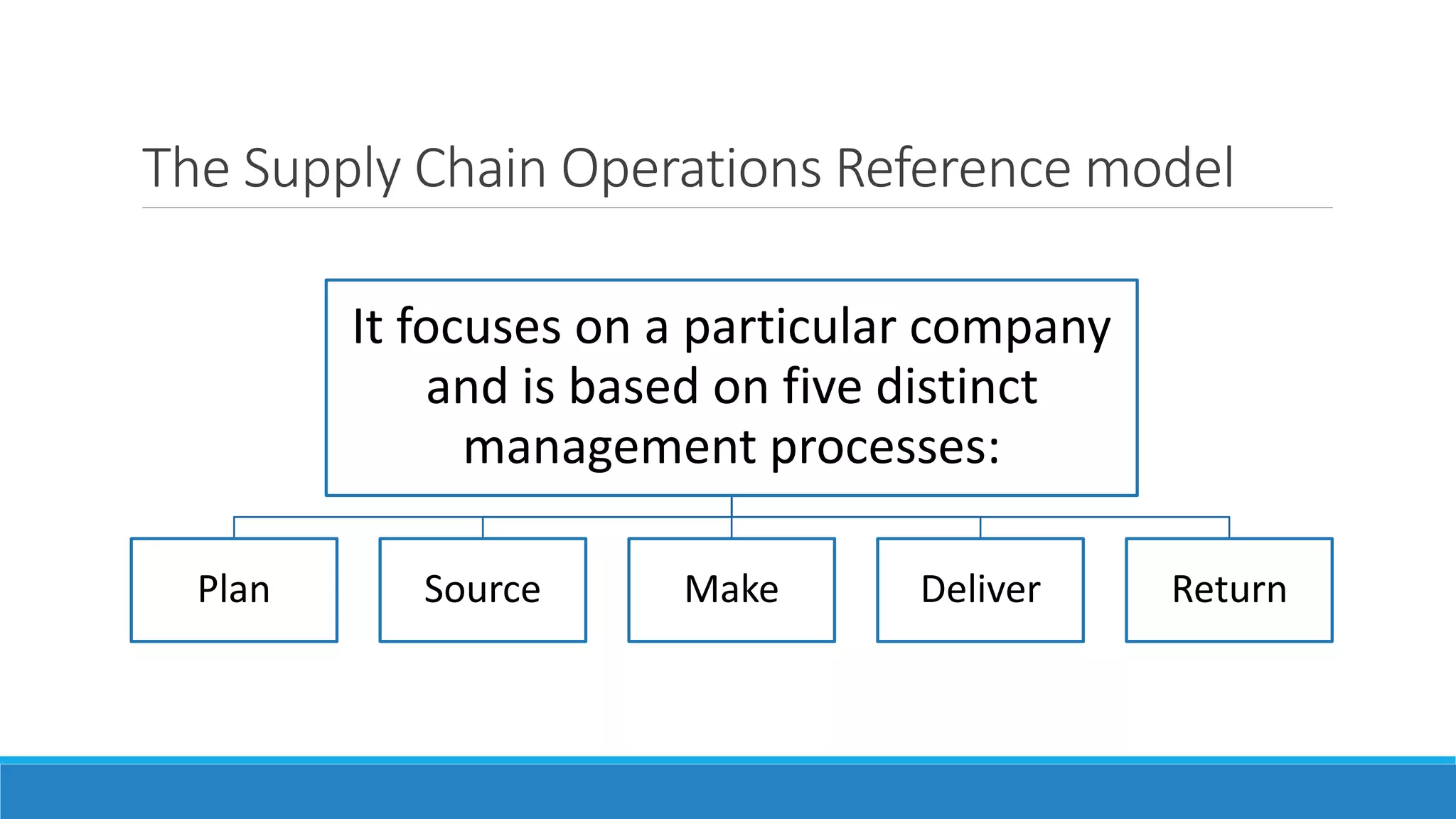
The Supply Chain Operations Reference model
It focuses on a particular company
and is based on five distinct
management processes:
Plan Source Make Deliver Return
Tete-a-tete with the Article
Fundamental nature of a supply chain
(a) The system under study is the supply chain of a given enterprise
Internal (Integration of previously separate operations) or
External (Cooperation between the enterprise and the other actors)
(b) The supply chain under study is a network of enterprises
Supply chain is a “network of organisations that are involved”
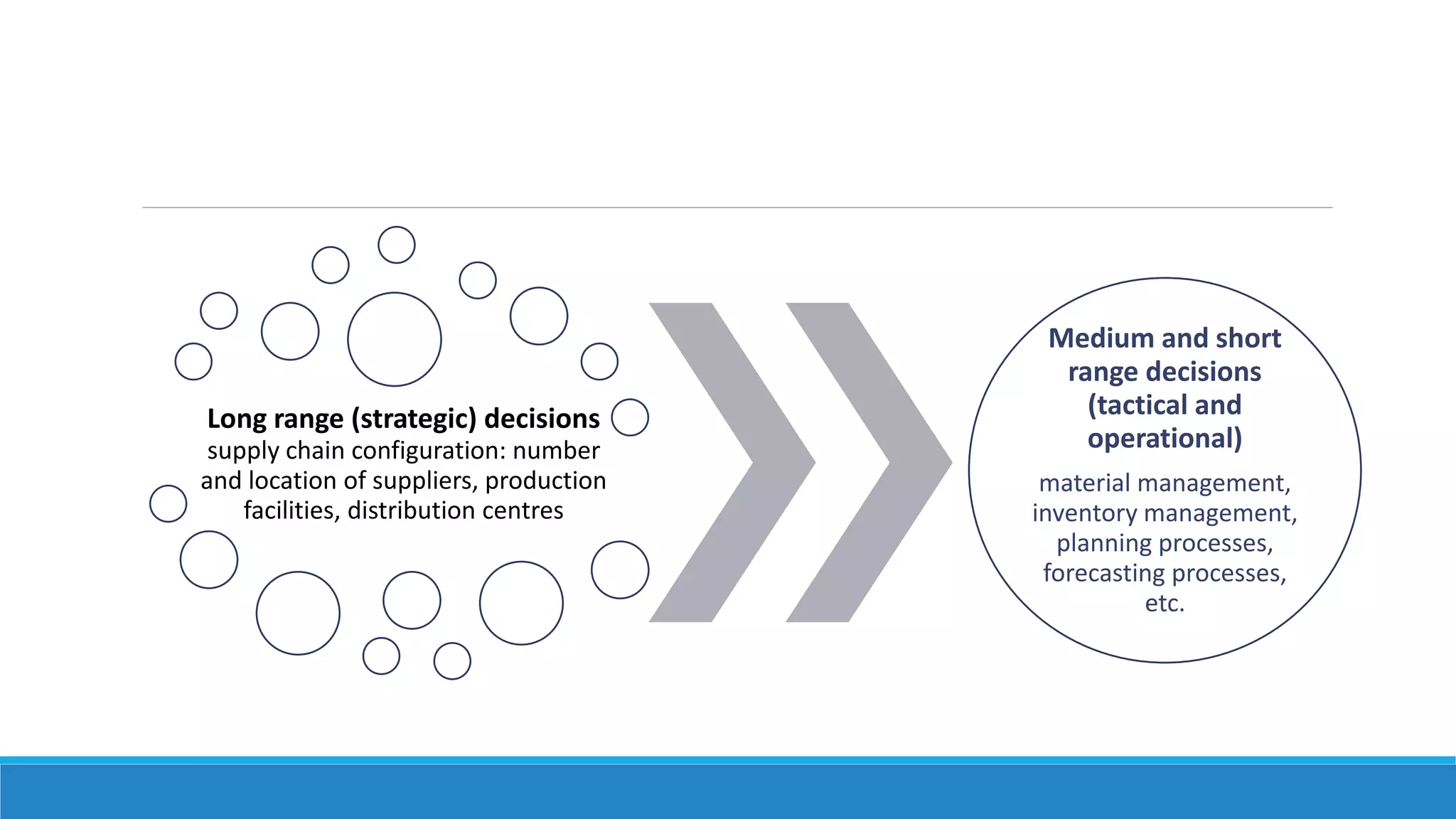
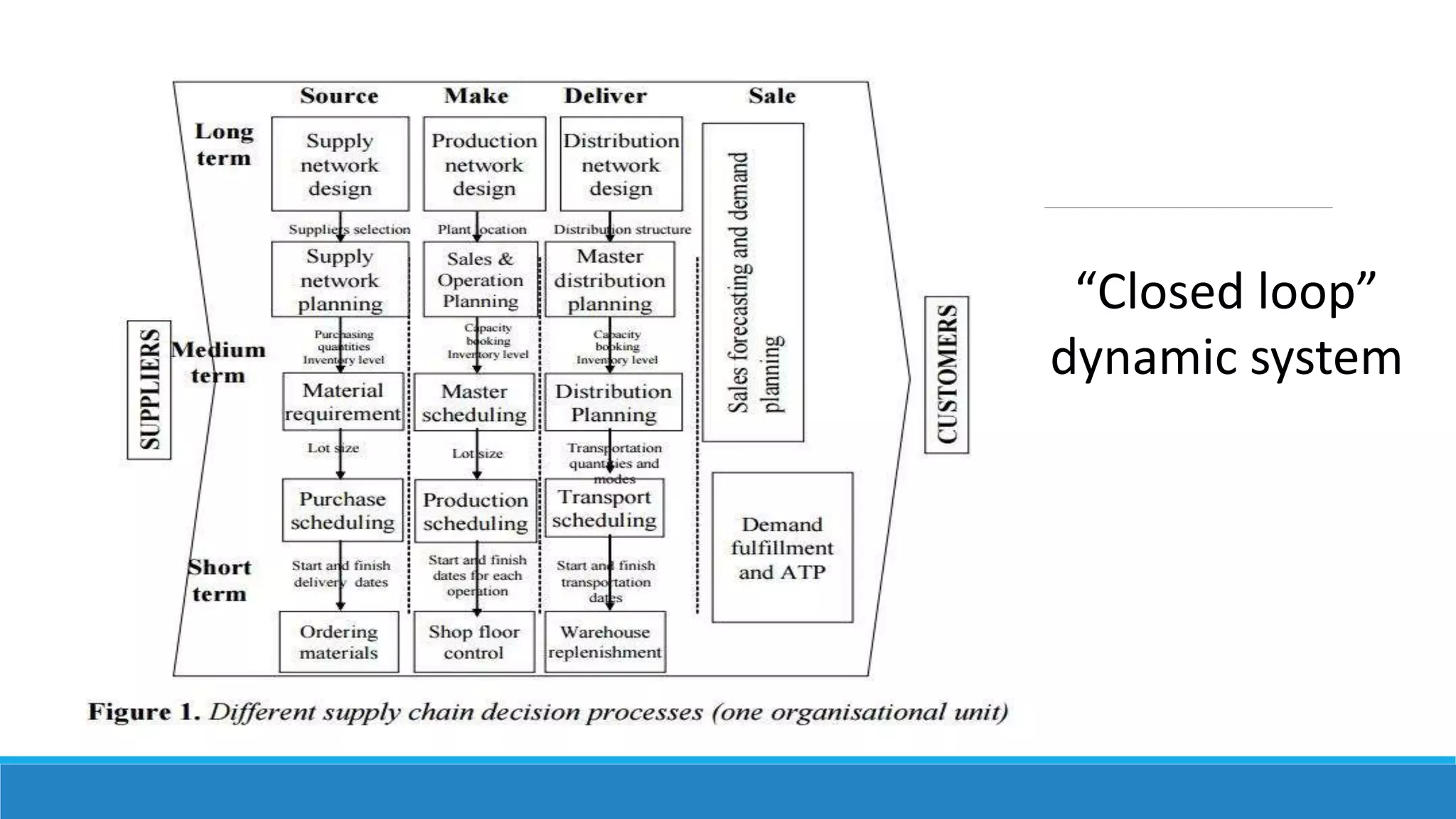
Long range (strategic) decisions
supply chain configuration: number
and location of suppliers, production
facilities, distribution centres
Medium and short
range decisions
(tactical and
operational)
material management,
inventory management,
planning processes,
forecasting processes,
etc.
“Closed loop”
dynamic system
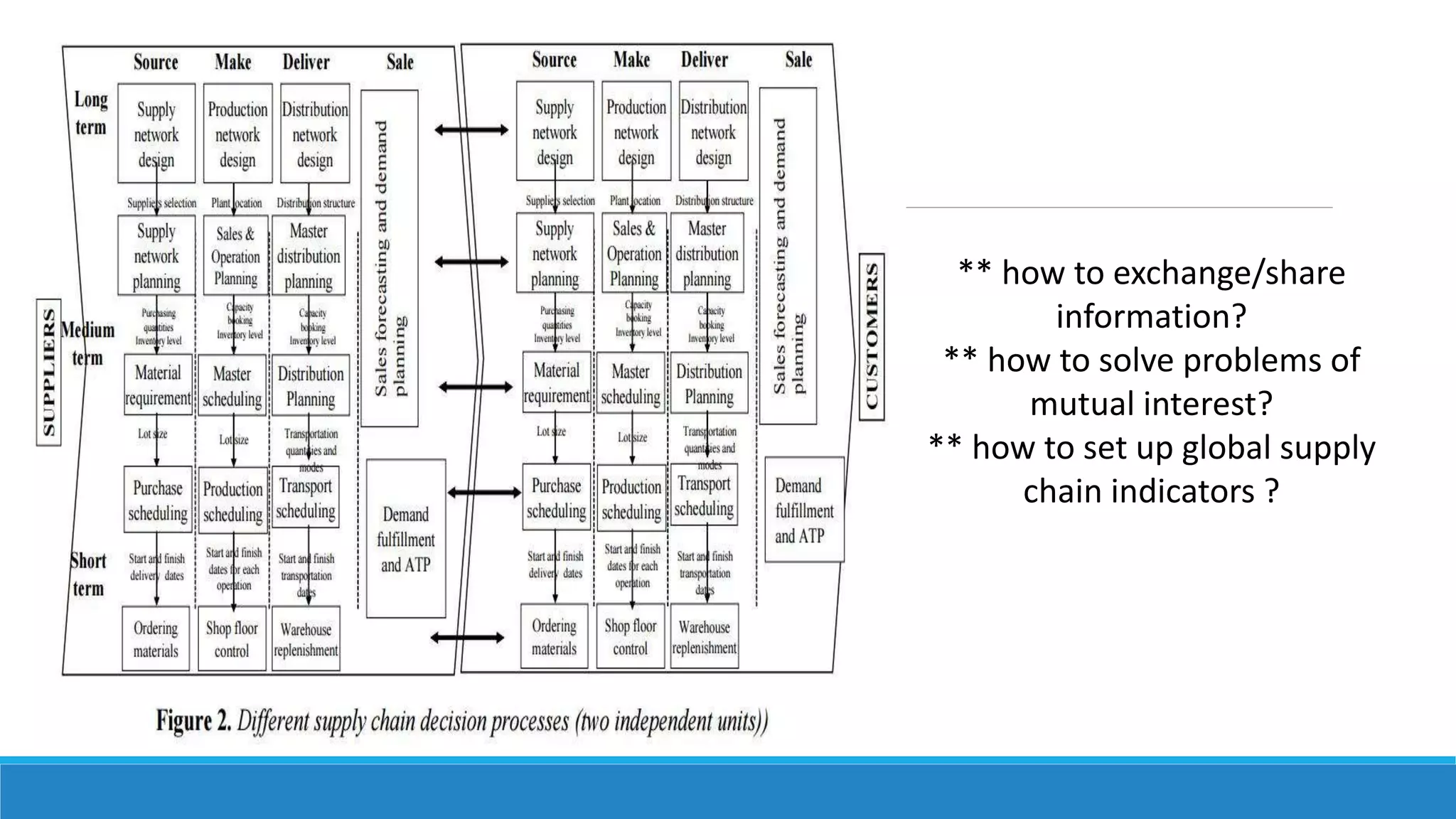
** how to exchange/share
information?
** how to solve problems of
mutual interest?
** how to set up global supply
chain indicators ?
Role of Simulation in SC
 Performance evaluation
(a) Analytical methods, such as queuing theory
(b) Physical experimentations
(c) Monte-Carlo methods, such as simulation or emulation
A modelling and simulation approach is the only practical recourse
The ability to carry out “what if“ analysis that lead to a “best” configuration
Here is how simulation helps!
1. Supply chain design decisions: Localisation, Selection of Suppliers, Size, Stock Level
2. Supply chain control policies: Inventory Management, VMI (Vendor Managed Inventory),
CPFR (Collaborative Planning, Forecasting and Replenishment), Info Sharing
Simulation focuses primarily on the dynamics of the physical and
decision processes in the supply chain
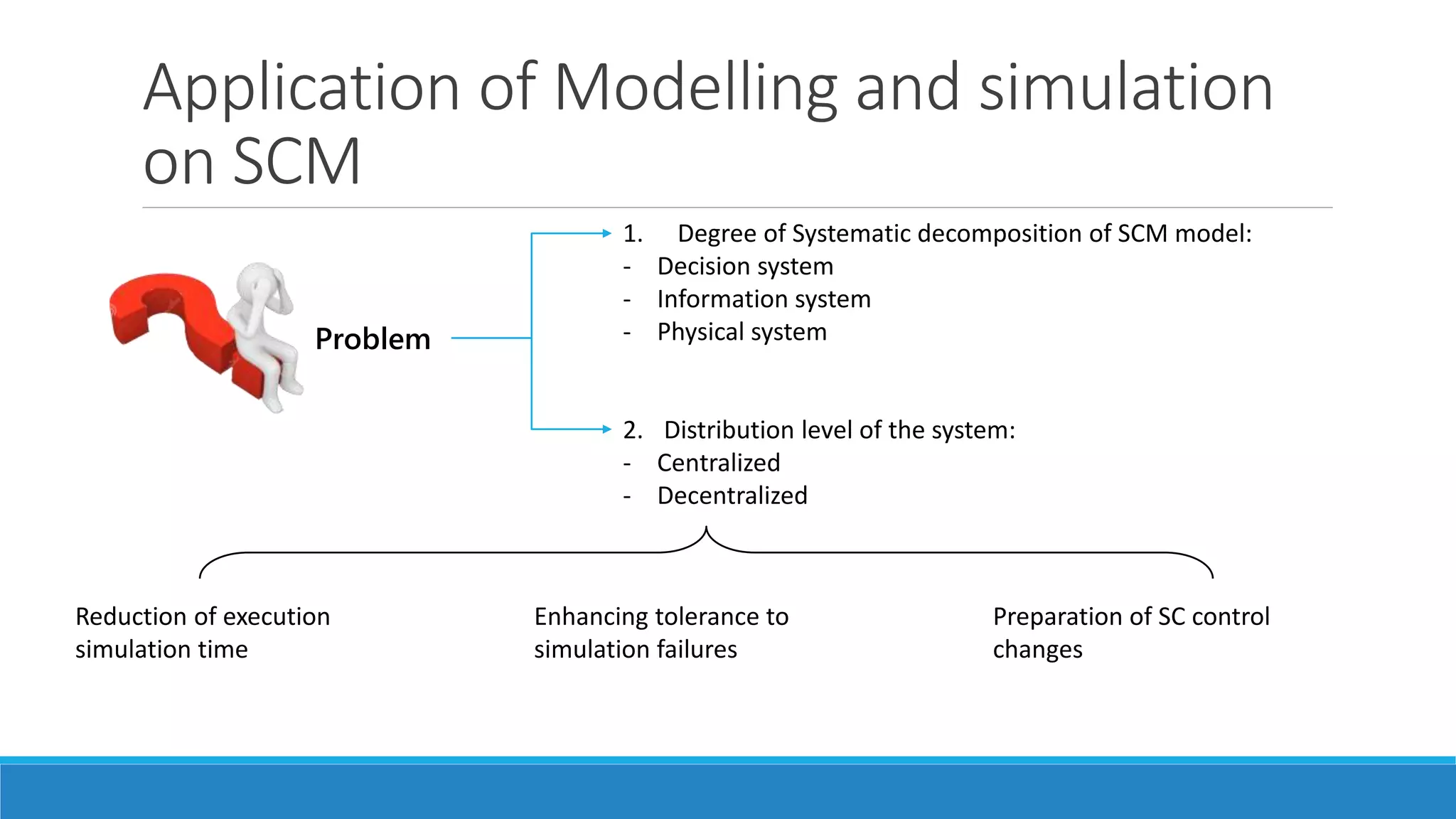
Application of Modelling and simulation
on SCM
Problem
1. Degree of Systematic decomposition of SCM model:
- Decision system
- Information system
- Physical system
2. Distribution level of the system:
- Centralized
- Decentralized
Reduction of execution
simulation time
Enhancing tolerance to
simulation failures
Preparation of SC control
changes
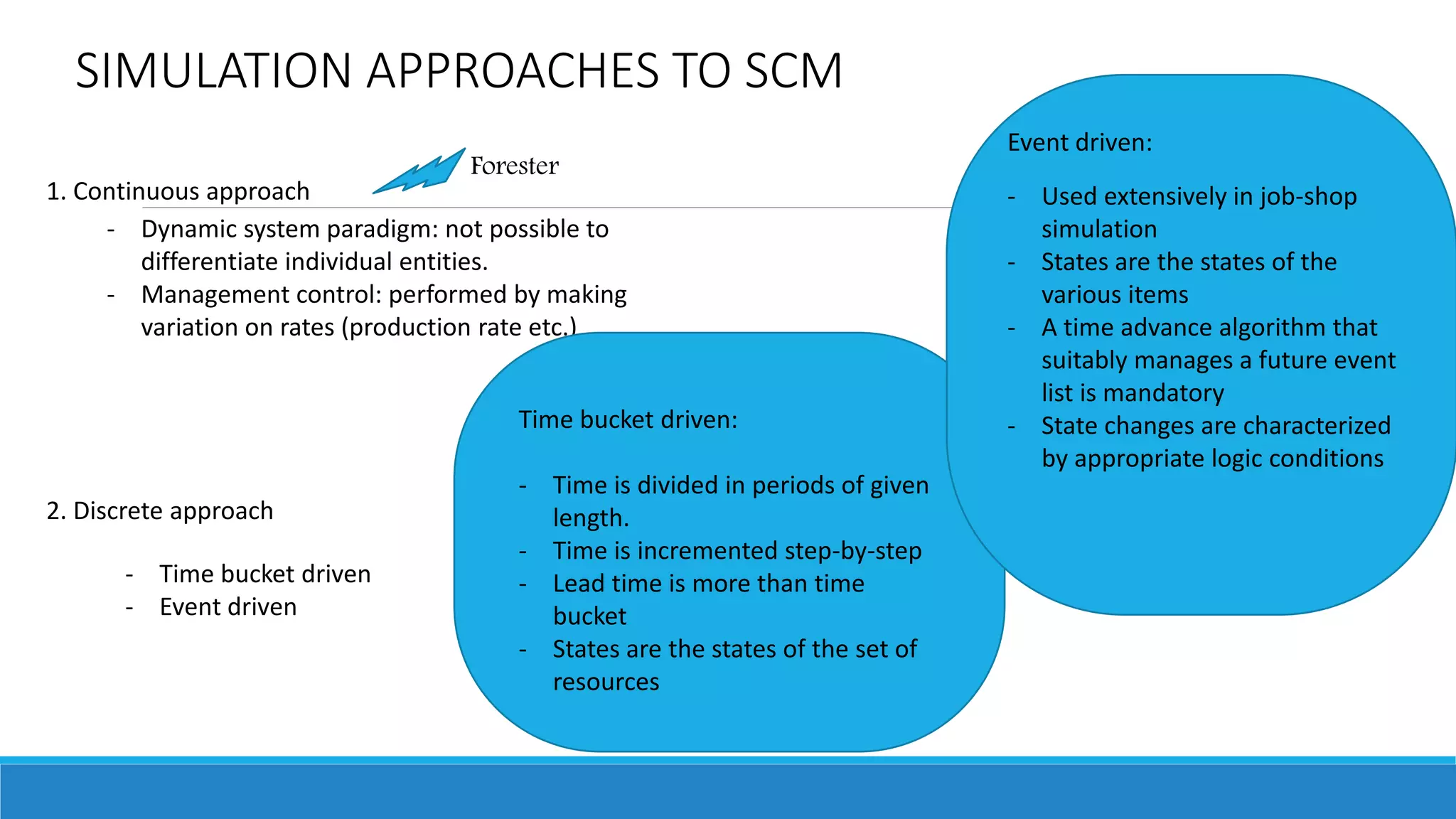
SIMULATION APPROACHES TO SCM
1. Continuous approach
Forester
- Dynamic system paradigm: not possible to
differentiate individual entities.
- Management control: performed by making
variation on rates (production rate etc.)
2. Discrete approach
- Time bucket driven
- Event driven
Time bucket driven:
- Time is divided in periods of given
length.
- Time is incremented step-by-step
- Lead time is more than time
bucket
- States are the states of the set of
resources
Event driven:
- Used extensively in job-shop
simulation
- States are the states of the
various items
- A time advance algorithm that
suitably manages a future event
list is mandatory
- State changes are characterized
by appropriate logic conditions
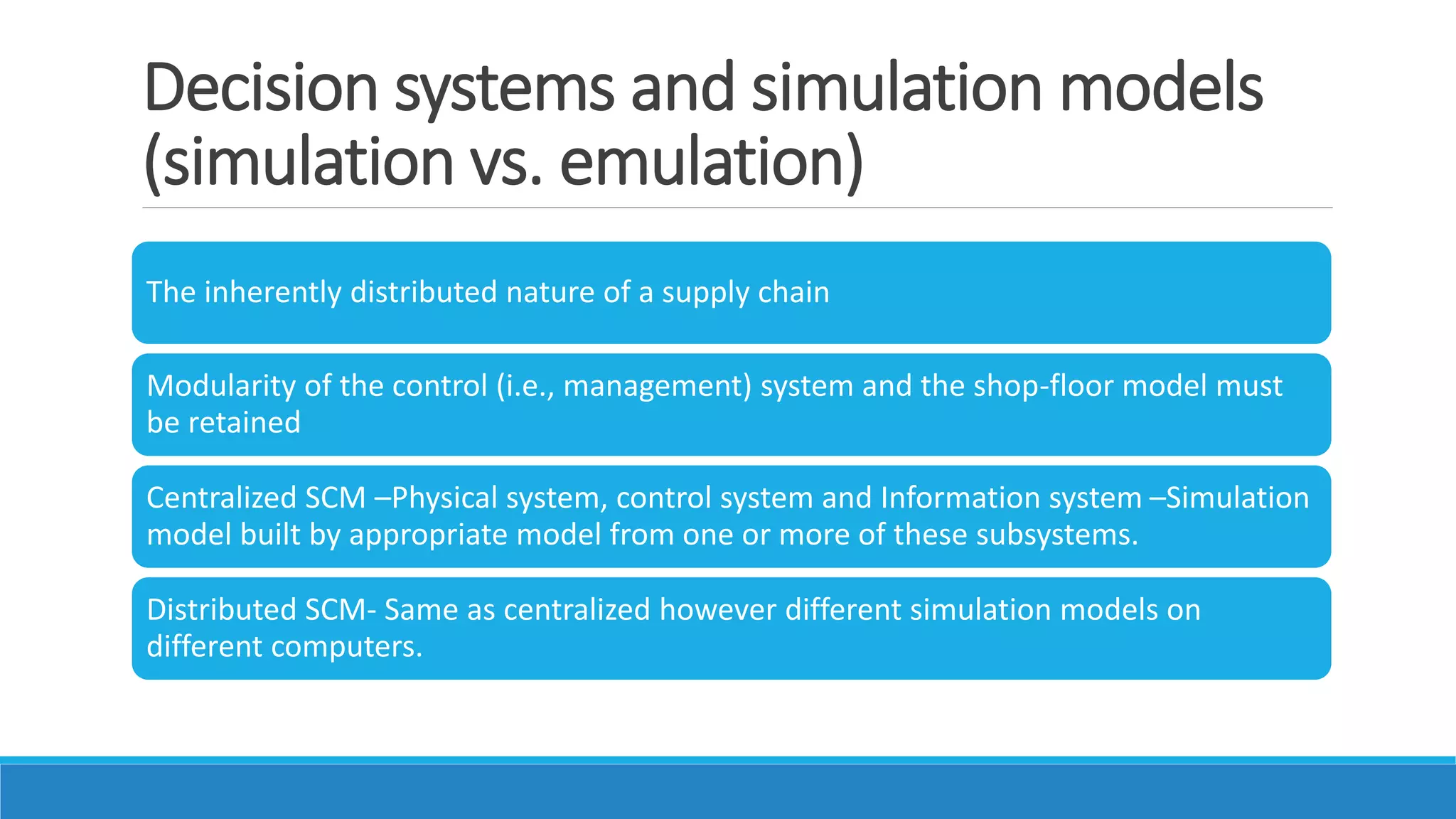
Decision systems and simulation models
(simulation vs. emulation)
The inherently distributed nature of a supply chain
Modularity of the control (i.e., management) system and the shop-floor model must
be retained
Centralized SCM –Physical system, control system and Information system –Simulation
model built by appropriate model from one or more of these subsystems.
Distributed SCM- Same as centralized however different simulation models on
different computers.
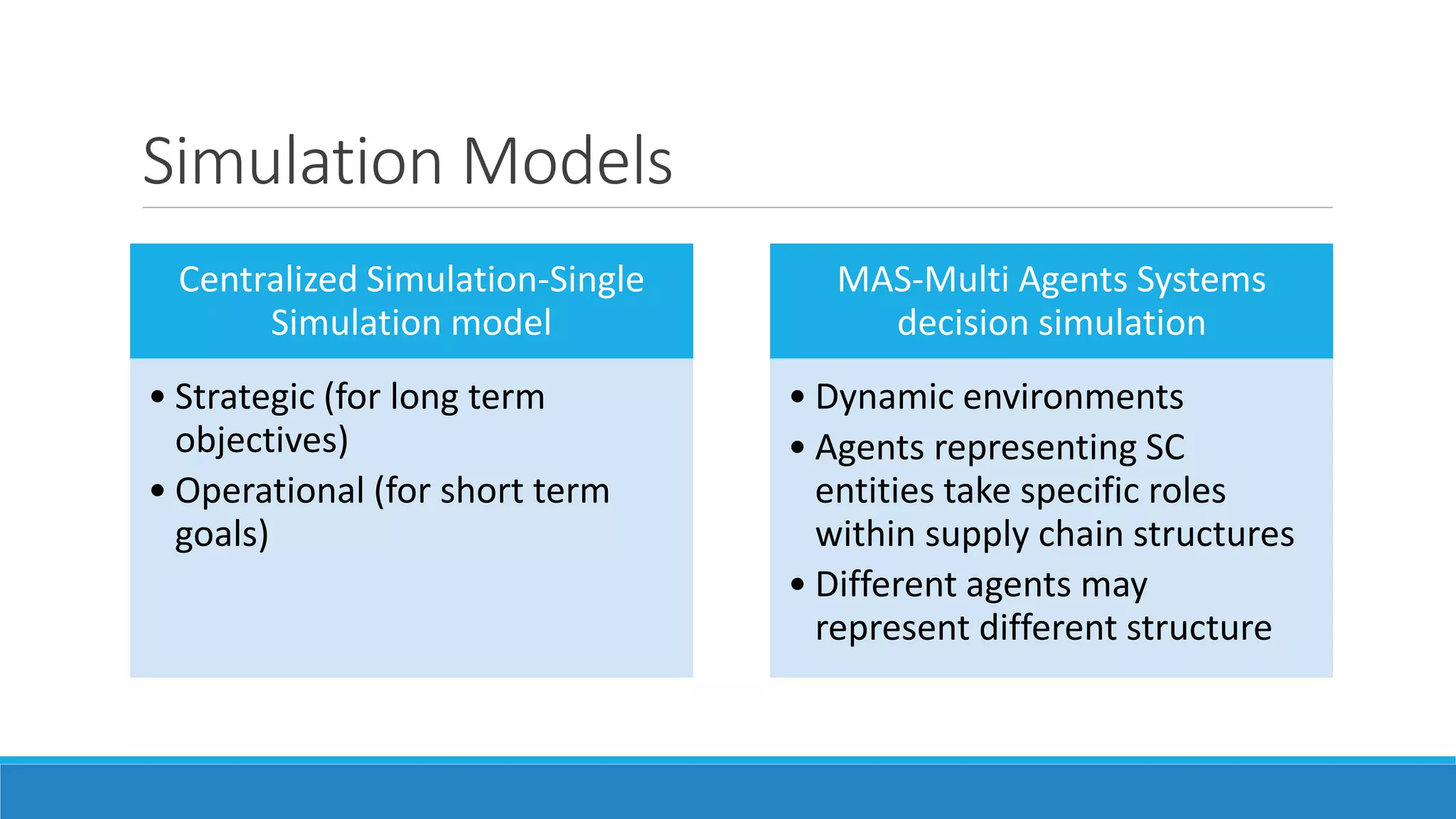
Simulation Models
Centralized Simulation-Single
Simulation model
• Strategic (for long term
objectives)
• Operational (for short term
goals)
MAS-Multi Agents Systems
decision simulation
• Dynamic environments
• Agents representing SC
entities take specific roles
within supply chain structures
• Different agents may
represent different structure
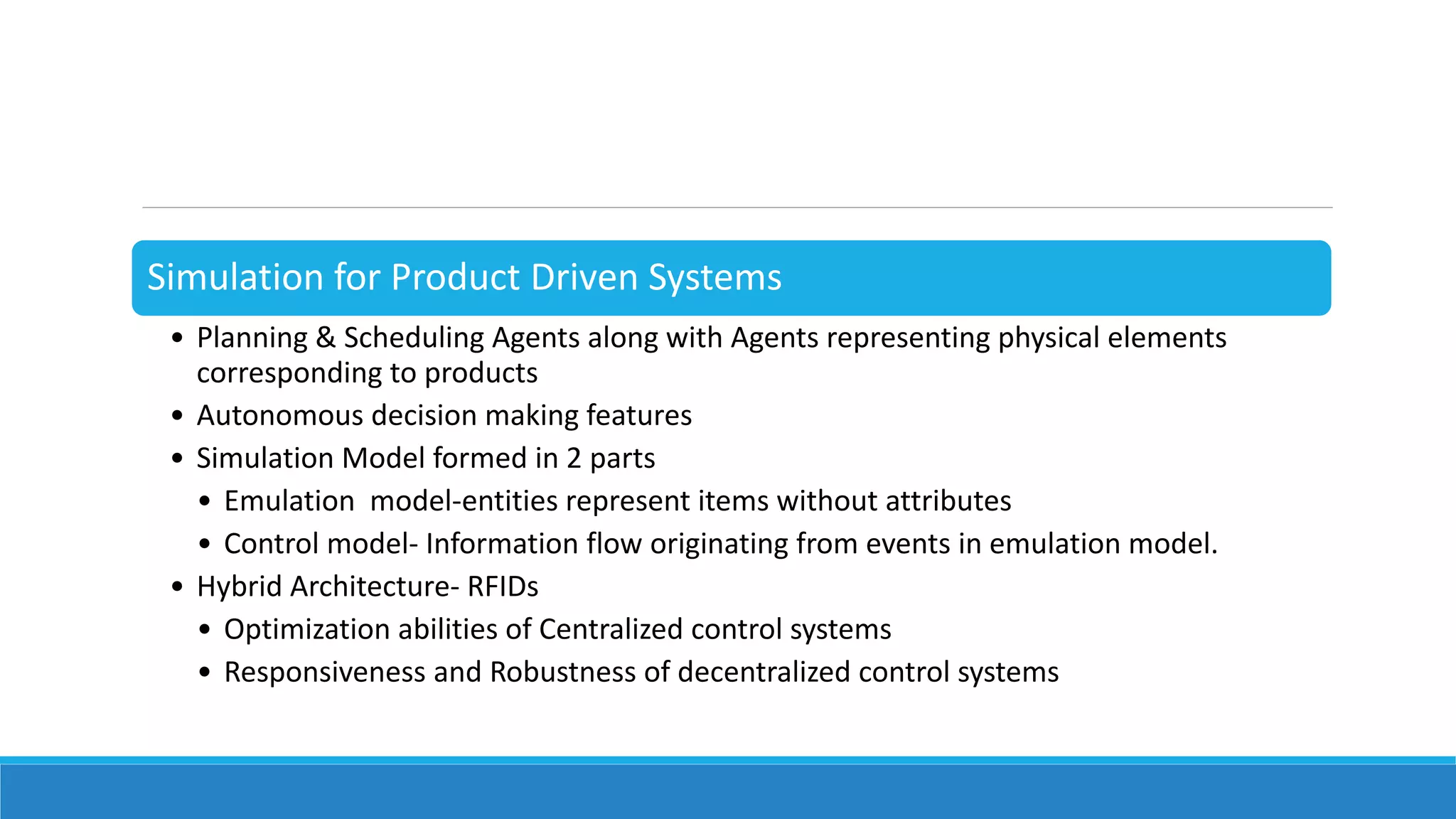
Simulation for Product Driven Systems
• Planning & Scheduling Agents along with Agents representing physical elements
corresponding to products
• Autonomous decision making features
• Simulation Model formed in 2 parts
• Emulation model-entities represent items without attributes
• Control model- Information flow originating from events in emulation model.
• Hybrid Architecture- RFIDs
• Optimization abilities of Centralized control systems
• Responsiveness and Robustness of decentralized control systems
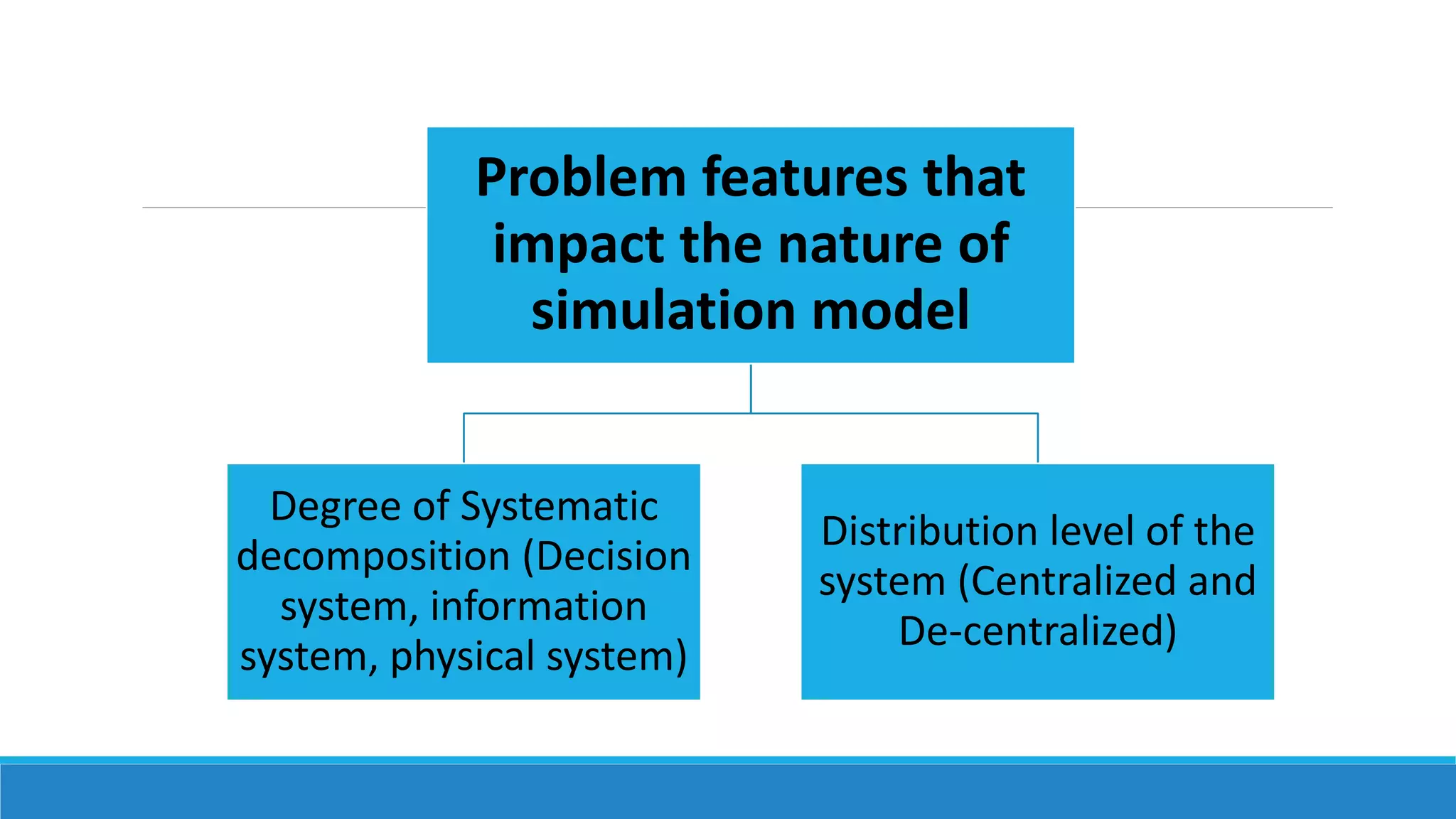
Problem features that
impact the nature of
simulation model
Degree of Systematic
decomposition (Decision
system, information
system, physical system)
Distribution level of the
system (Centralized and
De-centralized)
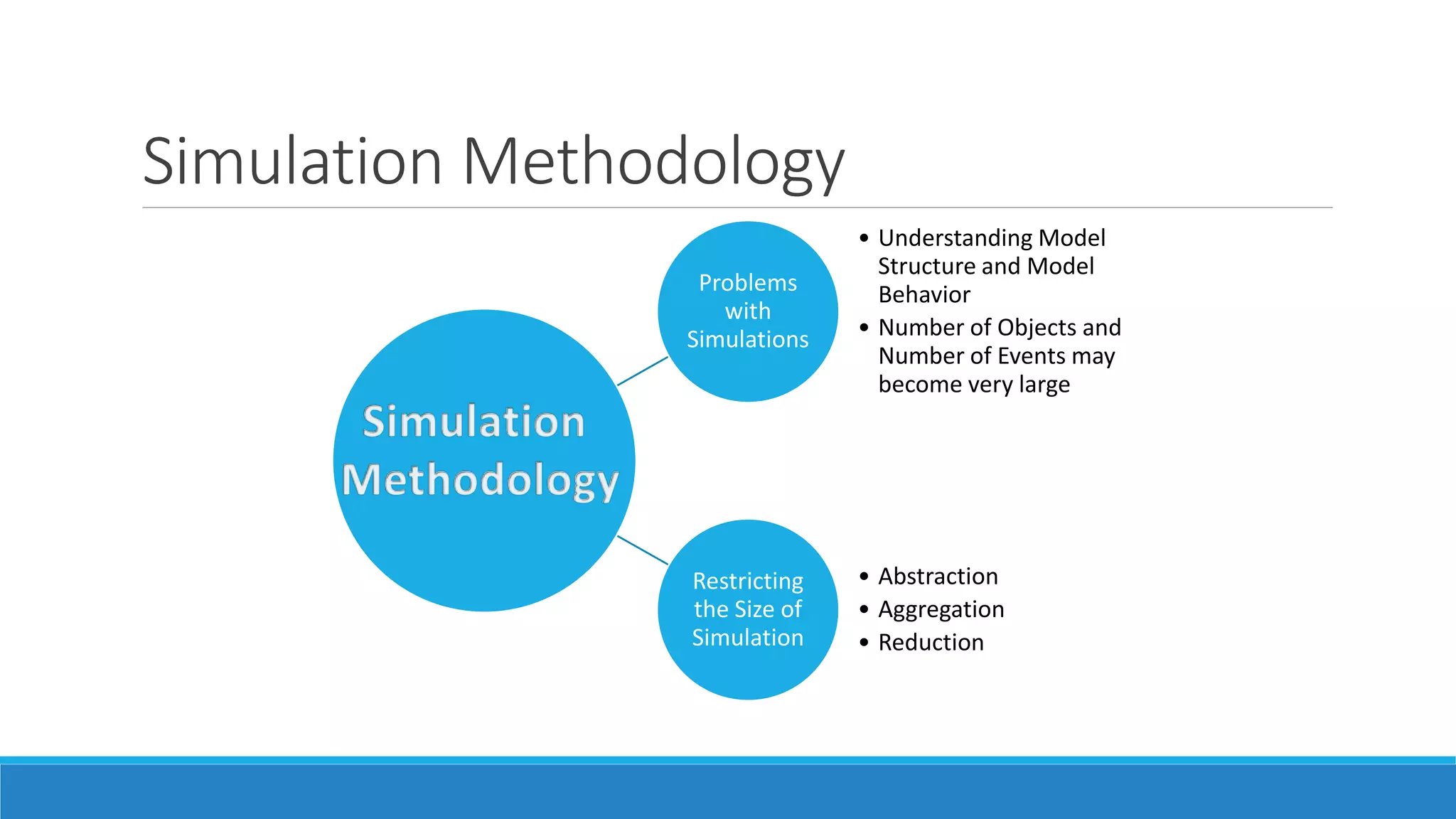
Simulation Methodology
Problems
with
Simulations
• Understanding Model
Structure and Model
Behavior
• Number of Objects and
Number of Events may
become very large
Restricting
the Size of
Simulation
• Abstraction
• Aggregation
• Reduction
Conclusion
Simulation is the most powerful technique to gain
insights into SC, but a lot of investigation needs to be
carried out to deal with inherently distributed nature of
Supply Chain.
Thank you!

Simulation

  • 1.
    The Role ofModelling and Simulation in Supply Chain Management SURAJ KUMAR BOTHRA – PGDM IB (06) CHANDAN TREHAN – PGDM OPS (160) AMIT KUMAR PRASAD – PGDM OPS (102)
  • 2.
    The Supply ChainOperations Reference model It focuses on a particular company and is based on five distinct management processes: Plan Source Make Deliver Return
  • 3.
    Tete-a-tete with theArticle Fundamental nature of a supply chain (a) The system under study is the supply chain of a given enterprise Internal (Integration of previously separate operations) or External (Cooperation between the enterprise and the other actors) (b) The supply chain under study is a network of enterprises Supply chain is a “network of organisations that are involved”
  • 4.
    Long range (strategic)decisions supply chain configuration: number and location of suppliers, production facilities, distribution centres Medium and short range decisions (tactical and operational) material management, inventory management, planning processes, forecasting processes, etc.
  • 5.
  • 6.
    ** how toexchange/share information? ** how to solve problems of mutual interest? ** how to set up global supply chain indicators ?
  • 7.
    Role of Simulationin SC  Performance evaluation (a) Analytical methods, such as queuing theory (b) Physical experimentations (c) Monte-Carlo methods, such as simulation or emulation A modelling and simulation approach is the only practical recourse The ability to carry out “what if“ analysis that lead to a “best” configuration
  • 8.
    Here is howsimulation helps! 1. Supply chain design decisions: Localisation, Selection of Suppliers, Size, Stock Level 2. Supply chain control policies: Inventory Management, VMI (Vendor Managed Inventory), CPFR (Collaborative Planning, Forecasting and Replenishment), Info Sharing Simulation focuses primarily on the dynamics of the physical and decision processes in the supply chain
  • 9.
    Application of Modellingand simulation on SCM Problem 1. Degree of Systematic decomposition of SCM model: - Decision system - Information system - Physical system 2. Distribution level of the system: - Centralized - Decentralized Reduction of execution simulation time Enhancing tolerance to simulation failures Preparation of SC control changes
  • 10.
    SIMULATION APPROACHES TOSCM 1. Continuous approach Forester - Dynamic system paradigm: not possible to differentiate individual entities. - Management control: performed by making variation on rates (production rate etc.) 2. Discrete approach - Time bucket driven - Event driven Time bucket driven: - Time is divided in periods of given length. - Time is incremented step-by-step - Lead time is more than time bucket - States are the states of the set of resources Event driven: - Used extensively in job-shop simulation - States are the states of the various items - A time advance algorithm that suitably manages a future event list is mandatory - State changes are characterized by appropriate logic conditions
  • 11.
    Decision systems andsimulation models (simulation vs. emulation) The inherently distributed nature of a supply chain Modularity of the control (i.e., management) system and the shop-floor model must be retained Centralized SCM –Physical system, control system and Information system –Simulation model built by appropriate model from one or more of these subsystems. Distributed SCM- Same as centralized however different simulation models on different computers.
  • 12.
    Simulation Models Centralized Simulation-Single Simulationmodel • Strategic (for long term objectives) • Operational (for short term goals) MAS-Multi Agents Systems decision simulation • Dynamic environments • Agents representing SC entities take specific roles within supply chain structures • Different agents may represent different structure
  • 13.
    Simulation for ProductDriven Systems • Planning & Scheduling Agents along with Agents representing physical elements corresponding to products • Autonomous decision making features • Simulation Model formed in 2 parts • Emulation model-entities represent items without attributes • Control model- Information flow originating from events in emulation model. • Hybrid Architecture- RFIDs • Optimization abilities of Centralized control systems • Responsiveness and Robustness of decentralized control systems
  • 14.
    Problem features that impactthe nature of simulation model Degree of Systematic decomposition (Decision system, information system, physical system) Distribution level of the system (Centralized and De-centralized)
  • 15.
    Simulation Methodology Problems with Simulations • UnderstandingModel Structure and Model Behavior • Number of Objects and Number of Events may become very large Restricting the Size of Simulation • Abstraction • Aggregation • Reduction
  • 16.
    Conclusion Simulation is themost powerful technique to gain insights into SC, but a lot of investigation needs to be carried out to deal with inherently distributed nature of Supply Chain.
  • 17.