24 October 2018
John D. Ferguson, Ph.D.
President / CEO
john@deepwavedigital.com
October 24, 2018
24 October 2018
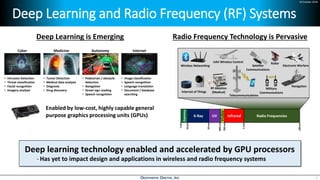
Deep Learning and Radio Frequency (RF) Systems
Deep Learning is Emerging
• Intrusion Detection
• Threat classification
• Facial recognition
• Imagery analysis
• Tumor Detection
• Medical data analysis
• Diagnosis
• Drug discovery
• Pedestrian / obstacle
detection
• Navigation
• Street sign reading
• Speech recognition
• Image classification
• Speech recognition
• Language translation
• Document / database
searching
Cyber Medicine Autonomy Internet
Deep learning technology enabled and accelerated by GPU processors
- Has yet to impact design and applications in wireless and radio frequency systems
Gamma
X-Ray UV
Visible
Infrared Radio Frequencies
1pm
10pm
10nm
400nm
700nm
1mm
100km
Radar
Satellite
Communications
Electronic Warfare
Telecommunications
Military
Communications
Navigation
UAV Wireless Control
Wireless Networking
Internet of Things
RF Ablation
(Medical)
Radio Frequency Technology is Pervasive
Enabled by low-cost, highly capable general
purpose graphics processing units (GPUs)
2
24 October 2018
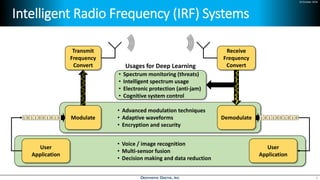
Usages for Deep Learning
• Advanced modulation techniques
• Adaptive waveforms
• Encryption and security
• Voice / image recognition
• Multi-sensor fusion
• Decision making and data reduction
• Spectrum monitoring (threats)
• Intelligent spectrum usage
• Electronic protection (anti-jam)
• Cognitive system control
Intelligent Radio Frequency (IRF) Systems
3
Modulate1 0 1 1 0 0 1 0 1 0
User
Application
Transmit
Frequency
Convert
User
Application
Receive
Frequency
Convert
1 0 1 1 0 0 1 0 1 0Demodulate
Usages for Deep Learning
24 October 2018
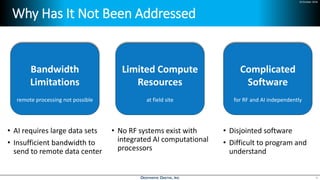
Why Has It Not Been Addressed
• AI requires large data sets
• Insufficient bandwidth to
send to remote data center
• No RF systems exist with
integrated AI computational
processors
• Disjointed software
• Difficult to program and
understand
4
Bandwidth
Limitations
Limited Compute
Resources
Complicated
Software
remote processing not possible at field site for RF and AI independently
24 October 2018
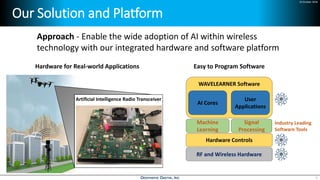
Our Solution and Platform
5
Artificial Intelligence Radio Transceiver
Approach - Enable the wide adoption of AI within wireless
technology with our integrated hardware and software platform
Hardware for Real-world Applications Easy to Program Software
5
RF and Wireless Hardware
Machine
Learning
Signal
Processing
Industry Leading
Software Tools
Hardware Controls
WAVELEARNER Software
User
Applications
AI Cores
24 October 2018
Outline
• Introduction
• Deep Learning in RF Systems
• Deepwave Digital Technology
• Example Signal Detection and Classification
• Real-time Signal Processing Benchmarks for GPUs
• Summary
6
24 October 2018
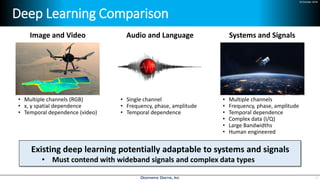
Deep Learning Comparison
• Multiple channels (RGB)
• x, y spatial dependence
• Temporal dependence (video)
• Single channel
• Frequency, phase, amplitude
• Temporal dependence
• Multiple channels
• Frequency, phase, amplitude
• Temporal dependence
• Complex data (I/Q)
• Large Bandwidths
• Human engineered
7
Image and Video Audio and Language Systems and Signals
Existing deep learning potentially adaptable to systems and signals
• Must contend with wideband signals and complex data types
24 October 2018
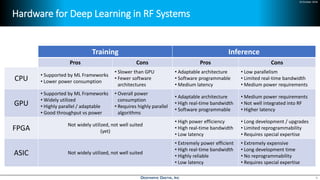
Hardware for Deep Learning in RF Systems
8
Training Inference
Pros Cons Pros Cons
CPU
• Supported by ML Frameworks
• Lower power consumption
• Slower than GPU
• Fewer software
architectures
• Adaptable architecture
• Software programmable
• Medium latency
• Low parallelism
• Limited real-time bandwidth
• Medium power requirements
GPU
• Supported by ML Frameworks
• Widely utilized
• Highly parallel / adaptable
• Good throughput vs power
• Overall power
consumption
• Requires highly parallel
algorithms
• Adaptable architecture
• High real-time bandwidth
• Software programmable
• Medium power requirements
• Not well integrated into RF
• Higher latency
FPGA
Not widely utilized, not well suited
(yet)
• High power efficiency
• High real-time bandwidth
• Low latency
• Long development / upgrades
• Limited reprogrammability
• Requires special expertise
ASIC Not widely utilized, not well suited
• Extremely power efficient
• High real-time bandwidth
• Highly reliable
• Low latency
• Extremely expensive
• Long development time
• No reprogrammability
• Requires special expertise
24 October 2018
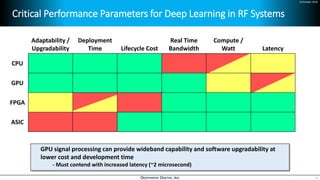
Critical Performance Parameters for Deep Learning in RF Systems
9
Adaptability /
Upgradability
Deployment
Time Lifecycle Cost
Real Time
Bandwidth
Compute /
Watt Latency
CPU
GPU
FPGA
ASIC
GPU signal processing can provide wideband capability and software upgradability at
lower cost and development time
- Must contend with increased latency (~2 microsecond)
24 October 2018
Outline
• Introduction
• Deep Learning in RF Systems
• Deepwave Digital Technology
• Example Signal Detection and Classification
• Real-time Signal Processing Benchmarks for GPUs
• Summary
10
24 October 2018
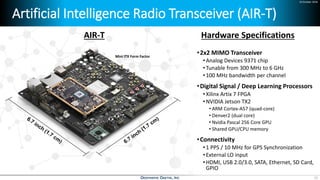
Artificial Intelligence Radio Transceiver (AIR-T)
•2x2 MIMO Transceiver
•Analog Devices 9371 chip
•Tunable from 300 MHz to 6 GHz
•100 MHz bandwidth per channel
•Digital Signal / Deep Learning Processors
•Xilinx Artix 7 FPGA
•NVIDIA Jetson TX2
• ARM Cortex-A57 (quad-core)
• Denver2 (dual core)
• Nvidia Pascal 256 Core GPU
• Shared GPU/CPU memory
•Connectivity
•1 PPS / 10 MHz for GPS Synchronization
•External LO input
•HDMI, USB 2.0/3.0, SATA, Ethernet, SD Card,
GPIO
AIR-T Hardware Specifications
Mini ITX Form Factor
13
24 October 2018
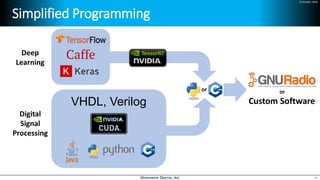
Simplified Programming
Deep
Learning
Digital
Signal
Processing
VHDL, Verilog
or
Custom Software
or
TensorRT
14
24 October 2018
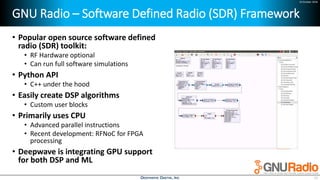
GNU Radio – Software Defined Radio (SDR) Framework
• Popular open source software defined
radio (SDR) toolkit:
• RF Hardware optional
• Can run full software simulations
• Python API
• C++ under the hood
• Easily create DSP algorithms
• Custom user blocks
• Primarily uses CPU
• Advanced parallel instructions
• Recent development: RFNoC for FPGA
processing
• Deepwave is integrating GPU support
for both DSP and ML
13
24 October 2018
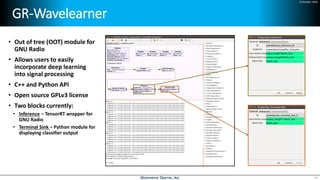
GR-Wavelearner
• Out of tree (OOT) module for
GNU Radio
• Allows users to easily
incorporate deep learning
into signal processing
• C++ and Python API
• Open source GPLv3 license
• Two blocks currently:
• Inference – TensorRT wrapper for
GNU Radio
• Terminal Sink – Python module for
displaying classifier output
14
24 October 2018
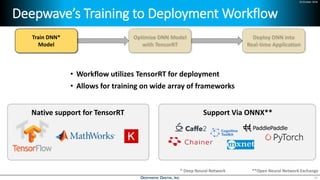
Deepwave’s Training to Deployment Workflow
• Workflow utilizes TensorRT for deployment
• Allows for training on wide array of frameworks
15
Train DNN*
Model
* Deep Neural Network **Open Neural Network Exchange
Native support for TensorRT Support Via ONNX**
24 October 2018
Deepwave’s Training to Deployment Workflow
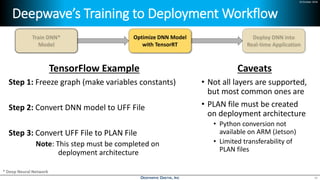
TensorFlow Example
Step 1: Freeze graph (make variables constants)
Step 2: Convert DNN model to UFF File
Step 3: Convert UFF File to PLAN File
Note: This step must be completed on
deployment architecture
Caveats
• Not all layers are supported,
but most common ones are
• PLAN file must be created
on deployment architecture
• Python conversion not
available on ARM (Jetson)
• Limited transferability of
PLAN files
16
Optimize DNN Model
with TensorRT
* Deep Neural Network
24 October 2018
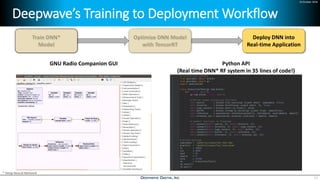
Deepwave’s Training to Deployment Workflow
17
Deploy DNN into
Real-time Application
* Deep Neural Network
GNU Radio Companion GUI Python API
(Real time DNN* RF system in 35 lines of code!)
24 October 2018
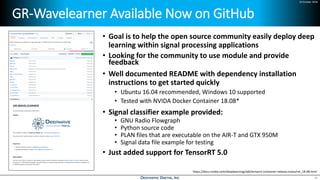
GR-Wavelearner Available Now on GitHub
18
• Goal is to help the open source community easily deploy deep
learning within signal processing applications
• Looking for the community to use module and provide
feedback
• Well documented README with dependency installation
instructions to get started quickly
• Ubuntu 16.04 recommended, Windows 10 supported
• Tested with NVIDA Docker Container 18.08*
• Signal classifier example provided:
• GNU Radio Flowgraph
• Python source code
• PLAN files that are executable on the AIR-T and GTX 950M
• Signal data file example for testing
• Just added support for TensorRT 5.0
https://docs.nvidia.com/deeplearning/sdk/tensorrt-container-release-notes/rel_18.08.html
24 October 2018
Outline
• Introduction
• Deep Learning in RF Systems
• Deepwave Digital Technology
• Example Signal Detection and Classification
• Real-time Signal Processing Benchmarks for GPUs
• Summary
19
24 October 2018
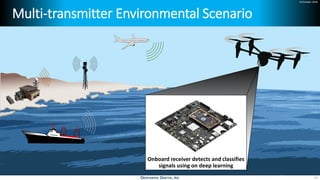
Multi-transmitter Environmental Scenario
Onboard receiver detects and classifies
signals using on deep learning
20
24 October 2018
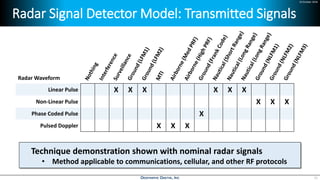
Radar Signal Detector Model: Transmitted Signals
Radar Waveform
Linear Pulse X X X X X X
Non-Linear Pulse X X X
Phase Coded Pulse X
Pulsed Doppler X X X
21
Technique demonstration shown with nominal radar signals
• Method applicable to communications, cellular, and other RF protocols
24 October 2018
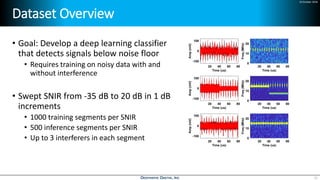
Dataset Overview
• Goal: Develop a deep learning classifier
that detects signals below noise floor
• Requires training on noisy data with and
without interference
• Swept SNIR from -35 dB to 20 dB in 1 dB
increments
• 1000 training segments per SNIR
• 500 inference segments per SNIR
• Up to 3 interferers in each segment
22
24 October 2018
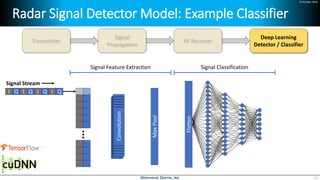
Radar Signal Detector Model: Example Classifier
23
Deep Learning
Detector / Classifier
Signal Feature Extraction Signal Classification
MaxPool
Flatten
Signal Stream
Convolution
QI
•••
QIQIQI
24 October 2018
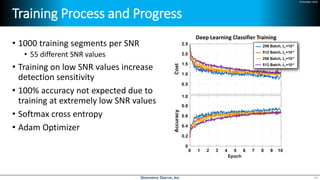
Training Process and Progress
• 1000 training segments per SNR
• 55 different SNR values
• Training on low SNR values increase
detection sensitivity
• 100% accuracy not expected due to
training at extremely low SNR values
• Softmax cross entropy
• Adam Optimizer
24
Deep Learning Classifier Training
24 October 2018
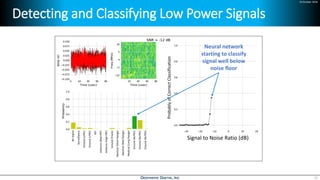
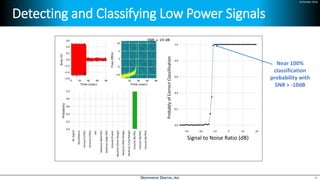
Detecting and Classifying Low Power Signals
25
Signal to Noise Ratio (dB)
ProbablyofCorrectClassification
Neural network
starting to classify
signal well below
noise floor
24 October 2018
Detecting and Classifying Low Power Signals
26
Signal to Noise Ratio (dB)
ProbablyofCorrectClassification
Near 100%
classification
probability with
SNR > -10dB
24 October 2018
Receiver Operating Characteristic (ROC) Curve
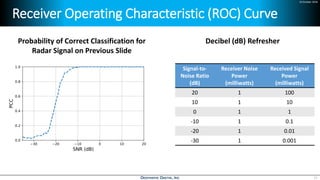
27
Probability of Correct Classification for
Radar Signal on Previous Slide
Signal-to-
Noise Ratio
(dB)
Receiver Noise
Power
(milliwatts)
Received Signal
Power
(milliwatts)
20 1 100
10 1 10
0 1 1
-10 1 0.1
-20 1 0.01
-30 1 0.001
Decibel (dB) Refresher
24 October 2018
Receiver Operating Characteristic (ROC) Curve
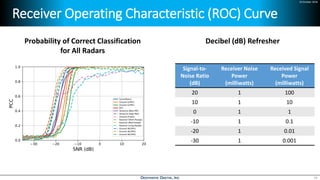
28
Probability of Correct Classification
for All Radars
Signal-to-
Noise Ratio
(dB)
Receiver Noise
Power
(milliwatts)
Received Signal
Power
(milliwatts)
20 1 100
10 1 10
0 1 1
-10 1 0.1
-20 1 0.01
-30 1 0.001
Decibel (dB) Refresher
24 October 2018
Receiver Operating Characteristic (ROC) Curve
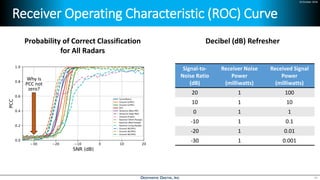
29
Why is
PCC not
zero?
Signal-to-
Noise Ratio
(dB)
Receiver Noise
Power
(milliwatts)
Received Signal
Power
(milliwatts)
20 1 100
10 1 10
0 1 1
-10 1 0.1
-20 1 0.01
-30 1 0.001
Decibel (dB) RefresherProbability of Correct Classification
for All Radars
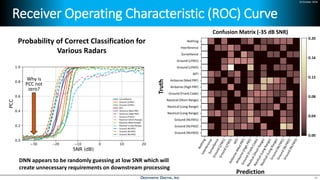
24 October 2018
Receiver Operating Characteristic (ROC) Curve
30
Confusion Matrix (-35 dB SNR)
Surveillance
Ground (LFM1)
Ground (LFM2)
MTI
Airborne (Med PRF)
Airborne (High PRF)
Ground (Frank Code)
Nautical (Short Range)
Nautical (Long Range)
Ground (NLFM1)
Ground (NLFM2)
Ground (NLFM3)
Interference
Nothing
Truth
0.20
0.16
0.12
0.08
0.04
0.00
Prediction
Why is
PCC not
zero?
Probability of Correct Classification for
Various Radars
DNN appears to be randomly guessing at low SNR which will
create unnecessary requirements on downstream processing
24 October 2018
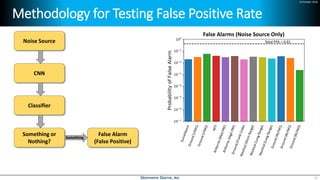
Methodology for Testing False Positive Rate
31
False Alarms (Noise Source Only)
Total PFA = 0.41Noise Source
Classifier
Something or
Nothing?
CNN
Something
False Alarm
(False Positive)
24 October 2018
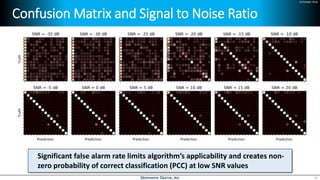
Confusion Matrix and Signal to Noise Ratio
32
Significant false alarm rate limits algorithm’s applicability and creates non-
zero probability of correct classification (PCC) at low SNR values
24 October 2018
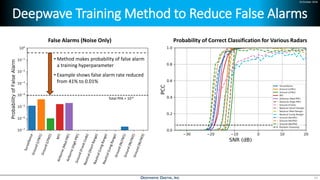
Deepwave Training Method to Reduce False Alarms
33
Probability of Correct Classification for Various RadarsFalse Alarms (Noise Only)
Total PFA = 10-4
• Method makes probability of false alarm
a training hyperparameter
• Example shows false alarm rate reduced
from 41% to 0.01%
24 October 2018
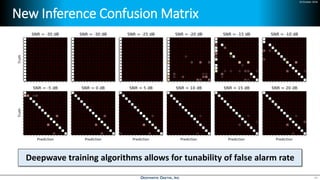
New Inference Confusion Matrix
34
Deepwave training algorithms allows for tunability of false alarm rate
24 October 2018
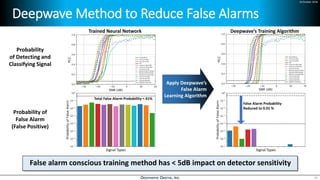
Deepwave Method to Reduce False Alarms
35
False Alarm Probability
Reduced to 0.01 %
Probability
of Detecting and
Classifying Signal
Probability of
False Alarm
(False Positive)
Total False Alarm Probability = 41%
Signal Types Signal Types
Apply Deepwave’s
False Alarm
Learning Algorithm
False alarm conscious training method has < 5dB impact on detector sensitivity
Deepwave’s Training AlgorithmTrained Neural Network
24 October 2018
Outline
• Introduction
• Deep Learning in RF Systems
• Deepwave Digital Technology
• Example Signal Detection and Classification
• Real-time Signal Processing Benchmarks for GPUs
• Summary
36
24 October 2018
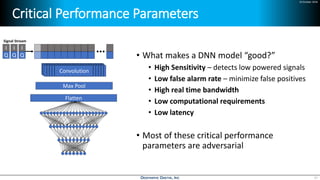
Critical Performance Parameters
• What makes a DNN model “good?”
• High Sensitivity – detects low powered signals
• Low false alarm rate – minimize false positives
• High real time bandwidth
• Low computational requirements
• Low latency
• Most of these critical performance
parameters are adversarial
37
Max Pool
Flatten
Signal Stream
Convolution
Q
I
•••
Q
I
Q
I
24 October 2018
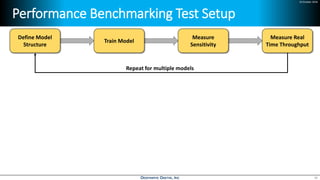
Performance Benchmarking Test Setup
38
Define Model
Structure
Train Model
Measure
Sensitivity
Measure Real
Time Throughput
Repeat for multiple models
24 October 2018
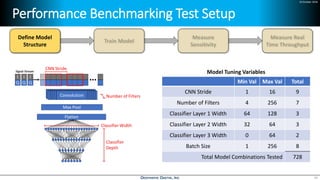
Performance Benchmarking Test Setup
39
Define Model
Structure
Min Val Max Val Total
CNN Stride 1 16 9
Number of Filters 4 256 7
Classifier Layer 1 Width 64 128 3
Classifier Layer 2 Width 32 64 3
Classifier Layer 3 Width 0 64 2
Batch Size 1 256 8
Total Model Combinations Tested 728
Model Tuning Variables
24 October 2018
Performance Benchmarking Test Setup
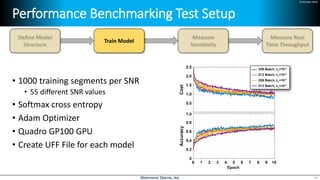
• 1000 training segments per SNR
• 55 different SNR values
• Softmax cross entropy
• Adam Optimizer
• Quadro GP100 GPU
• Create UFF File for each model
40
Train Model
24 October 2018
Performance Benchmarking Test Setup
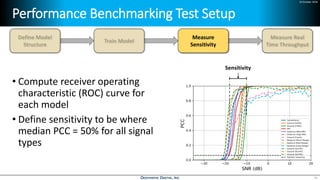
• Compute receiver operating
characteristic (ROC) curve for
each model
• Define sensitivity to be where
median PCC = 50% for all signal
types
41
Measure
Sensitivity
Sensitivity
24 October 2018
Performance Benchmarking Test Setup
• Create TensorRT PLAN file for
each platform tested
• Load signal data into RAM
• Stream unthrottled data to
gr-wavelearner
• Probe data rate at two locations:
1. Aggregate data rate for entire process
• Number of bytes processed / wall time
2. Computation data rate in work() function
• Number of bytes process / computation time
42
Measure Real
Time Throughput
24 October 2018
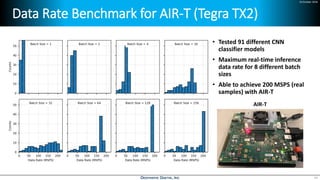
Data Rate Benchmark for AIR-T (Tegra TX2)
43
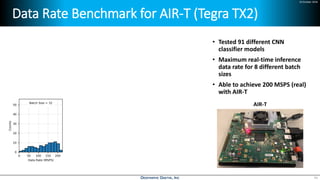
• Tested 91 different CNN
classifier models
• Maximum real-time inference
data rate for 8 different batch
sizes
• Able to achieve 200 MSPS (real)
with AIR-T
AIR-T
24 October 2018
Data Rate Benchmark for AIR-T (Tegra TX2)
44
• Tested 91 different CNN
classifier models
• Maximum real-time inference
data rate for 8 different batch
sizes
• Able to achieve 200 MSPS (real
samples) with AIR-T
AIR-T
24 October 2018
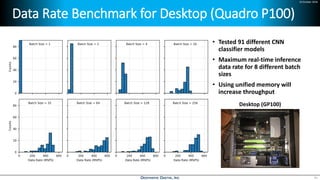
Data Rate Benchmark for Desktop (Quadro P100)
45
• Tested 91 different CNN
classifier models
• Maximum real-time inference
data rate for 8 different batch
sizes
• Using unified memory will
increase throughput
Desktop (GP100)
24 October 2018
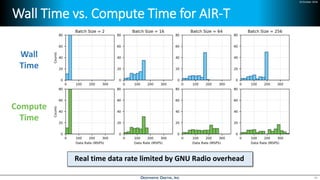
Wall Time vs. Compute Time for AIR-T
46
Wall
Time
Compute
Time
Real time data rate limited by GNU Radio overhead
24 October 2018
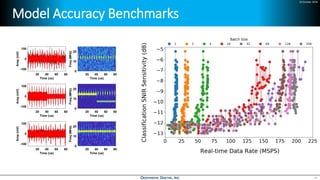
Model Accuracy Benchmarks
47
24 October 2018
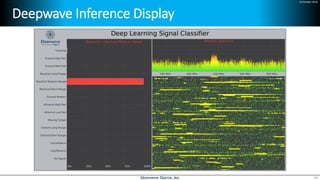
Deepwave Inference Display
48
24 October 2018
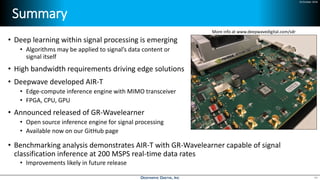
Summary
• Deep learning within signal processing is emerging
• Algorithms may be applied to signal’s data content or
signal itself
• High bandwidth requirements driving edge solutions
• Deepwave developed AIR-T
• Edge-compute inference engine with MIMO transceiver
• FPGA, CPU, GPU
• Announced released of GR-Wavelearner
• Open source inference engine for signal processing
• Available now on our GitHub page
• Benchmarking analysis demonstrates AIR-T with GR-Wavelearner capable of signal
classification inference at 200 MSPS real-time data rates
• Improvements likely in future release
49
More info at www.deepwavedigital.com/sdr
24 October 2018
44

Simplifying AI for Communications, Radar, and Wireless Systems

  • 1.
    24 October 2018 JohnD. Ferguson, Ph.D. President / CEO john@deepwavedigital.com October 24, 2018
  • 2.
    24 October 2018 DeepLearning and Radio Frequency (RF) Systems Deep Learning is Emerging • Intrusion Detection • Threat classification • Facial recognition • Imagery analysis • Tumor Detection • Medical data analysis • Diagnosis • Drug discovery • Pedestrian / obstacle detection • Navigation • Street sign reading • Speech recognition • Image classification • Speech recognition • Language translation • Document / database searching Cyber Medicine Autonomy Internet Deep learning technology enabled and accelerated by GPU processors - Has yet to impact design and applications in wireless and radio frequency systems Gamma X-Ray UV Visible Infrared Radio Frequencies 1pm 10pm 10nm 400nm 700nm 1mm 100km Radar Satellite Communications Electronic Warfare Telecommunications Military Communications Navigation UAV Wireless Control Wireless Networking Internet of Things RF Ablation (Medical) Radio Frequency Technology is Pervasive Enabled by low-cost, highly capable general purpose graphics processing units (GPUs) 2
  • 3.
    24 October 2018 Usagesfor Deep Learning Usages for Deep Learning • Advanced modulation techniques • Adaptive waveforms • Encryption and security • Voice / image recognition • Multi-sensor fusion • Decision making and data reduction • Spectrum monitoring (threats) • Intelligent spectrum usage • Electronic protection (anti-jam) • Cognitive system control Intelligent Radio Frequency (IRF) Systems 3 Modulate1 0 1 1 0 0 1 0 1 0 User Application Transmit Frequency Convert User Application Receive Frequency Convert 1 0 1 1 0 0 1 0 1 0Demodulate Usages for Deep Learning
  • 4.
    24 October 2018 WhyHas It Not Been Addressed • AI requires large data sets • Insufficient bandwidth to send to remote data center • No RF systems exist with integrated AI computational processors • Disjointed software • Difficult to program and understand 4 Bandwidth Limitations Limited Compute Resources Complicated Software remote processing not possible at field site for RF and AI independently
  • 5.
    24 October 2018 OurSolution and Platform 5 Artificial Intelligence Radio Transceiver Approach - Enable the wide adoption of AI within wireless technology with our integrated hardware and software platform Hardware for Real-world Applications Easy to Program Software 5 RF and Wireless Hardware Machine Learning Signal Processing Industry Leading Software Tools Hardware Controls WAVELEARNER Software User Applications AI Cores
  • 6.
    24 October 2018 Outline •Introduction • Deep Learning in RF Systems • Deepwave Digital Technology • Example Signal Detection and Classification • Real-time Signal Processing Benchmarks for GPUs • Summary 6
  • 7.
    24 October 2018 DeepLearning Comparison • Multiple channels (RGB) • x, y spatial dependence • Temporal dependence (video) • Single channel • Frequency, phase, amplitude • Temporal dependence • Multiple channels • Frequency, phase, amplitude • Temporal dependence • Complex data (I/Q) • Large Bandwidths • Human engineered 7 Image and Video Audio and Language Systems and Signals Existing deep learning potentially adaptable to systems and signals • Must contend with wideband signals and complex data types
  • 8.
    24 October 2018 Hardwarefor Deep Learning in RF Systems 8 Training Inference Pros Cons Pros Cons CPU • Supported by ML Frameworks • Lower power consumption • Slower than GPU • Fewer software architectures • Adaptable architecture • Software programmable • Medium latency • Low parallelism • Limited real-time bandwidth • Medium power requirements GPU • Supported by ML Frameworks • Widely utilized • Highly parallel / adaptable • Good throughput vs power • Overall power consumption • Requires highly parallel algorithms • Adaptable architecture • High real-time bandwidth • Software programmable • Medium power requirements • Not well integrated into RF • Higher latency FPGA Not widely utilized, not well suited (yet) • High power efficiency • High real-time bandwidth • Low latency • Long development / upgrades • Limited reprogrammability • Requires special expertise ASIC Not widely utilized, not well suited • Extremely power efficient • High real-time bandwidth • Highly reliable • Low latency • Extremely expensive • Long development time • No reprogrammability • Requires special expertise
  • 9.
    24 October 2018 CriticalPerformance Parameters for Deep Learning in RF Systems 9 Adaptability / Upgradability Deployment Time Lifecycle Cost Real Time Bandwidth Compute / Watt Latency CPU GPU FPGA ASIC GPU signal processing can provide wideband capability and software upgradability at lower cost and development time - Must contend with increased latency (~2 microsecond)
  • 10.
    24 October 2018 Outline •Introduction • Deep Learning in RF Systems • Deepwave Digital Technology • Example Signal Detection and Classification • Real-time Signal Processing Benchmarks for GPUs • Summary 10
  • 11.
    24 October 2018 ArtificialIntelligence Radio Transceiver (AIR-T) •2x2 MIMO Transceiver •Analog Devices 9371 chip •Tunable from 300 MHz to 6 GHz •100 MHz bandwidth per channel •Digital Signal / Deep Learning Processors •Xilinx Artix 7 FPGA •NVIDIA Jetson TX2 • ARM Cortex-A57 (quad-core) • Denver2 (dual core) • Nvidia Pascal 256 Core GPU • Shared GPU/CPU memory •Connectivity •1 PPS / 10 MHz for GPS Synchronization •External LO input •HDMI, USB 2.0/3.0, SATA, Ethernet, SD Card, GPIO AIR-T Hardware Specifications Mini ITX Form Factor 13
  • 12.
    24 October 2018 SimplifiedProgramming Deep Learning Digital Signal Processing VHDL, Verilog or Custom Software or TensorRT 14
  • 13.
    24 October 2018 GNURadio – Software Defined Radio (SDR) Framework • Popular open source software defined radio (SDR) toolkit: • RF Hardware optional • Can run full software simulations • Python API • C++ under the hood • Easily create DSP algorithms • Custom user blocks • Primarily uses CPU • Advanced parallel instructions • Recent development: RFNoC for FPGA processing • Deepwave is integrating GPU support for both DSP and ML 13
  • 14.
    24 October 2018 GR-Wavelearner •Out of tree (OOT) module for GNU Radio • Allows users to easily incorporate deep learning into signal processing • C++ and Python API • Open source GPLv3 license • Two blocks currently: • Inference – TensorRT wrapper for GNU Radio • Terminal Sink – Python module for displaying classifier output 14
  • 15.
    24 October 2018 Deepwave’sTraining to Deployment Workflow • Workflow utilizes TensorRT for deployment • Allows for training on wide array of frameworks 15 Train DNN* Model * Deep Neural Network **Open Neural Network Exchange Native support for TensorRT Support Via ONNX**
  • 16.
    24 October 2018 Deepwave’sTraining to Deployment Workflow TensorFlow Example Step 1: Freeze graph (make variables constants) Step 2: Convert DNN model to UFF File Step 3: Convert UFF File to PLAN File Note: This step must be completed on deployment architecture Caveats • Not all layers are supported, but most common ones are • PLAN file must be created on deployment architecture • Python conversion not available on ARM (Jetson) • Limited transferability of PLAN files 16 Optimize DNN Model with TensorRT * Deep Neural Network
  • 17.
    24 October 2018 Deepwave’sTraining to Deployment Workflow 17 Deploy DNN into Real-time Application * Deep Neural Network GNU Radio Companion GUI Python API (Real time DNN* RF system in 35 lines of code!)
  • 18.
    24 October 2018 GR-WavelearnerAvailable Now on GitHub 18 • Goal is to help the open source community easily deploy deep learning within signal processing applications • Looking for the community to use module and provide feedback • Well documented README with dependency installation instructions to get started quickly • Ubuntu 16.04 recommended, Windows 10 supported • Tested with NVIDA Docker Container 18.08* • Signal classifier example provided: • GNU Radio Flowgraph • Python source code • PLAN files that are executable on the AIR-T and GTX 950M • Signal data file example for testing • Just added support for TensorRT 5.0 https://docs.nvidia.com/deeplearning/sdk/tensorrt-container-release-notes/rel_18.08.html
  • 19.
    24 October 2018 Outline •Introduction • Deep Learning in RF Systems • Deepwave Digital Technology • Example Signal Detection and Classification • Real-time Signal Processing Benchmarks for GPUs • Summary 19
  • 20.
    24 October 2018 Multi-transmitterEnvironmental Scenario Onboard receiver detects and classifies signals using on deep learning 20
  • 21.
    24 October 2018 RadarSignal Detector Model: Transmitted Signals Radar Waveform Linear Pulse X X X X X X Non-Linear Pulse X X X Phase Coded Pulse X Pulsed Doppler X X X 21 Technique demonstration shown with nominal radar signals • Method applicable to communications, cellular, and other RF protocols
  • 22.
    24 October 2018 DatasetOverview • Goal: Develop a deep learning classifier that detects signals below noise floor • Requires training on noisy data with and without interference • Swept SNIR from -35 dB to 20 dB in 1 dB increments • 1000 training segments per SNIR • 500 inference segments per SNIR • Up to 3 interferers in each segment 22
  • 23.
    24 October 2018 RadarSignal Detector Model: Example Classifier 23 Deep Learning Detector / Classifier Signal Feature Extraction Signal Classification MaxPool Flatten Signal Stream Convolution QI ••• QIQIQI
  • 24.
    24 October 2018 TrainingProcess and Progress • 1000 training segments per SNR • 55 different SNR values • Training on low SNR values increase detection sensitivity • 100% accuracy not expected due to training at extremely low SNR values • Softmax cross entropy • Adam Optimizer 24 Deep Learning Classifier Training
  • 25.
    24 October 2018 Detectingand Classifying Low Power Signals 25 Signal to Noise Ratio (dB) ProbablyofCorrectClassification Neural network starting to classify signal well below noise floor
  • 26.
    24 October 2018 Detectingand Classifying Low Power Signals 26 Signal to Noise Ratio (dB) ProbablyofCorrectClassification Near 100% classification probability with SNR > -10dB
  • 27.
    24 October 2018 ReceiverOperating Characteristic (ROC) Curve 27 Probability of Correct Classification for Radar Signal on Previous Slide Signal-to- Noise Ratio (dB) Receiver Noise Power (milliwatts) Received Signal Power (milliwatts) 20 1 100 10 1 10 0 1 1 -10 1 0.1 -20 1 0.01 -30 1 0.001 Decibel (dB) Refresher
  • 28.
    24 October 2018 ReceiverOperating Characteristic (ROC) Curve 28 Probability of Correct Classification for All Radars Signal-to- Noise Ratio (dB) Receiver Noise Power (milliwatts) Received Signal Power (milliwatts) 20 1 100 10 1 10 0 1 1 -10 1 0.1 -20 1 0.01 -30 1 0.001 Decibel (dB) Refresher
  • 29.
    24 October 2018 ReceiverOperating Characteristic (ROC) Curve 29 Why is PCC not zero? Signal-to- Noise Ratio (dB) Receiver Noise Power (milliwatts) Received Signal Power (milliwatts) 20 1 100 10 1 10 0 1 1 -10 1 0.1 -20 1 0.01 -30 1 0.001 Decibel (dB) RefresherProbability of Correct Classification for All Radars
  • 30.
    24 October 2018 ReceiverOperating Characteristic (ROC) Curve 30 Confusion Matrix (-35 dB SNR) Surveillance Ground (LFM1) Ground (LFM2) MTI Airborne (Med PRF) Airborne (High PRF) Ground (Frank Code) Nautical (Short Range) Nautical (Long Range) Nautical (Long Range) Ground (NLFM1) Ground (NLFM2) Ground (NLFM3) Interference Nothing Truth 0.20 0.16 0.12 0.08 0.04 0.00 Prediction Why is PCC not zero? Probability of Correct Classification for Various Radars DNN appears to be randomly guessing at low SNR which will create unnecessary requirements on downstream processing
  • 31.
    24 October 2018 Methodologyfor Testing False Positive Rate 31 False Alarms (Noise Source Only) Total PFA = 0.41Noise Source Classifier Something or Nothing? CNN Something False Alarm (False Positive)
  • 32.
    24 October 2018 ConfusionMatrix and Signal to Noise Ratio 32 Significant false alarm rate limits algorithm’s applicability and creates non- zero probability of correct classification (PCC) at low SNR values
  • 33.
    24 October 2018 DeepwaveTraining Method to Reduce False Alarms 33 Probability of Correct Classification for Various RadarsFalse Alarms (Noise Only) Total PFA = 10-4 • Method makes probability of false alarm a training hyperparameter • Example shows false alarm rate reduced from 41% to 0.01%
  • 34.
    24 October 2018 NewInference Confusion Matrix 34 Deepwave training algorithms allows for tunability of false alarm rate
  • 35.
    24 October 2018 DeepwaveMethod to Reduce False Alarms 35 False Alarm Probability Reduced to 0.01 % Probability of Detecting and Classifying Signal Probability of False Alarm (False Positive) Total False Alarm Probability = 41% Signal Types Signal Types Apply Deepwave’s False Alarm Learning Algorithm False alarm conscious training method has < 5dB impact on detector sensitivity Deepwave’s Training AlgorithmTrained Neural Network
  • 36.
    24 October 2018 Outline •Introduction • Deep Learning in RF Systems • Deepwave Digital Technology • Example Signal Detection and Classification • Real-time Signal Processing Benchmarks for GPUs • Summary 36
  • 37.
    24 October 2018 CriticalPerformance Parameters • What makes a DNN model “good?” • High Sensitivity – detects low powered signals • Low false alarm rate – minimize false positives • High real time bandwidth • Low computational requirements • Low latency • Most of these critical performance parameters are adversarial 37 Max Pool Flatten Signal Stream Convolution Q I ••• Q I Q I
  • 38.
    24 October 2018 PerformanceBenchmarking Test Setup 38 Define Model Structure Train Model Measure Sensitivity Measure Real Time Throughput Repeat for multiple models
  • 39.
    24 October 2018 PerformanceBenchmarking Test Setup 39 Define Model Structure Min Val Max Val Total CNN Stride 1 16 9 Number of Filters 4 256 7 Classifier Layer 1 Width 64 128 3 Classifier Layer 2 Width 32 64 3 Classifier Layer 3 Width 0 64 2 Batch Size 1 256 8 Total Model Combinations Tested 728 Model Tuning Variables
  • 40.
    24 October 2018 PerformanceBenchmarking Test Setup • 1000 training segments per SNR • 55 different SNR values • Softmax cross entropy • Adam Optimizer • Quadro GP100 GPU • Create UFF File for each model 40 Train Model
  • 41.
    24 October 2018 PerformanceBenchmarking Test Setup • Compute receiver operating characteristic (ROC) curve for each model • Define sensitivity to be where median PCC = 50% for all signal types 41 Measure Sensitivity Sensitivity
  • 42.
    24 October 2018 PerformanceBenchmarking Test Setup • Create TensorRT PLAN file for each platform tested • Load signal data into RAM • Stream unthrottled data to gr-wavelearner • Probe data rate at two locations: 1. Aggregate data rate for entire process • Number of bytes processed / wall time 2. Computation data rate in work() function • Number of bytes process / computation time 42 Measure Real Time Throughput
  • 43.
    24 October 2018 DataRate Benchmark for AIR-T (Tegra TX2) 43 • Tested 91 different CNN classifier models • Maximum real-time inference data rate for 8 different batch sizes • Able to achieve 200 MSPS (real) with AIR-T AIR-T
  • 44.
    24 October 2018 DataRate Benchmark for AIR-T (Tegra TX2) 44 • Tested 91 different CNN classifier models • Maximum real-time inference data rate for 8 different batch sizes • Able to achieve 200 MSPS (real samples) with AIR-T AIR-T
  • 45.
    24 October 2018 DataRate Benchmark for Desktop (Quadro P100) 45 • Tested 91 different CNN classifier models • Maximum real-time inference data rate for 8 different batch sizes • Using unified memory will increase throughput Desktop (GP100)
  • 46.
    24 October 2018 WallTime vs. Compute Time for AIR-T 46 Wall Time Compute Time Real time data rate limited by GNU Radio overhead
  • 47.
    24 October 2018 ModelAccuracy Benchmarks 47
  • 48.
    24 October 2018 DeepwaveInference Display 48
  • 49.
    24 October 2018 Summary •Deep learning within signal processing is emerging • Algorithms may be applied to signal’s data content or signal itself • High bandwidth requirements driving edge solutions • Deepwave developed AIR-T • Edge-compute inference engine with MIMO transceiver • FPGA, CPU, GPU • Announced released of GR-Wavelearner • Open source inference engine for signal processing • Available now on our GitHub page • Benchmarking analysis demonstrates AIR-T with GR-Wavelearner capable of signal classification inference at 200 MSPS real-time data rates • Improvements likely in future release 49 More info at www.deepwavedigital.com/sdr
  • 50.