PRESENT SIMPLE
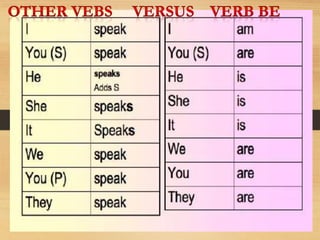
Verb Be/Other verbs (eat, jump, etc.)
Modal verbs: Can, could, may, should
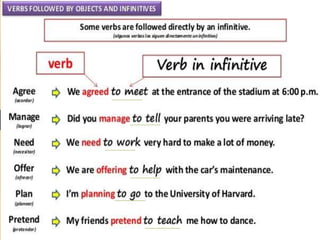
Infinitives
Welcome to this English course
My name is Rosalba Bryan.
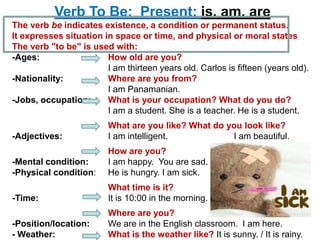
Verb To Be: Present: is, am, are
The verb be indicates existence, a condition or permanent status.
It expresses situation in space or time, and physical or moral states
The verb "to be" is used with:
-Ages: How old are you?
I am thirteen years old. Carlos is fifteen (years old).
-Nationality: Where are you from?
I am Panamanian.
-Jobs, occupation: What is your occupation? What do you do?
I am a student. She is a teacher. He is a student.
What are you like? What do you look like?
-Adjectives: I am intelligent. I am beautiful.
How are you?
-Mental condition: I am happy. You are sad.
-Physical condition: He is hungry. I am sick.
What time is it?
-Time: It is 10:00 in the morning.
Where are you?
-Position/location: We are in the English classroom. I am here.
- Weather: What is the weather like? It is sunny. / It is rainy.
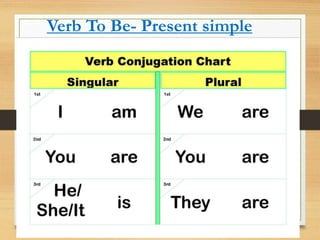
Verb To Be- Present simple
Sentence Structure- Verb To Be
Formative Assignment: Write 15 sentences about your friends. Describe you and your frien
5 affirmative sentences, 5 negative sentences and 5 interrogative sentences.
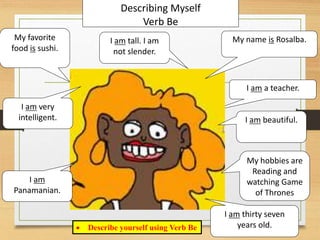
I am a teacher.
My favorite
food is sushi.
My name is Rosalba.
I am thirty seven
years old.
I am beautiful.
I am tall. I am
not slender.
I am
Panamanian.
I am very
intelligent.
Describing Myself
Verb Be
 Describe yourself using Verb Be
My hobbies are
Reading and
watching Game
of Thrones
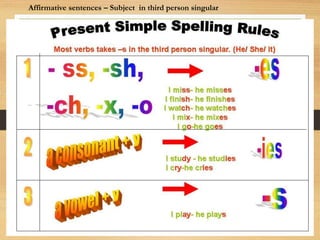
Affirmative sentences – Subject in third person singular
Use your English/Spanish dictionary to make sentences with this Verb .
1. __I know your secret.______________________________. know ( +)
2. __I don’t know your secret.______________________________. know ( -)
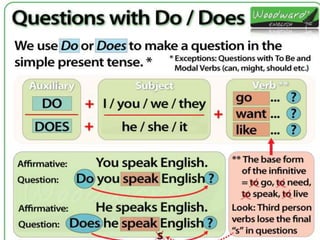
3. __Do I know your secret?______________________________. know ( ?)
SUBJECT MAIN VERB REST OF SENTENCE
SUBJECT AUXILIARY VERB
(DO-DOES) / NOT
MAIN VERB REST OF
SENTENCE
QUESTION
WORD
AUXILIARY VERB
(DO-DOES)
SUBJECT MAIN VERB REST OF
SENTENCE
Interrogative sentences
Simple Present - Sentence structure
Facts, Habitual activities, habits, hobbies
Affirmative sentences
Negative sentences
Carolyn’s children live in Panama.
He lives in Colon.
I need to pass this English course.
I have to study English every day.
I do not (don’t) like to wait for things.
He does not (doesn’t) have any hobbies.
Do my children go to the park?
Where do you have to go today?
Formative Assignment: Write 15 sentences to describe your habitual routines and permanent
Aspects of your life. 5 affirmative sentences, 5 negative sentences and 5 interrogative sentences.
Example: The boy in my classroom is sick.
( I know the boy.)
Example: a boy is sick.
( I don’t know the boy.)
No specific
Singular nouns
Specific
Plural or singular
nouns
Possessive Adjectives
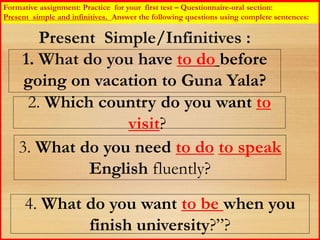
Present Simple/Infinitives :
1. What do you have to do before
going on vacation to Guna Yala?
2. Which country do you want to
visit?
3. What do you need to do to speak
English fluently?
4. What do you want to be when you
finish university?”?
Formative assignment: Practice for your first test – Questionnaire-oral section:
Present simple and infinitives. Answer the following questions using complete sentences:
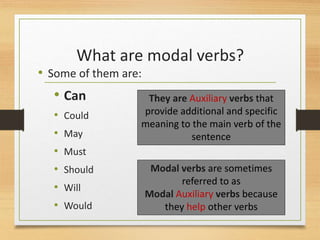
What are modal verbs?
• Some of them are:
• Can
• Could
• May
• Must
• Should
• Will
• Would
Modal verbs are sometimes
referred to as
Modal Auxiliary verbs because
they help other verbs
They are Auxiliary verbs that
provide additional and specific
meaning to the main verb of the
sentence
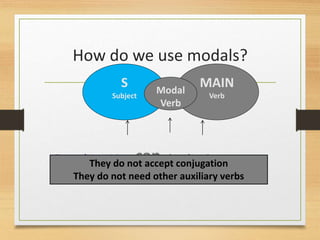
How do we use modals?
Example: Mary canplay the piano
S
Subject
MAIN
Verb
Modal
Verb
They do not accept conjugation
They do not need other auxiliary verbs
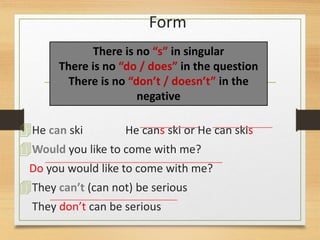
Form
He can ski He cans ski or He can skis
Would you like to come with me?
Do you would like to come with me?
They can’t (can not) be serious
They don’t can be serious
There is no “s” in singular
There is no “do / does” in the question
There is no “don’t / doesn’t” in the
negative
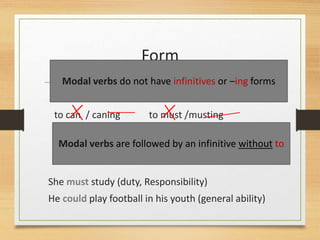
Form
to can / caning to must /musting
She must study (duty, Responsibility)
He could play football in his youth (general ability)
Modal verbs do not have infinitives or –ing forms
Modal verbs are followed by an infinitive without to
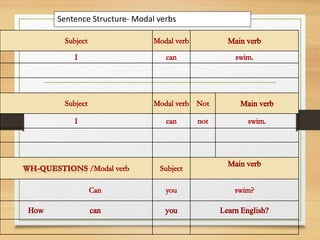
Sentence Structure- Modal verbs

Simple present, infinitives and modal verbs

  • 1.
    PRESENT SIMPLE Verb Be/Otherverbs (eat, jump, etc.) Modal verbs: Can, could, may, should Infinitives Welcome to this English course My name is Rosalba Bryan.
  • 2.
    Verb To Be:Present: is, am, are The verb be indicates existence, a condition or permanent status. It expresses situation in space or time, and physical or moral states The verb "to be" is used with: -Ages: How old are you? I am thirteen years old. Carlos is fifteen (years old). -Nationality: Where are you from? I am Panamanian. -Jobs, occupation: What is your occupation? What do you do? I am a student. She is a teacher. He is a student. What are you like? What do you look like? -Adjectives: I am intelligent. I am beautiful. How are you? -Mental condition: I am happy. You are sad. -Physical condition: He is hungry. I am sick. What time is it? -Time: It is 10:00 in the morning. Where are you? -Position/location: We are in the English classroom. I am here. - Weather: What is the weather like? It is sunny. / It is rainy.
  • 3.
    Verb To Be-Present simple
  • 5.
    Sentence Structure- VerbTo Be Formative Assignment: Write 15 sentences about your friends. Describe you and your frien 5 affirmative sentences, 5 negative sentences and 5 interrogative sentences.
  • 6.
    I am ateacher. My favorite food is sushi. My name is Rosalba. I am thirty seven years old. I am beautiful. I am tall. I am not slender. I am Panamanian. I am very intelligent. Describing Myself Verb Be  Describe yourself using Verb Be My hobbies are Reading and watching Game of Thrones
  • 10.
    Affirmative sentences –Subject in third person singular
  • 11.
    Use your English/Spanishdictionary to make sentences with this Verb . 1. __I know your secret.______________________________. know ( +) 2. __I don’t know your secret.______________________________. know ( -) 3. __Do I know your secret?______________________________. know ( ?)
  • 14.
    SUBJECT MAIN VERBREST OF SENTENCE SUBJECT AUXILIARY VERB (DO-DOES) / NOT MAIN VERB REST OF SENTENCE QUESTION WORD AUXILIARY VERB (DO-DOES) SUBJECT MAIN VERB REST OF SENTENCE Interrogative sentences Simple Present - Sentence structure Facts, Habitual activities, habits, hobbies Affirmative sentences Negative sentences Carolyn’s children live in Panama. He lives in Colon. I need to pass this English course. I have to study English every day. I do not (don’t) like to wait for things. He does not (doesn’t) have any hobbies. Do my children go to the park? Where do you have to go today? Formative Assignment: Write 15 sentences to describe your habitual routines and permanent Aspects of your life. 5 affirmative sentences, 5 negative sentences and 5 interrogative sentences.
  • 16.
    Example: The boyin my classroom is sick. ( I know the boy.) Example: a boy is sick. ( I don’t know the boy.) No specific Singular nouns Specific Plural or singular nouns
  • 18.
  • 20.
    Present Simple/Infinitives : 1.What do you have to do before going on vacation to Guna Yala? 2. Which country do you want to visit? 3. What do you need to do to speak English fluently? 4. What do you want to be when you finish university?”? Formative assignment: Practice for your first test – Questionnaire-oral section: Present simple and infinitives. Answer the following questions using complete sentences:
  • 21.
    What are modalverbs? • Some of them are: • Can • Could • May • Must • Should • Will • Would Modal verbs are sometimes referred to as Modal Auxiliary verbs because they help other verbs They are Auxiliary verbs that provide additional and specific meaning to the main verb of the sentence
  • 22.
    How do weuse modals? Example: Mary canplay the piano S Subject MAIN Verb Modal Verb They do not accept conjugation They do not need other auxiliary verbs
  • 23.
    Form He can skiHe cans ski or He can skis Would you like to come with me? Do you would like to come with me? They can’t (can not) be serious They don’t can be serious There is no “s” in singular There is no “do / does” in the question There is no “don’t / doesn’t” in the negative
  • 24.
    Form to can /caning to must /musting She must study (duty, Responsibility) He could play football in his youth (general ability) Modal verbs do not have infinitives or –ing forms Modal verbs are followed by an infinitive without to
  • 25.