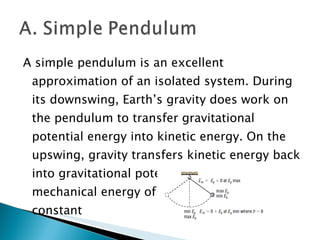
A simple pendulum is an excellent approximation of an isolated system. During its downswing, Earth’s gravity does work on the pendulum to transfer gravitational potential energy into kinetic energy. On the upswing, gravity transfers kinetic energy back into gravitational potential energy. The mechanical energy of the pendulum is constant
Even though such an object cannot physically exist due to relativity, objects can normally be assumed to be perfectly rigid if they are not moving near the speed of light.
particle would remain in equilibrium, in a state of rest, or in a state of uniform motion in a straight line when the resultant of all the forces acting on it was equal to zero.
Many of the problems of the equilibrium of extended bodies do not fulfill these conditions. The forces acting on the body do not pass through a single point, and the motion of the body is not one of uniform translational motion but may include rotation as well.
While all material bodies deform somewhat under the action of applied forces, it is convenient to think of them as nondeforming, or as rigid; we shall define a  rigid body as one in which all dimensions remain the same, regardless of the nature of the applied forces.
There are three main types of stress. If we stretch or compress an object, we are subjecting it to a  tensile stress . If an object is subjected to a force along an entire surface, changing its volume, then it is said to be experiencing a  bulk stress . Finally, if the force is acting tangentially to the surface, causing it to twist, then we are subjecting it to a  shear stress .
tensile stress  because every part of the object is subjected to a tension. The SI unit of stress is the Newton per square meter, which is called the Pascal
The fractional amount that an object stretches when it is subjected to a tensile stress is called the tensile strain.
Robert Hooke found that, when the forces are not too large, the amount of strain experience by an object was directly proportional to the stress. This is another example of  Hooke's law .

Simple pendulum, rigid statics, stress and

  • 1.
  • 2.
    A simple pendulumis an excellent approximation of an isolated system. During its downswing, Earth’s gravity does work on the pendulum to transfer gravitational potential energy into kinetic energy. On the upswing, gravity transfers kinetic energy back into gravitational potential energy. The mechanical energy of the pendulum is constant
  • 3.
    Even though suchan object cannot physically exist due to relativity, objects can normally be assumed to be perfectly rigid if they are not moving near the speed of light.
  • 4.
    particle would remainin equilibrium, in a state of rest, or in a state of uniform motion in a straight line when the resultant of all the forces acting on it was equal to zero.
  • 5.
    Many of theproblems of the equilibrium of extended bodies do not fulfill these conditions. The forces acting on the body do not pass through a single point, and the motion of the body is not one of uniform translational motion but may include rotation as well.
  • 6.
    While all materialbodies deform somewhat under the action of applied forces, it is convenient to think of them as nondeforming, or as rigid; we shall define a rigid body as one in which all dimensions remain the same, regardless of the nature of the applied forces.
  • 7.
    There are threemain types of stress. If we stretch or compress an object, we are subjecting it to a  tensile stress . If an object is subjected to a force along an entire surface, changing its volume, then it is said to be experiencing a  bulk stress . Finally, if the force is acting tangentially to the surface, causing it to twist, then we are subjecting it to a  shear stress .
  • 8.
    tensile stress  becauseevery part of the object is subjected to a tension. The SI unit of stress is the Newton per square meter, which is called the Pascal
  • 9.
    The fractional amountthat an object stretches when it is subjected to a tensile stress is called the tensile strain.
  • 10.
    Robert Hooke foundthat, when the forces are not too large, the amount of strain experience by an object was directly proportional to the stress. This is another example of  Hooke's law .