TOPIC 2
I N T R O D U C T I O N T O T I M E V A L U E O F M O N E Y
Session 2
2
• Determine the future value of an investment made today
• Determine the present value of cash to be received at a future date
• Find the return on an investment
• Calculate how long it takes for an investment to reach a desired
value
WHAT WE SHOULD KNOW
Session 2
3
• Future Value and Compounding
• Present Value and Discounting
• More about Present and Future Values
• Annuity and Annuity Due
NEW TERMS
Session 2
4
• How to determine the value of cash flow expected in future?
• How to allocate cash today for future liabilities?
• How to determine best projects based on expected future cash
flows?
CHALLENGES FOR A MANAGER
Session 2
5
• Present Value – earlier money on a time line
• Future Value – later money on a time line
• Interest rate – “exchange rate” between earlier money and later
money
 Discount rate
 Cost of capital
 Opportunity cost of capital
 Required return
BASIC DEFINITIONS
Session 2
6
• Suppose you invest $1,000 for one year at 5% per year. What is the
future value in one year?
• Suppose you leave the money in for another year. How much will you
have two years from now?
FUTURE VALUE – EXAMPLE 1
Session 2
7
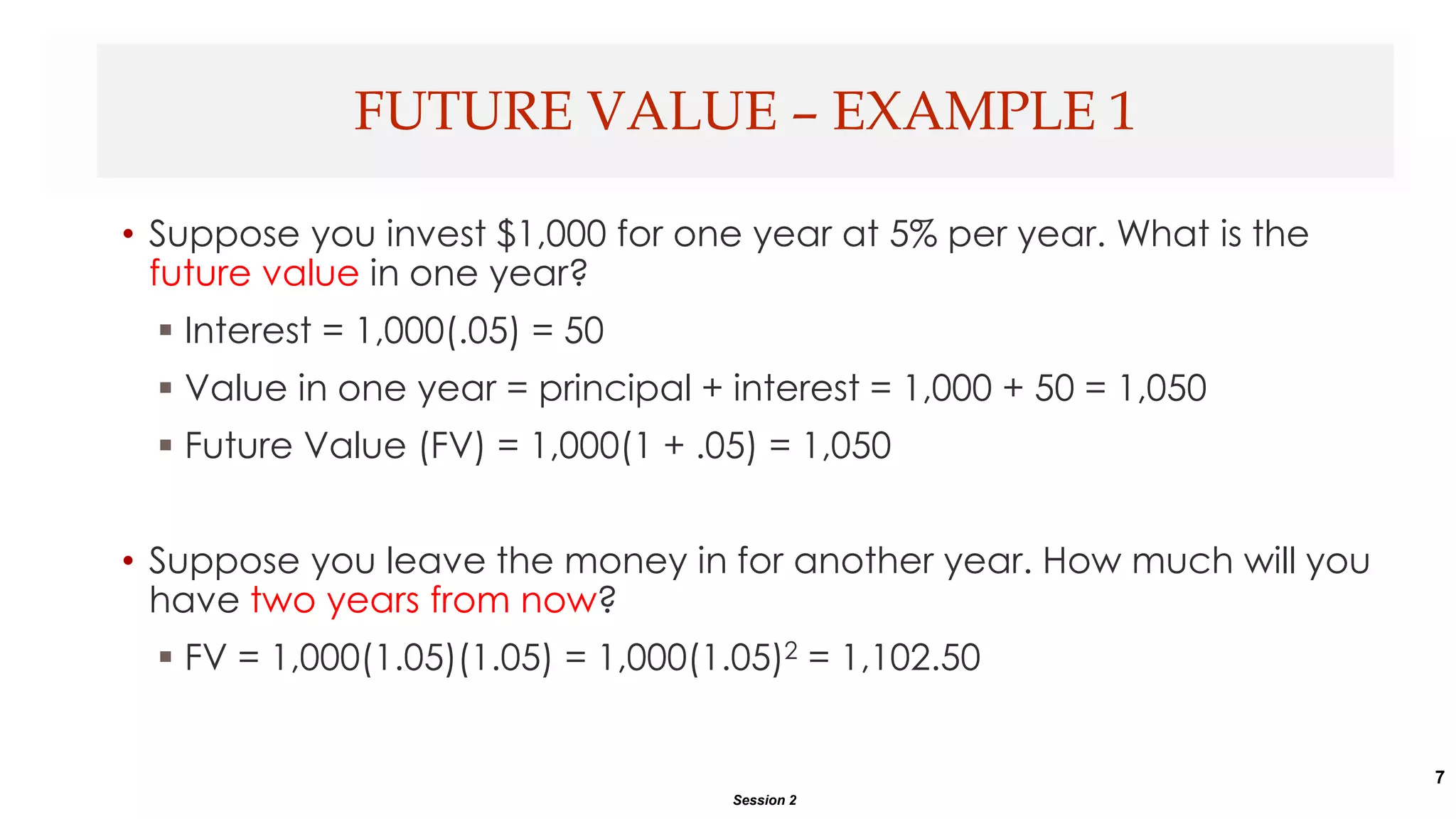
• Suppose you invest $1,000 for one year at 5% per year. What is the
future value in one year?
 Interest = 1,000(.05) = 50
 Value in one year = principal + interest = 1,000 + 50 = 1,050
 Future Value (FV) = 1,000(1 + .05) = 1,050
• Suppose you leave the money in for another year. How much will you
have two years from now?
 FV = 1,000(1.05)(1.05) = 1,000(1.05)2 = 1,102.50
FUTURE VALUE – EXAMPLE 1
Session 2
8
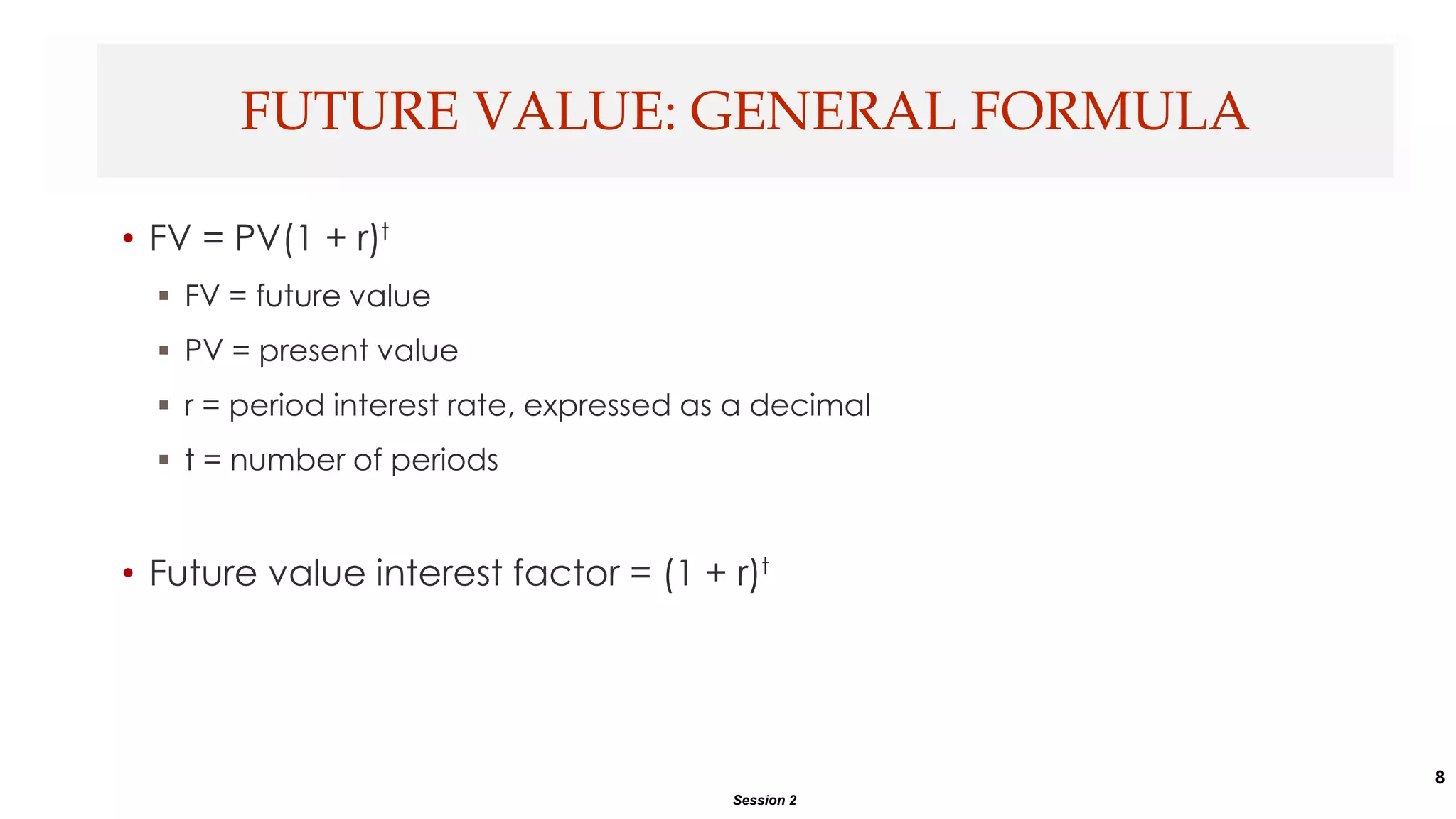
• FV = PV(1 + r)t
 FV = future value
 PV = present value
 r = period interest rate, expressed as a decimal
 t = number of periods
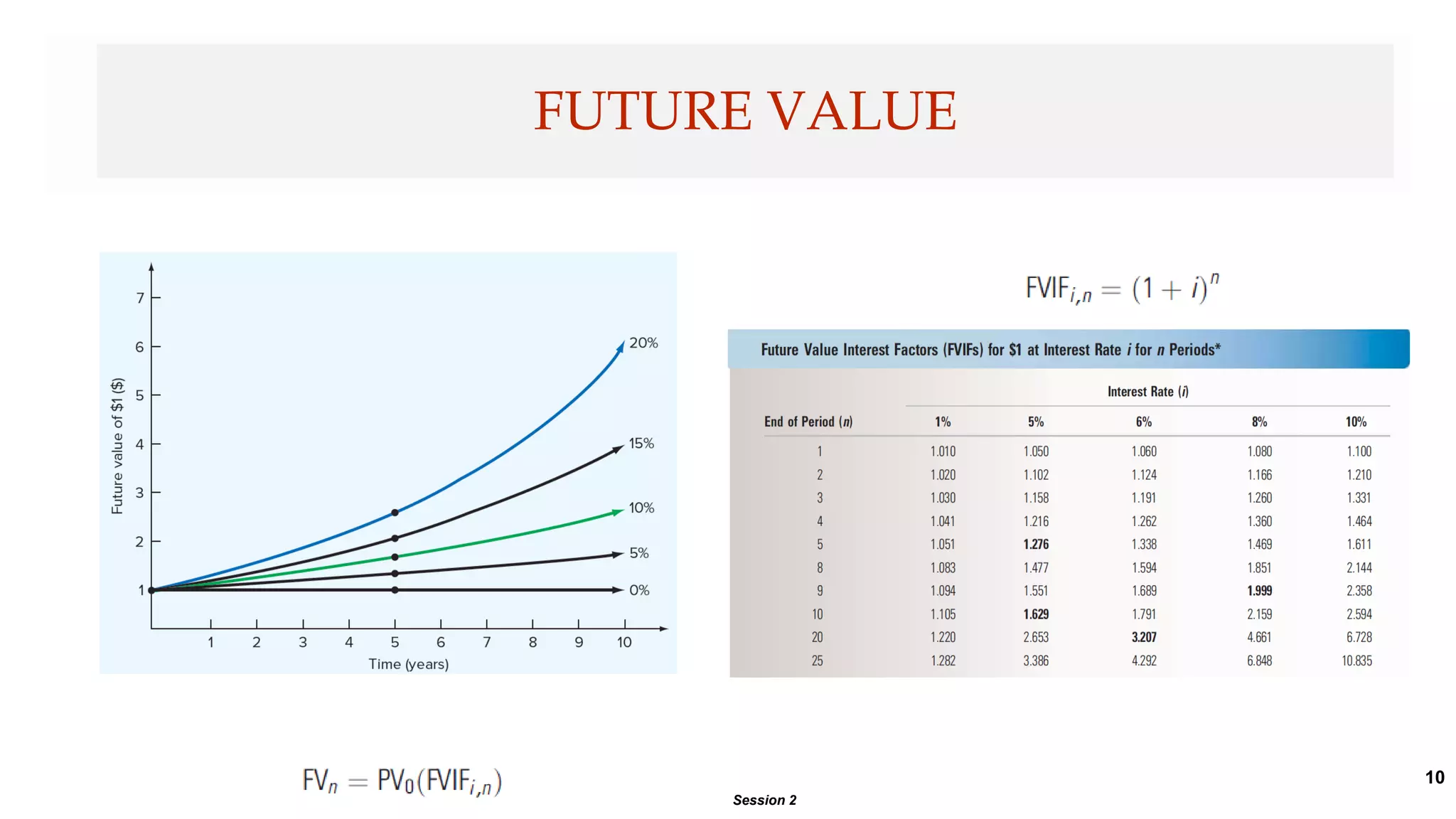
• Future value interest factor = (1 + r)t
FUTURE VALUE: GENERAL FORMULA
Session 2
9
• Simple interest vs. Compound interest
• Consider the previous example
 FV with simple interest = 1,000 + 50 + 50 = 1,100
 FV with compound interest = 1,102.50
 The extra 2.50 comes from the interest of .05(50) = 2.50 earned on the first interest
payment
EFFECTS OF COMPOUNDING
Session 2
10
FUTURE VALUE
Session 2
11
• Suppose you invest the $1,000 from the previous example for 5 years.
How much would you have?
FUTURE VALUE – PROBLEM
Session 2
12
• Suppose you invest the $1,000 from the previous example for 5 years.
How much would you have?
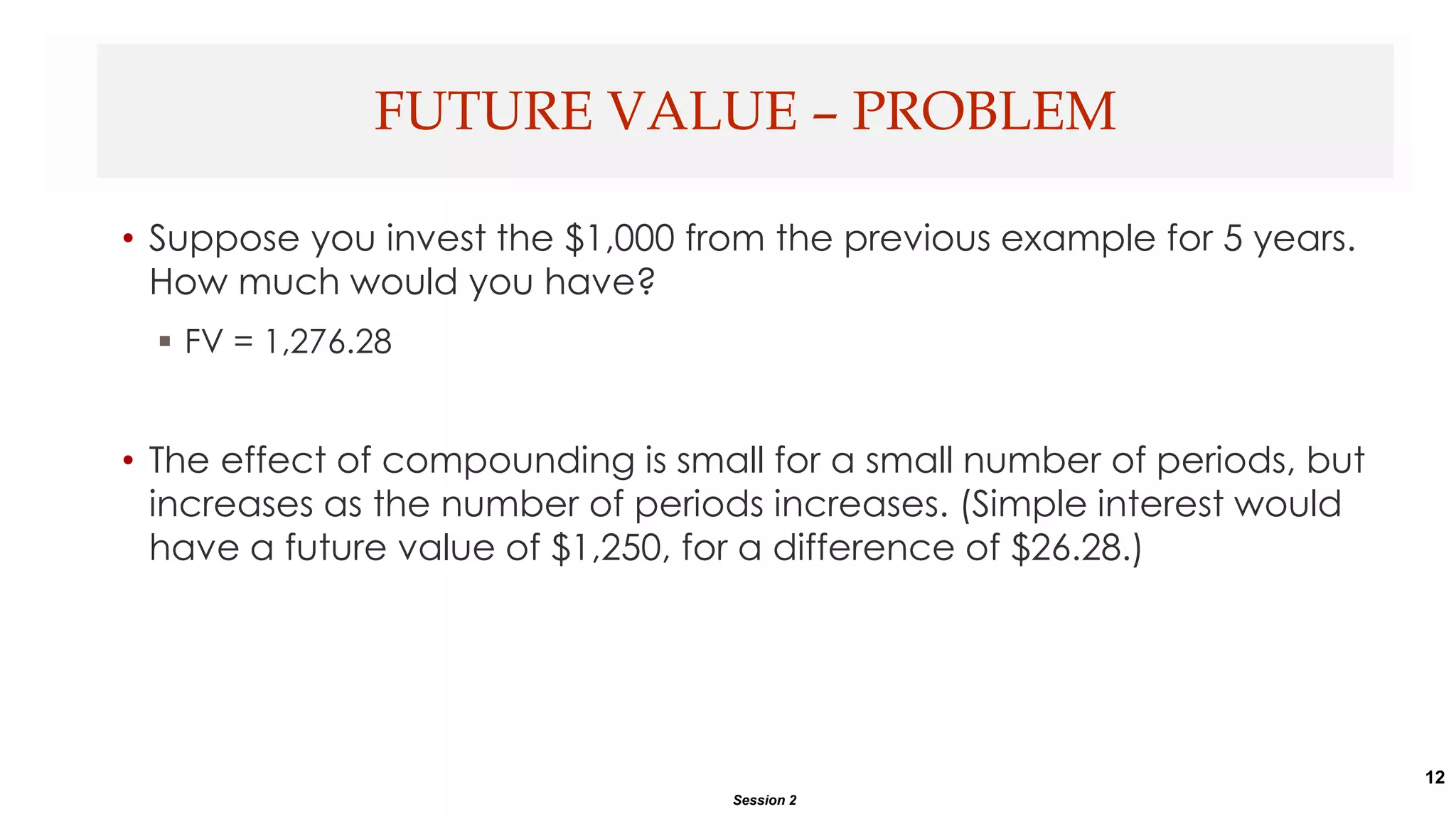
 FV = 1,276.28
• The effect of compounding is small for a small number of periods, but
increases as the number of periods increases. (Simple interest would
have a future value of $1,250, for a difference of $26.28.)
FUTURE VALUE – PROBLEM
Session 2
13
• Suppose you had a relative deposit $10 at 5.5% interest 200 years
ago. How much would the investment be worth today?
• What is the effect of compounding?
 Simple interest ???
FUTURE VALUE – PROBLEM
Session 2
14
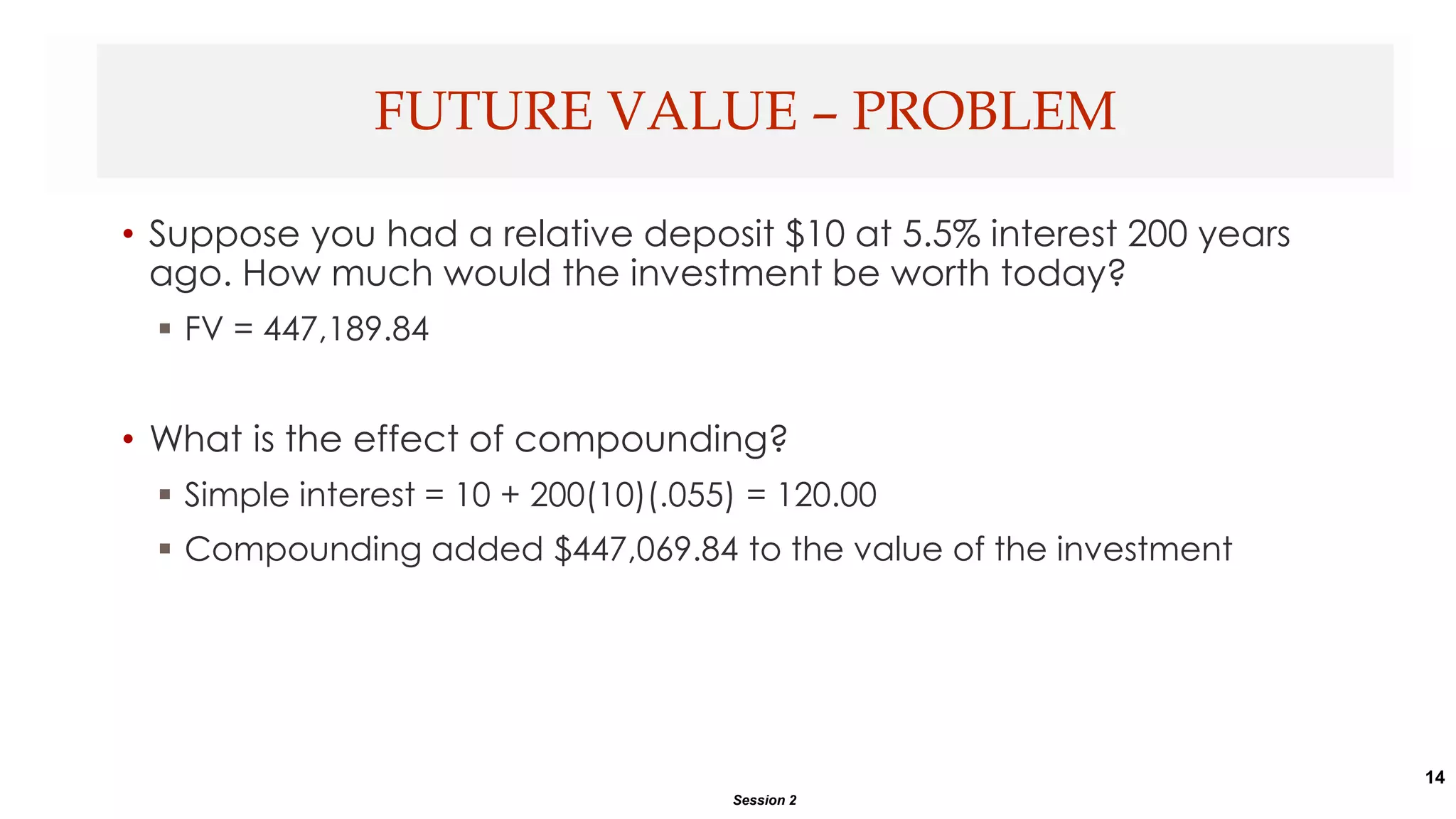
• Suppose you had a relative deposit $10 at 5.5% interest 200 years
ago. How much would the investment be worth today?
 FV = 447,189.84
• What is the effect of compounding?
 Simple interest = 10 + 200(10)(.055) = 120.00
 Compounding added $447,069.84 to the value of the investment
FUTURE VALUE – PROBLEM
Session 2
15
• Suppose your company expects to increase unit
sales of widgets by 15% per year for the next 5
years. If you sell 3 million widgets in the current year,
how many widgets do you expect to sell in the fifth
year?
FUTURE VALUE AS A GENERAL GROWTH
FORMULA
Session 2
16
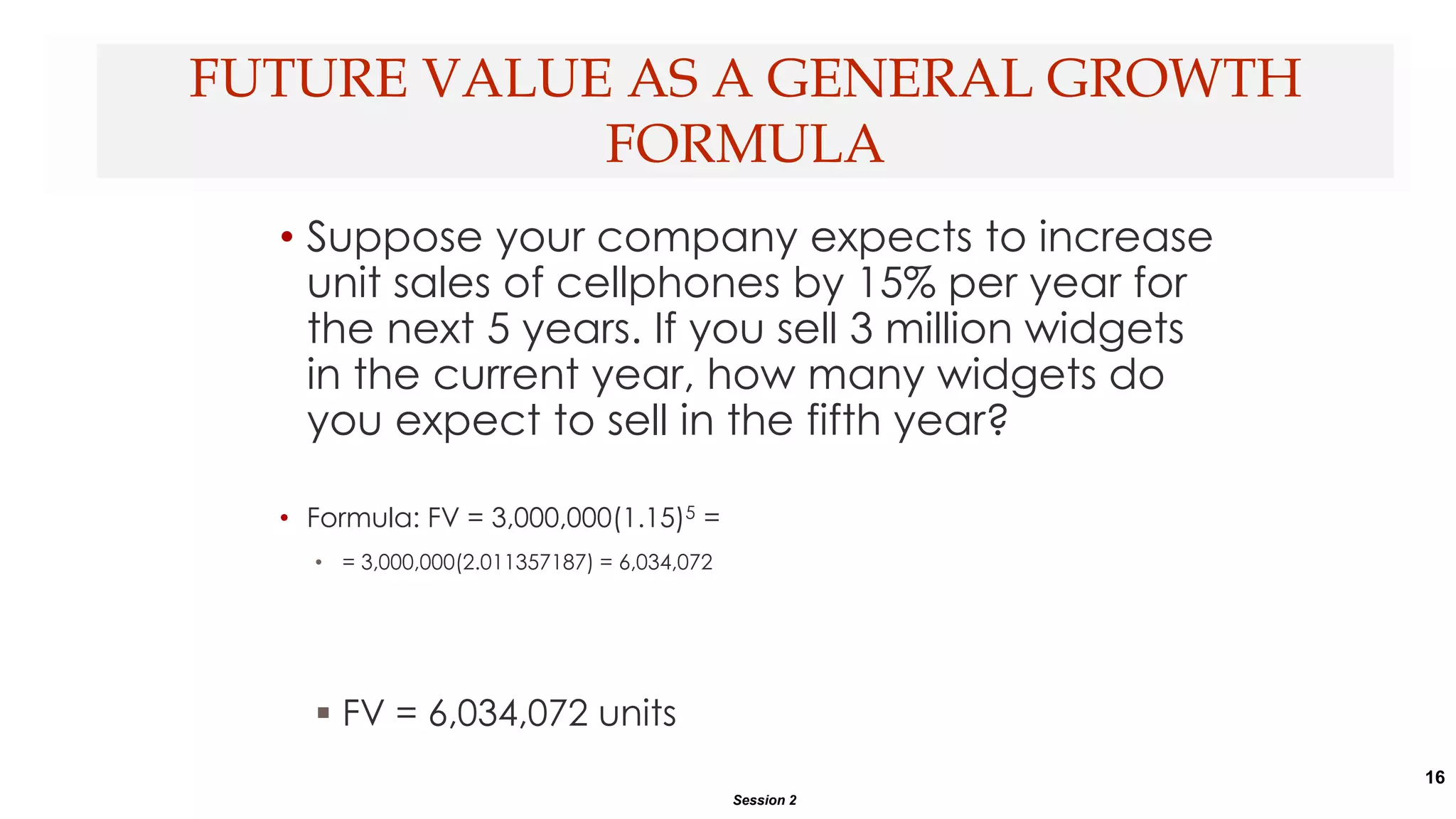
• Suppose your company expects to increase
unit sales of cellphones by 15% per year for
the next 5 years. If you sell 3 million widgets
in the current year, how many widgets do
you expect to sell in the fifth year?
• Formula: FV = 3,000,000(1.15)5 =
• = 3,000,000(2.011357187) = 6,034,072
 FV = 6,034,072 units
FUTURE VALUE AS A GENERAL GROWTH
FORMULA
Session 2
17
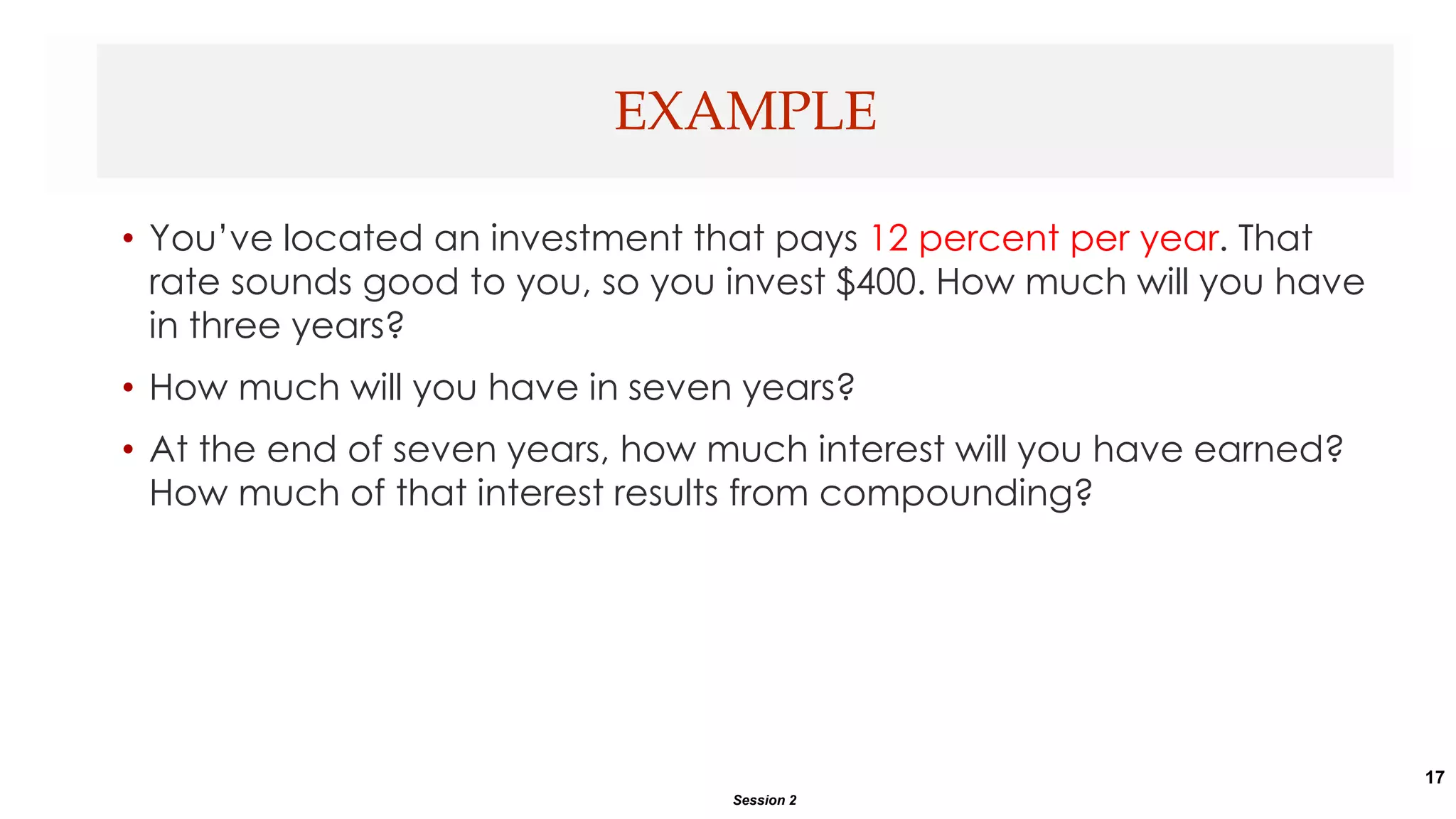
• You’ve located an investment that pays 12 percent per year. That
rate sounds good to you, so you invest $400. How much will you have
in three years?
• How much will you have in seven years?
• At the end of seven years, how much interest will you have earned?
How much of that interest results from compounding?
EXAMPLE
Session 2
18
SOLUTION
Session 2
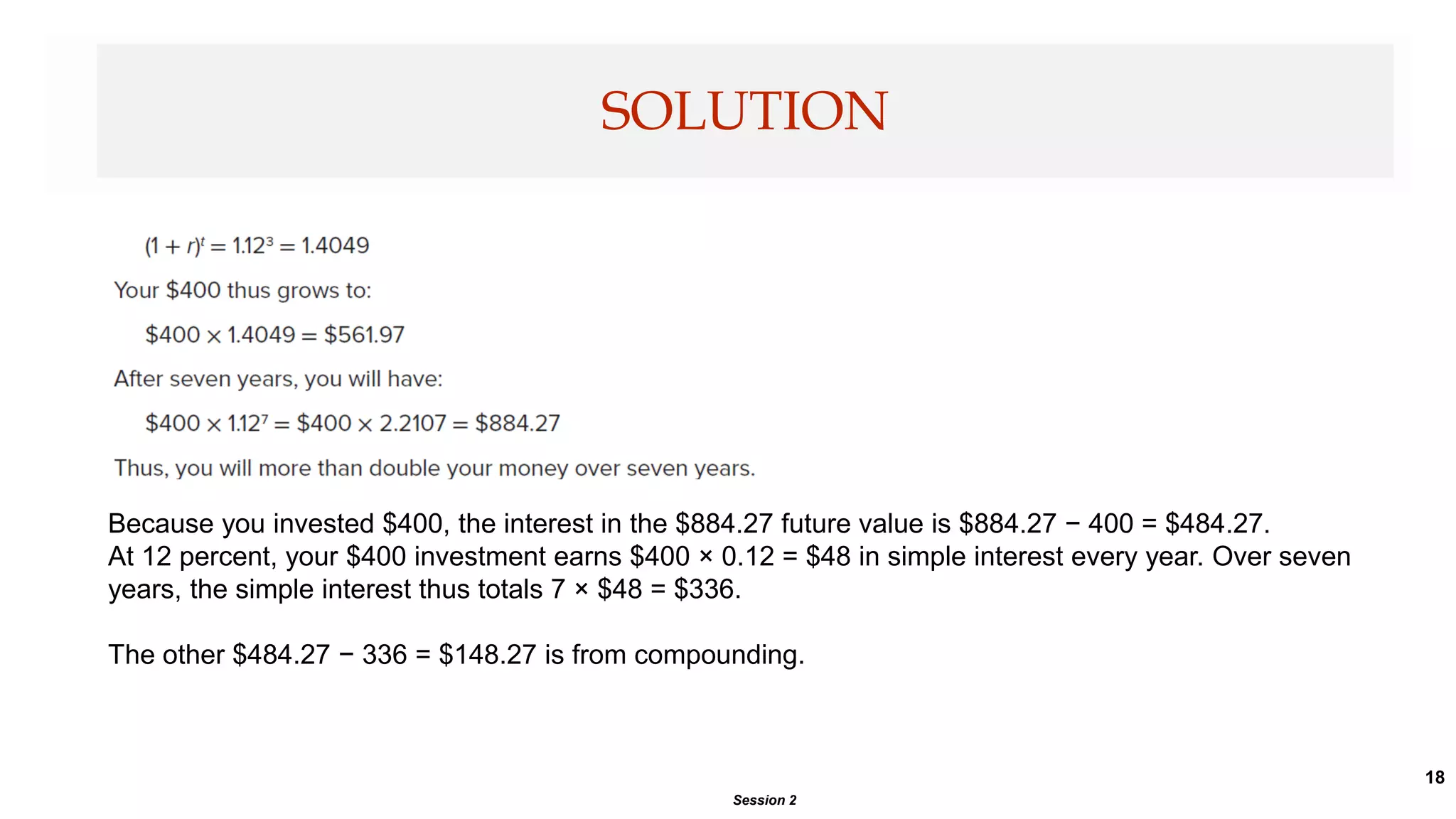
Because you invested $400, the interest in the $884.27 future value is $884.27 − 400 = $484.27.
At 12 percent, your $400 investment earns $400 × 0.12 = $48 in simple interest every year. Over seven
years, the simple interest thus totals 7 × $48 = $336.
The other $484.27 − 336 = $148.27 is from compounding.
19
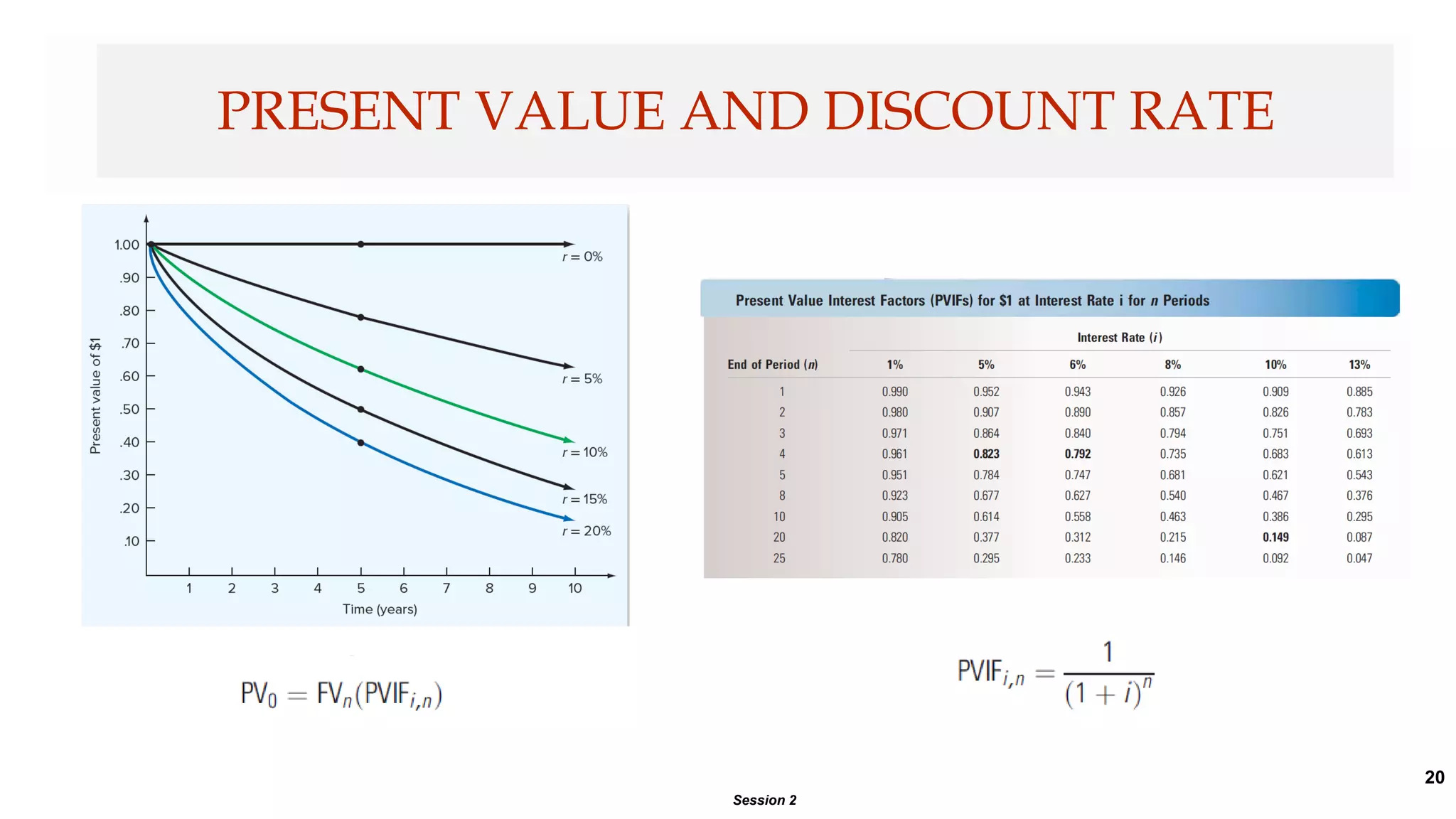
• How much do I have to invest today to have some amount in the
future?
 FV = PV(1 + r)t
 Rearrange to solve for PV = FV / (1 + r)t
• When we talk about discounting, we mean finding the present value
of some future amount.
• When we talk about the “value” of something, we are talking about
the present value unless we specifically indicate that we want the
future value.
PRESENT VALUE
Session 2
20
PRESENT VALUE AND DISCOUNT RATE
Session 2
21
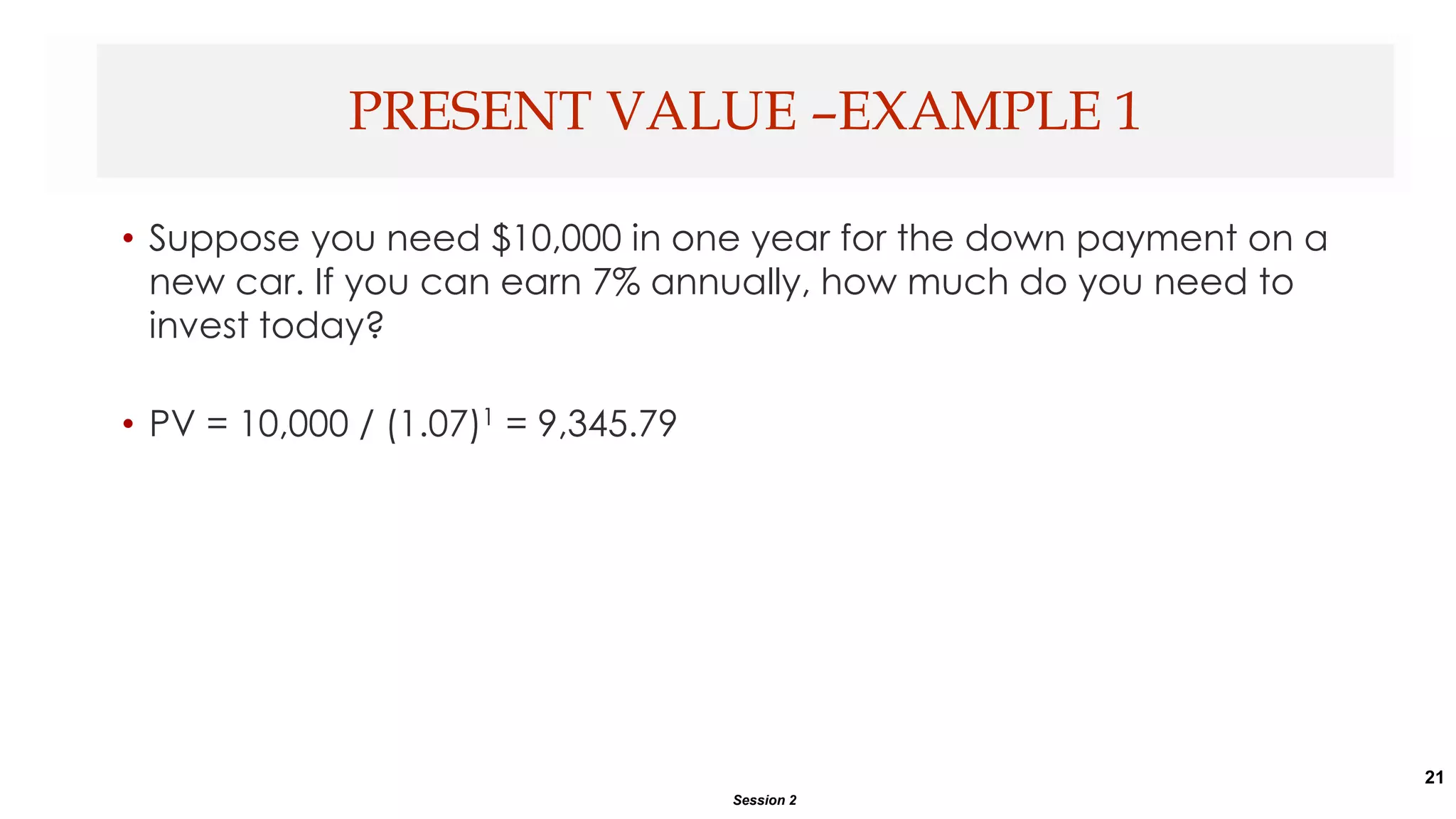
• Suppose you need $10,000 in one year for the down payment on a
new car. If you can earn 7% annually, how much do you need to
invest today?
• PV = 10,000 / (1.07)1 = 9,345.79
PRESENT VALUE –EXAMPLE 1
Session 2
22
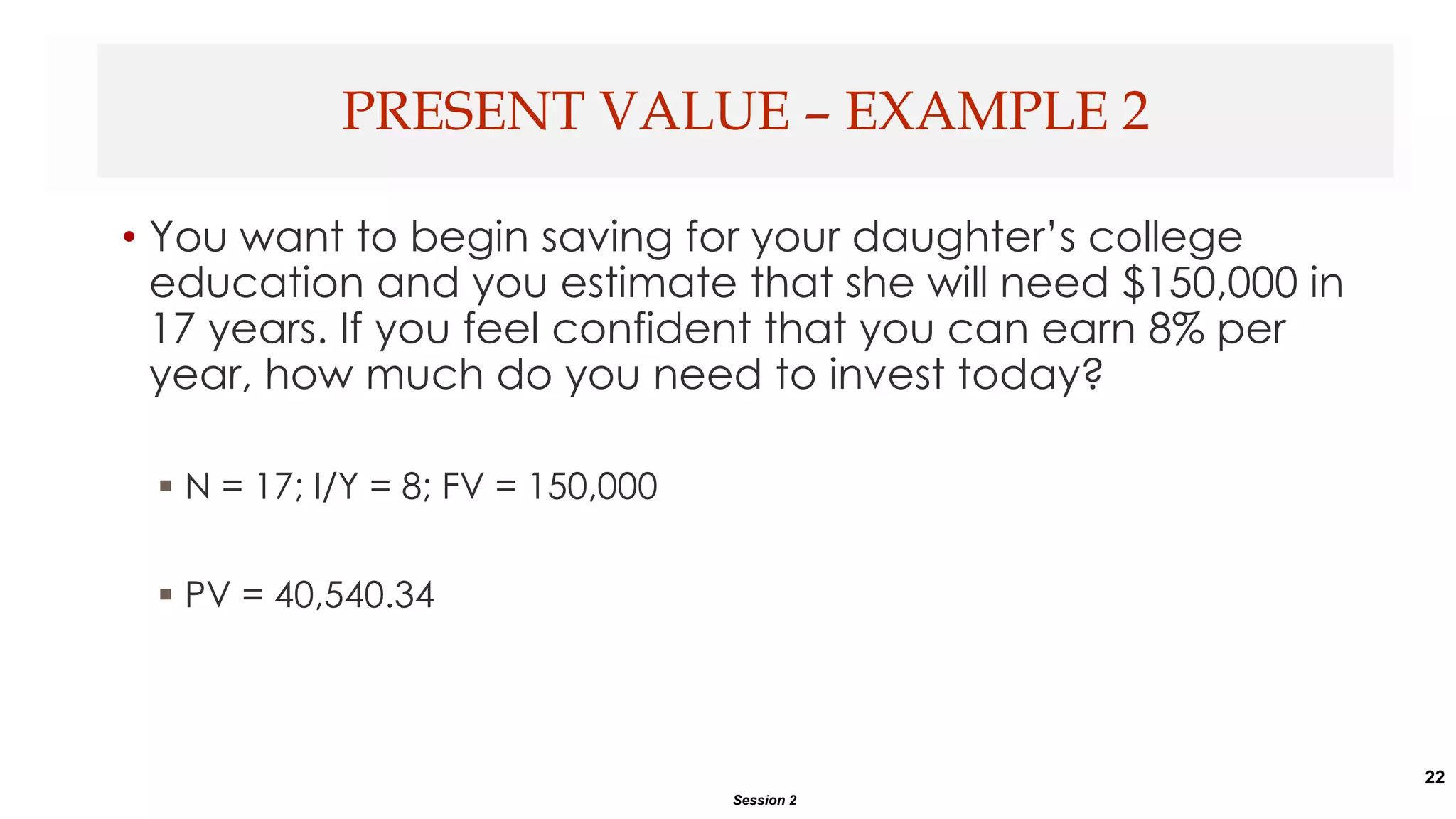
• You want to begin saving for your daughter’s college
education and you estimate that she will need $150,000 in
17 years. If you feel confident that you can earn 8% per
year, how much do you need to invest today?
 N = 17; I/Y = 8; FV = 150,000
 PV = 40,540.34
PRESENT VALUE – EXAMPLE 2
Session 2
23
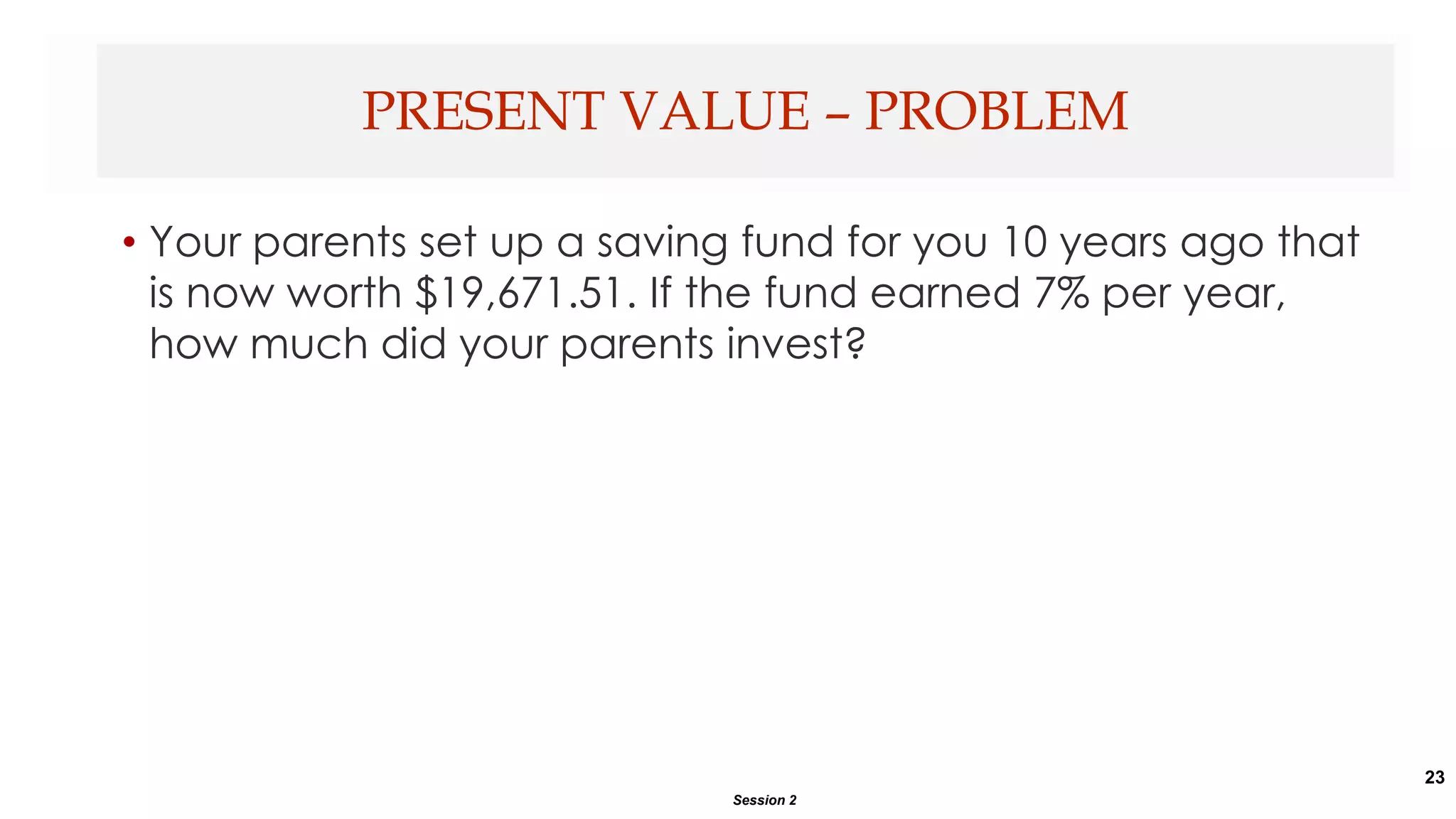
• Your parents set up a saving fund for you 10 years ago that
is now worth $19,671.51. If the fund earned 7% per year,
how much did your parents invest?
PRESENT VALUE – PROBLEM
Session 2
24
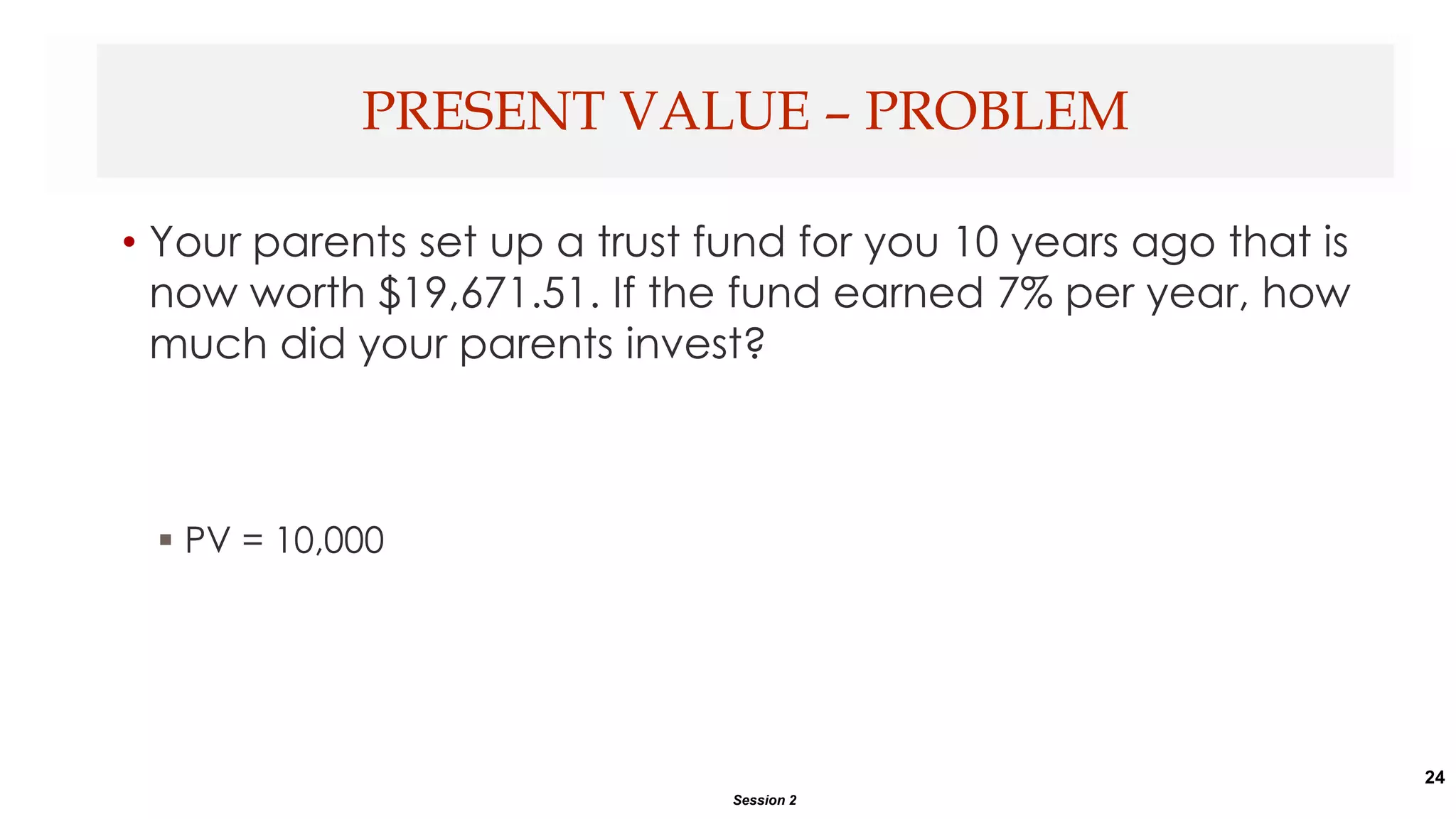
• Your parents set up a trust fund for you 10 years ago that is
now worth $19,671.51. If the fund earned 7% per year, how
much did your parents invest?
 PV = 10,000
PRESENT VALUE – PROBLEM
Session 2
25
• For a given interest rate – the longer the time period, the lower the
present value
 What is the present value of $500 to be received in 5 years? 10 years? The
discount rate is 10%
 PV = 310.46
 PV = 192.77
PRESENT VALUE – IMPORTANT RELATIONSHIP
I
Session 2
26
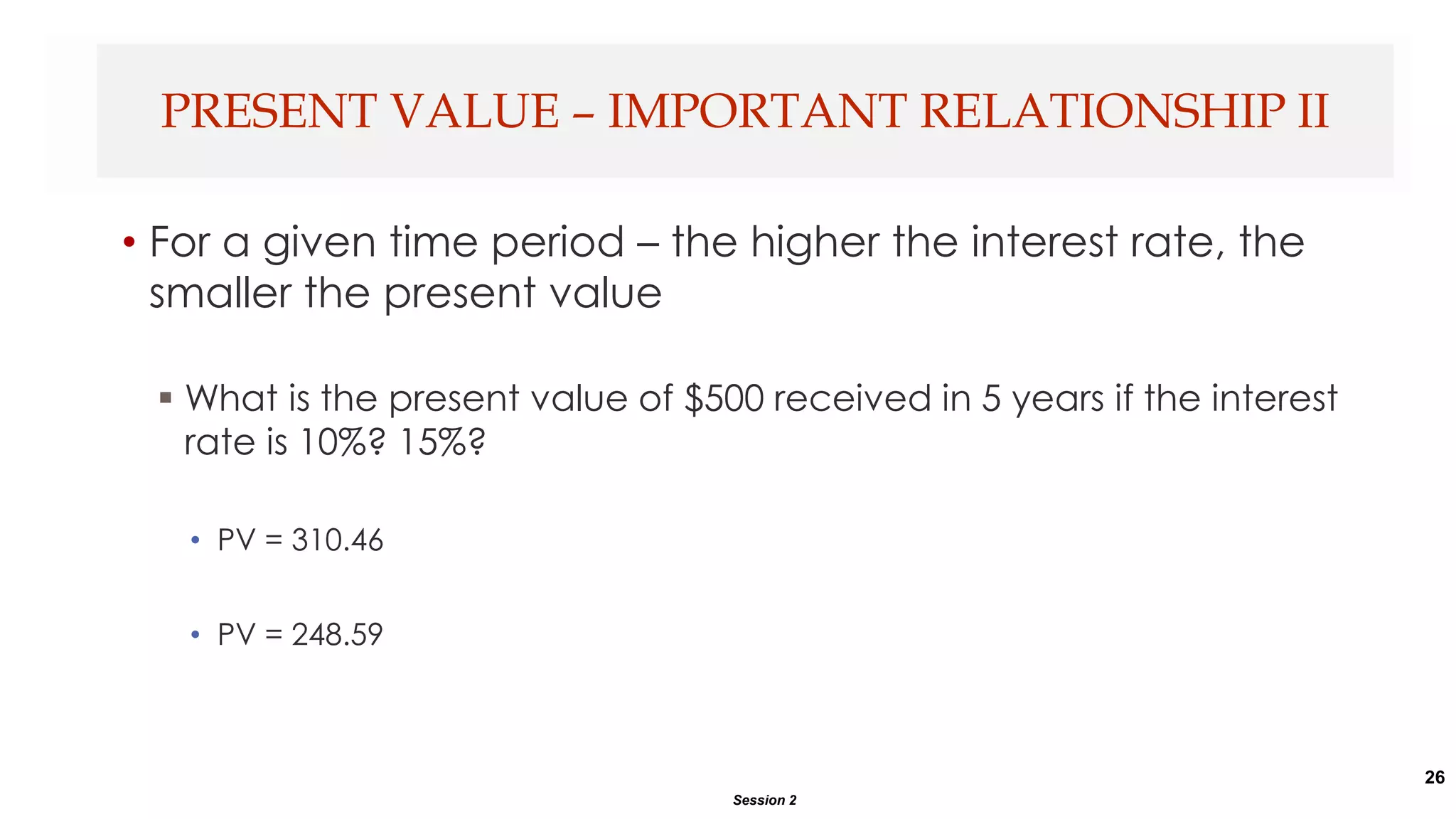
• For a given time period – the higher the interest rate, the
smaller the present value
 What is the present value of $500 received in 5 years if the interest
rate is 10%? 15%?
• PV = 310.46
• PV = 248.59
PRESENT VALUE – IMPORTANT RELATIONSHIP II
Session 2
27
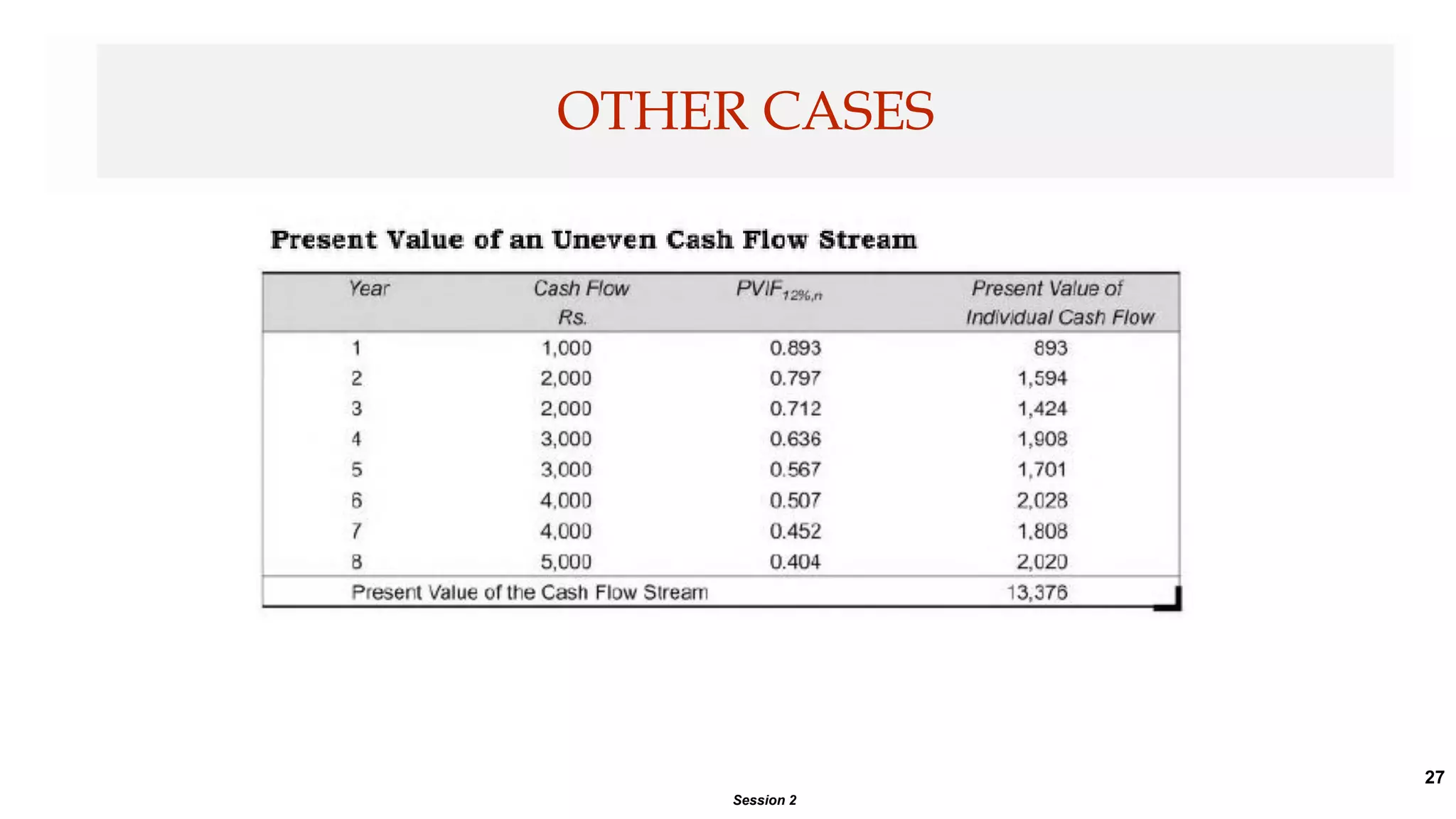
OTHER CASES
Session 2
31
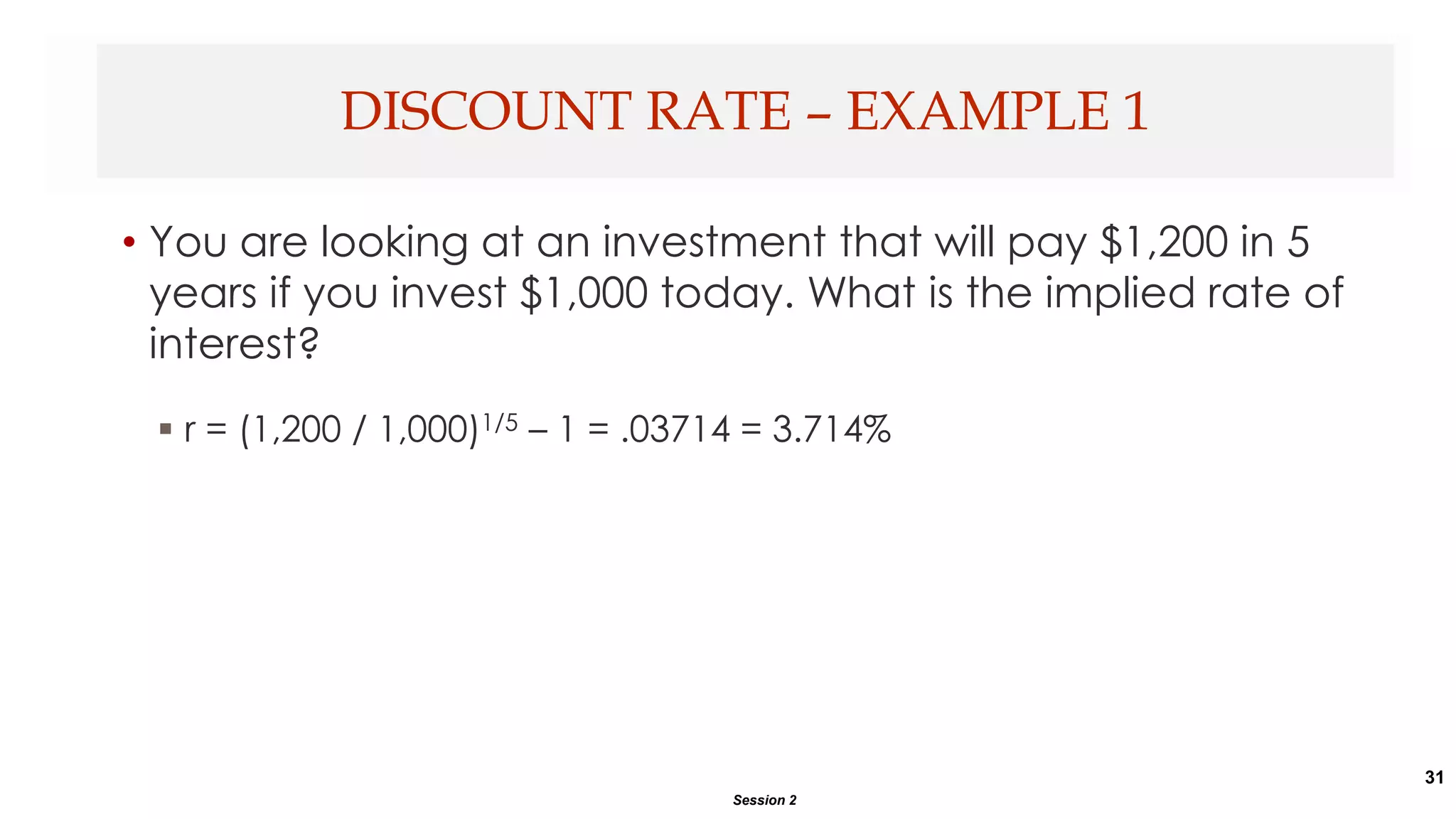
• You are looking at an investment that will pay $1,200 in 5
years if you invest $1,000 today. What is the implied rate of
interest?
 r = (1,200 / 1,000)1/5 – 1 = .03714 = 3.714%
DISCOUNT RATE – EXAMPLE 1
Session 2
32
• Suppose you are offered an investment that will allow you
to double your money in 6 years. You have $10,000 to
invest. What is the implied rate of interest?
DISCOUNT RATE – PROBLEM
Session 2
33
• Suppose you are offered an investment that will allow you
to double your money in 6 years. You have $10,000 to
invest. What is the implied rate of interest?
 N = 6
 PV = -10,000
 FV = 20,000
 I/Y = 12.25%
DISCOUNT RATE – PROBLEM
Session 2
34
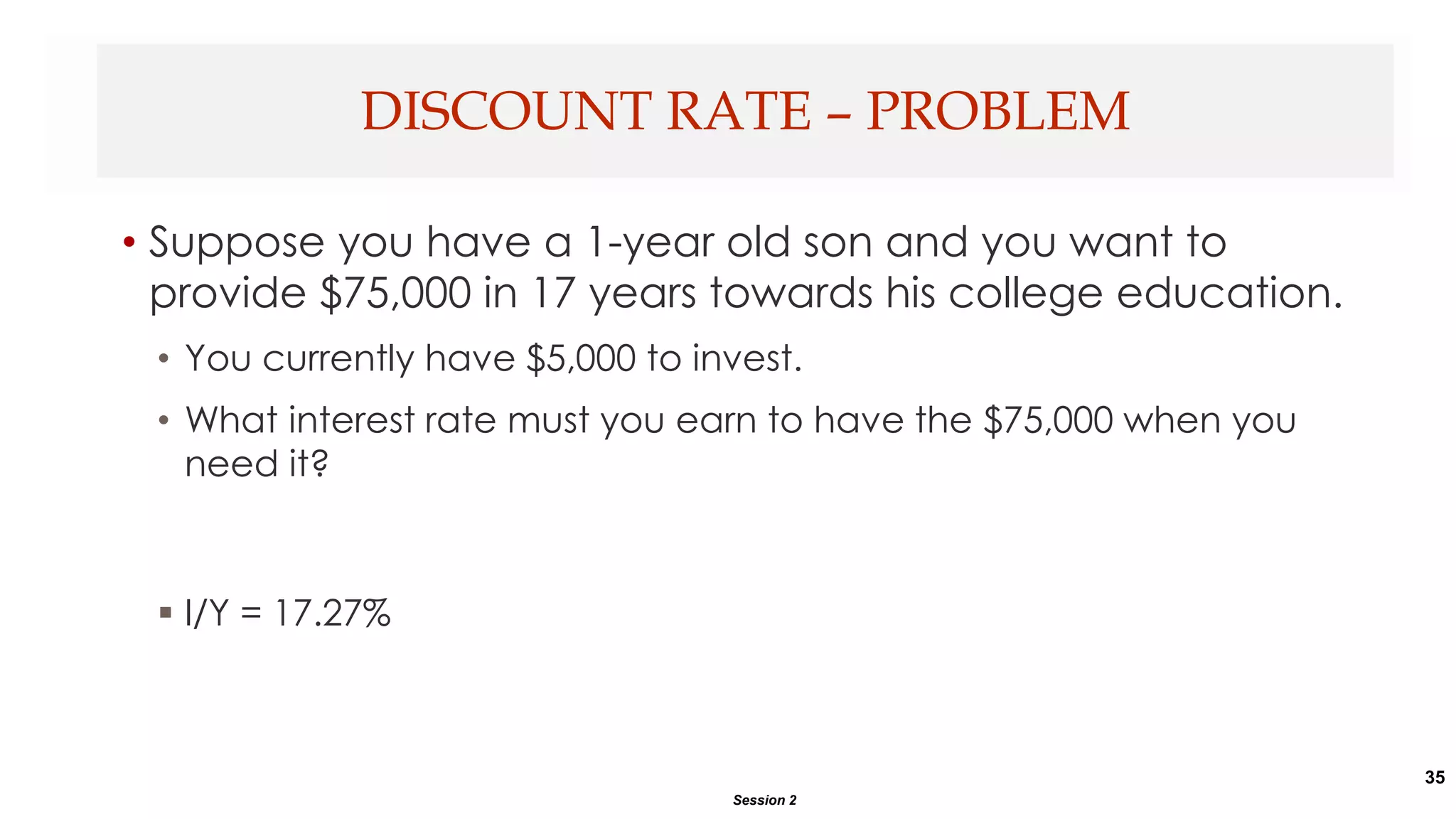
• Suppose you have a 1-year old son and you want to
provide $75,000 in 17 years towards his college education.
• You currently have $5,000 to invest.
• What interest rate must you earn to have the $75,000 when you
need it?
DISCOUNT RATE – PROBLEM
Session 2
35
• Suppose you have a 1-year old son and you want to
provide $75,000 in 17 years towards his college education.
• You currently have $5,000 to invest.
• What interest rate must you earn to have the $75,000 when you
need it?
 I/Y = 17.27%
DISCOUNT RATE – PROBLEM
Session 2
36
• Start with the basic equation and solve for t (remember your logs).
 FV = PV(1 + r)t
 t = ln(FV / PV) / ln(1 + r)
FINDING THE NUMBER OF PERIODS
Session 2
37
• You want to purchase a new car, and you are willing to
pay $20,000.
• If you can invest at 10% per year and you currently have
$15,000, how long will it be before you have enough money to
pay cash for the car?
 N = 3.02 years
 Formula: t = ln(20,000 / 15,000) / ln(1.1) = 3.02 years
NUMBER OF PERIODS – EXAMPLE 1
Session 2
38
• Suppose you want to buy a new house.
• You currently have $15,000, and you figure you need to have a 10%
down payment plus an additional 5% of the loan amount for closing
costs.
• Assume the type of house you want will cost about $150,000 and
you can earn 7.5% per year.
• How long will it be before you have enough money for the down
payment and closing costs?
NUMBER OF PERIODS – EXAMPLE 2
Session 2
39
• Future value of an Annuity
• Future value of an Annuity Due
• Present value of an Annuity
• Present value of an Annuity Due
ANNUITY AND ANNUITY DUE
Session 2
40
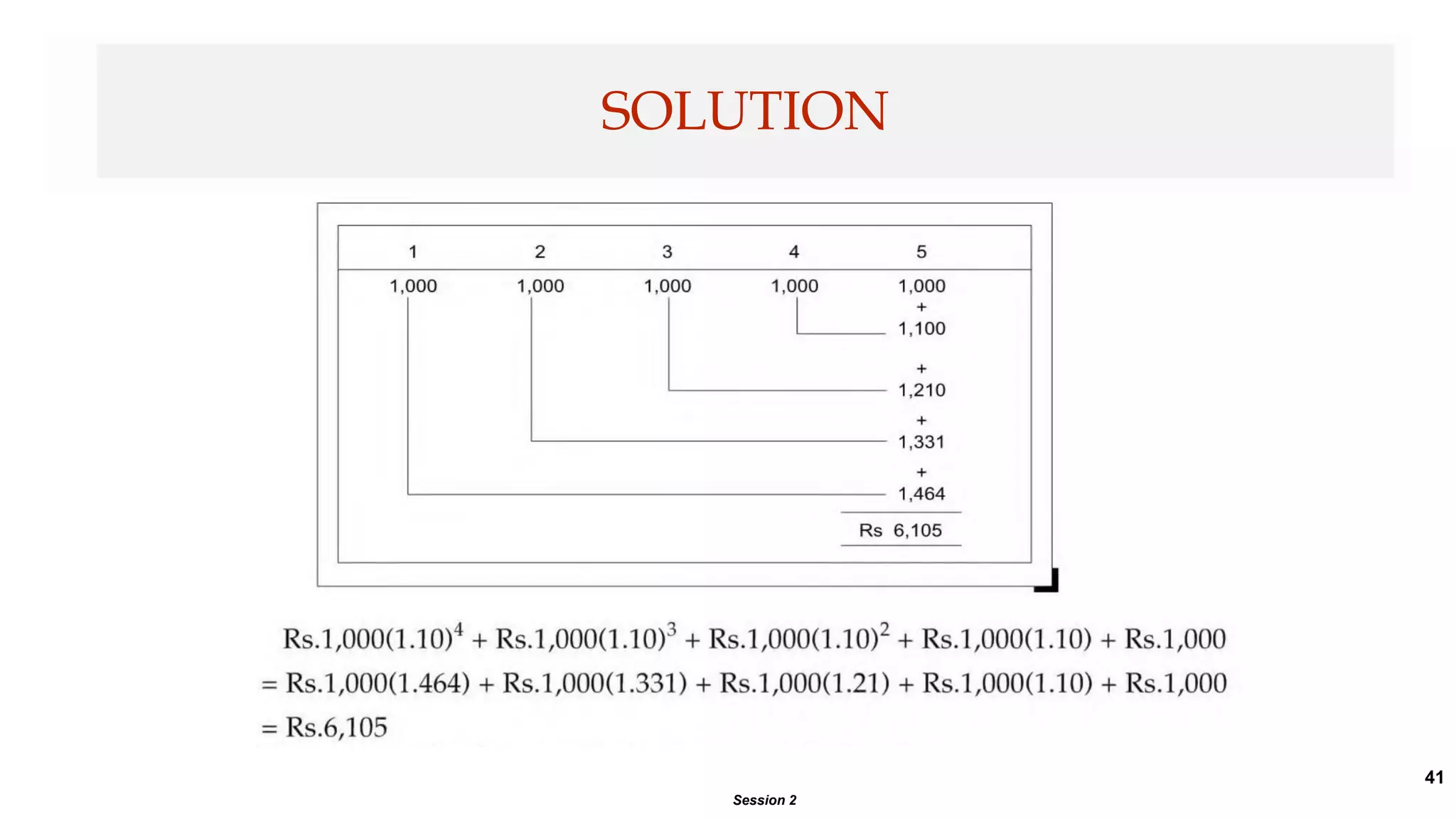
• Suppose you deposit Rs.1,000 annually in a bank for 5 years and your
deposits earn a compound interest rate of 10 percent. What will be the
value of this series of deposits (an annuity) at the end of 5 years?
FUTURE VALUE OF AN ANNUITY
Session 2
41
SOLUTION
Session 2
42
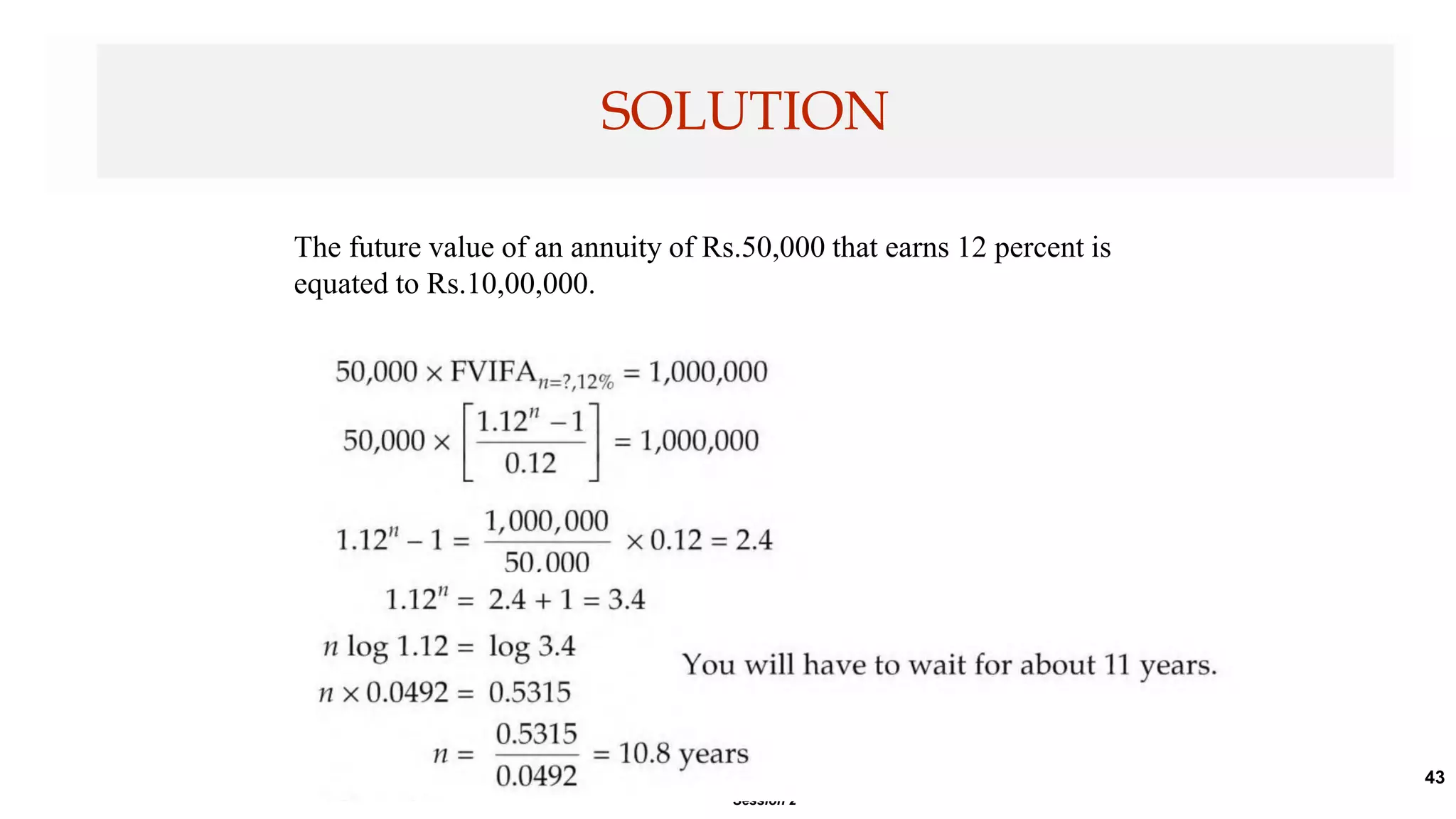
• You want to take up a trip to the Europe with a friend which costs Rs.10,00,000 - the
cost is expected to remain unchanged in nominal terms. You can save annually
Rs.50,000 to fulfill your desire. How long will you have to wait if your savings earn
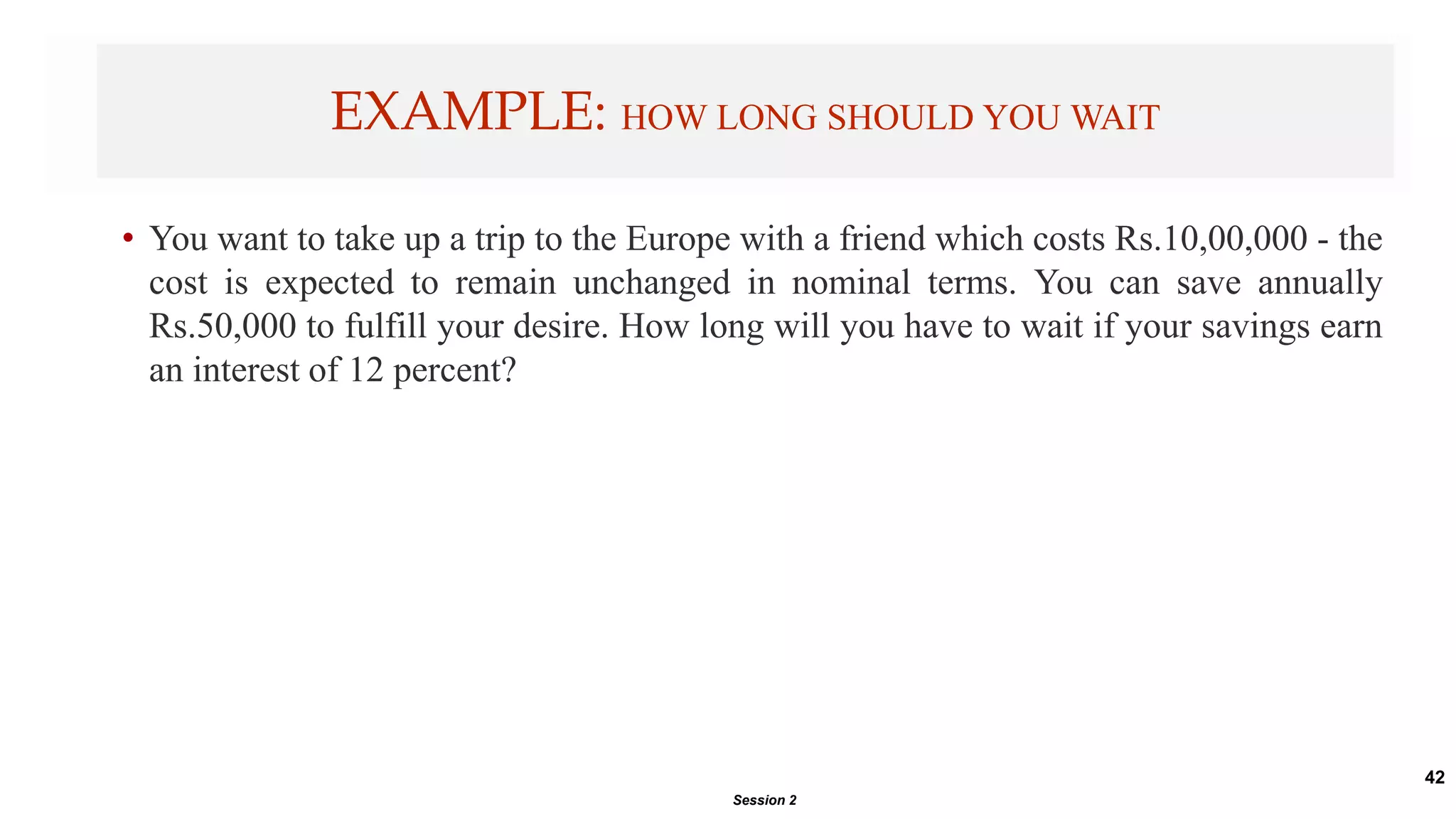
an interest of 12 percent?
EXAMPLE: HOW LONG SHOULD YOU WAIT
Session 2
43
SOLUTION
Session 2
The future value of an annuity of Rs.50,000 that earns 12 percent is
equated to Rs.10,00,000.
44
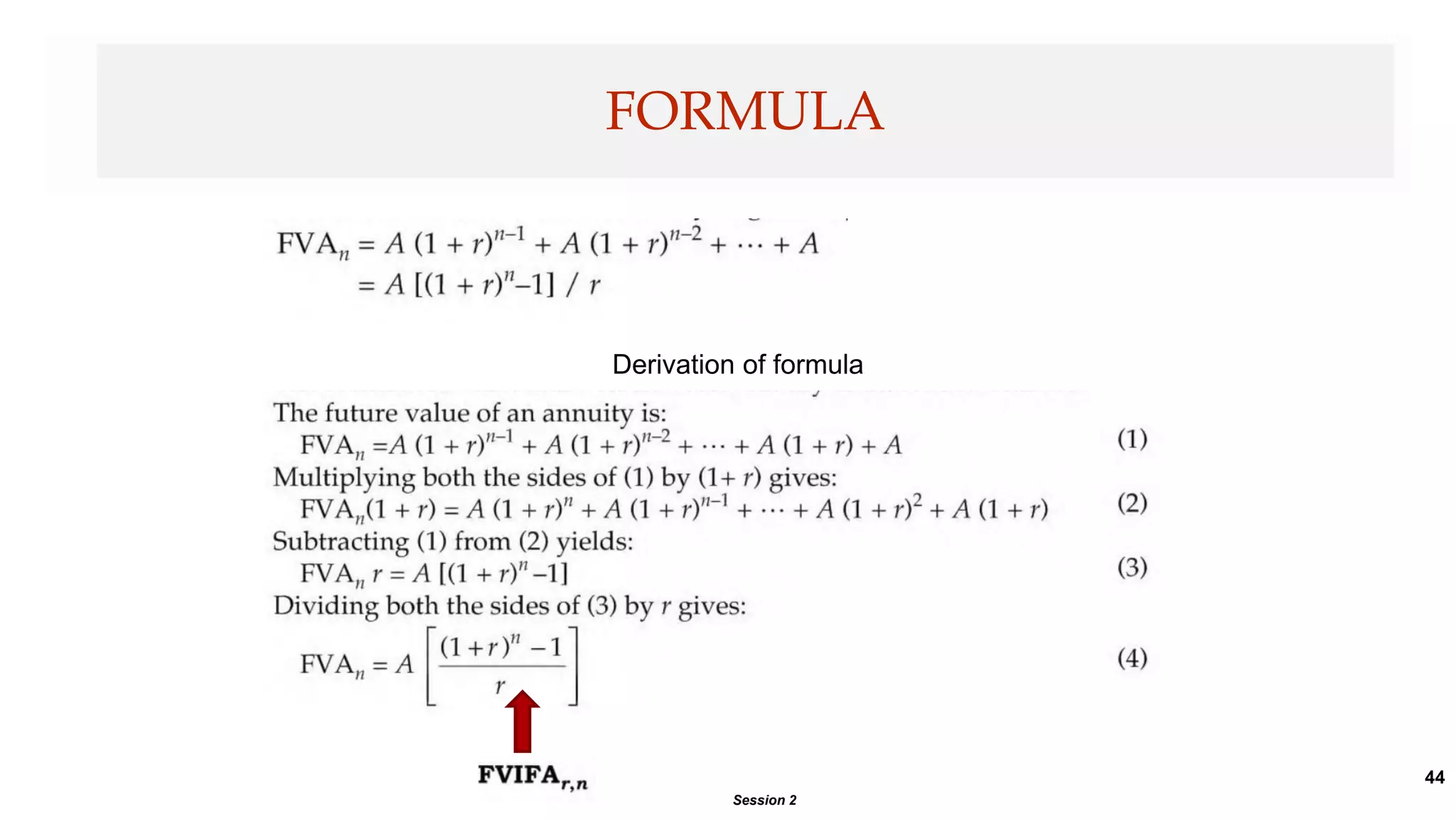
FORMULA
Session 2
Derivation of formula
45
• 𝐹𝑉 𝑜𝑓 𝐴𝑛𝑛𝑢𝑖𝑡𝑦 = 𝐴
(1+𝑟)𝑛−1
𝑟
• 𝐹𝑉 𝑜𝑓 𝐴𝑛𝑛𝑢𝑖𝑡𝑦 𝐷𝑢𝑒 = 𝐴
(1+𝑟)𝑛−1
𝑟
*(1+r)
• 𝑃𝑉 𝑜𝑓 𝐴𝑛𝑛𝑢𝑖𝑡𝑦 = 𝐴
1− (1+𝑟)−𝑛
𝑟
• 𝑃𝑉 𝑜𝑓 𝐴𝑛𝑛𝑢𝑖𝑡𝑦 = 𝐴
1− (1+𝑟)−𝑛
𝑟
*(1+r)
FORMULA
Session 2
46
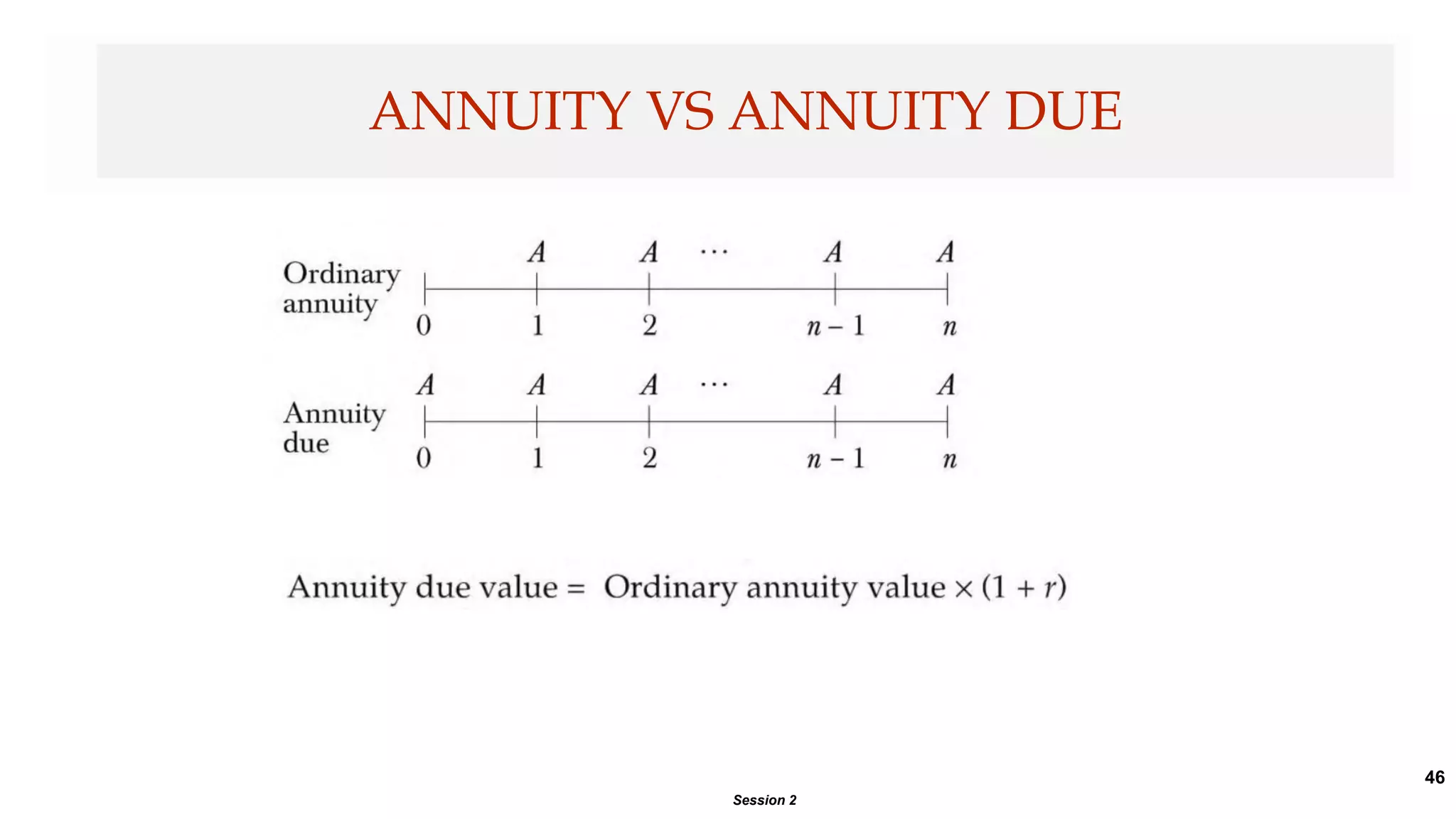
ANNUITY VS ANNUITY DUE
Session 2
47
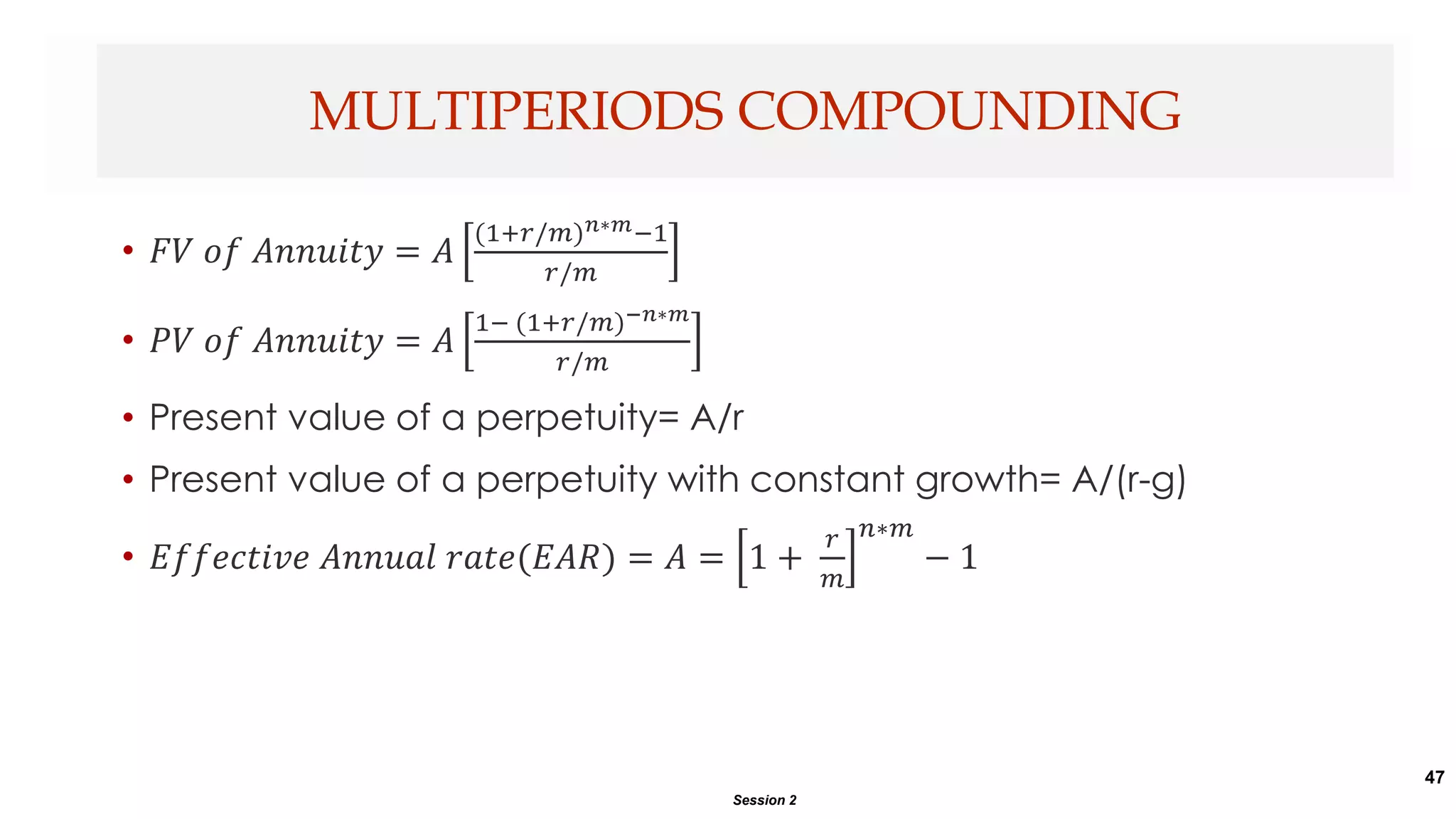
• 𝐹𝑉 𝑜𝑓 𝐴𝑛𝑛𝑢𝑖𝑡𝑦 = 𝐴
(1+𝑟/𝑚)𝑛∗𝑚−1
𝑟/𝑚
• 𝑃𝑉 𝑜𝑓 𝐴𝑛𝑛𝑢𝑖𝑡𝑦 = 𝐴
1− (1+𝑟/𝑚)−𝑛∗𝑚
𝑟/𝑚
• Present value of a perpetuity= A/r
• Present value of a perpetuity with constant growth= A/(r-g)
• 𝐸𝑓𝑓𝑒𝑐𝑡𝑖𝑣𝑒 𝐴𝑛𝑛𝑢𝑎𝑙 𝑟𝑎𝑡𝑒(𝐸𝐴𝑅) = 𝐴 = 1 +
𝑟
𝑚
𝑛∗𝑚
− 1
MULTIPERIODS COMPOUNDING
Session 2
48
• Suppose you are taking a loan of Rs 10 lacs from SBI bank at
12% interest rate for 5 years. Compute EMI that you’ll be
paying towards this loan. What would be total interest
amount on this loan?
COMPREHENSIVE PROBLEM
Session 2
49
• Suppose you expect to receive Rs. 1,000 annually for 3 years, each receipt
occurring at the end of the year. What is the present value of this stream of benefits
if the discount rate is 10 percent?
PRESENT VALUE OF AN ANNUITY
Session 2
50
SOLUTION
Session 2
51
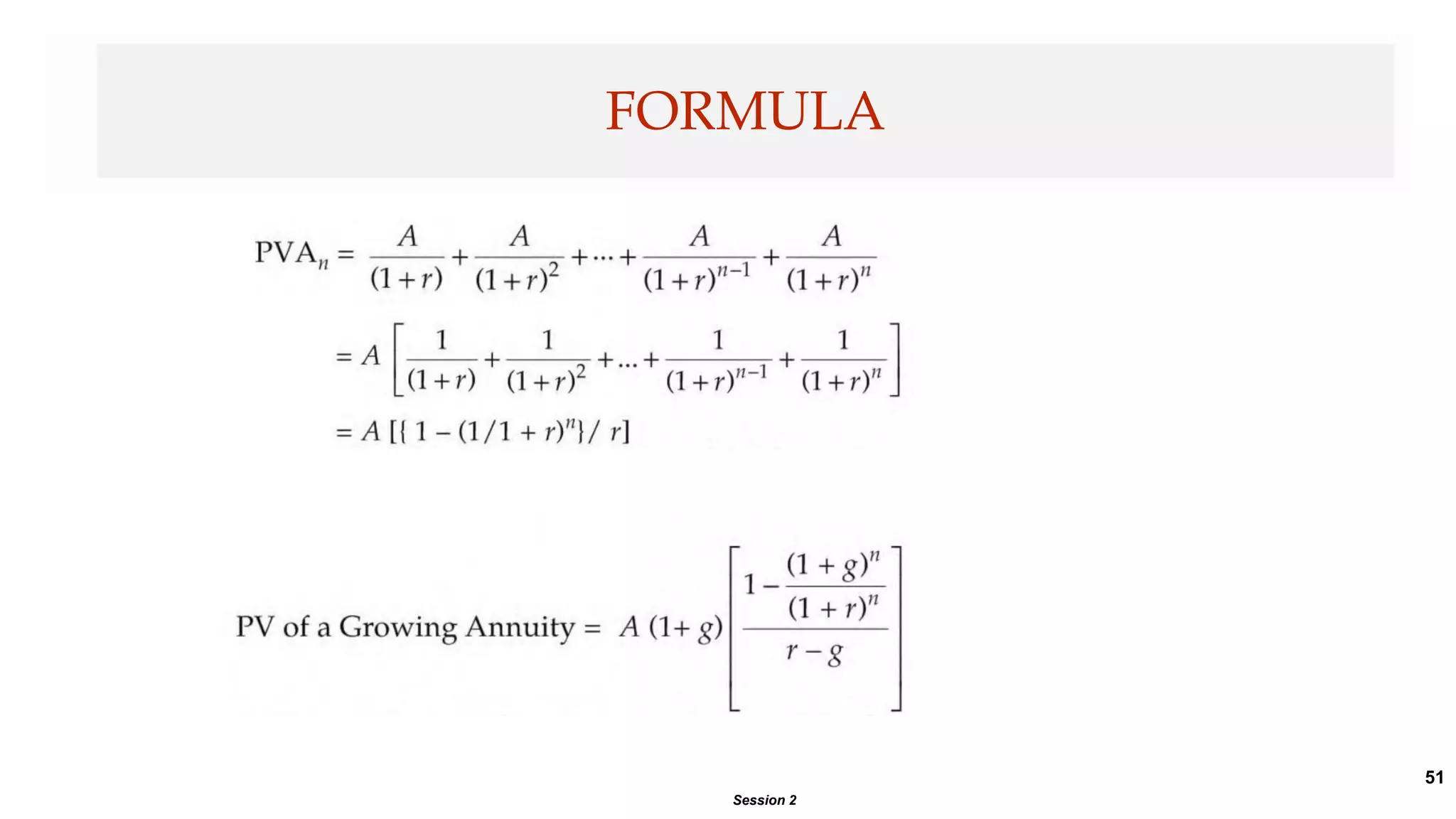
FORMULA
Session 2
52
DERIVATION
Session 2
53
OTHER FORMULA
Session 2
54
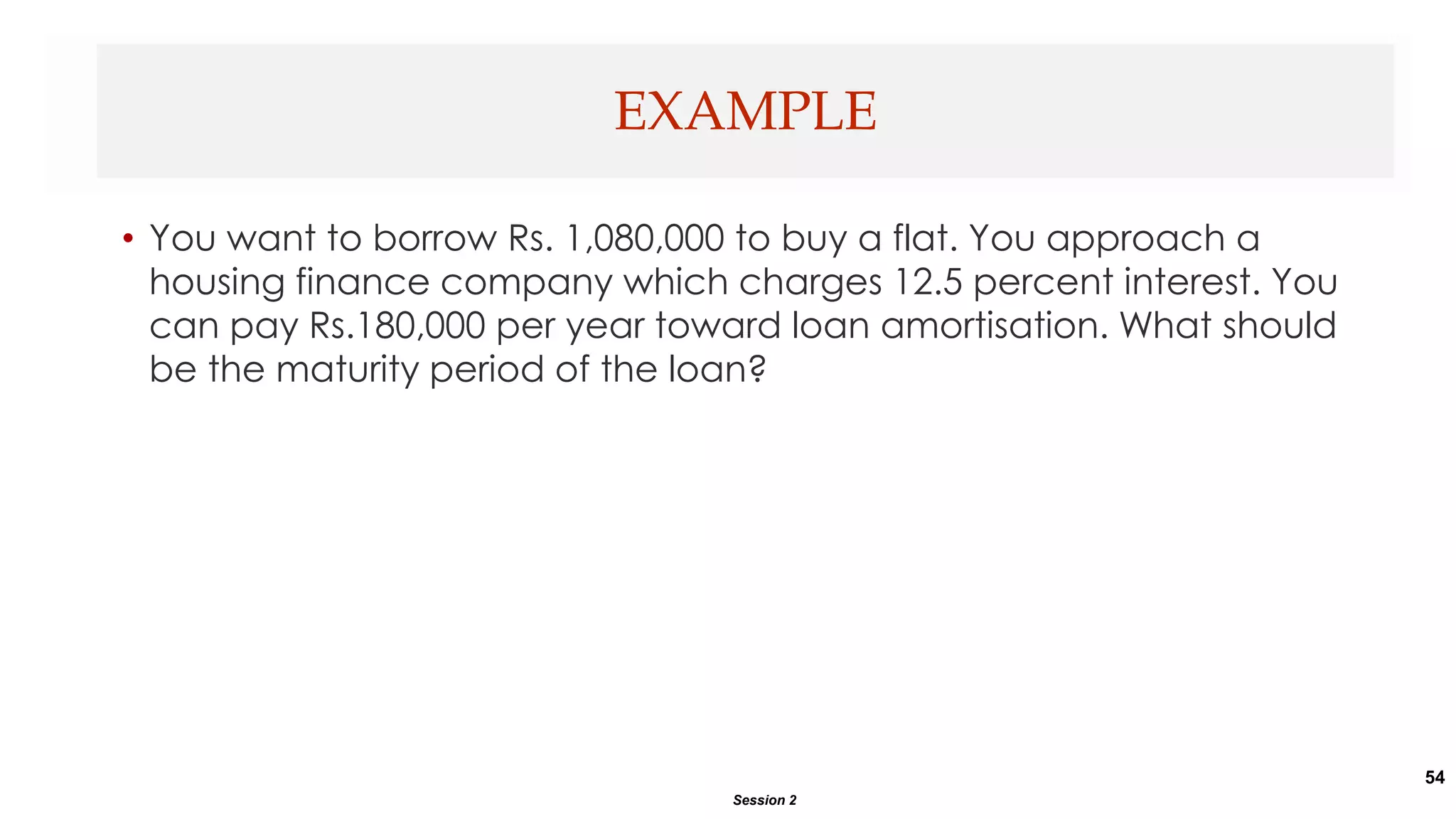
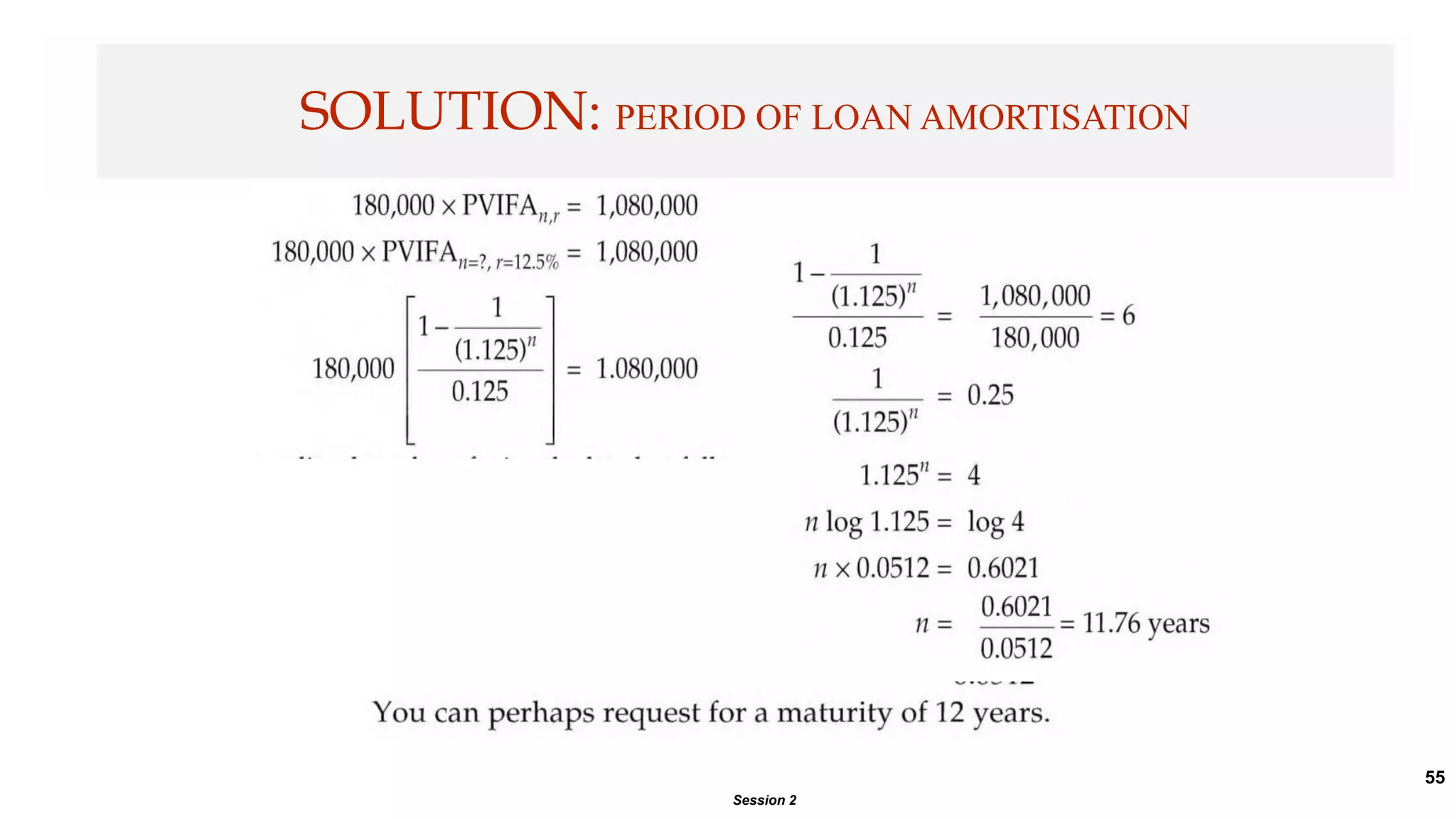
• You want to borrow Rs. 1,080,000 to buy a flat. You approach a
housing finance company which charges 12.5 percent interest. You
can pay Rs.180,000 per year toward loan amortisation. What should
be the maturity period of the loan?
EXAMPLE
Session 2
55
SOLUTION: PERIOD OF LOAN AMORTISATION
Session 2
56
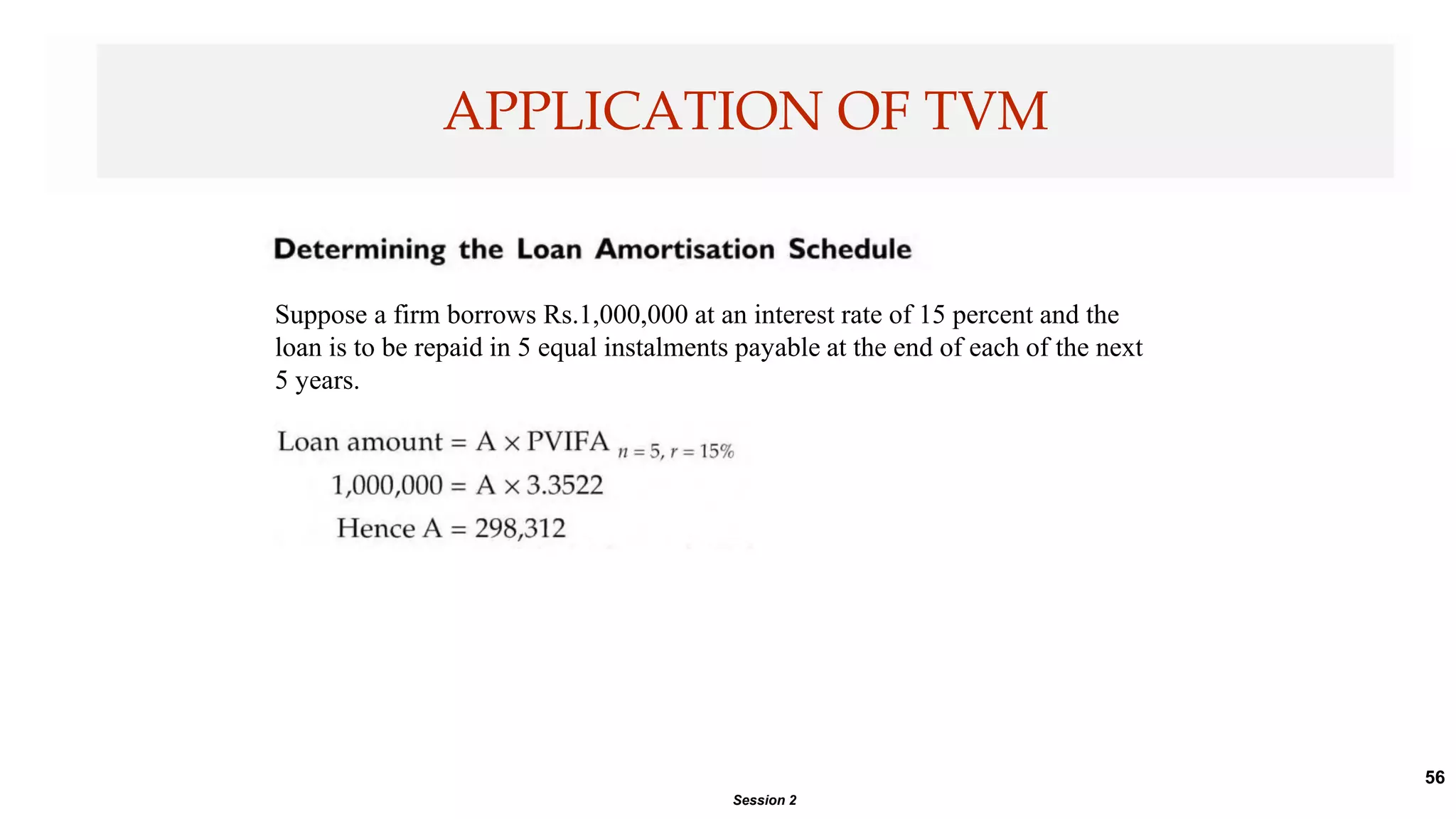
APPLICATION OF TVM
Session 2
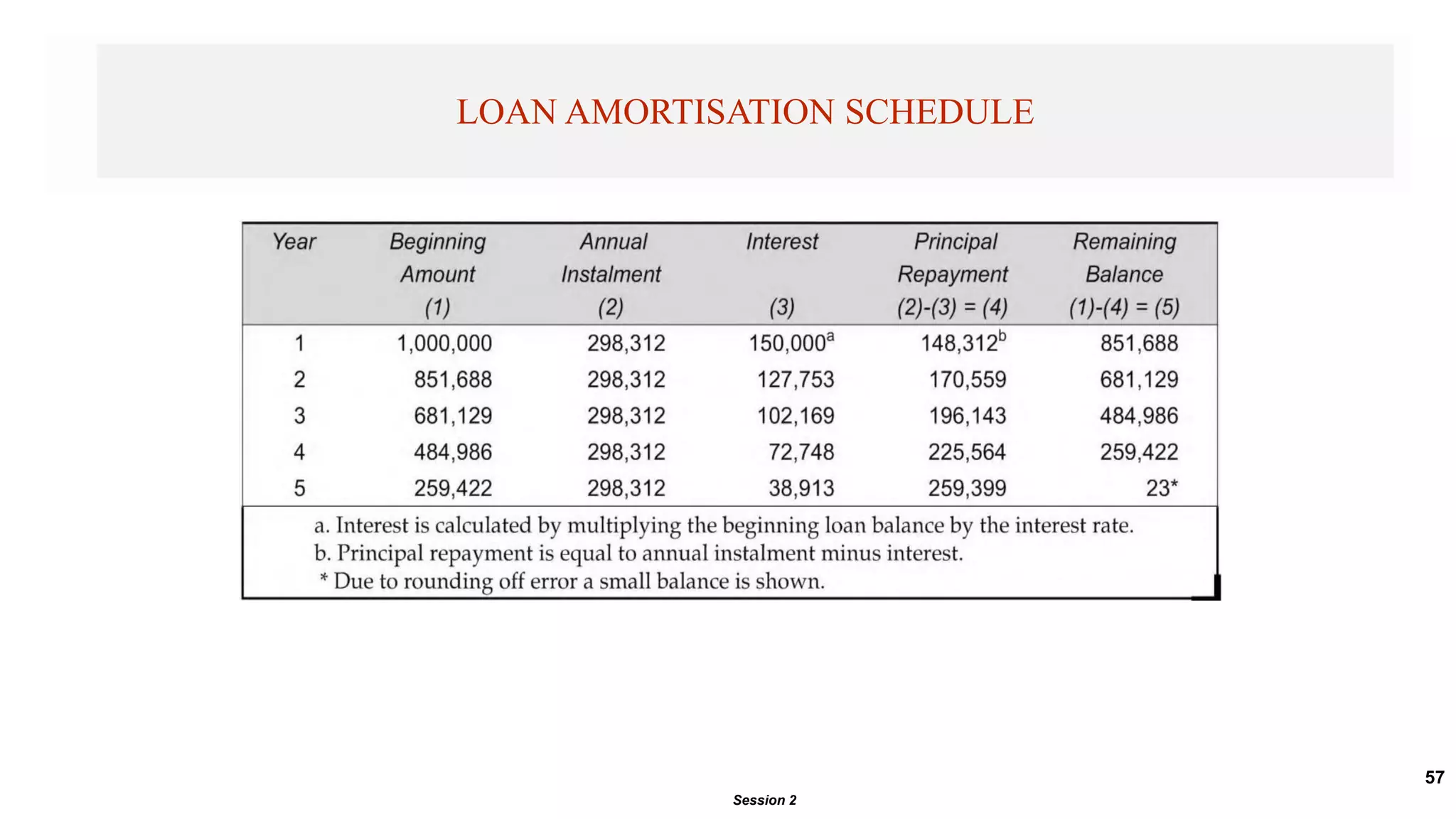
Suppose a firm borrows Rs.1,000,000 at an interest rate of 15 percent and the
loan is to be repaid in 5 equal instalments payable at the end of each of the next
5 years.
57
LOAN AMORTISATION SCHEDULE
Session 2
58
• Ravi wants to save for the college education of his son, Deepak. Ravi estimates that
the college education expenses will be rupees one million per year for four years
when his son reaches college in 16 years - the expenses will be payable at the
beginning of the years. He expects the annual interest rate of 8 percent over the
next two decades. How much money should he deposit in the bank each year for
the next 15 years (assume that the deposit is made at the end of the year) to take
care of his son's college education expenses?
OTHER EXAMPLE
Session 2
59
SOLUTION
Session 2
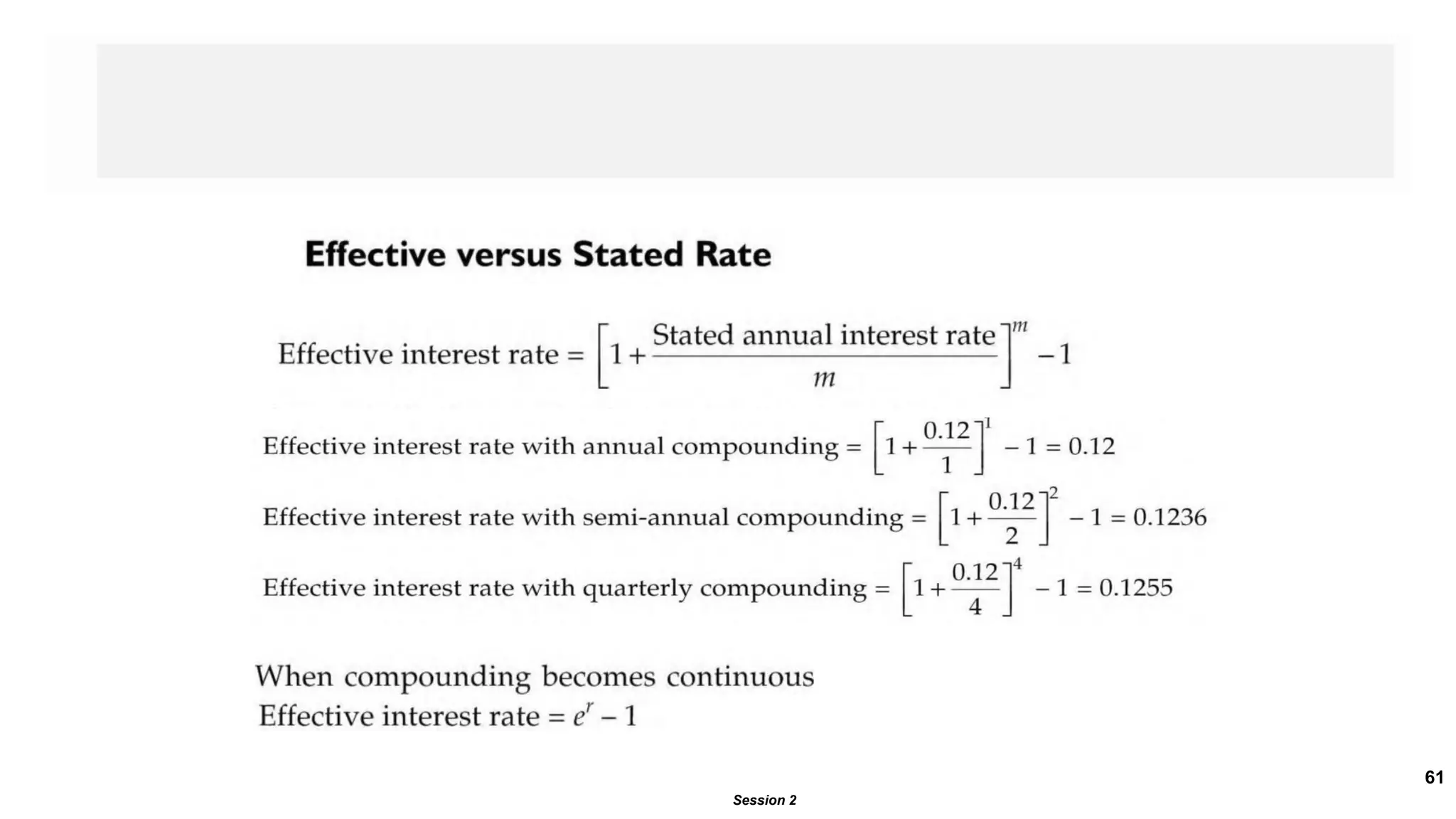
61
Session 2
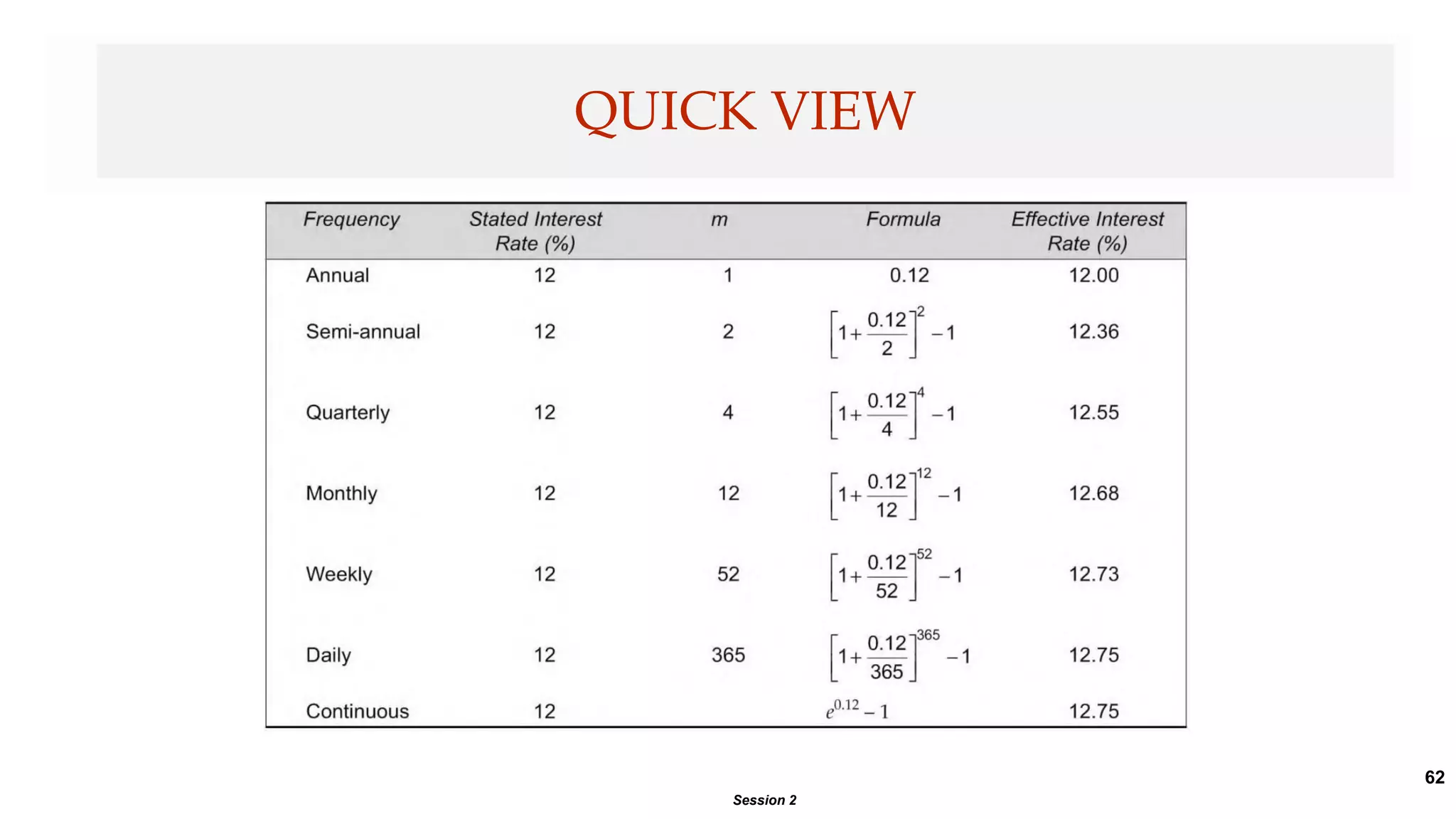
62
QUICK VIEW
Session 2
63
• Most mortgages are amortizing loans. For example, suppose that you take out a $250,000 house
mortgage from your local savings bank when the interest rate is 12%. The bank requires you to repay
the mortgage in equal annual installments over the next 30 years.
• Thus, principal and interest payment will be
PRINCIPAL AND INTEREST
Session 2
65
END OF SESSION
TIME VALUE OF MONEY
Session 2

Session 2 Time Value of Money.pdf

  • 1.
    TOPIC 2 I NT R O D U C T I O N T O T I M E V A L U E O F M O N E Y Session 2
  • 2.
    2 • Determine thefuture value of an investment made today • Determine the present value of cash to be received at a future date • Find the return on an investment • Calculate how long it takes for an investment to reach a desired value WHAT WE SHOULD KNOW Session 2
  • 3.
    3 • Future Valueand Compounding • Present Value and Discounting • More about Present and Future Values • Annuity and Annuity Due NEW TERMS Session 2
  • 4.
    4 • How todetermine the value of cash flow expected in future? • How to allocate cash today for future liabilities? • How to determine best projects based on expected future cash flows? CHALLENGES FOR A MANAGER Session 2
  • 5.
    5 • Present Value– earlier money on a time line • Future Value – later money on a time line • Interest rate – “exchange rate” between earlier money and later money  Discount rate  Cost of capital  Opportunity cost of capital  Required return BASIC DEFINITIONS Session 2
  • 6.
    6 • Suppose youinvest $1,000 for one year at 5% per year. What is the future value in one year? • Suppose you leave the money in for another year. How much will you have two years from now? FUTURE VALUE – EXAMPLE 1 Session 2
  • 7.
    7 • Suppose youinvest $1,000 for one year at 5% per year. What is the future value in one year?  Interest = 1,000(.05) = 50  Value in one year = principal + interest = 1,000 + 50 = 1,050  Future Value (FV) = 1,000(1 + .05) = 1,050 • Suppose you leave the money in for another year. How much will you have two years from now?  FV = 1,000(1.05)(1.05) = 1,000(1.05)2 = 1,102.50 FUTURE VALUE – EXAMPLE 1 Session 2
  • 8.
    8 • FV =PV(1 + r)t  FV = future value  PV = present value  r = period interest rate, expressed as a decimal  t = number of periods • Future value interest factor = (1 + r)t FUTURE VALUE: GENERAL FORMULA Session 2
  • 9.
    9 • Simple interestvs. Compound interest • Consider the previous example  FV with simple interest = 1,000 + 50 + 50 = 1,100  FV with compound interest = 1,102.50  The extra 2.50 comes from the interest of .05(50) = 2.50 earned on the first interest payment EFFECTS OF COMPOUNDING Session 2
  • 10.
  • 11.
    11 • Suppose youinvest the $1,000 from the previous example for 5 years. How much would you have? FUTURE VALUE – PROBLEM Session 2
  • 12.
    12 • Suppose youinvest the $1,000 from the previous example for 5 years. How much would you have?  FV = 1,276.28 • The effect of compounding is small for a small number of periods, but increases as the number of periods increases. (Simple interest would have a future value of $1,250, for a difference of $26.28.) FUTURE VALUE – PROBLEM Session 2
  • 13.
    13 • Suppose youhad a relative deposit $10 at 5.5% interest 200 years ago. How much would the investment be worth today? • What is the effect of compounding?  Simple interest ??? FUTURE VALUE – PROBLEM Session 2
  • 14.
    14 • Suppose youhad a relative deposit $10 at 5.5% interest 200 years ago. How much would the investment be worth today?  FV = 447,189.84 • What is the effect of compounding?  Simple interest = 10 + 200(10)(.055) = 120.00  Compounding added $447,069.84 to the value of the investment FUTURE VALUE – PROBLEM Session 2
  • 15.
    15 • Suppose yourcompany expects to increase unit sales of widgets by 15% per year for the next 5 years. If you sell 3 million widgets in the current year, how many widgets do you expect to sell in the fifth year? FUTURE VALUE AS A GENERAL GROWTH FORMULA Session 2
  • 16.
    16 • Suppose yourcompany expects to increase unit sales of cellphones by 15% per year for the next 5 years. If you sell 3 million widgets in the current year, how many widgets do you expect to sell in the fifth year? • Formula: FV = 3,000,000(1.15)5 = • = 3,000,000(2.011357187) = 6,034,072  FV = 6,034,072 units FUTURE VALUE AS A GENERAL GROWTH FORMULA Session 2
  • 17.
    17 • You’ve locatedan investment that pays 12 percent per year. That rate sounds good to you, so you invest $400. How much will you have in three years? • How much will you have in seven years? • At the end of seven years, how much interest will you have earned? How much of that interest results from compounding? EXAMPLE Session 2
  • 18.
    18 SOLUTION Session 2 Because youinvested $400, the interest in the $884.27 future value is $884.27 − 400 = $484.27. At 12 percent, your $400 investment earns $400 × 0.12 = $48 in simple interest every year. Over seven years, the simple interest thus totals 7 × $48 = $336. The other $484.27 − 336 = $148.27 is from compounding.
  • 19.
    19 • How muchdo I have to invest today to have some amount in the future?  FV = PV(1 + r)t  Rearrange to solve for PV = FV / (1 + r)t • When we talk about discounting, we mean finding the present value of some future amount. • When we talk about the “value” of something, we are talking about the present value unless we specifically indicate that we want the future value. PRESENT VALUE Session 2
  • 20.
    20 PRESENT VALUE ANDDISCOUNT RATE Session 2
  • 21.
    21 • Suppose youneed $10,000 in one year for the down payment on a new car. If you can earn 7% annually, how much do you need to invest today? • PV = 10,000 / (1.07)1 = 9,345.79 PRESENT VALUE –EXAMPLE 1 Session 2
  • 22.
    22 • You wantto begin saving for your daughter’s college education and you estimate that she will need $150,000 in 17 years. If you feel confident that you can earn 8% per year, how much do you need to invest today?  N = 17; I/Y = 8; FV = 150,000  PV = 40,540.34 PRESENT VALUE – EXAMPLE 2 Session 2
  • 23.
    23 • Your parentsset up a saving fund for you 10 years ago that is now worth $19,671.51. If the fund earned 7% per year, how much did your parents invest? PRESENT VALUE – PROBLEM Session 2
  • 24.
    24 • Your parentsset up a trust fund for you 10 years ago that is now worth $19,671.51. If the fund earned 7% per year, how much did your parents invest?  PV = 10,000 PRESENT VALUE – PROBLEM Session 2
  • 25.
    25 • For agiven interest rate – the longer the time period, the lower the present value  What is the present value of $500 to be received in 5 years? 10 years? The discount rate is 10%  PV = 310.46  PV = 192.77 PRESENT VALUE – IMPORTANT RELATIONSHIP I Session 2
  • 26.
    26 • For agiven time period – the higher the interest rate, the smaller the present value  What is the present value of $500 received in 5 years if the interest rate is 10%? 15%? • PV = 310.46 • PV = 248.59 PRESENT VALUE – IMPORTANT RELATIONSHIP II Session 2
  • 27.
  • 28.
    31 • You arelooking at an investment that will pay $1,200 in 5 years if you invest $1,000 today. What is the implied rate of interest?  r = (1,200 / 1,000)1/5 – 1 = .03714 = 3.714% DISCOUNT RATE – EXAMPLE 1 Session 2
  • 29.
    32 • Suppose youare offered an investment that will allow you to double your money in 6 years. You have $10,000 to invest. What is the implied rate of interest? DISCOUNT RATE – PROBLEM Session 2
  • 30.
    33 • Suppose youare offered an investment that will allow you to double your money in 6 years. You have $10,000 to invest. What is the implied rate of interest?  N = 6  PV = -10,000  FV = 20,000  I/Y = 12.25% DISCOUNT RATE – PROBLEM Session 2
  • 31.
    34 • Suppose youhave a 1-year old son and you want to provide $75,000 in 17 years towards his college education. • You currently have $5,000 to invest. • What interest rate must you earn to have the $75,000 when you need it? DISCOUNT RATE – PROBLEM Session 2
  • 32.
    35 • Suppose youhave a 1-year old son and you want to provide $75,000 in 17 years towards his college education. • You currently have $5,000 to invest. • What interest rate must you earn to have the $75,000 when you need it?  I/Y = 17.27% DISCOUNT RATE – PROBLEM Session 2
  • 33.
    36 • Start withthe basic equation and solve for t (remember your logs).  FV = PV(1 + r)t  t = ln(FV / PV) / ln(1 + r) FINDING THE NUMBER OF PERIODS Session 2
  • 34.
    37 • You wantto purchase a new car, and you are willing to pay $20,000. • If you can invest at 10% per year and you currently have $15,000, how long will it be before you have enough money to pay cash for the car?  N = 3.02 years  Formula: t = ln(20,000 / 15,000) / ln(1.1) = 3.02 years NUMBER OF PERIODS – EXAMPLE 1 Session 2
  • 35.
    38 • Suppose youwant to buy a new house. • You currently have $15,000, and you figure you need to have a 10% down payment plus an additional 5% of the loan amount for closing costs. • Assume the type of house you want will cost about $150,000 and you can earn 7.5% per year. • How long will it be before you have enough money for the down payment and closing costs? NUMBER OF PERIODS – EXAMPLE 2 Session 2
  • 36.
    39 • Future valueof an Annuity • Future value of an Annuity Due • Present value of an Annuity • Present value of an Annuity Due ANNUITY AND ANNUITY DUE Session 2
  • 37.
    40 • Suppose youdeposit Rs.1,000 annually in a bank for 5 years and your deposits earn a compound interest rate of 10 percent. What will be the value of this series of deposits (an annuity) at the end of 5 years? FUTURE VALUE OF AN ANNUITY Session 2
  • 38.
  • 39.
    42 • You wantto take up a trip to the Europe with a friend which costs Rs.10,00,000 - the cost is expected to remain unchanged in nominal terms. You can save annually Rs.50,000 to fulfill your desire. How long will you have to wait if your savings earn an interest of 12 percent? EXAMPLE: HOW LONG SHOULD YOU WAIT Session 2
  • 40.
    43 SOLUTION Session 2 The futurevalue of an annuity of Rs.50,000 that earns 12 percent is equated to Rs.10,00,000.
  • 41.
  • 42.
    45 • 𝐹𝑉 𝑜𝑓𝐴𝑛𝑛𝑢𝑖𝑡𝑦 = 𝐴 (1+𝑟)𝑛−1 𝑟 • 𝐹𝑉 𝑜𝑓 𝐴𝑛𝑛𝑢𝑖𝑡𝑦 𝐷𝑢𝑒 = 𝐴 (1+𝑟)𝑛−1 𝑟 *(1+r) • 𝑃𝑉 𝑜𝑓 𝐴𝑛𝑛𝑢𝑖𝑡𝑦 = 𝐴 1− (1+𝑟)−𝑛 𝑟 • 𝑃𝑉 𝑜𝑓 𝐴𝑛𝑛𝑢𝑖𝑡𝑦 = 𝐴 1− (1+𝑟)−𝑛 𝑟 *(1+r) FORMULA Session 2
  • 43.
    46 ANNUITY VS ANNUITYDUE Session 2
  • 44.
    47 • 𝐹𝑉 𝑜𝑓𝐴𝑛𝑛𝑢𝑖𝑡𝑦 = 𝐴 (1+𝑟/𝑚)𝑛∗𝑚−1 𝑟/𝑚 • 𝑃𝑉 𝑜𝑓 𝐴𝑛𝑛𝑢𝑖𝑡𝑦 = 𝐴 1− (1+𝑟/𝑚)−𝑛∗𝑚 𝑟/𝑚 • Present value of a perpetuity= A/r • Present value of a perpetuity with constant growth= A/(r-g) • 𝐸𝑓𝑓𝑒𝑐𝑡𝑖𝑣𝑒 𝐴𝑛𝑛𝑢𝑎𝑙 𝑟𝑎𝑡𝑒(𝐸𝐴𝑅) = 𝐴 = 1 + 𝑟 𝑚 𝑛∗𝑚 − 1 MULTIPERIODS COMPOUNDING Session 2
  • 45.
    48 • Suppose youare taking a loan of Rs 10 lacs from SBI bank at 12% interest rate for 5 years. Compute EMI that you’ll be paying towards this loan. What would be total interest amount on this loan? COMPREHENSIVE PROBLEM Session 2
  • 46.
    49 • Suppose youexpect to receive Rs. 1,000 annually for 3 years, each receipt occurring at the end of the year. What is the present value of this stream of benefits if the discount rate is 10 percent? PRESENT VALUE OF AN ANNUITY Session 2
  • 47.
  • 48.
  • 49.
  • 50.
  • 51.
    54 • You wantto borrow Rs. 1,080,000 to buy a flat. You approach a housing finance company which charges 12.5 percent interest. You can pay Rs.180,000 per year toward loan amortisation. What should be the maturity period of the loan? EXAMPLE Session 2
  • 52.
    55 SOLUTION: PERIOD OFLOAN AMORTISATION Session 2
  • 53.
    56 APPLICATION OF TVM Session2 Suppose a firm borrows Rs.1,000,000 at an interest rate of 15 percent and the loan is to be repaid in 5 equal instalments payable at the end of each of the next 5 years.
  • 54.
  • 55.
    58 • Ravi wantsto save for the college education of his son, Deepak. Ravi estimates that the college education expenses will be rupees one million per year for four years when his son reaches college in 16 years - the expenses will be payable at the beginning of the years. He expects the annual interest rate of 8 percent over the next two decades. How much money should he deposit in the bank each year for the next 15 years (assume that the deposit is made at the end of the year) to take care of his son's college education expenses? OTHER EXAMPLE Session 2
  • 56.
  • 57.
  • 58.
  • 59.
    63 • Most mortgagesare amortizing loans. For example, suppose that you take out a $250,000 house mortgage from your local savings bank when the interest rate is 12%. The bank requires you to repay the mortgage in equal annual installments over the next 30 years. • Thus, principal and interest payment will be PRINCIPAL AND INTEREST Session 2
  • 60.
    65 END OF SESSION TIMEVALUE OF MONEY Session 2