INTERVENTION MATERIAL IN ENGLISH
ROSARIO G. CASTRO
Writer/Proponent
Department of Education
Region III
Division of Pampanga
Magalang South District
STA. CRUZ ELEMENTARY SCHOOL
Magalang
LEARNING AREA:
ENGLISH
WRITER / PROPONENT: ROSARIO G. CASTRO
LEARNING COMPETENCIES:
Recognize names of people, animals,
things and places.
Recognize nouns in simple
sentences.
Use nouns in simple sentences.
INTERVENTION MATERIAL IN ENGLISH
ROSARIO G. CASTRO
Writer/Proponent
GUIDE
CARD
Hi! I am Mickey! Come and
join me and my friends in
our adventure as we learn
about NOUNS.
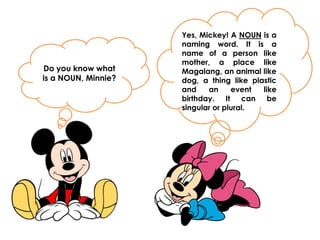
Do you know what
is a NOUN, Minnie?
Yes, Mickey! A NOUN is a
naming word. It is a
name of a person like
mother, a place like
Magalang, an animal like
dog, a thing like plastic
and an event like
birthday. It can be
singular or plural.
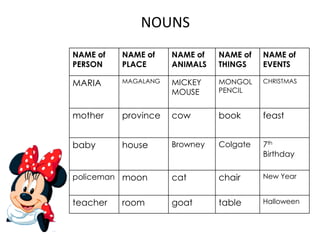
NAME of
PERSON
NAME of
PLACE
NAME of
ANIMALS
NAME of
THINGS
NAME of
EVENTS
MARIA MAGALANG MICKEY
MOUSE
MONGOL
PENCIL
CHRISTMAS
mother province cow book feast
baby house Browney Colgate 7th
Birthday
policeman moon cat chair New Year
teacher room goat table Halloween
NOUNS
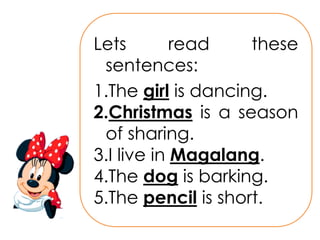
Lets read these
sentences:
1.The girl is dancing.
2.Christmas is a season
of sharing.
3.I live in Magalang.
4.The dog is barking.
5.The pencil is short.
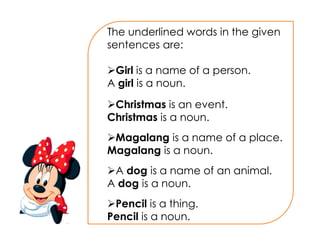
The underlined words in the given
sentences are:
Girl is a name of a person.
A girl is a noun.
Christmas is an event.
Christmas is a noun.
Magalang is a name of a place.
Magalang is a noun.
A dog is a name of an animal.
A dog is a noun.
Pencil is a thing.
Pencil is a noun.
Studying nouns
is fun, isn’t it
Minnie?
Yes Mickey. And I
am sure that our
friends already
know and
understand what a
noun is.
Now lets do these
activities with our
friends.
ACTIVITY
CARD
Activity I
Direction: Encircle all the nouns.
Marie delicious fan grow street
walk pretty mother pencil house
sister beautiful child Magalang dog
bee cousin tall tail snail
blue gate carabao hen red
Job well done!
Lets try another
activity.
Activity II
Excellent!
Here is another
one.
Activity III
Great job!
Lets answer the
following:
ASSESSMENT
CARD
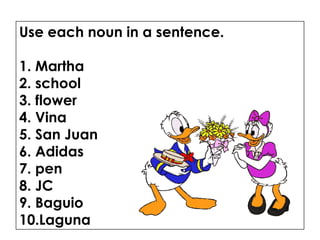
Use each noun in a sentence.
1. Martha
2. school
3. flower
4. Vina
5. San Juan
6. Adidas
7. pen
8. JC
9. Baguio
10.Laguna
ENRICHMENT
CARD
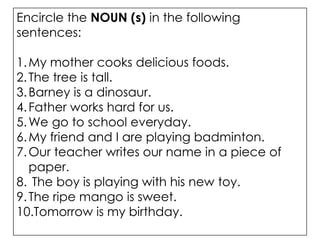
Encircle the NOUN (s) in the following
sentences:
1.My mother cooks delicious foods.
2.The tree is tall.
3.Barney is a dinosaur.
4.Father works hard for us.
5.We go to school everyday.
6.My friend and I are playing badminton.
7.Our teacher writes our name in a piece of
paper.
8. The boy is playing with his new toy.
9.The ripe mango is sweet.
10.Tomorrow is my birthday.
REFERENCE
CARD
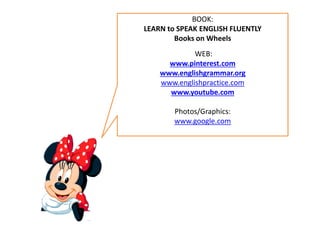
BOOK:
LEARN to SPEAK ENGLISH FLUENTLY
Books on Wheels
WEB:
www.pinterest.com
www.englishgrammar.org
www.youtube.com
Photos/Graphics:
www.google.com
ANSWER
CARD
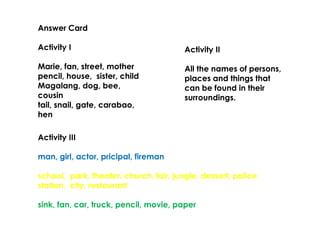
Answer Card
Activity I
Marie, fan, street, mother
pencil, house, sister, child
Magalang, dog, bee,
cousin
tail, snail, gate, carabao,
hen
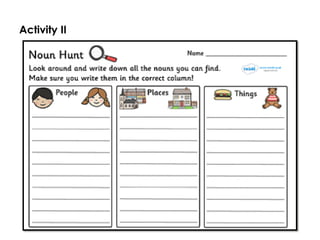
Activity II
All the names of persons,
places and things that
can be found in their
surroundings.
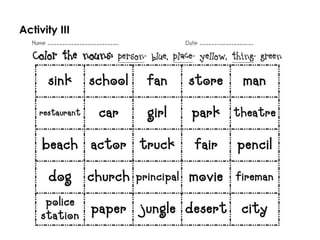
Activity III
man, girl, actor, pricipal, fireman
school, park, theater, church, fair, jungle, dessert, police
station, city, restaurant
sink, fan, car, truck, pencil, movie, paper
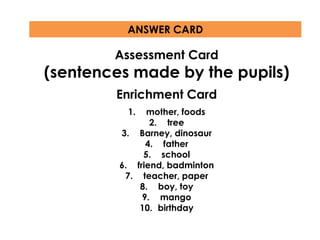
ANSWER CARD
Assessment Card
(sentences made by the pupils)
Enrichment Card
1. mother, foods
2. tree
3. Barney, dinosaur
4. father
5. school
6. friend, badminton
7. teacher, paper
8. boy, toy
9. mango
10. birthday
Congratulations!
You made it!
Intervention Material in English
MAGALANG SOUTH DISTRICT
District
ROSARIO G. CASTRO
Proponent / Author
COROZON N. TAGAY
English School Leader
EVANGELINE SUPAN
English District Coordinator
ENCARNACION M. GONZALES
Principal
ARMANDO M. SABALLE
Schools District Supervisor
JUNE CUNANAN
E.P.S. 1 in English
INTERVENTION MATERIAL IN ENGLISH
ROSARIO G. CASTRO
Writer/Proponent
Department of Education
Region III
Division of Pampanga
Magalang South District
STA. CRUZ ELEMENTARY SCHOOL
Magalang
LEARNING AREA:
ENGLISH
WRITER / PROPONENT: ROSARIO G. CASTRO
LEARNING COMPETENCIES:
Identify the types
of nouns.
Classify each noun
according to its type.
INTERVENTION MATERIAL IN ENGLISH
ROSARIO G. CASTRO
Writer/Proponent
GUIDE
CARD
Do you now understand what
a noun is all about?
If you do, lets pay attention to
Minnie as she discusses the
Types of Nouns.
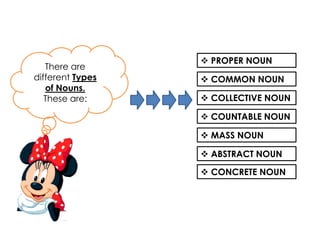
There are
different Types
of Nouns.
These are:
 PROPER NOUN
 COMMON NOUN
 ABSTRACT NOUN
 COLLECTIVE NOUN
 MASS NOUN
 COUNTABLE NOUN
 CONCRETE NOUN
COMMON NOUN
refers to the common
name of a person,
place, thing, animal
or an event.
Like the words pupil,
town and desk are
common nouns.
Examples:
1.Mother is sweet.
2.I am going to
market.
PROPER NOUN refers to
the particular name of
a person, place, thing,
animal and event. They
always begin with a
capital letter.
Examples:
1.Leah is dancing
gracefully.
2.Magalang is a nice
place to live in.
COLLECTIVE NOUN
refers to the name
given to a group of
people, animals and
things.
Examples:
1.The crowd is
shouting.
2. I have cut bunch
of flowers.
COUNTABLE NOUNS
refer to things that
can be counted.
Examples:
1.Micah has two
bags.
2.I have five pencils.
UNCOUNTABLE NOUNS
refer to things that
cannot be counted.
They are always
singular in form.
Examples:
1.I like to eat sugar.
2.He has more milk.
ABSTRACT NOUNS
refers to a quality, idea
or feeling. it is a thing
that we cannot see or
touch, but can only
think of, hear or feel.
Like strength, honesty,
joy, happiness and
friendship.
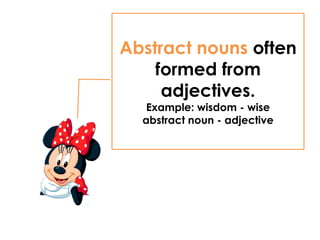
Abstract nouns often
formed from
adjectives.
Example: wisdom - wise
abstract noun - adjective
Abstract nouns also
name an action.
Example: discovery
Most abstract nouns
cannot be counted
and are singular in
number.
Example: friendship, kindness
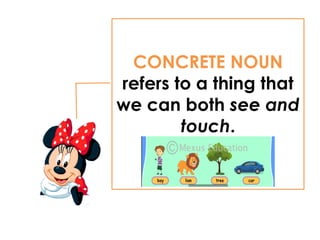
CONCRETE NOUN
refers to a thing that
we can both see and
touch.
.
Did you know now all
the types of nouns
and their differences?
.
I am glad you do.
Lets now do these
activities.
ACTIVITY
CARD
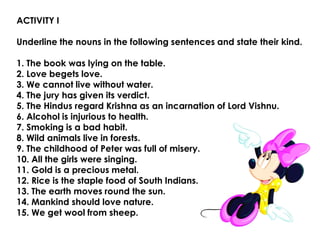
ACTIVITY I
Underline the nouns in the following sentences and state their kind.
1. The book was lying on the table.
2. Love begets love.
3. We cannot live without water.
4. The jury has given its verdict.
5. The Hindus regard Krishna as an incarnation of Lord Vishnu.
6. Alcohol is injurious to health.
7. Smoking is a bad habit.
8. Wild animals live in forests.
9. The childhood of Peter was full of misery.
10. All the girls were singing.
11. Gold is a precious metal.
12. Rice is the staple food of South Indians.
13. The earth moves round the sun.
14. Mankind should love nature.
15. We get wool from sheep.
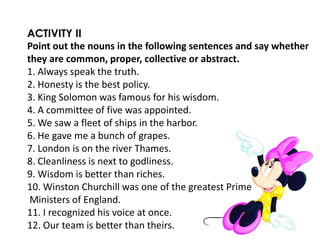
ACTIVITY II
Point out the nouns in the following sentences and say whether
they are common, proper, collective or abstract.
1. Always speak the truth.
2. Honesty is the best policy.
3. King Solomon was famous for his wisdom.
4. A committee of five was appointed.
5. We saw a fleet of ships in the harbor.
6. He gave me a bunch of grapes.
7. London is on the river Thames.
8. Cleanliness is next to godliness.
9. Wisdom is better than riches.
10. Winston Churchill was one of the greatest Prime
Ministers of England.
11. I recognized his voice at once.
12. Our team is better than theirs.
.
Great!
Lets have another
exercises.
ASSESSMENT
CARD
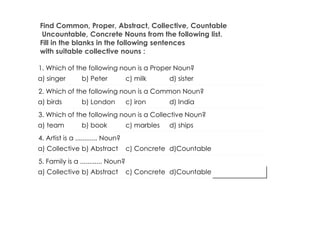
Find Common, Proper, Abstract, Collective, Countable
Uncountable, Concrete Nouns from the following list.
Fill in the blanks in the following sentences
with suitable collective nouns :
1. Which of the following noun is a Proper Noun?
a) singer b) Peter c) milk d) sister
2. Which of the following noun is a Common Noun?
a) birds b) London c) iron d) India
3. Which of the following noun is a Collective Noun?
a) team b) book c) marbles d) ships
4. Artist is a ............ Noun?
a) Collective b) Abstract c) Concrete d)Countable
5. Family is a ............ Noun?
a) Collective b) Abstract c) Concrete d)Countable
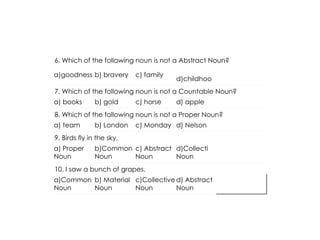
6. Which of the following noun is not a Abstract Noun?
a)goodness b) bravery c) family
d)childhoo
7. Which of the following noun is not a Countable Noun?
a) books b) gold c) horse d) apple
8. Which of the following noun is not a Proper Noun?
a) team b) London c) Monday d) Nelson
9. Birds fly in the sky.
a) Proper
Noun
b)Common
Noun
c) Abstract
Noun
d)Collecti
Noun
10. I saw a bunch of grapes.
a)Common
Noun
b) Material
Noun
c)Collective
Noun
d) Abstract
Noun
ENRICHMENT
CARD
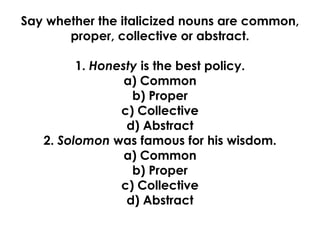
Say whether the italicized nouns are common,
proper, collective or abstract.
1. Honesty is the best policy.
a) Common
b) Proper
c) Collective
d) Abstract
2. Solomon was famous for his wisdom.
a) Common
b) Proper
c) Collective
d) Abstract
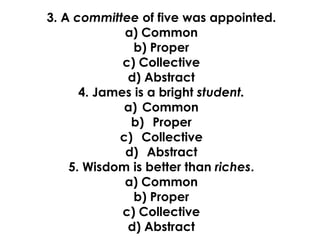
3. A committee of five was appointed.
a) Common
b) Proper
c) Collective
d) Abstract
4. James is a bright student.
a) Common
b) Proper
c) Collective
d) Abstract
5. Wisdom is better than riches.
a) Common
b) Proper
c) Collective
d) Abstract
6. I didn’t believe the girl’s story.
a) Common
b) Proper
c) Collective
d) Abstract
7. A teacher must have patience.
a) Common
b) Proper
c) Collective
d) Abstract
8. Cleanliness is next to godliness.
a) Common
b) Collective
c) Proper
d) Abstract
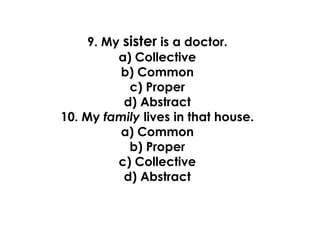
9. My sister is a doctor.
a) Collective
b) Common
c) Proper
d) Abstract
10. My family lives in that house.
a) Common
b) Proper
c) Collective
d) Abstract
REFERENCE
CARD
BOOK:
LEARN to SPEAK ENGLISH FLUENTLY
Books on Wheels
WEB:
www.pinterest.com
www.englishgrammar.org
www.englishpractice.com
www.youtube.com
Photos/Graphics:
www.google.com
ANSWER
CARD
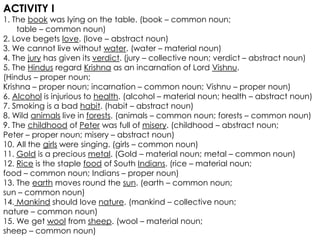
ACTIVITY I
1. The book was lying on the table. (book – common noun;
table – common noun)
2. Love begets love. (love – abstract noun)
3. We cannot live without water. (water – material noun)
4. The jury has given its verdict. (jury – collective noun; verdict – abstract noun)
5. The Hindus regard Krishna as an incarnation of Lord Vishnu.
(Hindus – proper noun;
Krishna – proper noun; incarnation – common noun; Vishnu – proper noun)
6. Alcohol is injurious to health. (alcohol – material noun; health – abstract noun)
7. Smoking is a bad habit. (habit – abstract noun)
8. Wild animals live in forests. (animals – common noun; forests – common noun)
9. The childhood of Peter was full of misery. (childhood – abstract noun;
Peter – proper noun; misery – abstract noun)
10. All the girls were singing. (girls – common noun)
11. Gold is a precious metal. (Gold – material noun; metal – common noun)
12. Rice is the staple food of South Indians. (rice – material noun;
food – common noun; Indians – proper noun)
13. The earth moves round the sun. (earth – common noun;
sun – common noun)
14. Mankind should love nature. (mankind – collective noun;
nature – common noun)
15. We get wool from sheep. (wool – material noun;
sheep – common noun)
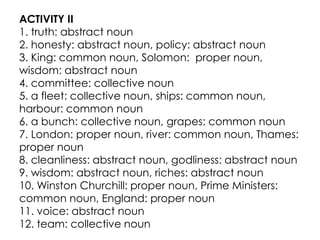
ACTIVITY II
1. truth: abstract noun
2. honesty: abstract noun, policy: abstract noun
3. King: common noun, Solomon: proper noun,
wisdom: abstract noun
4. committee: collective noun
5. a fleet: collective noun, ships: common noun,
harbour: common noun
6. a bunch: collective noun, grapes: common noun
7. London: proper noun, river: common noun, Thames:
proper noun
8. cleanliness: abstract noun, godliness: abstract noun
9. wisdom: abstract noun, riches: abstract noun
10. Winston Churchill: proper noun, Prime Ministers:
common noun, England: proper noun
11. voice: abstract noun
12. team: collective noun
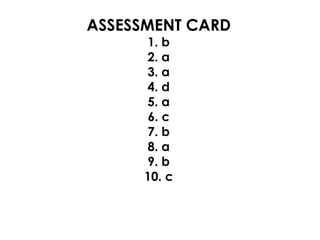
ASSESSMENT CARD
1. b
2. a
3. a
4. d
5. a
6. c
7. b
8. a
9. b
10. c
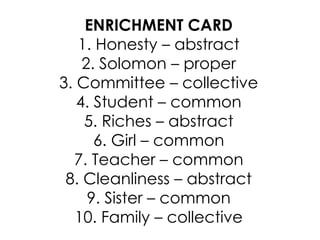
ENRICHMENT CARD
1. Honesty – abstract
2. Solomon – proper
3. Committee – collective
4. Student – common
5. Riches – abstract
6. Girl – common
7. Teacher – common
8. Cleanliness – abstract
9. Sister – common
10. Family – collective
Congratulations!
You made it!

Simenglishpdf 161118054835

  • 1.
    INTERVENTION MATERIAL INENGLISH ROSARIO G. CASTRO Writer/Proponent Department of Education Region III Division of Pampanga Magalang South District STA. CRUZ ELEMENTARY SCHOOL Magalang
  • 2.
    LEARNING AREA: ENGLISH WRITER /PROPONENT: ROSARIO G. CASTRO
  • 3.
    LEARNING COMPETENCIES: Recognize namesof people, animals, things and places. Recognize nouns in simple sentences. Use nouns in simple sentences.
  • 4.
    INTERVENTION MATERIAL INENGLISH ROSARIO G. CASTRO Writer/Proponent
  • 5.
  • 6.
    Hi! I amMickey! Come and join me and my friends in our adventure as we learn about NOUNS.
  • 7.
    Do you knowwhat is a NOUN, Minnie? Yes, Mickey! A NOUN is a naming word. It is a name of a person like mother, a place like Magalang, an animal like dog, a thing like plastic and an event like birthday. It can be singular or plural.
  • 8.
    NAME of PERSON NAME of PLACE NAMEof ANIMALS NAME of THINGS NAME of EVENTS MARIA MAGALANG MICKEY MOUSE MONGOL PENCIL CHRISTMAS mother province cow book feast baby house Browney Colgate 7th Birthday policeman moon cat chair New Year teacher room goat table Halloween NOUNS
  • 9.
    Lets read these sentences: 1.Thegirl is dancing. 2.Christmas is a season of sharing. 3.I live in Magalang. 4.The dog is barking. 5.The pencil is short.
  • 10.
    The underlined wordsin the given sentences are: Girl is a name of a person. A girl is a noun. Christmas is an event. Christmas is a noun. Magalang is a name of a place. Magalang is a noun. A dog is a name of an animal. A dog is a noun. Pencil is a thing. Pencil is a noun.
  • 11.
    Studying nouns is fun,isn’t it Minnie? Yes Mickey. And I am sure that our friends already know and understand what a noun is.
  • 12.
    Now lets dothese activities with our friends.
  • 13.
  • 14.
    Activity I Direction: Encircleall the nouns. Marie delicious fan grow street walk pretty mother pencil house sister beautiful child Magalang dog bee cousin tall tail snail blue gate carabao hen red
  • 15.
    Job well done! Letstry another activity.
  • 16.
  • 17.
  • 18.
  • 19.
    Great job! Lets answerthe following:
  • 20.
  • 21.
    Use each nounin a sentence. 1. Martha 2. school 3. flower 4. Vina 5. San Juan 6. Adidas 7. pen 8. JC 9. Baguio 10.Laguna
  • 22.
  • 23.
    Encircle the NOUN(s) in the following sentences: 1.My mother cooks delicious foods. 2.The tree is tall. 3.Barney is a dinosaur. 4.Father works hard for us. 5.We go to school everyday. 6.My friend and I are playing badminton. 7.Our teacher writes our name in a piece of paper. 8. The boy is playing with his new toy. 9.The ripe mango is sweet. 10.Tomorrow is my birthday.
  • 24.
  • 25.
    BOOK: LEARN to SPEAKENGLISH FLUENTLY Books on Wheels WEB: www.pinterest.com www.englishgrammar.org www.youtube.com Photos/Graphics: www.google.com
  • 26.
  • 27.
    Answer Card Activity I Marie,fan, street, mother pencil, house, sister, child Magalang, dog, bee, cousin tail, snail, gate, carabao, hen Activity II All the names of persons, places and things that can be found in their surroundings. Activity III man, girl, actor, pricipal, fireman school, park, theater, church, fair, jungle, dessert, police station, city, restaurant sink, fan, car, truck, pencil, movie, paper
  • 28.
    ANSWER CARD Assessment Card (sentencesmade by the pupils) Enrichment Card 1. mother, foods 2. tree 3. Barney, dinosaur 4. father 5. school 6. friend, badminton 7. teacher, paper 8. boy, toy 9. mango 10. birthday
  • 29.
  • 30.
    Intervention Material inEnglish MAGALANG SOUTH DISTRICT District ROSARIO G. CASTRO Proponent / Author COROZON N. TAGAY English School Leader EVANGELINE SUPAN English District Coordinator ENCARNACION M. GONZALES Principal ARMANDO M. SABALLE Schools District Supervisor JUNE CUNANAN E.P.S. 1 in English
  • 31.
    INTERVENTION MATERIAL INENGLISH ROSARIO G. CASTRO Writer/Proponent Department of Education Region III Division of Pampanga Magalang South District STA. CRUZ ELEMENTARY SCHOOL Magalang
  • 32.
    LEARNING AREA: ENGLISH WRITER /PROPONENT: ROSARIO G. CASTRO
  • 33.
    LEARNING COMPETENCIES: Identify thetypes of nouns. Classify each noun according to its type.
  • 34.
    INTERVENTION MATERIAL INENGLISH ROSARIO G. CASTRO Writer/Proponent
  • 35.
  • 36.
    Do you nowunderstand what a noun is all about? If you do, lets pay attention to Minnie as she discusses the Types of Nouns.
  • 37.
    There are different Types ofNouns. These are:  PROPER NOUN  COMMON NOUN  ABSTRACT NOUN  COLLECTIVE NOUN  MASS NOUN  COUNTABLE NOUN  CONCRETE NOUN
  • 38.
    COMMON NOUN refers tothe common name of a person, place, thing, animal or an event.
  • 39.
    Like the wordspupil, town and desk are common nouns.
  • 40.
  • 41.
    PROPER NOUN refersto the particular name of a person, place, thing, animal and event. They always begin with a capital letter.
  • 42.
  • 43.
    COLLECTIVE NOUN refers tothe name given to a group of people, animals and things.
  • 44.
    Examples: 1.The crowd is shouting. 2.I have cut bunch of flowers.
  • 45.
    COUNTABLE NOUNS refer tothings that can be counted.
  • 46.
  • 47.
    UNCOUNTABLE NOUNS refer tothings that cannot be counted. They are always singular in form.
  • 48.
    Examples: 1.I like toeat sugar. 2.He has more milk.
  • 49.
    ABSTRACT NOUNS refers toa quality, idea or feeling. it is a thing that we cannot see or touch, but can only think of, hear or feel. Like strength, honesty, joy, happiness and friendship.
  • 50.
    Abstract nouns often formedfrom adjectives. Example: wisdom - wise abstract noun - adjective
  • 51.
    Abstract nouns also namean action. Example: discovery
  • 52.
    Most abstract nouns cannotbe counted and are singular in number. Example: friendship, kindness
  • 53.
    CONCRETE NOUN refers toa thing that we can both see and touch.
  • 54.
    . Did you knownow all the types of nouns and their differences?
  • 55.
    . I am gladyou do. Lets now do these activities.
  • 56.
  • 57.
    ACTIVITY I Underline thenouns in the following sentences and state their kind. 1. The book was lying on the table. 2. Love begets love. 3. We cannot live without water. 4. The jury has given its verdict. 5. The Hindus regard Krishna as an incarnation of Lord Vishnu. 6. Alcohol is injurious to health. 7. Smoking is a bad habit. 8. Wild animals live in forests. 9. The childhood of Peter was full of misery. 10. All the girls were singing. 11. Gold is a precious metal. 12. Rice is the staple food of South Indians. 13. The earth moves round the sun. 14. Mankind should love nature. 15. We get wool from sheep.
  • 58.
    ACTIVITY II Point outthe nouns in the following sentences and say whether they are common, proper, collective or abstract. 1. Always speak the truth. 2. Honesty is the best policy. 3. King Solomon was famous for his wisdom. 4. A committee of five was appointed. 5. We saw a fleet of ships in the harbor. 6. He gave me a bunch of grapes. 7. London is on the river Thames. 8. Cleanliness is next to godliness. 9. Wisdom is better than riches. 10. Winston Churchill was one of the greatest Prime Ministers of England. 11. I recognized his voice at once. 12. Our team is better than theirs.
  • 59.
  • 60.
  • 61.
    Find Common, Proper,Abstract, Collective, Countable Uncountable, Concrete Nouns from the following list. Fill in the blanks in the following sentences with suitable collective nouns : 1. Which of the following noun is a Proper Noun? a) singer b) Peter c) milk d) sister 2. Which of the following noun is a Common Noun? a) birds b) London c) iron d) India 3. Which of the following noun is a Collective Noun? a) team b) book c) marbles d) ships 4. Artist is a ............ Noun? a) Collective b) Abstract c) Concrete d)Countable 5. Family is a ............ Noun? a) Collective b) Abstract c) Concrete d)Countable
  • 62.
    6. Which ofthe following noun is not a Abstract Noun? a)goodness b) bravery c) family d)childhoo 7. Which of the following noun is not a Countable Noun? a) books b) gold c) horse d) apple 8. Which of the following noun is not a Proper Noun? a) team b) London c) Monday d) Nelson 9. Birds fly in the sky. a) Proper Noun b)Common Noun c) Abstract Noun d)Collecti Noun 10. I saw a bunch of grapes. a)Common Noun b) Material Noun c)Collective Noun d) Abstract Noun
  • 63.
  • 64.
    Say whether theitalicized nouns are common, proper, collective or abstract. 1. Honesty is the best policy. a) Common b) Proper c) Collective d) Abstract 2. Solomon was famous for his wisdom. a) Common b) Proper c) Collective d) Abstract
  • 65.
    3. A committeeof five was appointed. a) Common b) Proper c) Collective d) Abstract 4. James is a bright student. a) Common b) Proper c) Collective d) Abstract 5. Wisdom is better than riches. a) Common b) Proper c) Collective d) Abstract
  • 66.
    6. I didn’tbelieve the girl’s story. a) Common b) Proper c) Collective d) Abstract 7. A teacher must have patience. a) Common b) Proper c) Collective d) Abstract 8. Cleanliness is next to godliness. a) Common b) Collective c) Proper d) Abstract
  • 67.
    9. My sisteris a doctor. a) Collective b) Common c) Proper d) Abstract 10. My family lives in that house. a) Common b) Proper c) Collective d) Abstract
  • 68.
  • 69.
    BOOK: LEARN to SPEAKENGLISH FLUENTLY Books on Wheels WEB: www.pinterest.com www.englishgrammar.org www.englishpractice.com www.youtube.com Photos/Graphics: www.google.com
  • 70.
  • 71.
    ACTIVITY I 1. Thebook was lying on the table. (book – common noun; table – common noun) 2. Love begets love. (love – abstract noun) 3. We cannot live without water. (water – material noun) 4. The jury has given its verdict. (jury – collective noun; verdict – abstract noun) 5. The Hindus regard Krishna as an incarnation of Lord Vishnu. (Hindus – proper noun; Krishna – proper noun; incarnation – common noun; Vishnu – proper noun) 6. Alcohol is injurious to health. (alcohol – material noun; health – abstract noun) 7. Smoking is a bad habit. (habit – abstract noun) 8. Wild animals live in forests. (animals – common noun; forests – common noun) 9. The childhood of Peter was full of misery. (childhood – abstract noun; Peter – proper noun; misery – abstract noun) 10. All the girls were singing. (girls – common noun) 11. Gold is a precious metal. (Gold – material noun; metal – common noun) 12. Rice is the staple food of South Indians. (rice – material noun; food – common noun; Indians – proper noun) 13. The earth moves round the sun. (earth – common noun; sun – common noun) 14. Mankind should love nature. (mankind – collective noun; nature – common noun) 15. We get wool from sheep. (wool – material noun; sheep – common noun)
  • 72.
    ACTIVITY II 1. truth:abstract noun 2. honesty: abstract noun, policy: abstract noun 3. King: common noun, Solomon: proper noun, wisdom: abstract noun 4. committee: collective noun 5. a fleet: collective noun, ships: common noun, harbour: common noun 6. a bunch: collective noun, grapes: common noun 7. London: proper noun, river: common noun, Thames: proper noun 8. cleanliness: abstract noun, godliness: abstract noun 9. wisdom: abstract noun, riches: abstract noun 10. Winston Churchill: proper noun, Prime Ministers: common noun, England: proper noun 11. voice: abstract noun 12. team: collective noun
  • 73.
    ASSESSMENT CARD 1. b 2.a 3. a 4. d 5. a 6. c 7. b 8. a 9. b 10. c
  • 74.
    ENRICHMENT CARD 1. Honesty– abstract 2. Solomon – proper 3. Committee – collective 4. Student – common 5. Riches – abstract 6. Girl – common 7. Teacher – common 8. Cleanliness – abstract 9. Sister – common 10. Family – collective
  • 75.