SILENT SOUND TECHNOLOGY
INTRODUCTION
 Silent sound technology has been introduced
to put end to noise pollution and help the
people that have lost their voice and cannot
speak on mobile phone.
 This deice is developed at Karlsruhe institute
of technology and expected to be seen in
near feature.
 This device will notice the lip movement in
the form of electrical impulse and transfer it
to sound speech that can be understood.
 It will be useful for people that want to make
a silent call by just receiving the electrical
impulse from lips movement and neglect all
other surrounding noise.
 It can be used for languages like English,
German French but it cannot be used for
Chinese because a different tone means
different meaning.
 It works based on 2 methods which are
electromyography and image processing.
Need for Silent Sound
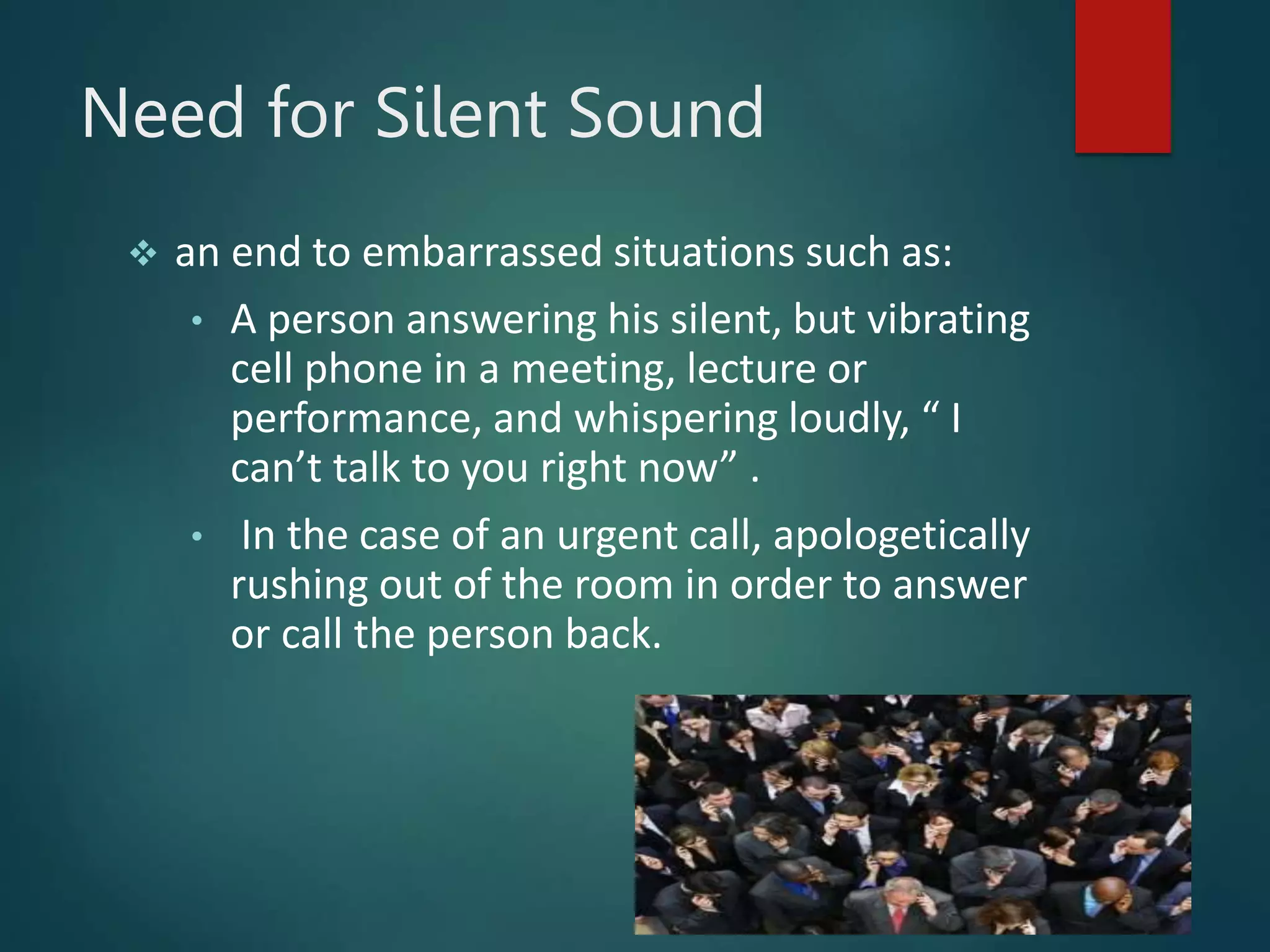
 an end to embarrassed situations such as:
• A person answering his silent, but vibrating
cell phone in a meeting, lecture or
performance, and whispering loudly, “ I
can’t talk to you right now” .
• In the case of an urgent call, apologetically
rushing out of the room in order to answer
or call the person back.
Origination
 idea of interpreting silent speech
electronically or with a computer was
popularized in the 1968 Stanley Kubrick
science-fiction film ‘‘2001 – A Space Odyssey”.
 Major focal point was the DARPA’s Advanced
Speech Encoding Program (ASE) of the early
2000’s.
Methods
 Two Methods for using Silent Sound
Technology
1. Electromyography
• Monitoring tiny muscular movements
that occur when we speak.
• Signals are converted into electrical
pulses that can then be turned into
speech, without a sound uttered.
2. Image Processing
• Converting digital data tape into a film
image with minimal corrections and
calibrations.
• Large mainframe computers employed
for sophisticated interactive
manipulation of the data.
Electromyography (EMG)
 Technique for evaluating and recording the
electrical activity produced by skeletal
muscles.
 Performed using an instrument called an
“Electromyograph”, to produce a record
called an “Electromyogram”.
 Electromyograph detects the electrical
potential generated by muscle cells when
these cells are electrically or neurologically
activated.
 Monitored signals are converted into
electrical pulses that can then be turned into
speech.
History of EMG
 First documented experiments dealing with
EMG started with Francesco Redi’s works in
1666.
 He discovered that a highly specialized muscle
of the electric ray fish (Electric Eel) generated
electricity.
 By 1773, it was demonstrated that the Eel’s
muscle tissue could generate a spark of
electricity.
 In 1849, Dubois-Raymond discovered that it
was also possible to record electrical activity
during a voluntary muscle contraction.
 First actual recording of this activity was
made by Marey in 1890, who also introduced
the term “Electromyography”.
EMG - Procedure
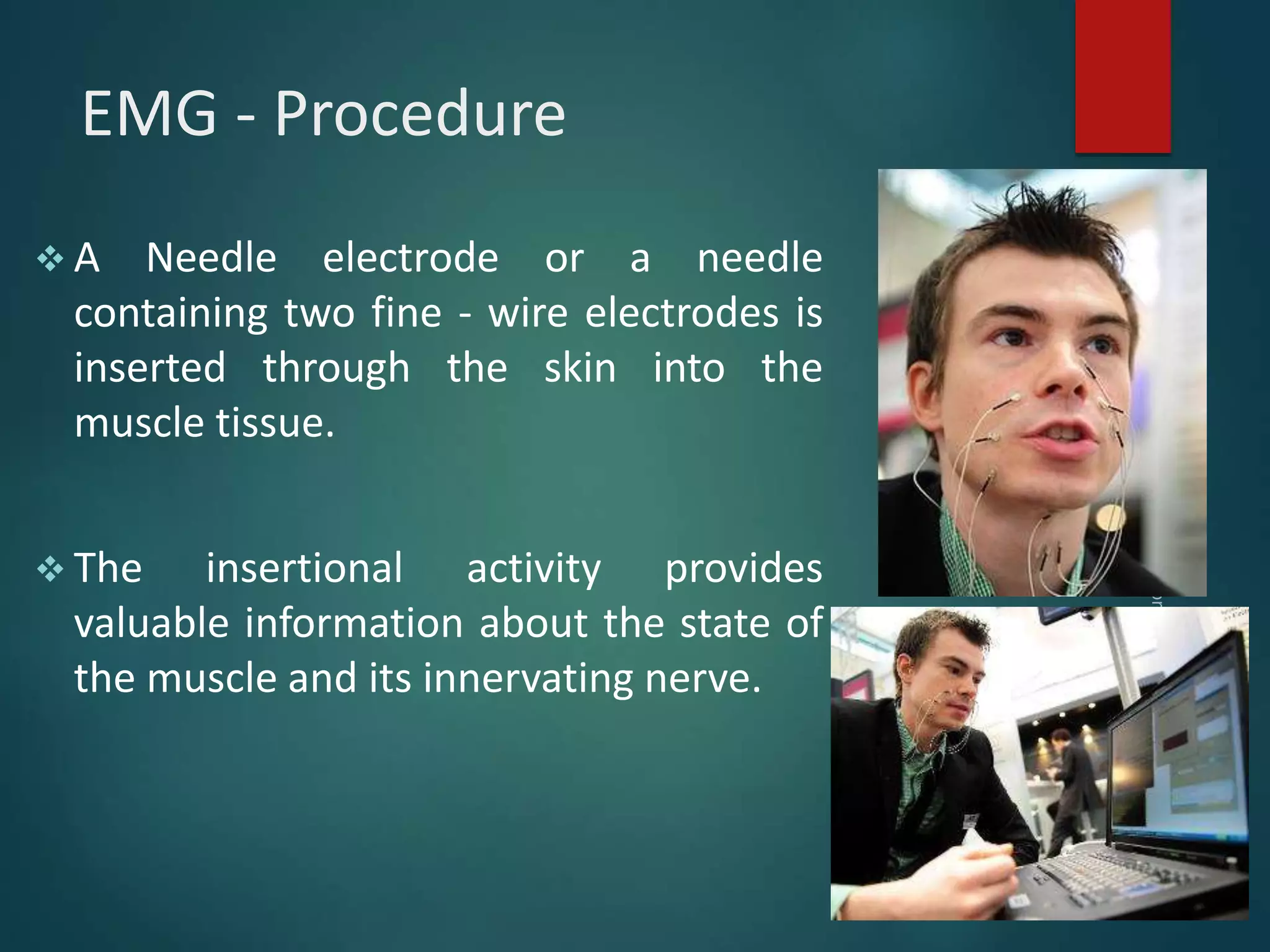
 A Needle electrode or a needle
containing two fine - wire electrodes is
inserted through the skin into the
muscle tissue.
 The insertional activity provides
valuable information about the state of
the muscle and its innervating nerve.
EMG – Procedure
 Normal muscles at rest make certain, normal
electrical signals when the needle is inserted
into them.
 Abnormal spontaneous activity might indicate
some nerve and/or muscle damage.
 Patient is asked to contract the muscle
smoothly and the shape, size, and frequency
of the resulting motor unit potentials are
judged.
 The electrode is retracted a few millimeters,
and again the activity is analyzed until at least
10–20 units have been collected.
EMG - Results
 Normal Results
• Muscle tissue at rest is normally
electrically inactive. After the electrical
activity caused by the irritation of needle
insertion subsides, the electromyograph
should detect no abnormal spontaneous
activity.
 Abnormal Results
• An action potential amplitude that is twice
normal due to the increased number of
fibers per motor unit because of
reinnervation of denervated fibers .
EMG - Signal Decomposition
 EMG signals are essentially made up of
superimposed motor unit action potentials
(MUAPs) from several motor units.
 MUAPs from different motor units tend to
have different characteristic shapes, while
MUAPs recorded by the same electrode from
the same motor unit are typically similar.
 MUAP size and shape depend on where the
electrode is located with respect to the fibers
and so can appear to be different if the
electrode moves position.
Features
 Native speakers can silently utter a sentence
in their language, and the receivers can hear
the translated sentence in their language.
 Allow people to make silent calls without
bothering others.
Applications
 Helping people who have lost their voice due
to illness or accident.
 Telling a trusted friend your PIN number over
the phone without anyone eavesdropping —
assuming no lip-readers are around.
 Silent Sound Techniques is applied in Military
for communicating secret/confidential
matters to others.
Conclusion
 Silent Sound Technology, one of the recent
trends in the field of information technology
implements ”Talking Without Talking”.
 It will be one of the innovation and useful
technology and in mere future this
technology will be use in our day to day life.
THANK YOU..!!

Silent-Sound-Technology.ppt

  • 1.
  • 2.
    INTRODUCTION  Silent soundtechnology has been introduced to put end to noise pollution and help the people that have lost their voice and cannot speak on mobile phone.  This deice is developed at Karlsruhe institute of technology and expected to be seen in near feature.  This device will notice the lip movement in the form of electrical impulse and transfer it to sound speech that can be understood.
  • 3.
     It willbe useful for people that want to make a silent call by just receiving the electrical impulse from lips movement and neglect all other surrounding noise.  It can be used for languages like English, German French but it cannot be used for Chinese because a different tone means different meaning.  It works based on 2 methods which are electromyography and image processing.
  • 4.
    Need for SilentSound  an end to embarrassed situations such as: • A person answering his silent, but vibrating cell phone in a meeting, lecture or performance, and whispering loudly, “ I can’t talk to you right now” . • In the case of an urgent call, apologetically rushing out of the room in order to answer or call the person back.
  • 5.
    Origination  idea ofinterpreting silent speech electronically or with a computer was popularized in the 1968 Stanley Kubrick science-fiction film ‘‘2001 – A Space Odyssey”.  Major focal point was the DARPA’s Advanced Speech Encoding Program (ASE) of the early 2000’s.
  • 6.
    Methods  Two Methodsfor using Silent Sound Technology 1. Electromyography • Monitoring tiny muscular movements that occur when we speak. • Signals are converted into electrical pulses that can then be turned into speech, without a sound uttered. 2. Image Processing • Converting digital data tape into a film image with minimal corrections and calibrations. • Large mainframe computers employed for sophisticated interactive manipulation of the data.
  • 7.
    Electromyography (EMG)  Techniquefor evaluating and recording the electrical activity produced by skeletal muscles.  Performed using an instrument called an “Electromyograph”, to produce a record called an “Electromyogram”.  Electromyograph detects the electrical potential generated by muscle cells when these cells are electrically or neurologically activated.  Monitored signals are converted into electrical pulses that can then be turned into speech.
  • 8.
    History of EMG First documented experiments dealing with EMG started with Francesco Redi’s works in 1666.  He discovered that a highly specialized muscle of the electric ray fish (Electric Eel) generated electricity.  By 1773, it was demonstrated that the Eel’s muscle tissue could generate a spark of electricity.  In 1849, Dubois-Raymond discovered that it was also possible to record electrical activity during a voluntary muscle contraction.  First actual recording of this activity was made by Marey in 1890, who also introduced the term “Electromyography”.
  • 9.
    EMG - Procedure A Needle electrode or a needle containing two fine - wire electrodes is inserted through the skin into the muscle tissue.  The insertional activity provides valuable information about the state of the muscle and its innervating nerve.
  • 10.
    EMG – Procedure Normal muscles at rest make certain, normal electrical signals when the needle is inserted into them.  Abnormal spontaneous activity might indicate some nerve and/or muscle damage.  Patient is asked to contract the muscle smoothly and the shape, size, and frequency of the resulting motor unit potentials are judged.  The electrode is retracted a few millimeters, and again the activity is analyzed until at least 10–20 units have been collected.
  • 11.
    EMG - Results Normal Results • Muscle tissue at rest is normally electrically inactive. After the electrical activity caused by the irritation of needle insertion subsides, the electromyograph should detect no abnormal spontaneous activity.  Abnormal Results • An action potential amplitude that is twice normal due to the increased number of fibers per motor unit because of reinnervation of denervated fibers .
  • 12.
    EMG - SignalDecomposition  EMG signals are essentially made up of superimposed motor unit action potentials (MUAPs) from several motor units.  MUAPs from different motor units tend to have different characteristic shapes, while MUAPs recorded by the same electrode from the same motor unit are typically similar.  MUAP size and shape depend on where the electrode is located with respect to the fibers and so can appear to be different if the electrode moves position.
  • 13.
    Features  Native speakerscan silently utter a sentence in their language, and the receivers can hear the translated sentence in their language.  Allow people to make silent calls without bothering others.
  • 14.
    Applications  Helping peoplewho have lost their voice due to illness or accident.  Telling a trusted friend your PIN number over the phone without anyone eavesdropping — assuming no lip-readers are around.  Silent Sound Techniques is applied in Military for communicating secret/confidential matters to others.
  • 15.
    Conclusion  Silent SoundTechnology, one of the recent trends in the field of information technology implements ”Talking Without Talking”.  It will be one of the innovation and useful technology and in mere future this technology will be use in our day to day life.
  • 16.