SEMIOTICS
The Study of ‘Signs’ as a tool for Textual Analysis
   A sign in the study of semiotics can be any image, word, or
    sound.

   Useful tool in image analysis and construction.

   Semiotics focuses upon a process called signification.


SEMIOTICS
   Linguist Ferdinand de Sassure argued that a ‘sign’ is made up of
    two parts the ‘signifier’ and the ‘signified’.

   The ‘signifier’ refers to a physical entity (e.g a word, sound or an
    image). The ‘signified’ is the mental concept evoked by the
    ‘signifier’

   E.g the image of a furry animal that barks (‘signifier’) evokes the
    mental concept of a dog (‘signified’)

   Also if we see ‘dog’ written down on a piece of paper this will
    evoke the mental concept of a ‘dog’


SEMIOTICS
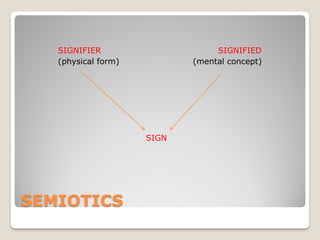
SIGNIFIER                     SIGNIFIED
   (physical form)          (mental concept)


                     SIGN


SEMIOTICS
   This basic level of signification operates at the level of
    ‘denotation’. In other words we are simply identifying or
    ‘describing’ a sign.


   A more complex level of signification operates at the level of
    ‘connotation’ these are more sophisticated mental associations we
    conjure up when we come across a particular sign.


SEMIOTICS
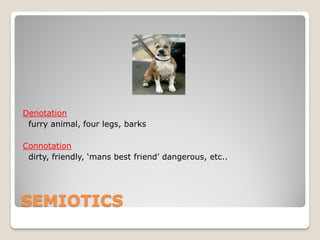
Denotation
 furry animal, four legs, barks

Connotation
 dirty, friendly, ‘mans best friend’ dangerous, etc..


SEMIOTICS
   A connotative response is less fixed that a denotative response
    and the associations ‘signified’ may well depend upon the
    individual, society or culture.

   Cow (in western societies) = food, farms, BSE

   Cow (in Hindu societies) = sacred, holy, respect


SEMIOTICS
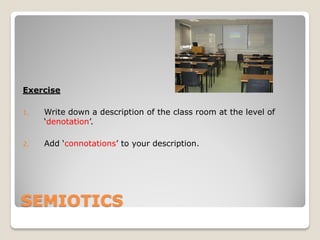
Exercise

1.   Write down a description of the class room at the level of
     ‘denotation’.

2.   Add ‘connotations’ to your description.


SEMIOTICS
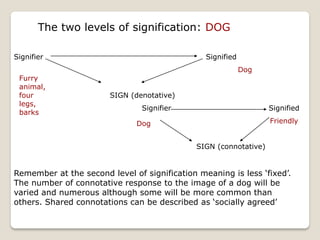
The two levels of signification: DOG

Signifier                                       Signified
                                                            Dog
 Furry
 animal,
 four                   SIGN (denotative)
 legs,
                                Signifier                          Signified
 barks
                              Dog                                  Friendly


                                              SIGN (connotative)


Remember at the second level of signification meaning is less ‘fixed’.
The number of connotative response to the image of a dog will be
varied and numerous although some will be more common than
others. Shared connotations can be described as ‘socially agreed’
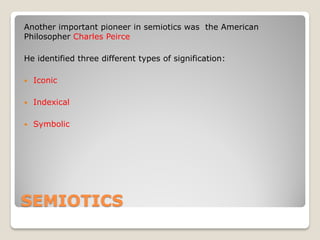
Another important pioneer in semiotics was the American
Philosopher Charles Peirce

He identified three different types of signification:

   Iconic

   Indexical

   Symbolic


SEMIOTICS
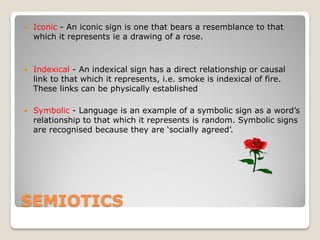
   Iconic - An iconic sign is one that bears a resemblance to that
    which it represents ie a drawing of a rose.


   Indexical - An indexical sign has a direct relationship or causal
    link to that which it represents, i.e. smoke is indexical of fire.
    These links can be physically established

   Symbolic - Language is an example of a symbolic sign as a word’s
    relationship to that which it represents is random. Symbolic signs
    are recognised because they are ‘socially agreed’.


SEMIOTICS
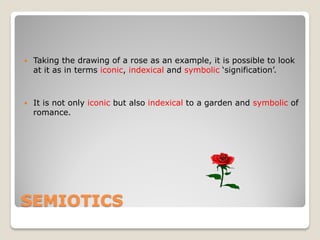
   Taking the drawing of a rose as an example, it is possible to look
    at it as in terms iconic, indexical and symbolic ‘signification’.


   It is not only iconic but also indexical to a garden and symbolic of
    romance.


SEMIOTICS
SEMIOTICS


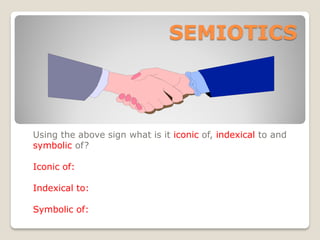
Using the above sign what is it iconic of, indexical to and
symbolic of?

Iconic of:

Indexical to:

Symbolic of:
   In terms of image analysis and construction it is most useful to
    consider signs at the level of connotation.

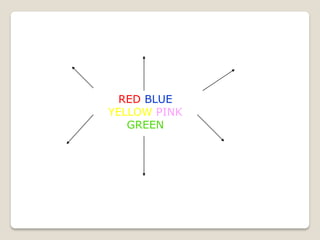
   A useful exercise is to look at the connotation of certain colours.
    In pairs on an A4 piece of paper list connotative responses to
    certain colours then identity those which are indexical and those
    which are symbolic.


SEMIOTICS
RED BLUE
YELLOW PINK
   GREEN
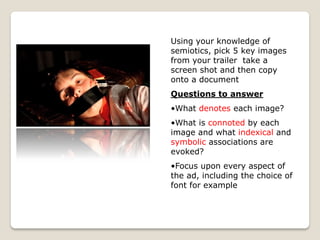
Using your knowledge of
semiotics, pick 5 key images
from your trailer take a
screen shot and then copy
onto a document
Questions to answer
•What denotes each image?
•What is connoted by each
image and what indexical and
symbolic associations are
evoked?
•Focus upon every aspect of
the ad, including the choice of
font for example
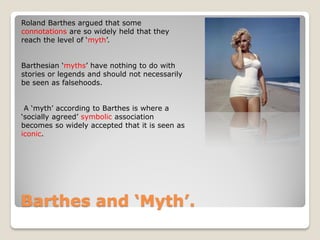
Roland Barthes argued that some
connotations are so widely held that they
reach the level of ‘myth’.


Barthesian ‘myths’ have nothing to do with
stories or legends and should not necessarily
be seen as falsehoods.


 A ‘myth’ according to Barthes is where a
‘socially agreed’ symbolic association
becomes so widely accepted that it is seen as
iconic.


Barthes and ‘Myth’.
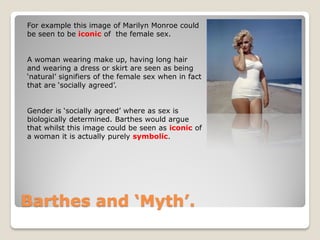
For example this image of Marilyn Monroe could
be seen to be iconic of the female sex.


A woman wearing make up, having long hair
and wearing a dress or skirt are seen as being
‘natural’ signifiers of the female sex when in fact
that are ‘socially agreed’.


Gender is ‘socially agreed’ where as sex is
biologically determined. Barthes would argue
that whilst this image could be seen as iconic of
a woman it is actually purely symbolic.


Barthes and ‘Myth’.
   Semiotics can be a very useful tool in textual analysis in terms of
    uncovering the meaning of a text.


   You can use the principles of Semiotics to analyse existing media
    products as well as your own practical work.


Application of Semiotics

Semiotics

  • 1.
    SEMIOTICS The Study of‘Signs’ as a tool for Textual Analysis
  • 2.
    A sign in the study of semiotics can be any image, word, or sound.  Useful tool in image analysis and construction.  Semiotics focuses upon a process called signification. SEMIOTICS
  • 3.
    Linguist Ferdinand de Sassure argued that a ‘sign’ is made up of two parts the ‘signifier’ and the ‘signified’.  The ‘signifier’ refers to a physical entity (e.g a word, sound or an image). The ‘signified’ is the mental concept evoked by the ‘signifier’  E.g the image of a furry animal that barks (‘signifier’) evokes the mental concept of a dog (‘signified’)  Also if we see ‘dog’ written down on a piece of paper this will evoke the mental concept of a ‘dog’ SEMIOTICS
  • 4.
    SIGNIFIER SIGNIFIED (physical form) (mental concept) SIGN SEMIOTICS
  • 5.
    This basic level of signification operates at the level of ‘denotation’. In other words we are simply identifying or ‘describing’ a sign.  A more complex level of signification operates at the level of ‘connotation’ these are more sophisticated mental associations we conjure up when we come across a particular sign. SEMIOTICS
  • 6.
    Denotation furry animal,four legs, barks Connotation dirty, friendly, ‘mans best friend’ dangerous, etc.. SEMIOTICS
  • 7.
    A connotative response is less fixed that a denotative response and the associations ‘signified’ may well depend upon the individual, society or culture.  Cow (in western societies) = food, farms, BSE  Cow (in Hindu societies) = sacred, holy, respect SEMIOTICS
  • 8.
    Exercise 1. Write down a description of the class room at the level of ‘denotation’. 2. Add ‘connotations’ to your description. SEMIOTICS
  • 9.
    The two levelsof signification: DOG Signifier Signified Dog Furry animal, four SIGN (denotative) legs, Signifier Signified barks Dog Friendly SIGN (connotative) Remember at the second level of signification meaning is less ‘fixed’. The number of connotative response to the image of a dog will be varied and numerous although some will be more common than others. Shared connotations can be described as ‘socially agreed’
  • 10.
    Another important pioneerin semiotics was the American Philosopher Charles Peirce He identified three different types of signification:  Iconic  Indexical  Symbolic SEMIOTICS
  • 11.
    Iconic - An iconic sign is one that bears a resemblance to that which it represents ie a drawing of a rose.  Indexical - An indexical sign has a direct relationship or causal link to that which it represents, i.e. smoke is indexical of fire. These links can be physically established  Symbolic - Language is an example of a symbolic sign as a word’s relationship to that which it represents is random. Symbolic signs are recognised because they are ‘socially agreed’. SEMIOTICS
  • 12.
    Taking the drawing of a rose as an example, it is possible to look at it as in terms iconic, indexical and symbolic ‘signification’.  It is not only iconic but also indexical to a garden and symbolic of romance. SEMIOTICS
  • 13.
    SEMIOTICS Using the abovesign what is it iconic of, indexical to and symbolic of? Iconic of: Indexical to: Symbolic of:
  • 14.
    In terms of image analysis and construction it is most useful to consider signs at the level of connotation.  A useful exercise is to look at the connotation of certain colours. In pairs on an A4 piece of paper list connotative responses to certain colours then identity those which are indexical and those which are symbolic. SEMIOTICS
  • 15.
  • 16.
    Using your knowledgeof semiotics, pick 5 key images from your trailer take a screen shot and then copy onto a document Questions to answer •What denotes each image? •What is connoted by each image and what indexical and symbolic associations are evoked? •Focus upon every aspect of the ad, including the choice of font for example
  • 17.
    Roland Barthes arguedthat some connotations are so widely held that they reach the level of ‘myth’. Barthesian ‘myths’ have nothing to do with stories or legends and should not necessarily be seen as falsehoods. A ‘myth’ according to Barthes is where a ‘socially agreed’ symbolic association becomes so widely accepted that it is seen as iconic. Barthes and ‘Myth’.
  • 18.
    For example thisimage of Marilyn Monroe could be seen to be iconic of the female sex. A woman wearing make up, having long hair and wearing a dress or skirt are seen as being ‘natural’ signifiers of the female sex when in fact that are ‘socially agreed’. Gender is ‘socially agreed’ where as sex is biologically determined. Barthes would argue that whilst this image could be seen as iconic of a woman it is actually purely symbolic. Barthes and ‘Myth’.
  • 19.
    Semiotics can be a very useful tool in textual analysis in terms of uncovering the meaning of a text.  You can use the principles of Semiotics to analyse existing media products as well as your own practical work. Application of Semiotics