Self-building projects in Italy
at a time of economic crisis:
an innovative housing practice?
Michela Semprebon & Serena Vicari Haddock
University of Milan Bicocca (Italy)

‘Social Frontiers: the next edge of social innovation research’
14-15 November 2013 - London
Structure of presentation
• Methodology, cases and questions
• Foreward: housing deprivation and the housing
policy agenda in Italy
• Background of self-building practices
• Theoretical framework of the paper
• The empirical evidence from the cases
• Conclusions
The methodology
• Qualitative research on two case studies:
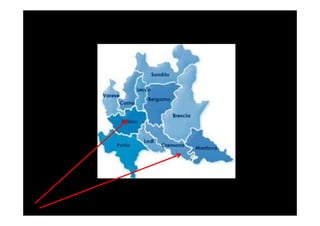
Casalmaggiore (Valsesia 2010; 2011); Paderno
Dugnano(Semprebon 2013):
– semi-structured interviews : 10 in Casalmaggiore; 5
(with more in progress) in Paderno Dugnano;
– (for Paderno Dugnano) non-systematic collection of
online press articles of Corriere della Sera and
Redattore Sociale; and of policy documents.
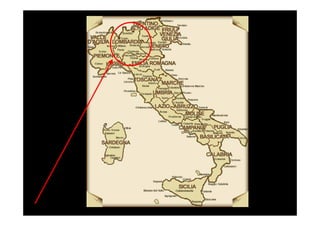
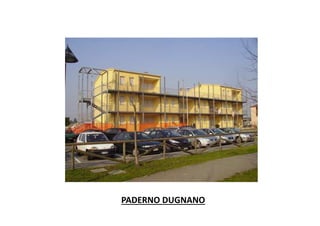
PADERNO DUGNANO
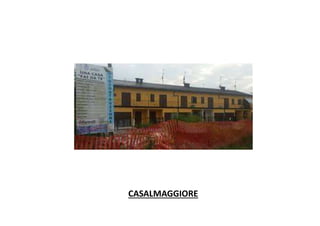
CASALMAGGIORE
Research questions
(1) To what extent do (current) forms of selfbuilding represent innovative practices?
(2) How relevant has institutional embeddedness
been to their emergence and to their
sustainability?
(3) To what extent are they sustainable with respect
to alternative housing initiatives?
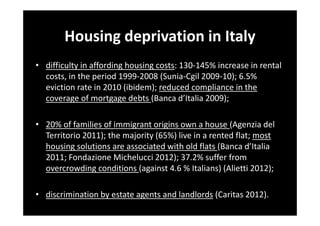
Housing deprivation in Italy
• difficulty in affording housing costs: 130-145% increase in rental
costs, in the period 1999-2008 (Sunia-Cgil 2009-10); 6.5%
eviction rate in 2010 (ibidem); reduced compliance in the
coverage of mortgage debts (Banca d’Italia 2009);
• 20% of families of immigrant origins own a house (Agenzia del
Territorio 2011); the majority (65%) live in a rented flat; most
housing solutions are associated with old flats (Banca d’Italia
2011; Fondazione Michelucci 2012); 37.2% suffer from
overcrowding conditions (against 4.6 % Italians) (Alietti 2012);
• discrimination by estate agents and landlords (Caritas 2012).
Normative framework
• Inadequate national normative framework for housing
and lack of conceptual innovation.
• In Lombardy: reduction in public resources to support
renters and first home buyers; differential restricted
treatment for social housing access (Regional
law7/2005).
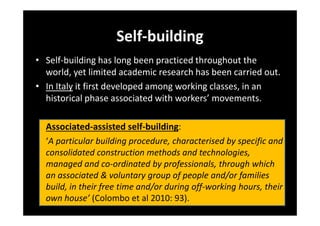
Self-building
• Self-building has long been practiced throughout the
world, yet limited academic research has been carried out.
• In Italy it first developed among working classes, in an
historical phase associated with workers’ movements.
Associated-assisted self-building:
‘A particular building procedure, characterised by specific and
consolidated construction methods and technologies,
managed and co-ordinated by professionals, through which
an associated & voluntary group of people and/or families
build, in their free time and/or during off-working hours, their
own house’ (Colombo et al 2010: 93).
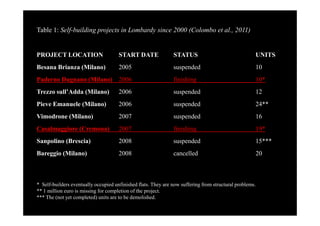
Table 1: Self-building projects in Lombardy since 2000 (Colombo et al., 2011)

PROJECT LOCATION

START DATE

STATUS

UNITS

Besana Brianza (Milano)

2005

suspended

10

Paderno Dugnano (Milano) 2006

finishing

10*

Trezzo sull’Adda (Milano)

2006

suspended

12

Pieve Emanuele (Milano)

2006

suspended

24**

Vimodrone (Milano)

2007

suspended

16

Casalmaggiore (Cremona)

2007

finishing

19*

Sanpolino (Brescia)

2008

suspended

15***

Bareggio (Milano)

2008

cancelled

20

* Self-builders eventually occupied unfinished flats. They are now suffering from structural problems.
** 1 million euro is missing for completion of the project.
*** The (not yet completed) units are to be demolished.
Main theoretical references
• Vicari and Torniaghi (2013): innovation and social
exclusion in the city; institutionalisation as a crucial
variable
• Vitale and Podestà (2011): innovation and political
contention
Empirical findings
• The Lombardy Experimental Program for self-building:
various critical aspects ranging from risk management to
involvement of public and private sector actors.
• Policy : potential impact of self-building in addressing
some of the limits of current housing policies.
• Politics: limited involvement of municipalities and of the
wider community; strong potential for the
empowerment of self-builders.
Preliminary conclusions
• The emergence of self-building initiatives in Italy, in the last
years, has been fuelled by the 3rd sector, in particular through
the promotional work of Alisei which has supported the
experimentation of a ‘new’ form of self-building.
• Self-building does bear the potential of addressing some
critical aspects of social housing policy but in order to be viable
it should be (?) institutionalised.
• Self-building could represent an innovative instrument but it
does not represent a sufficient solution to address the
structural problems of housing policy.
Thank you for your attention!
Michela Semprebon
michela.semprebon@unimib.it

Self building projects in Italy at a time of economic crisis

  • 1.
    Self-building projects inItaly at a time of economic crisis: an innovative housing practice? Michela Semprebon & Serena Vicari Haddock University of Milan Bicocca (Italy) ‘Social Frontiers: the next edge of social innovation research’ 14-15 November 2013 - London
  • 2.
    Structure of presentation •Methodology, cases and questions • Foreward: housing deprivation and the housing policy agenda in Italy • Background of self-building practices • Theoretical framework of the paper • The empirical evidence from the cases • Conclusions
  • 3.
    The methodology • Qualitativeresearch on two case studies: Casalmaggiore (Valsesia 2010; 2011); Paderno Dugnano(Semprebon 2013): – semi-structured interviews : 10 in Casalmaggiore; 5 (with more in progress) in Paderno Dugnano; – (for Paderno Dugnano) non-systematic collection of online press articles of Corriere della Sera and Redattore Sociale; and of policy documents.
  • 6.
  • 7.
  • 8.
    Research questions (1) Towhat extent do (current) forms of selfbuilding represent innovative practices? (2) How relevant has institutional embeddedness been to their emergence and to their sustainability? (3) To what extent are they sustainable with respect to alternative housing initiatives?
  • 9.
    Housing deprivation inItaly • difficulty in affording housing costs: 130-145% increase in rental costs, in the period 1999-2008 (Sunia-Cgil 2009-10); 6.5% eviction rate in 2010 (ibidem); reduced compliance in the coverage of mortgage debts (Banca d’Italia 2009); • 20% of families of immigrant origins own a house (Agenzia del Territorio 2011); the majority (65%) live in a rented flat; most housing solutions are associated with old flats (Banca d’Italia 2011; Fondazione Michelucci 2012); 37.2% suffer from overcrowding conditions (against 4.6 % Italians) (Alietti 2012); • discrimination by estate agents and landlords (Caritas 2012).
  • 10.
    Normative framework • Inadequatenational normative framework for housing and lack of conceptual innovation. • In Lombardy: reduction in public resources to support renters and first home buyers; differential restricted treatment for social housing access (Regional law7/2005).
  • 11.
    Self-building • Self-building haslong been practiced throughout the world, yet limited academic research has been carried out. • In Italy it first developed among working classes, in an historical phase associated with workers’ movements. Associated-assisted self-building: ‘A particular building procedure, characterised by specific and consolidated construction methods and technologies, managed and co-ordinated by professionals, through which an associated & voluntary group of people and/or families build, in their free time and/or during off-working hours, their own house’ (Colombo et al 2010: 93).
  • 12.
    Table 1: Self-buildingprojects in Lombardy since 2000 (Colombo et al., 2011) PROJECT LOCATION START DATE STATUS UNITS Besana Brianza (Milano) 2005 suspended 10 Paderno Dugnano (Milano) 2006 finishing 10* Trezzo sull’Adda (Milano) 2006 suspended 12 Pieve Emanuele (Milano) 2006 suspended 24** Vimodrone (Milano) 2007 suspended 16 Casalmaggiore (Cremona) 2007 finishing 19* Sanpolino (Brescia) 2008 suspended 15*** Bareggio (Milano) 2008 cancelled 20 * Self-builders eventually occupied unfinished flats. They are now suffering from structural problems. ** 1 million euro is missing for completion of the project. *** The (not yet completed) units are to be demolished.
  • 13.
    Main theoretical references •Vicari and Torniaghi (2013): innovation and social exclusion in the city; institutionalisation as a crucial variable • Vitale and Podestà (2011): innovation and political contention
  • 14.
    Empirical findings • TheLombardy Experimental Program for self-building: various critical aspects ranging from risk management to involvement of public and private sector actors. • Policy : potential impact of self-building in addressing some of the limits of current housing policies. • Politics: limited involvement of municipalities and of the wider community; strong potential for the empowerment of self-builders.
  • 15.
    Preliminary conclusions • Theemergence of self-building initiatives in Italy, in the last years, has been fuelled by the 3rd sector, in particular through the promotional work of Alisei which has supported the experimentation of a ‘new’ form of self-building. • Self-building does bear the potential of addressing some critical aspects of social housing policy but in order to be viable it should be (?) institutionalised. • Self-building could represent an innovative instrument but it does not represent a sufficient solution to address the structural problems of housing policy.
  • 16.
    Thank you foryour attention! Michela Semprebon michela.semprebon@unimib.it