12/02/14 1
State Institutions of Economic
Governance
State and Governance
Prof. Dr. Maria Bordas
National University of Public Service
Faculty of Public Governance and Internatitional
Studies
2020.
12/02/14 2
1. When does the Economy Operate Well?
Goals the Government has to follow:
a.) Development of the Economy
GDP (Gross Domestic Product)
Other aspects: mode of production, servicing sector, regional
development, structural problems
b.) Efficiency of the Economy
Widest sense: best production opportunities
Cost effective
Effective
Successful
12/02/14 3
Goals of the Government has to follow:
c.) Welfare of People
Military industry: Russia, nazy Germany, Iran
Poverty: African countries
Communist economic administration: restrictions
d.) Certain values and moral expectations
Role of politics: public interest – personal interest
Example: privatization in Hungary, Trump’ economic policy
Other factors: customs, religion, ideology, social values, attitudes
Example: sharing in taxation in Hugary, sacred cows in India,
Palestine people
12/02/14 4
2. Questions of State Intervention in the Economy
State intervention: how the state let market mechanisms prevail
The two extremes:
 Liberalcapitalism (however, it was never true in this clear form)
Theory of Adam Smith: „Invisible Hands” or „Laissez-Faire”:
- Free market competition
- Against any state intervention
 Communist economy
- Total state intervention in the economy
- Elimination of market mechanisms: military economic
administration, nationalization (confiscation) of private property,
plan-directives, use of human resources without any limitation,
political redistribution
12/02/14 5
Reasons for State Intervention in the Economy
State intervention: in the case of market failure (government
failure)
1. Market stability: recession, inflation, unemployment (by
economic policy (fiscal and moneraty – or emplyment government
actions)
2. Market competititon: dominance of monopolies, public law
means: to keep competition by competition supervision
3. Poverty: unequal incomes in the liberal-capitalism – tool:
redistribution (progressive tax system, family allowances, aid for
the poor and disabled) – Piketty: The Capital in the 21th Century
4. Public services: state responsibility, public interest
12/02/14 6
6. Economic activities:
public aim, not profitable - ste state finances them
examples: public health, basic research
7. External economic effects:
tort (cause damage) without regulations
examples: environment protection, quality and safety, climate
change
8. Information asymetry:
- insufficient information, regulation
examples: customer protection, banking supervision, health care
12/02/14 7
3. Expectations from Economic Governance
Expectations: flexible, quick, client-oriented, having expertise, well-
managed, efficient, etc.
European public administration:
Weberian model: centralized, public-private law distinction, heavily
regulated and law-centralized system,
American public administration:
Management-oriented: decentralized, self-governance, business
principles
New requirements: smaller and cheaper state, globalist tendencies,
regional development, etc.
12/02/14 8
4. Institutions of Economic Governance
a-.) Organizations of economic governance
 Political parties: economic policy, right wing and left wing –
populist tendencies
 Parliament – local governments: legislation based on the
government economic policy
 Government: determines economiy policy
 Administrative organizations: prepare government decisions
and implement acts (ministries)
 Iudicial : decides legal disputes (e.g. office of competition)
 International organizations: World Bank, IMF, European
Union, WTO
12/02/14 9
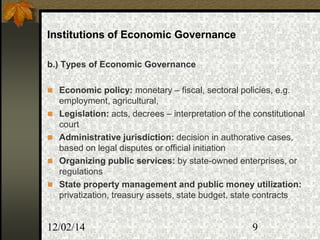
Institutions of Economic Governance
b.) Types of Economic Governance
 Economic policy: monetary – fiscal, sectoral policies, e.g.
employment, agricultural,
 Legislation: acts, decrees – interpretation of the constitutional
court
 Administrative jurisdiction: decision in authorative cases,
based on legal disputes or official initiation
 Organizing public services: by state-owned enterprises, or
regulations
 State property management and public money utilization:
privatization, treasury assets, state budget, state contracts
Questions?
12/02/14

Si 1st lecture 2020 (1)

  • 1.
    12/02/14 1 State Institutionsof Economic Governance State and Governance Prof. Dr. Maria Bordas National University of Public Service Faculty of Public Governance and Internatitional Studies 2020.
  • 2.
    12/02/14 2 1. Whendoes the Economy Operate Well? Goals the Government has to follow: a.) Development of the Economy GDP (Gross Domestic Product) Other aspects: mode of production, servicing sector, regional development, structural problems b.) Efficiency of the Economy Widest sense: best production opportunities Cost effective Effective Successful
  • 3.
    12/02/14 3 Goals ofthe Government has to follow: c.) Welfare of People Military industry: Russia, nazy Germany, Iran Poverty: African countries Communist economic administration: restrictions d.) Certain values and moral expectations Role of politics: public interest – personal interest Example: privatization in Hungary, Trump’ economic policy Other factors: customs, religion, ideology, social values, attitudes Example: sharing in taxation in Hugary, sacred cows in India, Palestine people
  • 4.
    12/02/14 4 2. Questionsof State Intervention in the Economy State intervention: how the state let market mechanisms prevail The two extremes:  Liberalcapitalism (however, it was never true in this clear form) Theory of Adam Smith: „Invisible Hands” or „Laissez-Faire”: - Free market competition - Against any state intervention  Communist economy - Total state intervention in the economy - Elimination of market mechanisms: military economic administration, nationalization (confiscation) of private property, plan-directives, use of human resources without any limitation, political redistribution
  • 5.
    12/02/14 5 Reasons forState Intervention in the Economy State intervention: in the case of market failure (government failure) 1. Market stability: recession, inflation, unemployment (by economic policy (fiscal and moneraty – or emplyment government actions) 2. Market competititon: dominance of monopolies, public law means: to keep competition by competition supervision 3. Poverty: unequal incomes in the liberal-capitalism – tool: redistribution (progressive tax system, family allowances, aid for the poor and disabled) – Piketty: The Capital in the 21th Century 4. Public services: state responsibility, public interest
  • 6.
    12/02/14 6 6. Economicactivities: public aim, not profitable - ste state finances them examples: public health, basic research 7. External economic effects: tort (cause damage) without regulations examples: environment protection, quality and safety, climate change 8. Information asymetry: - insufficient information, regulation examples: customer protection, banking supervision, health care
  • 7.
    12/02/14 7 3. Expectationsfrom Economic Governance Expectations: flexible, quick, client-oriented, having expertise, well- managed, efficient, etc. European public administration: Weberian model: centralized, public-private law distinction, heavily regulated and law-centralized system, American public administration: Management-oriented: decentralized, self-governance, business principles New requirements: smaller and cheaper state, globalist tendencies, regional development, etc.
  • 8.
    12/02/14 8 4. Institutionsof Economic Governance a-.) Organizations of economic governance  Political parties: economic policy, right wing and left wing – populist tendencies  Parliament – local governments: legislation based on the government economic policy  Government: determines economiy policy  Administrative organizations: prepare government decisions and implement acts (ministries)  Iudicial : decides legal disputes (e.g. office of competition)  International organizations: World Bank, IMF, European Union, WTO
  • 9.
    12/02/14 9 Institutions ofEconomic Governance b.) Types of Economic Governance  Economic policy: monetary – fiscal, sectoral policies, e.g. employment, agricultural,  Legislation: acts, decrees – interpretation of the constitutional court  Administrative jurisdiction: decision in authorative cases, based on legal disputes or official initiation  Organizing public services: by state-owned enterprises, or regulations  State property management and public money utilization: privatization, treasury assets, state budget, state contracts
  • 10.