OROMIA STATE UNIVERSITY
COLLEGE OF DEVELOPMENT AND MANAGEMENT
DEPARTMENT OF PROJECT MANAGEMENT
9 December 2022 CSU 1
Chapter Three
State and Development
Leading Q
• State and development?
• Role of state ?
• Public enterprise ?
• Characteristics of public enterprise
• Old public administration and NPM?
9 December 2022 CSU 2
Introduction
• Public finance economists have identified the roles of
state as: 2 roles
NORMATIVE ROLE:
– Determines guidelines, principles or norms for welfare-
enhancing public sector interventions in the economy.
– It attempts to define what the government should do to
correct market imperfections and to complement the
market to promote and maximize social welfare.
9 December 2022 CSU 3
Cont’d
 POSITIVE ROLE: describes and analyzes what the
government actually does.
• In an ideal world, the two roles would merge and become the
same:
Because the state would be doing exactly what it is expected to
do and all the reforms needed to maximize social welfare
would have been carried out.
9 December 2022 CSU 4
 In the real world, However, the two roles tend to diverge by
great deal – implying that many needed reforms have not
been carried out.
• The Reasons for this divergence include:
Differences between the interests of those who govern
and those who are governed;
Mistakes and misconceptions on the part of the policy
makers;
Inadequate controls on the part of the policy makers
over the policy instruments; and
The residual effects of past decisions
9 December 2022 CSU 5
Cont’d
 The general classically preferred role of state
limited to:
 The provision of essential public goods,
 Maintenance of law and order, and
 Defense of the country
In this 21st century the government believed to
plays the following roles among others
i. The economic roles
ii. The social roles, and
iii. The Political roles
9 December 2022 CSU 6
Cont’d
1). Economic Roles: the government allocates resources,
redistributes income and influences the level of activity.
 Until 19th century, the economic role of the government tended to be
much more limited.
o the classical economists considered the interference of public sector as
damaging to economic activity and as obstacle to growth.
9 December 2022 CSU 7
Cont’d
 The importance and areas of state intervention:
 The 20th century saw a gradual but large expansion in the
role of the state in the economy.
 Keynesian thinking was used to justify an expansion in the
economic role of the public sector.
 The intervention of government of many countries has been
seen as important after World War II in production and
supply of public goods – because the market would
undersupply or oversupply such goods.
oThe private sector would not have an incentive to
produce public goods - due to free riders (who would
not contribute to the cost of production.
9 December 2022 CSU 8
Cont’d
 Private sector fails to appropriately produce goods due to:
a). Free riders: difficulty of excluding from their consumption
individuals who would not contribute to the cost of production
b). Externalities of public goods: The consumption or
production of some goods may generate positive or negative
externalities not reflected in the price of which cause market
failure. This requires government intervention.
9 December 2022 CSU 9
Cont’d
 Without government intervention, the market would over
produce or under produce such goods depending on
whether externalities were good or bad.
• Thus, the government expected to increase the private
cost of producing or consuming goods with undesirable
externalities and to decrease the cost of goods with
desirable externalities.
 Externalities became important justifications for expanding the role of
the public sector in to health, education, transportation, research,
training, welfare payment (reduce crime) and many other areas.
9 December 2022 CSU 10
Cont’d
 In general, some of the economic roles that the state could
play include:
 Production and supply of public good;
 Promoting the right incentives to encourage efficient private production;
 Creation of employment opportunities;
 Check over monopolies, unhealthy trade practices and Moderate prices of commodities
 Correcting market failures;
 Reducing inequality through redistribution of income
 Stabilizing the economy:
 Fiscal policy - by expenditure reduction, export promotion and modulating taxes.
 Monetary policy- by modulating money supply in the economy through borrowing,
interest rate change and currency printing
9 December 2022 CSU 11
Factors Influence the Economic Roles of State:
 In developing countries, the economic roles of the state can be
influenced by factors such as:
• Colonies of foreign powers-many large enterprises had been on hands
of individuals from the colonial powers
• Social attitudes- determined by cultural heritage or religion.
• Level of economic development- sophistication of the market and
private sector may call for more or less state intervention.
• The degree of openness of the economy
• Technological developments - which may create or destroy natural
monopolies or increase the need to regulate certain activities like
financial market, transportation, communication, etc.
• Quality of public administration – which may impose limits on scope
of effective governmental interventions.
9 December 2022 CSU 12
2. Political roles of the state
 Government could play the following political roles:
 Organizing the government organs like the executive,
legislative and judiciary bodies with their respective
responsibilities
 ensuring a basic framework of legality, rights and
freedom of citizens
 Making and supporting the execution of policies
 Exercising public authority
 Ensuring respect for the law and combating organized
crime and corruption;
9 December 2022 CSU 13
Cont’d………. political role
 Guaranteeing the functioning of a state governed by the rule of
law;
 Bringing the state closer to the citizen, including policy- and
decision-making activities of public institutions;
 Establishing diplomatic relationship with other foreign
countries;
 Building the capacity of bureaucrats and enhancing their
commitment;
 Protecting the territory and civilian population of the country
against military and non-military threats;
 Enhancing the democracy through fair election;
 Maintaining law and order;
 Establishing and directing defense of the country; etc.
9 December 2022 CSU 14
3. Social roles:
Enhance the availability and provision of social services such as:
Education,
Health care,
Transportation,
Communication,
Electricity,
Safe drinking water,
agricultural extension services, etc.
Labors welfare improvements,
9 December 2022 CSU 15
Cont’d
 Establishing and implementing social protection mechanisms
o Contributory system of social insurance – provision of income and
services to individuals in the event of retirement, sickness, disability,
death, or unemployment.
 Other Social protection programs that a state must design and
implement may include:
o Old-Age, Survivors’benefits _ pension;
o Disability Insurance;
o Administration for Children and Families within Health and Human Services;
o Unemployment Compensation (temporary financial help during periods
between jobs);
o Maternity benefits
o Welfare improvement of handicapped person, and widows and orphans.
 Encouraging the organization of people and formation of civil
society
9 December 2022 CSU 16
The Role of Bureaucracy in Developing Countries
– The term bureaucracy refers to the body of employees in a
large-scale organization.
– It is notable that the bureaucracy does not include elected
politicians.
– Bureaucrats often stay in their jobs longer than politicians,
they have more detailed information.
– The provision of social services requires large numbers of
different types of specialists such as teachers, doctors, nurses,
economists, accountants, labor offices and social workers
who are referred as bureaucrats.
9 December 2022 CSU 17
Cont’d
 The role of bureaucrats in policy formulation is much greater
in LDC than DC due to the following main reasons:
i. Bureaucracy as a Channel of Communication
 In developing countries, interest groups and political
parties are often either weak or non- existent.
ii. The Bureaucracy as a Repository (source) of Information
 Bureaucracy has access to often secret information
relating to different time-frame and areas
iii. Bureaucracy as a Group of Technical Advisers
 They have technical knowledge that can be possessed
9 December 2022 CSU 18
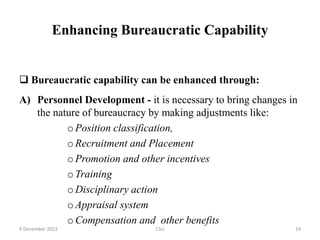
Enhancing Bureaucratic Capability
 Bureaucratic capability can be enhanced through:
A) Personnel Development - it is necessary to bring changes in
the nature of bureaucracy by making adjustments like:
oPosition classification,
oRecruitment and Placement
oPromotion and other incentives
oTraining
oDisciplinary action
oAppraisal system
oCompensation and other benefits
9 December 2022 CSU 19
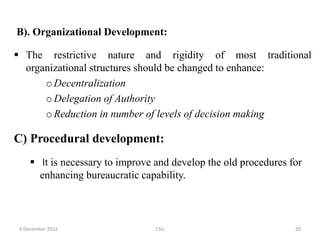
B). Organizational Development:
 The restrictive nature and rigidity of most traditional
organizational structures should be changed to enhance:
oDecentralization
oDelegation of Authority
oReduction in number of levels of decision making
C) Procedural development:
 It is necessary to improve and develop the old procedures for
enhancing bureaucratic capability.
9 December 2022 CSU 20
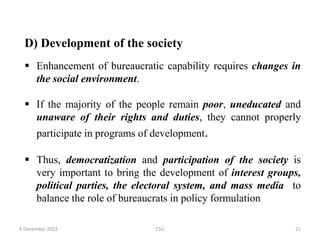
D) Development of the society
 Enhancement of bureaucratic capability requires changes in
the social environment.
 If the majority of the people remain poor, uneducated and
unaware of their rights and duties, they cannot properly
participate in programs of development.
 Thus, democratization and participation of the society is
very important to bring the development of interest groups,
political parties, the electoral system, and mass media to
balance the role of bureaucrats in policy formulation
9 December 2022 CSU 21
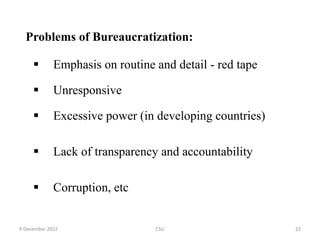
Problems of Bureaucratization:
 Emphasis on routine and detail - red tape
 Unresponsive
 Excessive power (in developing countries)
 Lack of transparency and accountability
 Corruption, etc
9 December 2022 CSU 22
New Public Management (NPM):
 NPM is a management technique and practice drawn mainly
from the private sector.
 NPM increases the tension on traditional state bureaucracies
and public administration to become more responsive to
citizens.
 The idea is to make the public service delivery system
function more and more like the private sector.
 It advocates managerialism - the application of the techniques
of managing a private business to the running of public
organizations .
9 December 2022 CSU 23
 Guiding principles of the NPM:
• Autonomy of the civil service and its various
departments
• More accountability for performance of agreed tasks
• Customer/client orientation
• Market orientation
• Corporate culture
• Combating corruption
• Democratic and innovative
• Result- oriented and competitive
9 December 2022 CSU 24
Public Enterprise & Development
 There is no single definition.
 Public enterprise is a business organization wholly or partly
owned by the state and controlled through a public authority.
 A public enterprise is an organization:
o Wholly or by a majority publicly owned,
o Set up to achieve commercial and social goals,
o Engaged in economic activities within the sphere of agriculture,
industry, commerce, or service involving investment and returns, and
o The sale of goods or services, and whose affairs are capable of being
stated in terms of balance sheets and profit and loss accounts
9 December 2022 CSU 25
The Public Dimension:
• Public purpose: the aim and purpose of the organization should
be fulfillment of public interest.
• Public ownership: public authority i.e. national or regional or
local government etc.) must either wholly or partly owned the
organization.
• Public control: public authority must be able to have upper say in
the decision making process .
• Public management : government must hold a sizable portion of
the management positions and its rules and regulations must by
large.
• Public accountability: It is routinely expected that performance
report of the enterprise should be submitted to the government
annually.
9 December 2022 CSU 26
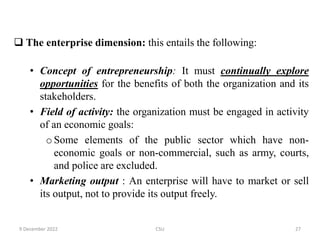
 The enterprise dimension: this entails the following:
• Concept of entrepreneurship: It must continually explore
opportunities for the benefits of both the organization and its
stakeholders.
• Field of activity: the organization must be engaged in activity
of an economic goals:
oSome elements of the public sector which have non-
economic goals or non-commercial, such as army, courts,
and police are excluded.
• Marketing output : An enterprise will have to market or sell
its output, not to provide its output freely.
9 December 2022 CSU 27
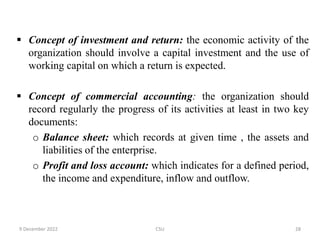
 Concept of investment and return: the economic activity of the
organization should involve a capital investment and the use of
working capital on which a return is expected.
 Concept of commercial accounting: the organization should
record regularly the progress of its activities at least in two key
documents:
o Balance sheet: which records at given time , the assets and
liabilities of the enterprise.
o Profit and loss account: which indicates for a defined period,
the income and expenditure, inflow and outflow.
9 December 2022 CSU 28
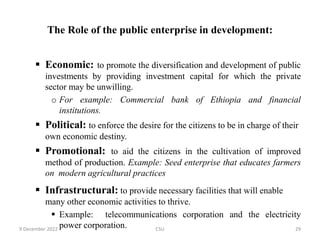
The Role of the public enterprise in development:
 Economic: to promote the diversification and development of public
investments by providing investment capital for which the private
sector may be unwilling.
o For example: Commercial bank of Ethiopia and financial
institutions.
 Political: to enforce the desire for the citizens to be in charge of their
own economic destiny.
 Promotional: to aid the citizens in the cultivation of improved
method of production. Example: Seed enterprise that educates farmers
on modern agricultural practices
 Infrastructural: to provide necessary facilities that will enable
many other economic activities to thrive.
 Example: telecommunications corporation and the electricity
power corporation.
9 December 2022 CSU 29
Cont’d
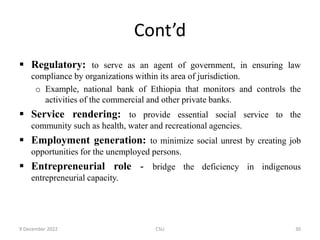
 Regulatory: to serve as an agent of government, in ensuring law
compliance by organizations within its area of jurisdiction.
o Example, national bank of Ethiopia that monitors and controls the
activities of the commercial and other private banks.
 Service rendering: to provide essential social service to the
community such as health, water and recreational agencies.
 Employment generation: to minimize social unrest by creating job
opportunities for the unemployed persons.
 Entrepreneurial role - bridge the deficiency in indigenous
entrepreneurial capacity.
9 December 2022 CSU 30
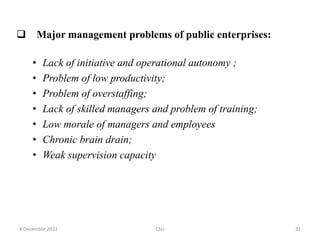
 Major management problems of public enterprises:
• Lack of initiative and operational autonomy ;
• Problem of low productivity;
• Problem of overstaffing;
• Lack of skilled managers and problem of training;
• Low morale of managers and employees
• Chronic brain drain;
• Weak supervision capacity
9 December 2022 CSU 31
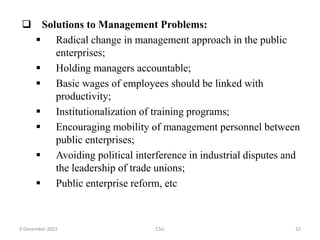
 Solutions to Management Problems:
 Radical change in management approach in the public
enterprises;
 Holding managers accountable;
 Basic wages of employees should be linked with
productivity;
 Institutionalization of training programs;
 Encouraging mobility of management personnel between
public enterprises;
 Avoiding political interference in industrial disputes and
the leadership of trade unions;
 Public enterprise reform, etc
9 December 2022 CSU 32
Local Government and Local Economic Development
 What is the difference between local government and local
governance?
 Local government is a form of public administration which
in a majority of contexts, exists as the lowest tier of
administration within a given state.
 Local government is one of the several actors of local
governance.
 Local governance is a broader concept and is defined as the
formulation and execution of collective action at the local
level.
9 December 2022 CSU 33
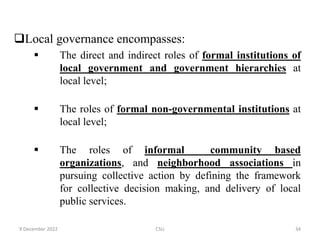
Local governance encompasses:
 The direct and indirect roles of formal institutions of
local government and government hierarchies at
local level;
 The roles of formal non-governmental institutions at
local level;
 The roles of informal community based
organizations, and neighborhood associations in
pursuing collective action by defining the framework
for collective decision making, and delivery of local
public services.
9 December 2022 CSU 34
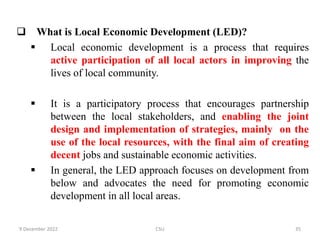
 What is Local Economic Development (LED)?
 Local economic development is a process that requires
active participation of all local actors in improving the
lives of local community.
 It is a participatory process that encourages partnership
between the local stakeholders, and enabling the joint
design and implementation of strategies, mainly on the
use of the local resources, with the final aim of creating
decent jobs and sustainable economic activities.
 In general, the LED approach focuses on development from
below and advocates the need for promoting economic
development in all local areas.
9 December 2022 CSU 35
 The aim of LED is to improve the quality of life for
all local citizens.
 Local institutions can be much more flexible and can
more easily interact with other local economic and
social actors to respond for local needs.
o National institutions are often too remote to be able to
respond effectively to the rapidly changing local and
regional needs .
9 December 2022 CSU 36

Chapter Three (State and Develoment) (2) (2).ppt

  • 1.
    OROMIA STATE UNIVERSITY COLLEGEOF DEVELOPMENT AND MANAGEMENT DEPARTMENT OF PROJECT MANAGEMENT 9 December 2022 CSU 1 Chapter Three State and Development
  • 2.
    Leading Q • Stateand development? • Role of state ? • Public enterprise ? • Characteristics of public enterprise • Old public administration and NPM? 9 December 2022 CSU 2
  • 3.
    Introduction • Public financeeconomists have identified the roles of state as: 2 roles NORMATIVE ROLE: – Determines guidelines, principles or norms for welfare- enhancing public sector interventions in the economy. – It attempts to define what the government should do to correct market imperfections and to complement the market to promote and maximize social welfare. 9 December 2022 CSU 3
  • 4.
    Cont’d  POSITIVE ROLE:describes and analyzes what the government actually does. • In an ideal world, the two roles would merge and become the same: Because the state would be doing exactly what it is expected to do and all the reforms needed to maximize social welfare would have been carried out. 9 December 2022 CSU 4
  • 5.
     In thereal world, However, the two roles tend to diverge by great deal – implying that many needed reforms have not been carried out. • The Reasons for this divergence include: Differences between the interests of those who govern and those who are governed; Mistakes and misconceptions on the part of the policy makers; Inadequate controls on the part of the policy makers over the policy instruments; and The residual effects of past decisions 9 December 2022 CSU 5
  • 6.
    Cont’d  The generalclassically preferred role of state limited to:  The provision of essential public goods,  Maintenance of law and order, and  Defense of the country In this 21st century the government believed to plays the following roles among others i. The economic roles ii. The social roles, and iii. The Political roles 9 December 2022 CSU 6
  • 7.
    Cont’d 1). Economic Roles:the government allocates resources, redistributes income and influences the level of activity.  Until 19th century, the economic role of the government tended to be much more limited. o the classical economists considered the interference of public sector as damaging to economic activity and as obstacle to growth. 9 December 2022 CSU 7
  • 8.
    Cont’d  The importanceand areas of state intervention:  The 20th century saw a gradual but large expansion in the role of the state in the economy.  Keynesian thinking was used to justify an expansion in the economic role of the public sector.  The intervention of government of many countries has been seen as important after World War II in production and supply of public goods – because the market would undersupply or oversupply such goods. oThe private sector would not have an incentive to produce public goods - due to free riders (who would not contribute to the cost of production. 9 December 2022 CSU 8
  • 9.
    Cont’d  Private sectorfails to appropriately produce goods due to: a). Free riders: difficulty of excluding from their consumption individuals who would not contribute to the cost of production b). Externalities of public goods: The consumption or production of some goods may generate positive or negative externalities not reflected in the price of which cause market failure. This requires government intervention. 9 December 2022 CSU 9
  • 10.
    Cont’d  Without governmentintervention, the market would over produce or under produce such goods depending on whether externalities were good or bad. • Thus, the government expected to increase the private cost of producing or consuming goods with undesirable externalities and to decrease the cost of goods with desirable externalities.  Externalities became important justifications for expanding the role of the public sector in to health, education, transportation, research, training, welfare payment (reduce crime) and many other areas. 9 December 2022 CSU 10
  • 11.
    Cont’d  In general,some of the economic roles that the state could play include:  Production and supply of public good;  Promoting the right incentives to encourage efficient private production;  Creation of employment opportunities;  Check over monopolies, unhealthy trade practices and Moderate prices of commodities  Correcting market failures;  Reducing inequality through redistribution of income  Stabilizing the economy:  Fiscal policy - by expenditure reduction, export promotion and modulating taxes.  Monetary policy- by modulating money supply in the economy through borrowing, interest rate change and currency printing 9 December 2022 CSU 11
  • 12.
    Factors Influence theEconomic Roles of State:  In developing countries, the economic roles of the state can be influenced by factors such as: • Colonies of foreign powers-many large enterprises had been on hands of individuals from the colonial powers • Social attitudes- determined by cultural heritage or religion. • Level of economic development- sophistication of the market and private sector may call for more or less state intervention. • The degree of openness of the economy • Technological developments - which may create or destroy natural monopolies or increase the need to regulate certain activities like financial market, transportation, communication, etc. • Quality of public administration – which may impose limits on scope of effective governmental interventions. 9 December 2022 CSU 12
  • 13.
    2. Political rolesof the state  Government could play the following political roles:  Organizing the government organs like the executive, legislative and judiciary bodies with their respective responsibilities  ensuring a basic framework of legality, rights and freedom of citizens  Making and supporting the execution of policies  Exercising public authority  Ensuring respect for the law and combating organized crime and corruption; 9 December 2022 CSU 13
  • 14.
    Cont’d………. political role Guaranteeing the functioning of a state governed by the rule of law;  Bringing the state closer to the citizen, including policy- and decision-making activities of public institutions;  Establishing diplomatic relationship with other foreign countries;  Building the capacity of bureaucrats and enhancing their commitment;  Protecting the territory and civilian population of the country against military and non-military threats;  Enhancing the democracy through fair election;  Maintaining law and order;  Establishing and directing defense of the country; etc. 9 December 2022 CSU 14
  • 15.
    3. Social roles: Enhancethe availability and provision of social services such as: Education, Health care, Transportation, Communication, Electricity, Safe drinking water, agricultural extension services, etc. Labors welfare improvements, 9 December 2022 CSU 15
  • 16.
    Cont’d  Establishing andimplementing social protection mechanisms o Contributory system of social insurance – provision of income and services to individuals in the event of retirement, sickness, disability, death, or unemployment.  Other Social protection programs that a state must design and implement may include: o Old-Age, Survivors’benefits _ pension; o Disability Insurance; o Administration for Children and Families within Health and Human Services; o Unemployment Compensation (temporary financial help during periods between jobs); o Maternity benefits o Welfare improvement of handicapped person, and widows and orphans.  Encouraging the organization of people and formation of civil society 9 December 2022 CSU 16
  • 17.
    The Role ofBureaucracy in Developing Countries – The term bureaucracy refers to the body of employees in a large-scale organization. – It is notable that the bureaucracy does not include elected politicians. – Bureaucrats often stay in their jobs longer than politicians, they have more detailed information. – The provision of social services requires large numbers of different types of specialists such as teachers, doctors, nurses, economists, accountants, labor offices and social workers who are referred as bureaucrats. 9 December 2022 CSU 17
  • 18.
    Cont’d  The roleof bureaucrats in policy formulation is much greater in LDC than DC due to the following main reasons: i. Bureaucracy as a Channel of Communication  In developing countries, interest groups and political parties are often either weak or non- existent. ii. The Bureaucracy as a Repository (source) of Information  Bureaucracy has access to often secret information relating to different time-frame and areas iii. Bureaucracy as a Group of Technical Advisers  They have technical knowledge that can be possessed 9 December 2022 CSU 18
  • 19.
    Enhancing Bureaucratic Capability Bureaucratic capability can be enhanced through: A) Personnel Development - it is necessary to bring changes in the nature of bureaucracy by making adjustments like: oPosition classification, oRecruitment and Placement oPromotion and other incentives oTraining oDisciplinary action oAppraisal system oCompensation and other benefits 9 December 2022 CSU 19
  • 20.
    B). Organizational Development: The restrictive nature and rigidity of most traditional organizational structures should be changed to enhance: oDecentralization oDelegation of Authority oReduction in number of levels of decision making C) Procedural development:  It is necessary to improve and develop the old procedures for enhancing bureaucratic capability. 9 December 2022 CSU 20
  • 21.
    D) Development ofthe society  Enhancement of bureaucratic capability requires changes in the social environment.  If the majority of the people remain poor, uneducated and unaware of their rights and duties, they cannot properly participate in programs of development.  Thus, democratization and participation of the society is very important to bring the development of interest groups, political parties, the electoral system, and mass media to balance the role of bureaucrats in policy formulation 9 December 2022 CSU 21
  • 22.
    Problems of Bureaucratization: Emphasis on routine and detail - red tape  Unresponsive  Excessive power (in developing countries)  Lack of transparency and accountability  Corruption, etc 9 December 2022 CSU 22
  • 23.
    New Public Management(NPM):  NPM is a management technique and practice drawn mainly from the private sector.  NPM increases the tension on traditional state bureaucracies and public administration to become more responsive to citizens.  The idea is to make the public service delivery system function more and more like the private sector.  It advocates managerialism - the application of the techniques of managing a private business to the running of public organizations . 9 December 2022 CSU 23
  • 24.
     Guiding principlesof the NPM: • Autonomy of the civil service and its various departments • More accountability for performance of agreed tasks • Customer/client orientation • Market orientation • Corporate culture • Combating corruption • Democratic and innovative • Result- oriented and competitive 9 December 2022 CSU 24
  • 25.
    Public Enterprise &Development  There is no single definition.  Public enterprise is a business organization wholly or partly owned by the state and controlled through a public authority.  A public enterprise is an organization: o Wholly or by a majority publicly owned, o Set up to achieve commercial and social goals, o Engaged in economic activities within the sphere of agriculture, industry, commerce, or service involving investment and returns, and o The sale of goods or services, and whose affairs are capable of being stated in terms of balance sheets and profit and loss accounts 9 December 2022 CSU 25
  • 26.
    The Public Dimension: •Public purpose: the aim and purpose of the organization should be fulfillment of public interest. • Public ownership: public authority i.e. national or regional or local government etc.) must either wholly or partly owned the organization. • Public control: public authority must be able to have upper say in the decision making process . • Public management : government must hold a sizable portion of the management positions and its rules and regulations must by large. • Public accountability: It is routinely expected that performance report of the enterprise should be submitted to the government annually. 9 December 2022 CSU 26
  • 27.
     The enterprisedimension: this entails the following: • Concept of entrepreneurship: It must continually explore opportunities for the benefits of both the organization and its stakeholders. • Field of activity: the organization must be engaged in activity of an economic goals: oSome elements of the public sector which have non- economic goals or non-commercial, such as army, courts, and police are excluded. • Marketing output : An enterprise will have to market or sell its output, not to provide its output freely. 9 December 2022 CSU 27
  • 28.
     Concept ofinvestment and return: the economic activity of the organization should involve a capital investment and the use of working capital on which a return is expected.  Concept of commercial accounting: the organization should record regularly the progress of its activities at least in two key documents: o Balance sheet: which records at given time , the assets and liabilities of the enterprise. o Profit and loss account: which indicates for a defined period, the income and expenditure, inflow and outflow. 9 December 2022 CSU 28
  • 29.
    The Role ofthe public enterprise in development:  Economic: to promote the diversification and development of public investments by providing investment capital for which the private sector may be unwilling. o For example: Commercial bank of Ethiopia and financial institutions.  Political: to enforce the desire for the citizens to be in charge of their own economic destiny.  Promotional: to aid the citizens in the cultivation of improved method of production. Example: Seed enterprise that educates farmers on modern agricultural practices  Infrastructural: to provide necessary facilities that will enable many other economic activities to thrive.  Example: telecommunications corporation and the electricity power corporation. 9 December 2022 CSU 29
  • 30.
    Cont’d  Regulatory: toserve as an agent of government, in ensuring law compliance by organizations within its area of jurisdiction. o Example, national bank of Ethiopia that monitors and controls the activities of the commercial and other private banks.  Service rendering: to provide essential social service to the community such as health, water and recreational agencies.  Employment generation: to minimize social unrest by creating job opportunities for the unemployed persons.  Entrepreneurial role - bridge the deficiency in indigenous entrepreneurial capacity. 9 December 2022 CSU 30
  • 31.
     Major managementproblems of public enterprises: • Lack of initiative and operational autonomy ; • Problem of low productivity; • Problem of overstaffing; • Lack of skilled managers and problem of training; • Low morale of managers and employees • Chronic brain drain; • Weak supervision capacity 9 December 2022 CSU 31
  • 32.
     Solutions toManagement Problems:  Radical change in management approach in the public enterprises;  Holding managers accountable;  Basic wages of employees should be linked with productivity;  Institutionalization of training programs;  Encouraging mobility of management personnel between public enterprises;  Avoiding political interference in industrial disputes and the leadership of trade unions;  Public enterprise reform, etc 9 December 2022 CSU 32
  • 33.
    Local Government andLocal Economic Development  What is the difference between local government and local governance?  Local government is a form of public administration which in a majority of contexts, exists as the lowest tier of administration within a given state.  Local government is one of the several actors of local governance.  Local governance is a broader concept and is defined as the formulation and execution of collective action at the local level. 9 December 2022 CSU 33
  • 34.
    Local governance encompasses: The direct and indirect roles of formal institutions of local government and government hierarchies at local level;  The roles of formal non-governmental institutions at local level;  The roles of informal community based organizations, and neighborhood associations in pursuing collective action by defining the framework for collective decision making, and delivery of local public services. 9 December 2022 CSU 34
  • 35.
     What isLocal Economic Development (LED)?  Local economic development is a process that requires active participation of all local actors in improving the lives of local community.  It is a participatory process that encourages partnership between the local stakeholders, and enabling the joint design and implementation of strategies, mainly on the use of the local resources, with the final aim of creating decent jobs and sustainable economic activities.  In general, the LED approach focuses on development from below and advocates the need for promoting economic development in all local areas. 9 December 2022 CSU 35
  • 36.
     The aimof LED is to improve the quality of life for all local citizens.  Local institutions can be much more flexible and can more easily interact with other local economic and social actors to respond for local needs. o National institutions are often too remote to be able to respond effectively to the rapidly changing local and regional needs . 9 December 2022 CSU 36