IMAGE BASED
QUESTIONS
( Based on the 21st edition
of Harrison’s Principles of
Internal Medicine )
JANUARY 2025
Included in this presentation are 10 image based questions
(IBQs) based on the 21st edition of harrison’s Principles of
Internal Medicine.
The figure number / table number in the textbook is mentioned.
The student is requested to read the relevant topic in Harrison’s
to understand the concept better.
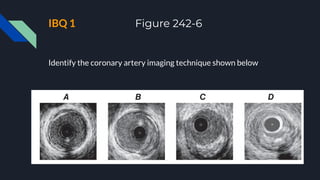
IBQ 1 Figure 242-6
Identify the coronary artery imaging technique shown below
ANSWER
Intravascular Ultrasound ( IVUS )
IVUS is performed using a small flexible catheter with a 40-mHz
transducer at its tip that is advanced into the coronary artery over a
guidewire. Data from IVUS studies may be used to image
atherosclerotic plaque precisely, determine luminal cross-sectional
area, and measure vessel size; it is also used during or following
percutaneous coronary intervention to assess the stenosis and
determine the adequacy of stent placement.
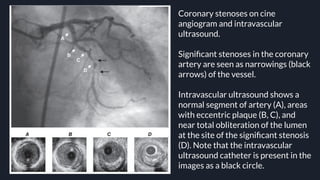
Coronary stenoses on cine
angiogram and intravascular
ultrasound.
Significant stenoses in the coronary
artery are seen as narrowings (black
arrows) of the vessel.
Intravascular ultrasound shows a
normal segment of artery (A), areas
with eccentric plaque (B, C), and
near total obliteration of the lumen
at the site of the significant stenosis
(D). Note that the intravascular
ultrasound catheter is present in the
images as a black circle.
IBQ 2 Figure 346-1
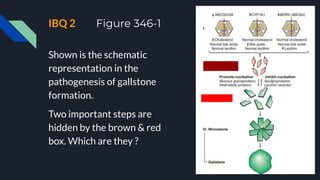
Shown is the schematic
representation in the
pathogenesis of gallstone
formation.
Two important steps are
hidden by the brown & red
box. Which are they ?
ANSWER
Brown box - Supersaturation
Redbox - Nucleation
IBQ 3 Figure 382-2
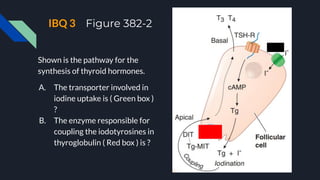
Shown is the pathway for the
synthesis of thyroid hormones.
A. The transporter involved in
iodine uptake is ( Green box )
?
B. The enzyme responsible for
coupling the iodotyrosines in
thyroglobulin ( Red box ) is ?
ANSWER
Green box - Sodium Iodide transporter
Redbox - Thyroid peroxidase
IBQ 4 Figure 316-5
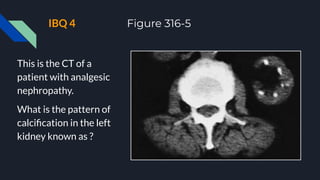
This is the CT of a
patient with analgesic
nephropathy.
What is the pattern of
calcification in the left
kidney known as ?
ANSWER
Garland pattern of calcification
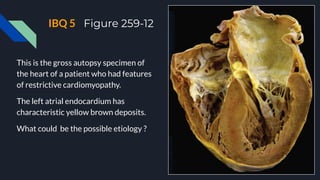
IBQ 5 Figure 259-12
This is the gross autopsy specimen of
the heart of a patient who had features
of restrictive cardiomyopathy.
The left atrial endocardium has
characteristic yellow brown deposits.
What could be the possible etiology ?
ANSWER
Amyloidosis
Amyloidosis is the most common cause of
restrictive cardiomyopathy.
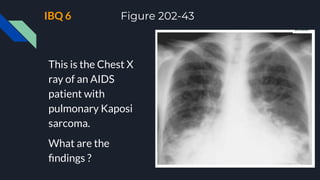
IBQ 6 Figure 202-43
This is the Chest X
ray of an AIDS
patient with
pulmonary Kaposi
sarcoma.
What are the
findings ?
ANSWER
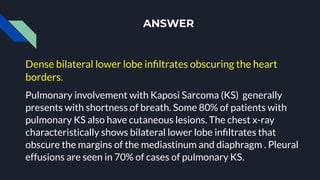
Dense bilateral lower lobe infiltrates obscuring the heart
borders.
Pulmonary involvement with Kaposi Sarcoma (KS) generally
presents with shortness of breath. Some 80% of patients with
pulmonary KS also have cutaneous lesions. The chest x-ray
characteristically shows bilateral lower lobe infiltrates that
obscure the margins of the mediastinum and diaphragm . Pleural
effusions are seen in 70% of cases of pulmonary KS.
IBQ 7 Figure 179-3
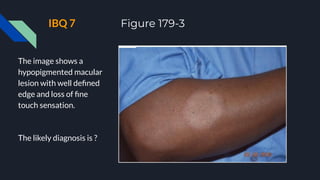
The image shows a
hypopigmented macular
lesion with well defined
edge and loss of fine
touch sensation.
The likely diagnosis is ?
ANSWER
Leprosy
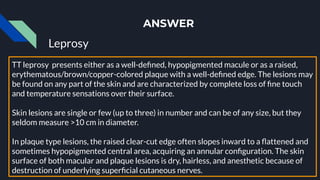
TT leprosy presents either as a well-defined, hypopigmented macule or as a raised,
erythematous/brown/copper-colored plaque with a well-defined edge. The lesions may
be found on any part of the skin and are characterized by complete loss of fine touch
and temperature sensations over their surface.
Skin lesions are single or few (up to three) in number and can be of any size, but they
seldom measure >10 cm in diameter.
In plaque type lesions, the raised clear-cut edge often slopes inward to a flattened and
sometimes hypopigmented central area, acquiring an annular configuration. The skin
surface of both macular and plaque lesions is dry, hairless, and anesthetic because of
destruction of underlying superficial cutaneous nerves.
IBQ 8 Figure 325-1
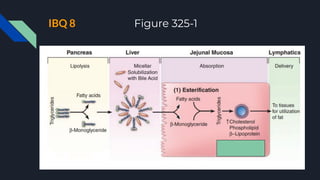
The assimilation of dietary lipid requires three integrated processes:
an intraluminal or digestive phase, a mucosal or absorptive phase,
and a delivery or postabsorptive phase.
Long-chain free fatty acids are dispersed by bile salts into mixed
micelles, which contact the brush border and permit fatty acid
absorption into enterocytes across this specialized apical membrane
Long-chain fatty acids are re-esterified to triglycerides in enterocytes,
packaged into ____________that contain apolipoproteins on the surface,
which are subsequently secreted into the extracellular space, and
because of their size, are excluded from capillaries and enter the
lymphatics.
ANSWER
Chylomicrons
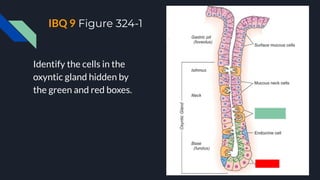
IBQ 9 Figure 324-1
Identify the cells in the
oxyntic gland hidden by
the green and red boxes.
ANSWER
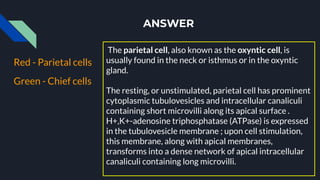
Red - Parietal cells
Green - Chief cells
The parietal cell, also known as the oxyntic cell, is
usually found in the neck or isthmus or in the oxyntic
gland.
The resting, or unstimulated, parietal cell has prominent
cytoplasmic tubulovesicles and intracellular canaliculi
containing short microvilli along its apical surface .
H+,K+-adenosine triphosphatase (ATPase) is expressed
in the tubulovesicle membrane ; upon cell stimulation,
this membrane, along with apical membranes,
transforms into a dense network of apical intracellular
canaliculi containing long microvilli.
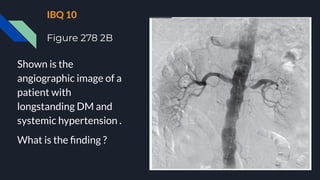
IBQ 10
Figure 278 2B
Shown is the
angiographic image of a
patient with
longstanding DM and
systemic hypertension .
What is the finding ?
ANSWER
Left renal artery stenosis
Atherosclerotic renal artery stenosis (ARAS) is common in the general
population .
The prevalence increases with age and for patients with other vascular
conditions such as coronary artery disease (18–23%) and/or peripheral aortic
or lower extremity disease (>30%).
If untreated, ARAS progresses in nearly 50% of cases over a 5-year period,
sometimes to total occlusion. Intensive treatment of arterial blood pressure
and statin therapy can slow these rates and improve clinical outcomes.

IMAGE BASED QUESTIONS - JANUARY 2025.pdf

  • 1.
    IMAGE BASED QUESTIONS ( Basedon the 21st edition of Harrison’s Principles of Internal Medicine ) JANUARY 2025
  • 2.
    Included in thispresentation are 10 image based questions (IBQs) based on the 21st edition of harrison’s Principles of Internal Medicine. The figure number / table number in the textbook is mentioned. The student is requested to read the relevant topic in Harrison’s to understand the concept better.
  • 3.
    IBQ 1 Figure242-6 Identify the coronary artery imaging technique shown below
  • 4.
    ANSWER Intravascular Ultrasound (IVUS ) IVUS is performed using a small flexible catheter with a 40-mHz transducer at its tip that is advanced into the coronary artery over a guidewire. Data from IVUS studies may be used to image atherosclerotic plaque precisely, determine luminal cross-sectional area, and measure vessel size; it is also used during or following percutaneous coronary intervention to assess the stenosis and determine the adequacy of stent placement.
  • 5.
    Coronary stenoses oncine angiogram and intravascular ultrasound. Significant stenoses in the coronary artery are seen as narrowings (black arrows) of the vessel. Intravascular ultrasound shows a normal segment of artery (A), areas with eccentric plaque (B, C), and near total obliteration of the lumen at the site of the significant stenosis (D). Note that the intravascular ultrasound catheter is present in the images as a black circle.
  • 6.
    IBQ 2 Figure346-1 Shown is the schematic representation in the pathogenesis of gallstone formation. Two important steps are hidden by the brown & red box. Which are they ?
  • 7.
    ANSWER Brown box -Supersaturation Redbox - Nucleation
  • 8.
    IBQ 3 Figure382-2 Shown is the pathway for the synthesis of thyroid hormones. A. The transporter involved in iodine uptake is ( Green box ) ? B. The enzyme responsible for coupling the iodotyrosines in thyroglobulin ( Red box ) is ?
  • 9.
    ANSWER Green box -Sodium Iodide transporter Redbox - Thyroid peroxidase
  • 10.
    IBQ 4 Figure316-5 This is the CT of a patient with analgesic nephropathy. What is the pattern of calcification in the left kidney known as ?
  • 11.
  • 12.
    IBQ 5 Figure259-12 This is the gross autopsy specimen of the heart of a patient who had features of restrictive cardiomyopathy. The left atrial endocardium has characteristic yellow brown deposits. What could be the possible etiology ?
  • 13.
    ANSWER Amyloidosis Amyloidosis is themost common cause of restrictive cardiomyopathy.
  • 14.
    IBQ 6 Figure202-43 This is the Chest X ray of an AIDS patient with pulmonary Kaposi sarcoma. What are the findings ?
  • 15.
    ANSWER Dense bilateral lowerlobe infiltrates obscuring the heart borders. Pulmonary involvement with Kaposi Sarcoma (KS) generally presents with shortness of breath. Some 80% of patients with pulmonary KS also have cutaneous lesions. The chest x-ray characteristically shows bilateral lower lobe infiltrates that obscure the margins of the mediastinum and diaphragm . Pleural effusions are seen in 70% of cases of pulmonary KS.
  • 16.
    IBQ 7 Figure179-3 The image shows a hypopigmented macular lesion with well defined edge and loss of fine touch sensation. The likely diagnosis is ?
  • 17.
    ANSWER Leprosy TT leprosy presentseither as a well-defined, hypopigmented macule or as a raised, erythematous/brown/copper-colored plaque with a well-defined edge. The lesions may be found on any part of the skin and are characterized by complete loss of fine touch and temperature sensations over their surface. Skin lesions are single or few (up to three) in number and can be of any size, but they seldom measure >10 cm in diameter. In plaque type lesions, the raised clear-cut edge often slopes inward to a flattened and sometimes hypopigmented central area, acquiring an annular configuration. The skin surface of both macular and plaque lesions is dry, hairless, and anesthetic because of destruction of underlying superficial cutaneous nerves.
  • 18.
  • 19.
    The assimilation ofdietary lipid requires three integrated processes: an intraluminal or digestive phase, a mucosal or absorptive phase, and a delivery or postabsorptive phase. Long-chain free fatty acids are dispersed by bile salts into mixed micelles, which contact the brush border and permit fatty acid absorption into enterocytes across this specialized apical membrane Long-chain fatty acids are re-esterified to triglycerides in enterocytes, packaged into ____________that contain apolipoproteins on the surface, which are subsequently secreted into the extracellular space, and because of their size, are excluded from capillaries and enter the lymphatics.
  • 20.
  • 21.
    IBQ 9 Figure324-1 Identify the cells in the oxyntic gland hidden by the green and red boxes.
  • 22.
    ANSWER Red - Parietalcells Green - Chief cells The parietal cell, also known as the oxyntic cell, is usually found in the neck or isthmus or in the oxyntic gland. The resting, or unstimulated, parietal cell has prominent cytoplasmic tubulovesicles and intracellular canaliculi containing short microvilli along its apical surface . H+,K+-adenosine triphosphatase (ATPase) is expressed in the tubulovesicle membrane ; upon cell stimulation, this membrane, along with apical membranes, transforms into a dense network of apical intracellular canaliculi containing long microvilli.
  • 23.
    IBQ 10 Figure 2782B Shown is the angiographic image of a patient with longstanding DM and systemic hypertension . What is the finding ?
  • 24.
    ANSWER Left renal arterystenosis Atherosclerotic renal artery stenosis (ARAS) is common in the general population . The prevalence increases with age and for patients with other vascular conditions such as coronary artery disease (18–23%) and/or peripheral aortic or lower extremity disease (>30%). If untreated, ARAS progresses in nearly 50% of cases over a 5-year period, sometimes to total occlusion. Intensive treatment of arterial blood pressure and statin therapy can slow these rates and improve clinical outcomes.