GAVIRIA PRIETO 
LUISA FERNANDA 
GRADO 8-1
So and neither responses can be very 
difficult. Let's just focus on what we 
say if we agree with someone. 
 If someone says something negative and 
we agree with them we can use neither. 
 If someone says something positive and 
we agree with them we can use so.
SO 
SO is used to show agreement with 
positive statements. 
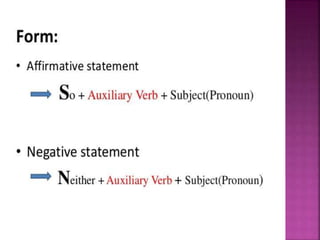
SO + Auxiliary + Subject (pronoun) 
The Auxiliary needs to agree with 
the verb tense in the original 
statement.
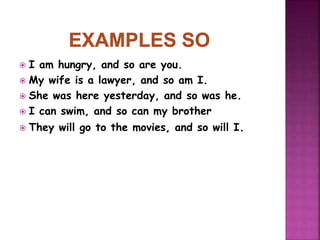
 I am hungry, and so are you. 
 My wife is a lawyer, and so am I. 
 She was here yesterday, and so was he. 
 I can swim, and so can my brother 
 They will go to the movies, and so will I.
Neither is used to show agreement 
with negative statements. 
Neither + Auxiliary + Subject 
(pronoun) 
The Auxiliary needs to agree with 
the verb tense in the original 
statement.
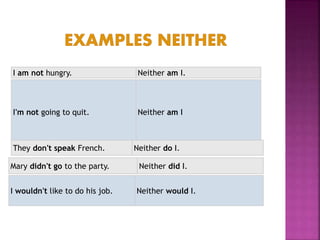
I am not hungry. Neither am I. 
I'm not going to quit. Neither am I 
They don't speak French. Neither do I. 
Mary didn't go to the party. Neither did I. 
I wouldn't like to do his job. Neither would I.
Neither
Neither

Neither

  • 1.
    GAVIRIA PRIETO LUISAFERNANDA GRADO 8-1
  • 2.
    So and neitherresponses can be very difficult. Let's just focus on what we say if we agree with someone.  If someone says something negative and we agree with them we can use neither.  If someone says something positive and we agree with them we can use so.
  • 3.
    SO SO isused to show agreement with positive statements. SO + Auxiliary + Subject (pronoun) The Auxiliary needs to agree with the verb tense in the original statement.
  • 4.
     I amhungry, and so are you.  My wife is a lawyer, and so am I.  She was here yesterday, and so was he.  I can swim, and so can my brother  They will go to the movies, and so will I.
  • 5.
    Neither is usedto show agreement with negative statements. Neither + Auxiliary + Subject (pronoun) The Auxiliary needs to agree with the verb tense in the original statement.
  • 6.
    I am nothungry. Neither am I. I'm not going to quit. Neither am I They don't speak French. Neither do I. Mary didn't go to the party. Neither did I. I wouldn't like to do his job. Neither would I.