ACADEMIC WRITING
Application Number:
e612b675f27111e980e12d039fd02161
NAME: Infenshirley. M
SASTRA UNIVERSITY
THANJAVUR
AN IMPROVED DC-LINK VOLTAGE CONTROL
STRATEGY FOR POWER QUALITY
IMPROVEMENT AND PV POWER INJECTION
BY D-STATCOM
Submitted by
M.Infenshirley
120047005
II M.Tech Power Systems
Guide Name
Dr. Augusti Lindiya
SAP,
SEEE.
ABSTRACT
• This work presents a robust control strategy to improve dc-link voltage
control performances for Power quality improvement and PV power
injection by D-STATCOM.
• The proposed control strategy is based on a Reduced Switch count-
Multilevel converter (RSC-MDC)and is aimed to ensure fast transient
response, low dc-link voltage fluctuations, low grid current THD and
good disturbance rejection after sudden changes of the active power
drawn by the system.
• The proportional and integral gains of the considered controller are self-
tuned so that they are well suited with regard to the operating point of the
controlled system and/or its state.
• Several simulation and experimental results are presented to confirm
and validate the effectiveness and feasibility of the proposed dc-link
voltage control strategy.
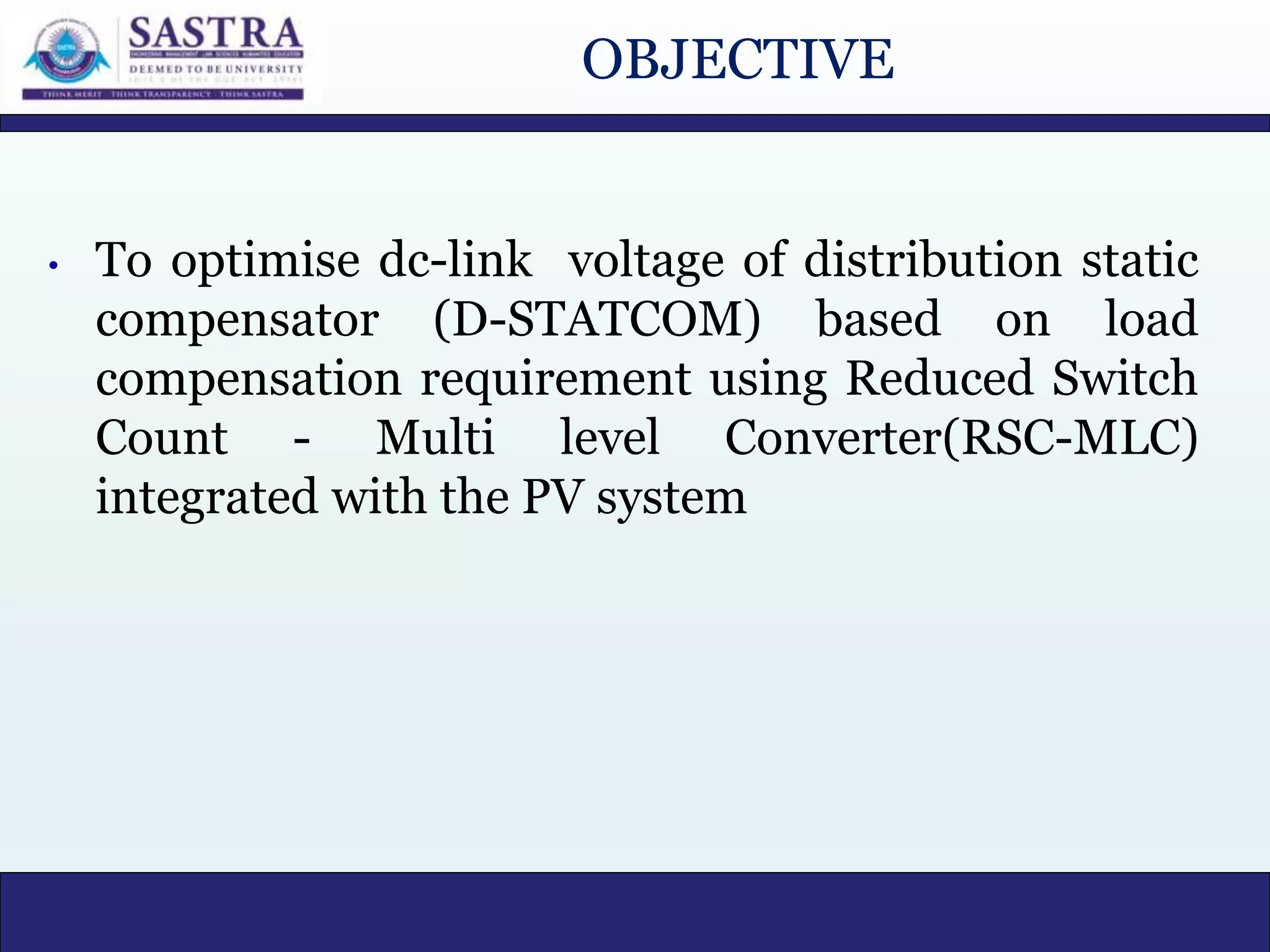
OBJECTIVE
• To optimise dc-link voltage of distribution static
compensator (D-STATCOM) based on load
compensation requirement using Reduced Switch
Count - Multi level Converter(RSC-MLC)
integrated with the PV system
LITERATURE REVIEW
S.N
O
TITLE OF THE PAPER PROPOSED WORK
1. An Improved DC-Link Voltage
Control Strategy for Grid
Connected Converters
This paper presented an improved dc-link voltage controller based on
an adaptive PI controller. The proportional and integral gains of the
proposed PI controller are self-tuned so that the following constraints
are satisfied: 1) no overshoot after step jumps of the dc-link voltage
reference input; 2) fast dynamic response after step jumps of the dc-
link voltage reference; 3) fast dynamic response after step jump of the
input current i and 4) low grid current THD value during steady state
operation.
2. Controlling of PV-STATCOM
for Increasing Power
Transmission based on VHDL
Signal Generation
A novel concept was proposed by which PV solar module can be
operated as a STATCOM, known as PV-STATCOM in the night-time
and day time. VLSI technology is used to generate the trigger pulses
for three phase inverter using the VHDL programming language to
generate the signal for the control of inverter section in STATCOM.
3. Power Balance Theory Based
Control of Grid Interfaced
Solar Photovoltaic Power
Generating System with
Improved Power Quality
A grid interfaced solar photovoltaic (SPV) power generating system
consisting of a SPV, DC-DC boost converter, voltage source
converter (VSC), interfacing inductors, ripple filter and a three phase
grid feeding variety of linear and nonlinear loads. The reference grid
currents are estimated by using power balance theory (PBT) to control
the three-leg voltage source converter (VSC).
LITERATURE REVIEW
S.N
O
TITLE OF THE PAPER PROPOSED WORK
4. Dynamic dc voltage regulation of
split- capacitor DSTATCOM for
power quality improvement.
A simple dynamic dc voltage regulation is proposed to reduce
the voltage stress across switching devices under the reduced
load conditions. The proposed algorithm optimize the value of
dc voltage based on reactive load without compromising the
performance of the DSTATCOM. To validate the proposed
method, simulation and experimental studies were carried out
on the three-phase two-level split-capacitor DSTATCOM for
harmonic mitigation, reactive power compensation and load
balancing.
5. A Fast-Acting DC-Link Voltage
Controller for Three-Phase
DSTATCOM to Compensate AC and
DC Loads
A fast-acting dc-link voltage controller based on the energy of a
dc-link capacitor is proposed. Mathematical equations are given
to compute the gains of the conventional controller based on
fast-acting dc-link voltage controllers to achieve similar fast
transient response.
6. SSR Mitigation With a New Control
of PV Solar Farm as STATCOM (PV-
STATCOM)
A novel control of a large-scale PV solar farm as STATCOM,
termed PV-STATCOM, for alleviation of sub-synchronous
resonance (SSR) in a steam turbine driven synchronous
generator connected to a series compensated transmission line.
During nighttime, the PV solar farm can operate as a
STATCOM with its entire inverter capacity for SSR mitigation.
During daytime, if a system fault triggers SSR, the solar farm
autonomously discontinues its normal active power generation
and releases its entire inverter capacity to operate as PV-
STATCOM for SSR prevention.
RESEARCH GAP
Existing Work
• Adaptive dc-link voltage
variation has been propose
using PI controller.
however, it suffers from
slow transient response
due to the behavior of pi
controller and leads to
rippled dc-link voltage
which makes it unreliable
for fast changing loads.
Proposed Work
• The dc-link voltage
regulation is achieved
using Reduced Switch
Count Multi Level
Converter (RSC-MLC). The
gate pulses of inverter
switches are controlled
using Hysteresis Controller
which is faster and
simpler.
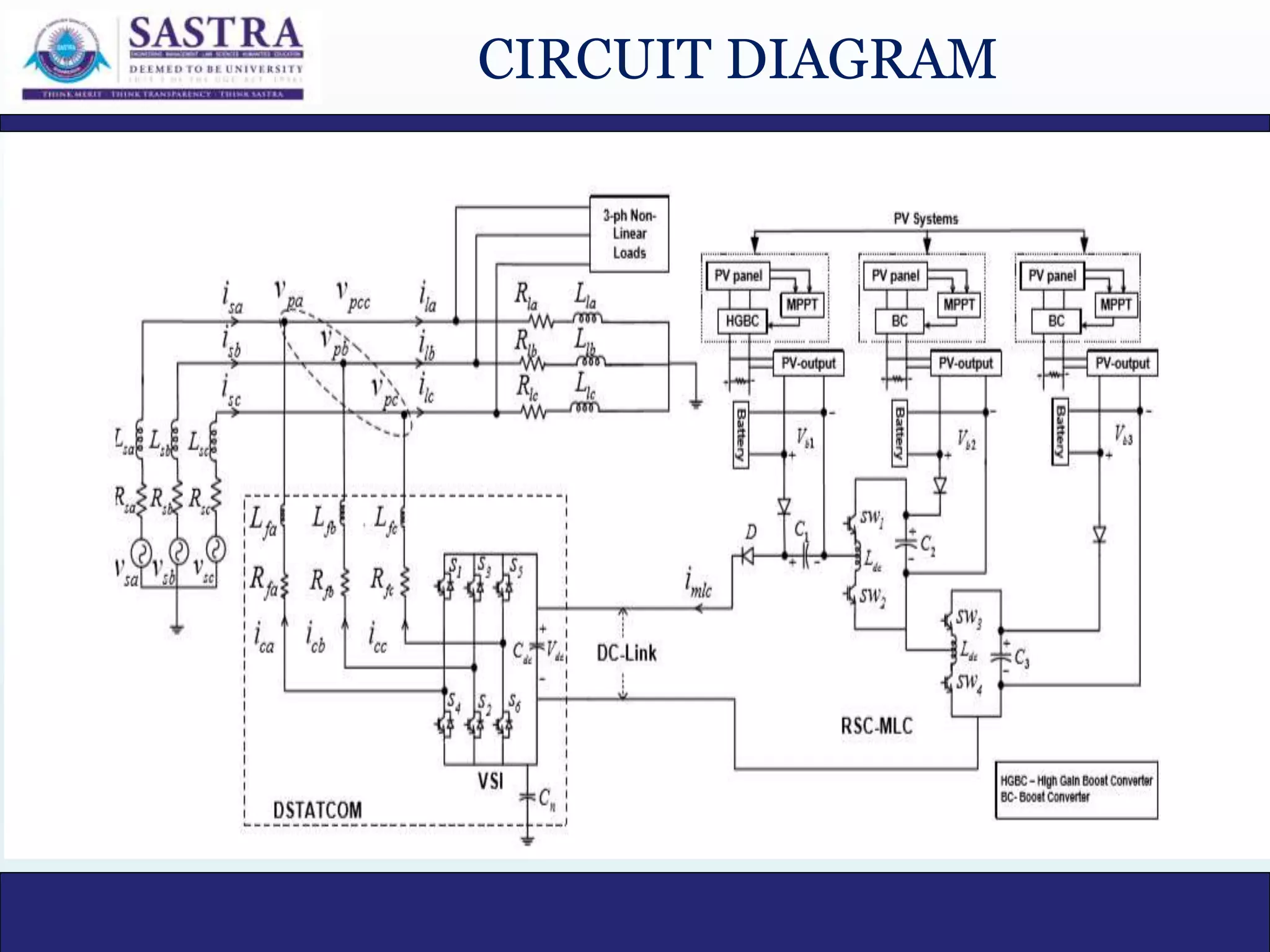
CIRCUIT DIAGRAM
METHODOLOGY
• Variable DC Link Voltage Control- RSC-MLC
• Maximum power point tracking (MPPT) of PV panels -
Perturb and Observe (P & O) algorithm
SOFTWARE USED
• MATLAB/SIMULINK
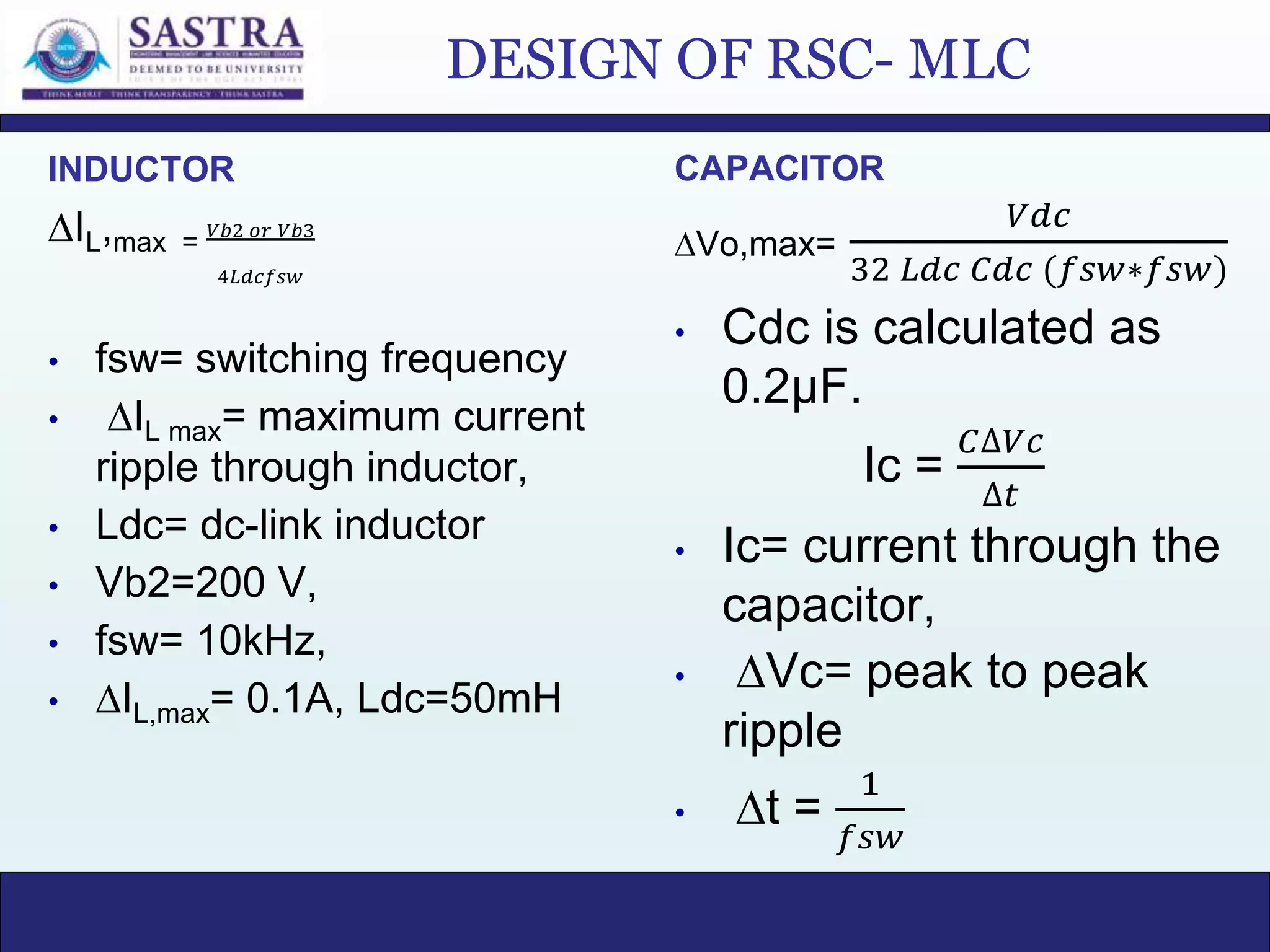
DESIGN OF RSC- MLC
INDUCTOR
∆IL,max =
𝑉𝑏2 𝑜𝑟 𝑉𝑏3
4𝐿𝑑𝑐𝑓𝑠𝑤
• fsw= switching frequency
• ∆IL max= maximum current
ripple through inductor,
• Ldc= dc-link inductor
• Vb2=200 V,
• fsw= 10kHz,
• ∆IL,max= 0.1A, Ldc=50mH
CAPACITOR
∆Vo,max=
𝑉𝑑𝑐
32 𝐿𝑑𝑐 𝐶𝑑𝑐 (𝑓𝑠𝑤∗𝑓𝑠𝑤)
• Cdc is calculated as
0.2µF.
Ic =
𝐶∆𝑉𝑐
∆𝑡
• Ic= current through the
capacitor,
• ∆Vc= peak to peak
ripple
• ∆t =
1
𝑓𝑠𝑤
Contd…
C=
𝐼𝑐
𝑓𝑠𝑤 ∆𝑉𝑐
• fsw=10KHz,
• C1=2.3µF,
• C2= 8.33µF,
• C3=8.33µF.
ISCT
𝑖 𝑐𝑎
∗ = 𝑖𝑙𝑎 −
𝑣𝑠𝑎 + 𝑣 𝑠𝑏 − 𝑣𝑠𝑐 ∗ 𝛽
𝐴
𝑃𝑙𝑎𝑣
𝑖 𝑐𝑏
∗
= 𝑖𝑙𝑏 −
𝑣 𝑠𝑏 + 𝑣𝑠𝑐 − 𝑣𝑠𝑎 ∗ 𝛽
𝐴
𝑃𝑙𝑎𝑣
𝑖 𝑐𝑐
∗
= 𝑖𝑙𝑐 −
𝑣𝑠𝑐 + 𝑣𝑠𝑎 − 𝑣 𝑠𝑏 ∗ 𝛽
𝐴
𝑃𝑙𝑎𝑣
• 𝑖 𝑐𝑎
∗ , 𝑖 𝑐𝑏
∗
, 𝑖 𝑐𝑐
∗ are the reference currents drawn from the
control theory.
• 𝑖𝑙𝑎, 𝑖𝑙𝑏 , 𝑖𝑙𝑐 are the respective load currents,
• 𝑣𝑠𝑎, 𝑣 𝑠𝑏 , 𝑣𝑠𝑐are the respective source voltages.
• 𝑃𝑙𝑎𝑣refers to the power delivered by the PV
systems.
CIRCUIT DIAGRAM
PV MODELLING
BOOST CONVERTER
MPPT P AND O
DSTATCOM
LOAD
RSC-MLC DESIGN
Range of 𝑽 𝒅𝒄
∗
Operating switches in RSC-MLC DC-Link Voltage
< Vdc,min Sw2, Sw4 Vb1
Vdc,min- V1 Sw1(d1), Sw4 Vb1+Vb2*d1
V1-V2 Sw1(d2), Sw4 Vb1+Vb2*d2
V2- V3 Sw1, Sw4 Vb1+Vb2
V3- V4 Sw1, Sw3(d1) Vb1+Vb2+Vb3*d1
V4-V5 Sw1, Sw3(d2) Vb1+Vb2+Vb3*d2
V5- Vdc,max Sw1, Sw3 Vb1+Vb2+Vb3
SOURCE CURRENT
LOAD VOLTAGE AND LOAD
CURRENT
PV OUTPUT
DC link Voltage
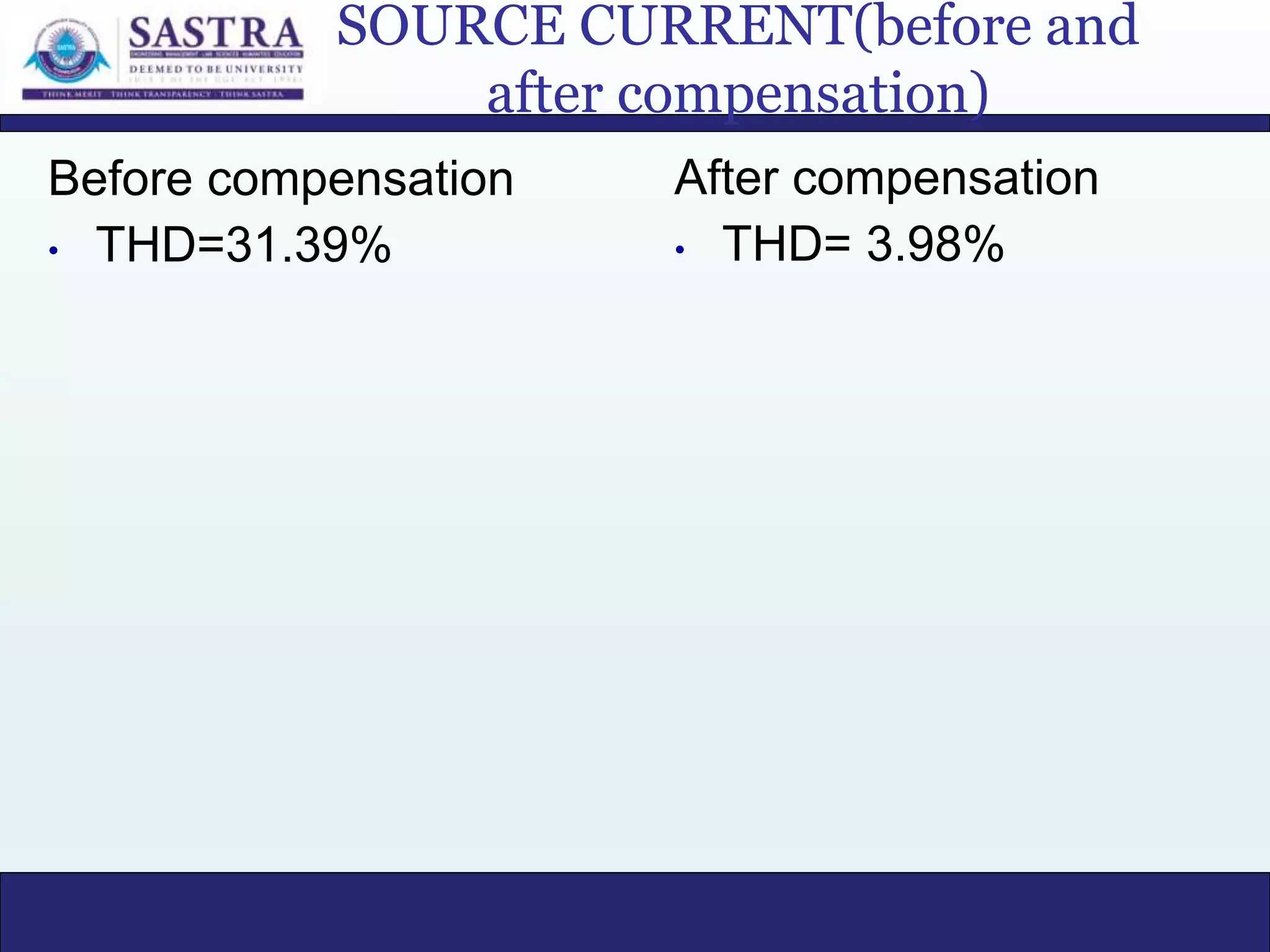
SOURCE CURRENT(before and
after compensation)
Before compensation
• THD=31.39%
After compensation
• THD= 3.98%
Load current (before and after
compensation)
Before compensation
• THD=13.6%
After compensation
• THD= 3.6%
REFERENCES
[1] J. Arrillaga, N. R. Watson, “Power system harmonics,” John Wiley and Sons, 2004.
[2] A. Ghosh A, G. Ledwich, “Power Quality Enhancement using Custom Power Devices,” Springer Science
and Business Media, 2012.
3] M. H. J. Bollen, “Understanding Power Quality Problems: Voltage Sags and Interruptions,” Wiley -
IEEE press, Piscataway, NJ, USA, 2002 .
[4] B. Singh, S. R. Arya, C. Jain, S. Goel, “Implementation of Four-leg Distribution Static Compensator,”
IET Gener. Transm. Distrib., vol. 8, no. 6, pp. 1127-1139, June 2014.
[5] R. P. Tondare, S. P. Gawande, M. R. Ramteke, “Modeling of Split Capacitor Based DSTATCOM and
Voltage Balancing Scheme for Load Compensation,” International Conference on Emerging Trends in
Communication, Control, Signal Processing and Computing Applications (C2SPCA), Bangalore, pp. 1-6,
2013.
[6] M.V.ManojKumar,M.K.Mishra,“Three-legInverter-basedDistribution Static Compensator Topology for
Compensating Unbalanced and NonlinearLoads,” IET Power Electron., vol. 8, no. 11, pp. 2076-2084, Nov.
2015.
[7] B. Singh, P. Jayaprakash, D. Kothari, “A T-Connected Transformer and Three-leg VSC Based
DSTATCOM for Power Quality Improvement,” IEEE Trans. Power Electron., vol. 23, no. 6, pp. 2710-2718,
Nov. 2008.
[8] M. Hareesh, G. Siva Kumar, D. Sreenivasarao, “Dynamic DC Voltage Regulation of Split-Capacitor
DSTATCOM for Power Quality Improvement,” IET Gener. Transm. Distrib., vol. 11, no. 17, pp. 4373-4383,
Dec. 2017.
[9] M. K. Mishra, K. Karthikeyan, “An Investigation on Design and Switching Dynamics of a Voltage
Source Inverter to Compensate Unbalanced and Nonlinear Loads,” IEEE Trans. Ind. Electron., vol. 56, no.
8, pp. 2802-2810, Aug. 2009.
THANK YOU

Shi review

  • 1.
  • 2.
    AN IMPROVED DC-LINKVOLTAGE CONTROL STRATEGY FOR POWER QUALITY IMPROVEMENT AND PV POWER INJECTION BY D-STATCOM Submitted by M.Infenshirley 120047005 II M.Tech Power Systems Guide Name Dr. Augusti Lindiya SAP, SEEE.
  • 3.
    ABSTRACT • This workpresents a robust control strategy to improve dc-link voltage control performances for Power quality improvement and PV power injection by D-STATCOM. • The proposed control strategy is based on a Reduced Switch count- Multilevel converter (RSC-MDC)and is aimed to ensure fast transient response, low dc-link voltage fluctuations, low grid current THD and good disturbance rejection after sudden changes of the active power drawn by the system. • The proportional and integral gains of the considered controller are self- tuned so that they are well suited with regard to the operating point of the controlled system and/or its state. • Several simulation and experimental results are presented to confirm and validate the effectiveness and feasibility of the proposed dc-link voltage control strategy.
  • 4.
    OBJECTIVE • To optimisedc-link voltage of distribution static compensator (D-STATCOM) based on load compensation requirement using Reduced Switch Count - Multi level Converter(RSC-MLC) integrated with the PV system
  • 5.
    LITERATURE REVIEW S.N O TITLE OFTHE PAPER PROPOSED WORK 1. An Improved DC-Link Voltage Control Strategy for Grid Connected Converters This paper presented an improved dc-link voltage controller based on an adaptive PI controller. The proportional and integral gains of the proposed PI controller are self-tuned so that the following constraints are satisfied: 1) no overshoot after step jumps of the dc-link voltage reference input; 2) fast dynamic response after step jumps of the dc- link voltage reference; 3) fast dynamic response after step jump of the input current i and 4) low grid current THD value during steady state operation. 2. Controlling of PV-STATCOM for Increasing Power Transmission based on VHDL Signal Generation A novel concept was proposed by which PV solar module can be operated as a STATCOM, known as PV-STATCOM in the night-time and day time. VLSI technology is used to generate the trigger pulses for three phase inverter using the VHDL programming language to generate the signal for the control of inverter section in STATCOM. 3. Power Balance Theory Based Control of Grid Interfaced Solar Photovoltaic Power Generating System with Improved Power Quality A grid interfaced solar photovoltaic (SPV) power generating system consisting of a SPV, DC-DC boost converter, voltage source converter (VSC), interfacing inductors, ripple filter and a three phase grid feeding variety of linear and nonlinear loads. The reference grid currents are estimated by using power balance theory (PBT) to control the three-leg voltage source converter (VSC).
  • 6.
    LITERATURE REVIEW S.N O TITLE OFTHE PAPER PROPOSED WORK 4. Dynamic dc voltage regulation of split- capacitor DSTATCOM for power quality improvement. A simple dynamic dc voltage regulation is proposed to reduce the voltage stress across switching devices under the reduced load conditions. The proposed algorithm optimize the value of dc voltage based on reactive load without compromising the performance of the DSTATCOM. To validate the proposed method, simulation and experimental studies were carried out on the three-phase two-level split-capacitor DSTATCOM for harmonic mitigation, reactive power compensation and load balancing. 5. A Fast-Acting DC-Link Voltage Controller for Three-Phase DSTATCOM to Compensate AC and DC Loads A fast-acting dc-link voltage controller based on the energy of a dc-link capacitor is proposed. Mathematical equations are given to compute the gains of the conventional controller based on fast-acting dc-link voltage controllers to achieve similar fast transient response. 6. SSR Mitigation With a New Control of PV Solar Farm as STATCOM (PV- STATCOM) A novel control of a large-scale PV solar farm as STATCOM, termed PV-STATCOM, for alleviation of sub-synchronous resonance (SSR) in a steam turbine driven synchronous generator connected to a series compensated transmission line. During nighttime, the PV solar farm can operate as a STATCOM with its entire inverter capacity for SSR mitigation. During daytime, if a system fault triggers SSR, the solar farm autonomously discontinues its normal active power generation and releases its entire inverter capacity to operate as PV- STATCOM for SSR prevention.
  • 7.
    RESEARCH GAP Existing Work •Adaptive dc-link voltage variation has been propose using PI controller. however, it suffers from slow transient response due to the behavior of pi controller and leads to rippled dc-link voltage which makes it unreliable for fast changing loads. Proposed Work • The dc-link voltage regulation is achieved using Reduced Switch Count Multi Level Converter (RSC-MLC). The gate pulses of inverter switches are controlled using Hysteresis Controller which is faster and simpler.
  • 8.
  • 9.
    METHODOLOGY • Variable DCLink Voltage Control- RSC-MLC • Maximum power point tracking (MPPT) of PV panels - Perturb and Observe (P & O) algorithm SOFTWARE USED • MATLAB/SIMULINK
  • 10.
    DESIGN OF RSC-MLC INDUCTOR ∆IL,max = 𝑉𝑏2 𝑜𝑟 𝑉𝑏3 4𝐿𝑑𝑐𝑓𝑠𝑤 • fsw= switching frequency • ∆IL max= maximum current ripple through inductor, • Ldc= dc-link inductor • Vb2=200 V, • fsw= 10kHz, • ∆IL,max= 0.1A, Ldc=50mH CAPACITOR ∆Vo,max= 𝑉𝑑𝑐 32 𝐿𝑑𝑐 𝐶𝑑𝑐 (𝑓𝑠𝑤∗𝑓𝑠𝑤) • Cdc is calculated as 0.2µF. Ic = 𝐶∆𝑉𝑐 ∆𝑡 • Ic= current through the capacitor, • ∆Vc= peak to peak ripple • ∆t = 1 𝑓𝑠𝑤
  • 11.
    Contd… C= 𝐼𝑐 𝑓𝑠𝑤 ∆𝑉𝑐 • fsw=10KHz, •C1=2.3µF, • C2= 8.33µF, • C3=8.33µF.
  • 12.
    ISCT 𝑖 𝑐𝑎 ∗ =𝑖𝑙𝑎 − 𝑣𝑠𝑎 + 𝑣 𝑠𝑏 − 𝑣𝑠𝑐 ∗ 𝛽 𝐴 𝑃𝑙𝑎𝑣 𝑖 𝑐𝑏 ∗ = 𝑖𝑙𝑏 − 𝑣 𝑠𝑏 + 𝑣𝑠𝑐 − 𝑣𝑠𝑎 ∗ 𝛽 𝐴 𝑃𝑙𝑎𝑣 𝑖 𝑐𝑐 ∗ = 𝑖𝑙𝑐 − 𝑣𝑠𝑐 + 𝑣𝑠𝑎 − 𝑣 𝑠𝑏 ∗ 𝛽 𝐴 𝑃𝑙𝑎𝑣 • 𝑖 𝑐𝑎 ∗ , 𝑖 𝑐𝑏 ∗ , 𝑖 𝑐𝑐 ∗ are the reference currents drawn from the control theory. • 𝑖𝑙𝑎, 𝑖𝑙𝑏 , 𝑖𝑙𝑐 are the respective load currents, • 𝑣𝑠𝑎, 𝑣 𝑠𝑏 , 𝑣𝑠𝑐are the respective source voltages. • 𝑃𝑙𝑎𝑣refers to the power delivered by the PV systems.
  • 13.
  • 14.
  • 15.
  • 16.
  • 17.
  • 18.
  • 19.
    RSC-MLC DESIGN Range of𝑽 𝒅𝒄 ∗ Operating switches in RSC-MLC DC-Link Voltage < Vdc,min Sw2, Sw4 Vb1 Vdc,min- V1 Sw1(d1), Sw4 Vb1+Vb2*d1 V1-V2 Sw1(d2), Sw4 Vb1+Vb2*d2 V2- V3 Sw1, Sw4 Vb1+Vb2 V3- V4 Sw1, Sw3(d1) Vb1+Vb2+Vb3*d1 V4-V5 Sw1, Sw3(d2) Vb1+Vb2+Vb3*d2 V5- Vdc,max Sw1, Sw3 Vb1+Vb2+Vb3
  • 20.
  • 21.
    LOAD VOLTAGE ANDLOAD CURRENT
  • 22.
  • 23.
  • 24.
    SOURCE CURRENT(before and aftercompensation) Before compensation • THD=31.39% After compensation • THD= 3.98%
  • 25.
    Load current (beforeand after compensation) Before compensation • THD=13.6% After compensation • THD= 3.6%
  • 26.
    REFERENCES [1] J. Arrillaga,N. R. Watson, “Power system harmonics,” John Wiley and Sons, 2004. [2] A. Ghosh A, G. Ledwich, “Power Quality Enhancement using Custom Power Devices,” Springer Science and Business Media, 2012. 3] M. H. J. Bollen, “Understanding Power Quality Problems: Voltage Sags and Interruptions,” Wiley - IEEE press, Piscataway, NJ, USA, 2002 . [4] B. Singh, S. R. Arya, C. Jain, S. Goel, “Implementation of Four-leg Distribution Static Compensator,” IET Gener. Transm. Distrib., vol. 8, no. 6, pp. 1127-1139, June 2014. [5] R. P. Tondare, S. P. Gawande, M. R. Ramteke, “Modeling of Split Capacitor Based DSTATCOM and Voltage Balancing Scheme for Load Compensation,” International Conference on Emerging Trends in Communication, Control, Signal Processing and Computing Applications (C2SPCA), Bangalore, pp. 1-6, 2013. [6] M.V.ManojKumar,M.K.Mishra,“Three-legInverter-basedDistribution Static Compensator Topology for Compensating Unbalanced and NonlinearLoads,” IET Power Electron., vol. 8, no. 11, pp. 2076-2084, Nov. 2015. [7] B. Singh, P. Jayaprakash, D. Kothari, “A T-Connected Transformer and Three-leg VSC Based DSTATCOM for Power Quality Improvement,” IEEE Trans. Power Electron., vol. 23, no. 6, pp. 2710-2718, Nov. 2008. [8] M. Hareesh, G. Siva Kumar, D. Sreenivasarao, “Dynamic DC Voltage Regulation of Split-Capacitor DSTATCOM for Power Quality Improvement,” IET Gener. Transm. Distrib., vol. 11, no. 17, pp. 4373-4383, Dec. 2017. [9] M. K. Mishra, K. Karthikeyan, “An Investigation on Design and Switching Dynamics of a Voltage Source Inverter to Compensate Unbalanced and Nonlinear Loads,” IEEE Trans. Ind. Electron., vol. 56, no. 8, pp. 2802-2810, Aug. 2009.
  • 27.