Introduction to CPT Coding
WHAT ARE WE DOING HERE?
 Coding Systems….how many?
 What are the differences?
 Who uses what?
 ……our focus for AHMS 160
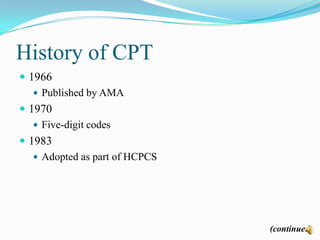
History of CPT
 1966
    Published by AMA
 1970
    Five-digit codes
 1983
    Adopted as part of HCPCS


                                (continued)
History of CPT
 1986
    Omnibus Budget Reconciliation Act (OBRA)
 1996
    HIPAA
 2004
    MMA
CPT Mandated Reporting
 Home health care and hospice agencies
 Outpatient hospital departments
 Physicians who are employees of health care facility
 Physicians who see patients in their offices or clinics and
  in patients’ homes
CPT Mandated Reporting
 Home health care and hospice agencies
 Outpatient hospital departments
 Physicians who are employees of health care facility
 Physicians who see patients in their offices or clinics and
  in patients’ homes
Non-Reportable Services
 Considered integral to procedure
 No separate code reported
Examples of Non-Reportable Services
 Administering sedatives
 Cleansing, shaving, and prepping of skin
 Draping and positioning of patient
 Irrigating wound
 Inserting and removing drains
CPT Categories
 Category I codes
    Procedures and services
 Category II codes
    Performance measures
 Category III codes
    Emerging technology
Organization of CPT
 Six sections
    Evaluation and Management (E/M) (99201–99499)
    Anesthesia (00100–01999, 99100–99140)
    Surgery (10021–69990)
    Radiology (70010–79999)
    Pathology and Laboratory (80048–89398)
    Medicine (90281–99199, 99500–99607)
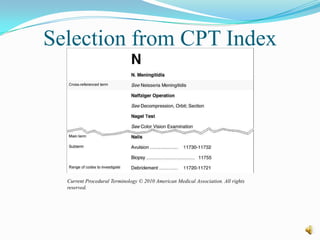
CPT Index
 Alphabetic main terms
    Boldfaced
    Represent procedures or services, organs, anatomic
     sites, conditions, eponyms, or abbreviations
    Subterms indented below
Selection from CPT Index


  Current Procedural Terminology © 2010 American Medical Association. All rights
  reserved.
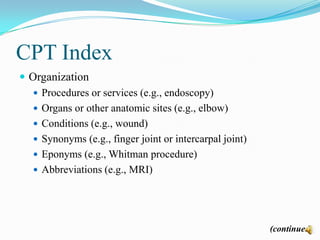
CPT Index
 Organization
    Procedures or services (e.g., endoscopy)
    Organs or other anatomic sites (e.g., elbow)
    Conditions (e.g., wound)
    Synonyms (e.g., finger joint or intercarpal joint)
    Eponyms (e.g., Whitman procedure)
    Abbreviations (e.g., MRI)


                                                          (continued)
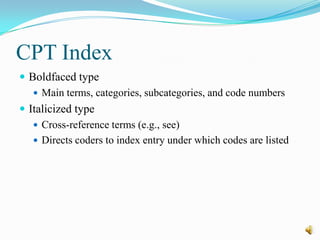
CPT Index
 Boldfaced type
    Main terms, categories, subcategories, and code numbers
 Italicized type
    Cross-reference terms (e.g., see)
    Directs coders to index entry under which codes are listed
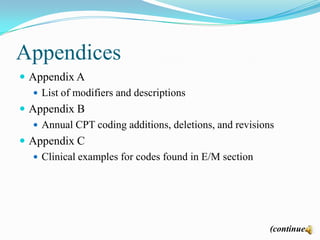
Appendices
 Appendix A
    List of modifiers and descriptions
 Appendix B
    Annual CPT coding additions, deletions, and revisions
 Appendix C
    Clinical examples for codes found in E/M section


                                                         (continued)
Appendices
 Appendix D
    List of add-on codes
    Identified with plus symbol (+)
 Appendix E
    List of codes exempt from modifier -51
 Appendix F
    List of codes exempt from modifier -63


                                              (continued)
Appendices
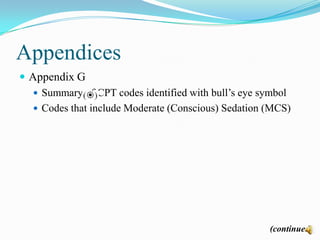
 Appendix G
    Summary of CPT codes identified with bull’s eye symbol
    Codes that include Moderate (Conscious) Sedation (MCS)


                                                      (continued)
Appendices
 Appendix H
    *Removed from CPT; Alphabetical Listing is available from
     the AMA web site: www.ama-assn.org/go/cpt
 Appendix I
    Genetic testing modifiers


                                                       (continued)
Appendices
 Appendix J
    Electrodiagnostic medicine listing of sensory, motor, and
     mixed nerves
 Appendix K
    List of codes pending Food and Drug Administration (FDA)
     approval


                                                       (continued)
Appendices
 Appendix L
    List of vascular families
 Appendix M
    List of deleted CPT codes and descriptions with crosswalk
     to new CPT codes
CPT Symbols
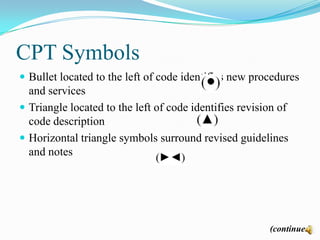
 Bullet located to the left of code identifies new procedures
  and services
 Triangle located to the left of code identifies revision of
  code description
 Horizontal triangle symbols surround revised guidelines
  and notes


                                                        (continued)
CPT SYMBOLS
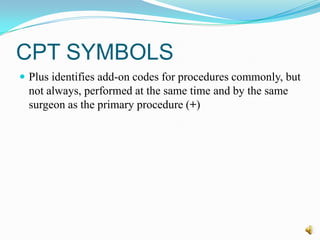
 Plus identifies add-on codes for procedures commonly, but
  not always, performed at the same time and by the same
  surgeon as the primary procedure (+)
CPT Symbols
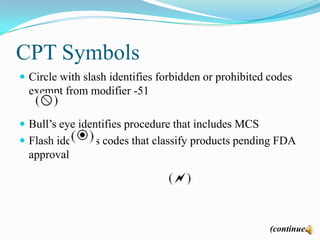
 Circle with slash identifies forbidden or prohibited codes
  exempt from modifier -51

 Bull’s eye identifies procedure that includes MCS
 Flash identifies codes that classify products pending FDA
  approval


                                                       (continued)
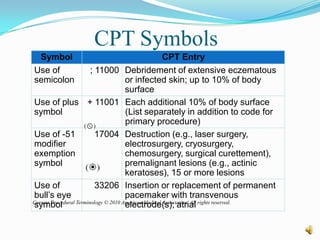
CPT Symbols
 Symbol                                                CPT Entry
Use of                   ; 11000 Debridement of extensive eczematous
semicolon                              or infected skin; up to 10% of body
                                       surface
Use of plus + 11001 Each additional 10% of body surface
symbol                                 (List separately in addition to code for
                                       primary procedure)
Use of -51                 17004 Destruction (e.g., laser surgery,
modifier                               electrosurgery, cryosurgery,
exemption                              chemosurgery, surgical curettement),
symbol                                 premalignant lesions (e.g., actinic
                                       keratoses), 15 or more lesions
Use of                     33206 Insertion or replacement of permanent
bull’s eye                             pacemaker with transvenous
Current Procedural Terminology © 2010 American Medical Association. All rights reserved.
symbol                                 electrode(s); atrial
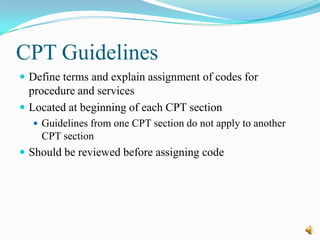
CPT Guidelines
 Define terms and explain assignment of codes for
  procedure and services
 Located at beginning of each CPT section
   Guidelines from one CPT section do not apply to another
    CPT section
 Should be reviewed before assigning code
Sections, Subsections, Categories, and
 Subcategories

 Six sections subdivided into the following:
    Subsections
    Categories
    Subcategories
 Guidelines at beginning of each subsection


                                                (continued)
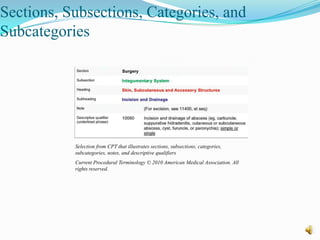
Sections, Subsections, Categories, and
Subcategories


           Selection from CPT that illustrates sections, subsections, categories,
           subcategories, notes, and descriptive qualifiers
           Current Procedural Terminology © 2010 American Medical Association. All
           rights reserved.
Unlisted Procedures and Services
 Unlisted procedure or unlisted service
    Assigned when provider performs procedure or service for
     which there is no CPT code
 Special report must accompany claim to provide more
  information
    e.g., copy of procedure report
Sections, Subsections, Categories, and
 Subcategories

 Notes, parenthetical notes, and descriptive qualifiers in
  each section, subsection, category, and subcategory
Instructional Notes
 Blocked un-indented note
 Indented parenthetical note
 Parenthetical note
Descriptive Qualifiers
 Terms that clarify assignment of CPT code


 Can you find the descriptive qualifier in code 35188?
  That’s right; head and neck qualifies the procedure as
  opposed to the same procedure involving the thorax and
  abdomen or extremities.

Ahms 160 ch. 8 pp part i

  • 1.
  • 2.
    WHAT ARE WEDOING HERE?  Coding Systems….how many?  What are the differences?  Who uses what?  ……our focus for AHMS 160
  • 3.
    History of CPT 1966  Published by AMA  1970  Five-digit codes  1983  Adopted as part of HCPCS (continued)
  • 4.
    History of CPT 1986  Omnibus Budget Reconciliation Act (OBRA)  1996  HIPAA  2004  MMA
  • 5.
    CPT Mandated Reporting Home health care and hospice agencies  Outpatient hospital departments  Physicians who are employees of health care facility  Physicians who see patients in their offices or clinics and in patients’ homes
  • 6.
    CPT Mandated Reporting Home health care and hospice agencies  Outpatient hospital departments  Physicians who are employees of health care facility  Physicians who see patients in their offices or clinics and in patients’ homes
  • 7.
    Non-Reportable Services  Consideredintegral to procedure  No separate code reported
  • 8.
    Examples of Non-ReportableServices  Administering sedatives  Cleansing, shaving, and prepping of skin  Draping and positioning of patient  Irrigating wound  Inserting and removing drains
  • 9.
    CPT Categories  CategoryI codes  Procedures and services  Category II codes  Performance measures  Category III codes  Emerging technology
  • 10.
    Organization of CPT Six sections  Evaluation and Management (E/M) (99201–99499)  Anesthesia (00100–01999, 99100–99140)  Surgery (10021–69990)  Radiology (70010–79999)  Pathology and Laboratory (80048–89398)  Medicine (90281–99199, 99500–99607)
  • 11.
    CPT Index  Alphabeticmain terms  Boldfaced  Represent procedures or services, organs, anatomic sites, conditions, eponyms, or abbreviations  Subterms indented below
  • 12.
    Selection from CPTIndex Current Procedural Terminology © 2010 American Medical Association. All rights reserved.
  • 13.
    CPT Index  Organization  Procedures or services (e.g., endoscopy)  Organs or other anatomic sites (e.g., elbow)  Conditions (e.g., wound)  Synonyms (e.g., finger joint or intercarpal joint)  Eponyms (e.g., Whitman procedure)  Abbreviations (e.g., MRI) (continued)
  • 14.
    CPT Index  Boldfacedtype  Main terms, categories, subcategories, and code numbers  Italicized type  Cross-reference terms (e.g., see)  Directs coders to index entry under which codes are listed
  • 15.
    Appendices  Appendix A  List of modifiers and descriptions  Appendix B  Annual CPT coding additions, deletions, and revisions  Appendix C  Clinical examples for codes found in E/M section (continued)
  • 16.
    Appendices  Appendix D  List of add-on codes  Identified with plus symbol (+)  Appendix E  List of codes exempt from modifier -51  Appendix F  List of codes exempt from modifier -63 (continued)
  • 17.
    Appendices  Appendix G  Summary of CPT codes identified with bull’s eye symbol  Codes that include Moderate (Conscious) Sedation (MCS) (continued)
  • 18.
    Appendices  Appendix H  *Removed from CPT; Alphabetical Listing is available from the AMA web site: www.ama-assn.org/go/cpt  Appendix I  Genetic testing modifiers (continued)
  • 19.
    Appendices  Appendix J  Electrodiagnostic medicine listing of sensory, motor, and mixed nerves  Appendix K  List of codes pending Food and Drug Administration (FDA) approval (continued)
  • 20.
    Appendices  Appendix L  List of vascular families  Appendix M  List of deleted CPT codes and descriptions with crosswalk to new CPT codes
  • 21.
    CPT Symbols  Bulletlocated to the left of code identifies new procedures and services  Triangle located to the left of code identifies revision of code description  Horizontal triangle symbols surround revised guidelines and notes (continued)
  • 22.
    CPT SYMBOLS  Plusidentifies add-on codes for procedures commonly, but not always, performed at the same time and by the same surgeon as the primary procedure (+)
  • 23.
    CPT Symbols  Circlewith slash identifies forbidden or prohibited codes exempt from modifier -51  Bull’s eye identifies procedure that includes MCS  Flash identifies codes that classify products pending FDA approval (continued)
  • 24.
    CPT Symbols Symbol CPT Entry Use of ; 11000 Debridement of extensive eczematous semicolon or infected skin; up to 10% of body surface Use of plus + 11001 Each additional 10% of body surface symbol (List separately in addition to code for primary procedure) Use of -51 17004 Destruction (e.g., laser surgery, modifier electrosurgery, cryosurgery, exemption chemosurgery, surgical curettement), symbol premalignant lesions (e.g., actinic keratoses), 15 or more lesions Use of 33206 Insertion or replacement of permanent bull’s eye pacemaker with transvenous Current Procedural Terminology © 2010 American Medical Association. All rights reserved. symbol electrode(s); atrial
  • 25.
    CPT Guidelines  Defineterms and explain assignment of codes for procedure and services  Located at beginning of each CPT section  Guidelines from one CPT section do not apply to another CPT section  Should be reviewed before assigning code
  • 26.
    Sections, Subsections, Categories,and Subcategories  Six sections subdivided into the following:  Subsections  Categories  Subcategories  Guidelines at beginning of each subsection (continued)
  • 27.
    Sections, Subsections, Categories,and Subcategories Selection from CPT that illustrates sections, subsections, categories, subcategories, notes, and descriptive qualifiers Current Procedural Terminology © 2010 American Medical Association. All rights reserved.
  • 28.
    Unlisted Procedures andServices  Unlisted procedure or unlisted service  Assigned when provider performs procedure or service for which there is no CPT code  Special report must accompany claim to provide more information  e.g., copy of procedure report
  • 29.
    Sections, Subsections, Categories,and Subcategories  Notes, parenthetical notes, and descriptive qualifiers in each section, subsection, category, and subcategory
  • 30.
    Instructional Notes  Blockedun-indented note  Indented parenthetical note  Parenthetical note
  • 31.
    Descriptive Qualifiers  Termsthat clarify assignment of CPT code  Can you find the descriptive qualifier in code 35188? That’s right; head and neck qualifies the procedure as opposed to the same procedure involving the thorax and abdomen or extremities.