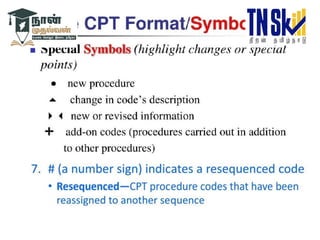
CPT
INTRODUCTION
IN COLLABRATION WITH
3470 HEALTHCARE PVT LTD
• CURRENT PROCEDURAL TERMINOLOGY
• 4TH EDITION
• FIVE DIGIT CODE
• REPORTING PROCEDURES AND SERVICES
• TERM PROCEDURE – USED TO DESCRIBE
SERVICES INCLUDING DIAGNOSTIC TESTS
• CPT IS MAINTAINED AND ANNUALLY UPDATED
BY THE AMERICAN MEDICAL ASSOCIATION
(AMA)
• CPT codes are a list of descriptive terms,
guidelines, and identifying codes for
reporting medical services and procedures.
• The purpose of CPT is to provide a uniform
language that describes medical, surgical, and
diagnostic services.
• Used as an effective communication
among physicians, patients and third party
payers
ORGANISATION OF CPT
• Introduction
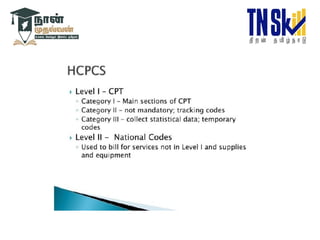
• Category I – 6 sections
• Section guidelines
• Section table of contents
• Notes
• Category II codes
• Category III codes
• Appendices A- P
• Index
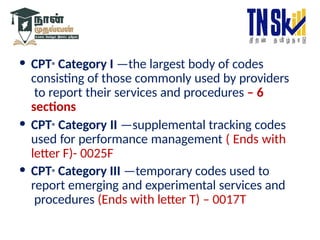
• CPT® Category I —the largest body of codes
consisting of those commonly used by providers
to report their services and procedures – 6
sections
• CPT® Category II —supplemental tracking codes
used for performance management ( Ends with
letter F)- 0025F
• CPT® Category III —temporary codes used to
report emerging and experimental services and
procedures (Ends with letter T) – 0017T
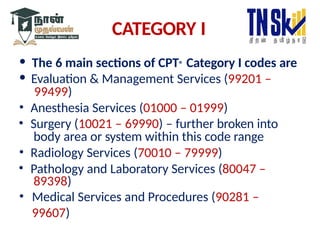
CATEGORY I
• The 6 main sections of CPT® Category I codes are
• Evaluation & Management Services (99201 –
99499)
• Anesthesia Services (01000 – 01999)
• Surgery (10021 – 69990) – further broken into
body area or system within this code range
• Radiology Services (70010 – 79999)
• Pathology and Laboratory Services (80047 –
89398)
• Medical Services and Procedures (90281 –
99607)
• Evaluation and Management Services E&M
• These services are for the visit portion
of a patient encounter.
• They have their own set of instructions
on selection of the appropriate code.
Guidelines
• At the beginning of each section are specific guidelines
on how to choose the appropriate code within the
section.
• Example: Radiology explains how supervision
and interpretation codes should be coded
• At the beginning of each code set are guidelines on
using the codes within the set
• Example: Laparoscopy heading states, Surgical
laparoscopy always includes diagnostic laparoscopy.
To report a diagnostic laparoscopy (peritoneoscopy)
(separate procedure), use 49320
HOW TO SELECT A PROCEDURE
CODE
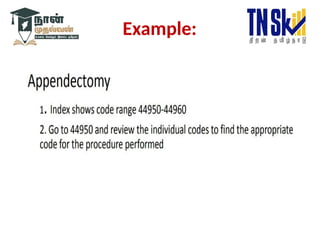
•Select the name of the procedure from the
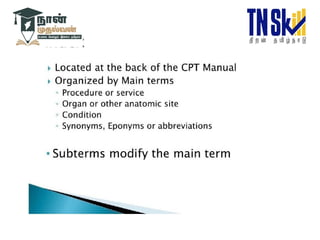
index of the CPT book
•Using the code set listed in the index review
the verbiage of the code within the body of the
CPT book
Example:
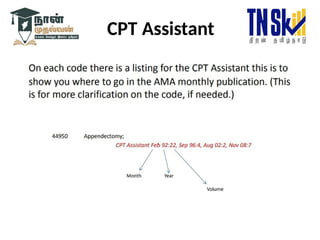
CPT Assistant
PLACE OF SERVICE
• The first page of the CPT book (no page number
designation) is a list of locations.
• These locations indicate where the procedure
was performed
• These are selected by the “coder” and they
print on the CMS 1500 form for billing
• Example:
11 Office
21 Inpatient Hospital
MODIFIERS
• Modifier - as the name implies a modifier will
modify a service / procedure or an item under
certain circumstances for appropriate
reimbursement.
• Modifiers may add information or change the
description according to the physician
documentation to give more specificity for the
service or procedure rendered.
• Appending of an appropriate modifier will
effectively respond to reimbursement.
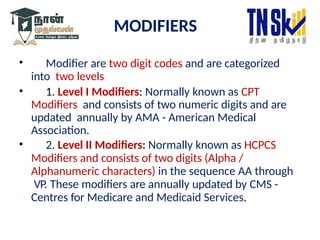
• Modifier are two digit codes and are categorized
into two levels
• 1. Level I Modifiers: Normally known as CPT
Modifiers and consists of two numeric digits and are
updated annually by AMA - American Medical
Association.
• 2. Level II Modifiers: Normally known as HCPCS
Modifiers and consists of two digits (Alpha /
Alphanumeric characters) in the sequence AA through
VP. These modifiers are annually updated by CMS -
Centres for Medicare and Medicaid Services.
MODIFIERS
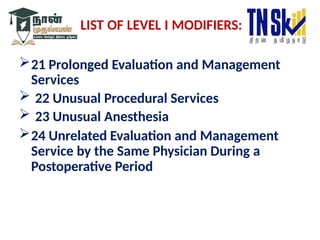
LIST OF LEVEL I MODIFIERS:
21 Prolonged Evaluation and Management
Services
 22 Unusual Procedural Services
 23 Unusual Anesthesia
24 Unrelated Evaluation and Management
Service by the Same Physician During a
Postoperative Period
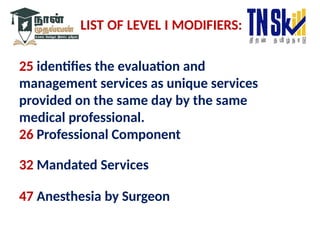
25 identifies the evaluation and
management services as unique services
provided on the same day by the same
medical professional.
26 Professional Component
32 Mandated Services
47 Anesthesia by Surgeon
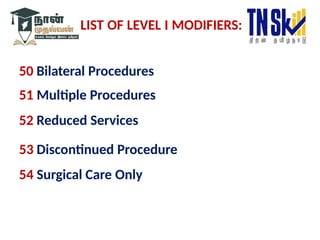
LIST OF LEVEL I MODIFIERS:
50 Bilateral Procedures
51 Multiple Procedures
52 Reduced Services
53 Discontinued Procedure
54 Surgical Care Only
LIST OF LEVEL I MODIFIERS:
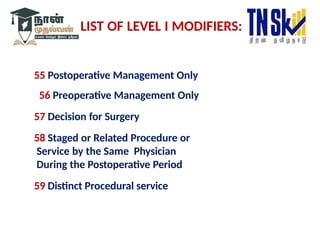
55 Postoperative Management Only
56 Preoperative Management Only
57 Decision for Surgery
58 Staged or Related Procedure or
Service by the Same Physician
During the Postoperative Period
59 Distinct Procedural service
LIST OF LEVEL I MODIFIERS:
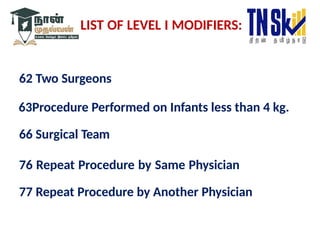
62 Two Surgeons
63Procedure Performed on Infants less than 4 kg.
66 Surgical Team
76 Repeat Procedure by Same Physician
77 Repeat Procedure by Another Physician
LIST OF LEVEL I MODIFIERS:
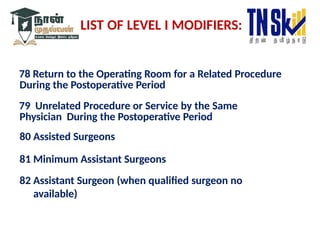
78 Return to the Operating Room for a Related Procedure
During the Postoperative Period
79 Unrelated Procedure or Service by the Same
Physician During the Postoperative Period
80 Assisted Surgeons
81 Minimum Assistant Surgeons
82 Assistant Surgeon (when qualified surgeon no
available)
LIST OF LEVEL I MODIFIERS:
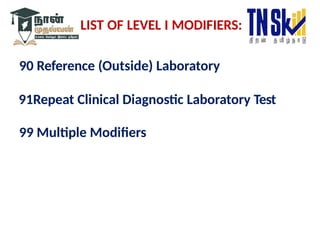
90 Reference (Outside) Laboratory
91Repeat Clinical Diagnostic Laboratory Test
99 Multiple Modifiers
LIST OF LEVEL I MODIFIERS:
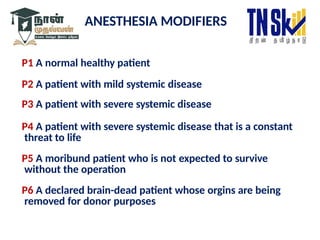
ANESTHESIA MODIFIERS
P1 A normal healthy patient
P2 A patient with mild systemic disease
P3 A patient with severe systemic disease
P4 A patient with severe systemic disease that is a constant
threat to life
P5 A moribund patient who is not expected to survive
without the operation
P6 A declared brain-dead patient whose orgins are being
removed for donor purposes
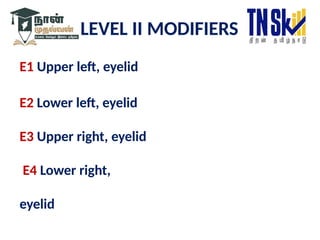
LEVEL II MODIFIERS
E1 Upper left, eyelid
E2 Lower left, eyelid
E3 Upper right, eyelid
E4 Lower right,
eyelid
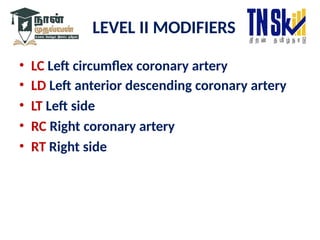
• LC Left circumflex coronary artery
• LD Left anterior descending coronary artery
• LT Left side
• RC Right coronary artery
• RT Right side
LEVEL II MODIFIERS
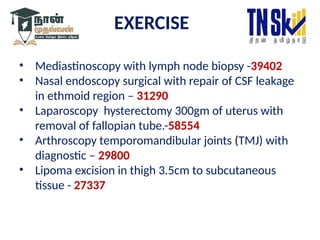
EXERCISE
• Mediastinoscopy with lymph node biopsy -39402
• Nasal endoscopy surgical with repair of CSF leakage
in ethmoid region – 31290
• Laparoscopy hysterectomy 300gm of uterus with
removal of fallopian tube.-58554
• Arthroscopy temporomandibular joints (TMJ) with
diagnostic – 29800
• Lipoma excision in thigh 3.5cm to subcutaneous
tissue - 27337
EXERCISE
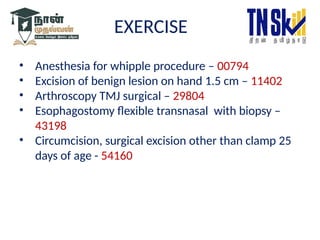
• Anesthesia for whipple procedure – 00794
• Excision of benign lesion on hand 1.5 cm – 11402
• Arthroscopy TMJ surgical – 29804
• Esophagostomy flexible transnasal with biopsy –
43198
• Circumcision, surgical excision other than clamp 25
days of age - 54160
EXERCISE
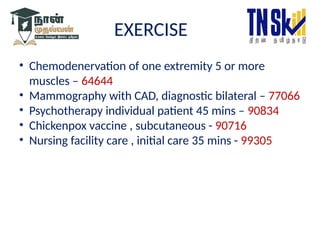
• Chemodenervation of one extremity 5 or more
muscles – 64644
• Mammography with CAD, diagnostic bilateral – 77066
• Psychotherapy individual patient 45 mins – 90834
• Chickenpox vaccine , subcutaneous - 90716
• Nursing facility care , initial care 35 mins - 99305
UNIT - 2 CPT GUIDELINES.pptx cptguideleness

UNIT - 2 CPT GUIDELINES.pptx cptguideleness

  • 2.
  • 3.
    • CURRENT PROCEDURALTERMINOLOGY • 4TH EDITION • FIVE DIGIT CODE • REPORTING PROCEDURES AND SERVICES • TERM PROCEDURE – USED TO DESCRIBE SERVICES INCLUDING DIAGNOSTIC TESTS • CPT IS MAINTAINED AND ANNUALLY UPDATED BY THE AMERICAN MEDICAL ASSOCIATION (AMA)
  • 5.
    • CPT codesare a list of descriptive terms, guidelines, and identifying codes for reporting medical services and procedures. • The purpose of CPT is to provide a uniform language that describes medical, surgical, and diagnostic services. • Used as an effective communication among physicians, patients and third party payers
  • 6.
    ORGANISATION OF CPT •Introduction • Category I – 6 sections • Section guidelines • Section table of contents • Notes • Category II codes • Category III codes • Appendices A- P • Index
  • 10.
    • CPT® CategoryI —the largest body of codes consisting of those commonly used by providers to report their services and procedures – 6 sections • CPT® Category II —supplemental tracking codes used for performance management ( Ends with letter F)- 0025F • CPT® Category III —temporary codes used to report emerging and experimental services and procedures (Ends with letter T) – 0017T
  • 11.
    CATEGORY I • The6 main sections of CPT® Category I codes are • Evaluation & Management Services (99201 – 99499) • Anesthesia Services (01000 – 01999) • Surgery (10021 – 69990) – further broken into body area or system within this code range • Radiology Services (70010 – 79999) • Pathology and Laboratory Services (80047 – 89398) • Medical Services and Procedures (90281 – 99607)
  • 12.
    • Evaluation andManagement Services E&M • These services are for the visit portion of a patient encounter. • They have their own set of instructions on selection of the appropriate code.
  • 13.
    Guidelines • At thebeginning of each section are specific guidelines on how to choose the appropriate code within the section. • Example: Radiology explains how supervision and interpretation codes should be coded • At the beginning of each code set are guidelines on using the codes within the set • Example: Laparoscopy heading states, Surgical laparoscopy always includes diagnostic laparoscopy. To report a diagnostic laparoscopy (peritoneoscopy) (separate procedure), use 49320
  • 14.
    HOW TO SELECTA PROCEDURE CODE •Select the name of the procedure from the index of the CPT book •Using the code set listed in the index review the verbiage of the code within the body of the CPT book
  • 15.
  • 16.
  • 17.
    PLACE OF SERVICE •The first page of the CPT book (no page number designation) is a list of locations. • These locations indicate where the procedure was performed • These are selected by the “coder” and they print on the CMS 1500 form for billing • Example: 11 Office 21 Inpatient Hospital
  • 18.
    MODIFIERS • Modifier -as the name implies a modifier will modify a service / procedure or an item under certain circumstances for appropriate reimbursement. • Modifiers may add information or change the description according to the physician documentation to give more specificity for the service or procedure rendered. • Appending of an appropriate modifier will effectively respond to reimbursement.
  • 19.
    • Modifier aretwo digit codes and are categorized into two levels • 1. Level I Modifiers: Normally known as CPT Modifiers and consists of two numeric digits and are updated annually by AMA - American Medical Association. • 2. Level II Modifiers: Normally known as HCPCS Modifiers and consists of two digits (Alpha / Alphanumeric characters) in the sequence AA through VP. These modifiers are annually updated by CMS - Centres for Medicare and Medicaid Services. MODIFIERS
  • 20.
    LIST OF LEVELI MODIFIERS: 21 Prolonged Evaluation and Management Services  22 Unusual Procedural Services  23 Unusual Anesthesia 24 Unrelated Evaluation and Management Service by the Same Physician During a Postoperative Period
  • 21.
    25 identifies theevaluation and management services as unique services provided on the same day by the same medical professional. 26 Professional Component 32 Mandated Services 47 Anesthesia by Surgeon LIST OF LEVEL I MODIFIERS:
  • 22.
    50 Bilateral Procedures 51Multiple Procedures 52 Reduced Services 53 Discontinued Procedure 54 Surgical Care Only LIST OF LEVEL I MODIFIERS:
  • 23.
    55 Postoperative ManagementOnly 56 Preoperative Management Only 57 Decision for Surgery 58 Staged or Related Procedure or Service by the Same Physician During the Postoperative Period 59 Distinct Procedural service LIST OF LEVEL I MODIFIERS:
  • 24.
    62 Two Surgeons 63ProcedurePerformed on Infants less than 4 kg. 66 Surgical Team 76 Repeat Procedure by Same Physician 77 Repeat Procedure by Another Physician LIST OF LEVEL I MODIFIERS:
  • 25.
    78 Return tothe Operating Room for a Related Procedure During the Postoperative Period 79 Unrelated Procedure or Service by the Same Physician During the Postoperative Period 80 Assisted Surgeons 81 Minimum Assistant Surgeons 82 Assistant Surgeon (when qualified surgeon no available) LIST OF LEVEL I MODIFIERS:
  • 26.
    90 Reference (Outside)Laboratory 91Repeat Clinical Diagnostic Laboratory Test 99 Multiple Modifiers LIST OF LEVEL I MODIFIERS:
  • 27.
    ANESTHESIA MODIFIERS P1 Anormal healthy patient P2 A patient with mild systemic disease P3 A patient with severe systemic disease P4 A patient with severe systemic disease that is a constant threat to life P5 A moribund patient who is not expected to survive without the operation P6 A declared brain-dead patient whose orgins are being removed for donor purposes
  • 28.
    LEVEL II MODIFIERS E1Upper left, eyelid E2 Lower left, eyelid E3 Upper right, eyelid E4 Lower right, eyelid
  • 29.
    • LC Leftcircumflex coronary artery • LD Left anterior descending coronary artery • LT Left side • RC Right coronary artery • RT Right side LEVEL II MODIFIERS
  • 30.
    EXERCISE • Mediastinoscopy withlymph node biopsy -39402 • Nasal endoscopy surgical with repair of CSF leakage in ethmoid region – 31290 • Laparoscopy hysterectomy 300gm of uterus with removal of fallopian tube.-58554 • Arthroscopy temporomandibular joints (TMJ) with diagnostic – 29800 • Lipoma excision in thigh 3.5cm to subcutaneous tissue - 27337
  • 31.
    EXERCISE • Anesthesia forwhipple procedure – 00794 • Excision of benign lesion on hand 1.5 cm – 11402 • Arthroscopy TMJ surgical – 29804 • Esophagostomy flexible transnasal with biopsy – 43198 • Circumcision, surgical excision other than clamp 25 days of age - 54160
  • 32.
    EXERCISE • Chemodenervation ofone extremity 5 or more muscles – 64644 • Mammography with CAD, diagnostic bilateral – 77066 • Psychotherapy individual patient 45 mins – 90834 • Chickenpox vaccine , subcutaneous - 90716 • Nursing facility care , initial care 35 mins - 99305