• The setting I come from I feel that parent
involvement is shallow and unrewarding.
When parents pick and drop children
educators miss to initiate interactions and
build on relationships and are unable to
recognise families as genuine partners. The
partnerships help to transform relationships as
they challenge knowledge and power links
between educators and families as suggested
by Stonehouse and Gonzalez Mena, 2008,
“While family involvement is not a partnership,
it can lead to a partnership”.
Issue/Concern
How we can build
Collaborative
partnerships with
Families
My beliefs and why we value collaborative
partnership with families
• I believe family is key influence in child’s learning.
By building strong relationships with the families,
we educators are able to find out about the child’s
everyday experiences and interests, which further
allow us to provide a culturally responsive and
relevant program to the children.
• According to sociocultural theories children learn
through interactions within their families and
communities. Hughes and Naughton suggested that
“effective partnerships between families and
educators give family members a voice and a role in
decision making and encourage the negotiation of
shared meanings”.
My beliefs and why we value collaborative
partnership with families (Contd.)
• When educators work in partnerships with the families, it enables us to
appreciate each others role and promote the sharing of information
which further enhances the child’s learning. As suggested by Puckett and
diffily,2004, “collaborative partnerships involve both educators and
family members making a commitment and sharing information and are
built on mutual benefit”.(Arthur, Beecher, Death, Dockett, Farmer, 2012,
p.50)
• When we educators exchange information with families, we are able to
identify children’s connections with community groups and it also
provides insight into their interest and funds of knowledge. Based on
these exchange of information with the families and using
Bronfenbrenner model , we can identify importance of relationships and
the strengths that a child brings to the setting.
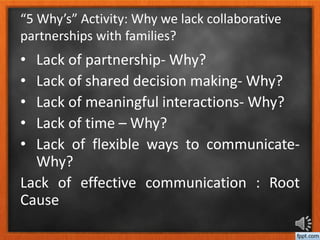
“5 Why’s” Activity: Why we lack collaborative
partnerships with families?
• Lack of partnership- Why?
• Lack of shared decision making- Why?
• Lack of meaningful interactions- Why?
• Lack of time – Why?
• Lack of flexible ways to communicate-
Why?
Lack of effective communication : Root
Cause
“2-1-2” activity:
Strengths are :1. Willingness to improve
2. Making initiatives
Opportunity for growth :
Effective communication.
Strategies: 1. Making an action Plan to have an
effective communication.
2. Critical Reflection & Evaluation.
Action Plan
1.Interview between Family and Educator
• Accept perspectives
• Understand/Preferable ways of communication
• Common Goal
2. Follow the information through being caring, consistent and with the
clarity.
https://www.youtube.com/watch?v=XCc6-qr0Gww
Action Plan (Contd.)
3. Orientation visits to be arranged as “careful orientation of a
family to the service and the service to family enables trust to
grow and dialogue to begin.”(Arthur et al. p.58)
https://www.youtube.com/watch?v=IHk3m9QS9Zc
Action Plan (Contd.)
4. Ongoing exchange of information enables us to “recognise the power
relationships that exist between educators and many families and take steps
to develop relationships with the families who are different from us.”(Blaise
& Nuttall, cited in, Arthur et al., 2012, p.51)
5. Building sense of community by providing multiple ways for families to
choose to be part of the setting.
• http://www.earlychildhoodaustralia.org.au/nqsplp/e-learning-videos/talking-about-practice/partnerships-with-families
Evaluation
• Success
• Excitement
• Nervous
• Worries

Shelly Presentation

  • 1.
    • The settingI come from I feel that parent involvement is shallow and unrewarding. When parents pick and drop children educators miss to initiate interactions and build on relationships and are unable to recognise families as genuine partners. The partnerships help to transform relationships as they challenge knowledge and power links between educators and families as suggested by Stonehouse and Gonzalez Mena, 2008, “While family involvement is not a partnership, it can lead to a partnership”. Issue/Concern
  • 2.
    How we canbuild Collaborative partnerships with Families
  • 3.
    My beliefs andwhy we value collaborative partnership with families • I believe family is key influence in child’s learning. By building strong relationships with the families, we educators are able to find out about the child’s everyday experiences and interests, which further allow us to provide a culturally responsive and relevant program to the children. • According to sociocultural theories children learn through interactions within their families and communities. Hughes and Naughton suggested that “effective partnerships between families and educators give family members a voice and a role in decision making and encourage the negotiation of shared meanings”.
  • 4.
    My beliefs andwhy we value collaborative partnership with families (Contd.) • When educators work in partnerships with the families, it enables us to appreciate each others role and promote the sharing of information which further enhances the child’s learning. As suggested by Puckett and diffily,2004, “collaborative partnerships involve both educators and family members making a commitment and sharing information and are built on mutual benefit”.(Arthur, Beecher, Death, Dockett, Farmer, 2012, p.50) • When we educators exchange information with families, we are able to identify children’s connections with community groups and it also provides insight into their interest and funds of knowledge. Based on these exchange of information with the families and using Bronfenbrenner model , we can identify importance of relationships and the strengths that a child brings to the setting.
  • 5.
    “5 Why’s” Activity:Why we lack collaborative partnerships with families? • Lack of partnership- Why? • Lack of shared decision making- Why? • Lack of meaningful interactions- Why? • Lack of time – Why? • Lack of flexible ways to communicate- Why? Lack of effective communication : Root Cause
  • 6.
    “2-1-2” activity: Strengths are:1. Willingness to improve 2. Making initiatives Opportunity for growth : Effective communication. Strategies: 1. Making an action Plan to have an effective communication. 2. Critical Reflection & Evaluation.
  • 7.
    Action Plan 1.Interview betweenFamily and Educator • Accept perspectives • Understand/Preferable ways of communication • Common Goal 2. Follow the information through being caring, consistent and with the clarity. https://www.youtube.com/watch?v=XCc6-qr0Gww
  • 8.
    Action Plan (Contd.) 3.Orientation visits to be arranged as “careful orientation of a family to the service and the service to family enables trust to grow and dialogue to begin.”(Arthur et al. p.58) https://www.youtube.com/watch?v=IHk3m9QS9Zc
  • 9.
    Action Plan (Contd.) 4.Ongoing exchange of information enables us to “recognise the power relationships that exist between educators and many families and take steps to develop relationships with the families who are different from us.”(Blaise & Nuttall, cited in, Arthur et al., 2012, p.51) 5. Building sense of community by providing multiple ways for families to choose to be part of the setting. • http://www.earlychildhoodaustralia.org.au/nqsplp/e-learning-videos/talking-about-practice/partnerships-with-families
  • 10.